LAN D SCA PE
R E V I E W
A J O U R N A L O F L A N D S C A P E A R C H I T E C T U R E
T h E m E
Interventions
CoNTRIbuToRS
Margaret Grose
, Considering Ecological Imperatives in Public open
Space in a Global hotspot of biodiversity
Kevin Thwaites, Ian Simkins, Alice Mathers
, Towards Socially Restorative
urbanism: Exploring Social and Spatial Implications for urban
Restorative Experience
Jacky Bowring
, meaning in Landscape Architecture and Gardens
Shelley Egoz
, horizon 101: Reflections and Paintings by
Jala makhzoumi
L A N D S C A P E R E V I E W
A Journal of Landscape ArchitectureEDITOR — Jacky Bowring School of Landscape Architecture,
Faculty of Environment, Society and Design,
PO Box 84, Lincoln University, Lincoln 7647, Canterbury, Aotearoa New Zealand
Telephone: +64–3–325–3838, extn 8439, fax +64–3–325–3854 Email: [email protected]
CONTRIBUTIONS — The editors welcome contributions and will forward a style guide on request.
Landscape Review aims to provide a forum for scholarly writing and critique on topics, projects and research relevant to landscape studies and landscape architecture. Articles are considered and published in three categories. ‘Research’ articles report on recent examples of substantial and systematic research, using a conventional format that normally includes a review of relevant literature, description of research method, and presentation and interpretation of findings. ‘Reflection’ articles undertake a more discursive examination of contem porary issues or projects and may be more flexible in format to suit the subject matter.
All published contributions are subject to double blind review in the ‘Research’ and ‘Reflection’ categories. Criteria for acceptance are critical insight, originality, theoretical and methodological rigour, and relevance to the aims of the journal.
A third category is entitled ‘Reports’. This category is intended for shorter commentaries, reviews and reports on progress. Although not normally fully refereed, contributions in this categ ory are nonetheless subject to editorial review.
The editors are particularly interested in contributions that examine issues arising from the interplay between the concepts and practices of western cultures and the indige nous environ ments and cultures of the AsiaPacific region. Contributions are encouraged from both academics and practitioners.
SUBSCRIPTION RATES
Subsequent issues of the journal will be free online at http://journals.lincoln.ac.nz/index.php/lr/index. For print copies of back issues, please see the details on the back inside cover of this issue.
C O N T E N T S
EDITORIAL
Interventions, Challenges and Opportunities
Jacky Bowring 1–5
RESEARCH
Considering Ecological Imperatives in Public Open Space in a Global Hotspot of Biodiversity
Margaret Grose 6–25
Towards Socially Restorative Urbanism: Exploring Social and Spatial Implications for Urban Restorative Experience
Kevin Thwaites, Ian Simkins, Alice Mathers 26–39
BOOK R E V IE WS
Meaning in Landscape Architecture and Gardens
Jacky Bowring 40–44
Horizon 101: Reflections and Paintings by Jala Makhzoumi
Shelley Egoz 45–47
Back Issues of Landscape Review 48
ISSN 1173 –3853
Published December 2011
© Edition: School of Landscape Architecture, Lincoln University.
© Text and illustrations: individual contributors, unless otherwise noted.
Jacky Bowring is an Associate Professor of Landscape Architecture.
School of Landscape Architecture, Environment, Society and Design Faculty, PO Box 84, Lincoln University, Lincoln 7647, Canterbury, Aotearoa New Zealand. Telephone: +64–3–325–3838, extn 8439
Fax: +64–3–325–3857
Email: [email protected]
Interventions, Challenges and Opportunities
J
ac k yB
ow r i n gpart One: interventiOns
landscape architecture is heralded as a complex discipline, positioned at the intersection of a vast array of fields of enquiry. geoffrey Jellicoe described landscape design as ‘the most comprehensive of all the arts … the art of the whole of man’s environment’ (in spens, 1992, p 15), and the articles and reviews in this issue demonstrate this breadth and potency. ranging across social and ecological spheres, the articles illustrate the ways in which landscape can contribute to this interface. each article explores possible interventions into existing conditions, in order to enhance function, wellbeing and identity.
in the first article, Margaret grose focuses her attention on the south-west australian Floristic region, which includes the city of perth, exploring the possible scenarios for public open space. grose makes a useful distinction between the issues facing perth as opposed to those in sheffield, which coincidentally is the location of one of the study areas for the second article in this issue. she points out that, in sheffield, which is not under biological pressure, ‘the relationships between green space and urban form are focused more on quality of life and housing prices than biota’, while in perth it is ecological issues that are the most pressing forces on public open space. the outcomes, however, are not purely directed at enhancing ecological health but also focus on the broader issue of the social dimension of landscape. relationships with nature are well documented as a significant dimension for health and wellbeing. an integrated and thorough understanding of landscape ecology is critical for areas facing the pressures of urban expansion, and this is more so under the exacerbating conditions of the water shortages faced by many australian cities.
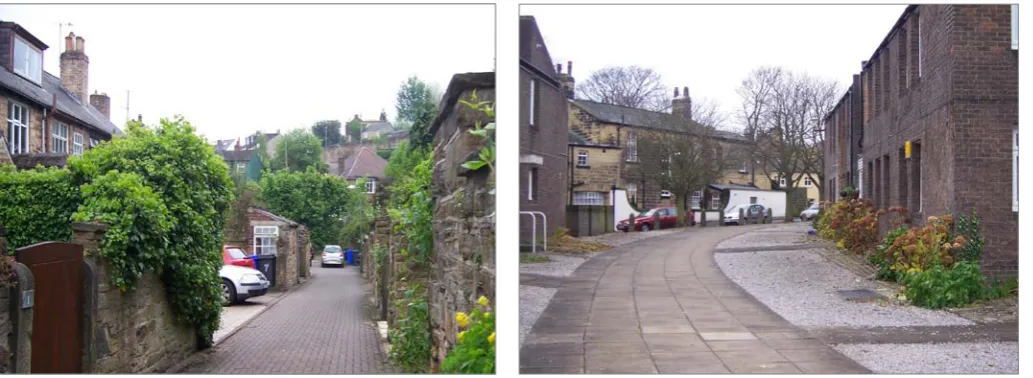
From the dynamics of public open spaces in designed suburban environments, the next article turns to the evolution of social places. Kevin thwaites, ian simkins and alice Mathers investigate the notion of socially restorative environments. places, they argue, are evolutionary. interventions are organic, constantly adjusting to human habitation, as in the work of Michael Martin on community alleys. in these landscapes, there is a ‘fine-grain tuning of features’ that sees the places become spatially balanced – exhibiting conditions of both hidden-ness and revealing-ness. the quality of the urban setting is, therefore, about process and not simply product. it is also about enabling the residents, placing them within environments that they can modify, to find an ‘ours’ between the ‘mine’ and the
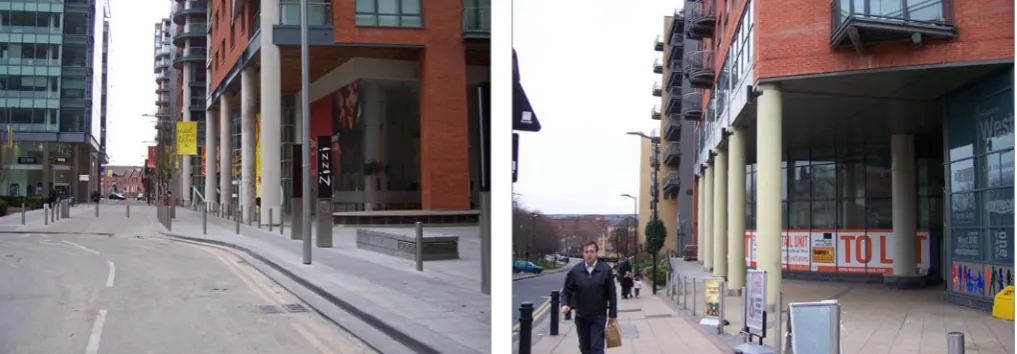
contrast, impose a strict polarity between internal space and the public realm, such that there is no opportunity for individuals to engage in their setting. this can produce what the authors call a sterile ‘designer neatness’ where there is no opportunity for fine-tuning and no sense of an ‘ours’. there is perhaps a parallel between this and the broader city fabric and the notion of a ‘third space’ – that place that challenges the binary of work and home, and exists within community facilities like local cafes and squares.
landscape architecture’s comprehensiveness is highlighted further in the two books reviewed in this issue. the first is a book edited by Marc treib, Meaning in Landscape Architecture and Gardens: Four Essays, Four Commentaries, which gathers together a series of essays that were published over two decades in Landscape Journal. each essay tackled the topic of meaning in landscape architecture, and the resonances between the works crackle with energy despite the long intervals between them. treib’s vision of assembling the essays, as well as bringing the authors together at a conference of the council of educators in landscape architecture, and expanding the commentary as a result, has produced a valuable book that refreshes the philosophical underpinnings of the discipline. while treib’s book reminds us of landscape architecture’s intellectual terrain and philosophical tensions, the second review in this issue embraces the poetics of our discipline in a remarkable book of watercolours and words by Jala Makhzoumi. the title,
Horizon 101, refers to a sustained viewing of the horizon from Makhzoumi’s apartment 101 at the american University of Beirut. Over a one-year period she repeatedly painted the view from her window, producing a series of luminous limned images and lyrical text. as reviewer shelley egoz observes, Makhzoumi’s work amplifies how ‘landscape is never static, and the framing of the vignettes in this book in accordance with a calendar diary is a straightforward way of depicting the sense of time and the dynamics of landscape change’.
part twO: the challenges and OppOrtUnities OF
pUBlishing in landscape architectUre
lives and leaving homes on the clifftops uninhabitable. Five thousand homes along the river margins in the residential ‘red zone’ are being bought by the government and will be demolished. residents will need to leave this area where the ground has been so severely compromised by liquefaction (eruption of silt onto the ground surface) and lateral spread resulting from ground shaking.
Further factors adding to the delays in publication involve the perennial challenges of academic publishing, a process that involves the goodwill of authors and reviewers. a debt of thanks goes to all of the authors and reviewers for their contributions to this issue and previous issues, as well as to the subscribers for their patience as we negotiated the various hurdles of recent months.
this is the final hardcopy issue of Landscape Review. volume 14 will see a new beginning for the journal, which will be relaunched on the Open Journal system (OJs) platform, embracing the opportunities of the new era of digital publication. while hardcopy offers the aesthetic appeal of a printed page – the tactility of the paper, even the smell of the ink – it has also meant major limitations for Landscape Review. as an independently published journal, the aspects of distribution and indexing have been restricted. Moving to the digital platform will dramatically increase the visibility of the journal, serving also to raise the profile of publishing in landscape architecture.
the move to digital publishing will allow for the publication of an open access and free journal. while maintaining the rigour of double-blind peer review,
Landscape Review will be widely available, raising the international profile as OJs is harvested by google and all other major search engines. this will not only enhance readership, but we anticipate that it will also encourage further contributions, enriching the breadth and depth of material related to the discipline. the digital publishing system provides a means of managing submissions and reviews. although this can seem somewhat impersonal, it enables the timelines and deadlines to be handled more effectively. as part of the migration to the digital format, all back issues of Landscape Review have been scanned using word recognition software. this means articles will be fully searchable, and it will considerably enhance the dissemination of the wealth of the material published to date. all authors are being contacted to obtain their permission for their work to be uploaded onto the digital site, providing them with the opportunity to gain further exposure for their articles.
the relaunch also sees a reorientation for the journal. while the early issues of Landscape Review had the subtitle of ‘an asia-pacific Journal of landscape architecture’, the shift to digital will be accompanied by an identification with the southern hemisphere. the two other main journals of landscape architecture,
a geographic region, the alignment of the southern hemisphere with the ‘south’ also signals an association with the so-called ‘global south’, the nations that are predominantly from this hemisphere and facing economic, political and social challenges. recognising the southern hemisphere as a ‘home’ for Landscape Review
will allow for the development of a particular character, while at the same time welcoming contributions from around the globe.
the shift to digital also heralds a new editorial approach. an editorial advisory board will be formed for the journal, providing a strong backbone that will guide and support publication. i will take on the role of editor in chief, with a view to regaining the journal’s momentum following the challenges of the past year. as we look to the future of Landscape Review, i would like to very gratefully acknowledge the vision of the founding editor, professor simon swaffield. simon’s idea to begin a journal of landscape architecture based at lincoln University undoubtedly helped to raise the profile of the discipline in this part of the world and internationally. as sole editor for the first five years, and joint editor in recent years, simon has made a significant contribution to the intellectual health of the discipline, and he will remain influential as a key member of the editorial advisory Board.
in addition to simon’s contribution, there are several vital behind-the-scenes roles that have ensured the high quality of publication. the article reviewers are the necessarily anonymous but critical components of any good-quality academic publication. Landscape Review has been fortunate to have the input of high-quality reviewers from around the world, with the feedback to authors assisting in raising the standard of research and writing. the authors too are essential, and looking back over the 13 volumes reveals several important articles that have been published by the journal.
the standard of publication has always been high for Landscape Review, reflecting the dedicated work of the copy editors. the journal was originally published by lincoln University press and, following its dissolution, transferred to daphne Brasell associates, then to edit and, subsequently, to whitireia publishing. Jenny heine has a long history of editing and production of Landscape Review, and we are pleased she will continue working with us on the digital journal. the work of an editor is at its best when readers are not aware of it, and i am always impressed with how Jenny’s subtle tweaking and diligent checking moves an article into a refined and polished final product. the move to digital has also benefited considerably from the skills of lincoln University’s information technology services (especially Online services Manager dorje McKinnon) and library, teaching and learning staff, particularly research collections librarian roger dawson.
this is an exciting new phase for research and publication in landscape architecture, signalled also by the introduction of a new journal to be published by the stuckeman school of pennsylvania state University. As Built: A Journal of Design Critique will be a biannual, peer-reviewed publication of critical analysis from students, scholars and professionals across a range of disciplines, including landscape architecture, architecture, planning, environmental art and engineering. we wish As Built all the best and look forward to the maturing of design critique in landscape architecture. in addition, the recently published text by elen deming and simon swaffield further emphasises a coming of age for landscape architectural research and publication. Landscape Architecture Research: Inquiry, Strategy, Design is set to become a standard text for research students in the discipline, providing a useful guide to the variety of methods relevant to research in our field.
the embracing of opportunities and negotiation of the challenges of publication are the elements that drive the engine of disciplinary development for landscape architecture. poised for its relaunch as a solely digital publication, Landscape Review
draws upon the comprehensive nature of the discipline, as well as the changing environment for scholarly publishing. we are optimistic that this new chapter in the journal’s history will assist in keeping research relevant, current and innovative, and we look forward to receiving submissions that both consolidate and test the discipline of landscape architecture.
reFerences
deming, Me and swaffield, s (2011) Landscape Architecture Research: Inquiry, Strategy, Design, hoboken, nJ: John wiley & sons.
spens, M (1992) Gardens of the Mind: The Genius of Geoffrey Jellicoe,woodbridge, UK: antique collectors’ club.
Considering Ecological Imperatives in Public
Open Space in a Global Hotspot of Biodiversity
M
a rg a r e tg
ro s eresearch
Margaret Grose is a Senior Lecturer in Landscape Architecture. Melbourne School of Design, Faculty of Architecture Building and Planning, University of Melbourne, Carlton, Victoria 3010, Australia. Telephone: +61–3–8344–4898
Fax: +61–3–8344–5532 Email: [email protected]
Key words
Suburban development Public open space Ecology Hotspots Biodiversity
Design
public open space within the suburbanising south-west australian Floristic region is reviewed in this paper in relation to key ecological imperatives. Qualitative sources, quantitative research and professional practice are examined across science, planning and landscape architecture, with a focus on turf, water, species and retained bush.
new relationships between turf and bush in public open spaces in designed suburban developments in this Mediterranean-type hotspot are outlined. Four types of public open space are distinguished, with a focus on ‘turf that works’ and the use of hydrozoning and ecozoning as new strategies in this hotspot. These strategies provide concurrent opportunities for water conservation and biodiversity, and are designed for resilience. This review positions these new strategies as an example of better design outcomes in public spaces as a result of improved translation of knowledge across the disciplines.
inTroducTion
This paper reflects on major aspects of the design and planning practices of public open space (pos) in a global hotspot of biodiversity, the south-west australian Floristic region (swaFr). The main concern relates to how ecological issues are dealt with in new suburban developments in a biodiverse region such as the swaFr, which includes the city of perth, which is central to studies of the ecologies of cities.
harris (2007, p 169) argues that while scientific knowledge is an agent of change, change will occur only if science works with and through various forms of natural, human and social capital to achieve outcomes.
Many practitioners in the swaFr recognise that planners and landscape architects often lack access to, or ignore, good, informative science to increase the richness of solutions for applied problems in suburban development and pos (grose, 2010a). at the same time, ecological science and studies in urban ecology continue to focus on detailed analyses of specific biological and spatial problems, and the causes and consequences of processes, and rarely provide accessible solutions to the design and planning ramifications of scientific aspirations in human landscapes. it has been suggested that the fields of design, planning and the sciences have separated into mutually unregarded discourses (see roux, et al, 2006), and, if so, this can lead to wasted knowledge. an important consequence of such separation is that the environmental aspects of sites have been found difficult to translate into better designed outcomes, a problem made more acute by the specificity of the journal publishing industry within the territories of ecological theory and research, and design theory and practice. This review incorporates cross-disciplinary matters about the planning and design of suburban pos that might be lost to those working within one specific discipline. ecological science has been placed here in terms of its intersections with the disciplines involved in the planning and design of suburbs rather than being purely as part of site analysis as so often occurs, both in practice and landscape architectural education. This review focuses on literature dealing specifically with the swaFr and the suburban development within it. The review examines current practice and ideas, much of which is in the grey literature; it can be seen as an international case study on issues that need to be addressed for improved ecological outcomes, and others, in suburbanising landscapes.
as a case study, the city of perth (32°s, 150° 50´e) on the west coast of australia provides a rich source of issues because its metropolitan area falls entirely within the boundaries of the swaFr, one of only 34 global hotspots of biodiversity on earth (Mittermeier, et al, 1999, 2004; Myers, et al, 2000) (Figure 1).
prices than biota, although general ecosystem services are recognised (davies, et al, 2008). in perth, ecological issues will become even more acute with the predicted drying of southern australia as a result of climate change (palutikof, 2010).
The siTe: noT single, BuT a suiTe oF coMplex
environMenTs
The city of perth is the capital of western australia and the largest centre of population in the area, with around 1.4 million people. its suburbs sprawl along the indian ocean coast. perth was a site of the nyoongar people’s almost permanent encampment on the swan river before British settlement in 1829, when a town was declared by cutting down a tree (appleyard and Manford, 1979). in 1901, the population was 44,000 and it is expected to reach 2.4 million by 2030 (wag, 2008a).
There are five major landscape complexes in which new residential areas are being constructed in this hotspot: (i) coastal dunes, (ii) mixed Banksia– Eucalyptus woodlands, (iii) Banksia-dominated woodlands, and (iv) paperbark (Melaleuca) wetland flats, with (i)–(iv) all found on poor, highly leached, sandy soils; and (v) wooded granite hills dominated by Eucalyptus. The characteristics of these landscape complexes have been described generally by seddon (1972). Thus, suburban development in the swaFr is not one site or one set of defined biophysical parameters but a suite of heterogeneous complex environments. within these complex environments are two essential ecological imperatives: water, which is popularly discussed, and biodiversity, which appears less widely understood by either design practitioners or members of the public.
apart from some sectors in the south-east of the city, perth is not moving into agricultural land or ex-urban territory, as is commonly found in other countries, but is primarily moving into bushland within the swaFr. indeed, perth has been described as a ‘city in the bush’ (seddon, 1972) (Figure 2). Bushland is being clear-felled for new suburbs.
within the city’s wider metropolitan area are various types of green space: large regional parks for passive recreation and biological or water conservation, sites for conservation known as ‘Bush Forever’, pos, and setbacks for rivers and ocean-fronts. Bush Forever and regional parks add to the percentage of total land given to bushland that might be considered to contribute to ecological function within the hotspot.
The issue of water is never far from australian imperatives because the country is the driest inhabited continent. Most major cities in australia are experiencing long-term water shortages. perth has experienced a 40 percent reduction in its catchment and groundwater aquifers in the last 30 years (wapc, 2006), with concern about early climatic drying (nicholls, et al, 1999; smith, et al, 2000). with inflows to perth’s dams between 2001 and 2007 a quarter of their pre-1974 levels (Farmonline, 2008), perth has long-term water restrictions in place. The urbanised part of the hotspot remains on water restrictions for outdoor watering, with programmes to encourage reduced internal household use. pos in the region is generally irrigated from groundwater sources and thus is susceptible to an uncertain water future in australia’s drying climate, particularly in winter rain-fed systems such as the swaFr.
planning and designing wiThin The
heTerogeneous landscape
historically, perth and all other towns in western australia have relied on neither ecological nor aesthetic imperatives on which to base both the process of and the form that urban development takes. policy-based frameworks – such as for the allocation of pos – and strong economic imperatives have been the drivers of urban development. perth has not been alone in struggling with the problems of suburban growth and preservation of landscape characters, ecology and aesthetics. some cities, for example phoenix, arizona (ewan, et al, 2004) and seattle (dooling, et al, 2006) are questioning the policy bases on which their growth has occurred and are seeking to build ecology more firmly and less vaguely into the planning continuum, with landscape ecological principles that can be readily understood by other disciplines. herlin (2004), for example, reported on explicit objectives to work in interdisciplinary ways to bring more of the applications of science into planning and policy for new developments in sweden.
of public concern is loss of contact with nature; the human need for an aesthetic natural experience, no matter how small, has been widely acknowledged and is of worldwide concern (Kaplan and Kaplan, 1989; louv, 2005; Kahn, 2002). in the last few years there has been a plethora of sustainability initiatives for south-western australia at both state and local government levels. This has increased the familiarisation of sustainability initiatives in the minds of members of the public, such that pos is now often regarded in professional design and planning practice as requiring some component of sustainability, though vaguely defined. recent built projects in the swaFr suggest that ecological function is now being required of pos (grose, 2009). Thus the uses to which pos can be put, and the allocation of the physical parts to achieve these aims, are still under debate, scrutiny and testing by design.
a key problem is that research bases on which design and planning decisions are made are generally poor. each site is worked upon without regard to the region or neighbouring suburbs (grose, 2010a), and is worked with data sets of species rather than functional ecology (pickett, et al, 2001). complex biological aspects of ‘green’ areas, whether in relation to pre- or post-development as pos, continue to receive scant detailed and long-term study. This means the landscape being consumed by the development of suburbs is incompletely known to either those who develop it or the decision makers in government. when basic ecology is understood more widely by stakeholders in suburban development, and ecological literacy (stone, et al, 2005) is reflected with more depth in the land planning structure and regional planning, improved long-term ecological and social outcomes can arise and exist side by side in local sites. Many people involved in suburban development in the swaFr are working towards an improved understanding of the complexities of specific landscape sites and desire to ‘do it better’, with both the environment and
aesthetic appeal of woodlands and heath of this global hotspot foremost in their minds (grose, 2010a). Meyer (2008) points out the importance of aesthetics as an effective agent for change in debates about what sustainable landscapes might be.
planning and research BacKgrounds
currently, 10 percent of land developable as residential is required to be allocated to pos in western australia. This has been based on a plan of 1955 (stephenson and hepburn, 1955) where the original purpose of pos was that of active recreation. recently, it has been suggested that the 10 percent be retained with 2 percent assigned to bushland or other conservation values, with developers being able to barter for a good piece of land to be kept untouched in exchange for a reduction in the pos or for money, thereby reducing pos to perhaps 8 percent of total developable land. while this allows a degree of site sensitivity, the central issue is whether 8 percent of land set aside for pos can achieve all the requirements now placed upon it, given its original purpose as land set aside solely for active recreation (grose, 2007). There are three important points in this ongoing debate. First, a set figure may give planners and developers statutory leverage to deny an opportunity to increase bushland in line with local community initiatives and wishes. second, none of these figures relates to site-sensitivity of landscape type. Third, there is no research basis on which the allocation of 10 percent land to pos in the swaFr has been based (grose, 2007).
linkages and connectivity are long extant ecological principles of wide use today (see Forman, 1995), and government policy in western australia states that an aim for managing urban growth in perth is ‘protecting biodiversity and areas of environmental significance, and promoting the concept of an interlinked system of regional and local open space’(wapc, 2006, p 1069). however, the concept of linkages has now been heavily subsumed into the sociological sphere, such that some planners consider that ‘linkage’ refers only to social connections and has nothing to do with ecology at all (grose, 2010a). ‘social’ connections, however, often appear to link people to bushland or other green space because these are walkable ‘lines of desire’. indeed Miller (2005) argues that more attention must be paid to restoring human connections with nature in proximity to the places where people live and work, with the same emphasis placed on spatial and temporal scale in conservation circles extended to the scale of human experience. Much pos today links into the suburban centre, not other green spaces, and this again shows a social sub-summation of the ecological concept of ‘connectivity’. The danger of such ‘social connectivity’ is that while the language is that of ecology, the actions and outcomes are not.
whaT is Bush?
open spaces are increasingly being considered as ecological links with all other types of green habitats (Forsyth and Musacchio, 2005; Tzoulas, et al, 2007) such as reserves for rail, freeway and streams, brownfields and cemeteries, which fall into the category of ‘naturmark’ (Florgård, 2007). These ‘bits and pieces’ are not included as pos in australia but can be used as complements and links to pos to support ecological diversity and function.
Bush Forever is a concept designed to increase the retention of native bushland in all urban regions in western australia (del Marco, et al, 2005). it is a response to great concerns about the conservation of biodiversity of both plants and animals in the suburbanising swaFr. with Bush Forever, the aim is to ‘keep the common, common’ and is in line with Kareiva and Marvier’s (2003) concern for recognition of the importance of the conservation of biodiversity ‘coldspots’, and foreshadows the ecological importance of commonness (gaston and Fuller, 2007).
in the swaFr, an environmental report prepared for a developer for a proposed new suburban development focuses on rare and endangered species as required by legislation. however, in other government documents from the same region, it is common species, not the rare and unusual, that are recognised as ‘the backbone of all natural areas’ (Boeken and shachak, 2006; walga, 2004). Thus, conundrums exist in planning and governance, with the specific policy framework of Bush Forever contrasting with the defined search for rare and endangered species by environmental assessors before suburban development. This conundrum fuels the public disappointment of outcomes as noted by Mcdonnell (2007).
Bush Forever sites cannot be included as pos because they are intended to be fenced and not generally available to members of the public. in this way, the sites are ‘locked away’ for purely biological functions and serve no role in giving personal contact with bushland for local people. in response, an initiative in the perth Biodiversity project means additional areas, aside from Bush Forever sites, will be untouchable by the development process (del Marco, et al, 2005). Thus, there have been measures to recognise and preserve biodiverse areas as a response to the losses created by suburban development. it is not known whether these measures will be enough.
promulgation of a sense of place (seddon, 1972) and an aesthetic response to the unique flora of this hotspot?
There have been increasing calls in the planning industry and local government in this hotspot to see the ‘park at the end of the street’ as a site of initiatives towards water conservation, biodiversity and resilience. in contrast, policies connecting
naturmark and public spaces have been in place in sweden since 1907 (Florgård, 2007). Naturmark requires all types of natural and semi-natural vegetation to be preserved, and meadows and pasture-land to be developed under long-term cultivation using traditional methods. Naturmark in the australian context might fall into several categories within suburbs:
(i) managed natural remnant bush, such as the perth Biodiversity project, and retained bushland in pos;
(ii) designed but managed bush, which is possible in pos;
(iii) designed more formal pos with locally endemic species that reflect local bushland; and
(iv) street tree plantings of endemic species.
These categories separate into ‘undesigned bush’ and ‘designed bush’, which are part of the dynamic changes and discussions under way in the swaFr hotspot.
designed Bush, TurF and puBlic open space
in The souTh-wesT ausTralian hoTspoT
Naturmark (Florgård, 2007) is a helpful concept when considering designing and planning for biodiversity. Naturmark links bushland with ‘remnant bush’, pos and street planting to give a holistic view, and thus to design at all scales from the landscape to streetscape. however, is it possible to ‘design’ bushland and design for biodiversity – both its continuation and possible increase? This question is difficult to answer when there is only a small research base on which to build. such a design ambition is very pertinent in the swaFr, where turf is used extensively in pos and its use is increasingly controversial (grose, 2010c).
The extent to which turf is required or present in pos is central to design possibilities in the swaFr, and this fact positions the imperatives of water and biodiversity acutely. Turf remains the most common feature of pos in the region and is typified as large expanses of lawn, usually reticulated or watered by bores extracting groundwater, and large remnant trees. palmer et al (2004) consider that designed ecosystems might blend technology and novel mixtures of native species, and create new systems that are not substitutes for natural systems but are important moves towards developing sustainable cities. an example of ecosystem design with technology and native species can be seen in the current reassessment of the amount of turf in pos in the water-scarce swaFr.
not used specifically; it is not part of the ball-game space – styled here ‘turf that works’ (grose, 2010c) – but is general walking space, where turf is not specifically required as a walking surface. it would seem imperative in a dry climate with water restrictions that turf in pos is kept only to areas essential for ball games. approximately 70 percent of perth’s total water usage is supplied by groundwater, with the remainder from catchments (wapc, 2001). gardens consume almost 56 percent of all domestic water used, with the majority going on lawns (loh and coghlan, 2003), and pos consumes 40 percent of all water used. The western australian government has recently moved to the expense of desalination. of vital concern in this hotspot is that groundwater is in danger of being so depleted by private bores it becomes physically alienated from the roots of native vegetation (groom, et al, 2000, 2001; Zencich, et al, 2002). if this were to occur regionally, losses of vegetation would amount to an ecological disaster. This concern underscores the reason why the swaFr is classed as a hotspot.
deeley et al (2006), inspired by the nyoongar concept of jippy joppie boodja
(rhythm of the land), examined the use of groundwater (non-potable) and catchment-derived water (potable) for turf in pos in the swaFr. The authors showed that by reducing turf to only those areas that are required for sports fields, substantial reductions in water use could be made without compromising sporting facilities. This led to ‘water smart parks’ being formally introduced by the state government in november 2008 (wag, 2008b). a feature of this new approach to pos and turf has been the practical methods of hydrozoning and ecozoning within each area of pos (wag, 2008b). hydrozoning is a process of applying different water rates for individual parts of pos according to use, and ecozoning replaces turf areas that are not specifically used for recreation with other species, notably ‘water-wise’ plants, or replanting these areas with bushland plantings. These strategies are helpful and timely changes to views of pos and can be seen as part of a wider climate adaptation strategy for resilience in the drying swaFr climate. The strategies have been supported by performance testing and cost data, with detailed water regimes (deeley, et al, 2006); the lack of these regimes has been found a hindrance to the uptake of water efficiency strategies by landscape architectural practitioners (calkins, 2005). deeley et al’s (2006) study is an example of a good ecological strategy, embedded in models of water use, that has been usefully linked with other biophysical conditions and economic assessment, and thus become understandable and accessible to local government. grimm et al (2008) note the coming importance in urban ecology in the linking of biophysical, economic and political settings.
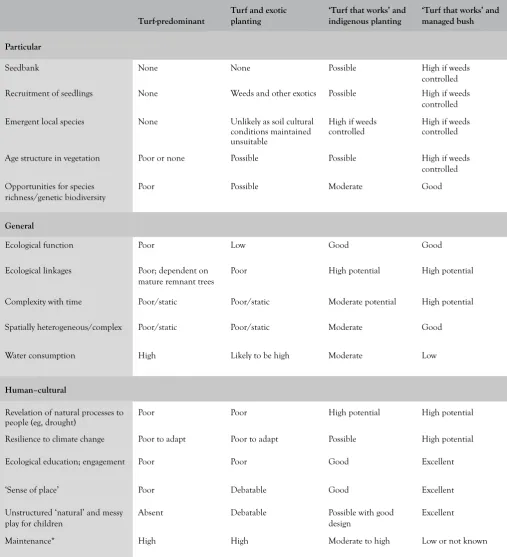
in the swaFr, there are four likely scenarios for pos (see Table 1):
(i) turf-based pos where turf is the main surface, with scattered mature remnant trees, rarely with a middle storey and lacking in spatial complexity; (ii) turf-based with designed but managed exotic plantings;
(iii) ‘turf that works’ for ball games, with designed locally endemic species that reflect local bushland complexity;
(iv) ‘turf that works’ with retained (existing) bushland as a component of pos.
if turf within this region were to be restricted for specific ball games, several positive ecological possibilities would arise in addition to a reduction in water consumption through hydrozoning and ecozoning as outlined above. These possibilities are outlined in Table 1, and can be considered to promote resilience, the ability of a system to absorb disturbance and still retain its basic functions and structures (walker and salt, 2006). resilience has generally not been considered by planners and designers within the swaFr. Table 1 suggests relative opportunities for increased resilience that might include soil seedbank development (leck, et al, 1989), seedling recruitment and increased emergent local species, age structure in vegetation, species richness and complexity over time, ecological linkages with local populations (schmiegelow, 2007), ecological function including complexity with time (white, 2007), spatial heterogeneity (Kolasa and rollo, 1991; pickett and cadenasso, 1995; pickett, et al, 2009), water consumption (deeley, et al, 2006), ecological education (stone, et al, 2005), ‘sense of place’ (see Figure 3) (seddon, 1972), unstructured natural play opportunities for children (louv, 2005) and maintenance by local councils (grose, 2010a). while Table 1 shows simple assessments based on observation and discussion with practitioners, it reveals that when the amount of turf in pos is controlled for water reduction other benefits or opportunities arise beyond immediate ecological benefits.
Table 1: Four likely scenarios for public open space
observed and predicted opportunities for increased resilience, ecological function and human experience in four scenarios for turf and pos in the swaFr global hotspot, namely: turf-dominated (as current), turf and exotic planting (also currently common), ‘turf that works’ with indigenous plantings, and ‘turf that works’ with managed bushland.
Table 1 cont: Four likely scenarios for public open space
Turf-predominant Turf and exotic planting ‘Turf that works’ and indigenous planting ‘Turf that works’ and managed bush
Particular
seedbank none none possible high if weeds
controlled
recruitment of seedlings none weeds and other exotics possible high if weeds
controlled
emergent local species none unlikely as soil cultural conditions maintained unsuitable
high if weeds
controlled high if weeds controlled
age structure in vegetation poor or none possible possible high if weeds
controlled
opportunities for species richness/genetic biodiversity
poor possible Moderate good
General
ecological function poor low good good
ecological linkages poor; dependent on mature remnant trees
poor high potential high potential
complexity with time poor/static poor/static Moderate potential high potential
spatially heterogeneous/complex poor/static poor/static Moderate good
water consumption high likely to be high Moderate low
Human–cultural
revelation of natural processes to
people (eg, drought) poor poor high potential high potential
resilience to climate change poor to adapt poor to adapt possible high potential
ecological education; engagement poor poor good excellent
‘sense of place’ poor debatable good excellent
unstructured ‘natural’ and messy play for children
absent debatable possible with good
design
excellent
Maintenance* high high Moderate to high low or not known
as an example of a general opportunity, pos treated as a water smart park with designed ‘turf that works’ could then reflect the scientific knowledge that common species contribute a disproportionately large number of individuals and biomass to assemblages (gaston and Fuller, 2007). For example, even though small woodland trees such as Banksiamenziesii are perceived as common in perth’s coastal plain, it is clear that, without care, common species such as these could suffer a ‘silent decline’ (sensu riley, 2005). This has already occurred in australia, with the placement of australia’s wild dog, the previously common dingo (Canis lupis dingo), on the endangered species list in october 2008 due to indirect anthropogenic effects. pos in urban and suburban areas could provide a role towards non-depletion of common species, both by formal and informal designs with ‘turf that works’ and indigenous plantings, and by street planting of common species. added benefits are anticipated to be water-saving, biodiversity-saving and enrichment, both psychological and aesthetic.
loss oF spaTial connecTiviTy By design decisions
in contrast to the complexity of landscape type and biology, new suburbs within the region are characterised by a resounding similarity of spatial form. The spatial form
Figure 3: (left) Remnants of the original bushland as part of POS in a new suburban area of south-east Perth. The trees are Melaleuca preissiana, the largest melaleuca of the SWAFR, and Melaleuca rhaphiophylla; seedling recruitment was occurring at this site amongst the mulch.
of pos, which has been discussed by swanwick et al (2003), is outside the scope of this paper, although spatial form is entwined in ecological, aesthetic and design concerns of pos. of particular note is the common lack of connections between adjoining new developments (stenhouse, 2004). This is a result of both statutory planning and design failing to make basic ecological principles of connectivity and linkages into real outcomes at every scale of development. For example, in Figure 4, remnant bush was broken to provide some turf that is not specific to a particular sport and thus not ‘turf that works’. in doing so, an existing wetland system was fragmented; the design ignored linkages and the impact of distance thresholds (dramstad, et al, 1996) between patches of bush, particularly for reptiles in this reptilian hotspot. This is a poor reading of country. The importance of better knowledge of basic ecological principles, such as patches and connectivity, and systems thinking by landscape architects and planners needs to be considered for pos to be truly meaningful for the resilience of urban areas in changing climates (Felson and pickett, 2005).
conclusions
at the heart of this review of a region of complex hydrology supporting a globally important floral and reptilian biota is the difficulty of incorporating ecological issues meaningfully into resolved designs and the planning policies that underpin them. The imperatives of decisions in a hotspot need to be in contrast to places where pos is being framed mainly on economic criteria (for example, choumert and salanié, 2008). The special nature of the swaFr highlights the point that imperatives will be dictated by the unique climatic and physical aspects of these landscapes, and social responses to and hopes for those landscapes. some social requirements might seem trite, such as with this hotspot and its pos, where the large field required for australian rules football and cricket needs to be taken into account for at least some pos. such requirements can challenge policy makers and designers.
Metabolic studies are needed to understand flows and relationships between biota, soils, topography, water, history, human socio-economic needs and emotional responses, and planning legislation, among others. we need such studies to draw the associations between what remain largely as parallel discourses of design, planning and science. if we are to look sideways as we make decisions in designing places, we will need these studies to accommodate the differences in problems and phenomena at different scales (wilson, 2006) to create the best opportunities for life in a hotspot. rethinking policy and design towards better water use and biodiversity within new suburban areas, from the regional to small site scale, will no doubt arise as a result of unravelling metabolic processes of both ecological and social responses.
on social premises (grose, 2007), general ideas of ‘sustainability’ or ‘ecology’ as promulgated in the grey literature (rather than specific local knowledge) and case histories (Flores, et al, 1997). ecological insights have become codified by planning and are not site specific or ‘grounded’ (Meyer, 1997), a common problem pointed out by pickett, et al (2001). designers have to deal within this codified framework with little ecological understanding and will continue to do so without better bridges between the disciplines, from both sides.
Two philosophical questions appear to be at play within the disciplines. First, environmental scientists need to ask what is the intellectual ambition for their knowledge (armstrong, 2008) – that is: what could this do in the world? here the ordinary, suburbanising world where 60 percent of the world’s population are soon to live, and thus: why is it good to know this? second, landscape architects and others have scarcely begun to understand scientists’ ecological knowledge because no one has been able to answer clearly for them the questions: why is it good to know this? and what could this do in the world? in terms of design and designing places of human engagement. if we ask these questions, there is a clear commonality. This is a far simpler view than the common assertion that, to facilitate better ecological design, the disciplines of planning, landscape architecture and environmental science need to move together towards a more holistic understanding of ecology in terms of socio-ecological systems (Berkes, et al, 2003; van Kamp, et al, 2003; ellis and ramankutty, 2008; alessa and chapin, 2008). hydrozoning and ecozoning within ‘turf that works’ can be seen as examples of a strategic practice and policy difference that has arisen due to the scientists involved seeing clearly what their knowledge could do in the world, and transmitting that view so new practical designs and policies for pos might occur in the swaFr hotspot.
if we ask what the combined intellectual ambitions for our knowledge might be, then they are surely primarily about ambitions for places, such as the south-west australian hotspot. First and foremost is that we wish to design places where we want to be, and where we give something to the human experience in an increasingly crowded urban world. Meyer (2008, p 18) propounds the need for the experience of beauty, ‘a process between the senses and reason’ as part of sustainable design. aesthetics and beauty are essential parts of the question: what could this do in the world?, as beauty is transformative of opinion, belief and actions. in a general sense, design can reveal that the climate-altered future can be beautiful, and this is an important part of environmental education. while aesthetic imperatives are outside the scope of this paper, the fact that designs embedded with biodiversity and water conservation can be beautiful is particularly important in the swaFr. Beauty can assist in helping to sway public opinion to make needed changes – such as water conservation and reduced turf – to the design of places like pos and home gardens. Missed opportunities today in hotspots will have greater ecological implications both now and in the future than those in non-hotspot regions. Beauty of spatial form and spiritual meaning or sense of place are also the very things that scientists cannot provide, and they look to designers to create these within a growing base of ecological knowledge of urban areas.
when considering ecological imperatives, such as water and biodiversity in the swaFr hotspot, and improved design outcomes, the global commonalities across the disciplines that need further exploration between science and design might be considered to be:
(i) celebrating differences in places at all scales, with ‘grounded landscapes’ (Meyer, 1997), which underpins the detailed assessments of sites, systems and organisms in science as noted by Mcdonnell, et al (2009);
(ii) the importance of local knowledge to understanding place (orr, 2004, p 10; Mcdaniel and alley, 2005) as local imperatives, with indigenous knowledge and the spiritual association of reading landscapes or reading country exemplified in the expression jippy joppie boodja (‘rhythm of the land’) of the swaFr’s nyoongar people (nannup and deeley, 2006); (iii) the preservation of sense of place (seddon, 1972);
(iv) the avoidance of ‘knowing in fragments’ (rowe, 1990, p 129) and thus building in fragments in an uncomplimentary way (sensu colding, 2007), which needs to include the avoidance of design without a strong aesthetic sense as a form of knowing (sensu Meyer, 2008), and jippy joppie boodja, which is surely central to landscape architecture and design; and
(v) addressing our combined intellectual ambitions for knowledge ‘to become real in the world’ (armstrong, 2007).
described as the complex matrices that ‘capture the hearts and minds of humanity and propel a public park forward for centuries’.
reFerences
alessa, l and chapin iii, Fs (2008) anthropogenic Biomes: a key contribution to earth-system science, Trends in Ecology and Evolution 23, pp 529–531.
antrop, M (2001) The language of landscape ecologists and planners: a comparative content analysis of concepts used in landscape ecology, Landscape and Urban Planning 55, pp 163–173. appleyard, r T and Manford, T (1979) The Beginning: European Discoveries and Early Settlement of Swan River Western Australia, nedlands, wa: university of western australia press.
armstrong, J (2007) On Knowledge Transfer. accessed 3 december 2010, http://uninews.unimelb. edu.au/news/4464/
——(2008) Transform into friends of society, The Australian, 26 november. accessed 3 december 2010, http://www.theaustralian.news.com.au/story/0,,24706676-25192,00.html
Beard, Js, chapman, ar and gioia, p (2000) species richness and endemism in the western australian Flora, Journal of Biogeography 27(6), pp 1257–1268.
Becher, T and Trowler, pr (2001) Academic Tribes and Territories: Intellectual Inquiry and the Culture of Disciplines,Buckingham: open university press.
Berkes, F, colding, J and Folke, c (2003) Navigating Social-Ecological Systems: Building Resilience for Complexity and Change, cambridge: cambridge university press.
Boeken, B and shachak, M (2006) linking community and ecosystem processes: The role of minor species,Ecosystems9(1), pp 119–127.
calkins, M (2005) strategy use and challenges of ecological design in landscape architecture,
Landscape and Urban Planning 73(1), pp 29–48.
choumert, J and salanié, J (2008) provision of urban green spaces: some insights from economics, Landscape Research 33(3), pp 331–345.
cincotta, rp and engleman, r (2000) Nature’s Place: Human Population and the Future of Biological Diversity, washington dc: population international.
colding, J (2007) ‘ecological land-use complementation’ for Building resilience in urban ecosystems, Landscape and Urban Planning 81(1–2), pp 46–55.
davies, rg, Barbosa, o, Fuller, ra, Tratalos, J, Burke, n, lewis, d, warren, ph and gaston, KJ (2008) city-wide relationships between green spaces, urban land use and Topography, Urban Ecosystems 11(3), pp 269–287.
deeley, dM, Milani, s and deeley, dM (2006) waterproofing perth’s sandplain landscapes. paper presented at the 1st national hydropolis conference, perth, 8–11 october. accessed 3 december 2010, http://www.hydropolis.com.au/papers/sia_deeld3.pdf
deh (2001) National Objectives and Targets for Biodiversity Conservation 2001–2005, canberra: department of environment and heritage, commonwealth of australia. accessed 3 december 2010, http://www.environment.gov.au/biodiversity/publications/objectives/pubs/objectives.pdf del Marco, a, Taylor, r, clarke, K, savage, K, cullity, J and Miles, c (2005) Local Government Biodiversity Planning Guidelines for the Perth Metropolitan Region, perth: western australian local government association, perth Biodiversity project.
dooling, s, simon, g and yocum, K (2006) place-based urban ecology: a century of park planning in seattle, Urban Ecosystems 9(4), pp 299–321.
ellis, ec and ramankutty, n (2008) putting people in the Map: anthropogenic biomes of the world, Frontiers of Ecology and the Environment 6(8), pp 439–447, doi:10.1890/070062.
ewan, J, Fish ewan, r and Burke, J (2004) Building ecology into the planning continuum: case study of desert land preservation in phoenix, arizona (usa), Landscape and Urban Planning 68(1), pp 53–75.
Farmonline (2008) ‘snippets plus’ – 22a – January 2008. accessed 3 december 2010, http://www. psmithersmyriver.com/docs/snippets/jan_2008_snippets1.pdf
Felson, aJ and pickett, sTa (2005) designed experiments: new approaches to studying urban ecosystems, Frontiers in Ecology and the Environment 3(10), pp 549–556.
Flores, a, pickett, sTa, Zipperer, wc, pouyat, rv and pirani, r (1997) adopting a Modern ecological view of the Metropolitan landscape: The case of a greenspace system for the new york city region, Landscape and Urban Planning 39(4), pp 295–308.
Florgård, c (2007) preserved and natural remnant vegetation in cities: a geographically divided field of research, Landscape Research 32(1), pp 79–92.
Forman, rTT (1995) Land Mosaics: The Ecology of Landscapes and Regions, cambridge: cambridge university press.
Forsyth, a and Musacchio, l (2005) Designing Small Parks: A manual addressing social and ecological concerns, new Jersey: John wiley.
Fry, gla (2001) Multifunctional landscapes—Towards transdisciplinary research, Landscape and Urban Planning 57, pp 159–168.
gaston, KJ and Fuller, ra (2007) commonness, population depletion and conservation Biology,
Trends in Ecology and Evolution 23(1), pp 14–19.
gibson, n, Keighery, BJ, Keighery, gJ, Burbidge, ah and lyons, M (1994) a Floristic survey of the southern swan coastal plain, unpublished report, perth: heritage council of western australia. grimm, nB, Faeth, sh, golubiewski, ne, redman, cl, wu, J, Bai, x and Briggs, JM (2008) global change and the ecology of cities, Science 319, pp 756–760.
groom, pK, Froend, Fh, Mattiske, eM and Koch, B (2000) Myrtaceous shrub species respond to long-Term decreasing groundwater levels on the gnangara groundwater Mound, northern swan coastal plain, Journal of the Royal Society of Western Australia 83, pp 75–82.
groom, pK, Froend, Fh, Mattiske, eM and gurner, rp (2001) long-term changes in vigour and distribution of Banksia and Melaleauca overstorey species on the swan coastal plain, Journal of the Royal Society of Western Australia 84, pp 63–69.
grose, MJ (2007)perth’s stephenson-hepburn plan of 1955, 10% pos, and housing Then and now, Australian Planner 44(4), p 20.
——(2009) changing relationships in public open space and private open space in suburbs in south-western australia, Landscape and Urban Planning 92(1), pp 53–63.
——(2010a) practice wisdom from planners, developers, environmentalists, and other players Finding the ‘True debates’ in suburban development in south-western australia, Australian Planner 47(1), pp 26–36.
——(2010b) small decisions in suburban open spaces: ecological perspectives from a hotspot of global biodiversity concerning knowledge flows between disciplinary territories, Landscape Research
35(1), pp 47–62.
hargreaves, g (2007) large parks: a designer’s perspective. in Large Parks, J czerniak and g hargreaves (eds), new york: princeton architectural press, pp 121–173.
harris, g (2007) Seeking Sustainability in an Age of Complexity, cambridge: cambridge university press. herlin, is (2004) new challenges in the Field of spatial planning: landscapes, Landscape Research
29(4), pp 399–411.
hobbs, r (1997) Future of landscapes and the Future landscape ecology, Landscape and Urban Planning 37(1–2), pp 1–9.
hopper, sd and gioia, p (2004) The southwest australian Floristic region: evolution and conservation of a global hot spot of biodiversity, Annual Review of Ecology,Evolution, and Systematics
35, pp 623–650.
Kahn, ph (2002) children’s affiliations with nature: structure, development and the problem of environmental generational amnesia. in Children and Nature: Psychological, Sociocultural, and Evolutionary Investigations, ph Kahn and sr Kellert (eds), cambridge, Ma: MiT press, pp 93–116. Kaplan, r and Kaplan, s (1989) The Experience of Nature: A Psychological Perspective, cambridge: cambridge university press.
Kareiva, p and Marvier, M (2003) conserving Biodiversity coldspots, American Scientist 91(4), pp 344–351.
Kolasa, J and rollo, cd (1991) introduction: The heterogeneity of heterogeneity: a glossary. in Ecological Heterogeneity, J Kolasa and sTa pickett (eds), new york: springer-verlag, pp 1–23. leck, Ma, parker, vT and simpson, rl (eds) (1989) Ecology of Soil Seed Banks, london: academic press. lister, n-M (2007) sustainable large parks: ecological design or designer ecology? in Large Parks, J czerniak and g hargreaves (eds), new york: princeton architectural press, pp 35–57.
loh, M and coghlan, p (2003) Domestic Water Use in Perth, Western Australia 1998–2001, perth: water corporation, western australia.
louv, r (2005) Last Child in the Woods: Saving Our Children from Nature-Deficit Disorder,chapel hill, north carolina: algonquin Books.
MacFarlane, r (2007) Multi-functional landscapes: conceptual and planning issues for the countryside. in Landscape and Sustainability (2nd edn), JF Benson and M roe (eds) , london: routledge, pp 138–166.
Mcdaniel, J and alley, Kd (2005) connecting local environmental Knowledge and land use practices: a human ecosystem approach to urbanisation in west georgia, Urban Ecosystems 8(1), pp 23–38.
Mcdonnell, M (2007) restoring and Managing Biodiversity in an urbanizing world Filled with Tensions, Ecological Management and Restoration 8(2), pp 83–84.
Mcdonnell, MJ, Breuste, Jh and hahs, a (2009) introduction: scope of the book and need for developing a comparative approach to the ecological study of cities and towns. in Ecology of Cities and Towns: A Comparative Approach, M Mcdonnell, a hahs and Jh Breuste (eds), cambridge: cambridge university press, pp 1–5.
Mcharg, il (1969) Design with Nature, new york: american Museum of natural history. Meyer, e (1997) The expanded Field of landscape architecture. in Ecological Design and Planning, gF Thomson and Fr steiner (eds), new york: John wiley & sons, pp 45–79.
——(2008) sustaining Beauty: The performance of appearance. a manifesto in three parts, Journal of Landscape Architecture spring, pp 6–23.
Miller, Jr (2005) Biodiversity conservation and the extinction of experience, Trends in Ecology and Evolution 20(8), pp 430–434.
Mittermeier, ra, Myers, n and Mittermeier, cg (1999) Hotspots: Earth’s Biologically Richest and Most Endangered Terrestrial Ecoregions, california: cemex conservation international.
Mittermeier, ra, gil, pr, hoffman, M, pilgrim, J, Brooks, T, Mittermeier, cg, lamoureux, J and da Fonseca, gaB (2004) Hotspots Revisited: Earth’s Biologically Richest and Most Endangered Terrestrial Ecoregions, california: cemex conservation international.
Musacchio, lr (2009) pattern: process metaphors for metropolitan landscapes. in Ecology of Cities and Towns: A Comparative Approach, M Mcdonnell, a hahs and Jh Breuste (eds), cambridge: cambridge university press, pp 484–502.
Myers, n, Mittermeier, ra, Mittermeier, cg, da Fonseca, gaB and Kent, J (2000) Biodiversity hotspots for conservation priorities, Nature 403, pp 803–808.
nannup, n and deeley, d (2006) rainfall and water as cultural drivers. paper presented at the 1st national hydropolis conference, perth, 8–11 october. accessed 6 december 2010,
www.hydropolis.com.au/papers/sia_nannn2.pdf
nicholls, n, chambers, l, haylock, M, Frederisksen, c, Jones, d and drosdowsky, w (1999) climate variability and predictability for south-west western australia, Indian Ocean Climate Initiative Research Report october, 1–52.
niemelä, J (1999) is There a need for a Theory of urban ecology? Urban Ecosystems 3(1), pp 57–65. orr, dw (2004) Earth in Mind: On Education, Environment and the Human Prospect, washington, dc: island press.
palmer, M, et al (2004) ecology for a crowded planet, Science 304, pp 1251–1252.
palutikof, Jp (2010) The view from the Front line: adapting australia to climate change, Global Environmental Change 20(2), pp 218–219.
pickett, s, cadenasso, M, grove, J, nilon, c, pouyat, r, Zipperer, w and costanza, r (2001) urban ecological systems: linking terrestrial ecological, physical, and socioeconomic components of metropolitan areas, Annual Review of Ecology and Systematics 32, pp 127–137.
pickett, sTa and cadenasso, Ml (1995) landscape ecology: spatial heterogeneity in ecological systems, Science 269, pp 331–334.
——(2008) linking ecological and Built components of urban Mosaics: an open cycle of ecological design, Journal of Ecology 96(1), 8–12.
pickett sTa, cadenasso, Ml, Mcdonnell, MJ and Burch, wr (2009) Frameworks for urban ecosystem studies: gradients, patch dynamics and the human ecosystem in the new york metropolitan area and Baltimore, usa. in Ecology of Cities and Towns: A Comparative Approach, M Mcdonnell, a hahs and Jh Breuste (eds), cambridge: cambridge university press, pp 25–50. riley, M (2005) silent Meadows: The uncertain decline and conservation of hay meadows in the British landscape, Landscape Research 30, pp 437–458.
robertson, dp and hull, rB (2001) Beyond Biology: Toward a more public ecology for conservation, Conservation Biology 15(4), pp 970–979.
roux, dJ, rogers, Kh, Biggs, hc, ashton, pJ and sergeant, a (2006). Bridging the science– Management divide: Moving from unidirectional knowledge transfer to knowledge interfacing and sharing, Ecology and Society 11(1): 4. accessed 6 december 2010, http://www.ecologyandsociety.org/ vol11/iss1/art4/
rowe, s (1990) Home Place: Essays on Ecology, edmonton, alberta: newest.
schmiegelow, Frs (2007) corridors, connectivity and Biological conservation. in Managing and Designing Landscapes for Conservation: Moving from Perspectives to Principles, dB lindenmayer and rJ hobbs (eds), oxford: Blackwell, pp 252–262.
smith, in, hunt, Bg, watterson, i and elliott, Ti (2000) Climate Variability and Predictability for Southwest Western Australia, csiro atmospheric research, second research phase Technical report for the indian ocean climate initiative, aspendale, victoria: commonwealth scientific industrial research organisation. accessed 6 december 2010, http://www.ioci.org.au/publications/pdf/ ioci_spr_3.pdf
soe (2001) Australia State of Environment Report 2001,part 3f Biodiversity, independent report to the commonwealth Minister for the environment and heritage, canberra: csiro publishing on behalf of the department of the environment and heritage.
stenhouse, rn (2004) Fragmentation and internal disturbance of native vegetation reserves in the perth Metropolitan area, western australia, Landscape and Urban Planning68, pp 389–401. stephenson, g and hepburn, Ja (1955) Plan for the Metropolitan Region Perth and Fremantle Western Australia, perth: government printing office.
stone, MK, Barlow, Z and capra, F (2005) Ecological Literacy: Educating our children for a sustainable world, san Francisco: sierra club Books.
sukopp, h, numata, M and huber, a (1995) Urban Ecology as the Basis of Urban Planning, The hague, netherlands: spB academic publishing.
swanwick, c, dunnett, n and woolley, h (2003) nature, role and value of green space in Towns and cities: an overview, Built Environment 29(2), pp 94–106.
Tzoulas, K, Korpela, K, venn, s, yli-pelkonen, v, Kazmierczak, a, niemela, J and James, p (2007) promoting ecosystem and human health in urban areas using green infrastructure: a literature review, Landscape and Urban Planning 81(3), pp 167–178.
van Kamp, i, leidelmeijer, K, Marsman, g and de hollander, a (2003) urban environmental Quality and human well-being: Towards a conceptual framework and demarcation of concepts; a literature survey, Landscape and Urban Planning 65, pp 5–18.
wag (2008a) State of the Environment Report Western Australia 2007, perth: western australian government. accessed 6 december 2010, http://www.soe.wa.gov.au.
——(2008b) water smart parks will be efficient, western australian government. accessed 6 december 2010, http://www.mediastatements.wa.gov.au/lists/statements/dispForm. aspx?id=130942
walga (2004) West Australian Local Government Association Biodiversity Planning Guidelines. accessed 6 december 2010, http://www.walga.asn.au/about/policy/pbp/publications/lg_bio_planning_guide walker, B and salt, d (2006) Resilience Thinking: Sustaining Ecosystems and People in a Changing World, washington, dc: island press.
wapc (2001) Gnangara Land Use and Water Management Strategy, perth: western australian planning commission. accessed 6 december 2010, http://www.wapc.wa.gov.au/publications/ gluwmssec1.pdf?id=260
——(2006) Statement of Planning Policy 3: Urban Growth and Settlement, perth: western australian planning commission (Western Australian Government Gazette no. 46, 17 March 2006). white, ep (2007) spatiotemporal scaling of species richness: patterns, processes, and implications. in Scaling Biodiversity, d storch, pa Marquet and Jh Brown (eds), cambridge: cambridge university press, pp 325–346.
wilson, ag (2006) ecological and urban systems Models: some explorations of similarities in the context of complexity theory, Environment and Planning A 38(4), pp 633–646.
Zencich, sJ, Froend, rh and Turner, Jv (2002) influence of groundwater depth on the seasonal sources of water accessed by Banksia Tree species on a shallow, sandy coastal aquifer, Oecologia
Towards Socially Restorative Urbanism: Exploring
Social and Spatial Implications for Urban
Restorative Experience
K
e v i nT
h wa i T e s, i
a ns
i m K i n s, a
l i c em
aT h e r sCorresponding author: Dr Kevin Thwaites, Senior Lecturer, Department of Landscape,
University of Sheffield, Arts Tower, Western Bank,
Sheffield, S10 2TN. Telephone: +44–114–222–0620
Fax: +44–114–275–4176 Email: [email protected]
Key words
Restorative environments Social sustainability Self-esteem Control Territoriality Phenomenological human–
environment relations
This paper explores ideas that might help to stimulate new avenues of inquiry into how those involved in shaping the urban environment might begin to restore a better balance of human benefit and urban form in approaches to urban regeneration and design. At present, growing evidence suggests that our capability to create socially sustainable urban regeneration and design may be compromised by over-privileging economic interests and rapid delivery over social relevance. Particularly in mixed-use residential development, an important consequence may be that people experience less of a sense of control over their homes and neighbourhoods, which diminishes opportunities for territorial expressions important to life quality and social cohesion. The paper begins by discussing the concept of restorative environments and asserts that there are important social dimensions to human restorative experience, not yet widely investigated, that can be related to the form of towns and cities. we suggest that a better understanding of these environments can be found in phenomenological perspectives on human–environment relations. These perspectives provide foundations for more evolutionary approaches to urban morphology that raise questions around the balance of control between professional processes and user-modification in urban place making. specifically identified and discussed are social processes that connect territorial expression with opportunities people have to develop and sustain self-esteem.
The paper concludes by suggesting that new research directions in urbanism might productively explore the interface where the need to establish structurally stable infrastructure may gradually give way to more indeterminate and evolutionary processes of occupation and territorial negotiation.
InTroducTIon
we live in cities where things happen without warning and without our participation. It is an alien world for most people. It is little surprise that most withdraw from community involvement to enjoy their own private and limited worlds (Jacobs and Appleyard, 1987, p 115).
urban regeneration has increased significantly in recent years guided in the united Kingdom by the urban Task Force report under the chairmanship of Lord rogers of riverside (urban Task Force, 1999), but evident across europe and beyond. In response to growing concern about the damaging social consequences of decades of neglect and decline in many urban areas, political will has stimulated growth in urban development and renewal to ensure towns and cities are not simply fit to live in, but should become thriving centres of human activity. The resulting changes to