Page 205
STUDY OF THE EFFECTIVENESS OF A SEMINAR “CHEMICAL ELEMENTS OF THE VI-A GROUP OF THE PERIODIC TABLE AND ENVIRONMENTAL PROTECTION”
(8TH GRADE) Antoaneta A. Angelacheva
University of Plovdiv Paisii Hilendarski, 24 Tzar Asen, Plovdiv 4000, Bulgaria
Abstract
The article presents a methodical version of a summary seminar in which is placed an emphasis on the significance of knowledge about the simple substances and chemical compounds of the elements of the VI-A Group of the Periodic table in solving problems related to the environmental protection. The effectiveness of the proposed seminar is demonstrated by pedagogical experiment. The data show that the developed seminar provides good conditions to enrich the environmental culture of students.
Keywords: chemistry education, environmental education, ecological culture, seminar
1. INTRODUCTION
At the beginning of the third millennium for society it is clear that the continuous expansion of production activity is connected with the exhaustion of natural resources and environmental pollution. The emergence of environmental problems require major turning point in the attitude of society towards nature, which can be realized through overcoming the incompetence and the ignorance of modern man on environmental problems. An important role in the preparation of young people for active participation in the environmental protection has the environmental education, which main purpose is construction of ecological culture among adolescents [1, 2].
The achievement of this purpose requires the search for effective teaching forms, methods and means for the formation of the students’ cognitive activity at acquiring knowledge, skills and attitudes relating to the environmental protection. The seminar as a form of training supports the organization and realization of a rich and varied self-cognitive activity of students, focused on enrichment their ecological culture [3, 4, 5]. The literature review, associated with the use of seminar in the training process, indicates the presence of sufficient didactic elaborations on this problem [6, 7, 8, 9]. However the seminar is rarely used in Bulgarian secondary schools, including in teaching chemistry [10, 11]. The questionnaire, conducted with teachers on the school subject “Chemistry and environmental protection” (8th grade) for study of their attitude towards the use of seminar for enrichment the students’ ecological culture, gives reason to systemize the following causes that restrict the application of this form in teaching chemistry:
– the need of self-study of literary and other sources on a subject, which is hampered by a number of objective and subjective causes (the ignorance of literature in fullness, the school equipment, the students’ abilities, etc.);
– the insufficient training time (the free choice of some of the themes and the proposed reserve of term-time for teaching chemistry in 8th grade is most frequently used by teachers for more teaching hours for control and evaluation of the results of the learning process);
– the incomplete coverage in the educational content of the underlying idea in the curriculum of the school subject “Chemistry and environmental protection” (8th grade) for increasing the level of environmental knowledge of students, for forming skills for environmental protection and attitudes towards the environment;
Page 206
The curriculum review of the school subject "Chemistry and environmental protection" (in 8th grade) indicates the presence of lessons for generalization and systematization of students’ knowledge, in which an emphasis on the role of chemical knowledge for solving global environmental problems almost absents. For increasing the environmental preparation of pupils in 8th grade some lessons for generalization of students’ knowledge about simple substances and chemical compounds of the elements can be realized as seminars with enhanced environmental focuses.
The actuality of the problem for optimization the learning process in chemistry, as well as the possibilities of the seminars to develop the cognitive interests of students, for enhancement the self-dependence in forming the system of knowledge, skills and attitudes towards the environment, determine the direction of this research. Its purposes are: (a) on the basis of theoretical analysis of the essence of seminars to specify the methodology for preparation and implementation of seminar for generalization and systematization the students’ knowledge and skills; (b) to develop a methodical variant of the summary seminar "Chemical elements of the VI-A Group and environmental protection" in studying the section "Non-metals. Chemical elements of the VI-A Group" in 8th grade; (c) to carry out pedagogical experiment for investigating the effectiveness of the created seminar lesson in the process of teaching chemistry.
2. METHODOLOGY OF THE RESEARCH
The aim of the study is to establish the appropriateness of the proposed seminar to achieve more productive learning in comparison with learning which is organized and carried out in conditions of traditional training.
The scientific admission is expressed in the reasoning that the productivity of learning in chemistry positively correlates with the actively mastering by pupils of environmental knowledge, the formation of skills for environmental protection and attitudes towards the environment.
Object of the research are pupils in 8th grade. The subject of the research covers the development and approbation of a summary seminar, which to stimulate more fully deployment of cognitive process in chemistry with an emphasis on the ecological culture of students (knowledge, skills and attitudes towards the problem of environmental protection).
The achievement of the aim of the study determines the choice of the following research methods: (a) methods of theoretical research – an analysis of publications in the field of Methodology of Chemistry Teaching; modeling a variant of a summary seminar; (b) methods of empirical research – discussion and questionnaire with teachers and students; pedagogical experiment; testing.
The choice of educational content for the VI-A Group of the Periodic table is in connection with:
– the spreading of simple substances and chemical compounds of the elements of the VI-A Group in the nature;
– the biological matter or the toxic effect of simple substances and chemical compounds of the elements of the VI-A Group;
– the environmental problems caused by the use of simple substances and chemical compounds of the elements of the VI-A Group;
– the natural sulphur and oxygen circle and the human activity for their preservation.
To these arguments can be added and some associated with the age and the mental abilities of pupils:
– the knowledge and skills for self-cognitive activity of pupils in 8th grade are at the high level; – in the greatest part of pupils the interest in the problems of chemistry as theory and practice is
more durable and conscious;
Page 207
– the age group of pupils allows creating an atmosphere for free exchange of views and discussion.
The successful implementation of the seminar is determined by his preparation. Conditionally can be outlined the following sequence of stages for the preparation of a summary seminar: (1) determination of the theme of a seminar and its aims; (2) creation of a plan of the seminar and introduction pupils with the aims and the plan; (3) construction of working groups and assignation of specific tasks of each group; giving instructions to work with literary and other sources, to prepare a multimedia presentation by each group; (4) self-employment of pupils on the tasks; preparation of multimedia presentation by each student in the group; discussion in the group of the developed presentations to form one common; (5) conducting the consultation with the teacher; performance of the final multimedia presentation from each group [3, 4, 5, 9, 12, 13].
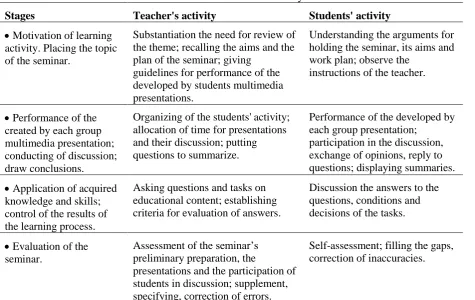
The main stages in which is specified the didactic structure of the developed summary seminar and related with them activity of the teacher and the students, are presented in table 1 [6, 7, 8].
Table 1. Didactic structure of a summary seminar
Stages Teacher's activity Students' activity
Motivation of learning activity. Placing the topic of the seminar.
Substantiation the need for review of the theme; recalling the aims and the plan of the seminar; giving
guidelines for performance of the developed by students multimedia presentations.
Understanding the arguments for holding the seminar, its aims and work plan; observe the
instructions of the teacher.
Performance of the created by each group multimedia presentation; conducting of discussion; draw conclusions.
Organizing of the students' activity; allocation of time for presentations and their discussion; putting questions to summarize.
Performance of the developed by each group presentation;
participation in the discussion, exchange of opinions, reply to questions; displaying summaries.
Application of acquired knowledge and skills; control of the results of the learning process.
Asking questions and tasks on educational content; establishing criteria for evaluation of answers.
Discussion the answers to the questions, conditions and decisions of the tasks.
Evaluation of the seminar.
Assessment of the seminar’s preliminary preparation, the
presentations and the participation of students in discussion; supplement, specifying, correction of errors.
Self-assessment; filling the gaps, correction of inaccuracies.
For the purposes of pedagogical research it is organized training in two versions – control and experimental. The first version follows the traditional lesson ("Chemical elements of the VI-A Group of the Periodic table – summary") in which leading methods are solving educational tasks and having a talk. The second version is associated with the application of the developed seminar (presented in the appendix), in which dominate methods of self-work of pupils with educational and scientific literature, Internet, preparation and presentation of multimedia presentations, work in groups, discussion.
Page 208
study not only diagnostic function but also forming function. The properties of the test are proven through an expert evaluation and statistical analysis of the results from the test’s approbation in a representative sample of students in 8th grade [10].
The pedagogical experiment is carried out during two consecutive school years (2016/2017; 2017/2018) under the scheme: preliminary test for the shaping of the equivalent groups of pupils in 8th grade; forming experiment by which the developed seminar is applied in the process of learning chemistry; final test for measuring the results of training.
3. RESULTS AND DISCUSSION
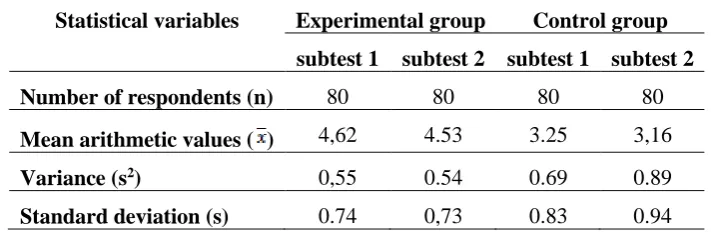
The data for the statistical parameters that characterize the pupils’ performances in the studied groups during the two years of the pedagogical experiment are presented in tables 2 and 3.
Table 2. Statistical variables that characterize the productivity of learning activity of students (2016/2017)
Statistical variables Experimental group Control group subtest 1 subtest 2 subtest 1 subtest 2
Number of respondents (n) 80 80 80 80
Mean arithmetic values ( ) 4,57 4,41 3.46 3.23
Variance (s2) 0.95 0,88 1.21 1.32
Standard deviation (s) 0.97 0,93 1.1 1.15
Table 3. Statistical variables that characterize the productivity of learning activity of students (2017/2018)
Statistical variables Experimental group Control group subtest 1 subtest 2 subtest 1 subtest 2
Number of respondents (n) 80 80 80 80
Mean arithmetic values ( ) 4,62 4.53 3.25 3,16
Variance (s2) 0,55 0.54 0.69 0.89
Standard deviation (s) 0.74 0,73 0.83 0.94
The data in tables 2 and 3 indicate, that the mean arithmetic values are higher in the experimental group of students during the two years of pedagogical research.
Statistical analysis of the final testing results is focused on solving the following question: Is there a difference between the distributions of random variables X and Y which characterize with numerical values the productivity of learning activity of students in the experimental and control group? The answer to that question is related to empirical verification of the following statistical hypotheses:
H0: The distributions of random variables X and Y in the studied groups are not significantly differ. HA: Between the distributions of random variables X and Y in the studied groups there is a significant difference.
Page 209
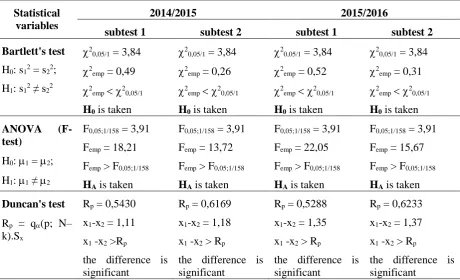
implementation of method ANOVA the presence of a homogenous variance in the studied groups of students [14, 15, 16].
Table 4. Summarized data from statistical analysis Statistical
variables
2014/2015 2015/2016
subtest 1 subtest 2 subtest 1 subtest 2
Bartlett's test H0: s12 = s22;
H1: s12 ≠ s22
20,05/1 = 3,84 2emp = 0,49 2emp 20,05/1
H0 is taken
20,05/1 = 3,84 2emp = 0,26 2emp 20,05/1
H0 is taken
20,05/1 = 3,84 2emp = 0,52 2emp 20,05/1
H0 is taken
20,05/1 = 3,84 2emp = 0,31 2emp 20,05/1
H0 is taken
ANOVA
(F-test) H0: 1 = 2; H1: 1 ≠ 2
F0,05;1/158 = 3,91
Femp = 18,21
Femp > F0,05;1/158
HA is taken
F0,05;1/158 = 3,91
Femp = 13,72
Femp > F0,05;1/158
HA is taken
F0,05;1/158 = 3,91
Femp = 22,05
Femp > F0,05;1/158
HA is taken
F0,05;1/158 = 3,91
Femp = 15,67
Femp > F0,05;1/158
HA is taken Duncan's test
Rp = q(p; N– k).Sx
Rp = 0,5430
x1-x2 = 1,11
x1 -x2 >Rp
the difference is significant
Rp = 0,6169
x1-x2 = 1,18
x1 -x2 > Rp
the difference is significant
Rp = 0,5288
x1-x2 = 1,35
x1 -x2 > Rp
the difference is significant
Rp = 0,6233
x1-x2 = 1,37
x1 -x2 > Rp
the difference is significant
The data from One-Way ANOVA show that for the both years of the pedagogical experiment the average parameters of the experimental groups differ from the average parameters of the control groups. The results of the criterion test demonstrate the appropriateness of the modeling seminar and its positive impact on the productivity of learning activity in chemistry in the experimental groups of students. The data from the testing is an argument that this test can be used to differentiate pupils from the experimental and control groups.
With acceptance of the alternative hypothesis HA the question about the significance of the difference between the average parameters of compared distributions arises. The Duncan's multiple range test results indicate that the difference between the mean arithmetic values of the two samples is statistically significant. It is not a product of the influence of random factors, but it appears as a result of the application of the developed seminar in the process of teaching chemistry in 8th grade.
When comparing the data from table 2 and 3 it can be establish how correlate the results of testing in the experimental groups of students during the two years of the pedagogical research. Solving the problem requires a definition of the following statistical hypotheses:
Н0: 1 = 2 there is no difference between the means of the studied groups; НA: 1 ≠ 2 the means of the studied groups are different.
Page 210
groups the productivity of learning in chemistry measured by the results of the criterion test mantains in the two stages of the pedagogical experiment. The established identity in the students' achievements from the studied groups proves the existence of repeatability of results from the influence of the modeling seminar on productivity of learning activity in chemistry in studying the VI-A Group of the Periodic table.
4. CONCLUSIONS
The analysis of the results of conducted pedagogical research provides the grounds for the following conclusions: (a) the didactic structure of the activity in the preliminary preparation and in conducting of the summary seminar is specified; (b) the concrete methodical decisions are proposed; they may be useful for pedagogical practice in chemistry with the common model for organization of the summary seminar (aims, a plan, a didactic structure, questions and tasks for preliminary study and for consolidation of students' knowledge and skills); (c) the educational content in the section "Non-metals. Chemical elements of the VI-A Group" (8th grade) with its practical applied focus is especially suitable for application of non-traditional organization forms of training; (d) the use of these forms leads to more complete and thoughtful mastering of ecological knowledge and their application in new cognitive situations; (e) the mastering environmental knowledge are a good basis for forming skills for making decisions on the current problems of environmental protection and for construction of attitudes towards the nature.
The created summary seminar is included in the developed version of didactic technology for enrichment the ecological culture of students in teaching chemistry and environmental protection in 8th grade. The results of the approbation of technology in pedagogical practice will be presented in the next article.
ACKNOWLEDGEMENTS
The author would like to thank the Research Fund of the Plovdiv University for its financial support (contract FP17-HF-013).
REFERENCES
1. Deryabo, S. & Yasvin, V. (1996). Ecological pedagogy and psychology. Fenics Publishing House, Rostov na Don.
2. Taylor, N., Littedyke, M., Eames, C. & Coll, R. (2009). Environmental education in context: an international perspective on the development of environmental education. Sense, Rotterdam.
3. Аngelacheva, А. (2006). The seminars in teaching chemistry and protection of the environment.
Scientific Articles Ecology 2006, Part 1, 172-185.
4. Аngelacheva, А. (2007). Model for ecological education in teaching chemistry (9th grade). PhD
thesis. Plovdiv.
5. Angelacheva, A. & Gergova E. (2011). Environmental education in teaching chemistry. Plovdiv University Press, Plovdiv.
6. Andreev, М. (1996). The process of learning. Didactics. Sofia University Press, Sofia.
7. Chernobelskaya, G. (2000). Methodology of chemistry teaching. VLADOS, Moscow.
8. Guzeev, V. (2002). Methods and organization forms of teaching. Narodnae obrazovanie, Moscow.
Page 211
10. Аngelacheva, А. (2014). Diagnostics of the environmental culture of pupils: a case study – teaching of the VI-A Group of the Periodic table in 8th grade. Chemistry: Bulgarian Journal of
Science Education, 23(2), 192-207.
11. Аngelacheva, А. & Gergova, Е. (2013). Didactical tools for developing an environmental culture of pupils in chemistry in the secondary school. Chemistry: Bulgarian Journal of Science Education, 22(4), 532-543.
12. Angelova, R. & Kabasanova, M. (1992). Methodology of biology teaching. Sofia University Press, Sofia.
13. Angelova, V., Malcheva, Z. & Genkova, L. (1994). Methodology of chemistry teaching. Sofia University Press, Sofia.
14. Bizhkov, G. & Kraevski, V. (2007). Methodology and methods of pedagogical researches. Sofia University Press, Sofia.
15. Cohen, L., Manion, L. & Morrison, K. (2011). Research methods in education. Routledge, New York.
16. Nasledov, А. (2012). Mathematical methods for psychological researches. Analysis and interpretation of data. Rech Publishing House, St. Petersburg.
Page 212 APPENDIX
"THE CHEMICAL ELEMENTS OF THE VI-A GROUP OF THE PERIODIC TABLE AND ENVIRONMENTAL PROTECTION"– SUMMARY SEMINAR
A. Aims of the seminar
Generalization and systematization the students’ knowledge about:
– simple substances and chemical compounds of the elements of the VI-A Group which are widespread in nature;
– biological importance or toxic action of the elements of the VI-A Group; ways to protect from the action of harmful substances and for giving first aid in destruction;
– physical and chemical properties of simple substances and chemical compounds of the elements of the VI-A Group that define them as real or potential environmental pollutants;
– main stages of the natural sulphur and oxygen cycle, causes for their disturbance and ways to save them;
– environmental problems associated with the receipt and use of simple substances and chemical compounds of the elements of the VI-A Group;
– main sources of air, water and soil pollution with simple substances and compounds of the elements of the VI-A Group, etc.
Improvement of skills for:
– self-study of the different sources of information and its systematization and use in specific cognitive situations;
– self-solving questions and tasks which are connected with the environmental problems of the country;
– composition or interpretation of tables, diagrams, charts related to the impact of simple substances and chemical compounds of the elements of the VI-A Group on the environment;
– preparation of a computer presentation as a result of preliminary self-activity;
– participation in discussion with argumentation of own opinion, putting questions to the expressed opinion, correction and addition the replies of the others;
– planning and performance of chemical experiments connected with detection the presence of harmful substances in the air, water and soil, which is a condition for building environmental awareness and motivation to participate in solving the problems for environmental protection;
– application the safety rules when performing chemical experiments;
– application of ecological knowledge in explanation chemical processes which occur in industry, daily round, nature and leading to pollution of the environment, etc.
Formation attitudes to the environment:
– understanding the importance of simple substances and chemical compounds of the elements of the VI-A Group for life, for the practice;
– building the right ideas about the processes leading to environmental pollution and the active role of chemistry science in solving one of the most actual problems – protection of the environment;
Page 213 B. Plan for preparation of the seminar
1. Presence of simple substances and chemical compounds of the elements of the VI-A Group in nature.
2. Biological importance and toxic action of simple substances and chemical compounds of the elements of the VI-A Group. First aid in destruction with sulfur compounds.
3. Atmosphere pollution with simple substances and compounds of the elements of the VI-A Group.
3.1. Natural and technological sources of atmosphere pollution. Consequences for the environment.
3.2. Establishment the presence of sulphur dioxide SO2, hydrogen sulphide H2S in air.
3.3. Methods to reduce or prevent atmosphere pollution with sulphur compounds.
4. Water pollution with sulphur compounds.
4.1. Sources of water pollution and methods for treatment of wastewater from sulfur compounds.
4.2. Analysis of drinking water and wastewater for the presence of sulphate ions SO42–, sulfide ions S2–.
5. Soil pollution with sulphur compounds.
5.1. Sources of soil pollution and consequences.
5.2. Establishment the presence of sulphate ions SO42– in the soil.
C. Questions and tasks for preliminary preparation
Which of the properties of simple substances and chemical compounds of the elements of the VI-A Group definite them as environmental pollutants?
Explain biological importance, toxic action and ways for entrance of simple substances and chemical compounds of the elements of the VI-A Group in the living organisms.
Substantiate the ways to render first aid in destruction with sulfur compounds.
Systematize the sources of air pollution with simple substances and compounds of the elements of the VI-A Group.
Acquaint with the methods for establishment the presence of sulphur dioxide SO2 and hydrogen sulphide H2S in air.
What methods are used for disposal of sulphur oxides contained in the waste gases from chemical industry, metallurgy, electric stations?
Reveal the importance of water to maintain vital functions of organisms; for development of industry and agriculture.
What are the reasons for the shortage of drinking water in Bulgaria?
What are the causes of water pollution with sulfur compounds and what are the consequences of this for the living and non-living nature?
Suggest chemical experiments to illustrate the impact of acid rain on the environment.
Study the methods for establishment the presence of sulphate ions SO42– and sulfide ions S2– in samples of water (drinking water, rainwater, mineral water, refuse waters).
Summarize the causes of soil pollution with sulphur compounds and methods for its protection.
Explore the soil samples for the presence of sulphate ions SO42–.
Page 214
D. Sample tasks for consolidation of the system of knowledge, skills and attitudes of students towards the environment
Which industrial enterprises are the major atmosphere pollutants in your region? What harmful substances enter in the environment from the local factories? Suggest ways to reduce air pollution in your area.
Does the river water, that runs near your location, use in industry, agriculture, daily life? With what substances is polluted the water stream?
Is there near your location wastewater purification plant? Visit it.
Point out examples of pollution soils in your region.