Page 170
EXAMINING THE POWER-SHARING LEVEL IN A HIGHER EDUCATION CLASSROOM Burcu Karafil1, Asım Arı2
1Bilecik Seyh Edebali University, Gulumbe Campus, Bilecik, Turkey 2Eskisehir Osmangazi University, Meselik Campus, Eskisehir, Turkey
Abstract
Learner-centered education gives importance to student motivation, exploration and productivity. Moreover, in learner-centered teaching, students are given more control and power is shared with students. This study aims to determine the power sharing level in higher education classes according to students’ opinions. In this study, survey method, one of the quantitative research methods, was used. The study was conducted to the population, 454 students at Foreign Languages School in Eskisehir Osmangazi University, Turkey in 2014-2015 academic years. The data was collected with “Power-sharing Scale” developed by Oruç (2014). SPSS Statistics was used for the statistical analysis of the data. It is found out that in the preparation classrooms power is shared on average level. It is thought that giving more responsibility to students in learning environment will make a great contribution to students’ educational process.
Key words: learner-centered education, power sharing, higher education
1. INTRODUCTION
In today’s educational system, it has a great importance to educate students in a way that they improve themselves, keep pace with the technological advances, make researches and analyze and synthesize the information instead of memorizing. In 21sth century of the developing Word, it is required to absorb and make sense of the new knowledge. Student-centered learning has been thought to be very effective in achieving these features (Dönmez 2008). Weimer (2002 states that there are five dimensions that should be in order to have a student-centered environment. These dimensions are as follows: the responsibility of learning, the role of the teacher, the function of content, evaluation process and the balance of power.
The responsibility of learning: Weimer (2002) indicates that most students do not have confidence in learning process and do not take the responsibility of learning decisions. Thefore, teachers should encourage the students to have their learning responsibilities. Within this scope, students should be active learners in the classroom environment. A positive classroom environment set by the teacher is a precondition of having responsible students (Alexandra 2013).
The role of the teacher: The control of the teachers prevents students from explaining their ideas and it poses an obstacle across the reflective education. As a result, students only focus on giving the correct answer instead of explaining their own ideas. On the contrary, in student-centered environment teachers enable students to make researches and they do not take place in the classroom environment as an authority. Teachers’ role is that of a guide and facilitator of learning (Overby 2011).
The function of content: In teacher-centered classroom environment, the content is very important and teachers try to teach as many subjects as possible. However, content is seen as a part of the class in student-centered learning environment. Students learn the content in a meaningful context (Brackenbury 2012). As a result, content has become more meaningful in learning process. In student-centered learning teachers do not focus on textbooks and the units. Instead, they make the content according to students’ needs, skills and interests. The content should be organized in a way that it provides the best learning environment for students (Brown 2003).
Page 171
multiple choice, drilling and true/false questions are inadequate in evaluation the students’ behaviors and they do not discover the students’ skills such as reading comprehension, writing, making a presentation and making research (Bulut 2008). Moreover, grading the students is very important in teacher-centered classroom environment and students are compared with each other. On the contrary, in student-centered learning self-evaluation and peer assessment techniques are frequently used. Students take the responsibility of learning with the help of these techniques (O’Neill & McMahon 2005). The evaluation process is made to support the learning and to determine the mistakes. It is aimed to provide the students learn from their mistakes (Saulnier & Landry & Longenecker & Wagner 2008).
The balance of power: Many teachers use classroom management techniques to control the class and they exert power (Plax & Kearney & McCroskey & Richmond, 1986). In teacher-centered classes all the decisions about learning process are made by teachers. However, the lesson planning process is performed with the collaboration of teachers and students. The balance of power is changed and students take part in the learning process actively. Therefore, it becomes possible for students to take the responsibility of their own learning in order to be independent learners (Brackenbury 2012). Students are required to control the learning process and learn actively by guiding the process. This control and participation opportunities should be presented to have a student-centered environment (Acat 2005). Therefore, it can be concluded that student-centered classes are far from the teacher control and there are mutual relationships between teachers and students.
1.1.Power in the class
In general terms, power refers to the ability to affect people in some ways. In classroom environment power refers to the ability of teachers to affect the students without the control of students (Mendez & Garcia 2012). Manke (1997) defines power as a relationship between teachers and students. This relationship is called as power since the power shapes the actions of people.
However, it t is difficult to conceptualize the power and there have been many different ideas in the literature. French and Raven (1968) indicated five power bases. These are coercive power, reward power, legitimative power, referent power and expert power.
McCroskey & Richmond (1984) examined these power bases in the classroom environment.
• Coercive power is based on students’ perception that they will be punished by teacher when they do not conform to what the teacher says and tells them.
• Reward power is based on the students’ perception that they will get a reward from teachers when they do what the teacher ask or tells them.
• Legitimative power is the perception of students’ that teachers have the right to make decisions in the class as they have the authority.
• Referent power is based on the relationship between teachers and students. Students see the teachers as an authority and they respect the teachers.
• Expert power is about students’ perceiving the teacher as being competent and knowledgeable in specific areas (Paulse & Chory-Assad & Dunleavy 2005).
With the economic, cultural and educational developments there have been changes in the relationship between teachers and students on power, power dynamics and power relations in the classroom. Therefore, a more effective classroom environment is achieved and the social as well as the academic needs of the students are met (Lovorn & Christensen & Sunal & Shwery 2012).
Page 172
1.2.Power sharing in class environment
Power sharing in the class environment refers to the process where all decisions are not made by teachers and students take part actively. Power sharing aims to give more responsibility to students and develop their capacities. In teacher-centered classes teachers exert power on students. They use control teaching methods. On the contrary, power is shared with students in student centered classes (Weimer 2002). Students share the power by participating to the learning process.
Teachers are not the only people in charge for the activities occurring in the class. Students share the power with teachers by participating the activities (Overby 2011). Teachers have some interactive resources affecting students’ behaviors and students also affect teachers’ behaviors by using their own interactive resources (Manke 1997). Therefore, power relations in the class are handled in a bidirectional way.
1.3.The importance of power sharing
Students feel more self-disciplined by sharing the control in the class. Being self-disciplined means that students are aware of their skills and capabilities and they take the necessary decisions to improve their personal growth (Freiberg & Lamb 2009).
Power sharing plays a crucial role to strength students’ character in higher education. Moreover, students explain their opinions on curriculum when they are encouraged to participate in their own learning (Humphreys 2012).
Power sharing is also important in terms of teachers and the institutions. Students feel more confident and they study hard in the classes where power is shared. As a result, student do not resist to learning. Therefore, teachers do not have to deal with passive and demotivated students. Power sharing has a positive effect on the environment. Classroom management becomes easier and the classes are far from noise. Moreover, students try to find solutions when they encounter problems. This constitutes a positive classroom environment for learning process (Weimer 2002).
Within these concepts, this study aims to determine the power sharing level in higher education classes according to students’ opinions. To this end, the following questions were proposed for this study:
1. What are the beliefs of students on current power sharing levels in higher education classes? 2. Does power sharing level belief differentiate according to gender?
3. Does power sharing level belief differentiate according to students’ level? 4. Does power sharing level belief differentiate according to English success level?
2. METHOD
This section gives information about research model, participants, data collection tool, data collection procedure and data analysis.
2.1.Research Model
Survey method, one of the quantitative research methods, was used for the research method of the study. Descriptive survey models describe, compare, analyze and interpret the situations of individuals, institutions, groups or sources in the way they are (Cohen & Manion & Morrison 2007).
2.2.Participants
Page 173
included 147 female and 307 male students. They were the students from International Relations, Machinery Engineering, Electrical-Electronics Engineering, Architecture, Computer Engineering and English Language Teachers departments. Their class-level ranged from beginner to pre-intermediate levels and their success level ranged from unsuccessful to very successful.
2.3.Data Collection Tool
A “Power sharing Scale” developed by Oruç (2014) was used to determine the power sharing level in higher education classes. The questionnaire consisted of 26 Likert-type questions. This scale was used to respond to statements from a five-item Likert range from very low= 1 to very high= 5. The questions were developed to cover six aspects of power sharing. These aspects were 1) content, 2) duties, 3) rules, 4) process, 5) activities and 6) evaluation. Moreover, some demographic information was available via self-report questions placed on the top of the questionnaire.
2.4.Procedure
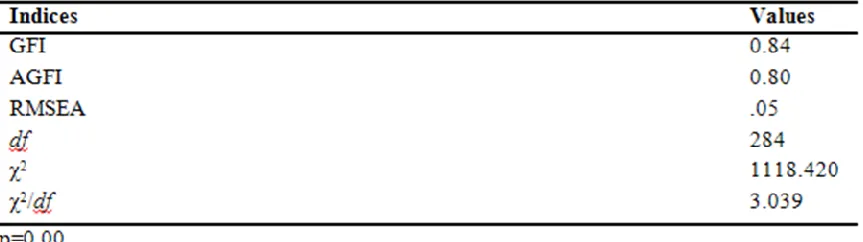
Firstly, the legal written permission was received in order to conduct the study. Data of the study were collected within the class hour. Before conducting the study, the teachers were informed about the study. The validity of the present study was provided by Confirmatory Factor Analysis (CFA) using AMOS programme. CFA was used to test whether the measurement model of a six- factor structure of Power sharing Scale is a good fit of the data. To construct the validity of the present study, Goodness of Fit Index (GFI), the Adjusted Goodness of Fir Index (AGFI), the Root Mean Square Error of Approximation (RMSEA), chi squares χ2, and degree of freedom are examined. The obtained results are shown in Table 1.
Table 1. Fit indicators of power sharing scale
Upon finding GFI, AGFI and RMSEA values as 0.84, 0.80 and .05 respectively, it can be concluded that Power Sharing scale fits the scale’s data. The acceptable wide range for GFI and AGFI is between .85 and .90. Moreover, RMSA value of .05 is seen to be in acceptable wide range (Scherbelleh-Engel & Moosbrugger & Huller 2003)
Page 174
2.5.Data Analysis
After collecting the completed questionnaires, all the data were coded and then analyzed through the Statistical Package for Social Science (SPSS18.0). Five-item Likert type questionnaires range from very low= 1 to very high= 5 and it consists of five equal intervals. The scores are determined according to the group intervals. For this aim, the minimum score (1) is subtracted from the maximum score (5) and the obtained value is divided into group number. Therefore, the score intervals corresponding to each option are determined (Büyüköztürk & Çokluk & Köklü 2011). The questionnaire options and the corresponding intervals are shown in Table 2.
Table 2. Power sharing level determination questionnaire options and score intervals
Firstly, descriptive statistics such as frequencies, means, and standard deviations were computed to display the subjects’ overall responses to the power sharing level belief items. Secondly, t-test was conducted in order to determine whether there are any significant differences in power sharing level beliefs of students’ in terms of gender. One-way ANOVA was conducted to investigate whether there are any differences in students’ beliefs on power sharing level in different groups based on student level and student success.
3. FINDINGS
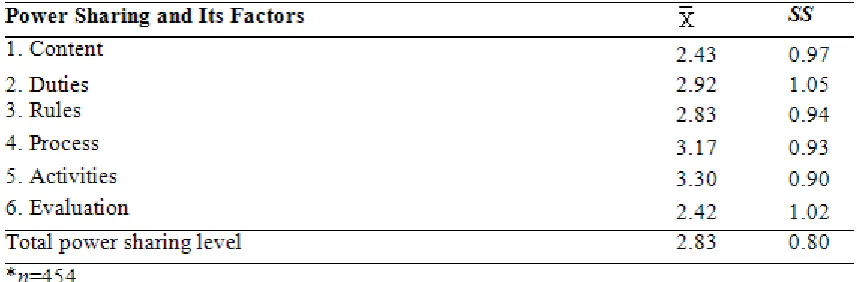
To assess the students’ opinions on power sharing level in higher education classes, descriptive statistics were conducted and means and standard deviations were presented in Table 3.
Table 3. Mean and standard deviation for the six aspects of power sharing level
Page 175
factor is (=2.43) at the lowest level and activities factor was ( =3.30) at the highest level. Also, the total power sharing level is at ( =2.83) moderate level, which means “somewhat fits me”.
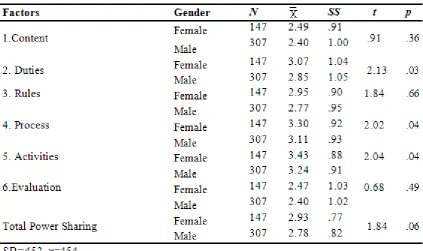
Therefore, it can be concluded that the students’ opinions on power sharing level in higher education class is at moderate level. The paired-samples t-test was utilized to see whether the students’ gender differ in beliefs on power sharing level. The t-test results are shown in Table 4.
Table 4. T-Test results on power sharing level beliefs of students
According to the results, no statistically significant gender differences were found for content, rules, evaluation and total power sharing level [p>0.05]. On the contrary female students are found to exhibit higher beliefs on power sharing level for duties [t(452)=2.13, p=.03], process [t(452)=2.02, p=.04] and
activities [t(452)=2.04, p=.04] factors [p<0.05]. The mean values of the female and male students’ answers for duties factor were at “mostly fits me” level. However, the mean values of females were found to be higher than the males. Therefore, female students exhibited higher beliefs on power sharing level compared to male students. Mean values of females for process factor was found as =3.30 and as =3.11 for females, which means “mostly fits me”. The mean values of female and male students for activities factor was at “somewhat fits me” and “mostly fits me”.
It can be concluded from t-test results that female students exhibited more positive beliefs on power sharing level for duties, process and activities factors. On the other hand, no statistically significant gender difference was found for content, evaluation and total power sharing level. Therefore, the student responses for these factors were similar.
Page 176
Table 5. One-Way ANOVA results for English level groups
The one-way ANOVA statistics for total power sharing level beliefs of students’ based on student level reveal that there are significant differences among three different English level groups [F(2-451)=17.226, p<.05]. In order to determine the differentiating groups, Tukey post-hoc test has been conducted. The test results showed that there was a statistically significant differences between beginner and elementary and beginner and pre-intermediate groups. As the above table indicates, Beginner group performed significantly differently from elementary group. Also students in intermediate group performed better than those in elementary group.
The mean and standard deviation values of power sharing level for English level groups are shown in Table 6.
Table 6. Power sharing level average for English level groups
The mean value of pre- intermediate group was (=3.09) the highest. Therefore, it can be concluded that the students in pre-intermediate group exhibited more positive beliefs on power sharing level. Moreover, the students in elementary level group exhibited more negative beliefs compared to the other groups.
On the other hand, there were statistically significant differences for content [F(2-451)=13.804, p<.05], duties [F(2-451)=11.680, p<.05], rules [F(2-451)=11.615, p<.05], process [F(2-451)=12.193, p<.05], activities [F(2-451)=7.690, p<.05] and evaluation [F(2-451)=10.86, p<.05] factors. The students in pre-intermediate group exhibited higher beliefs on power-sharing level compared to other groups.
Page 177
Table 7. One-Way ANOVA results for English success groups
The statistic results show that there is no statistically significant difference between students based on English success level [F(4-405)=1.090, p>.05]. Therefore, it can be said that English success level do not make any difference for students’ beliefs on power sharing level and all students exhibited similar beliefs.
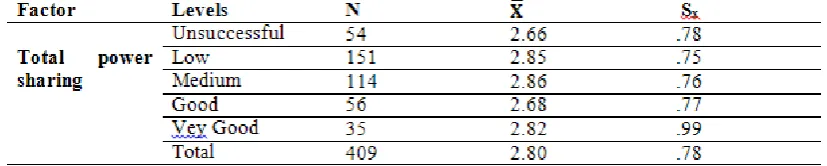
The mean values and standard deviation of power sharing level based on English success are shown in Table 8.
Table 8. The power sharing level for English level groups
As it is seen in the table, total power sharing level based on English success level is at moderate level with “somewhat fits me. The students in all English success level exhibited similar beliefs.
On the other hand, no statistically significant difference was found for content [F(4-405)=1.008, p>.05], duties [F(4-405)=.748, p>.05], rules [F(4-405)=.888, p>.05], process [F(4-405)=1.704, p>.05], activities [F(4-405)=.724, p>.05] and evaluation [F(4-405)=.460, p>.05] factors. Therefore, it can be concluded that all students exhibited similar beliefs on power sharing level at content, duties, rules, process, activities and evaluation factors.
CONCLUSIONS AND DISCUSSION
This study aims to determine the power sharing level in higher education classes according to students’ opinions. The results show that power is shared with students on average level in higher education classes. The students have given responsibilities at medium level for making decisions on content, duties, rules, process and activities factor. This result is similar with the findings of Oruç (2014) who conducted a study to determine the power sharing levels in English preparation classes. On the other hand, Oral (2013) examined the power sharing level in Foreign Language classes. The results showed that the power sharing level was not high. Moreover, the classroom was teacher-centered and the teacher authority was prior in the class. The results of these studies coincide with each other.
Page 178
(Humphreys 2012). However, teacher control prevents students from explaining their ideas Teacher authority weakens by power sharing. The research results indicated that power is shared on the average level. Therefore, it can be concluded that teacher authority dominates the classroom environment.
Students have a low level decision making right for content. In teacher-centered education, content is constructed by teachers or the institutions (Nunan 1998). A classroom environment where students have responsibility on content choice leads to student-centered environment.
The results on duties factor show that student responsibility on making decisions for duties in not high. Yüksel (2010) examined the power sharing in higher education. He gave responsibilities to students on homework selection by taking into account student experiences, interest and career expectations. He determined that this process increased the students’ motivation. Moreover, it was noted that students are found to have responsibilities on rules and process factors on average level. As a result, teachers do not make power sharing with students on rules and process very much. The learning process is frequently led by teachers.
The power sharing is made at the lowest level on evaluation factor. Evaluation is an important part of student-centered classes. Some evaluation methods such as self-evaluation enables students follow their own learning process (Nunan 1993). Moreover, students take their own learning responsibilities by self-evaluation and peer evaluation methods (O’Neill & McMahon 2005). The students’ answers on whether teachers give them responsibilities for self-evaluation and peer evaluation is at “absolutely does not fit me” level. Therefore, it can be said that classes are far from student-centeredness.
It has been found out the gender of the students do not affect students’ beliefs on power sharing level for content, rules, evaluation, total power sharing factors. On the contrary gender of the students had a statistically significant difference on students’ beliefs in process and activities factors. Female students exhibited higher belies on power sharing level compared to male students.
The results on power sharing level for English level groups indicate that the power sharing level points of pre-intermediate group were higher compared to the other groups in all factors. The beginner groups students’ opinions were found to be similar with the pre-intermediate group students’. The mean values of elementary group students were the lowest. Moreover, there was a statistically significant difference for content, duties, process, activities evaluation and total power sharing factors for English level groups. The significant difference among the groups was located between beginner and elementary groups and elementary and pre-intermediate groups. The beginner level students were found to have higher beliefs on power sharing level compared to elementary group students. Moreover, pre-intermediate level students exhibited higher beliefs on power sharing level compared to the elementary group students. The belief on power sharing level is higher in pre-intermediate group student.
On the contrary, no statistically significant difference for content, duties, rules, process, activities, evaluation and total power sharing level was noted between groups in terms of English success level. The result showed that the students had close opinions on power sharing level for the mentioned factors.
REFERENCES
Acat, MB 2005, ‘Öğrenci merkezli eğitimde öğrenme ortamı boyutlarının düzenlenmesi, V. Uluslararası Eğitim Teknolojileri Sempozyumu, Sakarya, Turkey.
Brackenbury, T 2012, ‘A qualitative examination of connections between learner-centered teaching and past significant learning experiences’, Journal of Scholarship of Teaching and Learning, vol. 12, no. 4, pp. 12-28.
Page 179
Bulut, İ 2008, ‘Yeni İlköğretim Programlarında Öngörülen Öğrenci Merkezli Uygulamalara İlişkin Öğretmen Görüşleri (Diyarbakır İli Örneği)’ Kuram ve Uygulamada Eğitim Yönetimi, vol. 56, pp. 521-546.
Büyüköztürk, Ş, Çokluk, Ö & Köklü, N 2011 ‘Sosyal Bilimler İçin İstatistik. 7. Baskı’, Pegem A Yayınları, Ankara.
Büyüköztürk, Ş 2002, ‘Faktör analizi: temel kavramlar ve ölçek geliştirmede kullanımı’, Eğitim Yönetimi Dergisi, vol. 32, pp. 470-483.
Cohen, L & Manion, L & Morrison, K 2013, ‘Research methods in education’, Routledge, New York. Çam, S & Oruç, E 2014, ‘Learning responsibility and balance of power’, International Journal of Instruction, vol. 7, no. 1, pp. 5-16.
Dönmez, İ. (2008), ‘İlköğretim Fen ve Teknoloji Dersi Öğrenme Ortamlarının Öğrenci Merkezli Eğitim Açısından Değerlendirilmesi’ Master Thesis, Eskişehir Osmangazi Üniversitesi, Eskişehir. Freiberg, HJ & Lamb, SM 2009, ‘Dimensions of person-centered classroom management’, Theory into Practice, vol. 48, no. 2, pp. 99-105.
Humphreys, CK 2012, ‘Developing student character: Community college professors who share power’, Community College Journal of Research and Practice, vo. 36, no. 6, pp. 436-447.
Lovorn, M &Sunal, CS & Christensen, LM & Sunal, DW & Shwery, C 2012 ‘Who’s in control? Teachers from five countries share perspectives on power dynamics in the learning environment’,
Journal of Research in International Education, vol.11, no. 1, pp. 70-86.
Manke, MP 1997, ‘Classroom power relations: Understanding student-teacher interaction’, Lawrence Erlbaum Associates, London.
Méndez, T & García, A 2012 ‘Exploring elementary students' power and solidarity relations in an EFL classroom’, Profile Issues in Teachers Professional Development, vol.14, no.1, pp.173-185.
McCroskey, JC & Richmond, V 1983, ‘Power in the classroom I: Teacher and student perceptions’,
Communication Education, vol.32, pp.175-184.
Nunan, D 1993, ‘The Learner-Centered curriculum revisited perspectives’, a Journal of TESOL, vol. 19, no. 1
O’Neill, G & McMahon, T 2005, ‘Student–centered learning: What does it mean for students and lecturers?’, O’Neill, G., Moore, S., McMullin, B. (Eds.) In Emerging Issues in the Practice of University Learning and Teaching, Dublin: AISHE.
Oral, Y 2013, ‘The right things are what I expect them to do: Negotiation of power relations in an English classroom’, Journal of Language Identity and Education, vol. 12, no.2, pp. 96-115.
Oruç, E 2014, ‘Yükseköğretim İngilizce hazırlık eğitimi sınıf ortamlarında güç paylaşım düzeyinin incelenmesi’, Mater Thesis, Eskişehir Osmangazi Üniversitesi, Eskişehir.
Overby, K 2011, ‘Student-centered learning’, ESSAI, vol. 9, no. 1, pp. 109-112.
Paulse, ML& Chory-Assad, RM & Dunleavy, KN 2005, ‘The Relationship between student perceptions of instructor power and classroom justice’, Communication Research Reports, vol. 22, no. 3, pp. 207-215
Plax, TG. &, Kearney, P & McCroskey, J & Richmond, V 1986, ‘Power in the classroom VI: Verbal control strategies, nonverbal immediacy and affective learning’, Communication Education, vol. 35, pp. 43-55.
Page 180
Scherbelleh-Engel, K, Moosbrugger, H & Muller, H 2003, “Evaluating the Fit of Structural Equation Models: Tests of Significance and Descriptive Goodness-of-it Measures”, Methods of Psychological Research Online, vol. 8, no.2, pp. 23-74
Weimer, M 2002, Learner Centered Teaching: Five Key Changes to Practice, Jossey-Bass, San Francisco.