Page 543
CREATIVE THINKING, CRITICAL THINKING AND SYSTEMIC THINKING - KEY INSTRUMENTS TO DEEPLY TRANSFORM THE HIGHER EDUCATION SYSTEM
IN ALBANIA: THE CASE OF LANDSCAPE ARCHITECTURE Zydi Teqja1, Samuel F. Dennis Jr 2
1
Agricultural University of Tirana, Koder Kamez, Tirana, Albania
2Department of Landscape Architecture and Nelson Institute for Environmental Studies, University of Wisconsin, 42A Agricultural Hall, 1450 Linden Drive, Madison, WI 53706, USA
Abstract
Albania has experienced tremendous changes during the past several decades, as it applied a rapid model of transition to a market economy. Since 2001, the higher education system has been involved with a new restructuring process according to the "Bologna Declaration". While structural changes are radical, we cannot say the same for the process of teaching and learning. The influences of old education system, which was focused on transmitting knowledge and building a storehouse of information in the students’ brain, are still evident. This presentation is a review of best theories and practices of higher education and it concludes that the new system should help learners to deal with ideas and information to construct their understanding. This system should produce a sustained influence on the way people think, act and feel. It is more evident for multi-disciplinary fields like landscape architecture and ecology, where creative thinking, critical thinking and systems thinking are crucial.
Key words: education, thinking, teaching, landscape architecture
1. INTRODUCTION
Page 544
The highly controlled environment that the communist regime had forced upon the educational system over the course of 4-5 decades was finally collapsed at the beginning of ’90 when Albania started the transition to democracy and market economy. A number of laws have been adapted and changed since then; Law on Higher Education on the Republic of Albania (1994), Law on Higher Education no. 8461 (1999) Law No. 9741, dated May 5, 2007 “On Higher Education in the Republic of Albania”, Law No. 10 307, dated July 22, 2010, and recently Law No.80/2015,"For higher education and Scientific Research in Higher Education Institutions of the Republic of Albania" (Katro, 2015; Kajsiu, 2015; Duro, 2015).
This everlasting process of discussions and laws changing has significantly transformed the structure of higher education in Albania but it has not done enough in really improving the content and the quality of teaching and learning. In fact, as Marilyn Ferguson in her well-known book “The Aquarian Conspiracy” says, “Change can only be facilitated not decreed.” Moreover, not enough energy and resources have been applied to designing a more effective learning environment. Some of the problems we face in higher education in Albania could be as follows:
There is lack of inspiration for students to deal with ideas and information to construct their own understanding and lack of sustained influence on the way they think, act, and feel; The teaching objectives often are arbitrarily tied to the course and they do not represent the kind of thinking and acting expected for life; There is lack of a “natural critical learning environment”, an environment where students learn by confronting problems or tasks that will challenge them to face ideas, rethink their assumptions, and examine their mental model of reality. Frequently teachers blame their students for the situation and difficulties they face. Not always teachers work to reflect high trust in students. In many cases students do not believe that their work will be considered fairly and honestly. Students do not feel a real sense of control over their education; they rarely work collaboratively with others. The above mentioned problems and others (Alhasani, 2015) are more evident, and even more important, for multi-disciplinary fields like landscape architecture and ecology, where creative thinking, critical thinking and systems thinking are crucial. This presentation is a review of best theories and practices of higher education with a focus on landscape architecture.
2. WESTERN EXPERIENCE AND DEBATES ON HIGHER EDUCATION
During the second half of twentieth century, there were a lot of discussions, research and publications on the education system. These discussions reached a high scientific level at the beginning of 1970. Among the most influential authors of that time, are William G. Perry, JR and Arnold Boris Arons. William G. Perry became full professor of education in Harvard Graduate School of education in 1965. He spent a long time interviewing college students and made some important discoveries about the development of critical thinking. Through his work Perry developed methods of mapping the cognitive and moral development of students that led to the publication of his well-known book “Forms of Intellectual and Ethical Development in the College Years: A Scheme”, in 1970. This book was republished in 1999 also (Perry 1999). Some of most important Perry’s discoveries are (Gallagher, 1998):
1) Students move through a consistent series of steps as they stop to be memorizers and learn to become sophisticated critical thinkers.
2) That movement from one stage to the next is accompanied by a complete transformation of the student’s philosophy about the nature of knowledge, the role of the student as learner, and the role of the teacher.
3) At different stages students accept and reject different kinds of instruction, which directly affects the teacher’s effectiveness.
Page 545
college students along a continuum that moves from unsighted receiving of facts to appreciation for independent complex thought.
In dualism, students believe that all valid questions have certain answers. They expect black-and-white evaluations from their teachers. Students in this stage try to develop thinking skills that help them to memorize information and be prepared for good answers.
Multiplicity is a stage when students enjoy and understand critical thinking skills. This helps them pose many different hypotheses for problems that have no clear and explicit correct answer.
Contextual relativism is the stage at which students learn that for giving validity to their opinions they need to support them with arguments. These arguments change according to fields of study. Students appreciate the critical thinking skills to build and support theories. They learn how to choose the best option among a group of alternatives and how to use supportive evidence.
At the dialectic stage, students are able to understand that one way of thinking might be not enough. They are able to exercise the use of the intellect, to shift from context to context. They are capable of looking at the different paradigms from which a problem could be viewed: artistic, scientific, social, technologic, economic and so on. Students start to be aware and understand the values of the discipline and the significant role they can play as professionals in this discipline.
Reaching stage three and four should be the goal of higher education. This is very important for interdisciplinary and contextual fields like landscape architecture.
Another very influential author of the second half of twentieth century is Arnold Boris Arons. He was widely regarded as one of the leaders in physics teaching and in physics education research. In 1972 he published “Toward wider public understanding of science.” Among many other publications in 1990 he published the textbooks “A Guide to Introductory Physics Teaching” and “Teaching Introductory Physics”, which broke new ground in bringing emerging insights into the teaching and learning at both college and high school levels. His focus was physics but as it is underlined by some researchers the Arons-Advocated Method is recommended for every science teacher, education researcher and cognitive scientist (Hake, R.R., 2004; Grossman R, 2004).
The so called Arons-Advocated Method emphasizes: (1) conceptual understanding, (2) operative knowledge, (3) interactive engagement, (4) Socratic dialogue, (5) attention to cognitive development, (6) attention to preconceptions of beginning students, (7) operational definitions, (8) reduction of volume and pace of standard introductory courses, (9) idea first, name afterward, (10) importance of a course “story line,” (11) science as a liberal art. All these are described in detail in the publication of Richard R. Hake (2004).
Everywhere there are teachers that stand out for their exceptional work and the impact they have on their students. Ken Bain in his book “What best college teachers do?” (Bain K, 2004) brings some real insights from the experiences of best teachers. Bain suggests a fundamental conceptual shift in the definition of teaching from "transmitting" knowledge, as if teaching is telling, to a different model in which teaching occurs only when learning takes place. He underlines:
“Most fundamentally, teaching in this conception is creating those conditions in which most, if not all, of our students will realize their potential to learn” (p. 173).
A summary of what best teachers do according to Ken Bain is:
1) They understand their field and have a strong interest in the broader issues of their disciplines. But more importantly, they have at least an intuitive understanding of human learning, recognizing that performing well on the tests is not a satisfactory indicator of learning. Learning is a transformative experience.
Page 546
3) The best teachers expect "more", but the more is clearly tied to the kind of thought and action expected in real life.
4) The best teachers create a "natural critical learning environment", one in which the learners feel a certain control over their learning experience. The environment is challenging yet supportive, collaborative, fair and honest, and most importantly a safe place to try, fail, and try again.
5) The best teachers treat students with trust and respect, assuming that each student wants to learn and that they will be able to.
6) The best teachers use a systematic program of evaluation and make the needed changes to improve their teaching.
7) The outstanding teachers follow the important intellectual and scientific or artistic developments within their fields, do research, have important and original thoughts on their subjects, study carefully and extensively what other people are doing in their field, often read extensively in other fields (sometimes far distant from their own), and take a strong interest in the broader issues of their disciplines: the histories, controversies and epistemological discussions. In short they can do intellectually, physically or emotionally what they expect from their students.
8) They know how to simplify and clarify complex subjects, to cut to the heart of the matter with provocative insights, and they can think about their own thinking in the discipline, analyzing its nature and evaluating its quality. That capacity to think metacognitively drives much of what Bain observed in the best teaching.
The term "metacognition" is most often associated with John Flavell, (1979). According to Flavell (1979, 1987), metacognition consists of both metacognitive knowledge and metacognitive experiences or regulation. Metacognitive knowledge refers to acquired knowledge about cognitive processes, knowledge that can be used to control cognitive processes. Flavell further divides metacognitive knowledge into three categories:
1) Knowledge of person variables which refers to general knowledge about how human beings learn and process information, as well as individual knowledge of one's own learning processes.
2) Knowledge of task variables includes knowledge about the nature of the task as well as the type of processing demands that it will place upon the individual.
3) Knowledge about strategy variables, including knowledge about both cognitive and metacognitive strategies, as well as conditional knowledge about when and where it is appropriate to use such strategies.
Some key concepts that can be found in Ken Bain book (Bain, 2004) are described in the next sections:
1) Knowledge is constructed not received
Page 547 3) Mental models change slowly
4) Best teachers believe that to accomplish those feat, learners must (1) face a situation in which their mental model will not work; (2) care that it does not work strongly enough to stop and grapple with the issue at hand; and (3) be able to handle the emotional trauma that sometimes accompanies challenges to longstanding beliefs. Best teachers believe that students must learn the facts while learning to use them to make decisions about what they understand or what they should do. To them “learning” makes little sense unless it has some sustained influence on the way the learner subsequently thinks, acts, or feels. So they teach the “facts” in a rich context of problems, issues, and questions.
5) Questions are crucial
6) When we successfully stimulate our students to ask their own questions, we are laying the foundation of learning.
7) Caring is crucial
8) People learn best when they ask an important question that they care about answering or adopt a goal that they want to reach. If we are not seeking an answer to anything, we pay little attention to random information.
Ken Bain concludes his book by recommended that “to learn from the experiences of the best teachers we need to overcome two main obstacles: the first one is the notion that teaching ability is somehow implanted at birth and that there is little we can do to change whether we have it or not; the second biggest obstacle is simplistic notion that good teaching is just a matter of technique.” Ken Bain insists that teaching should be conceived not as a transmission model but as creating good learning environments (Bain K, 2004).
3. EDUCATION IN LANDSCAPE ARCHITECTURE DURING SECOND HALF OF
TWENTIETH CENTURY
Page 548
early 1970s. These changes oriented a shift in the profession of landscape architecture, and in the processes and tools with which the profession operates.
John Motloch, in his text book “Introduction to landscape design,” identifies four foundations of landscape design education: art/aesthetic systems, technological systems, natural systems, and human systems. (Motloch J, 2001). He describes the chronology of development of these foundations as follows:
1) Before 1960s, landscape architecture had two major foundations: art/aesthetic and the technology through which a culture modified natural environments and constructed built ones.
2) By the 1960s, landscape design pioneers, including Ian L. McHarg and Phil Lewis, had introduced natural systems as a third foundation. These pioneers played a seminal role in transmitting environmental concerns into a third foundation for design. They also played a major role in leading society to an awareness of our ability to radically change the world beyond the planet’s ability to self-manage its ecological health. Global society’s responsibility to manage the earth as a resource also increased. Landscape design curricula continued to effectively build student understanding of the history of landscape and garden design traditions. In addition, these programs embraced the land ethics and systems-management paradigms. From the 1960s to 1980s, ecological planning and design pioneers played a significant leadership role not only in the landscape design professions, but also in the global interdisciplinary and systems based environmental movement.
3) In the 1980s and 1990s, landscape design curricula continued to build student understanding of aesthetic and technological design foundations. Curricula continued to build natural-systems foundations, and the students’ ability to integrate sustainability into landscape planning and design processes. In this period we realized that unsustainable decisions did not accrue primarily to lack of knowledge of how world works as physical and ecological systems, but due to the manner and paradigm through which we make decisions. We became more aware that for regenerative decisions to grow from local dynamics, people must be informed and responsive. We have also grown to appreciate the problems associated with looking only at the rational design side of the mirror. We have come to appreciate the need to focus also on the other side: the intuitive, mystical, and evocative aspects of design.
4) There is a present and profound need to develop a fourth design foundation: a human-systems foundation for design. An understanding of human sciences needs to be integrated into planning and design processes (much as an understanding of natural systems was applied during the 1960s and 1970s into design processes). Unfortunately, developing a human-science foundation for design is more difficult than developing our natural-systems foundation due to the complexity of human systems and the difference between natural and human system data. Like physical design data, natural science data is generated, organized, and analyzed spatially; human-science data is usually generated, organized and analyzed in other forms (lists, tables, and so forth).
In fact, from the beginning of 21st century, there has been a lot of research contributing to human systems foundation, supporting the increasing interest for studying the implications of built places for the health of population and there is a wide consensus that public participation can strengthen possibilities for sustainable design outcomes (Swaffield, 2002; Fors et al. 2015).
Page 549
4. CREATIVE THINKING, CRITICAL THINKING AND SYSTEMIC THINKING IN LANDSCAPE ARCHITECTURE
Landscape architecture is a complex, contextual, and interdisciplinary profession. Especially during the second half of last century, this profession gained advantages by using of natural sciences knowledge on landscapes. The success of the new generation of landscape architects will be very much dependent on the development and consolidation of the above mentioned foundations. Aiming to achieve this, the curricula of landscape architecture should promote creative thinking, critical thinking and systemic thinking.
4.1 CREATIVITY IN LANDSCAPE ARCHITECTURE
The central goal of education should be producing the cognitive skills of productive thinking and preparing students for the effective use of the mind with whatever subject matter and whatever problems with which they may have to deal (Kvashny, 1982).
According to Harma Horlings (2010), creativity requires the combination of six related components: intellectual power, knowledge, way of thinking, personality and motivation, and environment. Five of these have a significantly predictive value regarding creative achievements. These components can be recognized in the creative work process of landscape architects. Practiced designers use strategies, either intentionally or subconsciously, which seem to be distinguishable back to these components. Michel Murphy (Murphy, 2005) underlines that, “what designer do is to think creatively about how best to rearrange things in significant and unusual ways. The design components are created by nature. What designers create is new relationships.” For landscape designers, creation means thinking up meaningful ways to arrange the parts and the whole. The design process requires both creative and critical thinking, but they must be organized into a pattern that integrates rather than conflicts. A common way for designers to improve understanding is to pose a series of “what if?” questions and move from program to design response in an alternating pattern (Lyle 1985). The sequence enables designers to develop a series of conceptual design proposals and then evaluate them to gain insight into critical issues. The sequence alternates between creative and critical thinking (De Bono 1994). The designers create a new idea, critically evaluate it to determine its strengths and weaknesses from varied perspectives and, as a result, broaden the basis for improvements in understanding. Most significantly, the process creates an expending knowledge base from which to evaluate proposals and gain increasingly insightful feedback.
During last century the creation of vast national parks and the need for large-scale land planning, created many opportunities for landscape architects. The predominant architectural style throughout the century was Modernism, which emphasized the importance of function. Modernists believed that good design could make a positive difference in the lives of ordinary people. Two opposing philosophical positions were developed in landscape architecture, each related to the concept that quality of life is inseparably related to people’s relationship with their surrounding environment. One position, expressed by Eckbo, describes landscape architecture as a design discipline (not a science) in which the appropriate role for the profession is to create new and innovative ways for people to relate to the physical environment (Gerhard, 1992). An alternative position describes landscape architecture as functioning principally as a profession of stewardship, identifying and preserving for improved human utility the fundamental qualities found in nature through research and ecologically sound land planning and design (McHarg 1969). Both of these positions have been instrumental in informing theory of the discipline and bringing us to the more holistic and integrated perspective now developing (Murphy, 2005).
4.2 CRITICAL THINKING IN LANDSCAPE ARCHITECTURE
Page 550
“No curricular recommendation, reform or proposed structure has ever been made without some obeisance to the generic term “critical thinking”…
Arons recommends a list of processes that can help students to enhance their reasoning capacities. Some of his recommended processes fit very well with the discipline and practice of landscape architecture. Among others Arons suggests:
1) Consciously raising the questions “What do we know…? How do we know…? Why do we accept or believe…? What is the evidence for…?” when studying or approaching a problem.
2) Being clearly and explicitly aware of gaps in available information. Recognizing when a conclusion is reached or a decision is made in absence of complete information and being able to tolerate the ambiguity and uncertainty.
3) Discriminating between observation and inference, between established fact and subsequent conjecture.
4) Probing for assumptions (particularly the implicit, unarticulated assumptions) behind a line of reasoning.
5) Drawing inferences from data, observations, or other evidence and recognizing when firm inferences cannot be drawn.
6) Performing hypothetic-deductive reasoning; that is, given a particular situation, applying relevant knowledge of principles and constrains and visualizing, in the abstract, the plausible outcomes that might result from various changes one can imagine to be imposed on the system.
7) Discriminating between inductive and deductive reasoning; that is, being aware when an argument is being made from the particular to the general or from the general to particular.
8) According to Vincent R. Ruggiero, thinking is a controlled mental activity (Ruggiero 1998).
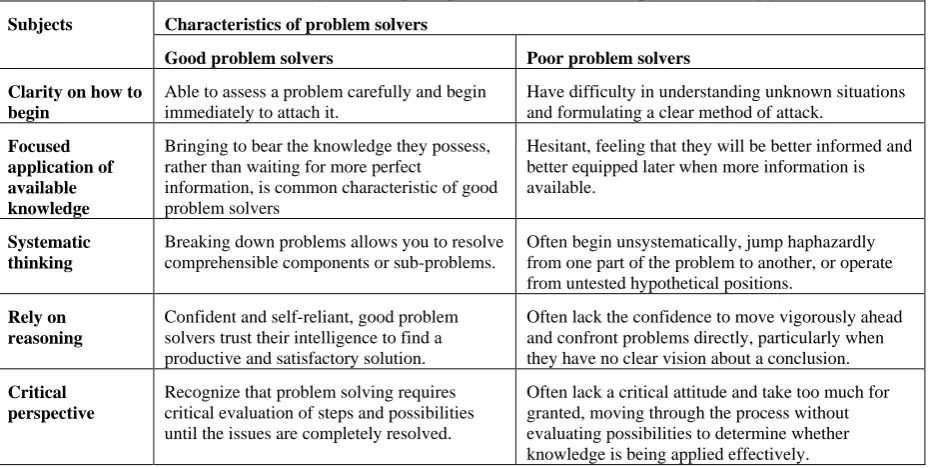
To be successful thinker requires both factual accuracy and facility in dealing with facts we possess: proficiency in thinking. Good problem solvers share a number of characteristics. These characteristics are summarized in Table 1 based on Ruggiero’s “Art of Thinking: A Guide to critical and Creative Thought” (Ruggiero, 1998):
Table 1. Differences between good and poor problem solvers (Adapted from Ruggiero, 1998)
Subjects Characteristics of problem solvers
Good problem solvers Poor problem solvers
Clarity on how to begin
Able to assess a problem carefully and begin immediately to attach it.
Have difficulty in understanding unknown situations and formulating a clear method of attack.
Focused application of available knowledge
Bringing to bear the knowledge they possess, rather than waiting for more perfect
information, is common characteristic of good problem solvers
Hesitant, feeling that they will be better informed and better equipped later when more information is available.
Systematic thinking
Breaking down problems allows you to resolve comprehensible components or sub-problems.
Often begin unsystematically, jump haphazardly from one part of the problem to another, or operate from untested hypothetical positions.
Rely on reasoning
Confident and self-reliant, good problem solvers trust their intelligence to find a productive and satisfactory solution.
Often lack the confidence to move vigorously ahead and confront problems directly, particularly when they have no clear vision about a conclusion.
Critical perspective
Recognize that problem solving requires critical evaluation of steps and possibilities until the issues are completely resolved.
Page 551
Critical thinking takes a special place in Michael Murphy’s publication “Landscape architecture theory: An evolving body of thought”. According to Murphy, critical thinking in landscape architecture is even more important than creative thinking. This is because we need to be sure that we are applying ourselves to the right, or at least the most important, problems. Critical thinkers are independent thinkers- skeptical of universal truths, simple answers and quick-fix solutions. One of the most common ways of describing design is to frame it as a problem-solving process. Designers are, among other things, problem solvers (Murphy, 2005).
Critical thinking is important because through it we develop an awareness of the assumptions we make to guide thoughts and actions and as a consequence, understand the context in which thoughts and actions are developed. Through critical awareness we examine ideas and decide for ourselves whether to accept or reject them. For critical thinkers, ideas are accepted not because they are acceptable to others, but because they are found to be congruent with the reality in which they exist (Brookfield 1987).
4.3 SYSTEMS THINKING IN LANDSCAPE ARCHITECTURE
System thinking is seeing the world as a web of interdependence that is in continuing evolution. We live in the midst of an extraordinary interdependence and it is very important to have the consciousness to appreciate it. According to Peter Senge, author of “The fifth discipline”, “Systems thinking – promotes the understanding that business and human life are systems, where single components affect the other elements of the set.” Too many people focus on “snapshots of isolated parts” and, in effect, don’t see the forest for the trees. Systems’ thinking is a relatively new scientific term for a very old idea. It is becoming more and more important because the modern society has reached a level of development where the actions made in on part of the planet may have direct effects in other parts also and the side effects accumulated for long time are becoming more and more evident.
According to Motloch (2001) systems are defined as “wholes” consisting of entities and relationships that function through the interrelatedness of their parts. Ackoff (1981) characterizes systems relationships as follows:
The behavior of each element of the system has an effect on the behavior of the whole. The behavior of the system elements and their effect on the whole are interdependent.
The elements of the system are so interconnected that independent subgroups of them cannot be formed.
Michael Murphy (2005) in his book “Landscape architecture theory” describes the difference between the mechanistic view of Descartes and Newton and the nowadays holistic view: “The parts of naturalistic systems are much more complex since each part contributes to its individual well-being as well as to function in concert with all others to influence the overall well-being of the system as a whole.”
Design in landscape architecture is an application oriented learning process (Murphy M, 2005). In order to be able to design effectively we should know what is desired in the future and what existing conditions should be changed by design. There are seven principles of systemic learning (Hutchins 1996):
1) Learning is driven by a search to explain the discrepancy between past knowledge and present or anticipated experience.
2) Learning is the active reconstruction of past knowledge and skills to integrate new information or behavior at a higher level of complexity.
Page 552
4) Learning requires feedback and comparison against an internalized standard or an accepted external standard.
5) Learning requires integration and automaticity, which are dependent on motivation and persistence.
6) Learning is both a single-looped and doubled-looped process (cognitive and metacognitive). 7) Learning is product and process. Product and process is the same thing, only seen from different
vantage points.
These principles fit very well with the process of landscape design. Design should be conceived as an application oriented-learning process. If we begin with the concept that we must know what is desired in the future and what conditions exist that require design change, it should be apparent that we need to learn these things in order to be able to design effectively. From a systems approach, design problems are best understood as a set of interdependent problems that are definable only by their specific interactions (Ackoff 1981). Based on the preposition that design requires learning, Murphy, (2005) defines three principles of design process when approached from a systems learning perspective:
1. Design is a learning process: change must be informed by reliable knowledge if it is to bring about predictable improvement within a complex system
2. Learning is a design process: it structures purposeful change in what we know and how we understand and relate to the world.
3. What must be known to design well must be learned: because the world is changing rapidly, we must learn continuously to be able to inform change in ways that result in the improvement required for design success.
Murphy continues: “In design it is always the relationship rather than the parts that are most important. The world is filled with examples of landscapes, tools, machines, buildings, and towns that are well designed, in comparison with others that are not. The examples in both categories may contain precisely the same type and number of parts. Having all the right parts does not equate to having a good design. They must be placed in harmonious relationship with one another.”
The deep understanding of systems relationship is fundamental to design. This importance is expressed by John Motloch (Motloch, 2001):
“For landscape management, planning, and design to effectively integrate diverse systems, landscape designers must be systems thinkers (thinking integratively and with cognizance of systems dynamics). They must be committed to landscape management, planning, and design that optimize the health and productivity of diverse physical, ecological and human systems. Landscape designers must inspire to manage, plan and design people-environment relationships and human interventions that promote landscapes of high relevance and deep meaning that are sustainable (address today’s needs while sustaining the ability to address the needs of the future) and regenerative (function to regenerate system capacity).”
Page 553 5. CONCLUSIONS
While structural changes of higher education system in Albania were radical, we cannot say the same for the process and content of teaching and learning. The influences of the old education system, which was focused in transmitting knowledge and building a storehouse of information in the students’ brain, are still evident. Some of the problems of higher education in Albania are: lack of inspiration for students to deal with ideas and information to construct their own understanding and lack of sustained influence on the way they think, act, and feel; teaching objectives often are arbitrarily tied to the course and they do not represent the kind of thinking and acting expected for life; lack of a “natural critical learning environment”, an environment where students learn by confronting problems or tasks that will challenge them to face ideas, rethink their assumptions, and examine their mental model of reality. It is time to directly address the above mentioned problems and focus more energies and resources in designing and supporting a more effective learning environment. This is especially important for landscape architecture which is a complex, contextual, and interdisciplinary profession. The success of the new generation of landscape architects will be very much dependent on the development and consolidation of creative, critical, and systems thinking.
REFERENCES
Ackoff, R. L. (1981). Creating the corporate future. New York: John Willy & Sons.
Alhasani D. M. (2015) Educational Turning Point in Albania: No More Mechanic Parrots but Critical Thinkers. Journal of Educational Issues. Vol. 1, No. 2; 117-128.
Arons, A. (1990) A guide to introductory physics teaching. New York: John Wiley & Sons. Bain K. (2004) What the Best College Teachers Do? London, England: Harvard University Press. Britton, J (2005) Intersecting Self-Reflection and Skill Development In Landscape Architecture Pedagogy. Landscape Research Record. 1: 45-54.
Brookfield, S. D. (1987). Developing critical thinkers. San Francisco: Jossey-Bass.
Burnham, C. C. (1989). The Perry Scheme and the Teaching of Writing. Rhetoric Review 4: 152-58. Carson, R. (1962). Silent Spring. USA: Houghton Mifflin Harcourt.
De Bono, E. (1994). Parallel thinking. London: Penguin.
Dennis, Jr. S. F., Gaulocher, S., Carpiano, R, Brown, D. (2009). “Participatory photo mapping (PPM): Exploring an integrated method for health and place research with young people.” Health and Place. 15: 466-473.
Duro, Ç (2015). The History of Higher Education in Albania University of Tirana (1957-1960). Mediterranean Journal of Social Sciences. Vol 6 No 5 S2: 663-673.
Ferguson M. (1980). The Aquarian Conspiracy. Los Angeles: J. P. Tarcher.
Flavell, J. H. (1979). Metacognition and cognitive monitoring: A new area of cognitive-developmental
inquiry. American Psychologist, 34, 906-911.
Flavell, J. H. (1987). Speculations about the nature and development of metacognition. In F. E. Weinert & R. H. Kluwe (Eds.), Metacognition, Motivation and Understanding (pp. 21-29). Hillside, New Jersey: Lawrence Erlbaum Associates.
Flavell, J. H. (1987). Speculation about the nature and development of metacognition. In F. Weinert & R. Kluwe (Eds.), Metacognition, motivation, and understanding (pp.21 - 29). Hillsdale, NJ: Lawrence Erlbaum.
Page 554
Fors, H., Molin, J. F, Murphy, M. A, van den Bosch, C. K. (2015). User participation in urban green spaces–for the people or the parks? Urban Forestry & Urban Greening. Available: https://www.researchgate.net/publication/277350395_User_participation_in_urban_green_spaces_-_For_the_people_or_the_parks [Accessed: 15 April 2016].
Gallagher A. Sh. (1998). The Road to Critical Thinking: The Perry Scheme and Meaningful Differentiation. NASSP Bulletin. 82, no 595: 12-20
Gazvoda, D, (2002). Characteristics of modern landscape architecture and its education. Landscape and Urban Planning. 60: 117–133
Gerhard, D. (1992). “Interview with Garret Eckbo.” Re-alignment. Cambridge, MA: Harvard University Press.
Grossman, R. W. (2005). Discovering hidden transformations: Making science and other courses more learnable. College Teaching. 53 (1), 33–40
Hake, R. R. (2004). The Arons Advocated Method. Indiana University Bloomington. Available at: www.physics.indiana.edu/~hake/AronsAdvMeth-8.pdf [Accessed: 28 February 2016]
Horlings H. (2010) Creativity in landscape architecture. Landscape Legacy, Maastricht 2010. Available: https://www.thecela.org/pdfs/cela-conf-2009-10-abstracts.pdf [Accessed 28 March 2016] Kajsiu, B. (2015). Higher Education in Albania: The Never Ending Challenge. International higher education. 82: 15-16
Katro, E. (2015). An Analysis of Recent Changes in Higher Education and Research in Albania. Academic Journal of Interdisciplinary Studies, Vol 4 No 2 S2: 46-51.
Kloss, R. J. (1994). A Nudge Is Best: Helping Students Through the Perry Scheme of Intellectual Development." College Teaching 42(1994): 151-58.
Kvashny, A. (1982). Enhancing Creativity in Landscape Architectural Education. Landscape Journal. Vol. 1, No. 2: 104-112.
Leopold, A. (1949). A Sand County Almanac. USA: Oxford University Press.
Lyle, J. T. (1985). The alternating current of design process. Landscape Journal. 4: 1. Madison: Univ. of Wisconsin Press.
McHarg I. (1969). Design with nature. 1-st ed. USA: John Willy & Sons.
McHarg I. (1996) A Quest for Life: An Autobiography. New York: John Willy & Sons.
Mehmeti, E (2015). The New Higher Education Reform and Higher Education Law in the “Social Dimension” Perspective: The Albanian Case. Academic Journal of Interdisciplinary Studies, Vol 4 No 2 S2: 284-287.
Motloch, L. J. (2001). Introduction to Landscape design. 2nd ed. New York: John Willy & Sons. Murphy, M (2005). Landscape Architecture Theory: An Evolving Body of Thought. Long Grove, Illinois: Waveland Press.
Perry, P. W. (1999) Forms of ethical and intellectual development in the college years: A scheme. USA: John Willy & Sons.
Ruggiero, V. R. (1998). The art of thinking: A guide to critical and creative thought. 5th ed. New York: Adison Wesley Longman.
Senge, P. (1994) The Fifth Discipline Field book: Strategies and Tools for Building a Learning Organization. New York: Crown Publishing Group.
Page 555
Thoma, G. A. (1993). The Perry Framework and Tactics for Teaching Critical Thinking in Economics. Journal of Economic Education 24: 128-36.