Page 16
STUDENT PERCEPTIONS OF THE IMPORTANCE AND ASSESSMENT OF CONCEPTS AND COMPETENCIES FOR THE 21ST CENTURY
Jon Lyons
American University in Bulgaria, Bulgaria
Abstract
The role of Higher Education is changing, as world economies develop rapidly. This has been identified as a Fourth Industrial Revolution by the World Economic Forum (WEF). In the United Sates (US) and United Kingdom (UK) universities and employees recognize the urgent need for a review of the skills and competencies which are taught to students. In the US, university representatives such as the American Association of Colleges and Universities (AACU) have recognized the need to develop the teaching and assessment of learning outcomes which students are taught. In the UK, employer representatives such as the Confederation of British Industry (CBI) have also identified a need for skills development. The aim of this is to prepare students for the workplace and civil society.
The purpose of this paper is to bring together the resources available from a variety of sources such as the Lumina Foundation, which consider how best to develop student learning outcomes. The resources are from the US and the UK and from a variety of perspectives such as academic writers, government departments and employee representative bodies. These are considered from the perspective of students, university staff and employees. The discussion puts forward a case that all disciplines at all universities need to work together to achieve success in preparing students for the new economy by raising the profile and assessment of skills and competencies.
A starting point for such an ambition project is a small scale survey at an American University in South East Europe. The paper reports upon a survey of students and their perspectives of the skills highlighted by the Lumina Foundation, and the manner in which they are assessed.
Keywords: skills, competencies, employers, liberal arts
1. INTRODUCTION
Page 17
However, there is no reason why both objectives, preparation for the workplace and for a life in a civil society, cannot be achieved throughout all forms of higher education, including both liberal arts and vocational. Some higher education institutions, including those of the liberal arts tradition, are in crisis, ([11] Docking and Curton, 2015) and admissions are falling. This could be because preparation for a career is why students want to study ([12] Bok, 2006). As ([11] Docking and Curton, 2015) contend: “students perceive that the employers in the “real world” want hard skills and pre-professional training, but they and their parents believe that a liberal arts degree is filled with esoteric classes that teach no hard skills.”
However, the nature of the world of work is changing significantly in an age of technical transformation ([13] WEF, 2016). They state:
“We stand on the brink of a technological revolution that will fundamentally alter the way we live, work, and relate to one another. In its scale, scope, and complexity, the transformation will be unlike anything humankind has experienced before.”
Many organizations which represent employers are expressing concerns that graduates lack the skills required for employment. This paper puts forward a case that there is an opportunity for all universities to prepare students for the new economy as identified by several employer representative groups. This will be achieved by examining students’ perception of the need to develop and be assessed on such skills for the new world economy
This paper brings together some of the several strands of literature regarding the future development of skills at university. There are several groups of stakeholders, and thus several literature sources; academic papers, reports and internet comment from representative bodies, the press and books. From such a plethora of resources this paper will tease out some of the key themes which the stakeholders need to address, and how the stakeholders might seek to prepare students for the new digital economy. The following sections commence with a literature review which focuses upon three groups of key stakeholders; students, university employees including faculty and support, and employers. This is followed by an introduction to some of the literature which identifies of the concepts and competences which employers perceive that graduates will require for the new economy and an assessment of such skills which will provide evidence of competence. There is a description of the survey and results. Finally, the discussion identifies possible methods, drawn from the literature for developing student competencies. The main research question is; do students perceive the development of skills for the new world economy to be important?
2. LITERATURE REVIEW
At a time of a crisis and expansion in university education ([4] Holmes and Mayhew, 2016) there are several groups of interested parties whose views need to be considered.
Students; and their sponsors, be it family or governments, who fund the higher education system; Faculty who teach students not only subject specific skills or concepts in their disciplines, but also
other metacognitive skills or competencies, which prepare them for the world of work and as citizens.
Employers who identify current and future skills and competencies needed by graduates for future employment ([14] Zimmer, 2014)
2.1 Student Perception of Skills
Page 18
the development of broader knowledge, and sometimes this might conflict with the need to develop subject specific knowledge ([15] Gerstein and Friedman, 2016).
Some universities take a general approach to skills development and teach non-subject specific “skills courses”, ([16] Wingate, 2006) names these “bolt-on” courses. Such courses do not relate specifically to the discipline being studied, and there appears to be a tendency for students to study such courses and not relate the skills being taught to their own disciplines. There is also a huge range of Study Skills publications and web sites for students to access which cover the wide range of skills necessary for higher education. Examples include The Study Skills Handbook ([16] Cottrell, 2014). In the UK some universities have introduced “Personal Development Plans” (PDPs), for students to track their own development. They achieved a mixed success rate. In an extensive review of PDPs ([17] McKenna et al., 2017) reported that “Making PDP more interesting and appealing for students to engage with was considered as important by students for improving support for PDP.” However, they also reported that some students:
“thought if PDP was introduced in to the curricula it could help the students to gain employment. However, many students also viewed PDP as a waste of their time, but if the PDP was integrated in to class activities then it could form an intermediary stage leading to continual reflection on learning and development.” ([17] McKenna et al., 2017)
It was also reported that improving links between the academic curriculum, the PDP and employability makes it more relevant to students studying at university. As the CBI highlight when discussing students’ opinions of skills development:
“there are plenty of opportunities to develop the necessary attitudes and aptitudes during their time in education, but students need to be alerted to their importance and encouraged to seize them.” ([8] CBI/Pearson, 2016)
Faculty staff need to emphasize to students that employers seek to employ students with such skills. However, many students appear to over rate their level of skills, for example, in a report sponsored is the US by the AAUA, it was reported that:
“College students are notably out of sync with employers in their perception of their preparedness on a wide range of skills and knowledge areas. Students express much greater confidence in their level of preparedness on all areas than employers indicate they see demonstrated.” ([6] Hart Research Associates, 2015)
However, the AAUA (Hart Research Associates, 2013) comment that a recent survey of 318 employers showed an explicit understanding that a liberal arts education provides students with the broad knowledge base and demonstrated an ability to think critically as well as to solve the complex problems that they encounter in the workplace.
In the UK, it has been reported that:
“students become progressively more positive about their development of those skills traditionally held central to higher education: thinking critically, speaking and writing effectively, quantitative analysis, developing employability skills and the ability to learn independently.” ([7] Buckley, 2015)
The report also indicated that students could distinguish between different types of skills; those that were focused on values and emotional intelligence, and those that were seen as more academic, such as speaking and writing coherently. Or as Buckley defines them “soft” and “hard” skills. There was also a difference in the perception of such skills in difference disciplines, with science, technology, engineering and mathematics (STEM) students viewing hard skills as significantly more important that soft skills, but arts and humanities students perceiving soft skills to be more important. This perhaps emphasizes the need to explicitly promote the development of both types of skills.
Page 19
financial debts ([18] Baum and Schwartz, 2006), which they need to repay. This can understandably lead to students studying for more vocational degrees which could lead to higher paid jobs ([19] Tobin, 2015). There is also a perception that courses need to be passed to accelerate the procedure, so the amount borrowed can be reduced, and repaid quicker. This can lead to a disconnect between general education courses and key subject specific courses.
2.2 Faculty
The importance of teaching and support staff in the development of skills cannot be over emphasized. There are several challenges which universities face to persuade experts in academic disciplines of the importance of developing student knowledge of concepts and competencies, as well as subject specific knowledge.
There is a problem for teaching staff who wish to develop soft skills alongside subject knowledge. Bok (2006) writes “even when professors make room for skills in the curriculum, they are often reluctant to teach the subject themselves” ([12] Bok, 2006). This can result in many skills courses being taught by post graduate students and part-time staff.
Several US studies ([10] Arum et al., 2016) report on several subject disciplines and conclude that university teachers have identified key concepts and competencies. Concepts being “what students know and understand” and competencies being “what students are able to do”. Arum et al expand that “the essential concepts that faculty have articulated aim to capture theoretical understandings and ways of thinking” and that competencies, are ways of practicing the discipline, or the skills necessary to engage effectively in the discipline. Such skills enable the student in the world outside university to practice the concepts they have learnt, or, the soft skills required to implement the hard skills. Whilst different disciplines have different key concepts many require similar competencies. However there has been a conflict identified ([20] Becher and Trowler, 2001), between the teaching of a discipline, and the need to also develop skills, as some academics do not perceive the skills to be as important as the detail of the discipline.
Key competencies have been identified for six different subject groups, including History, Sociology, Economics, Communication, Biology and Business Studies ([10] Arum et al., 2016). Business Studies has been chosen as an example, as many academic disciplines, such as accounting, economics and psychology contribute to it. Business is also an area which is being affected by rapid changes in technology. The key skills needed in business studies identified were identified in discussion with faculty, as well as previous efforts to identify such skills, such as the Association to Advance Collegiate Schools of Business (AACSB), as they state:
“We saw our charge as developing our conception of business excellence by articulation an explicit and structured set of learning outcomes essential to the study of business.” ([21] AASCB International, 2018).
The essential skills identified by the AASCB are: “Written and oral communication
Ethical understanding and reasoning Analytical thinking
Information Technology
Interpersonal relations and teamwork Diverse and multicultural work environments Reflective thinking
Application of knowledge” ([21] AASCB International, 2018)
Page 20
evidence of what they have learned. However, it could be said that it is easier to assess knowledge of concepts than it is to assess competencies. Therefore, faculty need to be aware of methods to assess competencies as well as core knowledge.
A recently survey commissioned by the AAUA ([6] Hart Research Associates, 2015) examined trends in general education design and learning outcomes. The study found methods of evidencing knowledge of concepts and development of competencies in some but not all institutions. An example of this included integrated learning projects which went across courses and E-portfolios, which employees prefer for evaluating candidates.
General education is a core component of the liberal arts tradition of higher education, the Hart report indicated three developments required in the institutions surveyed; redesign; clarity of learning outcomes and content. Redesign of courses was a high priority for the respondents, with “more emphasis on integration of knowledge and skills and their application in the general education program” ([6] Hart Research Associates, 2015). This can be assisted by clearer learning outcomes as a way of assessing student achievement. The placement in the degree of general education courses in the curriculum is also important with the majority of universities surveyed distributing such courses throughout the degree program. In the US a minority on institutions included engagement in real world learning as part of assessment procedure. Employers perceived real world learning as a positive aspect of higher education There is also a need for university teaching staff to identify and clearly assess learning outcomes, which need to be explicit for every assignment. Outcomes need to be mapped through a degree program to ensure there are no gaps or overlaps. However, the question needs to be asked, to whom do these tasks fall? Perhaps universities need to actively encourage staff development to raise awareness of the need for teaching staff in all disciplines to develop ways of assessing not only disciplinary concepts, but also relevant skills of competencies which are in demand by employers. Such development could include the use of clear rubrics ([22] Brookhart, 2013), to assist student learning.
2.3 Employers
Reports in the UK ([8] CBI/Pearson, 2016) and the US ([6] Hart Research Associates, 2015) have emphasized the need to develop student skills for the current and future work place. The World Economic Forum is a representative body of the world’s leading 1000 companies which produced “The Future of Jobs” ([13] WEF, 2016) which predicts “disruptive changes to business models which will have a profound impact on the employment landscape over the coming years” Such changes will need to be managed by a skilled workforce, with requisite skills and competencies to deal with them. The WEF claim that the current skills with which graduates are equipped with urgently need to be developed to deal with the predicted disruption or development of the workplace. New skills will need to be developed to ensure future employability of graduates, and such skills will need to be constantly developed over a lifetime. The WEF predict that new skills, such as “persuasion, emotional intelligence and teaching others will be in higher demand than narrow technical skills”. They conclude “In essence, technical skills will need to be supplemented with strong social and collaborative skills.” However, in order to achieve this, higher education also needs to develop. The WEF is critical of what they regard as a dichotomy between ‘humanities and sciences and applied and pure training”. They go further and criticize higher education, they state: “Most education systems at all levels provide highly siloed training and continue a number of 20th century practices that are hindering progress on today’s talent and labor market issues.” ([13] WEF, 2016).
A report commissioned by the AAUA ([6] Hart Research Associates, 2015) surveyed 400 employers who employed a minimum of 25% of students with a degree. They also surveyed 613 college students. The purpose of the survey was:
“to understand which learning outcomes employers believe are the most important to acquire to be able to succeed in today’s economy, how prepared they believe recent college graduates are in these areas.” ([6] Hart Research Associates, 2015).
Page 21
which include written and oral communication skills, teamwork, ethical decision making, critical thinking and to be able to apply knowledge in a real-world situation. To become competent in such skills, employers believed that college students needed a broad education with “both field-specific knowledge and skills and a broad range skills and knowledge that apply to a variety of fields.” ([6] Hart Research Associates, 2015). Employees also emphasized a need for graduates to be able to demonstrate a proficiency in such skills, and feel that this could be better achieved by engaging students in applied learning projects. This could be achieved by students presenting an electronic portfolio “summarizing and demonstrating the individual’s accomplishments in key skills and knowledge areas, in addition to a resume and college transcript.” This is similar to the E-portfolios or PDP reported upon by McKenna and Baxter (2017).
On a positive note, when discussing current hiring practices of employers, ([23] Stross, 2017) promotes a liberal arts education, and associated soft skills, he writes:
“This book seeks to persuade employers to take another look at their hiring practices by reminding them that there is no less need today than before for graduates who have demonstrated an omnivorous hunger for knowledge, who have honed communication skills who can justifiably claim that their course work has helped them to learn how to think.” ([23] Stross, 2017).
Stross interviewed several Stanford University graduates who were in employment, about the benefits of a liberal arts education. He concludes that such graduates have similar characteristic, including, as he puts it “an appetite for intellectual challenge, the defiant rejection of the easiest paths, the capacity to work hard, the drive to reach higher.” The liberal arts model of higher education does have a future but there needs to be a major re-examining of the core purpose of general education, and how it interacts with development on the knowledge of key concepts of the disciplines being studied.
2.4 Current developments in the assessment of skills and competencies
The Lumina Foundation is “an independent, private foundation committed to increasing the proportion of Americans with high quality degrees” ([24] Lumina Foundation, 2014). In order to achieve this, it has published “The Degree Qualifications Profile” (DQP), which highlights the need to develop soft skills and states “Employers continually lament the lack of specialized technical expertise, but also vital “soft skills” such as critical thinking, communication and teamwork.”
The Lumina Foundation provides a framework for ensuring concepts and competencies are taught within undergraduate degrees. These are:
“Analytic inquiry: The ability to recognize, describe and solve problems through differentiation, categorization and other relevant tools of inquiry and reasoning.”
“Use of information resources: The ability to Locate, evaluate, incorporate and properly cite multiple information resources in different media or languages in projects, papers or
performances and to Generate information through independent or collaborative inquiry and use that information in an assignment.”
“Engaging diverse perspectives: To be able to construct and written project, laboratory report, exhibit, performance or community service design expressing an alternate cultural, political or technological vision and explain how this differs from cultural realities.”
“Ethical reasoning: to be able to analyze and resolve of issues involving conflict in cultural, professional, occupational codes of conduct.”
“Quantitative fluency: The adept use of calculation and symbolic operations, including essential arithmetical skills, visualization, symbolic translation, and algorithms.”
Page 22
“Applied and collaborative learning: The ability to proficiently demonstrate what I can do with what they know by addressing existing problems.”
“Specialized knowledge: The proficiency that demonstrates a command of the vocabularies, theories and skills of the field of study.” ([24] Lumina Foundation, 2014)
One of the best methods of assessing if students have achieved specific learning outcomes is by assignment. This enables students to prove that they are competent in specific tasks. For example, effective communication can be tested through presentations, whether oral of written. This provides evidence of student learning both concepts and competences.
Several issues need to be considered which might influence the way in which all universities, are developing higher education to meet the needs of future employers and society at large. These include: subject discipline and key concepts, and assessment of key skills and competencies. Student and staff attitude to syllabus and assessment development, and how this is best achieved. As Gerstein and Friedman observe:
“The perceived purpose of college education keeps shifting. There was a time that its purpose was seen as teaching ethics/moral/values to students. Today the focus is on delivering skills and competencies to succeed in life.” ([15] Gerstein and Friedman, 2016).
Whilst this observation may apply to all disciplines, perhaps it applies more to some than to others. Those who argue for a vocational education may perceive the purpose of a college education as preparation for the workplace, while those who support a more liberal arts orientation may perceive the purpose to be a preparation for life. However perhaps to prepare for the modern economy, there is less of a divergence in the purpose and both objectives can be achieved.
From a more general perspective ([25] Gaston, 2015) writes for the AACU about transforming general education. The concept of general education as is “to help college students gain the knowledge and collaborative capacities the need to navigate in a complex world”. There are gaps between current practice and what is required to meet current environmental challenge. To move forward as Gaston argues: “those pursuing general education reform must recognize and evaluate impediments to moving from evident reality to urgently needed reforms.” Such impediments need to be identified and method developed to overcome them, so that employers can employ graduates who have the necessary concepts and competencies for the modern work environment.
3. METHODOLOGY
Page 23 4. SURVEY FINDINGS
The first question asked the respondents standing, that is their year of study. This was evenly distributed through the survey.
Table 1. Respondents First Year 25.22%
Sophomore 25.22% Junior 25.66%
Senior 23.89%
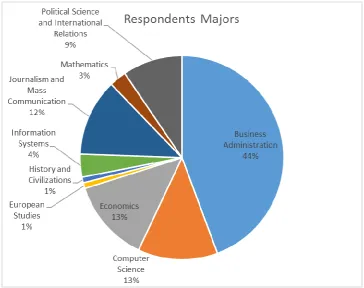
The second question asked what was the primary major that the respondents were studying. This is illustrated in Figure 1.
Figure 1. Primary Major of Respondents
Page 24
Figure 2. Importance of Skills
The results indicate that all the skills were considered to be important, with the minimum responses of “agree” or “strongly agree” being 61% for Quantitative Fluency. The highest being 91% for communicative fluency. Subject discipline was also perceived as being very important with just under 90% responding agree or strongly agree. These findings indicate that the sample considered all the skills as being important. Figure 3 illustrates the manner in which students perceived the way in which the skills were assessed.
Figure 3. Assessment Preferences
Page 25
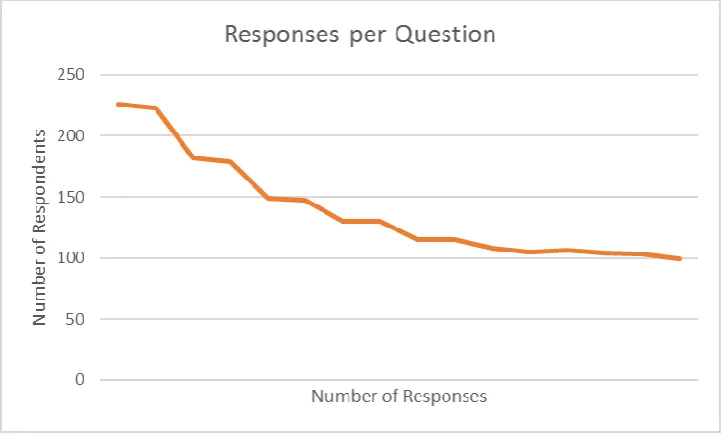
There were also some unsought for, but, interesting findings these included; Figure 4 illustrates a big drop off in response rate as the respondents worked through the survey. There was also an indication of the popularity, or otherwise, of certain types of assessment such as the lack of popularity of exams, and popularity of presentations.
Figure 4. Responses per question
5. DISCUSSION
As the research was primarily exploratory it was limited due to the convenience sample. Smith observes: “Random sampling is usually not practicable, so convenience samples predominate. Such criticisms apply to accounting research generally and make the application of standard statistical testing fraught with danger” ([26] Smith, 2011)
The falloff in responses was worrying. This could be due to poor research design, the on-line method used, or speculatively, decreasing attention spans.
There should be a more integrated approach to the development of skills for the new world economy, which includes all stakeholders; students, teaching staff; both part and full time, teaching staff and employers. As in any change management scenario, potential blockers to progress should be identified early. Possible methods of developing skills are competences include:
●
Raise the importance of the need to develop skills and competences and sell the idea to teaching staff and provide training, on or off site.●
Raise the profile of competencies to students, referring to key reports from employer organizations, such as the CBI and the WEF.●
If necessary, review current programs and assessment by assignments of both skills and competencies.●
Provide examples of how teaching staff can assess skills through assignments and link assignment both vertically and horizontally between courses.Page 26
Further studies could identify different perceptions of hard or soft skills in relation to the subject discipline, another interesting field of study might be to see how perception of skills develops as students progress through university.
All universities, including those providing vocational education need to work in tandem with employees and their representatives to ensure that the future workforce is prepared for a rapidly changing society and consequently workplace.
REFERENCES
1. McCowan, T. (2016) Universities and the post-2015 development agendas: an analytical framework. Higher Education. 72505–523.
2. Graham, G. (2002) Universities The Recovery of an Idea. Thorverston: Imprint Academic.
3. Department for Education and Skills (2003) The Future of Higher education [online]. Available from:
http://webarchive.nationalarchives.gov.uk/20040117000548/http://www.dfes.gov.uk/highereducati on/hestrategy/ (Accessed 28 November 2017).
4. Holmes, C. & Mayhew, K. (2016) The economics of higher education. Oxford Review of Economic Policy. [Online] 32 (4), 475–496.
5. Hart Research Associates (2015) Falling Short? College Learning and Career Success.
6. Buckley, A. (2015) Student Perception of Skills Development. [online]. Available from: https://www.heacademy.ac.uk/system/files/ukes_2015.pdf.(Accessed 28 November 2017). 7. CBI/Pearson (2016) The right combination: CBI/Pearson education and skills survey. [online].
Available from: education-and-skills-survey2016.pdf. p.52. [online]. Available from: http://www.cbi.org.uk/cbi-prod/assets/File/pdf/cbi-education-and-skills-survey2016.pdf. (Accessed 31 March 2018)
8. Leitch (2006) Prosperity for all in the global economy - world class skills: final report [online]. Available from: https://www.gov.uk/government/organisations/leitch-review-of-skills (Accessed 31 March 2018).
9. Arum, R. et al. (2016) Improving Quality in American Higher Education. San Fransisco: Jossey Bass.
10. Docking, J. R. & Curton, C. C. (2015) Crisis in Higher Education: A Plan to Save Small Liberal Arts Colleges in America. Transformations in Higher Education. [Place of publication not identified]: Michigan State University Press. [online]. Available from: http://search.ebscohost.com/login.aspx?direct=true&db=e000xww&AN=1042444&site=ehost-live. (Accessed 31 March 2018)
11. Bok, D. (2006) Our Underachieving Colleges. Vol. 1. Princetown University Press.
12. WEF (2016) The Fourth Industrial Revolution: what it means and how to respond [online]. Available from: https://www.weforum.org/agenda/2016/01/the-fourth-industrial-revolution-what-it-means-and-how-to-respond/ (Accessed 17 November 2017).
13. Zimmer, T. (2014) Are Recent Grads Prepared for the Workplace? [online]. Available from: https://www.forbes.com/sites/ccap/2014/08/06/are-recent-grads-prepared-for-the-workplace/ (Accessed 12 November 2017).
14. Gerstein, M. & Friedman, H. H. (2016) Rethinking Higher Education: Focusing on Skills and Competencies. Psychosocial Issues in Human Resource Management. 4 (2), 104–121.
15. Wingate, U. (2006) Doing away with ‘study skills’. Teaching in higher education. 11 (4), 457–469.
Page 27
17. McKenna, G. et al. (2017) E-portfolios and personal development: a higher educational perspective. Journal of Applied Research in Higher Education. [Online] 9 (1), 147–171.
18. Baum, S. & Schwartz, S. (2006) How Much Debt Is Too Much? Defining Benchmarks for Manageable Student Debt. College Board.
19. Tobin, L. (2015) Love or money? High tuition fees lead students to vocational degrees. The
Guardian. 4 August. [online]. Available from:
http://www.theguardian.com/education/2015/aug/04/love-money-tuition-fees-student-vocational-degrees-jobs-university-business (Accessed 28 November 2017).
20. Becher, T. & Trowler, P. R. (2001) Academic Tribes and Territories. 2nd edition. The Society for Research into Higher Education.
21. AASCB International (2018) Eligibility Procedures and Accreditation Standards for Business Accreditation. [online]. Available from: http://www.aacsb.edu/-/media/aacsb/docs/accreditation/standards/business-accreditation-2017-update.ashx?la=en
(Accessed 22 March 2018). p.60. [online]
22. Brookhart, S. M. (2013) How to create and use rubrics for formative assessment and grading. Ascd. 23. Stross, R. (2017) A Practical Education. Stanford: Redwood Press.
24. Lumina Foundation. (2014). The Degree Qualifications Profile. Lumina Foundation. Retrieved from https://www.luminafoundation.org/files/resources/dqp.pdf (Accessed 1 March 2018).
25. Gaston, P. (2015). General Education Transformed. How We Can, Why WE Must. Washington: AACU.