ORIGINAL ARTICLE
IJPHY
ABSTRACT
Background: Many therapeutic uses for Pulsed magnetic fields have been extensively studied. Beneficial effects on the musculoskeletal system were established including bone healing, pain relief, and inflammatory conditions. The study aimed at investigating the possible effects of the pulsed magnetic field on quadriceps muscle torque, hamstring muscle torque and knee proprioception accuracy in athletic subjects.
Methods: A randomized controlled trial which was carried out at the Faculty of Medical Rehabilitation Sciences, Taibah University, Saudi Arabia. Thirty healthy male athletic subjects, aging from 18 – 24 years were divided into two groups, study group (15 subjects) & control group (15 subjects). The pulsed magnetic field was applied for subjects of inter-vention group, while control group participants received sham pulsed magnetic field for 12 sessions over a period of 4 weeks. Quadriceps muscle torque, hamstring muscle torque & knee proprioception accuracy were measured before & after treatment for all participants using Biodex system 4 pro isokinetic dynamometer.
Results: Multiway ANOVA was carried out to detect any significant differences within and between groups. Statistically significant differences between study and control groups were found after pulsed magnetic field application in quadri-ceps peak torque (at 60 and 120deg/sec) & hamstring peak torque (at 60 and 120deg/sec) and in knee proprioception accuracy (p-value was 0.004, 0.0001, 0.02, 0.03, 0.0001 respectively).
Conclusion: Pulsed magnetic field has beneficial effects on quadriceps muscle peak torque, hamstring muscle peak torque and knee proprioception accuracy in healthy athletic subjects and can be advised as an adjunctive tool in reha-bilitation programs.
Keywords: Pulsed Magnetic Field, Muscle Torque, Knee Proprioception Accuracy.
Received 04th September 2017, revised 14th November 2017, accepted 28th November 2017
www.ijphy.org
10.15621/ijphy/2017/v4i6/163926
CORRESPONDING AUTHOR
Int J Physiother. Vol 4(6), 371-376, December (2017) ISSN: 2348 - 8336
EFFECT OF PULSED MAGNETIC FIELD ON PEAK TORQUE
OF QUADRICEPS/HAMSTRING MUSCLES AND KNEE
PRO-PRIOCEPTION IN ATHLETIC SUBJECTS: A RANDOMIZED
CONTROLLED STUDY
1Dr. Abdullah M. Al-Shenqiti
1Dr. Abdullah M. Al-Shenqiti
INTRODUCTION
Pulsed electromagnetic fields have been extensively used for therapeutic purposes for many years, mainly for their positive effects on bone healing (Vallbona et al, 1999) [1], fibromyalgia (Thomas et al, 2007) [2], and knee osteoar-thritis (Nicolakis et al, 2002) [3]. Pulsed electromagnetic field (PEMF) was documented to have beneficial effects in pain relief, healing of wounds and ulcers and treatment of inflammatory diseases of the musculoskeletal system (Quittan et al, 2004) [4].
The muscle strength has a very important role in every-day life of every human to allow good performance of ac-tivities of daily living such as walking & other acac-tivities (Perry, 1993 and Bohannon 1997) [5,6]. Sufficient muscle strength is very important for every day’s life activities of healthy subjects such as walking & other activities (Perry, 1993) [5]. The importance of muscle strength increases drastically in athletes to help them achieve the best-aimed sport performance. There is a strong relationship between increasing muscle power and improvement of sport per-formance (Wisløff1 et al, 2004) [7]. Therefore, there is an important need for using a reliable and accurate testing tool for the measurement of muscle performance parame-ters to detect individual’s abilities and limitations (Thomp-son et al, 1999) [8].
One of the most accurate measuring tools for testing mus-cle performance parameters is the isokinetic dynamome-try. The use of isokinetic machines in measuring dynamic muscle strength has increased considerably (Lord et al, 1992, Rochcongar et al, 1988, Akima et al, 2001 and West-ing et al, 1988) [9-12]. This increasWest-ing interest in isoki-netic testing as a measure of muscle performance may be attributed partly to that isokinetic dynamometry can give correct and precise data concerning the dynamic nature of muscle contraction & also due to isokinetic measure-ment was proven to be extremely accurate and repeatable (Hislop, 1967 and Ostering 1998) [13,14]. One of the most valuable somatic senses of the nervous system is proprio-ception. Proprioception is a combination of kinesthesia or movement sense which inform the nervous system about rate and direction of movement, and position sense, which determine the orientation of the body parts with respect to another (Grob et al, 2002) [15]. Proprioception it is a key component of active joint stability, because afferent signals indirectly induce and modify the efferent response that al-low the neuromuscular system to keep a balance of stability and mobility. In essence, active joint stability is the
“prod-uct” of the proprioceptive system (Laskowski et al, 1997)
[16]. Proprioception has a role in the maintenance of joint stability and prevention of joint and muscle trauma. Im-provement of proprioception accuracy can be positively reflected on muscle performance in sport.
There is much debate about the impact of magnetic field on neuromuscular system and microcirculation (Malikova et al, 1989, Krylov et al, 1990, Bickford et al, 1987 and Smith et al, 2004) [17-20]. If beneficial effects for the pulsed elec-tromagnetic field (PEMF) on the neuromuscular system can be proved, this may be implemented in training pro-grams that target muscle performance parameters such as muscle strength and endurance. So this controlled trial was conducted to examine the effects of magnetic field on quadriceps muscle torque, hamstring muscle torque and knee proprioception accuracy in athletic subjects.
MATERIALS AND METHODS
A randomized controlled study to examine the possible effects of the pulsed magnetic field on quadriceps muscle torque, hamstring muscle torque and knee proprioception accuracy in athletic subjects. A computer program generated a random list, with each consecutive subject referred to the study assigned to either intervention group or control group according to that list.
Subjects:
Measurement procedures
Quadriceps/hamstring muscle torque & proprioception accuracy of the knee joint were measured before and after treatment by using Biodex isokinetic dynamometer 4 Pro (Biodex Medical Inc, Shirley, NY).
Measuring quadriceps/hamstring torque:
All subjects were tested by using Biodex Isokinetic dyna-mometer at two angular velocities (60 & 120 degrees per second) for the knee extensor/flexor group during isoki-netic contraction (isokiisoki-netic mode) with the subject’s hips slightly reclined posteriorly for about 10 to 15 degrees, and knees flexed 90 degrees. A warm-up through doing two light contractions of extension/flexion at 120 degrees per sec and two medium contractions of extension at 120 de-grees per sec. After warming up, subjects were requested to push their dominant legs forwards using maximal effort against the lever arm for five repetitions of extension/flex-ion at 60 degrees per sec. then a rest period of sixty seconds was given. Another five repetitions of extension/flexion at 120 degrees per sec, with sixty seconds rest.
Knee repositioning accuracy measurement:
Active repositioning test as a measure of proprioception accuracy was assessed for dominant knees of both groups by using the Biodex isokinetic dynamometer 4 Pro. The va-lidity and reliability of this test were documented [21,22]. The anatomical reference angle or the target angle was set at 45°. Each subject was asked to actively move tested leg to target angle (45°), then the leg was fixed by the device for 10 seconds as a teaching process. After that, each subject was requested to actively move the tested leg to the
prede-Treatment procedures:
Pulsed magnetic field device (ASA magnetic field instru-ment, Italy) was used for delivering magnetic field treat-ment. Subjects of the first group (intervention group) received pulsed magnetic field over knee and thigh areas for 12 sessions over a period of 4 weeks (3 sessions/week). Removal of metals or things that can be affected by a mag-netic field was assured prior to magmag-netic field application. Each participant was requested to assume a lying posture on the treatment bed. The device was aligned directly over knee and thigh area. The treatment parameters were set as 15 Hz frequency, 20 gauss amplitude, and 20 minutes as a total treatment duration [24].Subjects of the second group (control group) received sham pulsed magnetic field over knee and thigh areas for 20 minutes.
Statistical Analysis:
Data collected were analyzed by the SPSS version 20.0. Quadriceps muscle peak torque, hamstring muscle peak torque in N.M and the absolute error was calculated and used for statistical analysis. Mixed MANOVA was con-ducted for comparing quadriceps muscle peak torque, hamstring muscle peak torque and repositioning accuracy between before and after magnetic field application within and between groups. The P value was set at ≤ 0.05).
RESULTS
Subject characteristics:
Table 1:Descriptive statistics and t-test for the mean age, weight, and height of study and control groups
Study group Control group
MD t- value value
p-Χ±SD Χ±SD
Age (years) 21.6 ±1.53 22.5 ±1.93 -0.9 -1.63 0.11*
Weight (kg) 72.9 ±8.03 70.7 ±6.39 2.2 0.95 0.34*
Height (cm) 164.55 ±7.09 163.65 ±8.22 0.9 0.37 0.71*
Χ, Mean; SD, standard deviation; MD, Mean difference; p-value, level of significance. *Non-significant
- Comparison between groups:
Knee extensors and flexors peak torque
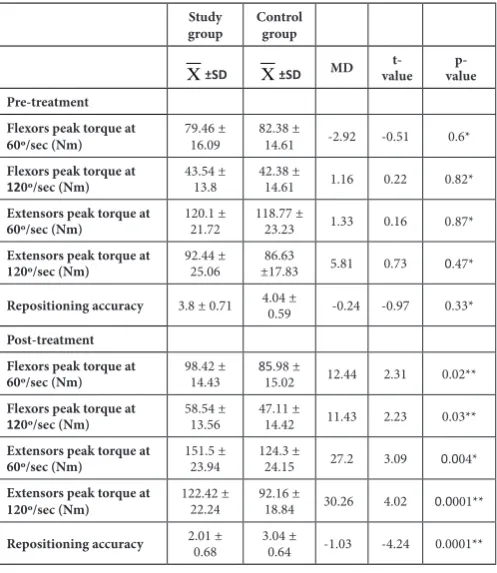
- No significant difference was detected between both groups in Knee extensors and flexors peak torque at 60° and 120°/sec before treatment (p > 0.05). Comparison be-tween both groups after treatment showed a significant increase of quadriceps and hamstring peak torque in the study group compared to control group at both velocities (p < 0.05) (Table 2).
Repositioning accuracy
- No significant difference was detected between both groups in repositioning accuracy before treatment (p > 0.05). After treatment, the comparison between both groups revealed a significant decrease of absolute error in the study group compared to control (p < 0.05) (table 2).
Table 2:Comparison between study and control groups pre and post-treatment:
Study
group Control group
Χ±SD Χ±SD MD valuet- value p-Pre-treatment
Flexors peak torque at
60º/sec (Nm) 79.46 ± 16.09 82.38 ± 14.61 -2.92 -0.51 0.6* Flexors peak torque at
120º/sec (Nm) 43.54 ± 13.8 42.38 ± 14.61 1.16 0.22 0.82* Extensors peak torque at
60º/sec (Nm) 120.1 ± 21.72 118.77 ± 23.23 1.33 0.16 0.87* Extensors peak torque at
120º/sec (Nm) 92.44 ± 25.06 ±17.8386.63 5.81 0.73 0.47*
Repositioning accuracy 3.8 ± 0.71 4.04 ± 0.59 -0.24 -0.97 0.33*
Post-treatment Flexors peak torque at
60º/sec (Nm) 98.42 ± 14.43 8515.02.98 ± 12.44 2.31 0.02** Flexors peak torque at
120º/sec (Nm) 58.54 ± 13.56 47.11 ± 14.42 11.43 2.23 0.03** Extensors peak torque at
60º/sec (Nm) 151.5 ± 23.94 124.3 ± 24.15 27.2 3.09 0.004* Extensors peak torque at
120º/sec (Nm) 122.42 ± 22.24 92.16 ± 18.84 30.26 4.02 0.0001**
Repositioning accuracy 2.01 ± 0.68 3.04 ± 0.64 -1.03 -4.24 0.0001**
Χ, Mean; SD, standard deviation; MD, mean difference;
p-value, level of significance. * Nonsignificant. ** Signifi-cant.
- Results of study group:
Knee extensors and flexors peak torque
- A significant increase in hamstring peak torque at 60° and
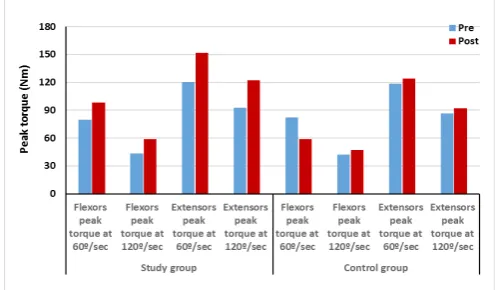
120°/sec was found post-treatment compared with pre-treatment (p = 0.0001). The percent of the increase in ham-string peak torque were 23.86 and 34.45% at 60 and 120°/ sec respectively. Also, a significant increase in quadriceps peak torque at 60 and 120°/sec was found post-treatment compared with pretreatment (p = 0.0001). The percent of the increase in quadriceps peak torque were 26.14 and 32.43% at 60 and 120°/sec respectively. (Table 3, figure 2).
Repositioning accuracy
- A significant decrease in absolute error after treatment in comparison with pretreatment (p = 0.0001). The percent of decrease of absolute error was 47.1.
Results of control group:
Knee extensors and flexors peak torque
- A significant increase in hamstring peak torque at 60° and 120°/sec was found post-treatment compared with pre-treatment (p = 0.0001). The percent of the increase in ham-string peak torque was 4.36 and 11.16% at 60 and 120°/ sec respectively. Also, a significant increase in quadriceps peak torque at 60 and 120°/sec was found after treatment in comparison with before treatment (p = 0.0001). The per-cent of the increase in extensors peak torque were 4.65 and 6.38% at 60 and 120°/sec respectively. (Table 3, figure 7).
Repositioning accuracy
- A significant decrease in absolute error after treatment in comparison with pretreatment (p = 0.001). The percent of decrease of absolute error was 24.75.
Table (3): Comparison between pre and post-treatment in study and control groups:
Pre- treat-ment
Post- treatment
Χ±SD Χ±SD MD change% of p-value Study group
Flexors peak torque at
60º/sec (Nm) 79.46 ± 16.09 98.42 ± 14.43 -18.96 23.86 0.0001** Flexors peak torque at
120º/sec (Nm) 43.54 ± 13.8 58.54 ± 13.56 -15 34.45 0.0001** Extensors peak torque
at 60º/sec (Nm) 120.1 ± 21.72 151.5 ± 23.94 -31.4 26.14 0.0001** Extensors peak torque
at 120º/sec (Nm) 92.44 ± 25.06 122.42 ± 22.24 -29.98 32.43 0.0001** Repositioning
accu-racy 3.8 ± 0.71 2.01 ± 0.68 1.79 47.1 0.0001** Control group
Flexors peak torque at
60º/sec (Nm) 82.38 ± 14.61 8515.02.98 ± -3.6 4.36 0.0001** Flexors peak torque at
120º/sec (Nm) 42.38 ± 14.61 47.11 ± 14.42 -4.73 11.16 0.0001** Extensors peak torque
at 60º/sec (Nm) 118.77 ± 23.23 124.3 ± 24.15 -5.53 4.65 0.0001** Extensors peak torque
at 120º/sec (Nm) ±17.8386.63 92.16 ± 18.84 -5.53 6.38 0.0001** Repositioning
accu-racy 4.04 ± 0.59 3.04 ± 0.64 1 24.75 0.001**
Figure 2: Knee flexors and extensors peak torque at 60° and 120°/sec pre and post-treatment of study and control
groups DISCUSSION
In this study, the effects of the pulsed magnetic field on quadriceps muscle torque, hamstring muscle torque and knee proprioception accuracy in athletic subjects were investigated. For these purposes, 30 healthy male athletes from students of College of Medical Rehabilitation science, Taibah University, Saudi Arabia participated in this study. In the current study, statistically significant differences be-tween study & control groups after pulsed magnetic field application in quadriceps & hamstring peak torque and in knee proprioception accuracy were shown. The cur-rent data of this study demonstrate an increase in the peak torques particularly in the study group, as differences were statistically different for flexion, extension peak torque be-tween the study and the control group. This was supple-mented by higher proportions of the extensors peak torque and flexors peak torque in the study group compared to control group noted in this study.
The results of this study showed within-group statistical significant differences in the study group and the control group. However, the changes in the peak torque of the con-trol group might be influenced by the unaccounted level of strength achieved by usual training of athletics subjects during the period of the study [25].
To our knowledge, this the first study that investigates the
effects of the pulsed magnetic field on quadriceps muscle torque, hamstring muscle torque and knee proprioception accuracy in athletic subjects.
The positive changes in muscle torque may be attributed to possible stimulatory effects of the pulsed magnetic field on the neuromuscular system [20], which in turn may help to recruit more motor units during muscle contraction that finally increase muscle torque and force production abili-ties. Also, strength changes in experimental group may be related to the microcirculatory effects of pulsed magnetic
oxide and improve local circulation in the tissues subject-ed to PEMF including muscle fibers. The highly significant positive effects observed in favor of the pulsed electromag-netic field group immediately post application might be at-tributed to possible stimulatory effects of PEMF.
Kartush et al, (1989) found that both magnetic and elec-tric stimulation of the extratemporal facial nerve led to nearly similar compound muscle action potentials, indi-cating that the locations and the underlying mechanisms of neural depolarization are similar; also, transtempo-ral magnetic stimulation seems to help triggering depo-larization of the proximal intratemporal nerve [27]. Those findings are intriguing as it may explain the ability of the pulsed magnetic field to directly stimulate motor nerves leading to the production of action potentials that result in muscle stimulation which if repeated and continued for enough time may improve muscle force production abili-ties and maybe muscle cross-section.
Our findings are similar the results of the study of Madaria-ga et al, (2007) [28], who investiMadaria-gated the effect of direct magnetic stimulation on quadriceps muscle. Study partic-ipants could perform contractions of the quadriceps mus-cle in isometric contraction mode equivalent to 80% of the maximum twitch stimulation which considered being good enough for direct stimulation by the magnetic field and can be used in muscle rehabilitation.
The findings of this study are promising and are of high clinical importance. The treatment procedures included in this study is beneficial, short and used unsophisticated equipment which is available in most physiotherapy de-partments. Therefore, the adoption of the same technique into clinical practice is readily feasible. Further studies with greater sample number could be used to assure the results and further research need to be conducted to investigate the effect of different treatment parameters other than that was used in the current study and also other skeletal mus-cles are to be investigated.
CONCLUSION
Pulsed magnetic field showed positive effects on quadri-ceps muscle peak torque, hamstring muscle peak torque and knee proprioception accuracy in healthy athletic sub-jects. In the light of positive findings of the present study and the general absence of undesired effects, PEMF may represent challenging area for future research.
REFERENCES
Erdogmus, C.B., Nicolakis, J. Pulsed magnetic field therapy for osteoarthritis of the knee - A double-blind sham-controlled trial. Wiener Klinische Wochen-schrift. 2002;114(15-16): 678-684.
[4] Quittan M, Schuhfried O, Wiesinberg G, Moser V. Clinical effectiveness of magnetic field therapy. A re-view of literature. Acta Med Austriaca. 2004 27(3):61– 68
[5] Perry 1, Mulroy Sl, Renwick SE. The relationship of lower extremity strength and gait parameters in pa-tients with post-polio syndrome. Arch Phys Med Re-habil. 1993; 74: 165-169.
[6] Bohannon RW. Comfortable and maximum walking
speed of adults aged 20-79 years: reference values and determinants. Age Ageing. 1997; 26: 15-19.
[7] Wisløff1 U, Castagna C, Helgerud J, Jones R, Hoff J. Strong correlation of maximal squat strength with sprint performance and vertical jump height in elite soccer players. Br J Sports Med. 2004;38:285-288. [8] Thompson C.J., Bemben M.G. Reliability and
compa-rability of the accelerometer as a measure of muscular power. Medicine and Science in Sports and Exercise. 1999; 31: 897-902.
[9] Lord JP, Aitkens SG, Megan BA, McCrory MA, Ber-nauer EM. Isometric and isokinetic measurement of hamstring and quadriceps strength. Arch Phys Med Rehabil. l992; 74: 324-330.
[10] Rochcongar P, Morvan R, DassonviII JJ, BeiIlot J. Isokinetic investigation of knee extensors and knee flexors in young French soccer players. Int J Sports Med. 1988; 9: 448-450.
[11] Akima H, Kano Y, Enomoto Y, Ishizu M, Okada M, Oishi Y. Muscle function in 164 men and women aged 20-84 yr. Med Sci Sports Exerc. 200 I; 33: 220-226.
[12] Westing SH, Seger lY, Karlson E, Ekblom B. Eccentric and concentric torque-velocity characteristics of the quadriceps femoris in men. Eur J Appl Physiol. 1988; 58: 100-104.
[13] Hislop Hl, Perrine JJ. The Isokinetic concept of exer-cise. Phys Ther. 1967; 47: 114-117.
[14] Ostering LR. Isokinetic dynamometry: Applications for muscle testing and rehabilitation. Exerc Sport Sci Rev. 1998; 14: 45-80.
[15] Grob K, Kuster M, Higgins S, Lloyd D, Yata H. Lack of correlation between different measurements of proprioception in the knee. J Bone Joint Surg [Br]. 2002;84-B:614-8.
[16] Laskowski E, Aney K and Smith G. Refining reha-bilitation with proprioception training: Expediting return to play. The Physician and sports medicine. 1997; 25(10):1-11.
[17] Malikova SN, Antonov AB, Govor GA, Dubrov-enskiĭ VM. A comparative analysis of the action of pulsed magnetic and electrical stimulation on the skeletal musculature. Vopr Kurortol Fizioter Lech Fiz Kult. 1989 May-Jun;(3):50-3.
[18] Krylov OA, Malikova SN, Antonov AB. The efficien-cy of the action of a pulsed magnetic field on the neu-romuscular apparatus. Fiziol Zh SSSR Im I M Seche-nova. 1990 ;76(11):1544-9.
[19] Bickford RG, Guidi M, Fortesque P, Swenson M. Magnetic stimulation of human peripheral nerve and brain: response enhancement by combined magnetoelectrical technique. Neurosurgery. 1987; 20(1):110-6.
[20] Contu S, Cappello L, Konczak J, et al. Preliminary analysis of non-dominant proprioceptive acuity and interlimb asymmetry in the human wrist. Conf Proc IEEE Eng Med Biol Soc; 2015: 3598–3601.
[21] Smith TL, Wong-Gibbons D, Maultsby J. Microcircu-latory effects of pulsed electromagnetic fields. J Or-thop Res. 2004;22(1):80-4.
[22] Elangovan N, Herrmann A, Konczak J. Assessing proprioceptive function: evaluating joint position matching methods against psychophysical thresh-olds. Phys Ther. 2014,;94: 553–561.
[23] Voight ML, Hardin JA, Blackburn TA, Tippett S and Canner GC. The effects of muscle fatigue on and the relationship of arm dominance to shoulder proprio-ception. JOSPT 1996; 23(6):348-352.
[24] Trock DH, Bollet AJ, Dyer PH, Fielding LP, Minger WK, Markoll R. A Double-blind trial of the clinical effects of pulsed electromagnetic fields in osteoar-thritis. J Rheumatol, 1993; 20(3):456–460.
[25] LehnertM , Psotta R , ChvojkaP, Croix M. Seasonal variation in isokinetic peak torque in youth soccer players. Kinesiology, 2014; 46(1):79-87.
[26] Diniz P, Soejima K, ItoG. Nitric oxidemediates the effects of pulsed electromagnetic field stimulation on the osteoblast proliferation and differentiation. Ni-tric Oxide 2002; 7(1):18–23.
[27] Kartush JM, Bouchard KR, Graham MD, Linstrom CL. Magnetic stimulation of the facial nerve. Am J Otol. 1989;10(1):14-9.
[28] Madariaga,V, Manterola A, Miró E, and Iturri J. Magnetic Stimulation of the Quadriceps: Analysis of 2 Stimulators Used for Diagnostic and Therapeutic Applications, Arch Bronconeumol. 2007; 43(7):411-7.
Citation