https://doi.org/10.5194/tc-13-927-2019
© Author(s) 2019. This work is distributed under the Creative Commons Attribution 4.0 License.
Resolving the influence of temperature forcing through heat
conduction on rock glacier dynamics: a numerical
modelling approach
Alessandro Cicoira1, Jan Beutel2, Jérome Faillettaz1, Isabelle Gärtner-Roer1, and Andreas Vieli1 1Department of Geography, University of Zurich, Zurich, Switzerland
2Computer Engineering and Networks Laboratory, ETH, Zurich, Switzerland Correspondence:Alessandro Cicoira ([email protected]) Received: 25 August 2018 – Discussion started: 26 September 2018
Revised: 18 January 2019 – Accepted: 13 February 2019 – Published: 18 March 2019
Abstract.In recent years, observations have highlighted sea-sonal and interannual variability in rock glacier flow. Tem-perature forcing, through heat conduction, has been proposed as one of the key processes to explain these variations in kinematics. However, this mechanism has not yet been quan-titatively assessed against real-world data.
We present a 1-D numerical modelling approach that cou-ples heat conduction to an empirically derived creep model for ice-rich frozen soils. We use this model to investigate the effect of thermal heat conduction on seasonal and interan-nual variability in rock glacier flow velocity. We compare the model results with borehole temperature data and surface velocity measurements from the PERMOS and PermaSense monitoring network available for the Swiss Alps. We fur-ther conduct a model sensitivity analysis in order to resolve the importance of the different model parameters. Using the prescribed empirically derived rheology and observed near-surface temperatures, we are able to model the correct or-der of magnitude of creep. However, both interannual and seasonal variability are underestimated by an order of mag-nitude, implying that heat conduction alone cannot explain the observed variations. Therefore, we conclude that non-conductive processes, likely linked to water availability, must dominate the short-term velocity signal.
1 Introduction
For several rock glaciers, and especially in Switzerland, sur-face displacements have been calculated over long time pe-riods (Chaix, 1923; Wahrhaftig and Cox, 1959; Barsch and Hell, 1975; Francou and Reynaud, 1992; Berthling et al., 1998) by using position time series of landmark features (boulders). Since these early investigations, velocity vari-ability has been detected on a multi-year scale. In the past decades, starting with some measurements on Gruben rock glacier (Haeberli, 1985), seasonal velocity variability has been observed on such creeping periglacial landforms. Even though differences exist between individual rock glaciers, ve-locity peak maxima are in general observed between summer and early winter and minima between spring and early sum-mer (Delaloye et al., 2010). In the past years, advances in monitoring techniques and the introduction of continuously measuring DGPS (differential global positioning system) loggers (Buchli et al., 2012) have confirmed the previous observations on several rock glaciers and have further high-lighted velocity peaks on a daily to a weekly scale, which are predominantly present during the melt season (Wirz et al., 2016a; Kenner et al., 2017; Buchli et al., 2018).
Figure 1.Overview of the four case study sites. Overview site map (middle) and aerial view of the four studied rock glaciers(a–d)with locations of boreholes (red dots) and DGPS (blue dots) according to PERMOS (2016a): (a)Ritigraben,(b) Murtèl,(c)Schafberg and (d)Muragl.
Similarly, temperature forcing has also been suggested as one of the most important factors controlling rock glacier flow velocity variability on a seasonal scale (Arenson et al., 2002; Kääb et al., 2007; Delaloye et al., 2010; Wirz et al., 2016b). Wirz et al. (2016b) have suggested liquid precipitation, snowmelt, air and ground temperature as the main factors controlling rock glacier flow on interannual, seasonal and shorter timescales. Previous studies (Johnson, 1978; Barsch, 1992; Krainer and He, 2006, amongst others) highlighted the influence of water on rock glacier and their dynamics. Possible positive feedback processes between rising temperature and increased deformation have also been suggested (Ikeda et al., 2008; Buchli et al., 2018).
Even though great improvements have been achieved in this field, our understanding of the processes governing rock glacier dynamics and their relation with external forcings and controlling factors remains at a qualitative level, and many questions remain unanswered. However, it is clear that, in order to understand rock glacier dynamics, the complex thermo-hydro-mechanical behaviour of the ice-rich frozen soil and its coupling with the climate have to be consid-ered. In particular, when aiming to understand the influ-ence of temperature forcing on permafrost creep and its rela-tive importance on rock glacier dynamics, we have to con-sider two aspects. On one hand, the thermal regime of a rock glacier is mainly controlled by heat conduction, driven by external temperature forcing (Vonder Mühll et al., 2003; Haeberli et al., 2006). Nevertheless, in some cases other processes have been observed, like air and water advection through the permafrost matrix (Hanson and Hoelzle, 2004; Zenklusen Mutter and Phillips, 2012; Scherler et al., 2014; Luethi et al., 2017; Pruessner et al., 2018). On the other hand, from glaciological studies, it is well known that the rate of deformation of ice is described by a power law (Nye,
1952; Glen, 1955) and depends on ice viscosity, which in turn depends on ice temperature (Mellor and Testa, 1969; Duval et al., 1983). Therefore, heat conduction forced by external surface temperature variations is expected to influ-ence rock glacier creep. However, investigations that quan-titatively couple temperature evolution and rock glacier rhe-ology are rare and remain very limited (Kääb et al., 2007; Müller et al., 2016). The numerical modelling study by Kääb et al. (2007) investigated this process, but has two main lim-itations: it used a rock glacier rheology that has been derived for pure ice, and more importantly, it applied this rheology to a purely synthetic set-up and could not directly compare the results to real-world observations.
In this study, we quantify the relative importance of the conductive thermal influence on flow and extend previous research (Kääb et al., 2007) by applying the most up-to-date rheological relation available for rock glacier material (Aren-son and Springman, 2005a) to four real-world rock glaciers and constrain the modelling with observations from borehole measurements, kinematics surveys and DGPS observations available from the Swiss Permafrost Monitoring Network PERMOS (here on named PERMOS) and PermaSense mon-itoring networks (https://doi.org/10.13093/permos-2016-01).
2 Study sites
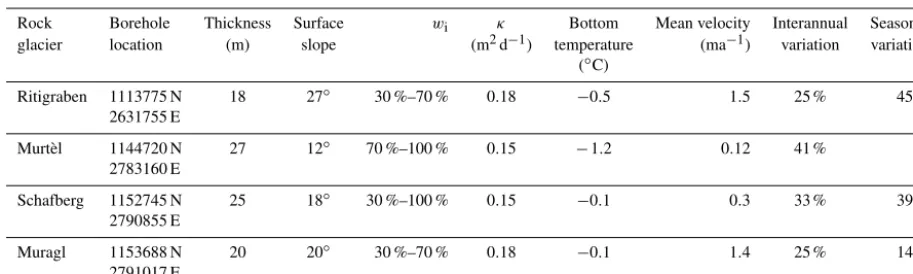
Table 1.Summary of field sites. The borehole locations are given in the CH1903+ coordinate system. The values of the geometrical and physical properties of the rock glaciers are given (thickness, slope, volumetric ice content and thermal diffusivity) as discussed in Sect. 2. For the ice content an acceptable range of values is proposed according to the literature (Hoelzle et al., 1998; Arenson et al., 2002). The mean observed rock glacier bottom temperature, measured at the lower end of the shear horizon (from summer 2006 to summer 2015) and surface velocity (from summer 2009) are reported, as well as the interannual and seasonal velocity variations relative to the mean velocity (from summer 2012 to summer 2016) (PERMOS, 2016a).
Rock Borehole Thickness Surface wi κ Bottom Mean velocity Interannual Seasonal
glacier location (m) slope (m2d−1) temperature (ma−1) variation variation (◦C)
Ritigraben 1113775 N 18 27◦ 30 %–70 % 0.18 −0.5 1.5 25 % 45 % 2631755 E
Murtèl 1144720 N 27 12◦ 70 %–100 % 0.15 −1.2 0.12 41 % – 2783160 E
Schafberg 1152745 N 25 18◦ 30 %–100 % 0.15 −0.1 0.3 33 % 39 % 2790855 E
Muragl 1153688 N 20 20◦ 30 %–70 % 0.18 −0.1 1.4 25 % 14 % 2791017 E
displacements and subsurface temperatures from boreholes. Further, several borehole deformation profiles are available for different time steps for all rock glaciers. This type of data is rather unique and made available through the PERMOS monitoring network.
These four rock glaciers cover a wide range of geomet-ric settings and dynamic states: thickness, slope and flow velocity from decimetres to several metres per year; for an overview see Table 1. The rock glaciers are located at el-evations between 2500 to 2900 m a.s.l. and their aspect is north to north-west. Their lithology mainly consists of crys-talline formations, with prevailing granodiorite and schist for Murtèl and gneiss for Muragl, Schafberg and Ritigraben. The internal structure and deformation profiles are known for all four rock glaciers from boreholes (Haeberli et al., 1998; Arenson et al., 2002; Lugon and Stoffel, 2010). Here, we define the rock glacier thickness on the basis of their de-formation profiles, which are dominated by shear horizon a few metres thick at 18 to 30 m depth. Laboratory shear experiments have been undertaken on cores from boreholes for the two rock glaciers Murtèl and Muragl and were used by Arenson and Springman (2005a) to derive an empirical creep rheology (Arenson et al., 2004; Arenson and Spring-man, 2005b), which is also used in the flow-modelling inves-tigations of this study (for details see Sect. 3.3).
2.1 Ritigraben
The Ritigraben rock glacier is located above the village of Grächen (VS) and originates from the northern slope of the Gabelhorn (3135 m a.s.l.). It develops a simple linear flow lobe of about 500 m length on a steep slope (27◦in the prox-imity of the borehole, Fig. 1 and Table 1) and terminates at the upper end of the Ritigraben gully. The surface is affected by the ski slope facilities that have been built on the rock
glacier. Accounting for the steep slope and the geometrical setting, the flow unit is only 20 m thick and the flow veloc-ities are rather high relative to other rock glaciers. Continu-ous DGPS measurements have provided velocity data since 2012, showing a mean value of 1.4 m a−1 and strong sea-sonal and interannual variations of more then 45 % and 25 % respectively; see Table 1. Even though no ice cores have been analysed, volumetric ice content has been estimated in pre-vious studies at 30 %–70 % (Lugon and Stoffel, 2010; Luethi et al., 2017). Borehole measurements since 2002 show warm permafrost temperatures close to the melting point and the progressive development of a talik at a depth between 10 and 12 m (Zenklusen Mutter and Phillips, 2012), which has been related to the influence of water infiltration and air circulation (Luethi et al., 2017).
2.2 Murtèl-Corvatsch
The temperatures within the main body of the rock glacier are between −4 and −1◦C and therefore relatively cold
compared to other instrumented rock glaciers in Switzer-land (Vonder Mühll et al., 2003; PERMOS, 2016a). Annual velocities have been measured since 2009 by a geodetic sur-vey of 11 surface markers around the borehole (PERMOS, 2016a). Further, several years of borehole deformation data (at time intervals of several months) are available from 1987 to 1994 (Haeberli et al., 1998; Arenson et al., 2002). The time-averaged yearly velocities show an increasing trend, co-herent with observations for other rock glaciers throughout the Swiss Alps, as shown in the PERMOS Glaciological Re-port no. 12–15 (PERMOS, 2016a).
2.3 Schafberg
The Schafberg rock glacier originates in a cirque south of the Piz Muragl ridge, has an extent of less than 300 m and an average surface slope of 18◦(Table 1, Fig. 1c). In the lower part, the rock glacier splits into two separate tongues as a result of a bedrock outcrop. This study focuses on the north-western lobe, where in 1997 a borehole was drilled and tem-peratures were monitored thereafter within PERMOS. This lobe has a thickness of approximately 26 m and a flow veloc-ity of 0.3 m a−1. Investigations by Vonder Mühll (1993) show a volumetric ice content ranging from 35 % to 100 %. Hoel-zle et al. (1998) investigated internal deformation profiles from borehole measurements in relation to photogrammetric analysis. Continuous daily velocities have been measured by DGPS within the PermaSense framework since 2012 approx-imately 200 m upstream of the borehole location and show clear seasonal variations with an amplitude of up to 39 % relative to the mean velocity and a rising interannual trend (33 % increase in the observed period).
2.4 Muragl
The Muragl rock glacier is located on the western side of the ridge of Piz Muragl (3156 m a.s.l.) and consists of several generations of overlapping flow units of variable flow veloc-ity (Fig. 1d). The main lobe, where the borehole is located, moves at 1.5 m a−1, is approximately 25 m thick and has a surface slope of 20◦(Table 1). The annual surface motion has been available from terrestrial survey since 2009, whereas continuous daily velocities from DGPS measurements at the lower end of the lobe have been measured since 2012 and in-dicate clear interannual (25 %) and seasonal variations (14 %) (PERMOS, 2016a). Older geophysical and photogrammetri-cal measurements have been presented in Vonder Mühll and Schmid (1993). Volumetric ice content has been estimated from boreholes investigations at 40 %–70 % and is found to be very heterogeneous (Arenson et al., 2002). The temper-atures within the rock glacier, measured since the drilling in 1999, range from−3 to 0◦C and are relatively close to the melting point (Vonder Mühll et al., 2003). As for the
Murtèl rock glacier and consistent with other observations in the Alps, there is a rising trend of multi-annual velocities (PERMOS, 2016a).
3 Data and methods
We designed a suite of 1-D numerical models, based on finite differences, to simulate the response of viscous and plastic flow to external near-surface temperature forcing using the software MATLAB (2016). The modelling framework cou-ples heat conduction, forced by external temperature, to a power-law creep relation for ice-rich frozen soils proposed by Arenson and Springman (2005a). The model inputs are the surface slope, the thickness and other physical proper-ties (density, volumetric ice content and thermal diffusiv-ity) of the creeping rock glacier. All the parameters are as-sumed to be homogeneous in time and space in first approxi-mation. Note that geophysical investigations on several rock glaciers including the ones presented here (amongst others: Arenson et al., 2002, 2010; Maurer and Hauck, 2007; Buchli et al., 2018) showed high heterogeneity and spatial variabil-ity. The model is forced by permafrost temperature time se-ries measured in boreholes below the active layer. At the lower boundary of the rock glacier a constant temperature value representative of the observed bottom temperature is prescribed. The model is applied to the four study cases de-scribed in Sect. 2 and the results are compared to observed borehole temperatures and surface flow velocities.
3.1 Data overview
Here, we provide a detailed description of the data used for model input and for comparison with the model results.
Figure 2.Contour plots of ground temperatures time series (colour coded) for rock glaciers(a)Ritigraben,(b)Murtèl,(c)Schafberg and (d)Muragl. Each panel shows, from top to bottom, measured temperatures, modelled temperatures and differences between the measured and the modelled temperatures. Note the different temperature scales of the lower sub panels with the temperature differences.
four study cases from spring 2002 to autumn 2015 with a time resolution of 6 h (the time series of Muragl terminates in autumn 2014). For our modelling, we resample these data to a daily average. For all four study cases, some data gaps occur due to sensor failure, in particular at depth. For tem-peratures at depth just below the active layer, which are used as forcing input for the model, the data gaps are below a few months apart from the case of Muragl, for which temperature data in the period between August 2008 and April 2009 are missing. Missing temperature data are linearly interpolated. Note that this linear interpolation does not aim to reconstruct exact real temperatures, but rather bridges the gaps in order to create a continuous temperature time series that can be used as model input. This approach is considered satisfac-tory due to the combination of the scarcity of data gaps in the surface temperature time series and the length of the con-sidered seasonal to multi-annual timescales. Note that more sophisticated methods (e.g. Staub et al., 2017) could be used for interpolating the temperature time series. This means, the modelled short-term velocity variations should be analysed carefully near these gap-filled periods. Figure 2 shows the measured temperatures for all case study sites.
Several types of velocity data are available. For Murtèl and Muragl rock glacier mean annual surface velocities are avail-able between 2009 and 2015 from terrestrial surveys with total station from the PERMOS network. For all study cases but Murtèl, daily velocities from continuous single frequency DGPS measurements are available from 2012 from the
Per-maSense network. For a summary of the study case sites see Table 1.
3.2 Heat conduction model
We model vertical heat conduction throughout the rock glacier unit by solving the diffusion equation for temperature evolution with depth (Williams and Smith, 1989):
∂T ∂t =κ
∂2T
∂z2, (1)
whereT is the permafrost temperature,zthe vertical coor-dinate,t the time andκ the thermal diffusivity of the rock glacier material. At the upper boundary the observed temper-ature history just below the active layer depth is prescribed. At the bottom of the rock glacier (below the shear horizon) a constant temperature value corresponding to the time av-erage of the observations is prescribed. The initial condition is prescribed from the measured vertical temperature profile at the first time step of the simulation. The temporal reso-lution of the model is 1 day, and its vertical resoreso-lution is 0.1 m. Convective and advective heat fluxes and any influ-ence from basal heating due to frictional processes, heat dis-sipation from deformation and geothermal heat flux are not considered in this model.
3.3 Ice-creep model
samples used to derive this relation have been cored from Murtèl and Muragl rock glacier, also investigated in this study, and are described in detail in Arenson and Springman (2005b). The creep relation is a modified Glen’s flow law, which relates strain rateε˙to a stress invariantσeas proposed by Von Mises (1913), taking into account the volumetric ice contentwiand the temperatureT of rock glacier material:
˙
ε=A(T , wi)σen(wi). (2)
The flow law exponentnlinearly depends on volumetric ice content only,
n=3wi, (3)
and the creep parameterAdepends on temperature and vol-umetric ice content by
logA= 2
1+T +b(wi), (4)
whereb(wi)is a function of the volumetric ice content,
b=log(5×10⁻¹¹e−10.2wi). (5)
Assuming an infinitely wide surface parallel slab, the shear stressσeat a depthzis given by
σe= 1 √
3ρrgz
∂s
∂x, (6)
where ρr to the density of the rock glacier material, g the constant of gravity and ∂x∂s the slope of the ice surface, which is assumed to be parallel to the rock glacier surface slope. Note that the densityρralso depends on the ice density by ρr=ρs(1−wi)+ρiwi, (7) whereρiandρs are the densities of ice and sediment parti-cles respectively. As in our case the ice thickness of the rock glacier landform is fixed, any variation in volumetric ice con-tentwiwill change the density and as consequence the shear stressσe(see Eq. 6).
Given the temperature field and assuming an inclined in-finite parallel slab, the velocities are solved from Eq. (2) through vertical integration under the assumption of zero displacement at the lower boundary. This hypothesis is con-firmed by the low deformation rates at the bottom of the bore-hole inclinometer profiles for all the studied rock glaciers. The physical properties of the material are considered con-stant in time and homogeneous in space. The temporal and the spacial model resolution are the same as for the heat con-duction model. Despite its limitations, the proposed consti-tutive relation is one of the most up to date on rock glacier material and has the great advantage of being based on labo-ratory experiments.
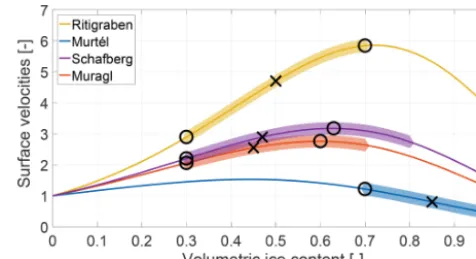
Figure 3.Normalised surface velocities for the four case studies with volumetric ice content values. For each rock glacier the veloci-ties are normalised with the velocity value corresponding to 0 % ice content. The coloured buffer around the curve shows the range pro-posed by the literature (Vonder Mühll, 1993; Arenson et al., 2002; Lugon and Stoffel, 2010). The black circles show for each curve the maximum and the minimum possible velocity values within this range, also representing the uncertainty range for the modelling. The black cross shows the chosen volumetric ice content value for the modelling, i.e. the middle value of the latter range.
3.3.1 Calibration of the model
The model is calibrated to best fit the average observed sur-face velocities by varying the volumetric ice content parame-ter within the range of liparame-terature values. Because of the math-ematical formulation of the applied rheology, calibrating the model by varying the volumetric ice content gives a concave curve for the mean velocities, with a maximum correspond-ing to around 60 % volumetric ice content (see Fig. 3). On the one hand, an increasing volumetric ice content causes the creep relation exponent to grow, resulting in higher surface velocities. On the other hand, a higher volumetric ice con-tent implies a lower density and thus a lower shear stress and deformation. This mathematical artefact is because the thick-ness of the rock glacier in the modelling is fixed. In reality, for varying volumetric ice content values, the rock glacier thickness and velocity would adjust until the shear stress at the base of the rock glacier reaches a critical value.
Within the range of possible volumetric ice content val-ues proposed in the literature (Vonder Mühll, 1993; Arenson et al., 2002; Lugon and Stoffel, 2010), we further refine the range for which the maximum and the minimum velocities are obtained (black circles in Fig. 3). We set the volumetric ice content parameter to the mean of this range and further assess the effect of the uncertainty range on the velocity re-sults.
We consider further uncertainties in input parame-ters: slope ±2◦, ice content (corresponding to the maxi-mum and minimaxi-mum velocity value) and thermal diffusivity ±0.02 m2day−1.
con-Table 2.Summary of modelling inputs and results. Values of geometrical and physical input parameters for the modelling are listed (thick-ness, slope, volumetric ice content and thermal diffusivity). The mean modelled surface velocity and its relative interannual and seasonal variations are reported in the last three columns.
Rock Thickness Temperature Slope wi κ Mean surface Interannual Seasonal
glacier (m) input depth (m2d−1) velocity variation variation
(m) (ma−1)
Ritigraben 18 3.5 27◦±2◦ 50±20 % 0.18±0.02 0.59 2 % 8 %
Murtèl 27 3.5 12◦±2◦ 85±15 % 0.15±0.02 0.12 5 % 2 %
Schafberg 25 5.2 16◦±2◦ 48±18 % 0.15±0.02 0.69 4 % 5 %
Muragl 20 4.5 20◦±2◦ 45±15 % 0.18±0.02 0.46 6 % 5 %
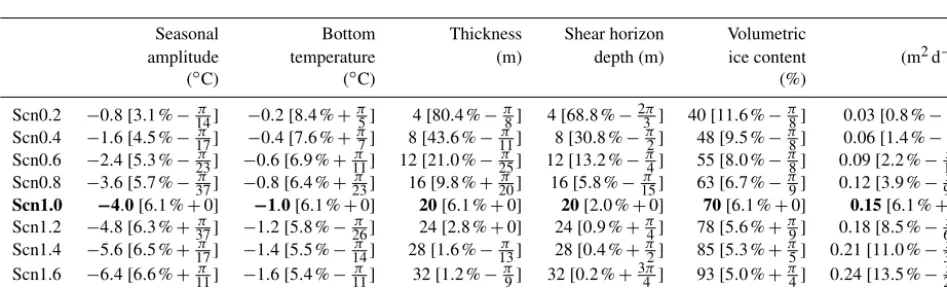
Table 3.Parameters and results of the sensitivity experiments. The first column indicates the scenario with a label in the form of Scnα, where αrefers to the value of the multiplication factor for the investigated parameter relative to the reference values. Each column represents a set of experiments for one variable parameter, with the first number in each column referring to the input parameter value. The numbers in the bracket of each column refer to seasonal variations as a percentage of the mean value on the left side and the phase shift relative to the reference scenario on the right side (with a cycle of 2πreferring to 1 year).
Seasonal Bottom Thickness Shear horizon Volumetric κ
amplitude temperature (m) depth (m) ice content (m2d−1)
(◦C) (◦C) (%)
Scn0.2 −0.8 [3.1 %− π
14] −0.2 [8.4 %+π5] 4 [80.4 %−π8] 4 [68.8 %−2π3] 40 [11.6 %−π8] 0.03 [0.8 %−π8] Scn0.4 −1.6 [4.5 %− π
17] −0.4 [7.6 %+ π
7] 8 [43.6 %−11π] 8 [30.8 %− π
2] 48 [9.5 %− π
8] 0.06 [1.4 %− π 8] Scn0.6 −2.4 [5.3 %− π
23] −0.6 [6.9 %+11π] 12 [21.0 %−25π] 12 [13.2 %−π4] 55 [8.0 %−π8] 0.09 [2.2 %−12π] Scn0.8 −3.6 [5.7 %− π
37] −0.8 [6.4 %+ π
23] 16 [9.8 %+ π
20] 16 [5.8 %− π
15] 63 [6.7 %− π
9] 0.12 [3.9 %− π 90] Scn1.0 −4.0[6.1 %+0] −1.0[6.1 %+0] 20[6.1 %+0] 20[2.0 %+0] 70[6.1 %+0] 0.15[6.1 %+0] Scn1.2 −4.8 [6.3 %+ π
37] −1.2 [5.8 %−26π] 24 [2.8 %+0] 24 [0.9 %+π4] 78 [5.6 %+π9] 0.18 [8.5 %−60π] Scn1.4 −5.6 [6.5 %+ π
17] −1.4 [5.5 %−14π] 28 [1.6 %−13π] 28 [0.4 %+π2] 85 [5.3 %+π5] 0.21 [11.0 %−30π] Scn1.6 −6.4 [6.6 %+ π
11] −1.6 [5.4 %−11π] 32 [1.2 %−π9] 32 [0.2 %+3π4] 93 [5.0 %+π4] 0.24 [13.5 %−20π] Scn1.8 −7.2 [6.8 %+π
9] −1.8 [5.2 %−10π] 36 [0.9 %−π9] 36 [0.1 %+π] 100 [4.8 %+π3] 0.27 [15.9 %−15π]
duction model and to take into account all possible heat trans-fer process, we perform additional numerical experiments forcing the ice-creep relation directly with the observed tem-perature fields with depth.
3.3.2 Consideration of shear horizon
The above described approach for creep does not consider enhanced deformation in the shear horizon, where most of the displacement takes place. In order to investigate the sen-sitivity of the model to such a phenomenon, we perform addi-tional numerical experiments. We approximate the behaviour of the shear horizon with a pseudo-plastic creep relation, by increasing the flow law exponent of Eq. (2) by a factor 4 (nplastic=12·wi), similarly to Frehner et al. (2015). The creep parameterAhas been reduced by a factorfAto match the time-averaged surface velocities modelled before:
˙
εplastic=fA(ε)A(T , w˙ i)σ
nplastic(wi)
e . (8)
In this way, we approximate the plastic behaviour of the lower layer to better represent the whole deformation profile of the studied rock glaciers.
3.4 Sensitivity experiments
the reference scenario. Only for the experiments on the vol-umetric ice content parameter the multiplications factors are different, as shown in Table 3.
Additionally, the thickness sensitivity experiments have been repeated using the pseudo-plastic rheology (Eq. 8) in order to investigate the effect of the presence of the shear horizon in our experiment. In the case of both sets of vary-ing thickness experiments (with and without shear horizon), the bottom temperature for the scenarios with thicknesses less than the one of the reference are always prescribed at 20 m depth. For these shallow depths, prescribing a constant temperature would unrealistically constrain the temperature field. For all the values and the results of this analysis we refer to Table 3.
4 Results
4.1 Modelled temperatures
The modelled and measured temperatures are shown in Fig. 2. For Schafberg and Muragl rock glaciers (Fig. 2c and d respectively) the modelled temperatures agree very well with the measurements (temperature differences are be-low 0.2◦C). For the case of Murtèl rock glacier, given the prescribed temperatures below the active layer, the modelled temperature evolution with depth agrees well with regard to seasonal amplitude and phase with depth. However, between a depth of 5 and 20 m, temperatures are in particular dur-ing cold seasonal phases slightly underestimated, but the dif-ferences stay below 0.5◦C. For Ritigraben rock glacier, as shown in Fig. 2a, in a depth between 8 and 12 m and in partic-ular in early summer, observed temperatures are substantially higher (up to 1◦C), which is related to the talik observed and
discussed in Luethi et al. (2017). The depth of the zero annual temperature amplitude is according to the PERMOS (2016a) report, usually between 10 and 20 m depth. This depth is slightly overestimated by our model (see Fig. 2), with the seasonal temperature signal reaching slightly deeper in com-parison to the borehole measurements (PERMOS, 2016a). 4.2 Modelled velocities
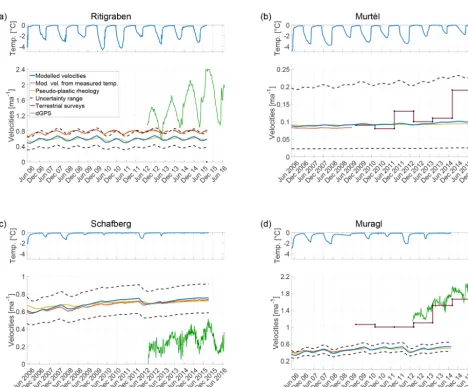
The observed and modelled surface flow velocities with time are shown in Fig. 4 for the modelled temperatures (solid blue line), for the observed temperature fields (red solid line), and for the pseudo-plastic rheology (yellow solid line) with mod-elled temperatures. The resulting maximum and minimum velocities accounting for uncertainties in the input parameter of volumetric ice content, slope and thermal diffusivity are shown with two black dashed lines.
For the chosen volumetric ice content values within the proposed range, we obtain the correct order of magnitude of the observed surface velocities for all four case study rock glaciers. For Ritigraben and Muragl rock glaciers the mod-elled velocities are smaller (by a factor 2), for Murtèl the
average velocity matches the observations and for Schafberg the modelled velocities are overestimated (by a factor 3) in comparison to the observed ones.
The modelled amplitudes in seasonal and multi-annual ve-locity variations (values in Table 2, solid blue, yellow, and red line in Fig. 4) are in general rather low: below 10 % relative to the mean velocity. In comparison, the observed variations in flow (solid green and purple lines in Fig. 4, Ta-ble 1) are 1 order of magnitude higher. This result does not change when considering uncertainties in the input parame-ters (dashed black lines in the same figure).
For the three rock glaciers with continuous DGPS mea-surements, we are also able to compare the phase of the sea-sonal variations. The modelled velocity maxima occur in late winter and are substantially delayed in comparison to the ob-served velocity peaks in autumn. The above findings (am-plitude underestimation and phase shift) do not change when the observed temperature fields are used as input for the creep model. The exception is the case of Ritigraben, where, as discussed above, substantial discrepancies between veloci-ties obtained using modelled (blue solid line) and observed (red solid line) temperatures occur. When using the observed temperature field, the modelled and the observed seasonal velocity variations are phase synchronous (see red and green line in Fig. 4).
The discrepancies found between observed and modelled velocity variations do not improve when using the pseudo-plastic creep model for all rock glaciers. On the contrary, the seasonal velocity amplitude further reduces and the phase shift increases further (see yellow line in Fig. 4).
4.3 Sensitivity experiments
The results of the sensitivity experiments are plotted in Figs. 5 and 6 and are summarised in Table 3.
Figure 4.Observed and modelled surface flow velocities for(a)Ritigraben,(b)Murtèl,(c)Schafberg and(d)Muragl rock glaciers. The upper subpanel shows the observed subsurface temperature used as model input. The lower subpanel shows the modelled and observed velocities. The modelled velocities are shown for using the modelled temperatures (solid blue line), the observed temperature fields (red solid line), and the pseudo-plastic rheology (yellow solid line). The uncertainty range resulting from variations in slope (±2◦), volumetric ice content (within the proposed range; see Fig. 3 and Table 2) and thermal diffusivity (±0.02 m2day−1) is plotted with black dashed lines. The modelled velocities are compared with the observed velocities from terrestrial surveys (dark solid red line with black dots) and with DGPS measurements (green solid line).
a power law with variations of almost 400 % and 600 % re-spectively. When varying volumetric ice content the mean velocities show variations of up to 70 % for the used param-eter range (see Sect. 3.3).
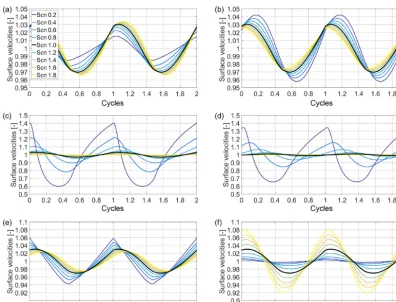
In Fig. 6, the velocities of the different sensitivity experi-ments normalised with their mean are presented and a sum-mary is given in Table 3. The seasonal velocity response to different amplitudes in surface winter temperature forcing is small and stays below 7 %, even for an 80 % increase in the temperature amplitude. The sensitivities of the velocity variations to varying bottom temperature are slightly higher, but remain below 9 % in the given range. For the thickness experiment, a velocity variation of up to 80 % is obtained when considering a 4 m thick rock glacier, representing an
Figure 5. Plots of the time-averaged values of surface velocities for the sensitivity experiments with the different parameter scenarios. The mean velocities are normalised with the mean values of the reference scenario Scn1.0. Panel(a)shows the results for varying surface temperature-forcing amplitudes (blue line), bottom temperature values (red line), thermal diffusivity parameters (yellow line) and initial condition temperature values (purple line). The yellow line is hidden behind the purple line. Panel(b)shows the results for varying thicknesses (blue line), slope angles (red line) and volumetric ice content values (yellow line).
Figure 6.Results of the modelling sensitivity experiments of the model to(a)seasonal amplitude (winter minimum temperature),(b)bottom temperature,(c)thickness,(d)thickness with shear horizon,(e)volumetric ice content and(f)thermal diffusivity. The surface velocities normalised with their mean are plotted for each experiment with time, given here as the number of cycles (after the 28th cycle). One cycle corresponds to 1 year. For all experiments the different scenarios are colour coded as illustrated in the legend of panel(a); the reference scenario is plotted with a thicker solid black line.
5 Discussion
In this study, we developed a simple numerical model approach to investigate the dynamical behaviour of rock glaciers with the aim of resolving the influence of external
obtained. However, interannual and seasonal variations are strongly underestimated for all four cases, being at least 1 order of magnitude smaller than the observed ones.
5.1 Temperature modelling
We model rock glacier temperature evolution based on near-surface temperatures as measured below the active layer (see Sect. 3.2). In some cases, data gaps are present and linear in-terpolation of the data is used. The data gaps are short (below a few months) and are expected to not affect the overall mod-elling, but interpretation of the modelled velocities for these periods has to consider this limitation.
The assumption of constant bottom temperature agrees well with the observed borehole temperatures. This is fur-ther supported by the good agreement between the modelled velocities from prescribed observed and modelled tempera-tures. We assume the physical properties of the rock glacier (density, ice content and thermal diffusivity) to be constant in time and homogeneous in space, which seems justified at the considered short (seasonal to multi-annual) timescales and is supported by the good performance of the temperature evo-lution model.
For Schafberg (Fig. 2c) and Muragl (Fig. 2d) rock glaciers, we can reproduce the observed temperature fields very well. For Ritigraben and Murtèl (Fig. 2b and 2d) our results show some disagreement with seasonal pattern, in particular at 12–15 m depth. At Ritigraben, this disagreement can be ex-plained by the influence of a talik caused by air and water advection (Luethi et al., 2017), which refers to processes that are not included in our modelling. For Murtèl, the cause of the discrepancy between modelled and observed tempera-tures is currently not clear. A possible explanation of this ef-fect could be related to advective water fluxes or varying ther-mal conductivity within the rock glacier body, likely linked to the variable unfrozen water content at temperatures close to zero degree (Arenson et al., 2010). However, the results of our modelling for the four study cases, in combination with the available borehole temperature observations, allow us to confidently model and analyse rock glacier velocities. 5.2 Ice-creep modelling
Using the modelled and observed temperature fields respec-tively, we force the empirical creep relation for rock glacier material. Additionally, we run a separate experiment with the pseudo-plastic rheology to investigate the impact on the model from including enhanced deformation within the shear horizon.
5.2.1 Absolute velocities
When applying the creep rheology of Arenson and Spring-man (2005a) and using acceptable and uniform values of the model input parameters, we obtain the correct order of
mag-nitude of the average observed surface velocities for all case studies.
For Murtèl, the mean surface velocities (averaged over the whole time series) match the observations. For Ritigraben and Muragl the modelled average velocities are between 30 % and 40 % of the observed ones. This result is consistent with the observed borehole deformation contribution from above the shear horizon, accounting for 10 % to 30 % of the total deformation (Arenson et al., 2002). This finding sug-gests that the rheology proposed by Arenson and Spring-man (2005a) may not be applicable to describe the rheol-ogy of the shear horizon of a rock glacier. On the contrary, for Schafberg the modelled velocities overestimate the ob-servations. This mismatch can likely be explained by using an input thickness that is too high, resulting from the dis-tance between the DGPS and borehole locations. The rock glacier thickness at the location of the observed velocities by DGPS is not known and the used thickness was taken from the borehole on the lobe further down which is less steep. The observed flow magnitude can be matched almost per-fectly when using a thickness of 17 m, which was observed in a nearby borehole at the same field site (Arenson et al., 2002) and which can be expected for a steeper surface. 5.2.2 Seasonal and multi-annual variations
For all rock glaciers, we find that both seasonal and in partic-ular interannual variations are strongly underestimated. This result is also coherent when considering relative velocity variations (see Fig. 4). In particular, the results for Murtèl and Schafberg rock glacier show very small seasonal varia-tions of 3 % to 4 %. This result is not due to an underesti-mation in the seasonal temperature variations, as confirmed by the comparison between modelled and measured tempera-tures and further corroborated by the results of our modelling constrained with the observed temperatures. In fact, the lat-ter forcing indirectly takes into account all non-conductive processes governing the temperature field. The lower sensi-tivities of rock glacier Murtèl and Schafberg compared to the other two can be explained by their greater thicknesses. For thicker rock glaciers, temperature variations at the surface reach shallower depth in relative terms and hence do not af-fect the near-bottom layers where most of the deformation occurs. For the thinner Muragl and Ritigraben glaciers, the modelled seasonal variations of 5% and 8% are substantially higher, but are still a factor 3 to 5 below the observations.
Consistent with the results for similar thicknesses of Kääb et al. (2007), we also find that including a shear horizon in the modelling (by using the pseudo-plastic rheology) decreases the sensitivity of the seasonal variations in flow to tempera-ture forcing. This result further corroborates the underestima-tion of seasonal and interannual variaunderestima-tions in our modelling compared to the observations. It is unlikely that this under-estimation is a result of an insufficient sensitivity of the used rheology of Arenson and Springman (2005a) to temperature. In fact, this rheology is based on laboratory deformation ex-periments on core material from real rock glaciers. Unfrozen water is known to have a significant influence on frozen soils creep (Arenson et al., 2006; Moore, 2014). The influence of interstitial water on creep is partially implicitly taken into ac-count in the adopted empirical creep relation through the de-pendency on temperature; however, the impact on the stress regime due to pore pressure is not taken into account in the adopted rheology. Further, the discrepancy in the phase shift between modelled and observed velocity variations would not improve for a more temperature-sensitive rheology. 5.2.3 Phase shift
A phase lag of about 2–3 months between the seasonal sum-mer peak in the observed ground surface temperatures and measured surface velocity has been detected on several rock glaciers including Ritigraben, Schafberg and Muragl (see Fig. 7) and has partly been attributed to the time it takes for the seasonal temperature signal to propagate into the rock glacier (Kääb et al., 2007; Delaloye et al., 2010; Wirz et al., 2016b). In our modelling this delay is however almost dou-bled, with the seasonal peak in velocity obtained in early Jan-uary rather than early October. For the pseudo-plastic rheol-ogy this delay is further extended by several months.
In contrast, the seasonal winter minima in measured tem-peratures below the active layer (used as model input forc-ing) only have a lag of 2 months from the surface tempera-tures and seem in phase with the observed velocity minima (Fig. 7). Due to the zero curtain effect there is no clear sum-mer peak in the observed and prescribed near-surface tem-peratures (Fig. 7) and the quantification of the summer peak phase shift is therefore ambiguous.
Despite the highly asymmetric seasonal temperature pat-tern, the resulting modelled surface flow variations are al-most symmetric (Fig. 4), which is further supported by the sensitivity experiments using a capped sinusoidal forcing function pattern (Fig. 6). This transformation of the seasonal pattern is, on the one hand, a result of the diffusion of the temperature signal and, on the other hand, a result of an in-tegrated contribution of deformation over the entire depth. The seasonal pattern in surface velocity variation is therefore neither a direct reflection of the temperature signal at a single depth nor of the depth-averaged temperature signal. In conse-quence, estimating the phase lag between seasonal variations in surface temperature and surface flow from heat
conduc-Figure 7.Temperature and velocity time series in the(a)Ritigraben, (b)Schafberg and(c)Muragl rock glaciers. The leftyaxis shows the temperatures (borehole measurements if available, model results otherwise) at 1.5 m (within the active layer), 5, 10 and 15 m depth. The righty axis with the green line shows the surface velocities from DGPS measurements.
tion is non-trivial and interpreting phase lags is potentially misleading.
seem to significantly warm the temperatures at depth, as con-firmed by the good agreement between observed and mod-elled temperatures, and we can therefore exclude this heat ad-vection process. Secondly, with increasing water infiltration the water content and pore-water pressure within the rock glacier material are expected to increase which in turn may reduce the shear strength and thereby enhance deformation and flow. This process has been suggested in other studies (Ikeda et al., 2008; Wirz et al., 2016b; Kenner et al., 2017; Buchli et al., 2018) and has also been proposed to explain the short-term velocity peaks with timescales of days that are related to a sudden input of water at the surface, for exam-ple during the snowmelt period (Wirz et al., 2016b; Kenner et al., 2017). To what depth such water infiltration occurs is poorly known, but this process would be most effective within the shear horizon, as deformation is highest. Further, in several boreholes, pressurised water was observed when drilling into the shear horizon (Arenson et al., 2002 and Alex Blast, personal communication, November 2015 for Murtél rock glacier, and Buchli et al., 2018 for the Furggwanghorn rock glacier).
Regarding the multi-annual variations, which are well doc-umented and synchronous for many rock glaciers in Switzer-land (PERMOS, 2016a), our modelling suggests that the re-sponsible process between the observed acceleration in flow (e.g. from 2011 to 2015) and the observed surface warm-ing cannot be explained by heat conduction into the ground alone. It is likely an indirect effect of enhanced meltwater penetrating into the rock glacier body and thereby affecting its rheology. Phases of slowdown related to conductive cool-ing in cold or long winters (e.g. 2007 and 2011) are more dis-tinct in our modelled velocities, and thus winter cooling may contribute more substantially to the longer-term slow-down of rock glacier flow (Fig. 4). The enhanced sensitivity to win-ter temperatures is (in contrast to summer temperatures) not surprising given that the zero curtain effect basically caps the summer temperature peak at 0 degrees and inhibits the prop-agation of the summer heat into the ground, which is well reflected in the observed temperatures below the active layer (Fig. 4).
Including a shear horizon with a pseudo-plastic rheology (with the same temperature dependency as for the main rock glacier body and enforcing the same mean flow velocity) does not improve our results. On the contrary, interannual and seasonal variations are even more underestimated, be-cause at the shear horizon depth, where the main deformation occurs, the signal of seasonal temperature variations from the surface is too small, being close to one-tenth of a degree (PERMOS, 2016a).
In summary, the strong underestimations in both amplitude in seasonal and multi-annual variations, as well as the over-estimation in time lag of seasonal peaks in our modelling, suggest that heat conductive processes alone cannot explain the observed variation in flow velocity, suggesting the need for other processes, such as the interaction of rock glacier
rheology with surface water advecting into the rock glacier body.
5.3 Sensitivity experiments
Sensitivity experiments were carried out to explore the in-fluence of different input geometries and parameters on the simulated surface velocity in a systematic way. In their set-up and results, the experiments are an extension of the ear-lier modelling study by Kääb et al. (2007), but here we use a more realistic model set-up and rheology, and explore a more extensive parameter space.
Absolute mean velocities are strongly affected by varia-tions in geometry due to changing stress condivaria-tions (Eq. 6). However, over the timescales considered in this study (sea-sonal to multi-annual), the geometry of a rock glacier is not expected to change substantially. For the other parameters, mean velocities are most sensitive to the bottom temperature of the rock glacier, which is somewhat representative of the thermal state of the entire rock glacier body. Again, the gen-eral thermal state of a rock glacier should not change over the considered timescales. Nevertheless, the considerable warm-ing of a rock glacier would lead to faster flow, as also re-flected in the observational data sets presented in Kääb et al. (2007). The insensitivity of the mean velocity to thermal dif-fusivity reflects the fact that the average thermal state of the rock glacier is not affected by uncertainties in this parameter. For high thermal conductivity values, which would require high water content and hence degrading permafrost condi-tions, relative seasonal variation of 16 % are modelled, but this remains an order of magnitude below observed seasonal velocity variations.
The model used shows a dependency of the surface veloc-ities on the volumetric ice content value (Figs. 5 and 6). The relative seasonal variations stay below 12 %, even for a re-duction to 40 % of the volumetric ice content value. For high values of ice content, the velocity peak considerably shifts in time, with a delay of 2 months (π/3 of 1-year cycle) in com-parison to the reference scenario. Note that the ice content of the rock glacier material is rather static and not expected to change even over timescales of several decades.
sig-nificantly affect modelled velocities (absolute and seasonal variations).
For all other remaining parameters, except the rock glacier thickness, the modelled seasonal velocity variations do not change much and stay again below 8 % to 12 % of their mean flow and phase shifts vary below 2 months, even for extreme and relatively unrealistic end-member parameter values.
By considering the pseudo-plastic relation, the seasonal variations are coherently decreasing for all the scenarios (even for shallow rock glaciers) and the velocity peaks are considerably shifted in time, with a delay of up to 6 months (see Table 3). Thus in summary, we conclude from our sen-sitivity study that our modelling results for the four rock glaciers above are, apart from thickness, insensitive to un-certainties in our input parameters, and the modelled magni-tudes of seasonal variations and related conclusions are ro-bust.
6 Conclusions
We quantitatively investigated the contribution of heat con-duction to seasonal and multi-annual variations in rock glacier flow velocity on the basis of numerical modelling and a multi-year time series of observed surface velocities and borehole temperatures from four different rock glaciers. The numerical model couples heat conduction to an empir-ically derived rheology of rock glacier creep that accounts for temperature and ice content. We find that, using standard parameters from the literature, our modelling reproduces the correct order of magnitude of mean surface velocities for all chosen rock glaciers. However, the magnitudes of seasonal and multi annual variations are strongly underestimated by our modelling, and the phase-lags of the seasonal peaks are too long. This suggests that the effect of heat conduction on the observed variations in surface flow is very limited and cannot explain more than about 25 % of the observed varia-tions. The exception is extremely thin rock glaciers, as shown during the sensitivity study (see Sect. 4.3), where short-term temperature variations can force heat conduction to affect the whole deforming thickness of the rock glacier, thus leading to more substantial velocity variations.
Additional sensitivity experiments underpin the robustness of these conclusions within expected parameter uncertain-ties, also when including a shear horizon at the bottom of the rock glacier. Our idealised sensitivity experiments further in-dicate that, when the temperature changes over the full depth of the rock glacier (changing bottom temperature), the mean deformation maybe affected substantially, but this requires changes in climate over periods of several decades or cen-turies.
From our quantitative process modelling approach we can therefore exclude heat conduction as the governing process for seasonal to multi-annual variations in rock glacier flow. Considering the phase-lag information of the summer peak
(e.g. the case of case of Ritigraben) and indications from earlier qualitative and statistical analysis of rock glacier ve-locities (Wirz et al., 2016b), we conclude that advection of surface water into the rock glacier and its interaction over pore-water pressure with the creep rheology are required to explain short- to mid-term velocity variations of rock glacier flow. However, further investigations are required for a bet-ter understanding of the advection of wabet-ter within the rock glacier material as well as of the role of water and water pres-sure on creep rheology.
Data availability. Data on rock glacier kinematics and temperature are available from the PERMOS office upon request. The reference web link is http://www.permos.ch/data.html (PERMOS, 2016b).
Competing interests. Andreas Vieli is an editor ofThe Cryosphere.
Acknowledgements. The work presented in this paper is part of the project X-Sense 2 funded by Nano-Tera.ch (ref. no. 530659). This work could not have been possible without the pioneering results obtained from the DGPS pilot project funded by the Swiss Federal Office for the Environment BAFU. We thank Johann Müller for the coherent fieldwork in Engadine, and Vanessa Wirz for her preliminary study on this topic. We further acknowledge the editor, Christian Hauck, and the referees, Martin Hoelzle and Lukas U. Arenson, for their constructive and thorough comments, which helped to improve the manuscript.
Edited by: Christian Hauck
Reviewed by: Lukas U. Arenson and Martin Hoelzle
References
Arenson, L., Hoelzle, M., and Springman, S.: Borehole defor-mation measurements and internal structure of some rock glaciers in Switzerland, Permafrost Periglac., 13, 117–135, https://doi.org/10.1002/ppp.414, 2002.
Arenson, L., Springman, S. M., and Sego, D.: The rhe-ology of frozen soils, Appl. Rheol., 17, 12147-1, https://doi.org/10.3933/ApplRheol-17-12147, 2006.
Arenson, L. U. and Springman, S. M.: Mathematical descriptions for the behaviour of ice-rich frozen soils at temperatures close to 0◦C, Can. Geotech. J., 42, 431–442, https://doi.org/10.1139/t04-109, 2005a.
Arenson, L. U. and Springman, S. M.: Triaxial constant stress and constant strain rate tests on ice-rich permafrost samples, Can. Geotech. J., 42, 412–430, https://doi.org/10.1139/t04-111, 2005b.
Arenson, L. U., Johansen, M. M., and Springman, S. M.: Effects of volumetric ice content and strain rate on shear strength under triaxial conditions for frozen soil samples, Permafrost Periglac., 15, 261–271, https://doi.org/10.1002/ppp.498, 2004.
Murtèl. Corvatsch Rock Glacier, Switzerland, in: Proceedings of the joint 63rd Canadian Geotechnical Conference and the 6th Canadian Permafrost Conference, pp. 1494–1500, Canadian Geotechnical Society, the 6th Canadian Permafrost Conference, Conference Location: Calgary, Canada, Conference Date: 12–16 September 2010, 2010.
Barsch, D.: Permafrost creep and rockglaciers, Permafrost Periglac., 3, 175–188, https://doi.org/10.1002/ppp.3430030303, 1992.
Barsch, D. and Hell, G.: Photogrammetrische Bewegungsmessun-gen am Blockgletscher Murtel I, Oberengadin, Schweizer Alpen, Zeitschrift für Gletscherkunde und Glazialgeologie, 11, 111– 142, 1975.
Berthling, I., Etzelmüller, B., Eiken, T., and Sollid, J. L.: Rock glaciers on Prins Karls Forland, Svalbard. I: inter-nal structure, flow velocity and morphology, Permafrost Periglac., 9, 135–145, https://doi.org/10.1002/(SICI)1099-1530(199804/06)9:2<135::AID-PPP284>3.0.CO;2-R, 1998. Buchli, B., Sutton, F., and Beutel, J.: GPS-Equipped Wireless
Sen-son Network Node for High-Accuracy Positioning Applications, Wireless Sensor Network, 179–195, 2012.
Buchli, T., Kos, A., Limpach, P., Merz, K., Zhou, X., and Spring-man, S. M.: Kinematic investigations on the Furggwanghorn Rock Glacier, Switzerland, Permafrost Periglac., 29, 3–20, 2018. Chaix, A.: Les coulées de blocs du Park National suisse d’Engadine,
Le Globe, 62, 1–35, 1923.
Delaloye, R., Lambiel, C., and Gärtner-Roer, I.: Overview of rock glacier kinematics research in the Swiss Alps, Geogr. Helv., 65, 135–145, https://doi.org/10.5194/gh-65-135-2010, 2010. Duval, P., Ashby, M. F., and Anderman, I.: Rate-controlling
pro-cesses in the creep of polycrystalline ice, J. Phys. Chem., 87, 4066–4074, 1983.
Federal Office of Topography swisstopo: https://map.geo.admin. ch/, last access: 20 August 2018.
Francou, B. and Reynaud, L.: 10 year surficial velocities on a rock glacier (Laurichard, French Alps), Permafrost Periglac., 3, 209– 213, 1992.
Frehner, M., Ling, A. H. M., and Gärtner-Roer, I.: Furrow-and-Ridge Morphology on Rockglaciers Explained by Gravity-Driven Buckle Folding: A Case Study From the Murtèl Rockglacier (Switzerland), Permafrost Periglac., 26, 57–66, https://doi.org/10.1002/ppp.1831, pPP-14-0032.R2, 2015. Glen, J.: The creep of polycrystalline ice, Proceedings of the Royal
Society of London A: Mathematical, Physical and Engineering Sciences, 228, 519–538, https://doi.org/10.1098/rspa.1955.0066, 1955.
Haeberli, W.: Creep of mountain permafrost, Mitteilungen der Ver-suchsanstalt für Wasserbau, Hydrologie und Glaziologie der ETH Zürich, vol. 77, 1985.
Haeberli, W., Hunder, J., Keusen, H.-R., Pika, J., and Röthlisberger, H.: Core drilling through rock-glacier permafrost, Fifth Interna-tional Conference on Permafrost, Trondheim, 2, 937–942, 1988. Haeberli, W., Hoelzle, M., Kääb, A., Keller, F., Vonder Mühll, D., and Wagner, S.: Ten years after drilling through the permafrost of the active rock glacier Murtél, Seventh International Conference on Permafrost, Yellowknife, 403–410, 1998.
Haeberli, W., Hallet, B., Arenson, L., Elconin, R., Humlum, O., Kääb, A., Kaufmann, V., Ladanyi, B., Matsuoka, N., Springman,
S., and Vonder Mühll, D.: Permafrost Creep and Rock Glacier Dynamics, Permafrost Periglac., 17, 189–214, 2006.
Hanson, S. and Hoelzle, M.: The thermal regime of the active layer at the Murtèl rock glacier based on data from 2002, Permafrost Periglac., 15, 273–282, 2004.
Hoelzle, M., Wagner, S., Kääb, A., and Vonder Mühll, D.: Surface movement and internal deformation of ice-rock mixtures within rock glaciers in the Upper Engadin, Switzerland, Proceedings of the 7th International Conference on Permafrost, 465–471, 1998. Ikeda, A., Matsuoka, N., and Kääb, A.: Fast deformation of peren-nially frozen debris in a warm rock glacier in the Swiss Alps: An effect of liquid water, J. Geophys. Res.-Earth, 113, f01021, https://doi.org/10.1029/2007JF000859, 2008.
Johnson, P. G.: Rock glacier types and their drainage systems, Griz-zly Creek, Yukon Territory, Can. J. Earth Sci., 15, 1496–1507, https://doi.org/10.1139/e78-155, 1978.
Kääb, A. and Weber, M.: Development of transverse ridges on rock glaciers: Field measurements and laboratory experiments, Per-mafrost Periglac., 15, 379–391, https://doi.org/10.1002/ppp.506, 2004.
Kääb, A., Gudmundsson, G., and Hoelzle, M.: Surface deforma-tion of creeping mountain permafrost. Photogrammetric investi-gations on rock glacier Murtél, Swiss Alps, Proceedings of the 7th International Conference on Permafrost, 57, 531–537, 1998. Kääb, A., Frauenfelder, R., and Roer, I.: On the re-sponse of rockglacier creep to surface tempera-ture increase, Global Planet. Change, 56, 172–187, https://doi.org/10.1016/j.gloplacha.2006.07.005, 2007.
Kenner, R., Phillips, M., Beutel, J., Hiller, M., Limpach, P., Point-ner, E., and Volken, M.: Factors Controlling Velocity Vari-ations at Short-Term, Seasonal and Multiyear Time Scales, Ritigraben Rock Glacier, Western Swiss Alps, Permafrost Periglac., 28, 675–684, https://doi.org/10.1002/ppp.1953, pPP-16-0044.R2, 2017.
Krainer, K. and He, X.: Flow velocities of active rock glaciers in the Austrian Alps, Geogr. Ann. A, 88, 267–280, https://doi.org/10.1111/j.0435-3676.2006.00300.x, 2006. Loewenherz, S. D., Lawrence, C. J., and Weaver, R. L.: On the
De-velopment of Transverse Ridges on Rock Glaciers, J. Glaciol., 35, 383–391, https://doi.org/10.1017/S002214300000931X, 1989.
Luethi, R., Phillips, M., and Lehning, M.: Estimating Non-Conductive Heat Flow Leading to Intra-Permafrost Talik Formation at the Ritigraben Rock Glacier (West-ern Swiss Alps), Permafrost Periglac., 28, 183–194, https://doi.org/10.1002/ppp.1911, 2017.
Lugon, R. and Stoffel, M.: Rock-glacier dynamics and magnitude– frequency relations of debris flows in a high-elevation watershed: Ritigraben, Swiss Alps, Global Planet. Change, 73, 202–210, https://doi.org/10.1016/j.gloplacha.2010.06.004, 2010.
MATLAB: version 9.1.0 (R2016b), The MathWorks Inc., Natick, Massachusetts, 2016.
Maurer, H. and Hauck, C.: Geophysical imaging of alpine rock glaciers, J. Glaciol., 53, 110–120, https://doi.org/10.3189/172756507781833893, 2007.
Moore, P. L.: Deformation of debris-ice mixtures, Rev. Geophys., 52, 435–467, https://doi.org/10.1002/2014RG000453, 2014. Müller, J., Gärtner-Roer, I., Kenner, R., Thee, P., and Morche,
D.: Sediment storage and transfer on a periglacial mountain slope (Corvatsch, Switzerland), Geomorphology, 218, 35–44, https://doi.org/10.1016/j.geomorph.2013.12.002, 2014. Müller, J., Vieli, A., and Gärtner-Roer, I.: Rock glaciers on the
run – understanding rock glacier landform evolution and recent changes from numerical flow modeling, The Cryosphere, 10, 2865–2886, https://doi.org/10.5194/tc-10-2865-2016, 2016. Nye, J. F.: The Mechanics of Glacier Flow, J. Glaciol., 2, 82–93,
https://doi.org/10.3189/S0022143000033967, 1952.
PERMOS: Permafrost in Switzerland 2010/2011 to 2013/2014, edited by: Noetzli, J., Luethi, R., and Staub, B., the Cryospheric Commission of the Swiss Academy of Sciences, Glaciological Report (Permafrost) No. 12–15, 85 pp., 2016a.
PERMOS: PERMOS Database, Swiss Permafrost Monitoring Net-work, Fribourg, Switzerland, https://doi.org/10.13093/permos-2016-01, 2016b.
Pruessner, L., Phillips, M., Farinotti, D., Hoelzle, M., and Lehning, M.: Near-surface ventilation as a key for modeling the thermal regime of coarse blocky rock glaciers, Permafrost Periglac., 29, 152–163, https://doi.org/10.1002/ppp.1978, 2018.
Roer, I., Kääb, A., and Dikau, R.: Rockglacier accel-eration in the Turtmann valley (Swiss Alps): Prob-able controls, Norsk Geogr. Tidsskr., 59, 157–163, https://doi.org/10.1080/00291950510020655, 2005.
Scherler, M., Schneider, S., Hoelzle, M., and Hauck, C.: A two-sided approach to estimate heat transfer processes within the active layer of the Murtèl-Corvatsch rock glacier, Earth Surf. Dynam., 2, 141–154, https://doi.org/10.5194/esurf-2-141-2014, 2014.
Staub, B., Hasler, A., Noetzli, J., and Delaloye, R.: Gap-Filling Al-gorithm for Ground Surface Temperature Data Measured in Per-mafrost and Periglacial Environments, PerPer-mafrost Periglac., 28, 275–285, https://doi.org/10.1002/ppp.1913, 2017.
Vonder Mühll, D.: Geophysikalische Untersuchungen im Per-mafrost des Oberengadins, Mitteilungen der Versuchsanstalt für Wasserbau, Hydrologie und Glaziologie an der Eidgenössischen Technischen Hochschule Zürich, Versuchsanstalt für Wasserbau Hydrologie und Glaziologie der Eidgenössischen Technischen Hochschule Zürich, 1993.
Vonder Mühll, D. and Schmid, W.: Geophysical and photogram-metrical investigations of rock glacier Muragl I, Engadin, Swiss Alps, in: Ed. 6th International Conference on Permafrost Pro-ceedings, pp. 654–659, South China University Technology Press, Ed. 6th International Conference on Permafrost, 1993. Vonder Mühll, D., Arenson, L., and Springman, S.: Temperature
conditions in two Alpine rock glaciers, Eight International Con-ference on Permafrost, pp. 1195–1200, 2003.
Von Mises, R.: Mechanics of solid bodies in the plastically-deformable state, Nachrichten von der Gesellschaft der Wis-senschaften zu Göttingen, Mathematisch-Physikalische Klasse, 1913.
Wahrhaftig, C. and Cox, A.: Rock Glaciers in the Alaska Range, GSA Bulletin, 70, 383, 1959.
Williams, P. J. and Smith, M. W.: The Frozen Earth: Fundamentals of Geocryology, Studies in Polar Research, Cambridge Univer-sity Press, https://doi.org/10.1017/CBO9780511564437, 1989. Wirz, V., Geertsema, M., Gruber, S., and Purves, R. S.:
Tempo-ral variability of diverse mountain permafrost slope movements derived from multi-year daily GPS data, Mattertal, Switzer-land, Landslides, 13, 67–83, https://doi.org/10.1007/s10346-014-0544-3, 2016a.
Wirz, V., Gruber, S., Purves, R. S., Beutel, J., Gärtner-Roer, I., Gubler, S., and Vieli, A.: Short-term velocity varia-tions at three rock glaciers and their relavaria-tionship with me-teorological conditions, Earth Surf. Dynam., 4, 103–123, https://doi.org/10.5194/esurf-4-103-2016, 2016b.