www.atmos-meas-tech.net/7/3959/2014/ doi:10.5194/amt-7-3959-2014
© Author(s) 2014. CC Attribution 3.0 License.
Differential absorption radar techniques: surface pressure
L. Millán1,2, M. Lebsock2, N. Livesey2, S. Tanelli2, and G. Stephens2
1Joint Institute for Regional Earth System Science and Engineering, University of California, Los Angeles, California, USA 2Jet Propulsion Laboratory, California Institute of Technology, Pasadena, California, USA
Correspondence to: L. Millán ([email protected])
Received: 13 May 2014 – Published in Atmos. Meas. Tech. Discuss.: 10 June 2014 Revised: 17 October 2014 – Accepted: 24 October 2014 – Published: 27 November 2014
Abstract. Two radar pulses sent at different frequencies near the 60 GHz O2 absorption band can be used to determine
surface pressure by measuring the differential absorption on and off the band. Results of inverting synthetic data assum-ing an airborne radar are presented. The analysis includes the effects of temperature, water vapor, and hydrometeors, as well as particle size distributions and surface backscatter uncertainties. Results show that an airborne radar (with sen-sitivity of−20 and 0.05 dBZ speckle and relative calibration uncertainties) can estimate surface pressure with a precision of ∼1.0 hPa and accuracy better than 1.0 hPa for clear-sky and cloudy conditions and better than 3.5 hPa for precipitat-ing conditions. Generally, accuracy would be around 0.5 and 2 hPa for non-precipitating and precipitating conditions, re-spectively.
1 Introduction
Surface pressure is an essential variable in atmospheric dy-namics and numerical weather forecasting. Historically, its spatial distribution has been used to reveal weather system patterns such as depressions, anticyclones, troughs, ridges, and blocks. However, despite its importance, it is not yet available from remote sensing measurements, and hence there are large gaps in the measured surface pressure cov-erage, particularly over oceans.
Over the last decades, several techniques to remotely mea-sure surface presmea-sure have been proposed. All of them are based upon comparing radiation backscatter in an O2 band
with the radiation in a nearby atmospheric window. In other words, one measurement needs to be sufficiently far into the band (online) to be notably affected by changes in the O2
to-tal mass, while the other needs to be on the wing of the band
(offline) and in consequence barely affected by O2
absorp-tion. The ratio of these measurements, or the differential ab-sorption, is then a measure of the O2column abundance and
since O2is a well-mixed gas, a proxy for surface pressure.
The basic idea was proposed by Hanel (1961) for the esti-mation of cloud top height from a satellite. The method was based on measuring the absorption of cloud-reflected sun-light in the 2 µm CO2band. Yamamoto and Wark (1961)
im-proved this method by recommending the 0.76 µm O2A band
instead, a region with stronger signal and minimal interfer-ence from other species. Promptly, several authors (Singer, 1968; Smith et al., 1972; Barton and Le Marshall, 1979; Korb and Weng, 1982) proposed to use the same band but with a laser as a light source instead of the Sun. This tech-nique is known as differential absorption lidar (DiAL). Bar-ton and Scott (1986) suggested a passive instrument follow-ing Yamamoto and Wark (1961) but focusfollow-ing on the surface as a reflecting layer. However, due to the inability of visible radiation to penetrate clouds, these pressure measurements are restricted to clear-sky areas and above clouds elsewhere. Furthermore, the passive instrument is restricted to daytime measurements only.
Flower and Peckham (1978) proposed the use of a dif-ferential absorption radar (DAR) in the 60 GHz (5 mm) O2
radar echoes for any scene type (clear-sky, cloudy, or pre-cipitating). Simulated differential absorptions measurements are covered in Sect. 4 and results of synthetic retrievals are discussed in Sect. 5. Results show that this technique has the potential of achieving∼0.5 to 3.5 hPa (the latter for precip-itating scenes) accuracy with realistically attainable airborne radar technology.
2 Theory
The return power measured by a monostatic radar which transmits a powerPTat wavelengthλcan be simplified as
PR(λ, s)=
PT(λ)G2λ2
(4π )2r2 ϒ
2(λ, s)η(λ, s)1r, (1)
where G is the antenna gain, r is the range to the target, is the two-way solid angle, 1r is the range resolution, η(λ, s)represents the hydrometeors backscatter coefficients, andϒ2(λ, s)is the two-way transmission along the slant path sgiven by
ϒ2(λ, s)=exp
−2 r Z
0
σgas(λ, s)+σPext(λ, s)
ds
, (2)
where σgas(λ, s) represents the gaseous absorption
coeffi-cient and σPext(λ, s) the particulate extinction (the sum of
absorption and scattering) coefficient. Equation (1) can be further simplified as
PR(λ, s)=
C(λ)ϒ2(λ, s)η(λ, s)
r2 1r, (3)
whereC(λ)=PT(λ)G2λ2/(4π )2 is the radar system
pa-rameter varying with the radar wavelength.
Assuming that the radar tones are chosen close to a strong absorption line, the wavelength dependence of σPext(λ, s)
andη(λ, s)is small relative to that ofσgas(λ, s)(see Fig. 1);
the ratio of the return radar powers is given by PR(λ1, s)
PR(λ2, s)
=C(λ1) C(λ2)
ϒ2(λ1, s)
ϒ2(λ 2, s)
, (4)
where ϒ2(λ1, s)
ϒ2(λ 2, s)
=
exp
−2 r Z
0
σgas(λ1, s)−σgas(λ2, s)ds
, (5)
-40 -30 -20 -10 0
ϒ
2 gas
[dB]
-4 -3 -2 -1 0
ϒ
2 Pext
[dB]
50 55 60 65 70
frequency [GHz] 12.0
13.0 14.0
σ
0 [dB]
Figure 1. Typical atmospheric transmittance due to gases (top) and hydrometeors (middle) (Eq. 2) for a surface return journey (down-ward atmospheric pass, surface reflection, up(down-ward pass) for a nim-bostratus cloud near the 60 GHz O2band region. (bottom) Ocean backscatter for a surface wind of 3 m s−1and temperature of 28◦C. Note that only the transmittance due to gases (top) show a signifi-cant frequency dependence.
which becomes ϒ2(λ1, s)
ϒ2(λ 2, s)
=
exp
−2
r Z
0
ρ(s)X i
vi(s)[κi(λ1, s)−κi(λ2, s)] ds
, (6)
whereρ(s)is the air density and the sum is over all the ab-sorbers with monochromatic absorption coefficientκi(λ, s)
and volume mixing ratiovi(s).
Using the ideal gas law, PR(λ1, s)
PR(λ2, s)
=C(λ1) C(λ2)
exp
−2 r Z
0 p(s) R T (s)
X
i
vi(s)[κi(λ1, s)−κi(λ2, s)] ds
, (7)
Furthermore, close to a strong absorption line, the monochromatic absorption coefficient for the rest of the ab-sorbers (at two close enough wavelengths) are similar, leav-ing mostly the influence of the main absorber. For example, next to the 60 GHz O2absorption band, Eq. (7) can be
sim-plified as PR(λ1, s)
PR(λ2, s)
=C(λ1) C(λ2)
exp
−2
r Z
0 p(s)
R T (s)vO2(s)[κO2(λ1, s)−κO2(λ2, s)]ds
, (8)
where, since the O2mixing ratio is well known, the only
un-knowns remaining are pressure and temperature. Then, it fol-lows that, assuming a temperature profile (e.g., from analysis fields), it should be possible to retrieve surface pressure from the backscattered return from the Earth’s surface.
In this study a pulsed radar system will be simulated to explore the expected uncertainty characteristics of sur-face pressure retrievals based on the physics of Eq. (7). We consider a radar minimum detectable signal (sensitivity) of −20 dBZ and speckle and relative calibration uncertainties of 0.05 dBZ, with a vertical resolution of 500 m, and assume a sub-second integration time resulting in a sub-kilometer-scale horizontal resolution. These system parameters should be achievable from an airborne platform. We consider both instrument uncertainties and those associated with the as-sumptions necessary in the measurement inversion process.
3 Radar forward model
Simulated radar reflectivities were calculated computing the scattering properties of cloud and precipitation hydrome-teors by means of Mie scattering theory, evaluating the gaseous absorption using the absorption coefficient calcu-lations of the clear-sky forward model for the EOS Mi-crowave Limb Sounder (MLS) (Read et al., 2006), estimat-ing the sestimat-ingle and multiple scatterestimat-ing by the hydrometeors using the fast time-dependent two-stream approximation de-scribed by Hogan and Battaglia (2008), and computing the ocean radar backscatter by a quasi-specular scattering model (Valenzuela, 1978; Brown, 1990; Li et al., 2005).
3.1 Optical constants
The dielectric properties of water and ice hydrometeors were taken from the parametrizations described by Liebe et al. (1991) and Hufford (1991), respectively. These parametriza-tions were developed using empirical fits to published exper-imental data and can be considered as an evolution of the commonly used Ray model (Ray, 1972).
3.2 Hydrometeors size distributions 3.2.1 Ice water content
We assume that all ice clouds can be described in terms of the McFarquhar and Heymsfield (1997) particle size distri-bution (PSD) parametrization derived from measurements during the Central Equatorial Pacific Experiment Campaign. This PSD characterizes the average properties of tropi-cal ice crystal size distributions, dependent on temperature and ice water content (IWC). This PSD is commonly used in cloud retrieval algorithms including that of the EOS-Microwave Limb Sounder (MLS), ODIN Sub-mm Radiome-ter, and the Superconducting Submillimeter-Wave Limb-Emission Sounder (SMILES) (Wu, 2006; Eriksson et al., 2007; Millán et al., 2013).
3.2.2 Liquid water content
Measurements using a wide variety of techniques show that the mean liquid cloud drop radius varies from 2 to around 16 µm depending on the type of cloud (Howell, 1949; Squires et al., 1958; Fitzgerald and Spyers-Duran, 1973; Tsay and Jayaweera, 1984; King, 1993; Gerber, 1996; Yum, 2002). In this study, we model liquid clouds using a lognormal dis-tribution with a 10 µm median radius and a 1.3 spread. The lognormal distribution is described by
n(r)=√N0 2π
1 log(ζ )
1 rexp
−(log(r)−log(rm))2)
2log2(ζ )
!
, (9)
wheren(r)is the number density of particles as a function of the radius r, N0 is the total number of particles, rm is
the median particle radius of the size distribution, andζ is the spread of the distribution where the standard deviation of log(r)is equal to log(ζ ).
3.2.3 Rain
Precipitating liquid was distributed according to the Abel and Boutle (2012) PSD. This distribution was derived from in situ aircraft measurements in a wide variety of precipitation from stratocumulus to heavy stratiform rain. This PSD is described by an exponential function with variable intercept and slope parameters which are functions of the rain water content. 3.2.4 Snow
0
2 4 6 8 10 12 14
altitude [km]
IWC
LWC
Rain
Snow
0
2 4 6 8 10 12 14
altitude [km]
Cirrus CloudSat measurement
FM Simulation
100 300 500
[mg m-3]
0 2 4 6 8 10 12 14
altitude [km]
100 300 500
[mg m-3]
0 2 4 6 8 10 12 14
altitude [km]
Moderate Rain
-20 0 20 40
[dBZ]
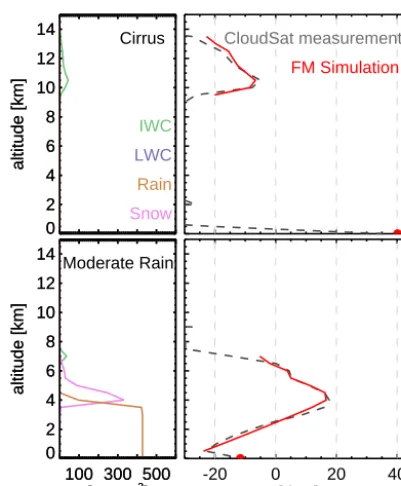
Figure 2. Comparisons between CloudSat measurements and for-ward model simulations. Forfor-ward model simulations are only shown for those altitudes with hydrometeors; the surface return is represented by a dot. For a detailed description see Sect. 3.6.
3.3 Gas absorption
The absorption coefficient with respect to volume mixing ra-tio,κi for theith species, was computed using
κi=κLBLi +κconti , (10)
whereκLBLi is the line-by-line cross-section contribution de-scribed in Read et al. (2004, Chapter 11) and Read et al. (2006) using a Voigt lineshape with a Van Vleck–Huber pref-actor (Huber and Vleck, 1966; Buehler et al., 2005) and whereκconti is the continuum contribution described in Read et al. (2004, Chap. 12). Molecular line strengths and frequen-cies were taken from the HITRAN database (Rothman et al., 1998) and the JPL spectroscopy catalog (Pickett et al., 1998) in the same manner as the EOS MLS molecular line catalog (Read et al., 2006).
3.4 TDTS approximation
Using the scattering properties and the gaseous absorp-tion previously computed, we use the publicly avail-able code described by Hogan (2013), which follows the time-dependent two-stream (TDTS) approximation by Hogan and Battaglia (2008) to compute the time-dependent radar return. This model splits the photons into two cate-gories: those that have only being affected by single scat-tering and those that have experienced wide-angle multiple scattering events. The time-dependent two-stream model has
200 240 280 320 Temparature [K] 0
5 10 15 20
altitude [km]
0.000 0.004 0.008 H2O [VMR] 0
5 10 15 20
altitude [km]
980 1000 1020 1040
surface pressure [hPa] 42
44 46 48 50 52
Z52.8 - Z54.9 [dB]
980 1000 1020 1040
surface pressure [hPa] 42
44 46 48 50 52
Z52.8 - Z54.9 [dB]
Midlatitudes Polar Summer Polar Winter
Figure 3. Simulated clear-sky relationships between surface pres-sure and surface radar returns. The top row shows the effect of varying the temperature profile while the bottom shows the effect of varying water vapor. Each color-coded point represents an ad-justment of the entire pressure profile.
been shown to perform well in comparison with benchmark Monte Carlo simulations in most cloud scenarios of interest here (i.e., not deep convection) while being more computa-tionally efficient (Battaglia et al., 2010).
3.5 Ocean radar backscatter
Ocean surface backscattering properties were computed with the quasi-specular scattering model for low incidence an-gles described by Valenzuela (1978), Brown (1990), and Li et al. (2005). This model has been used in the external cal-ibration of CloudSat (Tanelli et al., 2008) and the Radar Aéroporté et Sol de Télédétection des Propriétés Nuageuses (RASTA) (Bouniol et al., 2008). Mean-square surface slopes were taken from the empirical relationship described by Wu (1990), using the microwave dielectric constants for seawa-ter modeled by Klein and Swift (1977). The incidence angle was assumed to be zero (nadir), the sea surface temperature 28◦C, the surface wind 3 m s−1, the Fresnel reflection coef-ficient correction factor 1 and zero salinity (which does not impact radar observables at around 60 GHz).
3.6 Forward model evaluation
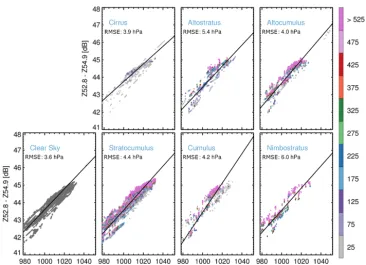
Figure 4. Simulated relationships between surface radar returns and surface pressure. Each point represents a CloudSat-driven simulation for each of the CloudSat measurements available in 15 January 2007 (clear-sky and cloudy cases only). The total hydrometeor column (for these cases IWC+LWC only) is color-coded. Dark gray is used for clear-sky cases (total hydrometeor column equal to zero). The root-mean-square error (RMSE) displayed is the overall linear regression error (black line) when fitting all the cases for each scenario.
Figure 5. As in Fig. 4 but for precipitating cases. In this case, the total hydrometeor column includes IWC, LWC, rain, and snow. Drizzle, slight, and moderate correspond to rain rates lower than 0.1, between 0.1 and 1, and between 1 and 10 mm h−1, respectively.
temperature, pressure, water vapor, and ozone from the Euro-pean Centre for Medium-Range Weather Forecasts auxiliary (ECMWF-aux) products. A description of the 2B-GeoProf measurements and the 2B-CWC-RO R04 and 2C-RAIN-PROFILE retrievals can be found in Marchand et al. (2008), Austin et al. (2009), and Lebsock and L’Ecuyer (2011), re-spectively. The ECMWF-aux data are ECMWF model out-puts interpolated in time and space to the CloudSat mea-surements (Partain, 2007). Furthermore, we also use the
2B-CLDCLASS product (Sassen and Wang, 2008) for cloud classification.
Table 1. Systematic uncertainties perturbations∗.
Perturbation Amount Comments
Temperature 3 K Calculated as the average of 10
randomly perturbed profiles
Water vapor 10 % Applied at all heights
IWC error 50 % –
LWC error 50 % –
Rain error 50 % –
Snow error 50 % –
IWC PSD1 – Heymsfield et al. (2002)
IWC PSD2 – Donovan and van Lammeren (2002)
LWC PSD1 – Lognormal distribution with a
6 µm mean radius and a 1.5 spread.
Rain PSD1 – Marshall and Palmer (1948)
Rain PSD2 – Willis (1984)
Snow PSD1 – Gunn and Marshall (1958)
Surface wind 12 m s−1 –
∗For the “unperturbed” characteristics see Sect. 3.
a comparison between the forward model run and CloudSat measurements under two scenarios, a cirrus and a precip-itating case (rain rate>1 mm h−1). In both cases, the for-ward model matches the CloudSat return, suggesting that the forward model assumptions are similar to the assumptions made in the CloudSat forward models used in such retrievals. Around 300 scenarios were simulated with an root-mean-square error (RMSE) of∼3.5 dB.
4 Forward model simulations
Figure 3 shows clear-sky simulated differential radar surface returns between 52.8 (with return values of around 40 dBZ) and 54.9 (with return values of around ±1 dBZ) GHz and surface pressure under three thermal and three water vapor conditions. These radar tones are used because they were se-lected by Lin and Hu (2005) as the best combination among a subset of six tones. As shown, there is a linear relation-ship between the differential radar surface returns and sur-face pressure. The slope of this curve is the exploitable sig-nal, which is on the order of 1 dB/20 hPa. This figure shows that this signal is essentially insensitive to atmospheric wa-ter vapor burden but demonstrates a large sensitivity to the atmospheric temperature, which affects the pressure broad-ening of the lines within the oxygen band. In particular, it is the temperature close to the surface that influences the signal the most.
To investigate the effect of clouds and rain, as in Sect. 3.6, we use CloudSat-driven simulations (i.e., using IWC, LWC, rain, snow, temperature, pressure, water vapor, and ozone from CloudSat products) using data from 15 January 2007. We subset the data into clear-sky, cloudy, and rainy scenar-ios using the CloudSat cloud classification product as well as the rain rate estimate. Figures 4 and 5 display clear-sky,
0 2 4 6 8 10 altitude [km] 0 2 4 6 8 10 altitude [km] IWC LWC Rain Snow Clear Sky 0.0001 0.0010 0.0100 0.1000 1.0000 10.0000 [hPa]
Max Pot Bias: 0.43 [hPa] Prec: 1.47 [hPa]
0 2 4 6 8 10 altitude [km] 0 2 4 6 8 10 altitude [km] Cirrus 0.0001 0.0010 0.0100 0.1000 1.0000 10.0000 [hPa]
Max Pot Bias: 0.42 [hPa] Prec: 1.47 [hPa]
0 2 4 6 8 10 altitude [km] 0 2 4 6 8 10 altitude [km] Nimbostratus 0.0001 0.0010 0.0100 0.1000 1.0000 10.0000 [hPa]
Max Pot Bias: 0.41 [hPa] Prec: 1.45 [hPa]
0 2 4 6 8 10 altitude [km] 0 2 4 6 8 10 altitude [km] Drizzle 0.0001 0.0010 0.0100 0.1000 1.0000 10.0000 [hPa]
Max Pot Bias: 2.90 [hPa] Prec: 1.47 [hPa]
0 100 200 300 [mg m-3
] 0 2 4 6 8 10 altitude [km]
0 100 200 300 [mg m-3
] 0 2 4 6 8 10 altitude [km] Slight Rain 0.0001 0.0010 0.0100 0.1000 1.0000 10.0000 [hPa] Temperature H 2O
IWC IWC PSD1 IWC PSD2 LWC LWC PSD Rain Rain PSD1 Rain PSD2 Snow Snow PSD Surf Wind Max Pot Bias Precision
Max Pot Bias: 6.60 [hPa] Prec: 1.48 [hPa]
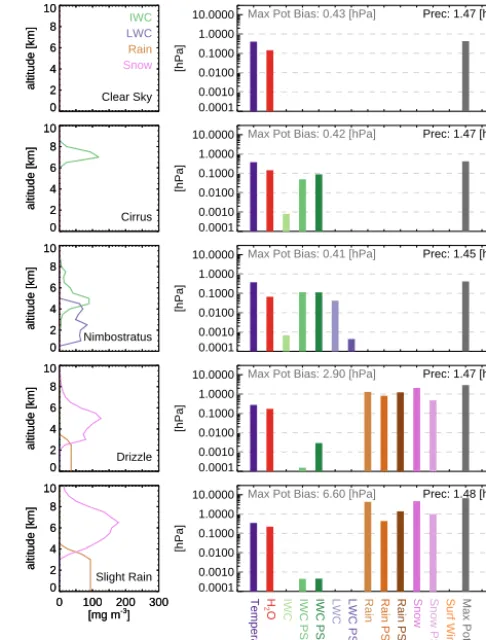
Figure 6. Systematic error estimates caused by each of the sources described in Table 1 as well as the precision and maximum poten-tial bias for five different scenarios (clear sky, cirrus, nimbostratus, drizzle, and slight rain). The maximum potential bias is the root-sum-square combination of all the error sources shown. These ulations were performed using 52.8 and 54.8 GHz radar tones; sim-ulations using optimum frequencies are shown in Fig. 8.
cloudy, and rainy simulated relationships between differen-tial radar surface returns and surface pressure. As shown, there are good linear relationships between the differential radar returns and surface pressure even under moderate rain conditions. The RMSE in surface pressure varies from 3.6 to 6 hPa using scenario-by-scenario linear regressions. For example, an RMSE of 4.4 hPa was found by a linear regres-sion using all the stratocumulus simulations. Under clear-sky conditions, the spread found in these simulations is due to the different background conditions, in particular temperature, as demonstrated in Fig. 3. For cloudy and rainy conditions, the spread results from a mixture of different background con-ditions plus different hydrometeors. The hydrometeor influ-ence is most evident in the moderate rain subplot.
0.1
1.0 10.0 100.0
error [hPa]
Precision Worst Case Temperature biases
Worst Case H2O biases Worst Case Hydrometeor biases
50.0 50.5 50.0 51.0 50.0 51.5 50.0 52.0 50.0 52.5 50.0 53.0 50.0 53.5 50.0 54.0 50.0 54.5 50.0 55.0 50.5 51.0 50.5 51.5 50.5 52.0 50.5 52.5 50.5 53.0 50.5 53.5 50.5 54.0 50.5 54.5 50.5 55.0 51.0 51.5 51.0 52.0 51.0 52.5 51.0 53.0 51.0 53.5 51.0 54.0 51.0 54.5 51.0 55.0 51.5 52.0 51.5 52.5 51.5 53.0 51.5 53.5 51.5 54.0 51.5 54.5 51.5 55.0 52.0 52.5 52.0 53.0 52.0 53.5 52.0 54.0 52.0 54.5 52.0 55.0 52.5 53.0 52.5 53.5 52.5 54.0 52.5 54.5 52.5 55.0 53.0 53.5 53.0 54.0 53.0 54.5 53.0 55.0 53.5 54.0 53.5 54.5 53.5 55.0 54.0 54.5 54.0 55.0
0.0 0.2 0.4 0.6 0.8
1.0 pair of radar tones [GHz]
Figure 7. Precision and potential biases for the nimbostratus case shown in Fig. 6 using all the possible combinations between 50 and 55 GHz every 0.5 GHz. The hydrometeor bias is the root-mean-square sum of the errors labeled IWC, IWC PSD1, IWC PSD2, LWC, LWC PSD, Rain, Rain PSD1, Rain PSD2, Snow, and Snow PSD in Fig. 6.
Table 2. “Optimum” radar tones.
Scene Radar tones Precisiona Potential biasa Potential biasa
type (GHz) (hPa) 80 % of the time (hPa) 90 % of the time (hPa)
Clear sky 50.0, 55.0 1.1 0.45 0.45
Cirrus 50.0, 55.0 1.1 0.45 0.50
Altostratus 50.0, 55.0 1.1 0.50 0.70
Altocumulus 50.0, 55.0 1.1 0.50 0.70
Stratocumulus 50.0, 55.0 1.1 0.55 0.90
Cumulus 50.0, 55.0 1.1 0.70 1.10
Nimbostratus 50.0, 55.0 1.1 0.70 1.00
Drizzleb 53.5, 55.0 1.6 1.35 1.65
Slight rainb 54.0, 55.0 2.1 1.80 2.35
Moderate rainb 54.0, 55.0 2.1 2.75 3.35
aEstimates computed using end-to-end retrievals for each of the CloudSat measurements available in 15 January 2007 (Figs. 9
and 10).bDrizzle, slight, and moderate rain correspond to rain rates lower than 0.1, between 0.1 and 1, and between 1 and 10 mm h−1, respectively.
course, such naive assumption is not expected, as opera-tional weather analysis can provide reasonable constraints on the atmospheric temperature and a range gated radar system would itself provide information on the cloud/precipitation scenario. Note that subsetting the data using this ancillary knowledge will reduce the RMSE.
5 Error characterization and tone selection
To further study the capabilities of this technique, end-to-end retrievals were performed using 1 day of CloudSat-driven simulations as synthetic measurements. The retrieval algo-rithm used was a least-squares fit following Rodgers (2000) and assuming hydrostatic equilibrium. These retrievals allow us to quantify both the precision and accuracy of the sur-face pressure retrievals when using ancillary knowledge of
the atmospheric temperature or cloud/precipitation scenar-ios. The precision reflects the contribution from the measure-ment noise. The accuracy reflects systematic error sources, such as the error due to the assumed temperature profile, the error due to the characterization of particulate extinction (σPext(λ, s)) or the error due to the characterization in the
surface backscatter (σ0(λ)) properties.
0 2 4 6 8 10 altitude [km] 0 2 4 6 8 10 altitude [km] IWC LWC Rain Snow Clear Sky 0.0001 0.0010 0.0100 0.1000 1.0000 10.0000 [hPa]
Max Pot Bias: 0.44 [hPa] Prec: 1.11 [hPa]
0 2 4 6 8 10 altitude [km] 0 2 4 6 8 10 altitude [km] Cirrus 0.0001 0.0010 0.0100 0.1000 1.0000 10.0000 [hPa]
Max Pot Bias: 0.51 [hPa] Prec: 1.11 [hPa]
0 2 4 6 8 10 altitude [km] 0 2 4 6 8 10 altitude [km] Nimbostratus 0.0001 0.0010 0.0100 0.1000 1.0000 10.0000 [hPa]
Max Pot Bias: 0.51 [hPa] Prec: 1.09 [hPa]
0 2 4 6 8 10 altitude [km] 0 2 4 6 8 10 altitude [km] Drizzle 0.0001 0.0010 0.0100 0.1000 1.0000 10.0000 [hPa]
Max Pot Bias: 2.32 [hPa] Prec: 1.63 [hPa]
0 100 200 300 [mg m-3] 0 2 4 6 8 10 altitude [km]
0 100 200 300 [mg m-3] 0 2 4 6 8 10 altitude [km] Slight Rain 0.0001 0.0010 0.0100 0.1000 1.0000 10.0000 [hPa] Temperature H 2O
IWC IWC PSD1 IWC PSD2 LWC LWC PSD Rain Rain PSD1 Rain PSD2 Snow Snow PSD Surf Wind Max Pot Bias Precision
Max Pot Bias: 4.55 [hPa] Prec: 2.13 [hPa]
Figure 8. As Fig. 6 except these simulations were performed using the radar tones listed in Table 2.
a perturbed set of synthetic measurements were generated and run through the retrieval algorithm. For instance, when computing the systematic uncertainty related to temperature, only the temperature values were perturbed, while the rest (IWC, LWC, rain, snow, PSDs, etc.) were left unperturbed. The surface pressure retrieved for each of these perturba-tions is then compare to the base case. Table 1 summarizes the perturbations used. The spectroscopic uncertainties such as the errors due to the atmospheric absorption continuum (O2, N2, H2O), the line strength, and line width, as well as
the line mixing due to close spacing of the O2 lines around
the 60 GHz spectral region, will be investigated in a future study but presumably their impact will be small (i.e., given the successful DAR measurements from Flower and Peck-ham, 1978, and Lawrence et al., 2011), and calibrated out as part of a vicarious calibration campaign and can be better bounded through dedicated laboratory measurements.
Figure 6 shows the result of the uncertainty characteriza-tion for surface pressure retrievals under five different sce-narios using 52.8 and 54.9 GHz radar tones. Using these particular tones with 0.05 dBZ instrument noise, the preci-sion estimate was 1.5 hPa. In general, for all-sky conditions the most persistent potential error source was the assumed
temperature profile; this uncertainty results in biases of no more than∼0.5 hPa. In cloudy but non-precipitating situa-tions this is followed by uncertainties due to errors in IWC and LWC as well as their corresponding PSD. For precip-itating cases, the dominant source of uncertainty originates from errors in the rain and snow estimates as well as their corresponding PSD uncertainties; this can lead to worst-case biases as large as ∼6.6 hPa. Lastly, uncertainties induced by possible errors in water vapor and surface wind (which change the surface backscattering) are negligible.
End-to-end retrievals allow us to select the radar tones which minimize the total error (precision plus accuracy). The precision can be thought of as a measure of the signal-to-noise ratio of the measurement system. As already shown (see Fig. 1 – top), atmospheric attenuation varies drastically near the 60 GHz O2band; the closer to the band center, the
stronger the O2 absorption. Clearly, positioning both radar
tones near the absorption wings will provide no surface pres-sure information because the absorption for the two radar tones will be almost equal. Tones close to the band cen-ter will provide no information because they are fully at-tenuated. Hence, frequencies with moderate O2 absorption
carry the most potential surface pressure information. Fur-thermore, these moderately O2absorbed frequencies should
be spaced as far apart as possible to increase their spectral contrast, which translates to a better differential signal and therefore improves the precision of the retrieved surface pres-sure.
As a demonstration of the tone selection process, we high-light the nimbostratus case shown in Fig. 6. Figure 7 shows the precision and potential biases using all the possible com-binations between 50 and 55 GHz every 0.5 GHz. As ex-pected, precision increases with tone spectral separation; specifically 50 and 50.5 have the worst precision while 50 and 55 have the highest precision.
Also shown in Fig. 7 are the potential biases due to tem-perature, water vapor, and hydrometeors. In principle, these biases should increase with tone separation because the spec-tral differences in the target optical properties increase (see Fig. 1). However Fig. 7 demonstrates that the increase in sig-nal with tone separation dominates the potential increase in these biases. In general, this results in a decrease in retrieval biases with tone separation. Nonetheless, we note that the smallest hydrometeor and H2O potential biases are found
us-ing 54 and 55 GHz, the two closest radar tones still contain-ing pressure information.
0.0 0.2 0.4 0.6 0.8 1.0
Frequency
0.0 0.2 0.4 0.6 0.8 1.0
Frequency
Cirrus Altostratus
0.0 0.2 0.4 0.6 0.8 1.0
Cumulative Frequency
Altocumulus
0 1 2 3 max pot bias [hPa] 0.0
0.2 0.4 0.6 0.8 1.0
Frequency
0 1 2 3 max pot bias [hPa] 0.0
0.2 0.4 0.6 0.8 1.0
Frequency
Clear Sky
0 1 2 3 max pot bias [hPa] 0 1 2 3
max pot bias [hPa] Stratocumulus
0 1 2 3 max pot bias [hPa] 0 1 2 3
max pot bias [hPa] Cumulus
0 1 2 3 max pot bias [hPa]
0.0 0.2 0.4 0.6 0.8 1.0
Cumulative Frequency
0 1 2 3 max pot bias [hPa]
Nimbostratus
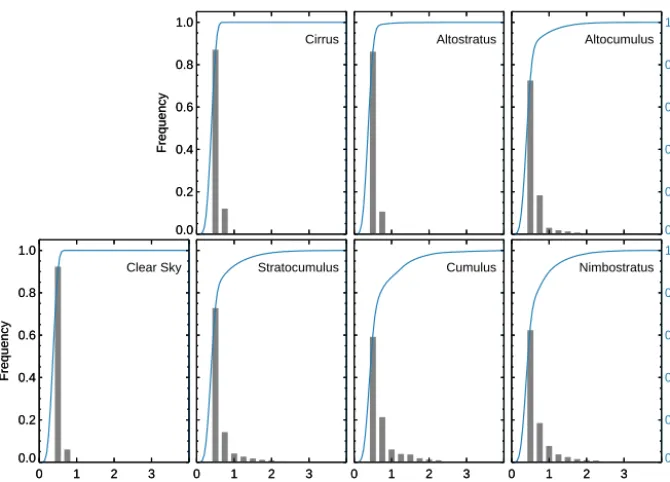
Figure 9. Histogram (gray) and cumulative histogram (blue) of the maximum potential biases for CloudSat-driven end-to-end retrievals for each of the CloudSat measurements available in 15 January 2007 (clear-sky and cloudy cases only).
0 1 2 3 4 5 6
max pot bias [hPa] 0.0
0.2 0.4 0.6 0.8 1.0
Frequency
0 1 2 3 4 5 6
max pot bias [hPa] 0.0
0.2 0.4 0.6 0.8 1.0
Frequency
Drizzle
0 1 2 3 4 5 6
max pot bias [hPa]
0 1 2 3 4 5 6
max pot bias [hPa] Slight Rain
0 1 2 3 4 5 6
max pot bias [hPa] 0.0 0.2 0.4 0.6 0.8 1.0
Cumulative Frequency
0 1 2 3 4 5 6
max pot bias [hPa] Moderate
Rain
Figure 10. As in Fig. 9 but for precipitating cases.
To quantify this general conclusion for specific types of scenario we repeated this tone selection process for clear-sky, cloudy, and precipitating conditions, constructed from CloudSat representative profiles spread through 2007. For each scene type, around 30 cases were selected. As expected, for non-precipitating cases, the best combination was 50 and 55 GHz because the hydrometeor potential biases were small. For drizzle, the best combination was 53.5 and 55 GHz, be-cause the hydrometeor potential biases had comparable lev-els to the precision. Lastly, for slight and moderate rain, where the error budget was dominated by the hydrometeor potential biases, we found that the best combination was 54 and 55 GHz.
To test this technique under a wide range of conditions, end-to-end retrieval simulations were performed for all the available CloudSat measurements from 15 January 2007 us-ing the optimum tones. Under clear-sky and cloudy condi-tions the precision of all the retrievals was improved to∼1.1, under drizzle rain it was∼1.6, and under slight and moder-ate rainy conditions it was∼2.1 hPa. Figures 9 and 10 show clear-sky, cloudy, and precipitating maximum potential bi-ases histograms. The potential bibi-ases 90 % of the time for clear-sky and cloudy conditions will be less than∼1.1, for drizzle and slightly rainy conditions they will be less than ∼2.4, and for moderate rain they will be less than 3.4 hPa. Table 2 also lists the precision and potential maximum bias for each scene type. Note that, due to the differential na-ture of this technique, even though all the simulations were performed using an ocean backscatter model, these results are expected to be similar over land because the land sur-face backscattering coefficient (σ0(λ)) is also weakly de-pendent on wavelength within the region of interest. These results demonstrate that this technique holds considerable potential as a method for retrieving surface pressure under realistic clear sky through moderate precipitating scenarios. Furthermore, these measurements should provide useful con-straints for numerical weather forecasting (Flower and Peck-ham, 1978; Lin and Hu, 2005), closing the large gaps in the measured surface pressure coverage, particularly over the oceans. The quantitative impact of these measurements needs to be investigated using Observing System Simulation Ex-periments (OSSEs) or similar techniques to study the impact on data assimilation and forecast system performance.
6 Summary and conclusions
We have discussed the theoretical capabilities of a differ-ential absorption radar technique to retrieve surface pres-sure under clear-sky, cloudy, and precipitating conditions. It was established that the differential radar returns near to the 60 GHz O2 absorption region mostly depend upon surface
pressure and temperature distribution. From this, it follows that, assuming a temperature distribution, it should be possi-ble to invert a set of radar tones to retrieved surface pressure. An inversion scheme was implemented focusing on the re-trieval propagation of systematic biases as well as random er-rors (the retrieval precision). This provided a tool to weight the surface pressure signal against errors introduced by un-certainties in other parameters needed by the retrieval such as the assumed temperature distribution, hydrometeor abun-dances, and particle size distributions.
To find optimum radar tones for different scenarios (cir-rus, altostratus, altocumulus, stratus, stratocumulus, cumu-lus, and nimbostratus, as well as drizzle, slight, and moder-ate rain), an ensemble of around 30 cases for each scenario was constructed using CloudSat data. Then, end-to-end re-trievals were performed using all possible pairs of radar tones
between 50 and 55 every 0.5 GHz. Ultimately, the best pair of radar tones depends upon the magnitude of the potential biases. For biases smaller than the precision uncertainty, the best pair is 50 and 55 GHz, which increases the spectral con-trast hence reducing the precision error. This is typically the case for clear-sky and cloudy scenarios. For biases greater than the precision uncertainty, the best pair is 54 and 55 GHz, which reduces the impact of the variation in particulate ex-tinction with frequency. This is typical for slight and moder-ate rain scenarios. Lastly, for biases comparable to the pre-cision, the best pair is such that both the precision and the biases are minimized.
Finally, using these optimum sets of radar tones, we in-verted a whole day of CloudSat measurements to show the capabilities of this technique under a wide range of condi-tions. Our results suggest a minimal radar system with tones at 50 and 55 GHz to maximize precision in the prevalent non-precipitating scenarios. Addition of a third tone at 54 GHz would provide an optimum platform for retrievals with pre-cision better than 2 hPa in all-sky conditions and commonly ∼1 hPa. Generally, worst-case scenario biases will be less than 2 hPa, typically 0.5 and 1 hPa for non-precipitating and precipitating conditions. These results demonstrate that this technique holds considerable potential as a method for re-trieving surface pressure under a realistic clear sky through moderate precipitating scenarios.
Future research will investigate the feasibility of using not only the surface returns but also the atmospheric returns due to the hydrometeors in a given scene to invert vertical pres-sure profiles. This may allow us to derive the atmospheric scale height and thus the temperature profile in the lower tro-posphere.
Acknowledgements. The research described in this paper was
carried out at the Jet Propulsion Laboratory, California Institute of Technology, under contract with the National Aeronautics and Space Administration and funded through the internal Research and Technology Development program.
Edited by: S. Kirkwood
References
Abel, S. J. and Boutle, I. A.: An improved representation of the raindrop size distribution for single-moment microphysics schemes, Q. J. Roy. Meteorol. Soc., 138, 2151–2162, 2012. Austin, R. T., Heymsfield, A. J., and Stephens, G. L.: Retrieval
of ice cloud microphysical parameters using the CloudSat millimeter-wave radar and temperature, J. Geophys. Res., 114, D00A23, doi:10.1029/2008JD010049, 2009.
Barton, I. J. and Scott, J. C.: Remote measurement of surface pres-sure using absorption in the oxygen A-band, Appl. Optics, 25, 3502–3507, 1986.
Battaglia, A., Tanelli, S. Kobayashi, S., Zrnic, D., Hogan, R. J., and Simmer, C.: Multiple-scattering in radar systems: a review, J. Quant. Spectrosc. Ra., 111, 917–947, 2010.
Bouniol, D., Protat, A., Plana-Fattori, A., Giraud, M., Vinson, J.-P., and Grand, N.: Comparison of airborne and spaceborne 95-ghz radar reflectivities and evaluation of multiple scattering ef-fects in spaceborne measurements, J. Atmos. Ocean. Tech., 25, 1983–1995 doi:10.1175/2008JTECHA1011.1, 2008.
Brown, G.: Quasi-specular scattering from the air–sea interface, in: Surface Waves and Fluxes, edited by: Plant, W. and Geernart, G., 2, Kluwer Academic, 1–40, 1990.
Buehler, S. A., Eriksson, P., Kuhn, T., von Engeln, A., and Verdes, C.: ARTS, the atmospheric radiative transfer simulator, J. Quant. Spectrosc. Ra., 91, 65–93, 2005.
Donovan, D. and Lammeren, A.: First ice cloud effective particle size parameterization based on combined Lidar and radar data, Geophys. Res. Lett., 29, 1006, doi:10.1029/2001GL013731, 2002.
Eriksson, P., Ekström, M., Rydberg, B., and Murtagh, D. P.: First Odin sub-mm retrievals in the tropical upper tropo-sphere: ice cloud properties, Atmos. Chem. Phys., 7, 471–483, doi:10.5194/acp-7-471-2007, 2007.
Fitzgerald, J. W. and Spyers-Duran, P. A.: Changes in cloud nucleus concentration and cloud droplet size distribution associated with pollution from St. Louis, J. Appl. Meteorol., 12, 511–516, 1973. Flower, D. A. and Peckham, G. E.: A Microwave Pressure Sounder,
JPL Publication 78-68, Caltech, 1978.
Gerber, H.: Microphysics of marine stratocumulus clouds with two drizzle modes, J. Atmos. Sci., 53, 1649–1662, 1996.
Gunn, K. L. S. and Marshall, J. S.: The distribution with size of aggregate snowflakes, J. Meteorol., 15, 452–461, 1958. Hannel, R. A.: Determination of cloud altitude from a satellite, J.
Geophys. Res., 66, p. 1300, 1961.
Heymsfield, A., Bansemer, A., Field, P. R., Durden, S. L., Stith, J. L., Dye, J. E., Hall, W., and Grainger, C. A.: Observa-tions and parameterizaObserva-tions of particle size distribuObserva-tions in deep tropical cirrus and stratiform precipitating clouds: results from in situ observations in TRMM field campaigns, J. Atmos. Sci., 59, 3457–3491, 2002.
Hogan, R. J.: Multiscatter: a fast, approximate multiple scat-tering algorithm, University of Reading, available at: http:// www.met.reading.ac.uk/clouds/multiscatter/ (last access: March 2013), 2013.
Hogan, R. J. and Battaglia, A.: Fast lidar and radar multiple-scattering models. Part II: Wide-angle multiple-scattering using the time-dependent two-stream approximation, J. Atmos. Sci., 65, 3636–3651, doi:10.1175/2008JAS2643.1, 2008.
Howell, W.: The growth of cloud drops in uniformly cooled air, J. Meteorol., 6, 134–149, 1949.
Huber, D. L. and van Vleck, J. H. V.: The role of Boltzmann factors in line shape, Rev. Mod. Phys., 38, 187–204, 1966.
Hufford, G. A.: A model for the complex permittivity of ice at fre-quencies below 1 THz, Int. J. Infrared Milli., 12, 677–682, 1991. King, M. D., Radke, L. D., and Hobbs, P. V.: Optical properties of marine stratocumulus clouds modified by ships, J. Geophys. Res., 98, 2729–2739, 1993.
Klein, L. A. and Swift, C. T.: An improved model for the dielectric constant of sea water at microwave frequencies, IEEE T. Antenn. Propag., 25, 104–111, 1977.
Korb, C. L. and Weng, C. Y.: A theoretical study of a two-wavelength lidar technique for the measurement of atmospheric temperature profiles, J. Appl. Meteorol., 21, 1346–1355, 1982. Lawrence, R. Lin, B., Harrah, S., Hu, Y., Hunt, P., and Lipp, C.:
Ini-tial flight test results of differenIni-tial absorption barometric radar for remote sensing of sea surface air pressure, J. Quant. Spec-trosc. Ra., 12, 247–253, 2011.
Lebsock, M. and L’Ecuyer, T. S.: The retrieval of warm
rain from CloudSat, J. Geophys. Res., 116, D20209,
doi:10.1029/2011JD016076, 2011.
Li, L., Heymsfield, G. H., Tian, L., and Racette, P. E.: Measure-ments of ocean surface backscattering using an airborne 94-GHz cloud radar – implication for calibration of airborne and space-borne W-Band radars, J. Atmos. Ocean. Tech., 22, 1033–1045, doi:10.1175/JTECH1722.1, 2005.
Liebe, H. J., Hufford, G. A., and Manabe, T.: A model for the com-plex permittivity of water at frequencies below 1 THz, Int. J. In-frared Milli., 12, 659–675, 1991.
Lin, B. and Hu, Y.: Numerical simulations of radar surface air
pres-sure meapres-surements at O2 bands, IEEE T. Geosci. Remote, 2,
324–328, 2005.
Marchand, R., Mace, G. G., Ackerman, T., and Stephens, G.: Hy-drometeor detection using CloudSat – an earth-orbiting 94-GHz cloud radar, J. Atmos. Ocean. Tech., 25, 519–533, 2008. Marshall, J. S. and Palmer, W. Mc K.: The distribution of raindrops
with size, J. Meteorol., 5, 165–166, 1948.
McFarquhar, G. M. and Heymsfield, A. J.: Parameterization of tropical cirrus ice crystal size distribution and implications for radiatiave transfer: results from CEPEX, J. Atmos. Sci., 54, 2187–2200, 1997.
Millán L., Read, W., Kasai, Y., Lambert, A., Livesey, N., Men-drok, J., Sagawa, H., Sano, T., Shiotani, M., and Wu, D. L.: SMILES ice cloud products, J. Geophys. Res., 118, 6468–6477, 2013.
Partain, P.: CloudSat ECMWF-AUX Auxiliary Data Process De-scription and Interface Control Document, Cooperative Insti-tute for Research in the Atmosphere, Colorado State University, 2007.
Pickett, H. M., Poynter, R. L., Cohen, E. A., Delitsky, M. L., Pear-son, J. C., and Muller, H. S. P.: Submillimeter, millimeter, and microwave spectral line catalog, J. Quant. Spectrosc. Ra., 60, 883–890, 1998.
Ray, P. S.: Broadband complex refractive indices of ice and water, Appl. Optics, 11, 1836–1844, 1972.
Read, W. G., Shippony, Z., and Snyder, W. V.: EOS MLS Forward Model Algorithm Theoretical Basis Document, Jet Propulsion Lab., Pasadena, CA, JPL D-18130/CL#04-2238, 2004.
Read, W. G., Shippony, Z., Schwartz, M. J., Livesey, N. J., and Sny-der, W. V.: The clear-sky unpolarized forward model for the EOS Microwave Limb Sounder (MLS), IEEE T. Geosci. Remote, 44, 1367–1379, doi:10.1109/TGRS.2006.873233, 2006.
Rodgers, C.: Inverse Methods for Atmospheric Sounding: The-ory and Practice, Series on Atmospheric, Oceanic and Planetary Physics, Vol. 2, World Scientific, Singapore, 2000.
Mandin, J. Y., Schroeder, J., McCann, A., Gamache, R. R., Wattson, R. B., Yoshino, K., Chance, K. V., Jucks, K. W., Brown, L. R., Nemtchinov, V., and Varinasi, P.: The HITRAN molecular spectroscopic database and HAWKS (HITRAN atmo-spheric workstation): 1996 edition, J. Quant. Spectrosc. Ra., 60, 665–710, doi:10.1016/S0022-4073(98)00078-8, 1998.
Sassen, K. and Wang, Z.: Classifying clouds around the globe with the CloudSat radar: 1-year of results, Geophys. Res. Lett., 35, L04805, doi:10.1029/2007GL032591, 2008.
Sekhon, R. S. and Sirvastava, R. C.: Snow size spectra and radar reflectivity, J. Atmos. Sci., 37, 299–307, 1970.
Singer, S. F.: Measurement of atmospheric surface pressure with a satellite-borne laser, Appl. Optics, 5, 1125–1127, 1968. Smith, S. D., Colles, M. J., and Peckham, G.: The measurement of
surface pressure from a satellite, Q. J. Roy. Meteorol. Soc., 98, 431–433, 1972.
Squires, P.: The microstructure and colloidal stability of
warm clouds, Tellus, 10, 256–261,
doi:10.1111/j.2153-3490.1958.tb02011.x, 1958.
Stephens, G. L., Vane, D. G., Boain, R. J., Mace, G. G., Sassen, K., Wang, Z., Illingworth, A. J., O’Connor, E. J., Rossow, W. B., Durden, S. L., Miller, S. D., Austin, R. T., Benedetti, A., Mitrescu, C., and the CloudSat Science Team: The CloudSat mission and the A-train a new dimension of space-based obser-vations of clouds and precipitation, B. Am. Meteorol. Soc., 83, 1771–1790, 2002.
Tanelli, S., Durden, S. L., Im, E., Pak, K. S., Reinke, D. G., Par-tain, P., Hyanes, J. M., and Marchand, R. T.: CloudSat’s cloud profiling radar after two years in orbit: performance, calibration, and processing, IEEE Geosci. Remote S., 46, 3560–3573, 2008. Tsay, S.-C. and Jayaweera, K.: Physical characteristcs of Arctic
sta-tus clouds, J. Clim. Appl. Meteorol., 23, 584–596, 1984. Valenzuela, G. R.: Theories for the interaction of electromagnetic
and oceanic waves – a review, Bound.-Lay. Meteorol., 13, 61–85, 1978.
Willis, P. T.: Functional fits to some observed drop size distributions and parameterization of rain, J. Atmos. Sci., 41, 1648–1661, 1984.
Wu, D. L.: EOS MLS cloud ice measurements and cloud-sky radia-tive transfer model, IEEE Geosci. Remote. S., 44, 1156–1165, 2006.
Wu, J.: Mean square slopes of the wind-disturbed water surface, their magnitude, directionality, and composition, Radio Sci., 25, 37–48, doi:10.1029/RS025i001p00037, 1990.
Yamamoto, G. and Wark, D. Q.: Discussion of the letter by R. A. Hanel, “Determination of Cloud Altitude from a Satellite”, J. Geophys. Res., 6, p. 3596, 1961.