ORIGINAL ARTICLE
IJPHY
ABSTRACT
Background: Musculoskeletal disorders are the most common health problems for computer users who work for an extended period. The aim of this study was to identify the best work-rest schedule with the three different work-rest groups: no rest break, mid-rest break, and multiple- rest breaks, which was associated with the least EMG activities of the upper trapezius muscle and would be beneficial for musculoskeletal health.
Methods: Forty-five right-handed females complaining of neck discomfort were randomly assigned into three equal groups, Group1 (no rest break) they were be engaged in sixty minutes of typing followed by ten minutes break (60-10), group 2 (mid-rest break) thirty minutes of typing followed by five minutes break (30-5), and group 3 (multiple rest breaks) fifteen minutes of typing followed by 2.5 minutes break (15-2.5). Surface EMG was used to pick up the electrical activity of right and left upper trapezius throughout the computer typing task.
Results: There was a statistically significant reduction of normalized RMS (p<0.05) between the three groups for both right and left upper trapezius. Also, our results demonstrated a positive effect of mid and multiple rest breaks regarding reduced muscle activity in the upper trapezius muscle during a computer work.
Conclusion: There is a positive effect of mid and multiple rest breaks regarding reduced muscle activity in the upper trapezius muscle throughout a computer work in subjects with neck and shoulder discomfort.
Keywords: work-rest schedule, computer users, upper trapezius muscle, normalized RMS, EMG, musculoskeletal dis-orders.
Received 05th January 2017, revised 03rd March 2017, accepted 03rd April 2016
www.ijphy.org
10.15621/ijphy/2017/v4i2/141944
CORRESPONDING AUTHOR
Int J Physiother. Vol 4(2), 71-76, April (2017) ISSN: 2348 - 8336
OPTIMAL WORK-REST SCHEDULE FOR COMPUTER
USERS
*1
Mervat Abdelrahman Mohamed
²Nadia Lotfy Radwan
*1
Mervat Abdelrahman Mohamed
Associate Professor of Physical Therapy and Health Rehabilitation Department
College of Applied Medical Science, Prince Sattam bin Abdulaziz University,
Saudi Arabia. ²Lecturer of Physical Therapy and Health
Rehabilitation Department,
College of Applied Medical Science, Prince Sattam bin Abdulaziz University Saudi Arabia.
INTRODUCTION
Computer work tasks are often outlined by lengthened ex-posure to the monitor while keeping static position with continuous arm movements. Computer work is also te-dious and needs a protracted constant attitude with low muscle contraction. Musculoskeletal syndromes are the most common health problems for computer users who works for an extended period [1, 2,3]. The liability factors for musculoskeletal disorders (MSD) mainly belong to the improper head position, poor extremity postures and pro-tracted exposure time to display unit [4].
Female computer users are more affected than male com-puter users regarding musculoskeletal discomfort. Several studies have reported a positive association between the amount of vulnerability to computer work and the acerbi-ty of discomfort [5]. Furthermore, some authors observed that the duration of mouse use was strongly about the on-going of hand–arm syndrome than the total computer and keyboard time usage [6].
Work-related MSD in the dispersion of office employees is a convincing problem for the head, neck, and shoulder areas [7]. They prevailing perturb the trapezius muscle and afford pain, numbness, tingling, and wreckage of the work time, diminish production rates, decline performance, and cause health problems by generating a variety of symptoms called fatigue [8].
Work fatigue is a normal sensation. However, in a case of intense fatigue, it may influence the person’s performance on the activity of daily living both at work and home. Moreover, severe long-term fatigue may lead to work im-pairment and skip [9].
Thus, put in consideration long exposure to a computer which motive neck and shoulder MSD for operators, phys-ical work capacity, and spiritual force may decline when rest breaks are summated. Rest breaks (pauses) may boost time for muscle recovery and also discontinue static pos-ture duration, time of exposure and continuance in com-puter work. Also, metabolic and circling materials within the muscles may be intensified, and local muscle load may decline [7, 10].
Pauses during computer work possibly may be an active or passive pause. During the active pause, the computer workers are needed to accomplish some specific move-ments such as shoulder elevation and neck exercises while during passive pauses, they fence their computer work, sit back and rest throughout this time [11].
Surface electromyography (EMG) is a non-invasive meth-od giving direct data about muscle activity during the oc-cupational task. Picking up of surface EMG activity have therefore been widely used in ergonomic researchers to as-sess the internal biomechanical vulnerability of the shoul-der region. Most of these studies have incorporated the recordings from the upper trapezius (UT) muscle activity because it is the main site of work-related pain and it is easily reachable with surface electrodes [12].
Nonetheless, there is bounded scientific declaration about
the efficiency of summating rest breaks throughout com-puter operators with work-related MSD. So, the aim of this study is to identify the best work-rest schedule throughout the different three work-rest times: sixty minutes of work followed by ten minutes break (60-10), thirty minutes of work followed by five minutes break (30-5), and fifteen minutes of work followed by 2.5 minutes break (15-2.5) which is associated with the least EMG activities of the UT muscles and would be beneficial for developing musculo-skeletal health.
METHODS
1. Design
This study was implemented in a lab which was construct-ed to be identical to the computer center and an office work circumstances. The experiment was handled at 9 o’clock am. Forty-five right-handed females working with a com-puter for more than four hours daily and sense of neck dis-comfort or shoulders or both of them. They were initiated through written announcement submitted to six offices at Alkharj city, Saudi Arabia. They were asked to answer the questionnaire (a standardized Nordic musculoskele-tal questionnaire)concerning muscle discomfort, general health, and work profile (current position at work, daily time for computer use).
Physical examination of musculoskeletal symptoms was done to reject any other pathological causes of neck em-barrassment. The subjects were randomly assigned into three equal groups, Group1 (no rest break) they were be engaged in sixty minutes of typing followed by ten minutes break (60-10), group 2 (mid-rest break) thirty minutes of typing followed by five minutes break (30-5), and group 3 (multiple rest breaks) fifteen minutes of typing followed by 2.5 minutes break (15-2.5). The typing task was achieved at their normal pace for sixty minutes. The electrical activity of right and left UT was recorded throughout the computer typing task (one hour). The task was composed of typing a document in Arabic which was settled on the right side at document holder.
The computer workstation was individually constructed during the study following the guidelines of the Occupa-tional Safety and Health Administration [11]. Standard computer desk with a flexible glide-out board for the key-board, a chair with flexible armrests was used. The comput-er workstation was adapted to presume a good posture for computer users. Seat height was adjusted in relation to the subject popliteal lengths with subject’s feet were rested flat on the floor. The keyboard and screen were placed central-ly in front of the subjects with the screen top were adapted to the subject’s eye level and the screen distance equal to their arm length.
2. Subjects
coming principles: their age was ranged from 25 to 35 years, work at a computer office for more than four hours daily, have symptoms of neck or shoulder muscle discomfort or both of them at least three on Borg’s CR-10 scale [13] (0 = nothing at all, 10 = extremely strong), muscle discom-fort for over than three months. They were right-handed, working at the same position for at least two years. Subjects were rejected if they were pregnant, overweight i.e. (BMI) was over 25kg/m2 or they had a visual deficit.
3. Interventions
The subjects in all groups were advised to achieve neck and shoulder muscles active exercises during the rest break pe-riod as shoulder shrugging, neck flexion, and extension. During the trial, all subjects followed the exercise sequenc-es provided by a video play.
4. Outcomes
Surface electromyography (SEMG) signals were picked up from the right and the left UT because they are the large muscles involved during computer work [11,14]. Cleaning of the skin at the site of electrode contact was done with an alcohol pad. Two pairs of bipolar silver chloride sur-face electrodes with six millimeters diameter and a cen-tre-to-centre length of two cm were put at the anatomical landmarks of the trapezius muscles (two centimeters later-al to the midpoint between the spinous process of C7 and the acromion process)[15]. A ground electrode was located on the acromion process. Each cable electrode was securely attached with a regular tape to avoid artifacts from cable movement.
The Noraxon Telemyo System was used to pick up the EMG signals. Raw EMG signals were transported through a high-pass filter at 20Hz, a low-pass filter at 200Hz. These signals were achieved through a differential amplifier posi-tioned at active leads with a common mode rejection ratio of more than 100 dB, the input impedance of over 100 MΩ and base gain at 500 times to gain a high-quality signal. Baseline noise was filtered below 1 μVroot mean square (RMS). During the computer typing task, raw EMG signals were recorded and averaged within 200 ms to determine RMS. The electrical activity of both the right and the left UT were picked up during the computer typing task. RMS was analyzed regarding normalized EMG and expressed as a ratio of maximum voluntary electrical activity.
The surface EMG normalization procedures were done be-fore the sixty minutes typing task. Each subject achieved three trials each five seconds of isometric maximal volun-tary contractions (MVCs) for the chosen muscles. Before MVC measurement achievement, active neck and shoulder muscles stretching was done for warming up. EMG nor-malization of the UT muscles was done while the subject was sitting in the upright position and the shoulder was abducted 90°with palms facing down. They were asked to do shoulder abduction against fixed perpendicular resis-tance which was applied through vertically adaptable belt fixed to motionless resistance placed above the elbow, and a straight belt was settled to the trunk of the subject to limit
lousy movement.
Statistical Analysis
SPSS version 20.0 was used, the level of significance was set at p<0.05. The subjects were selected regarding work pro-file (current work duration and the daily working hours), anthropometry and age. Analysis of variance ANOVA was done to examine the efficacy of rest-break time for the de-pendent variable, Root Mean Square (RMS) within groups. Post hoc Bonferroni test was used for pairwise comparison to detect the difference between groups. Nonparametric Kruskal-Wallis test was used to test the muscular discom-fort difference between all groups before proceeding of the rest-break plan time during sixty-minute computer tasks. RESULTS
Participant’s baseline characteristics are outlined in Table 1. It showed that there were no statistically significant dif-ference (p>0.05) throughout all groups concerning age, anthropometric measures (weight, height, and BMI), and work profile measures (current work duration and daily working time) which indicate homogeneity of the three groups.
Table 1: Characteristics of the study participants
(Mean±SD) Groups
F
(2,42) valueP- No-rest
break
(n=15)
Mid- rest break
(n=15)
Multi-ple-rest
breaks
(n=15)
Age(years) 28.53 ± 3.18 30.20 ± 3.62 28.67 ± 3.11 1.447 0.247
BMI ±0.6524.12 23.97 ± 0.93 24.02 ± 0.74 0.737 0.458
Weight(kg) 57.13 ± 7.85 54.74 ± 7.67 56.27 ± 7.10 0.640 0.532
Height(cm) 153.73 ± 8.10 151.27 ± 8.56 154.20 ± 7.96 0.549 0.582
Current work duration
(years)
6.67 ±
1.98 5.73 ± 2.12 4.93 ± 1.58 3.095 0.056
Daily working
time (hours) 6.20 ± 0.94 5.87 ± 0.74 6.20 ± 1.12 1.212 0.308
F: variance between sample means (one-way ANOVA test) P: level of significance
Table 2: Perceived discomfort of RT and LT upper trape-zius muscles on Borg’s CR-10 scale at the baseline.
Perceived discomfort
Groups
Chi-Square
(X2) P-value
No-rest break (n=15)
Mid- rest break (n=15)
Multiple-rest breaks (n=15) (RT upper
trapezius) 5 (5-6) 5 (4-6) 5 (3-6) 1.299 0.522 (LT upper
trapezius) 4 (4-6) 5 (3-6) 4 (3 - 4) 3.452 0.178 Data are expressed as Median (Interquartile ranges)
X2Chi-Squarevalue(Kruskal-Wallis test)
P: level of significance
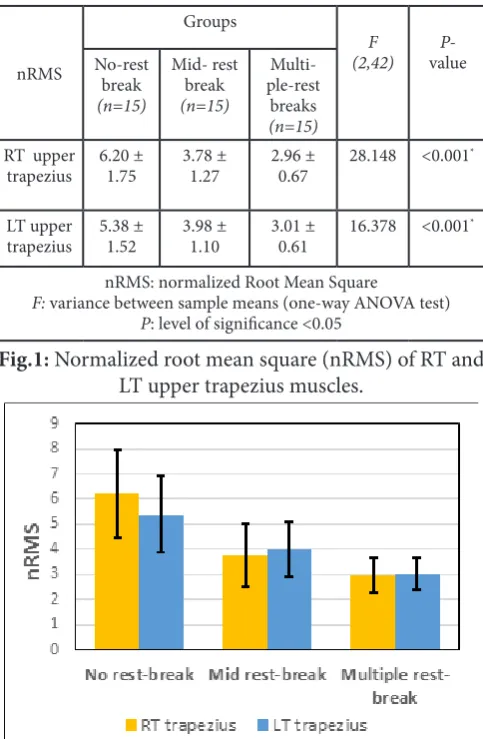
UT muscle’s electrical activity (RT, LT) during sixty min-utes computer task are granted in the table (3). There was statistically significant group effect of rest break times on normalized RMS during sixty minutes of computer work (p<0.05).
Table 3: UT muscle’s electrical activity during sixty min-utes computer work (RT, LT)
nRMS
Groups
F
(2,42) value
P-No-rest break (n=15)
Mid- rest break (n=15)
Multi-ple-rest
breaks (n=15) RT upper
trapezius 6.20 ± 1.75 3.78 ± 1.27 2.96 ± 0.67 28.148 <0.001
*
LT upper
trapezius 5.38 ± 1.52 3.98 ± 1.10 3.01 ± 0.61 16.378 <0.001
*
nRMS: normalized Root Mean Square
F: variance between sample means (one-way ANOVA test) P: level of significance <0.05
Fig.1: Normalized root mean square (nRMS) of RT and LT upper trapezius muscles.
The pairwise comparison as demonstrated in the table (4). Post-hoc analysis registered a significant difference in normalized nRMS of right and left UT muscles between subjects who had no rest-break, mid-rest break or those who had multiple rest breaks (p<0.05) humor the later. However, these results showed a non-significant difference between mid-rest break group and multiple-rest breaks group (p>0.05).
Table 4: Post hoc Bonferroni test for multiple compari-sons of nRMS during sixty minutes of computer work.
RTupper trapezius
muscle LT upper trapezius muscle (X̅1-X̅2) P- value (X̅1-X̅2) P- value
nRMS
No-rest break Vs Mid-rest
break 2.41 0.001
* 1.40 0.005*
No-rest break Vs
Multi-ple-rest break 3.24 0.001
* 2.37 0.001*
Mid-rest break Vs Multiple-rest
break
0.83 0.218 0.97 0.073
nRMS: normalized Root Mean Square (X̅1 - X̅2): the mean difference
P: level of significance <0.05
DISCUSSION
This study was conducted to detect the best work-rest time with the three different work-rest groups: no-rest break, mid-rest break, and multiple- rest breaks, which was asso-ciated with the least EMG activities of the UT muscle and would be beneficial for musculoskeletal health.
About the UT muscle’s electrical activity during sixty min-utes computer work, the results showed that there was a statistically significant difference between the three groups on normalized RMS (p<0.05) for both right and left UT. This result may be referred to the given rest breaks which enhance the oxygen and nutrients supply to the muscles, remove the waste products specifically lactic acid [11.16]. Also, our results demonstrated a positive effect of mid and multiple rest-breaks regarding reduced muscle activity in the UT muscle during a computer work in subjects with neck and shoulder discomfort. These results may be inter-preted that frequent rest breaks may reduce the develop-ment of fatigue of the UT muscle during its static work. In contrast, rest-break of a quite long duration is shown to be improper to achieve total comfort of the UT muscle throughout computer task [17].
Gallis 2013[16], ascertain that multiple-rest breaks are more favorable than single rest-break on work perfor-mance. Moreover, Rohmert 1973 [18], found that short-term rest breaks are associated with fast recovery rate espe-cially throughout the initial part of a rest time.
Henning et al. 1997 [20] study aimed to detect if frequent short- term rest breaks (three times of thirty seconds and one time of three minutes) from computer task hourly, ad-ditional to daily rest breaks had a favorable effect on partic-ipant’s productivity rate and wellbeing. They had reported that there was an increase in the productivity rate as well as eye, leg and foot comfort when the short-term breaks were joined. These results illustrate that frequent short-term breaks from lengthened computer work can improve work productivity rate and wellbeing when the rest breaks are correspondent with the work concerns [21].
The definite results of rest breaks in this study may be due to the effect of active exercises performed during the rest time as supported by the study of Beurskens et al..2000 [9], Mathiassen et al.1997 [22], and Madeleine et al.2008 [23,24]. It is supposed that voluntary muscle contraction (active rest break) may result in enhancement of local circulation which helps the washout of the collected sub-stances throughout the computer work [25]. Lactate re-moval rate was markedly quicker when aerobic exercises were done during recovery as compared with the results that noticed when the subjects are relaxed during recovery period [26].
Similarly, Samani 2010 [27], has reported that active rest breaks improved the variability of the trapezius muscle ac-tivity throughout organized computer work. In this con-text, the general aim of frequent rest break is to give the overloaded motor units an opportunity to relax [11, 28]. Crenshaw et al. [25] contradict our study as they did not report any significant effect of active rest breaks on surface EMG amplitude and discomfort level when compared with the passive rest break.
Furthermore, regarding Cinderella hypothesis developed by Hägg 1991 [29], neck and shoulder muscles disorders may occur as a result of the overuse of low threshold motor units throughout computer work [30,31, 32]. This suggests that a shift in activity from a computer work to a speci-fied activity of the neck and shoulder muscles during rest breaks could create muscle relaxation for computer work-ers with MSD [21].
Proper timing of rest breaks is also of great value. Short, frequent rest breaks are adequate than longer rest breaks. Henning et al.1997 [20], found that short (30-60 seconds) rest breaks from computer work at fifteen minutes inter-vals during the day may assist in reducing musculoskeletal discomfort and improving work rate productivity.
McLean et al.2001 [33], also examined the effects of micro rest breaks on computer terminal workers. They evaluat-ed the myoelectric signals, behavior, perceivevaluat-ed discomfort and work rate productivity while subjects performed their usual keyboard tasks. The study consisted of three groups: A control group with micro breaks at their attention, a group with micro breaks at twenty minutes intervals, and a group with micro breaks at forty minutes intervals. They concluded that micro breaks had a positive effect on di-minishing discomfort during the computer terminal task
especially when breaks were given at twenty minutes in-tervals.
In this study, it is difficult to analyze that the significant dif-ference between the tested groups was due to the rest break time effect or the active exercise effect, or both. Other re-searchers supported our results as they found that short rest breaks combined with exercise were more valuable than passive rest breaks for computer workers. This indi-cates that active rest break is more effective than passive one in reducing musculoskeletal discomfort.
CONCLUSION
There is a positive effect of mid and multiple rest-breaks regarding reduced muscle activity in the upper trapezius muscle during a computer work in subjects with neck and shoulder discomfort.
Acknowledgment
We grant the deanship of scientific research, Prince Sattam Bin Abdulaziz University for their financial support for thisproject.
REFERENCES
[1] Rempel D, Krause N, Goldberg R, Benner D, Hudes M, Goldner GU: A randomized controlled trial eval-uating the effects of two workstation interventions on upper body pain and incident musculoskeletal dis-orders among computer operators. Occup. Environ. Med.2006; 63: 300-306.
[2] Buckle P & Devereux J: Work-related neck and upper limb musculoskeletal disorders. Luxembourg: Office for Official Publications of the European Communi-ties; 1999.Retrieved April 22, 2014.
[3] Strøm V, Røe C, Knardahl S: Work-induced pain, tra-pezius blood flux, and muscle activity in workers with chronic shoulder and neck pain. Pain. 2009;144(1-2):147-155.
[4] Burr H,” Danskernes anvendelse af computer pa arbe-jdet 1999”, National Institute Of Occupational Health, Copenhaen, Denmark: 2000.
[5] Tsauo J, Jang Y, Liang H: Incidence and risk factors of neck discomfort: A 6- month sedentary- worker co-hort study. J OccupRehabil.2007;17:171-179.
[6] Ekman A, Andersson A, Hagberg M, Hjelm EW: Gen-der differences in musculoskeletal health of comput-er and mouse uscomput-ers in the Swedish workforce. Occup Med. 2000;50:608-613.
[7] Janwantanakul P, Pensri P, Jiamjarasrangsri V, Sinsong-sook T: Prevalence of self-reported musculoskeletal symptoms among office workers. Occup Med (Lond). 2008;58(6): 436-8.
[8] Buckle P, Devereux J. The nature of work-related neck and upper limb musculoskeletal disorders. Appl Er-gon.2002;33(3):207-217.
[9] Beurskens A, Bultmann U, Kant I, Vercoulen, J, Blei-jenberg G, Swaen G: Fatigue among working people: validity of a questionnaire measure. Occupational and Environmental Medicine. 2000; 57(5): 353-357.
musculoskeletal load as a basis for intervention: a crit-ical review. ApplErgon. 1996;27(2):79-88.
[11] Nakphet N, Chaikumarn M, Janwantanakul P: Ef-fect of Different Types of Rest-Break Interventions on Neck and Shoulder Muscle Activity, Perceived Discomfort and Productivity in Symptomatic VDU Operators: A Randomized Controlled Trial, Interna-tional Journal of OccupaInterna-tional Safety and Ergonom-ics.2014; 20(2):339-353.
[12] Mathiassen S, Winkel J, and Hagg G: Normalization of Surface EMG Amplitude from the Upper Trapezius Muscle in Ergonomic Studies – A Review j. electro-myogr. kinesiol. 1995; 5(4):197-226.
[13] Borg G: Psychophysical scaling with applications in physical work and the perception of exertion. Scand J Work Environ Health. 1990;16(1):55-58.
[14] Choi H, Vanderby R: Comparison of biomechanical human neck models: muscle forces and spinal loads at C4/5 level. J Appl Biomech. 1999;15(2):120-138. [15] Jensen C, Vasseljen O, Westgaard R: Estimating
max-imal EMG amplitude for the trapezius muscle: on the optimization of experimental procedure and electrode placement for improved reliability and increased sig-nal amplitude. J ElectromyogrKinesiol. 1996;6(1):51-58.
[16] Gallis C : Increasing Productivity and Controlling of Work Fatigue in Forest Operations by Using Pre-scribed Active Pauses: a Selective Review Croat. j. for. eng. 2013; 34(1):103-112.
[17] Blangsted A, Søgaard K, Christensen H, Sjøgaard G: The effect of physical and psychosocial loads on the trapezius muscle activity during computer keying tasks and rest periods. Eur J Appl Physiol 2004;91:253-258.
[18] Rohmert W: Problems of determination of rest allow-ances, part 2: Determining rest allowances in different human tasks. Applied Ergonomics.1973; 4:158-162. [19] Østensvik T, Veiersted K, Nilsen P: A method to
quantify frequency and duration of sustained low-lev-el muscle activity as a risk factor for musculosklow-lev-eletal discomfort. Journal of Electromyography and Kinesi-ology.2009;19(2): 283-294.
[20] Henning R, Jacques P, Kissel G, Sullivan A, Alteras Webb S: Frequent short breaks from computer work: effects on productivity and well-being at two field sites. Ergonomics.1997.40(1): 78-91.
[21] Crenshaw A, Lyskov E, Heiden M and et al: Impact of time pressure and pauses on physiological respons-es to standardized computer mouse use- a review of three papers focusing on mechanisms behind com-puter-related disorders. SJWEH Suppl 2007;(3):68-75.
[22] Mathiassen S, Burdorf A, van der Beek A & Hansson
G: Efficient one-day sampling of mechanical job ex-posure data—A study based on upper trapezius activ-ity in cleaners and office workers. American Industri-al Hygiene Association JournIndustri-al.1997;64:196-211.
[23] Madeleine P, Voigt S, Mathiassen E: The size of
cy-cle-to-cycle variability in biomechanical exposure among butchers performing a standardized cutting task. Ergonomics.2008.51;1078-1095.
[24] Madeleine P, Mathiassen E and Arendt-Nielsen L:
Changes in the degree of motor variability associated with experimental and chronic neck–shoulder pain during a standardized repetitive arm movement. Exp Brain Re.2008;185:689-698.
[25] Crenshaw A, Djupsjöbacka M, Svedmark Å:
Oxy-genation, EMG and position sense during computer mouse work. Impact of active versus passive pauses. Eur J Appl Physiol 2006;97:59-67.
[26] Beynon C, Burke J, Doran D, Nevill A: Effects of
activity-rest schedules on physiological strain and spinal load in hospital-based porters. Ergonomics 43;(10):1063-1770.
[27] Samani A: On advanced biofeedback and trapezius
muscular activity during computer work. Aalborg: Center for Sensory-Motor Interaction (SMI), Depart-ment of Health Science and Technology, Aalborg Uni-versity.2010.
[28] Mathiassen S. Diversity and variation in
biomechan-ical exposure: what is it, and why would we like to know? Appl Ergon. 2006;37(4):419-427.
[29] Hägg G: Static workloads and occupational
myal-gia—a new explanation model. In: Anderson PA, Hobart DJ, Danoff JV, editors. Electromyographical kinesiology. Amsterdam: Elsevier Science Publish-ers.1991: 141-144.
[30] Westad C, Westgaard R and Luca C: Motor unit
re-cruitment and derere-cruitment induced by brief in-crease in contraction amplitude of the human trape-zius muscle,” J. Physiol. (Lond.).2003;552:645-656.
[31] Szeto G, Straker L, O’Sullivan P: EMG median
fre-quency changes in the neck- shoulder stabilizers of symptomatic office workers when challenged by dif-ferent physical stressors. Journal of Electromyography and Kinesiology 2005;15:544-55.
[32] Visser B and van Dieën J: Pathophysiology of upper
extremity muscle disorders. J Electromyogr Kinesi-ol.2006;16:1-16.
[33] McLean L, Tingley M, Scott R, Rickards J: Computer
terminal work and the benefit of microbreaks. Appl Ergon 2001;32:225-237.
Citation