ORIGINAL ARTICLE
IJPHY
ABSTRACT
Background: Physiotherapists are looked upon as role models for practicing a healthy lifestyle. They require a good amount of flexibility and endurance to meet the professional demands. Enhanced flexibility of hamstrings plays a cru-cial role for physiotherapists to maintain good fitness levels and prevent injuries. Suryanamaskar and dynamic stretch-ing exercises have been proved effective in improvstretch-ing hamstrstretch-ing flexibility in various studies. However, no study proves which technique is better. The objective of this study was to assess the effect of Suryanamaskar and dynamic stretching on Hamstring flexibility and also to compare the effect of suryanamaskar and dynamic stretching on Hamstring flexi-bility.
Methods: This was a comparative experimental study done on 30 Physiotherapy students. The subjects were selected by the inclusion criteria and were equally divided into two groups. Suryanamaskar and dynamic stretching were given as intervention program for four weeks to group 1 and two respectively. The measurements of active knee extension test and back savers sit and reach test were separately assessed for both the groups pre and post four weeks.
Results: Statistical analysis proved that there was a significant effect in increasing hamstring flexibility bilaterally in both groups with a P value<0.0001. Intergroup comparison showed that suryanamaskar was more effective in improv-ing hamstrimprov-ing flexibility bilaterally with a P value<0.0001.
Conclusion: This study concluded that suryanamaskar was more effective to improve hamstring flexibility compared to dynamic stretching exercises.
Keywords: Physiotherapists, Hamstring muscle, Hamstring flexibility, Suryanamaskar, Dynamic stretching.
Received 19th February 2018, accepted 19th November 2018, published 09th December 2018
www.ijphy.org
10.15621/ijphy/2018/v5i6/178058
CORRESPONDING AUTHOR
Int J Physiother. Vol 5(6), 202-206, December (2018) ISSN: 2348 - 8336
EFFECT OF SURYANAMASKAR VS DYNAMIC STRETCHING
ON HAMSTRING FLEXIBILITY AMONG PHYSIOTHERAPY
STUDENTS: A PILOT STUDY
*1Anagha Mangaonkar ²Anjali Puntambekar
*1Anagha Mangaonkar
Research Intern, K.J Somaiya College of Physio-therapy, Sion, Mumbai, India.
Email: [email protected] ²Associate Professor, K.J Somaiya College of
Physiotherapy, Sion, Mumbai, India.
INTRODUCTION
Muscle flexibility is defined as the ability to move a single joint or series of joints smoothly and easily through an un-restricted, pain-free range of motion [1]. Hamstring is a two joint muscle which contracts eccentrically to maintain a proper posture in standing hence are prone to be tight. Hamstrings are an example of muscle groups that tend to shorten (Turner et al., 1988). A tight hamstring causes in-creased patellofemoral compressive force, which may even-tually lead to patellofemoral syndrome (Odunaiya N.A., Hamzatt.K., Ajayi O.F.2005) [2]. Hamstring tightness can also lead to altered gait patterns that are inadequate knee extension at initial contact and overuse injuries. Donald E Hartig (1999) reported that increasing hamstring flexibili-ty decreases lower extremiflexibili-ty overuse injuries in basic mil-itary trainees [3]. Hence, hamstring flexibility is essential to prevent the injuries associated with it.
Suryanamaskar or salutation to the sun is an ancient meth-od of yogic practice in India. It is a series of 12 physical postures made up of a variety of forward and backward bends which are – Pranamasan, hasta uthanasan, pada-hastasan, ashwa sanchalasan, parvatasan, ashtanga nam-askar, bhujangasan . The series of movement in suryana-maskar stimulates blood circulation to the whole spinal column and brain resulting in a healthy nervous system. Suryanamaskar causes stretching and contraction of the muscles in a systematic manner leading to increased flexi-bility and strength of muscles [4,5].
The dynamic range of motion(DROM) is defined as a con-trolled movement through the joint active range of motion while moving but not exceeding individual’s extensibili-ty limits (Fletcher & Jones, 2004). According to Murphy, during DROM a contraction of antagonist’s muscle causes the joint crossed by the agonist (lengthening muscle) to move through full range of motion(ROM) at a controlled and slow tempo. This contraction by the antagonist causes
the lengthened muscle to relax due to the principle of re-ciprocal inhibition [6].
Physiotherapists play an important role in the healthcare system hence they need to have a good level of physical fit-ness to meet their job demands. However, this health-relat-ed awareness should be inculcathealth-relat-ed right from the student level. According to a study done in Punjab 2013 which assessed the level of fitness among physiotherapy students, the physical fitness level of physiotherapy students is not satisfactory as compared to the physical demands of the profession. Hence this study emphasizes the hamstring flexibility of physiotherapy students [7].
The objective of this study was to find the effects of sury-anamaskar and dynamic stretching on hamstring flexibility and also to compare the effects of suryanamaskar and dy-namic stretching on hamstring flexibility in physiotherapy students.
METHODOLOGY
The study was conducted in the research lab of KJ Somaiya College of Physiotherapy, Sion. The subjects were
select-ed from KJ Somaiya College of Physiotherapy, Sion.Thirty subjects with a knee extension range <50 degrees and aged 19 -25years were selected for the study. After taking the written consent of the subjects, they were randomly divid-ed into two groups by lottery method. Subjects having any neuromuscular disorders, cardiovascular disorders, ortho-pedic conditions of lower limbs and athletes were exclud-ed from the study. The materials usexclud-ed for the study were plinth, goniometer, straps, sit and reach plinth box and measuring tape.
Outcome measures: Active knee extension test and back savers sit and reach test were used to assess hamstring flex-ibility amongst the subjects. Active knee extension test was performed by subject lying in supine and hip and knee at 90degrees. Knee extension was measured with the univer-sal goniometer. For Back savers sit and reach test, the sub-ject was made to sit at the test apparatus with one leg fully extended such that the sole was flat against the end of the box. The subject bent the other leg so that foot was flat on the floor and 7-10cm to the side of the straight knee. With the leg extended as much as possible, hands on top of each other and palms down, the subject reached forward sliding the hands along the box scale as far as possible. Similarly, the measurements were taken for the other leg [8].
Intervention: Each group comprised of 15 subjects. Group 1 performed suryanamaskar, and group 2 performed dy-namic stretching exercises. Both the protocols began with 5 minutes of warm-up (mobility exercise for all joints). In suryanamaskar protocol, the subjects were well ex-plained about the procedure, and a demonstration of each pose was done. The subjects performed 8 Suryanamaskars in one session. Each Suryanamaskar pose was held for 5 seconds. Hence one cycle of Suryanamaskar lasted for 60 seconds cooldown of 2 minutes followed each session. In dynamic stretching, the protocol included 1 set of 8 ex-ercises – Straight leg strides, inchworm, walking diagonal lunges, carioca, low lateral shifts, single step Romanian deadlift, backward run, high knee pulls. Each set of exer-cise lasted for 1 minute (30 seconds for each leg). Hence, the total duration of the dynamic stretch protocol was 8 minutes [9.10].Each session ended with a cooldown of 2 minutes. The total duration of both the protocols was 15minutes.
STATISTICAL ANALYSIS
Table 1: Bilateral pre-intervention measurements of both outcome measures for suryanamaskar and dynamic
stretching
Protocol Mean (rt) Mean (lt) SD(rt) SD(lt) P value
Suryanamaskar
AKE 34.33 34.933 5.0237 4.0964
0.7927, Not significant Dynamic
stretch-ing AKE 34.8 35.4 4.601 4.355
Suryanamaskar
BSSR 12.866 13.4 2.5317 2.3844 0.6031, Not significant Dynamic
stretch-ing BSSR 12.4 13 2.3237 2.3196
Table 2: Bilateral post-intervention measurements of both outcome measurements for suryanamaskar and dynamic
stretching
Protocol Mean (rt) Mean (lt) SD(rt) SD(lt) P value
Suryanamaskar
AKE 47.133 47.4 5.5788 4.6260 <0.0001(ex-tremely significant) Dynamic
stretching AKE 43.266 43.866 4.6208 4.4859 Suryanamaskar
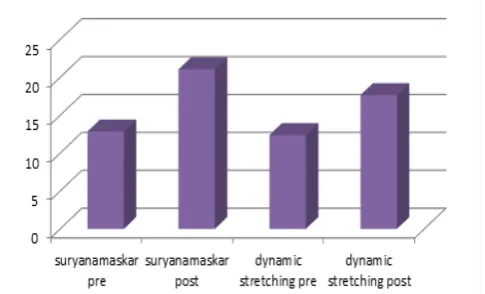
BSSR 21.066 20.933 3.0347 2.5485 <0.0001(ex-tremely significant) Dynamic
stretching BSSR 17.667 18.466 2.3296 2.669
Graph 1: Intergroup comparison for active knee exten-sion test measurements in degrees of right side
Graph 2: Intergroup comparison for active knee exten-sion test measurements in degrees of left side
Graph 3: Intergroup comparison of back savers sit and reach test measurements in centimeters for the right side
Graph 4: Intergroup comparison of back savers sit and reach test measurements in centimeters for the left side
DISCUSSION
Statistical analysis proves that both suryanamaskar and dy-namic stretching are effective in improving hamstring flex-ibility for both legs with p-value <0.0001. This study also proves that suryanamaskar has a more significant effect in improving hamstring flexibility as compared to dynamic stretching for both legs. Hence, this study accepts the alter-nate hypothesis.
Hamstrings form a part of the superficial back line. The superficial back line connects and protects the entire pos-terior surface of the body from the bottom of the foot to the top of the head. When the knees are extended, as in standing, the SBL functions as a continuous line of inte-grated myofascial. Hence the hamstrings get stretched through the superficial back line when Suryanamaskar is performed [11].
Mastrengelo et al. performed a study which concluded that Suryanamaskar has a significant difference in improving hamstring flexibility in menopausal women [12].
Dynamic stretching works on the principle of reciprocal inhibition. Muscle spindles are stretch receptors within the body of a muscle that primarily detect changes in the length of the muscle. When a muscle spindle is stretched, and the stretch reflex is activated, the opposing muscle group is inhibited to prevent it from working against the resulting contraction of the homonymous muscle. This inhibition is accomplished by the actions of inhibitory interneuron in the spinal cord.
Murphy has theorized that as the dynamic range of motion is performed, metabolic processes increase. A decrease in muscle viscosity is caused by the increased temperature of the muscle allowing a smoother contraction. The flexibility of the muscle improves as it becomes more pliable and ac-commodating to the forces placed on it due to its elevated temperature [15].
William D. Bandy, lean M. Irion, Michelle Briggler stud-iedthe effect of Static Stretch and Dynamic Range of Mo-tion Training on the Flexibility of the Hamstring muscles which concluded that dynamic stretching is effective in increasing hamstring flexibility [16]. Erica Taylor Perri-er pPerri-erformed a study which assessed the effect of static and dynamic stretching on reaction time, performance in countermovement jump which concluded that athletes in sports requiring lower extremity power should use dynam-ic stretching techniques in warm up to enhance hamstring flexibility while improving performance [17].
In suryanamaskar, the superficial front line also gets stretched which causes co-contraction of the superficial back line. Owing to the contraction of the muscles of the back, even the smallest muscles of the spinal column, as well as the muscles of the back, are strengthened where-as dynamic stretching affects only the targeted muscle and joint. Suryanamaskar improves blood circulation in the vertebral region, and consequently, the nerves in this re-gion are invigorated. Along with the hamstrings, the flexi-bility of the spine is increased and maintained in suryana-maskar [18].
In addition to flexibility, Suryanamaskar has been proved to have positive physiological effects by improving pulmo-nary function, respiratory pressures, hand grip strength, endurance and resting cardiovascular parameters [19]. These are the possible reasons why suryanamaskar was better as compared to dynamic stretching in this study. Limitations: The study was performed on a smaller sample size. The subjects were chosen from the same geographic region. Carryover effects of both the techniques were not studied.
CONCLUSION
The study concluded that suryanamaskar, as well as dy-namic stretching, are effective in improving hamstring flexibility. It also proved that suryanamaskar is more ef-fective in improving hamstring flexibility as compared to dynamic stretching.
REFERENCES
[1] Carolyn Kisner, Lynn Allen Colby. Therapeutic exer-cise. 6th edition.2012
[2] Odunaiya N.A., Hamzatt.K., Ajayi O.F. The Effects of Static Stretch Duration on the Flexibility of Ham-string Muscles. African Journal of Biomedical Re-search.2005;8: 79 – 82.
[3] Donald E Hartig, John M Henderson. Increasing ham-string flexibility decreases lower extremity overuse in-juries in military basic trainees. The American Journal of Sports Medicine.1999;27(2):173-176.
[4] Amit Vaibhav, Swati Shukla, Om prakash Singh. Suryanamaskar(Sun Salutation): A Path To Good Health. International Journal of Pharmacological Re-search.2016;6(7):224-230.
[5] Saraswati.S. Suryanamaskar: a technique of solar vital-isation .Munger Yoga Publications Trust .1983.
[6] Murphy DR. Dynamic range of motion: an alterna-tive to static stretching. Chiropractic sports Medi-cine.1994;8:59-66.
[7] NK Multani, Bhawna and Amandeep Singh. Level of physical fitness among physiotherapy students. World Applied Science Journal.2013;21(8):1136-1140.
[8] G Baltaci, N Un, V Tunay, A Besler, S Gerceker. Com-parative of three different sit and reach tests for mea-surement of hamstring flexibility in female university students. Journal of Sports Medicine.2003;37:59-61.
[9] Douglas P Mann, Margaret T.Jones. Guidelines to im-plementation of dynamic stretching program. Strength and Conditioning Journal.1999;21:53-55.
[10] Taichi Yamaguchi , Kojiro Ishii. An optimal
proto-col for dynamic stretching to improve explosive per-formance. Journal of Physical fitness Sports Medi-cine.2014;3:121-129.
[11] Thomas W Myers. Myofascial meridians for manual
and movement therapist Anatomical Trains 2nd
edi-tion,2009.
[12] Mastrangelo, MA., Galantino, M., and House, L.
Ef-fects of yoga on quality of life and flexibility in meno-pausal women: a case series. Explore. 2007; 3:1.
[13] Kanwaljeet Singh , Baljinder Singh Bal ,Wilfred
Vaz.The Effect of Suryanamskar Yogasana on Mus-cular Endurance And Flexibility Among Inter-college Yoginis.Journal of Physical Education and Sports.2010;27:61-67.
[14] Kristine Marie Fondran. The Effect of Surya
Nam-askara Yoga Practice on Resting Heart Rate and Blood Pressure, Flexibility, Upper Body Muscle Endurance, and Perceived Well-Being in Healthy Adults(disserta-tion). Cleveland state University;1992
[15] Murphy DR. A critical look at static stretching: are
we doing our patients any harm. Chiropractic Sports Medicine.1991;5:67-70.
[16] William D Bandy, Lean M, Irion, Michelle Briggler.
[17] Erica Taylor Perrier. The effects of static and dynam-ic stretching on reaction time and performance in a countermovement jump(dissertation). Oregon State University;2009.
[18] Sadashiv Nimbalkar. Yoga for health and peace. 8th
edition 2012.
[19] Bhavanani AB, Udupa K, Madanmohan, Ravindra P.
A comaprative study of slow and fast suryanamaskar practice oh physiological function. International Journal of Yoga.2011;4(2):71-76.
Citation