https://doi.org/10.5194/soil-4-83-2018
© Author(s) 2018. This work is distributed under the Creative Commons Attribution 4.0 License.
SOIL
A systemic approach for modeling soil functions
Hans-Jörg Vogel1,5, Stephan Bartke1, Katrin Daedlow2, Katharina Helming2, Ingrid Kögel-Knabner3, Birgit Lang4, Eva Rabot1, David Russell4, Bastian Stößel1, Ulrich Weller1, Martin Wiesmeier3, and
Ute Wollschläger1
1Helmholtz Centre for Environmental Research – UFZ, Permoserstr. 15, 04318 Leipzig, Germany 2Leibniz Centre for Agricultural Landscape Research (ZALF),
Eberswalder Straße 84, 15374 Müncheberg, Germany
3TUM School of Life Sciences Weihenstephan, Technical University of Munich,
Emil-Ramann-Straße 2, 85354 Freising, Germany
4Senckenberg Museum of Natural History, Sonnenplan 7, 02826 Görlitz, Germany 5Martin-Luther-University Halle-Wittenberg, Institute of Soil Science and
Plant Nutrition, Von-Seckendorff-Platz 3, 06120 Halle (Saale), Germany
Correspondence:Hans-Jörg Vogel ([email protected])
Received: 13 September 2017 – Discussion started: 4 October 2017 Revised: 2 February 2018 – Accepted: 14 February 2018 – Published: 15 March 2018
Abstract. The central importance of soil for the functioning of terrestrial systems is increasingly recognized. Critically relevant for water quality, climate control, nutrient cycling and biodiversity, soil provides more func-tions than just the basis for agricultural production. Nowadays, soil is increasingly under pressure as a limited resource for the production of food, energy and raw materials. This has led to an increasing demand for concepts assessing soil functions so that they can be adequately considered in decision-making aimed at sustainable soil management. The various soil science disciplines have progressively developed highly sophisticated methods to explore the multitude of physical, chemical and biological processes in soil. It is not obvious, however, how the steadily improving insight into soil processes may contribute to the evaluation of soil functions. Here, we present to a new systemic modeling framework that allows for a consistent coupling between reductionist yet observable indicators for soil functions with detailed process understanding. It is based on the mechanistic relationships between soil functional attributes, each explained by a network of interacting processes as derived from scien-tific evidence. The non-linear character of these interactions produces stability and resilience of soil with respect to functional characteristics. We anticipate that this new conceptional framework will integrate the various soil science disciplines and help identify important future research questions at the interface between disciplines. It allows the overwhelming complexity of soil systems to be adequately coped with and paves the way for steadily improving our capability to assess soil functions based on scientific understanding.
1 Introduction
In 2015, the Food and Agriculture Organization of the United Nations (FAO) decreed the International Year of Soils, and the International Union of Soil Science initiated the Interna-tional Decade of Soils (2015–2024). With these initiatives, the awareness of soil as a limited but essential resource has gained significant momentum through a considerable num-ber of special events and publications. Undoubtedly, this is
written in the way in which it cares for its soil”: F.D. Roo-sevelt), but this recognition has substantially declined since then.
In this paper, we do not reiterate the facts about the impor-tance of the multitude of soil functions. This has been done in many recent publications at least partly triggered by the Inter-national Year of Soils (Amundson et al., 2015; Montanarella, 2015; Paustian et al., 2016; Keesstra et al., 2016; Adhikari and Hartemink, 2016). Instead, we focus on a key question related to ongoing research, which is far less addressed in the actual discussion on the importance of soil: what could the contribution of the soil sciences be to sustainable soil man-agement? Here, and in the remainder of the paper, the term soil sciences is focused on natural soil sciences including the classical disciplines of soil biology, soil chemistry and soil physics.
Recently, Keesstra et al. (2016) and Bouma and Mon-tanarella (2016) addressed the question of how soil scien-tists can help to reach the recently adopted UN Sustain-able Development Goals (SDGs) in the most effective man-ner. They stress the key position of soil scientists within the stakeholder-policy arena in the role of an honest broker and the need to explicitly demonstrate and efficiently communi-cate the importance of soil in reaching the SDGs. Based on these and many similar publications, the impression may be that our scientific knowledge on soil processes and how they produce emergent soil functions is pretty much settled, and it is only insufficient how to translate this knowledge into sus-tainable management practices. We are convinced that this is a misimpression – certainly not intended by the authors above. We do not question that a significant effort is re-quired regarding knowledge transfer and implementation and that a transdisciplinary approach is highly required (Bouma, 2017, 2018). However, we stress the fact that our knowl-edge on soil processes is fragmented throughout various dis-ciplines and the system perspective required to truly capture the reaction of soils to external forcing through land use and climate change is still in its infancy. This systemic approach is furthermore necessary considering the need to distinguish the enormous variety of different soil types in various geo-graphic and climatic regions, all of whose functioning reacts specifically in response to external forcing.
Thus, what are the crucial research questions today? Ade-wopo et al. (2014) organized a poll among experts to deter-mine the priority research questions in soil science. Such an approach, however, bears the drawback that each expert culti-vates his/her particular field of research. It certainly provides an excellent overview of the various research fronts, but the individual bias ultimately hampers a system perspective on soil processes, which we believe is highly needed. Another approach is to start from major societal concerns and how the soil sciences may contribute to corresponding solutions, as proposed by Baveye (2015). With respect to soils, there are mainly two major concerns: food security and the func-tioning of terrestrial systems. Both are jeopardized by land
use and climate change, having a direct impact on the contri-bution of soil functions to ecosystem services: food and fiber production, nutrient provisioning and cycling, climate regu-lation and carbon storage, water provision and quality main-tenance, pollutant degradation and pest control, and conser-vation of biodiversity. We still do not yet have a clear idea how to specifically measure all these functions (Baveye et al., 2016) and how these functions are related to the multitude of physical, chemical and biological processes interacting in soils. Indeed, this defines a formidable challenge for soil re-search, calling for a systemic approach connecting the frag-mented disciplines within the soil science community.
Such a systemic approach, providing a clear perspective on how soil functions emerge from small-scale process inter-actions, is a prerequisite to actually understanding the basic controls and to developing science-based strategies towards sustainable soil management. This will also have an enor-mous potential for facilitating communication towards stake-holders and policy makers by replacing the cacophony gener-ated by a disciplinarily fragmented research community with harmonized information on the soil system’s behavior.
In this contribution, we begin from societal demand and the manner in which socioeconomic and soil systems are coupled. This defines the quality of information required for the communication between these two complex systems. Based on this, we then derive the actual challenges for soil research in light of the recognized ultimate goal of quanti-fying and predicting the impact of external forcing on the ensemble of soil functions. Finally, this leads to the proposal of a general framework for modeling soils as complex adap-tive systems, thereby integrating the considerable amount of new insights on soil processes generated within the various disciplines of soil science during the last decades.
2 The human–soil interface
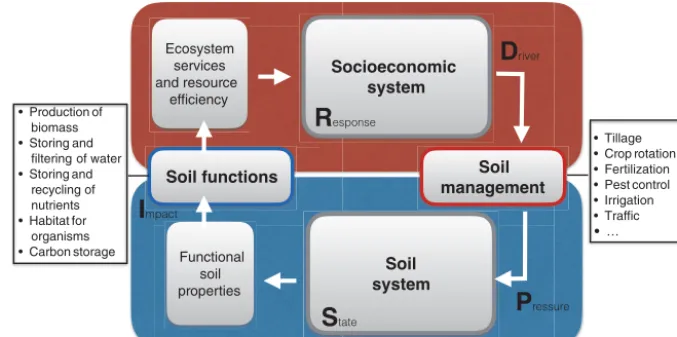
loop illustrated in Fig. 1 reflects the Drivers, Pressures, State, Impact, Response model of intervention (DPSIR) framework (Smeets and Weterings, 1999; Tscherning et al., 2012). Our main focus here is on the interface between the natural and the socioeconomic systems, which are soil management as driven by the latter and soil functions provided by the for-mer.
Thus, there are well-definable links between the two sys-tems, while both are internally highly complex. Within the socioeconomic box, the challenge is to assess soil functions by some form of valuation system. This is increasingly dis-cussed in the framework of ecosystem services. While vari-ous approaches of valuation are still a matter of debate (Bav-eye et al., 2016; Adhikari and Hartemink, 2016; Stolte et al., 2015; Robinson et al., 2014; Müller and Burkhard, 2012), the need for such a concept appears to be obvious. It is nec-essary to include the expected impact of soil management on soil functions in sustainability assessment and decision-making. We do not reiterate the concept of soil ecosystem services; however, when asking for the contribution of soil science to the understanding of soil functions, we believe it is important to separate soil functions from soil ecosystem services and not to consider these terms to be synonymous, as explicitly proposed recently by Schwilch et al. (2016) or implied by Stavi et al. (2016). Soil functions are produced by complex interactions of natural processes and are the ba-sis for the functioning of terrestrial ecosystems (located in the blue box in Fig. 1 without direct anthropogenic involve-ment), while ecosystem services and resource efficiency are defined in the context of the current human perception and may change according to the societal context (Spangenberg et al., 2014; Hauck et al., 2013).
Within the soil box of Fig. 1, the impact of pressures gen-erated by soil management on the multitude of soil functions needs to be evaluated and predicted. For assessing manage-ment effects, substantial knowledge on the interaction be-tween physical, chemical and biological properties driving processes in soil is required. In a following step, the set of soil functions needs to be derived from the ensemble of ob-servable soil properties, so that the feedback loop can be closed. These soil functions are considered to emerge from the underlying processes, which are the core subject of soil research.
The general framework as illustrated in Fig. 1 is appealing in its simplicity. However, we recognize critical obstacles in the interplay between basic soil sciences and the social sci-ences needed to make such a framework operational. Those working on ecosystem services do not delve into the jungle of detailed soil processes. They typically stop at a quantifi-cation or estimation of soil functions using some proposed indicators (Dominati et al., 2014; Rutgers et al., 2012). There is little effort – since putatively not required – to go into greater depth about which underlying processes actually pro-duce these functions.
On the other hand, soil scientists working on a detailed process understanding are scattered across different disci-plines with limited cooperation among each other and with little awareness about the knowledge needs of the colleagues in social sciences. There has been enormous progress within these disciplines during the last decades, and a consider-able arsenal of new methods for studying physical, chemical and biological processes in great detail is presently available. However, when it comes to a comprehensive understanding of emergent soil functions, the required systemic integration is still lacking. Thus, a gap exists where detailed process un-derstanding needs to be converted to soil functions. Symp-tomatically, at the interface between the soil science and so-cioeconomic perspectives, the terminology becomes vague, hampering the communication even more, as recently noted by Schwilch et al. (2016). The good news is that the link be-tween social sciences and natural sciences can be very clearly defined, as illustrated in Fig. 1; nonetheless, the interface be-tween the two perspectives needs to be further developed. Based on this rough analysis, some crucial challenges for soil research are deduced in the following section.
3 The challenges for soil research
As stated in the previous section, the ultimate goal of soil research support of sustainable soil management is to quan-tify and predict the impact of external forcing (right side in Fig. 1) on the ensemble of soil functions (left side in Fig. 1). Depending on local soil properties, this impact may range from ameliorative to destructive. The way soils react to the imposed forcing depends on a multitude of interacting physi-cal, chemical and biological processes, and each soil function is considered to be an integrative property emerging from these interacting processes (Kibblewhite et al., 2008; Karlen et al., 2003).
A fundamental problem when analyzing the behavior of soil systems is that soil processes and their interactions are far too complex to be disentangled at the level of detailed in-dividual processes – which in fact are very well understood in many cases – and then to rebuild the system behavior by combining all the individual processes. It is not the required computing power, which hinders such a bottom-up approach, but rather the lack of required information on soil properties, including their spatial heterogeneity and, most importantly, the highly non-linear character and multitude of process in-teractions.
Socioeconomic system
Soil system
Soil management Soil functions
Functional soil properties Ecosystem services and resource
efficiency
• Production of biomass • Storing and
filtering of water • Storing and
recycling of nutrients • Habitat for
organisms • Carbon storage
• Tillage • Crop rotation • Fertilization • Pest control • Irrigation • Traffic •…
D
riverP
ressureS
tateI
mpactR
esponseFigure 1.The human–soil interface related to the DPSIR framework. The obvious interfaces between the human and soil systems are soil
management and soil functions. Human societies are the drivers of soil management producing various pressures on soils. A change in the soil’s functionality may in turn provoke some response in soil management methods. Climate is another crucial driver for the soil system which is obviously required when zooming into the soil system (see Figs. 2 and 3).
are thought to contain sufficient information about these pro-cesses so that they can be used as proxies for quantifying soil functions. It should be noted that such indicators need to be evaluated in a site-specific way, since different soil types de-veloped under different site conditions (i.e., geology, climate, relief, vegetation) behave differently, which is often ignored. A prominent example is soil organic carbon (SOC, “hu-mus”) as an indicator for soil fertility or, more generally, for soil health (Franzluebbers, 2002; Loveland and Webb, 2003; Ogle and Paustian, 2005). This is because SOC has been recognized as supporting the stability of soil structure and thereby soil hydraulic properties and the physical habi-tat for soil organisms and their activity. Likewise, soil func-tions can be addressed from a physical perspective, i.e., soil structure being evaluated by an index based on observable hydraulic properties. This was suggested by Dexter (2004), who emphasized the close feedback between soil structure, root growth, biological activity and, again, SOC. Biological indicators in the past stressed management effects on biodi-versity, e.g., were conservation oriented, but recent develop-ments emphasize methods indicating soil functions and gen-eral soil health (Doran and Zeiss, 2000; Kibblewhite et al., 2008; Ritz et al., 2009; Rutgers et al., 2012). These different approaches reflect the obvious interrelations between physi-cal, chemical and biological agents in the soil systems.
The concept of using such indicators to estimate the state of soil in terms of soil functions is well justified and sup-ported by substantial empirical evidence. However, if the im-pact of soil management is to be evaluated or measures for improving soil functions are to be developed, we need to fo-cus on the dynamics of soil functions, i.e., their management-induced changes. This requires a profound understanding of the underlying processes and their interactions. For example,
the soil’s potential to store carbon is not just a simple mea-sure of the capacity of some storage pool in soil; it depends on the type of mineral composition and pore structure, in-cluding its temporal dynamics, the biological activity in the soil food web and the dynamics of water and gas, to name just the most important factors. Moreover, all these different features relate in close interaction: water dynamics depend on soil structure, which is formed by soil biota, which itself depends on the structural soil properties with a feedback to vegetation and the quality of soil carbon, etc.
Hence, to predict the dynamics of soil functions in re-sponse to external forcing, the concept of empirical indica-tors needs to be augmented by their dynamics at the timescale of the forcing under consideration. Here, the basic soil sci-ence disciplines can provide the required process understand-ing. Kibblewhite et al. (2008) criticize the “reductionist” approach of using simple indicators describing some fixed state. As a promising new approach, they suggest some form of “diagnostic tests” to directly evaluate the dynamics of soil in response to targeted forcing (e.g., compaction, added nu-trients), so that the observable dynamics provide information on the internal pattern of interacting processes.
4 A new systemic approach for modeling soil functions
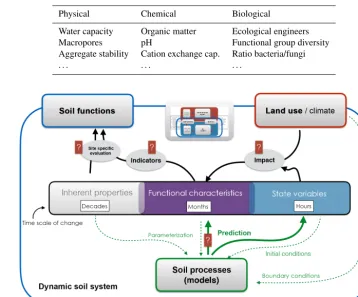
Starting from the insight that the dynamics of soils with respect to soil functions cannot be modeled based on first principles, an obvious question analogous to the search for suitable indicators is what the most relevant and observable soil properties are that provide valuable information on soil functioning. Looking at the broad spectrum of observable soil attributes, as a first step we propose distinguishing three different attribute groups according to their characteristic timescale of change. There are “inherent soil properties” that depend on the parent material and the stage of soil forma-tion (e.g., the mineral composiforma-tion, texture, layering, depth), which are not immediately affected by soil management and can be considered to be stable at a timescale of decades or more. In contrast, there are other observable soil attributes that may change at short timescales from minutes to days in response to external forcing (e.g., water content, tempera-ture, redox potential, microbiological activity), which we re-fer to as “soil state variables”. In between these extremes is a category, which we will refer to as “functional soil charac-teristics”, that might change abruptly in response to external forcing but has an intermediate timescale of change (days to months) as a result of internal processes and interactions. In this category are physical, chemical and biological char-acteristics as listed in Table 1, which is not intended to be comprehensive.
Based on the consideration of characteristic timescales of change, the category of functional soil characteristics is ex-pected to carry the most valuable information on soil pro-cesses. The various indicators for soil functions that have been used in the literature (see above) are manifold, but all are in fact included in this category.
A major challenge is to identify a suitable set of functional characteristics and to derive meaningful indicators based on them, as illustrated in Fig. 2. There seems to be a consen-sus on which physical and chemical characteristics are es-sential in this category. This is still being developed for bi-ological attributes. For instance, while most studies on ef-fects of agricultural management measures on soil biodiver-sity have concentrated on taxonomic community parameters in the past, a more meaningful approach regarding soil func-tions would stress community functional diversity and/or key(stone) species driving specific processes such as biotur-bation (Pulleman et al., 2012; Wall et al., 2010; Heemsbergen et al., 2004; Hedde et al., 2012). Generally, it should be noted that the impact of external forcing on functional character-istics may depend on the actual state variables (e.g., com-paction due to traffic depends on the actual water content) and that the evaluation of derived indicators depends on in-herent soil properties (e.g., relevance of macropores depends on soil texture).
Process-oriented research in the soil sciences mainly fo-cuses on the dynamics of state variables (e.g., soil
mois-ture, redox potential, soil respiration, soil biological com-munities), the related fluxes (e.g., evaporation, leaching of nutrients, greenhouse gas emission) and transformations (e.g., mineral N, biomass production, nutrient transfer). When modeling these processes, the category of functional soil characteristics is typically treated as static soil proper-ties represented by suitable parameterizations (e.g., water re-tention curve, water capacity, hydraulic conductivity, poros-ity, pH, cation exchange capacporos-ity, biological composition or group abundances) as illustrated in Fig. 2. This seems to be too simplistic when changing the perspective towards the im-pact of soil management on soil functions. In this case, we need to account for the fact that the functional soil charac-teristics are also dynamic and affected by external forcing. Hence, it seems to be a formidable scientific challenge to extend the research on soil processes towards an in-depth exploration of the dynamics of functional soil characteris-tics and their interactions. Based on the understanding that these functional characteristics emerge from a multitude of process interactions at smaller scales, such a concept targets an intermediate (and hopefully manageable) level of com-plexity between the inextricably small-scale comcom-plexity and highly simplified static indicators. Nevertheless, the dynam-ics of state variables need to be included in the model concept since the impact of soil management or climate on functional soil characteristics depends on such state variables. For ex-ample, the change of soil bulk density due to external loads is highly sensitive to soil moisture (see example below).
It has long been recognized that soils can be considered to be complex, self-organized systems (Young and Crawford, 2004). However, a corresponding model approach is not yet available. Actually, the reaction of soils to external forcing exhibits some essential features which are typical for com-plex systems: within a certain range of forcing, soils are re-markably resilient against external perturbation, while be-yond some critical point, the state of soils may switch to some different mode or configuration. Prominent examples are critical degrees of soil compaction, which can no longer be compensated by internal soil structure-forming processes (Keller and Dexter, 2012) or some critical level of soil or-ganic matter, below which soil degradation is invoked fol-lowed by a positive feedback loop: reduced OM →reduced biological activity→ reduced nutrient cycling → reduced plant growth→reduced OM production, etc. (Loveland and Webb, 2003).
Table 1.Examples for soil functional characteristics reflecting a multitude of soil processes. (Ellipses indicate that this list is not thought to be comprehensive.)
Physical Chemical Biological
Water capacity Organic matter Ecological engineers
Macropores pH Functional group diversity
Aggregate stability Cation exchange cap. Ratio bacteria/fungi
. . . .
Figure 2. Zoom into Fig. 1 to illustrate the dynamics of soil functions within hierarchical categories of soil properties related to their
characteristic timescale of change. Soil functions emerge from a combination of soil functional characteristics, which need to be evaluated according specific site conditions. Typical soil process models are focused on the dynamics of soil state variables, while soil functional characteristics are often parameterized and considered to be static. The actual challenges in predicting the impact of external forcing are marked by “?” (see text for further explanation).
alone often does not explain distributional patterns (Fromm et al., 1993; Lauber et al., 2008; Kanianska et al., 2016).
The US Soil Taxonomy (Soil Survey Staff, 1999) and the World Reference Base for Soil Resources (Pulleman et al., 2012) are explicitly based on the combination of such (abi-otic) functional characteristics in addition to what we have identified as inherent properties (Fig. 2). The specific com-bination of soil functional characteristics that can be found at a specific location depends on the local conditions for soil formation and development, including parent material (i.e., geology), climate, topography, vegetation and land use. This has already been suggested by Jenny (1941) and still forms the basis for quantitative pedology today referred to, e.g., in the SCORPAN approach (McBratney et al., 2003).
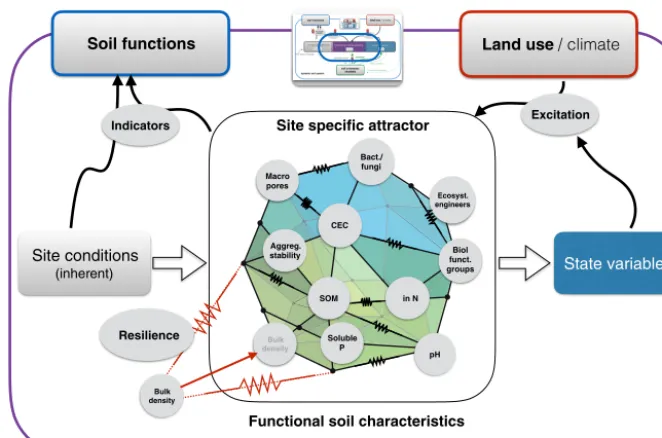
For the analysis of soil as complex systems, we suggest in-terpreting the traditional consideration of soil types as a char-acteristic combination of functional soil charchar-acteristics as il-lustrated in Fig. 3. Then, according to the terminology used for complex systems, a functional soil type is considered to be an attractor within the multidimensional state space of
functional soil characteristics. An attractor is meant to be a combination of property states that are more frequently found than others, and the interpretation is that the under-ling soil processes and their interactions pull (i.e., attract) the system towards this state. This also implies that such attrac-tors are relatively stable in response to external forcing, as is actually observed for soil.
An important corollary of this concept is that the set of functional characteristics is not a set of independent features, but the set members are all closely interrelated. This is evi-dent in that all share the same basis of interacting soil pro-cesses from which they emerge. The type of interrelations as illustrated in Fig. 3 by springs are virtual and are expected to exhibit some elasticity. They are accessible not only through empirical observation but might be derived from a profound process understanding, since they represent an integral mani-festation of the underlying physical, chemical and biological processes.
Soil functions Land use / climate
Site specific attractor
State variables Site conditions
(inherent)
Bulk density
Aggreg.
stability funct.Biol
groups
SOM CEC Macro pores
Min N Ecosyst. engineers
pH Bact./ fungi
Soluble P
Excitation
Functional soil characteristics Bulk
density
Indicators
Resilience
Figure 3. Zoom into Fig. 2: functional soil characteristics are related, forming a site-specific attractor as a quasi-stable state. External
perturbations (e.g., increase in bulk density by traffic) might be compensated by these relations or the system is pulled towards another stable state (see text for further explanation).
be an essential key in describing the macroscopic behavior of soil in response to external perturbations. These relations are macroscopically observable, but the underlying processes that produce these relations are not easily accessible or mea-surable. They are expected to be interlaced, nested and, as typical for natural systems, highly non-linear.
Examples are the relation between soil organic matter (SOM) and aggregate stability, which is certainly not linear but expected to be an optimum function, or the relationship between burrowing macrofauna and soil bulk density, where the latter is obviously bounded by minimal and maximal val-ues. We postulate that the stability and resilience of soils in response to perturbations can be described by the complex interplay between such effective non-linear relations. In the following section, we discuss the example of soil structure dynamics after compaction.
5 An example of systemic modeling of soil
structure dynamics
It is well known that traffic on arable soil often leads to compaction and an increase in bulk density (illustrated in Fig. 3). This will impact the habitat pore space as well as the aeration and herewith the spatial distribution of redox con-ditions and the activities and interactions between soil or-ganisms, which in turn affect nutrient availability for plant growth, etc. Hence, the functional soil characteristic abruptly affected first is the soil pore volume or soil bulk density. Other chemical and biological functional characteristics are then affected through subsequent feedback processes. While
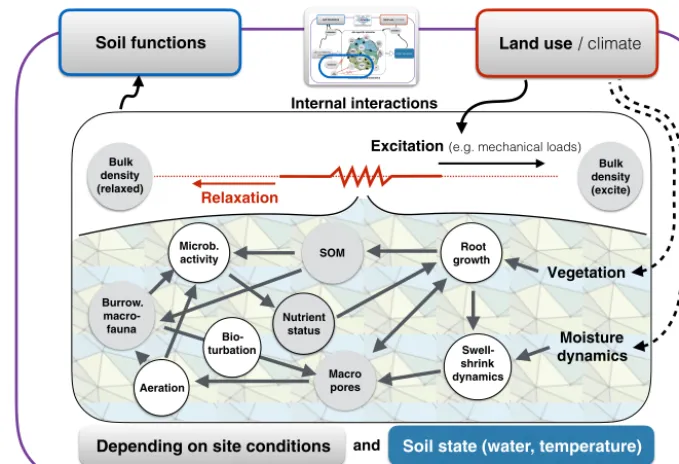
the physical impact of compaction as a function of load, soil texture and water content has been intensely studied (Hamza and Anderson, 2005; Keller and Auset, 2007), much less is known about the potential recovery of soil structure af-ter compaction (Keller et al., 2017) as a result of structure (re)formation by plants, burrowing soil biota and physical processes such as swelling–shrinking and freezing–thawing. However, this is what we must know if we wish to evalu-ate the general impact of traffic and mechanical loads on soil functions. In Fig. 4, some potentially relevant process inter-actions during soil structure recovery are illustrated. Accord-ing to the proposed approach, the followAccord-ing processes should be considered and quantitatively described: the formation of pores by root growth, the supply of organic matter by plant roots, the stimulation of burrowing soil fauna by the available and supplied organic matter, the nutrient dynamics invoked by microbial activity stimulating plant growth, the impact of soil fauna on soil structure through bioturbation and the im-pact of swell–shrink dynamics on structure formation, just to name the most obvious. All these processes are intensely coupled since they all depend on the actual soil structure (and the related water and gas dynamics) while at the same time changing it.
Soil functions Land use / climate
Internal interactions
Bulk density (excite)
Excitation (e.g. mechanical loads)
Relaxation
Burrow. macro-fauna Bulk density (relaxed)
Macro pores SOM
Vegetation
Moisture dynamics
Microb. activity
Root growth
Swell-shrink dynamics Aeration
Nutrient status
Depending on site conditions and Soil state (water, temperature)
Bio-turbation
Figure 4. Zoom into Fig. 3: the excitation (i.e., disturbance) of the soil system by compaction due to mechanical loads is relaxed by
interacting processes at the smaller scale. The functional characteristics considered for this case are indicated by grey circles while the connecting processes are in white.
level. Therefore, the proposed modeling concept should also be able to identify critical tipping points in system behavior and thus critical thresholds with respect to external forcing.
Following the proposed concept, we need to identify the relevant soil functional characteristics and to connect them based on our current process understanding. There is sub-stantial knowledge about individual processes, especially in the field of soil hydrology and soil carbon dynamics. It is yet limited for biological interactions. The overview required for such a systemic approach is still missing. This is espe-cially true for interactions at the interface between different soil science disciplines and the interactions between phys-ical, chemical and biological properties. For example, soil physics typically ignores chemical heterogeneities and bio-logically induced structure dynamics, while in biology and chemistry soil analyses are often performed in homogenized or standardized samples and the natural structure/habitat is lost (Heemsbergen et al., 2004; Crowther et al., 2012).
The proposed concept will also reveal new research ques-tions which are essential for understanding the system’s be-havior. Following the example of soil compaction and relax-ation (Fig. 4), such a missing link is, for example, the impact of root growth on soil structure development. More specifi-cally, we need to know the affinity of plant roots to grow into existing pores or their capacity to generate new pores. We ex-pect this to be a function of soil texture, bulk density and soil moisture, and certainly depends on the plant species as well. To the best of our knowledge, there is very little experimen-tal evidence currently available along these lines, although
much progress has recently been made to investigate plant roots by non-invasive imaging (Downie et al., 2015; Mooney et al., 2012).
Obviously, our process understanding will always be lim-ited and some of the implemented interactions might be pure speculation. Nonetheless, the proposed modeling framework will provide a valuable tool for evaluating alternative process descriptions with respect to their impact, sensitivity and im-portance for the system’s behavior. A promising perspective is that the uncertainty in the assumed process interactions is expected to decrease with ongoing research.
This provokes the question of how to eventually validate such a model approach. In fact, the model behavior needs to be assessed with historical and newly generated observations to evaluate its plausibility and to develop new insights for the formulation of site-specific process interactions. A cru-cial problem is the longer timescales in which soil processes rebound or move to an alternative state, and their adaption to changing boundary conditions. Therefore, another valuable source of information are long-term field experiments where the history of these boundary conditions is well documented. Yet another option is to involve farmers who may provide the historic information that led to the actual state of soil func-tional characteristics in their fields.
6 Conclusions
re-search being carried out in the soil sciences can substantially contribute to improving the scientific fundament of this ap-proach, which is especially true for the exploration of inter-acting processes leading to stable configurations of the soil “functional characteristics”. The set of these functional char-acteristics and the level of complexity can be adapted to spe-cific soil functions of interest and developed according to the growing state of knowledge. Hence, the proposed modeling framework may continuously grow with respect to scientific evidence. In other words, it paves the way from simple rules of farmers’ proverbs to sophisticated scientific analyses.
Starting from the pressing need to predict the impact of soil management measures on essential soil functions, we de-veloped a systemic modeling framework based on the com-plex interactions of physical, chemical and biological pro-cesses. It forms a basis to use past and ongoing soil research for evaluating soil functions. Thereby, not only the actual state but also the dynamics of soil functions in response to external forcing induced by land use and climate can be pre-dicted. We consider this to be of utmost importance for mak-ing decisions on soil management options in the light of sus-tainability.
Data availability. No data sets were used in this article.
Competing interests. The authors declare that they have no
con-flict of interest.
Acknowledgements. This research has been funded by the
German Ministry of Education and Research (BMBF) in the framework of the funding measure “Soil as a Sustainable Resource for the Bioeconomy – BonaRes” (grant 031A608). For further information, please visit www.bonares.de.
Edited by: Paul Hallett
Reviewed by: Johan Bouma and one anonymous referee
References
Adewopo, J. B., VanZomeren, C., Bhomia, R. K., Almaraz, M., Ba-con, A. R., Eggleston, E., Judy, J. D., Lewis, R. W., Lusk, M., Miller, B., Moorberg, C., Snyder, E. H., and Tiedeman, M.: Top-Ranked Priority Research Questions for Soil Science in the 21 Century, Soil Sci. Soc. Am. J., 78, 337–347, 2014.
Adhikari, K. and Hartemink, A. E.: Linking soils to ecosys-tem services – A global review, Geoderma, 262, 101–111, https://doi.org/10.1016/j.geoderma.2015.08.009, 2016.
Amundson, R., Berhe, A. A., Hopmans, J. W., Olson, C., Sztein, A. E., and Sparks, D. L.: Soil and human security in the 21st century, Science, 348, 1261071, 2015.
Baveye, P. C.: Grand challenges in the research on soil processes, Frontiers in Environmental Science, 3, 10, https://doi.org/10.3389/fenvs.2015.00010, 2015.
Baveye, P. C., Baveye, J., and Gowdy, J.: Soil “Ecosystem” Ser-vices and Natural Capital: Critical Appraisal of Research on Uncertain Ground, Frontiers in Environmental Science, 4, 41, https://doi.org/10.3389/fenvs.2016.00041, 2016.
Bouma, J.: How Alexander von Humboldt’s life story can inspire innovative soil research in developing countries, SOIL, 3, 153– 159, https://doi.org/10.5194/soil-3-153-2017, 2017.
Bouma, J.: The challenge of soil science meeting society’s demands in a “post-truth”,“fact free” world, Geoderma, 310, 22–28, 2018. Bouma, J. and Montanarella, L.: Facing policy challenges with inter- and transdisciplinary soil research focused on the UN Sustainable Development Goals, SOIL, 2, 135–145, https://doi.org/10.5194/soil-2-135-2016, 2016.
Crowther, T. W., Boddy, L., and Jones, T. H.: Functional and eco-logical consequences of saprotrophic fungus–grazer interactions, ISME J., 6, 1992–2001, 2012.
Dexter, A.: Soil physical quality: Part I. Theory, effects of soil tex-ture, density, and organic matter, and effects on root growth, Geo-derma, 120, 201–214, 2004.
Dominati, E., Mackay, A., Green, S., and Patterson, M.: A soil change-based methodology for the quantification and valuation of ecosystem services from agro-ecosystems: A case study of pastoral agriculture in New Zealand, Ecol. Econ., 100, 119–129, 2014.
Doran, J. W. and Zeiss, M. R.: Soil health and sustainibility: man-aging the biotic component of soil quality, Appl. Soil Ecol., 15, 3–11, 2000.
Downie, H. F., Adu, M., Schmidt, S., Otten, W., Dupuy, L. X., White, P., and Valentine, T. A.: Challenges and opportunities for quantifying roots and rhizosphere interactions through imaging and image analysis, Plant Cell Environ., 38, 1213–1232, 2015. European Commission: Proposal for a Directive of the European
Parliament and of the Council establishing a framework for the soil protection of soil and amending Directive 2004/35/EC, COM (2006), 231, available at: http://eur-lex.europa.eu/legal-content/ EN/TXT/?uri=celex:52006PC0232 (last access: 14 March 2018), 2006.
Franzluebbers, A. J.: Soil organic matter stratification ratio as an indicator of soil quality, Soil Till. Res., 66, 95–106, https://doi.org/10.1016/S0167-1987(02)00018-1, 2002. Fromm, H., Winter, K., Filser, J., Hantschel, R., and Beese, F.: The
influence of soil type and cultivation system on the spatial distri-butions of the soil fauna and microorganisms and their interac-tions, Geoderma, 60, 109–118, 1993.
Hamza, M. and Anderson, W.: Soil compaction in cropping sys-tems: A review of the nature, causes and possible solutions, Soil Till. Res., 82, 121–145, 2005.
Hauck, J., Görg, C., Varjopuro, R., Ratamäki, O., and Jax, K.: Bene-fits and limitations of the ecosystem services concept in environ-mental policy and decision making: some stakeholder perspec-tives, Environ. Sci. Policy, 25, 13–21, 2013.
Hedde, M., Van Oort, F., and Lamy, I.: Functional traits of soil invertebrates as indicators for expo-sure to soil disturbance, Environ. Pollut., 164, 59–65, https://doi.org/10.1016/j.envpol.2012.01.017, 2012.
available at: http://www.sciencemag.org/content/306/5698/1019. abstract, 2004.
Jenny, H.: Factors of soil formation, McGraw-Hill Book Co, New York, 1941.
Kanianska, R., Jad’ud’ová, J., Makovníková, J., and Kizeková, M.: Assessment of Relationships between Earthworms and Soil Abi-otic and BiAbi-otic Factors as a Tool in Sustainable Agricultural, Sus-tainability, 8, 906, https://doi.org/10.3390/su8090906, 2016. Karlen, D. L., Ditzler, C. A., and Andrews, S. S.: Soil
quality: Why and how?, Geoderma, 114, 145–156, https://doi.org/10.1016/S0016-7061(03)00039-9, 2003. Keesstra, S. D., Bouma, J., Wallinga, J., Tittonell, P., Smith,
P., Cerdà, A., Montanarella, L., Quinton, J. N., Pachepsky, Y., van der Putten, W. H., Bardgett, R. D., Moolenaar, S., Mol, G., Jansen, B., and Fresco, L. O.: The significance of soils and soil science towards realization of the United Nations Sustainable Development Goals, SOIL, 2, 111–128, https://doi.org/10.5194/soil-2-111-2016, 2016.
Keller, A. A. and Auset, M.: A review of visualization techniques of biocolloid transport processes at the pore scale under saturated and unsaturated conditions, Adv. Water Resour., 30, 1392–1407, 2007.
Keller, T. and Dexter, A. R.: Plastic limits of agricultural soils as functions of soil texture and organic matter content, Soil Res., 50, 7–17, 2012.
Keller, T., Colombi, T., Ruiz, S., Manalili, M. P., Rek, J., Stadelmann, V., Wunderli, H., Breitenstein, D., Reiser, R., Oberholzer, H., Schymanski, S., Romero-Ruiz, A., Linde, N., Weisskopf, P., Walter, A., and Or, D.: Long-Term Soil Structure Observatory for Monitoring Post-Compaction Evolution of Soil Structure, Vadose Zone J., 16, https://doi.org/10.2136/vzj2016.11.0118, 2017.
Kibblewhite, M., Ritz, K., and Swift, M.: Soil health in agricultural systems, Philos. T. R. Soc. B, 363, 685–701, 2008.
Lauber, C. L., Strickland, M. S., Bradford, M. A., and Fierer, N.: The influence of soil properties on the structure of bacterial and fungal communities across land-use types, Soil Biol. Biochem., 40, 2407–2415, 2008.
Loveland, P. and Webb, J.: Is there a critical level of organic matter in the agricultural soils of temperate regions: A review, Soil Till. Res., 70, 1–18, https://doi.org/10.1016/S0167-1987(02)00139-3, 2003.
McBratney, A. B., Santos, M. L. M., and Minasny, B.: On digital soil mapping, Geoderma, 117, 3–52, https://doi.org/10.1016/S0016-7061(03)00223-4, avail-able at: http://www.sciencedirect.com/science/article/ B6V67-496FTGD-1/2/81065d61583bf2273a3e4deb685f6c61, 2003.
Moebius-Clune, B. N.: Comprehensive Assessment of Soil Health: The Cornell Framework Manual, Cornell University, 2016. Montanarella, L.: Agricultural policy: Govern our soils, Nature,
528, 32–33, 2015.
Mooney, S. J., Pridmore, T. P., Helliwell, J., and Bennett, M. J.: Developing X-ray computed tomography to non-invasively im-age 3-D root systems architecture in soil, Plant Soil, 352, 1–22, 2012.
Müller, F. and Burkhard, B.: The indicator side of ecosystem ser-vices, Ecosyst. Serv., 1, 26–30, 2012.
Noel, S.: Economics of Land Degradation Initiative: Report for policy and decision makers_ Reaping economic and environ-mental benefits from sustainable land management, available at: http://hdl.handle.net/20.500.11766/4881 (last access: 14 March 2018), 2016.
Ogle, S. M. and Paustian, K.: Soil organic carbon as an indicator of environmental quality at the national scale: Inventory monitoring methods and policy relevance, Can. J. Soil Sci., 85, 531–540, 2005.
Paustian, K., Lehmann, J., Ogle, S., Reay, D., Robertson, G. P., and Smith, P.: Climate-smart soils, Nature, 532, 49–57, 2016. Pulleman, M., Creamer, R., Hamer, U., Helder, J., Pelosi, C.,
Pérès, G., and Rutgers, M.: Soil biodiversity, biological indica-tors and soil ecosystem services – an overview of European ap-proaches, Curr. Opin. Environ. Sustain., 4, 529–538, 2012. Ritz, K., Black, H. I., Campbell, C. D., Harris, J. A., and Wood, C.:
Selecting biological indicators for monitoring soils: a framework for balancing scientific and technical opinion to assist policy de-velopment, Ecol. Indic., 9, 1212–1221, 2009.
Robinson, D., Fraser, I., Dominati, E., Davíðsdóttir, B., Jónsson, J., Jones, L., Jones, S., Tuller, M., Lebron, I., Bristow, K., Souza, D. M., Banwart, S., and Clothier, B. E.: On the value of soil re-sources in the context of natural capital and ecosystem service delivery, Soil Sci. Soc. Am. J., 78, 685–700, 2014.
Rutgers, M., Van Wijnen, H., Schouten, A., Mulder, C., Kuiten, A., Brussaard, L., and Breure, A.: A method to assess ecosystem ser-vices developed from soil attributes with stakeholders and data of four arable farms, Sci. Total Environ., 415, 39–48, 2012. Schwilch, G., Bernet, L., Fleskens, L., Giannakis, E., Leventon, J.,
Marañón, T., Mills, J., Short, C., Stolte, J., van Delden, H., and Verzandvoort, S.: Operationalizing ecosystem services for the mitigation of soil threats: A proposed framework, Ecol. Indic., 67, 586–597, 2016.
Smeets, E. and Weterings, R.: Environmental indicators: Typology and overview, dPSIR, European Environment Agency Copen-hagen, CopenCopen-hagen, 1999.
Soil Survey Staff: Soil taxonomy: A basic system of soil classifica-tion for making and interpreting soil surveys, Natural Resources Conservation Service, Handbook 436, US Department of Agri-culture, Washington, D.C., 1999.
Spangenberg, J. H., Görg, C., Truong, D. T., Tekken, V., Busta-mante, J. V., and Settele, J.: Provision of ecosystem services is determined by human agency, not ecosystem functions. Four case studies, International Journal of Biodiversity Science, Ecosystem Services & Management, 10, 40–53, 2014.
Stavi, I., Bel, G., and Zaady, E.: Soil functions and ecosystem ser-vices in conventional, conservation, and integrated agricultural systems. A review, Agron. Sustain. Dev., 36, 1–12, 2016. Stolte, J., Tesfai, M., Øygarden, L., Kværnø, S., Keizer, J.,
Verhei-jen, F., Panagos, P., Ballabio, C., and Hessel, R.: Soil threats in Europe, Publications Office, Luxembourg, 2015.
Tscherning, K., Helming, K., Krippner, B., Sieber, S., and y Paloma, S. G.: Does research applying the DPSIR framework support decision making?, Land Use Policy, 29, 102–110, 2012. Wall, D. H., Bardgett, R. D., and Kelly, E.: Biodiversity in the dark,
Nat. Geosci., 3, 297–298, 2010.