Published online November 20, 2014 (http://www.sciencepublishinggroup.com/j/ijmsa) doi: 10.11648/j.ijmsa.20140306.22
ISSN: 2327-2635 (Print); ISSN: 2327-2643 (Online)
Plasticity at absolute zero as a fundamental characteristic
of dislocation properties
Yuly Milman
*, Svitlana Chugunova, Irina Goncharova
Institute for Problems of Materials Sciences, National Academy of Sciences of Ukraine, Kiev, Ukraine
Email address:
[email protected] (Y. Milman)
To cite this article:
Yuly Milman, Svitlana Chugunova, Irina Goncharova. Plasticity at Absolute Zero as a Fundamental Characteristic of Dislocation Properties.
International Journal of Materials Science and Applications. Vol. 3, No. 6, 2014, pp. 353-362. doi: 10.11648/j.ijmsa.20140306.22
Abstract:
Values of a plasticity characteristic δH for different materials were determined by the indentation method at cryogenic temperatures. Using the linear dependence δH(T) at low temperatures, the value of δH at 0 K, designated by δH(0), was obtained by the extrapolation method. Values of δH(0) for different materials, namely FCC, HCP and BCC metals, intermetallics, metallic glasses, quasicrystals, ceramics and covalent crystals, are discussed. An analytic expression for a dependence of δH(0) on the parameters of thermoactivated movement of dislocations, melting point and Young’s modulus E is obtained. It is shown that any type of hardening of a crystal and an increase in the Peierls–Nabarro stress σS(0) reduce δH(0). Only a rise in E leads to the simultaneous increase in σS(0) and δH(0). δH(0) can be considered as a dislocation plasticity in the absence of thermal vibrations of atoms and should be considered together with strength parameters as an important fundamental characteristic of dislocation properties.Keywords:
Hardness, Plasticity, Indentation, Dislocations, Plastic Deformation1. Introduction
Some methods for estimation of plasticity of materials by indentation were proposed [1–3 etc]. In the present paper we use the procedure for the determination of plasticity by the indentation method which was elaborated in [3–7] and is used now in a number of studies [8–16 etc]. A plasticity characteristic determined by this method is described by the formula
t e
t p
H 1 ε
ε − = ε ε =
δ , (1)
where εp, εe and εt are, respectively, the plastic, elastic
and total average strains on the contact area indenter − specimen in the direction of the load applied to the indenter;
e p t = ε + ε
ε . This plasticity characteristic (as seen from (1)) is determined by the fraction of the plastic strain in the total elastoplastic strain that agrees well with the physical definition of plasticity [17–18]. The physical definitions of the notion of plasticity are usually given as the susceptibility of a material to undergo permanent deformation under load and do not include the attainment of fracture conditions, which is realized in the determination of the elongation to fracture δ
or the reduction of the cross-sectional area of a specimen to fracture ψ in a tensile test. In indentation, a small volume of a deformed material and the specific character of stress fields decrease the susceptibility to macroscopic fracture and abruptly reduce the ductile-brittle transition temperature T . db This makes it possible to determine the hardness and the plasticity characteristic of most materials even at cryogenic temperatures.
The procedure for the determination of the plasticity characteristic δH also enables one to assess the plasticity of materials at 0 K by extrapolation of the curve δH
( )
T to 0 K. The extrapolation of the values of δH obtained at cryogenic temperatures to 0 K appears to be possible due to the linear character of the dependence δH( )
T at low temperatures.The linear character of the dependence δH
( )
T at low temperatures follows from theoretical prerequisites [3] and is substantiated well by experimental results for crystalline materials (see below).Thus, the possibility to analyze the plasticity of materials in the absence of thermal vibrations of atoms first appeared.
The dependence of δH
( )
0 on the parameters of thermoactivated movement of dislocations and Young’s modulus is considered.The strength characteristics at 0 К (the theoretical rupture strength and theoretical shear strength for perfect crystals and the Peierls – Nabarro stress for crystals with the dislocation mechanism of deformation) are usually associated with the character of the atomic structure and electronic structure of materials of different type assuming them to be fundamental characteristics [19, 20]. The authors believe that the experimentally determined plasticity δH at 0 K, which can
be considered as dislocation plasticity, typical for a material in the absence of thermal vibrations of atoms, should also be considered together with strength parameters as a fundamental characteristic of dislocation properties.
2. Plasticity Characteristic
δδδδ
HDetermined by the Indentation Method
The plasticity characteristic defined by expression (1) was proposed in [3]. In this work, the average elastic strain on an contact area indenter − specimen in the direction of an applied load was obtained in the form
(
2)
1 1
e 1 2
E HM ν − ν − − =
ε . (2)
Here HM is the Meyer hardness, which is considered as the average contact pressure, E is Young’s modulus and ν1 is Poisson’s ratio of the investigated material.
The total strain εt was determined for pyramidal indenters in the form
γ − =
εt lnsin , (3)
where γ is the angle between a face and the axis of the pyramid.
Then, according to equation (1), for a pyramidal indenter, the plasticity characteristic determined in indentation is as follows:
(
2)
1 1 t
H 1 2
E HM
1 − ν − ν
ε − =
δ , (4)
In particular, for a Vickers indenter, in view of
γ ⋅ = HM sin
HV and γ = 680, we have
(
)
E HV 2 1 3 . 141 1 12
H = − − ν − ν
δ . (5)
For Berkovich hardness, in the determination of which a trihedral indenter with an angle γ = 650 is used, and the hardness is determined as the ratio of the load to the projection area of the indent on the surface of the specimen
(
)
E HM 2 1 2 . 101 1 21
H = − − ν − ν
δ . (6)
The theory of determination of the plasticity characteristic
H
δ was further developed in [4]. In this work, the condition of incompressibility of a material under an indenter was used only for the calculation of the plastic part of strain εp, rather than of the total strain, as was done in [3]. That is why the results obtained in [4] can be used in the computation of strains and the plasticity characteristic δH for hard and superhard materials with a larger fraction of the elastic strain in indentation.
For the plastic strain, the following expression was obtained: 2 p * kE HM ctg 1 ln − γ + − =
ε . (7)
Here k = 0.565 for a trihedral and a tetrahedral pyramid and k = 0.5 for a conic indenter with an apex angle of 2 , γ
*
E is the effective Young’s modulus for the contact pair indenter − specimen, and
2 2 2 1 2 1 E 1 E 1 * E
1 − ν
+ ν −
= . (8)
The subscripts 1 and 2 correspond to the specimen and indenter, respectively.
Using relations (7), (2) and (1), the plasticity characteristic can be calculated more precisely.
In [7], it was shown that the use of the improved theory for most materials changes the value of δH by no more than
±0.01 and, thus, does not change the character of the analytic dependence δH
( )
T , which follows from the use of relation (4). That is why, in the present work, in the construction of the dependence δH( )
T and in the deduction of the corresponding analytic relations, we use relation (4), which is more convenient for this purpose, (or equation (5), analogous to it, for a Vickers indenter). However, for diamond, Si, Ge and SiC,( )
0 Hδ was calculated with equations (1), (2) and (7). Of course, plasticity characteristic δH can not be determined, if indentation is accompanied by intensive fracture.
From equation (1) it is seen that the new plasticity characteristic δH is a dimensionless parameter and may change from 0 (completely elastic strain) to 1 (for the completely plastic behavior of the material). For low-plasticity materials, the parameter δH correlates to some
degree with the elongation to fracture δ determined in tensile tests at T > Tdb [3]. It is natural that at T < Tdb, the
elongation to fracture tends to zero (δ→0), whereas δH has definite values, which characterize the plasticity of the material. As an example, in Fig. 1, temperature dependences of δ (obtained in a bending test as the elongation to fracture of extended edge fibers) and the plasticity characteristics δH
value δHC exists. The materials that have δH > δHC are
ductile in standard mechanical tensile and bending tests ( δ>0 ), and, for the materials with δH < δHC , the elongation in tensile tests δ usually approaches zero. For pure single phase materials, δHC ≈ 0.9, and, for composites and coatings, it may be lower [6].
Figure 1. Temperature dependences of the elongation to fracture δ and plasticity characteristic δH obtained in microindentation for a WC − 6 wt.% Co hard alloy with an average grain size d = 3 µm.
Note also that a plasticity characteristic similar to δH can be determined in instrumented indentation when loading and unloading curves are recorded in the coordinates load applied to an indenter P − displacement of the indenter h [7, 22].
In this case, the plasticity characteristic can be written in the form
t e
t p A
A A 1 A A
− = =
δ , (9)
where Ap , Ae and At are, respectively, the work expended on plastic, elastic and total deformation during the penetration of the indenter; the ratio Ae At can be determined from the ratio of the area under the unloading curve to the area under the loading curve.
In [7, 22], it was shown that δH ≈ δA if they are determined with identical indenters under the same load applied to the indenter. An advantage of the characteristic δA is that, in its determination, the preliminary determination of the hardness, Young’s modulus and Poisson’s ratio is not required, which increases the accuracy of determination of this characteristic. However, unfortunately, at present, data on the determination of δA at cryogenic temperatures are practically absent.
3. Materials and Experimental Results
In the present work, in the calculation of the temperature dependence δH
( )
T , a number of results on the temperature dependence of hardness HV( )
T published earlier by the authors [3, 5, 23–25] and a set of additional measurements of( )
THV are used.
The materials used in these works are highly pure metallic single crystals or annealed polycrystals, natural diamond single crystal, semiconducting silicon and germanium single crystals.
Refractory compounds (WC, SiC, NbC, Al2O3, TiC and ZrC) were also investigated in the form of single crystals. Metallic glasses (alloys on the base of Fe, Co and Ni) were studied in the form of ribbons produced by the spinning technique. An Al63Cu25Fe12 quasicrystal was obtained by melting followed by annealing at 700 0C, and an Al70Pd20Mn10 quasicrystal was investigated in the form of a single quasicrystal.
The low-temperature microhardness was measured in a modernized PMTN unit under a layer of cooling liquid [26]. In this case, the frosting-up of surfaces of specimens with the formation of hard layers of СО2, etc. is ruled out, and homogeneous cooling and the equality of the temperature of the specimen and the temperature of the indenter are provided. The hardness at temperatures above room temperature was investigated in a vacuum no lower than 10-3 Pa using a unit with a free suspension of an indenter (as in a PMTN unit), which excludes the use of elastic elements, properties of which depend on temperature.
In this case, the load applied to the indenter is determined by the total weight of the indenter and used weights. The value of Young’s modulus at cryogenic temperatures was calculated by extrapolation of the experimental data [27–29] taking into account concepts developed in [27].
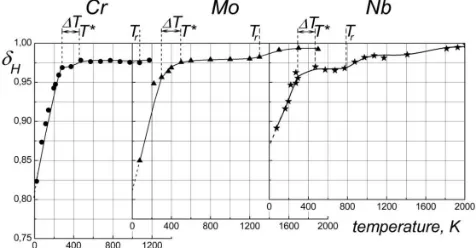
Temperature dependences of δH for different materials are shown in Figs. 2-8.
Figure 2. Temperature dependences of the plasticity characteristic δH for Cr, Mo and Nb. For Мо and Cr, the values of the characteristic temperature
*
Figure 3. Temperature dependences of the plasticity characteristic δH calculated from data of HV
( )
T for aluminum by [30] and for copper by [13, 31].Figure 4. Temperature dependences of the plasticity characteristic δH for refractory compounds WС, NbC, ZrC and TiC.
Figure 5. Temperature dependences of the plasticity characteristic δH for single crystals: diamond (plane (001)), Si (plane (111)), Ge (plane (111)) and SiC (plane (0001)). The extrapolation of δH
( )
T from the region of dislocation mechanism of deformation (dotted lines) was performed to determine temperatures TC at which δH = 0 in the absence of a phase transition in diamond, Si and Ge during indentation. For SiC, the low-temperature region, in which the leading mechanism of formation of an indent is fracture, is ignored to determine temperature TC.Figure 6. Temperature dependences of the plasticity characteristic δH for Ti and Zr.
Figure 7. Temperature dependences of the plasticity characteristic δH for intermetallics.
Figure 8. Temperature dependence of the plasticity characteristic δH for metallic glasses Co56Ni10Fe5Si12B17 and Fe83B17 and an Al63Cu25Fe12 quasicrystal. TC is the temperature at which δH of the Al63Cu25Fe12 quasicrystal would be equal to zero if the phase transition was absent in the process of indentation.
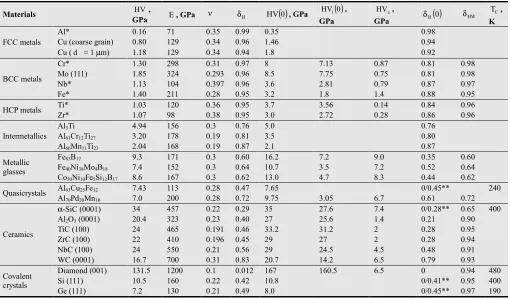
In Table 1, values of δH at 20 0С and values of δH at 0 K, obtained by extrapolation of the curves δH
( )
T to 0 K, are presented.4. Influence of Temperature on the
Plasticity Characteristic
δδδδ
HFor the description of the temperature dependence of the hardness HM , it is most expedient to use the theory of the temperature dependence of the conventional yield strength
S
0 K, the temperature dependence of the conventional yield strength is described by the expression
( )
− ε σ= ε −
= σ
ɺ
ɺ ln M
V kT 0 V
M ln kT U
S S
. (10)
Here U is the activation energy of movement of dislocations, V is the activation volume, M is a material constant, εɺ is the strain rate and σS
( )
0 is the yield stress at 0 K.According to Tabor [34] and Johnson [35], we assume
S
C
HM = ⋅ σ , (11)
where C ≈const.
Using relations (4), (10) and (11) and ignoring the temperature dependence of Young’s modulus in comparison with σS
( )
T , we obtain( )
VE AT 0 H
H = δ +
δ , (12)
where δH
( )
0 is the plasticity at 0 K and( )
( )
(
− ν − ν)
= εσ − =
δ 2
1 1 t
S
H 1 2
E 0 C 1 0
( )
(
2)
1 1 t
2 1
E 0 HM
1 − ν − ν
ε −
= , (13)
(
− ν − ν)
εε =
ɺ M ln 2 1
Ck
A 1 12
t
.
It is seen from above given results that theory and experimental results indicate the linear dependence of δH(T) at the cryogenic temperatures. For this reason we interpolate this dependence by linear function. For metals the Standard deviation of the fit (SD) was lower than 2 %. For other materials SD was not more than 3 %. δH(0) was obtained by extrapolation of the obtained linear dependence of δH(T) to 0 K.
Table 1. Values of the hardness HV, Young’s modulus E, Poisson’s ratio ν at 293 К, hardness HV
( )
0 at 0 K, values of HVt( )
0 and HVa, the plasticity characteristic at 293 К δH, at 0 K δH( )
0 and in the temperature range of warm deformation δHW. TC is the temperature at which δH = 0 under the dislocation mechanism of deformation in the absence of phase transitions in diamond, Si, Ge and an Al63Cu25Fe12 quasicrystal.Materials HV,
GPa E, GPa ν δH HV
( )
0 , GPa( )
0 HVt ,GPa
a HV ,
GPa δH
( )
0 δHWC
T , K
FCC metals
Al* 0.16 71 0.35 0.99 0.35 0.98
Cu (coarse grain) 0.80 129 0.34 0.96 1.46 0.94
Cu (d ≈ 1 µm) 1.18 129 0.34 0.94 1.8 0.92
BCC metals
Cr* 1.30 298 0.31 0.97 8 7.13 0.87 0.81 0.98
Мо (111) 1.85 324 0.293 0.96 8.5 7.75 0.75 0.81 0.98
Nb* 1.13 104 0.397 0.96 3.6 2.81 0.79 0.87 0.97
Fe* 1.40 211 0.28 0.95 3.2 1.8 1.4 0.88 0.95
HCP metals Ti* 1.03 120 0.36 0.95 3.7 3.56 0.14 0.84 0.96
Zr* 1.07 98 0.38 0.95 3.0 2.72 0.28 0.86 0.96
Intermetallics
Al3Ti 4.94 156 0.3 0.76 5.0 0.76
Al61Cr12Ti27 3.20 178 0.19 0.81 3.5 0.80
Al66Mn11Ti23 2.04 168 0.19 0.87 2.1 0.87
Metallic glasses
Fe83B17 9.3 171 0.3 0.60 16.2 7.2 9.0 0.35 0.60
Fe40Ni38Mo4B18 7.4 152 0.3 0.64 10.7 3.5 7.2 0.52 0.64
Co50Ni10Fe5Si12B17 8.6 167 0.3 0.62 13.0 4.7 8.3 0.44 0.62
Quasicrystals Al63Cu25Fe12 7.43 113 0.28 0.47 7.65 0/0.45** 240 Al70Pd20Mn10 7.0 200 0.28 0.72 9.75 3.05 6.7 0.61 0.72
Ceramics
α-SiC (0001) 34 457 0.22 0.29 35 27.6 7.4 0/0.28** 0.65 400 Al2O3 (0001) 20.4 323 0.23 0.40 27 25.6 1.4 0.21 0.90
TiC (100) 24 465 0.191 0.46 33.2 31.2 2 0.28 0.95
ZrC (100) 22 410 0.196 0.45 29 27 2 0.28 0.94
NbC (100) 24 550 0.21 0.56 29 24.5 4.5 0.48 0.91
WC (0001) 16.7 700 0.31 0.83 20.7 14.2 6.5 0.79 0.93
Covalent crystals
Diamond (001) 131.5 1200 0.1 0.012 167 160.5 6.5 0 0.94 480
Si (111) 10.5 160 0.22 0.42 10.8 0/0.41** 0.95 400
Ge (111) 7.2 130 0.21 0.49 8.0 0/0.45** 0.97 190
*Polycrystal,
5. Relation of the Plasticity Characteristic
δδδδ
H(0) to Parameters of
Thermoactivated Movement of
Dislocations
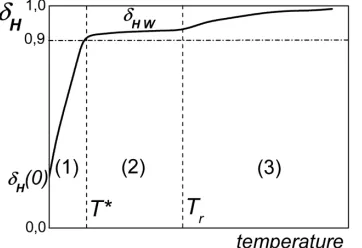
Typical dependence δH
( )
T in the temperature ranges of cold, warm and hot deformation is shown in Fig. 9 according to [3, 5, 36]. Characteristic deformation temperature T * and recrystallization temperature T are the boundaries between r temperature ranges. Here T * is the temperature below which the Peierls – Nabarro stress is essential and yield stress increases sharply and δH decreases with the temperature diminution [32, 37]. In the temperature range of warm deformation, the plasticity characteristic is δHW ≈const, and,for the majority of perfect crystalline materials, 98
. 0 90 . 0
HW ≈ −
δ (Fig. 9, Table 1).
For the approximate solution of the stated problem, we assume that, in the considered temperature range, the dependence δH
( )
T is described by two straight lines.Figure 9. Scheme of the temperature dependence of the plasticity δH in regions of cold (1), warm (2) and hot (3) deformation.
In this case, the point of intersection of these straight lines coincides approximately with the characteristic temperature of deformation T * (or more precisely, it corresponds to
T *
T −∆ , where ∆T is the temperature range of cold
deformation within which the dependence HM
( )
T is nonlinear, see Fig. 2).Then, using expression (12), we get
( )
(
)
VE T * T A
0 HW
H
∆ − −
δ =
δ . (14)
From this expression it is seen that materials with a high temperature T * must have a lower value of δH
( )
0 . Naturally, the ratio A VE is also crucial for the magnitude( )
0 Hδ .
From [32, 37] it follows that the temperature T * can be represented in the form
2 / 1 m
k UT 21 1 *
T
= ,
where U is the activation energy of movement of dislocations, Tm is the melting point and k is the Boltzmann constant.
Consequently,
( )
(
)
VE A T k
21 UT
0 1/2
2 / 1 m HW
H
∆ − −
δ =
δ . (14a)
6. Discussion of Experimental Results
It is seen from Figs. 2-7 that, δH increases with the growth of temperature in the whole investigated temperature range for crystalline materials in contrast to the elongation to fracture
δ, (the exceptions are some intermetallics with anomalous temperature dependence of the yield stress [38]). For metallic glasses, a rise in temperature to the crystallization temperature usually leads to a decrease in δH (Fig. 8). In the curves of the dependence δH
( )
T for crystalline materials, three temperature regions can be distinguished (Fig. 9). These are regions of cold, warm and hot deformation [5, 36, 39]. In the( )
T Hδ curves, these regions are most pronounced for refractory metals with a BCC lattice (Fig. 2). The boundary between the temperature intervals of cold and warm deformations is the characteristic temperature of deformation
*
T [39] and the boundary between the temperature regions of warm and hot deformations is the recrystallization temperature Tr . Features of the behavior of δH
( )
T indifferent temperature intervals were discussed in [3, 5]. For the present work, the behavior of δH in the temperature range of cold deformation is of particular importance. As is seen from Figs. 2-8, for all investigated materials, excepting Si, Ge and the Al63Cu25Fe12 quasicrystal (where the indentation process is accompanied by a phase transition [40–43]), an abrupt decrease in δH with decreasing temperature is observed. Note that, in the temperature region adjacent to 0 K, the dependence δH
( )
T is linear, which agrees with equation (12). The formation of practically athermal regions (adjacent to 0 K) of the dependences H( )
T and δ( )
T may be caused by factors such as the phase transition in the process of indentation [40], the replacement of the sliding mechanism of deformation by the twinning mechanism and by the fact that the mechanism of fracture rather than the mechanism of plastic deformation may become the leading mechanism of formation of a hardness indent in low-plasticity materials at low temperatures [41]. For intermetallics, a weak dependence( )
THM and, hence, a weak dependence δH
( )
T are characteristic (Fig. 7).determined by the thermally activated overcoming of Peierls barriers and decreases with decreasing temperature. That is why, as temperature decreases, plastic deformation is hindered, the hardness HM increases, and the plasticity characteristic
H
δ decreases.
From expression (13) it is evident that the plasticity at 0 K
( )
0H
δ diminishes with increasing σS
( )
0 and rises with increasing Young’s modulus E and Poisson’s ratio ν. The yield strength at 0 K usually consists of two components, namely a thermal component σSt and an athermal component σSa( )
St SaS 0 = σ + σ
σ . (15)
For crystals with a covalent component in the interatomic bond, σSt corresponds to the Peierls − Nabarro stress, and
Sa
σ is determined by the structural factors and hardening caused by alloying elements, impurity elements and disperse particles of the second phase.
From expressions (13) and (15) it is clearly seen that an increase in the Peierls − Nabarro stress σSt
( )
0 , which can be considered to be a fundamental property of a perfect crystal with a covalent component of the interatomic bond, reduces the plasticity δH( )
0 .The value of δH
( )
0 for a perfect crystal, in which σSa is negligibly small, can also be considered to be a fundamental characteristic of the material under the dislocation mechanism of deformation.From expressions (13) and (15) it is also seen that an increase in σSa
( )
0 as a result of an increase in the dislocation density, a decrease in the grain size, solid solution hardening by alloying elements and disperse hardening by particles of the second phase also reduces δH( )
0 .The hardness at 0 K can also be represented in the form of two components
( )
0 HVt( )
0 HVaH = + . (15a)
In Table 1, values of HV and t HV for a number of a materials are presented. From the values of HV and t HV a one can assess the contribution of lattice retardation of dislocations (HVt
( )
0 ) and the contribution of the structural and impurity factors (HV ) on the value of a δH( )
0 .It is very important to note that Young’s modulus E , which is the most important parameter determining the Peierls − Nabarro stress and the theoretical strength of crystals [19, 20], enters also in expression (13), and an increase in E leads not only to an increase in the theoretical strength, but also to an increase in the plasticity δH
( )
0 .From expression (12) it follows that, in the low-temperature region, the parameter δH must rise linearly with temperature, which is observed in practice. In this case,
VE A dT
d H
= δ
,
i.e., Young’s modulus E and the activation volume V are the most important parameters that cause an increase in δH with temperature.
Expression (14а) relates δH
( )
0 to the parameters of thermoactivated movement of dislocations ( U and V ), melting point T and E . From this expression it follows m that an increase in the height of potential barriers U and a decrease in their width, which can be characterized by V, leads to a decrease in δH( )
0 . An increase in the melting pointm
T also decreases δH
( )
0 . Only an increase in the modulus of elasticity E and Poisson’s ratio ν lead to a rise in( )
0H
δ .
From Table 1 and Fig. 3 it is seen that, in FCC metals (Al and Cu), the value of δH at room temperature is substantially larger than the critical value δHC. Moreover, it is known that these metals have high plasticity to fracture δ not only at room temperature, but also at cryogenic temperatures, including the liquid-nitrogen temperature and even the liquid-helium temperature [13]. Estimation indicates that, for these metals, δH
( )
0 >δHC even at 0 K. The reserves of plasticity in these metals appear to be so significant that, even after grain refining to 1 µm, δH >δHC not only at room temperature, but also at temperatures close to 0 K (see also Table 1). However, in nanostructured copper, at a grain size25
d ≈ nm, even at room temperature, δH ≈δHC, and the plasticity to fracture δ is only 1–2 % [44].
For highly pure BCC metals, the inequality δH >δHC is also satisfied at room temperature, i.e., they have some plasticity in tensile tests. However, as temperature decreases, due to the significant fraction of the covalent component in the interatomic bond and a high Peierls – Nabarro stress in these metals, the yield strength and hardness increase drastically [32], whereas the plasticity characteristic δH decreases
abruptly (Fig. 2), and, at 0 K, δH
( )
0 <δHC, i.e., in these metals, as temperature decreases to a value lower than room temperature, the ductile-brittle transition occurs. In the present work, we do not consider commercially pure BCC metals and alloys on the base of them, in which the ductile-brittle transition temperature may be higher than room temperature (particularly in VI-A group metals, namely Cr, Mo and W [32]). Much the same situation is observed for HCP metals. In Table 1, results for pure titanium and zirconium are presented. At room temperature, δH >δHC, but at 0 K, δH( )
0 <δHC.the extrapolation of the dependence δH
( )
T can be performed only from a region of higher temperatures where the mechanism of deformation has the dislocation character. Such an extrapolation indicates that, a value δH = 0 is attained in these crystals at a certain temperature T , which is much C higher than 0 K (see Fig. 5). The values of T for these C crystals are also presented in Table 1, in which it is shown that, in these crystals, δH( )
0 would be equal to 0 under the dislocation mechanism of deformation, but, actually, as a consequence of the phase transition, δH( )
0 is much higher.In refractory compounds with a significant fraction of the covalent component of the interatomic bond (SiC, Al2O3, TiC, ZrC, NbC and WC), δH < δHC even at 20 0С, and, as temperature decreases, δH further diminishes (Fig. 4) so that, for most of these crystals, δH
( )
0 is very low. Note that tungsten carbide WC has a higher value of δH than those of other considered compounds both at room temperature and at 0 K, which can be explained by a large value of Young’s modulus E and a lower ratio HM E. Evidently, high value of δH (higher than those of other carbides) provides the efficient operation of WC in hard alloys.For silicon carbide SiC, the low-temperature athermal segment of the dependence H
( )
T is due to the change of the mechanism of deformation, i.e., at low temperatures, fracture rather than plastic deformation becomes the leading mechanism of formation of an indent in indentation [41].For the studied intermetallic Al3Ti, δH is low at 20
0 C, and this intermetallic is brittle. The alloying of Al3Ti with Cr or Mn leads to the formation of the cubic L12 structure and an increase in the plasticity δH, which, however, remains much
lower than δHC. The temperature dependence of the yield strength of these intermetallics is weak, and, as seen from Fig. 7 and Table 1, δH decreases slightly as temperature decreases to 0 K [50].
The low value of δH in metallic glasses, is mainly due to
the athermal component of the yield stress σSa (and the athermal component of the hardness H ), which, for these a
materials, is large and usually larger than the thermal component (in contrast to BCC metals and covalent crystals). The amorphous state can be considered as a limit defective state, which leads to a high value of σSa in these materials [25].
The studied quasicrystals Al63Cu25Fe12 and Al70Pd20Mn10 are also brittle at room temperature, and, for them,
HC H < δ
δ . At the same time, in indentation, in the Al63Cu25Fe12 alloy, a phase transition to a more plastic, so-called approximant phase is observed [43]. As a result, here, as in the case of covalent crystals, there exists a wide low-temperature range where HM ≈const and δH ≈ const. If the phase transition did not occur in this quasicrystal, δH would be equal to zero even at 240 К (Fig. 8 and Table 1).
7. Conclusions
An analytic expression for plasticity at 0 K δH
( )
0 was obtained, from which it follows that an increase in the Peierls− Nabarro stress and any type of athermal hardening of a material (an increase in the dislocation density, a decrease in the grain size, solid solution hardening with alloying elements, dispersion hardening, etc.), lead to a decrease in the plasticity characteristic at 0 K δH
( )
0 . An analytic connection of the plasticity at 0 K δH( )
0 to the parameters of the thermally activated dislocation motion (activation energy of dislocations movement U and activation volume V ), melting point T m and Young’s modulus E was determined. An increase in the height of potential barriers (U ), a decrease in the width ( V ) and a rise in T lead to a decrease in m δH( )
0 . At the same time, a rise in Young’s modulus E , which determines strength properties, leads to an increase in δH( )
0 , as well. The real values of δH( )
0 for a number of FCC, BCC and HCP metals of high purity, refractory compounds, covalent crystals, intermetallic compounds, metallic glasses and quasicrystals were analyzed.The studied materials can be arranged in order of decreasing value of δH
( )
0 as follows:FCC metals;
BCC and HCP metals; intermetallics; metallic glasses; quasicrystals;
refractory compounds (WC is distinguished noticeably by its increased value of δH
( )
0 and approaches intermetallics in terms of this parameter);covalent crystals: diamond, Si, and Ge, for which δH
( )
0 = 0 under the dislocation mechanism of deformation without phase transition during indentation.For FCC metals, a high level of plasticity at 0 K, which is sufficient for the plastic behavior in tensile tests, is retained. In BCC and HCP metals, δH
( )
0 is decreased so that, in tensile tests in the vicinity of 0 K, these materials are brittle. However, for these metals, the value of δH( )
0 is much higher than those of intermetallics, refractory compounds (e.g., carbides) and covalent crystals.For Si, Ge, diamond and an Al63Cu25Fe12 quasicrystal, the extrapolation of δH from the region of dislocation plasticity to low temperatures leads to values δH = 0 even at 400 К for Si; at 190 К for Ge; at 480 К for diamond and at 240 К for the Al63Cu25Fe12 quasicrystal. However, the indentation in a wide temperature range adjacent to 0 K in these materials is accompanied by a phase transition, which provides a nonzero value of δH
( )
0 in them.For FCC metals, for which V is very large, the decrease in
H
δ appears to be insignificant.
Materials differing in the type of the interatomic bond and atomic structure differ substantially in plasticity at 0 K δH
( )
0 , which can be considered to be the important characteristic of a material under the dislocation mechanism of deformation (with above-barrier motion of dislocations in the absence of thermal vibrations of atoms) and must be discussed for every material simultaneously with the value of the Peierls − Nabarro stress or, more precisely, with the yield stress at 0 K( )
0S
σ , which, besides the Peierls − Nabarro stress, includes the athermal component of the yield stress.
For the adequate characterization of the mechanical behavior of the materials, knowledge of the strength characteristics in the form of the yield stress σS
( )
0 or hardness HV( )
0 , the plasticity characteristic δH( )
0 , and dependences of these properties on temperature is necessary.References
[1] M. P. Markovets, Definition of the Mechanical Properties of Metals by Hardness. Moscow: Mashinostroenie, 1979, 191 p., in Russian.
[2] H. M. Pollock, Nanoindentation, Friction, Lubrication, and Wear, Metals Handbook, vol. 18, P. J.Blau, Eds. ASM International, 1992, pp. 419-429.
[3] Yu. V. Milman, B. A. Galanov, and S. I. Chugunova, “Plasticity characteristic obtained through hardness measurement” (overview 107), Acta metall mater, vol. 41, no.9, pp. 2523-2532, 1993.
[4] B. A. Galanov, Yu. V. Milman, S.I. Chugunova, and I. V. Goncharova, “Investigation of mechanical properties of high-hardness materials by indentation”, Superhard Mater, no.3, pp. 25-38, 1999.
[5] Yu. V. Milman, S. I. Chugunova, and I. V. Goncharova. “Plasticity chracteristic obtained by indentation technique for crystalline and noncrystalline materials in the wide temperature range”, High Temp Mater Process, vol. 25, no. 1-2, pp. 39-46, 2006.
[6] A. Byakova, Yu. Milman, and A. Vlasov, “High performance ceramic coatings for cutting tool – Perspectives in improvement of coating mechanical properties”, in: Proc. 8th CIRP Int. Workshop on Modeling of Machining Operations, Chemnitz, Germany, R. Neugebauer, Ed. Chemnitz: Fraunhofer Inst. Werkzeugmaschinen und Umformtechnik, 2005, pp. 559-568.
[7] Yu. Milman, “Plasticity characteristic obtained by indentation”, J Phys D: Appl Phys, vol. 41, 074013, 9 p., 2008.
[8] B. Bozzini, M. Boniardi, A. Fanigliulo, and F. Bogani, “Tribological properties of electroless Ni-P/diamond composite films”, Mater Res Bull, vol. 36, iss.11, pp. 1889-1902, 2001.
[9] P. H. Boldt, G. C. Weatherly, and J. D. Embury, “A tranmission electron microscope study of hardness indentations in MoSi2”, J Mater Res, vol. 15, no.4, pp. 1025-1031, 2000.
[10] J. B. Qiang, W. Zhang, G. Xie, H. Kimura, C. Dong, and A. Inoue, “An in situ bulk Zr58Al9Ni9Cu14Nb10 quasicrystal-glass composite with superior room temperature mechanical properties”, Intermetallics, vol. 15, pp. 1197-1201, 2007.
[11] F. Meng, B. Wang, F. Ge, and F. Huang, “Microstructure and mechanical properties of Ni-alloyed SiC coatings”, Surface&Coatings Tech, vol. 213, pp. 77-83, 2012.
[12] P. Mogilevsky, “Indentification of slip systems in CaWO4 scheelite”, Phil Mag, vol. 85, no.30, pp. 3511-3539, 2005.
[13] Y. Estrin, N. V. Isaev, S. V. Lubenets, S. V. Malykhin, A. T. Pugachov, V. V. Pustovalov, E. N. Reshetnyak, V. S. Fomenko, L. S. Fomenko, S. E. Shumilin, M. Janecek, and R. J. Hellmig, “Effect of microstructure on plastic deformation of Cu at low homologous temperatures”, Acta Mater, vol. 54, pp. 5581-5590, 2006.
[14] G. Sharma, R. V. Ramanujan, T. R. G. Kutty, and N. Prabhu, “Indentation creep studies of iron aluminide intermetallic alloy” Intermetallics, vol. 13, pp. 47-53, 2005.
[15] M. Gogebakan, B. Avar, and M. Tarakci, ”Microstructures and mechanical properties of conventionally solidified Al63Cu25Fe12 alloys”, J Alloys and Compounds, vol. 509S, pp. S316-S319, 2011.
[16] N. K. Mukhopadhyay, G. C. Weatherly, and J. D. Embury, “An analysis of microhardness of single-quasicrystals in the Al-Cu-Co-Si system”, Mater Sci Eng A, vol. 315, pp. 202-210, 2001.
[17] en.wikipedia.org/wiki/Plasticity_(physics).
[18] A. L. Roytburd, Plasticity of crystals, Physical Encyclopedic Dictionary. Moscow: Soviet Encyclopaedia, 1983, p. 548, in Russian.
[19] A. Kelly. Strong Solids. Oxford: Clarendon Press, 1973, 261 p.
[20] J. J. Gilman, “Electronic basis of hardness and phase transformations (covalent crystals)”, J Phys. D: Appl Phys, vol. 41, 074020, 5 p., 2008.
[21] Yu. V. Milman, S. Luyckx, V. A. Goncharuk, and Y. T. Northrop, “Results from bending tests on submicron and micron WC-Co grades at elevated temperatures”, Int. J Ref Met Hard Mater, vol. 20, pp. 71-79, 2002.
[22] Yu. Milman, S. Dub, and A. Golubenko, “Plasticity characteristic obtained through instrumental indentation”, Mater Res Soc Symp Proc, vol. 1049, pp. 123-128, 2008.
[23] I. V. Gridneva, Yu. V. Milman, and V. I. Trefilov, “On the Mechanical Properties of Crystals with Covalent Bond”, Phys stat sol, vol. 36, no. 59, pp. 59-67, 1969.
[24] V. I. Trefilov, V. A. Borisenko, G. G. Gnesin, I. V. Gridneva, Yu. V. Milman, and S. I. Chugunova, “On the phase transition under pressure in silicon carbide”, Sov Phys Dokl, vol. 23, pp. 207-208, 1978.
[25] Yu. V. Milman and E. S. Koba, “On the dislocation mechanism of plastic flow in metallic glasses”, Sci Sintering, vol. 31, pp. 65-82, 1999.
[27] I. N. Frantsevich, F. F. Voronov, and S. A. Bakuta, Elastic Constants and Modulus of Metals and Non-Metals. Kiev: Naukova Dumka, 1982, 286 p., in Russian.
[28] R. A. Andrievsky, A. G. Lanin, and G. A. Rymashevsky, Strength of Refractory Compounds. Moscow: Metallurgija, 1974, 232 p., in Russian.
[29] V. V. Pustovalov and S. E. Shumilin, “Plastic deformation and super-conducting properties of aluminium alloys at temperatures 0.5-4.2K”, The Physics of Metals and Metallographs (USSR), vol.62, pp. 171-179, 1986.
[30] R. P. Reed, “Aluminium 2. A review of deformation properties of high purity aluminium and dilute aluminium alloys”, Cryogenics, vol. 12, iss. 4, pp. 259-291, 1972.
[31] Z. Huang, L. Y. Gu, and J. R. Weertman, “Temperature dependence of hardness of nanocrystalleve copper in low-temperature range”, Scrip Mater, vol. 37, iss. 7, pp. 1071-1075, 1997.
[32] V. I. Trefilov, Yu. V. Milman, and S. A. Firstov. Physical Basis of Strength of Refractory Metals. Kiev: Naukova Dumka, 1975, 315 p., in Russian.
[33] Yu. V. Milman and V. I. Trefilov, “Physical nature of the temperature dependence of yield stress”, Powder Metall Met Ceram, vol. 49, no. 7-8, pp. 374-385, 2010.
[34] D. Tabor. The Hardness of Metals. Oxford Clarendon Press, 1951, 130 p.
[35] K. J. Johnson. Contact Mechanics. Cambridge: Cambridge University Press, 1985, 510 p.
[36] Yu. V. Milman, “Structure and mechanical properties of materials in the temperature ranges of cold, warm and hot deformation”, Mater Sci Forum, vol. 426-432, pp. 4399-4404, 2003.
[37] V. I. Trefilov, Yu. V. Milman, and I. V. Gridneva, “Characteristic temperature of deformation of crystalline materials”, Crys Res and Technol, vol. 19, no. 3, pp. 413-421, 1984.
[38] P. H. Thornton, R. G. Davies, and T. L. Johnston, “The temperature dependence of the flow stress of the γ′ phase based upon Ni3Al”, Metall Trans, vol. 1, iss.1, pp. 207-218, 1970.
[39] Yu. V. Milman, “Deformation mechanisms, microstructure and mechanical properties of nanoscale crystalline and noncrystalline materials in different temperature ranges”, Mater Res Soc Symp Proc, vol. 1297, pp. 77-82, 2011.
[40] I. V. Gridneva, Yu. V. Milman, and V. I. Trefilov, “Phase transition in diamond structure crystals at hardness measurement”, Phys Status Solidi (a), vol. 14, pp. 177-182, 1972.
[41] Yu. V. Milman, S. I. Chugunova, I. V. Goncharova, T. Chudoba, W. Lojkowski, and W. Gooch, “Temperature dependence of hardness in silicon-carbide ceramics with different porosity”, Int J Refractory Met Hard Mater, vol. 17, pp. 361-368, 1999.
[42] Yu. V. Milman, D. V. Lotsko, A. N. Belous, and S. N. Dub, “Quasicrystalline materials. Structure and mechanical properties”, in: Functional Gradient Materials and Surface Layers Prepared by Fine Particles Technology, M.-I. Baraton and I. Uvarova, Eds. Kluwer Acad. Publ., Kiev, 2001, pp. 289-296.
[43] Yu. V. Milman, D. V. Lotsko, S. N. Dub, A. I. Ustinov, S. S. Polishchuk, and S. V. Ulshin, “Mechanical properties of quasicrystalline Al-Cu-Fe coatings with submicron-sized grains”, Surface & Coatings Techn, vol. 201, pp. 5937-5943, 2007.
[44] H. V. Swygenhoven and J. R. Weertman, “Deformation in nanocrystalline metals”, Mater Today, vol. 9, iss.5, pp. 24-31, 2006.
[45] T. Suzuki and T. Ohmura, “Ultra-microundentation of silicon at elevated temperatures”, Phil Mag A, vol. 74, no.5, pp. 1073-1084, 1996.
[46] S. J. Lloyd, A. Castellero, F. Giuliani, Y. Long, K. K. McLaughlin, J. M. Molina-Aldareguia, N. A. Stelmashenko, L. J. Vandeperre, and W. J. Clegg, “Observations of nanoindents via cross-sectional transmission electron microscopy: a survey of deformation mechanisms”, Proc R Soc A, vol. 461, pp. 2521-2543, 2005.
[47] V. Domnich, Yu. Gogotsi, and S. Dub, “Effect of phase transformations on the shape of the unloading curve in the nanoindentation of silicon”, Appl Phys Lett, vol. 76, no.16, pp. 2214-2216, 2000.
[48] M. M. Chaudri, M. M. O. Khayyat, D. G. Hasko, “Investigations of the indentation-induced crystallographic phase changes in silicon using Raman spectroscopy”, Surface Review and Letters, vol. 14, no.4, pp.719-723, 2007.
[49] V. Domnich, Y. Aratyn, W. M. Kriven, Yu. Gogotsi, “Temperature dependence of silicon hardness: Experimental evidence of phase transformations”, Rev Adv Mater Sci, vol. 17, no.1-2, pp. 33-41, 2008.