METHODS AND TOOLS FOR PROCESSING SEMI-STRUCTURED DATA ON THE
EXAMPLE OF ACCOUNTING FOR EDUCATION IN THE SELECTION OF
PERSONNEL IN THE IT INDUSTRY
I N. I. Yusupova, O. N. Smetanina, М. М. Gayanova
Department of Computer Science and Robotics, Ufa State Aviation Technical University, Ufa, Russia e-mail: [email protected], [email protected], ,[email protected]
Abstract: This article is devoted to the analysis of documents containing requirements and underlying the development of educational programs, their structures, methods and tools that facilitate the automated processing of data contained in documents and the ability to make decisions using the results obtained. In the content plan, the task is to identify patterns between a given list of educational standards with possible types of professional activity in the IT field and key technologies using automation of data processing tools.
1. Introduction
The volume of digital data by 2020 in the world will be 40,000 billion Gb [1]. And, as a rule, these data can be used to make decisions in various spheres of human activity.
Due to the interest in the results of the use of heterogeneous data and processing technologies, it became necessary to train specialists who possess technologies and methods for developing applications based on digital data. Therefore, questions concerning the training of personnel in the field of IT, as well as the development of tools for analyzing and processing data, identifying new knowledge and making decisions with their use, are undoubtedly relevant.
Education, specializing in the reproduction of skilled workers for all branches of material and non-material production, ideally should take into account the needs of the relevant industry.
The issue of training IT staff is directly related to the improvement of university educational programs, since this field of activity is very dynamic. In addition, it should be noted that one of the sections approved in July of 2017, the program “Digital Economy of the Russian Federation” is dedicated to training.
In this regard, the issues of the educational program analysis, taking into account the requirements of original documents and educational standards become an urgent task. With the questions of the study of educational programs, many works are connected [2,3,4,5].
This article is devoted to the analysis of documents containing requirements and underlying the development of educational programs, their structures, methods and tools that facilitate the automated processing of data contained in documents and the ability to make decisions using the results obtained. In the content plan, the task is to identify the patterns between a given list of educational standards with possible types of professional activity in the IT field and key technologies using automation of data processing tools.
2. State of the analysis of educational programs and IT sphere development
Professional staff in the field of IT is always in demand on the labor market. The education system in this sphere has been developing since the 60s of the 20th century, but due to the rapid development of information technology around the world, the number of specialists with university education is much less than the needs of the industry.
In 2017, the Government of the Russian Federation developed and approved a program to create conditions for the country's transition to a digital economy [6]. This Program defines goals and objectives within the framework of five basic directions for the development of the digital economy in the Russian Federation for the period up to 2024, among which are areas such as personnel and education, formation of research competencies, and technical reserves. Many scientists are engaged in the training of personnel for the IT sphere, such as: N.A. Polyanskaya, A.E. Shamin “Actual problems of training personnel for the IT sector of the Nizhny Novgorod region”, D.I. Monakhov “Model of training of personnel in the field of information technology”, V.P. Gergel, R.G. Strongin
“Experience of Nizhny Novgorod University in training specialists in the field of supercomputer technologies”, etc. [2].
The said authors are engaged in the analysis of educational programs for more than 20 years. Many issues related to the problems formulated in this article were previously considered in such articles as: “Models and methods of information processing in the analysis of educational programs” [3], “The state and prospects of the development of the information technology industry in the context of training” [4], “Decision-making in the selection of personnel for enterprises in the IT industry” [5].
The labor market for IT graduates is associated with three activities [7]: IT services, software development and equipment supply. At each stage of the development of the digital society, new information technologies are emerging. At the moment, within the digital economy, six key technologies have been identified that will guide the development of the IT industry for many years to come. These are cloud computing, large data, Internet of things, digital production, mobility and information security.
Analysis of staff requirements for enterprises in the IT industry. The IT industry today is not only large enterprises, but now also small private business; for example, only in Belarus today there are more than 1000 companies in the IT market. The analysis showed that despite the different activities of these enterprises, three main activities of these enterprises can be distinguished: IT services, software development, supply and maintenance of equipment. IT services are projects for the integration of IT systems, development of applications for the customer, outsourcing, support and maintenance, consulting, training and education in the field of IT. The software development area includes infrastructure applications, user applications, business software and consumers, and so on. The scope of supply includes the supply of PCs, servers, peripherals, equipment, etc. [7].
In connection with the lack of IT professionals in companies, it is natural to seek and retain high-quality specialists. Research in this article should show how the specificity of basic education can be taken into account in the selection of personnel.
Analysis of Russian educational programs in the field of computer science and IT. The system of training bachelors, specialists and masters in the Russian Federation is based on educational standards [8]. In the Russian Federation, there are two enlarged groups of specialties and areas (EGSA) for training personnel for the IT industry: 02.00.00 Computer and Information Science and 09.00.00 Informatics and Computer Science.
Educational programs are developed taking into account educational standards, often, professional standards.
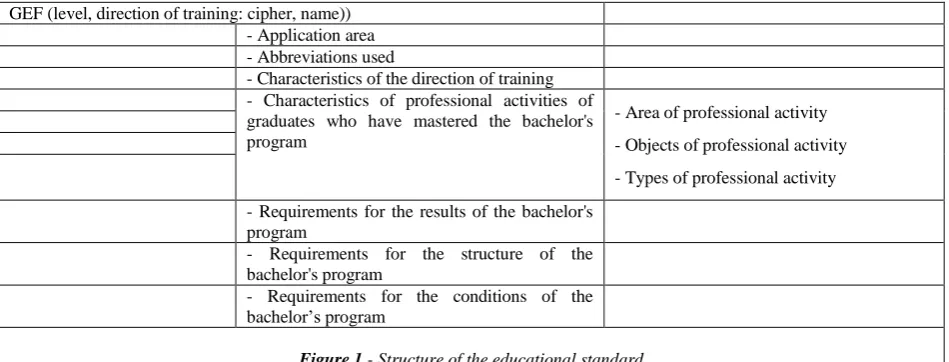
GEF (level, direction of training: cipher, name)) - Application area - Abbreviations used
- Characteristics of the direction of training - Characteristics of professional activities of graduates who have mastered the bachelor's program
- Area of professional activity
- Objects of professional activity
- Types of professional activity
- Requirements for the results of the bachelor's program
- Requirements for the structure of the bachelor's program
- Requirements for the conditions of the bachelor’s program
Figure 1 - Structure of the educational standard So for the "professional activities of graduates", characteristics /
attributes are defined in the field of professional activity, objects of professional activity, types of professional activity. Below in the article are their "values" for a number of areas of training in the field of IT.
Such a document as a professional standard has the following structure (Figure 2).
Professional standard (name, date of approval, number, who approved) - General information
Name of the type of professional activity
The main purpose of the type of professional activity
Occupation group OKZ code
Name Assignment to economic activities OKVED code
Name - Functional map of the type
of professional activity
Generalized labor functions Code
Name
Qualification level
Labor functions Code
Name
Qualification level - Characterization of
generalized labor functions
Generalized labor function Code
Name
Qualification level Origin of labor function Possible job titles
Requirements for education and training
Requirements for practical work experience
Special conditions for admission to work
additional characteristics
Work function Name
Code
Level (sublevel) of qualification Origin of labor function
Labor actions Required skills Required nowledge
Other Features - Information on professional
Italicized elements of the document, which “have” several meanings. Thus, in the professional standard “programmer”, the following generalized labor functions are indicated: development and debugging of the program code (labor functions: formalization and algorithmizing of tasks, writing code using programming languages, defining and manipulating data, creating code in accordance with established requirements, work with the version control system, checking and debugging the program code); validation and refactoring of the software code (development of procedures for verifying the health and measuring software characteristics, developing test data sets, checking the operation of the software, refactoring and optimizing the program code, correcting defects recorded in the database of defects); integration of program modules and components and validation of software product releases (development of procedures for the integration of software modules, integration of software modules and components and verification of software product releases), etc.
The considered schemes will allow selecting a tool for automated processing of data contained in documents.
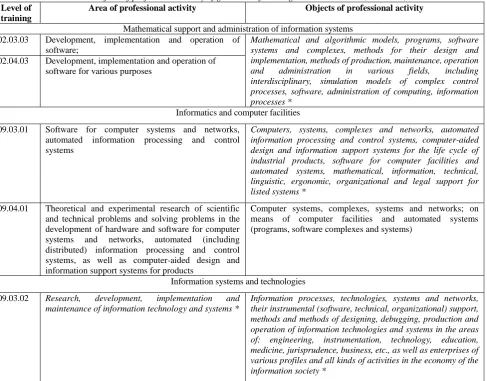
Returning to the educational standard, we note that the field of professional activity of graduates who have mastered the bachelor's program includes the development, implementation and operation of software for various purposes, etc. (Table 1).
Features of training specialists 02.00.00 EGSA is their focus on mathematical aspects, and graduates 09.00.00 EGSA - applied aspects of tasks to be solved, such as software development,
automated information processing and management systems; research, development, implementation and maintenance of information technologies and systems; system analysis of the application domain, etc.
When hiring a decision-maker in a company, it will be necessary to analyze the capabilities of graduates of larger groups of specialties and areas (EGSA) [8]: 02.00.00 "Computer and Information Science", 09.00.00 "Computer Science and Computer Science "(Table 1, * - repeated for bachelor's and master's training areas and objects of professional activity).
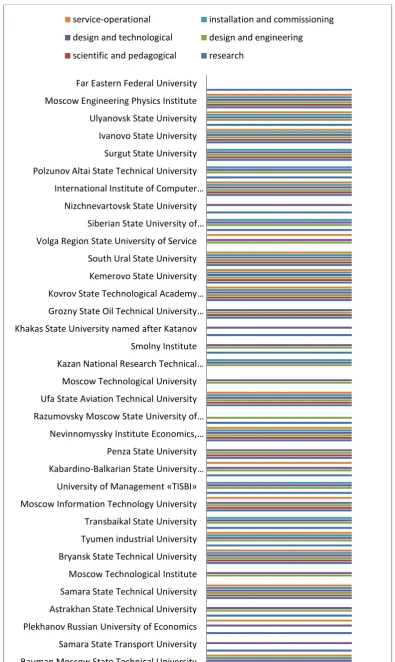
When developing the basic educational programs, the types of professional activity provided for by the educational standard in each direction are taken into account. Figure 3 is a diagram showing the types of professional activity that are selected for the preparation of bachelors in the direction of 09.03.01 Computer science and computer technology by a number of Russian universities. Considering that only a part of the universities chose all six types of professional activity recommended by the educational standard, it can be concluded that the graduates of higher educational institutions are more narrowly trained.
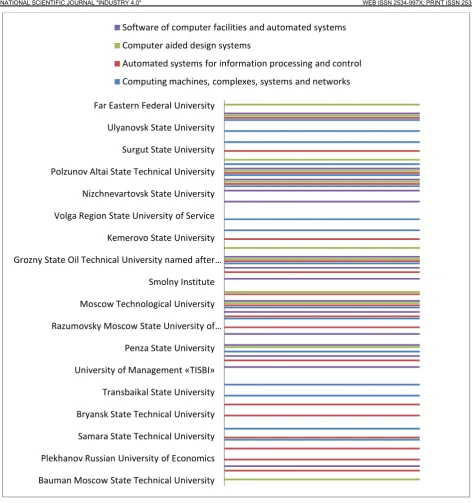
Another aspect that is taken into account in the development of the educational program is the so-called profile (Fig. 4).
Table 1. The areas and objects of professional activity of graduates of training directions 02.00.00, 09.00.00 (bachelor's and master's)
Level of training
Area of professional activity Objects of professional activity
Mathematical support and administration of information systems 02.03.03 Development, implementation and operation of
software;
Mathematical and algorithmic models, programs, software systems and complexes, methods for their design and implementation, methods of production, maintenance, operation and administration in various fields, including interdisciplinary, simulation models of complex control processes, software, administration of computing, information processes *
02.04.03 Development, implementation and operation of software for various purposes
Informatics and computer facilities
09.03.01 Software for computer systems and networks, automated information processing and control systems
Computers, systems, complexes and networks, automated information processing and control systems, computer-aided design and information support systems for the life cycle of industrial products, software for computer facilities and automated systems, mathematical, information, technical, linguistic, ergonomic, organizational and legal support for listed systems *
09.04.01 Theoretical and experimental research of scientific and technical problems and solving problems in the development of hardware and software for computer systems and networks, automated (including distributed) information processing and control systems, as well as computer-aided design and information support systems for products
Computer systems, complexes, systems and networks; on means of computer facilities and automated systems (programs, software complexes and systems)
Information systems and technologies
09.03.02 Research, development, implementation and maintenance of information technology and systems *
Level of training
Area of professional activity Objects of professional activity
09.04.02
Applied Informatics 09.03.03 System analysis of the applied field; formalization of
the solution of applied problems and IP processes, development of projects for automation and informatization of applied processes and the creation of IP in applied fields
Applied and information processes, information technologies, information systems *
09.04.03 Study of patterns information and development of the information society, properties of information and characteristics of information processes; research and development of effective methods for implementing information processes and building IP in applied areas based on the use of modern ICT; organization and implementation of system analysis and reengineering of applied and information processes, formulation and solution of applied problems; modeling of applied and information processes, development of requirements for the creation and development of IP and its components; organization and implementation of works on feasibility study of design solutions, development of projects for automation and informatization of applied processes and creation of IP in applied fields; project management for informatization of enterprises and organizations, decision-making on the implementation of these projects, organization and management of the implementation of IP projects in the applied field; automation quality management of applied problems, IP creation processes; organization and management of IP operation; Training and consulting on automation and informatization of applied processes and the introduction of IP in the application areas
Software Engineering 09.03.04 Industrial production of software for information and
computing systems for various purposes *
A software project (a software product development project), a software product (the created software), software product lifecycle processes, methods and tools for developing a software product, personnel participating in life-cycle processes
09.04.04 Methods and algorithms for data processing in information and
computing systems; parallel, high-performance and distributed information and computing systems; processes of industrial software testing; programming languages and their translators; network protocols and network services; OS
The analysis shows that in general, the objects of activity of the graduates of the second group are mathematical and algorithmic models, simulation models of complex management processes, etc., and the graduates of group 9: computers, complexes, systems and networks, information processes, technologies, methods and algorithms for data processing, etc. The authors believe that on the basis of this analysis, it is possible to establish a link between educational programs and core activities in the IT field and give practical recommendations to decision-makers in the field of recruitment at IT enterprises.
Different types of training can be associated with different sectors in the IT field, with activities in each sector. For example: the sector associated with the provision of services as one of the activities considers training and education in the field of IT. Among the types of professional activity in the educational standards of the training
areas under consideration are scientific-pedagogical or pedagogical ones. A custom application development can be associated with such types of professional activities as design, design and technology, etc. These are simple examples of correspondences. More complex relationships, considering the areas and objects of professional actions, training profiles, as well as tasks to be solved, will require the automation of the analysis process.
Figure 3. Types of professional activities identified for educational programs in the area of training 09.03.01 (Computer science and computer technology) in a number of Russian universities
Bauman Moscow State Technical University Samara State Transport University Plekhanov Russian University of Economics Astrakhan State Technical University Samara State Technical University Moscow Technological Institute Bryansk State Technical University Tyumen industrial University Transbaikal State University Moscow Information Technology University University of Management «TISBI» Kabardino-Balkarian State University …
Penza State University Nevinnomyssky Institute Economics, … Razumovsky Moscow State University of … Ufa State Aviation Technical University
Moscow Technological University Kazan National Research Technical …
Smolny Institute Khakas State University named after Katanov Grozny State Oil Technical University … Kovrov State Technological Academy … Kemerovo State University South Ural State University Volga Region State University of Service Siberian State University of … Nizchnevartovsk State University International Institute of Computer … Polzunov Altai State Technical University
Surgut State University Ivanovo State University Ulyanovsk State University Moscow Engineering Physics Institute Far Eastern Federal University
service-operational installation and commissioning
design and technological design and engineering
Fig. 4. Profiles of educational programs for training directions 09.03.01 (Computer science and computer technology) at a number of Russian universities
3. Formulation of the problem
The task of the authors within the framework of this article is to investigate and establish the patterns between the given list of educational standards and the educational programs developed within them with possible activities in the IT field and key technologies using automation of data processing tools. In terms of set theory, the establishment of regularities can be represented as the identification of functions f1: SoхSop→SecIT and f
2
: SoхSop→KlTIT, where So – educational standard, Sop - educational program; SecIT – IT sector (services, software development, equipment supply), KlTIT – key technologies in IT.
The analysis will allow to correct the list of directions considering modern requirements, improve educational standards and give recommendations to the IT industry on the accounting of education in the selection of personnel.
As it was shown earlier, all the documents submitted are inferior structured data. When working with such data, as a rule, there are problems of search in large data sets and their immediate
representation and presentation of metadata. One way to present data for processing them is an ontology that can be defined as a set of the domain description schema and the rules for assigning data to this domain. The ontology must contain concept-entities, entity attributes and loaded connections.
The author [9] notes the ways of processing such data: ontology allocation - a description of the schema for a domain characterized by a certain logical structure (the content of the selected ontology is filled using the semantic analysis of the text, a set of written linguistic rules); search for mentions, categorization and retrieval of facts (search by keywords, selection of facts related to objects of search); emotional coloring, evaluation of interest, attitude (semantic analysis based on linguistic rules applied after the ontology is singled out); the identification of patterns - the dynamics and course of the change in the relationship, the allocation of general borrowing (based on the concept-entities identified in the framework of ontology, their attributes and connections).
The developed ontology will allow to solve the following problem
Bauman Moscow State Technical University Plekhanov Russian University of Economics Samara State Technical University Bryansk State Technical University Transbaikal State University University of Management «TISBI» Penza State University Razumovsky Moscow State University of …
Moscow Technological University Smolny Institute Grozny State Oil Technical University named after …
Kemerovo State University Volga Region State University of Service Nizchnevartovsk State University Polzunov Altai State Technical University Surgut State University Ulyanovsk State University Far Eastern Federal University
Software of computer facilities and automated systems
Computer aided design systems
Automated systems for information processing and control
4. Models and methods for data analysis
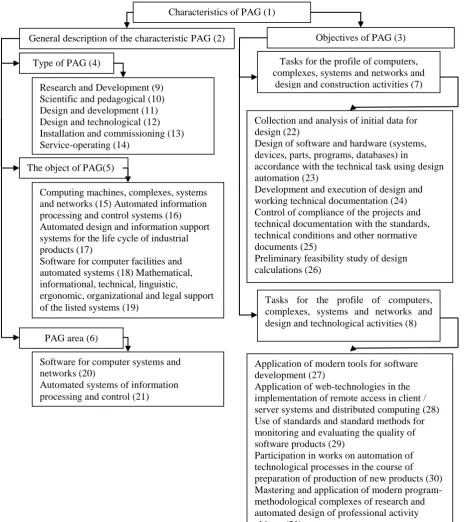
The authors have repeatedly dealt with the problems of data analysis in the educational sphere using artificial intelligence technologies, including ontological models [10]. In particular, it included the analysis of educational programs for improving the quality of training, for the formation of educational routes, etc. The analysis of previously developed ontological models in the field of education made it possible to single out both general classes regardless of the tasks to be solved (the main educational program, discipline, educational standard, competence, etc.) and classes directly related to the purpose of the application, such as provision (hardware, software), literary sources, educational process, etc. In addition, we can talk about the use of basic relations in ontology (for example, subsumption, "part-whole", situational (when in one set combined knowledge relevant to a typical situation)), and so special. The improved ontology in the part of the educational system in combination with the ontology being developed in the IT sphere can be used for the task posed in the article. The formal representation of an ontology using the set-theoretic description can look as follows: 𝐾𝐵 = 𝐶, 𝐼𝑛, 𝑅𝑒𝑙, 𝐷, 𝑅𝑢𝑙𝑒𝑠 , where C is the set of classes (concepts) of subject ontology ("educational standard", "enlarged group of training directions", "basic educational program", "IT sector", etc.); In - a set of instances of classes (for example, instances of the class "enlarged group of training directions" can be "09.00.00 Computer Science and Computer Science", "02.00.00 Computer and Information Sciences"); Rel - a set of ontology relations, D - data (property values); Rules - developed rules. Let us consider relations and rules in more detail. Ontologies include different types of connections: taxonomic ("is a species", "part / whole"), composite ("is part", "includes"), topological ("object is its property"), problem-specific ("the object participates in process "," the object manages the process "), etc. Separately, one can note the relations set by descriptive logic:" is "," has ". Each link is presented in a specific ontology by a variety of options. Some examples of relationships in the proposed ontology can serve as the following: class-subclass (the class "enlarged group of training areas" may contain a subclass of "training direction"); class-instance (copies of the class "training direction" can be "09.03.04 Software Engineering" (bachelor's degree), "09.04.04 Software Engineering" (Master's program)); the properties of classes / individuals (the class "professional activity" can "possess" the properties "view", "area", "object", "view" "defines activity" "research" or "design"); problem-specific communication ("student is studying" or "university is preparing"). Let us consider in more detail the relationship of the hierarchy on the example of the concept of "characteristics of the professional activities of the graduate "PAG" in the framework of the problem being solved (Figure 5), and an apparatus that can be used for automatic language processing.
To model the semantics of free word combinations with subsumption / hierarchical relationships, a mathematical apparatus for describing deterministic, discrete and finite information objects - the algebra of finite predicates [11] can be used.
For the example in question, you can enter variables and areas of their allowed values. Let x1∈ {1}, x2∈ {2, 3}, x3∈ {4, 5, 6, 7, 8},
x4∈ {9, 10, 11, ..., 31}. The equation describing the tree will look
like this.
1 1
(
x
~x
22
x
23)
(
x
22 ~x
34
x
35
x
36)
(
x
23 ~x
37
x
38)
4 3
(
x
~x
49
x
410
x
114
x
412
x
134
x
144)
5 3
(
x
~x
154
x
164
x
174
x
184
x
194)
(
x
36 ~x
420
x
421)
7 3
(
x
~x
422
x
423
x
424
x
425
x
426)
(
x
38 ~31 4 30 4 29 4 28 4 27
4
x
x
x
x
x
)=1.Having determined the maximum possible number of variables at each level, we can create a universal equation for a given fragment of the ontology. The solution of this type of equation corresponds to the nodes of the genus-species tree.
We describe an example in terms of the algebra of finite predicates. Syntax: the alphabet of symbols A = {a1, a2, ..., ak}, the alphabet of
variables B = {b1, b2, ..., bn}, the predicate P(x1, x2, ..., xn). The
formulas are based on the symbols of the alphabet A, variables, signs (basic for the algebra of predicates), logical constants 0 and 1. The predicate specified on Dn (full-text documents) is a function P(x1, x2, ..., xn) mapping the set Dn into the set K={0, 1}. The
variables xj are subject variables, their meanings are objects. Since we are talking about a bounded n, then the predicate is finite. The basic predicates for the algebra of predicates are predicates of the form:
1,
(1
),
0,
(1
),
I j i
a j
j i
x
a
j
n
x
x
a
j
n
where i={1, 2,…, n}; ai – is an element of Dn. A predicate
i a j
x
is called the predicate of recognition of the object ai with respect to the variable xj. The hierarchy level j can be represented as follows:
1
j
x
~(
x
aj11
x
aj21
...
x
ajl1)
1
,
where ai are the elements of the set А.Simulation of semantic relations is used in the task of automatic language processing.
Returning to a formal description of the ontology, let us consider an example of a rule constructed in the form of Horn clauses:
Rule i: С1(?х1)
C3(?x2)
P1(?x1,?x2)
C2(?x1,?z)→С4(?z,?x2).Here: Ci – classes (university, student, training direction, IT sector, respectively); Pi – predicates (learns); xi – instances or variables, z - variables or values.
Thus, a recommendation for a decision can be formulated. In general, the ontology being worked on is a solution to the problems posed, namely, the definition of the functions f1: SoхSop →SecIT and f2: SoхSop→KlTIT using rules and additional data.
5. Personnel selection taking into account the peculiarities of educational training programs
Fig. 5. The term "characteristic of the professional activity of a graduate" To improve the educational process, it is necessary to understand the extent to which the educational process ensures the formation of competences in the main types of IT activities and key technologies.
The authors are convinced that this information is useful for persons engaged in the selection of personnel in IT enterprises; there is a
link between the activity of the enterprise and the direction of training bachelors. In many cases, representatives of different areas
(02 and 09 EGSA) can be selected to form an effective project team. For example, a graduate of the 02.03.03 direction "Mathematical support and administration of information systems"
will be able to build a mathematical model, a release of the direction 09.03.03 "Applied Information" – to compile system
requirements, graduate of the direction 09.03.04 "Software Engineering" – write the software
Characteristics of PAG (1)
General description of the characteristic PAG (2) Objectives of PAG (3)
Type of PAG (4)
Research and Development (9) Scientific and pedagogical (10) Design and development (11) Design and technological (12) Installation and commissioning (13) Service-operating (14)
The object of PAG(5)
Computing machines, complexes, systems and networks (15) Automated information processing and control systems (16) Automated design and information support systems for the life cycle of industrial products (17)
Software for computer facilities and automated systems (18) Mathematical, informational, technical, linguistic,
ergonomic, organizational and legal support of the listed systems (19)
PAG area (6)
Software for computer systems and networks (20)
Automated systems of information processing and control (21)
Tasks for the profile of computers, complexes, systems and networks and
design and construction activities (7)
Collection and analysis of initial data for design (22)
Design of software and hardware (systems, devices, parts, programs, databases) in
accordance with the technical task using design automation (23)
Development and execution of design and working technical documentation (24) Control of compliance of the projects and technical documentation with the standards, technical conditions and other normative documents (25)
Preliminary feasibility study of design calculations (26)
Tasks for the profile of computers, complexes, systems and networks and design and technological activities (8)
Application of modern tools for software development (27)
Application of web-technologies in the implementation of remote access in client / server systems and distributed computing (28) Use of standards and standard methods for monitoring and evaluating the quality of software products (29)
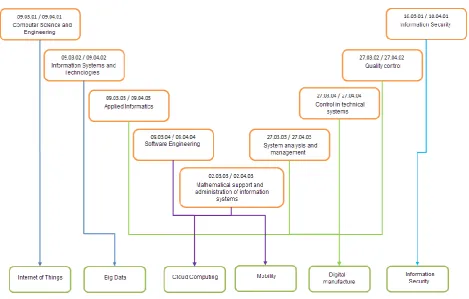
Fig. 6. Linking the areas of training with IT activities (Bachelor and Master) .
Fig. 7. Linking the areas of training with key technologies (Bachelor and Master) 02.03.03 / 02.04.03 Mathematical support and
administration of information systems
09.03.01 / 09.04.01 Computer science and computer facilities
09.03.02 / 09.04.02 Information systems and technologies
System integration
IT implementation
Application Development
Outsourcing
Offshore
Consulting
IT training
02.03.03 / 02.04.03 Mathematical support and administration of information systems 09.03.02 / 09.04.02 Information systems and technologies
09.03.04 / 09.04.04 Software Engineering
Infrastructure applications
Development and support of solutions
Custom applications
Business software
Software for users
Embedded Software
09.03.01 / 09.04.01 Computer science and computer facilities
09.03.02 / 09.04.02 Information systems and technologies
09.03.03 / 09.04.03 Applied Informatics
PC
Servers
Peripherals
External devices
6. Conclusion
The analysis of the documents used in the development of educational programs showed that they represent poorly structured data. To effectively use this kind of data, an ontology can be built. To simulate the semantics of free word combinations with subsumption / hierarchical relations, a mathematical device can be used to describe deterministic, discrete and finite information objects - the algebra of finite predicates.
The rules developed in ontology in the form of Horn clauses will make it possible to formulate recommendations for decision-making.
Analysis of existing educational programs and core activities in the IT field allows us to identify regular links. The conducted analysis can be useful to HR managers, developers of educational programs to take into account the requirements of the IT industry, etc.
References
1. Saraev,V. When the data became large / V.Saraev // Expert. Series Science and Technology. IT, 2013, №19 (850) http://expert.ru/expert/2013/19/kogda-dannyie-stali-bolshimi/ 2. Scientific electronic library "Ciberleninka" [Electronic
resource] // https://cyberleninka.ru/ (available at 03.08.2018); 3. Yusupova N.I., Smetanina O.N., Gayanova М.М. Models and
methods of information processing in the analysis of educational programs (on the example of training informatics) / Journal of Information Technologies №6. Tom 23. 2017 4. Yusupova N.I., Smetanina O.N., Gayanova М.М. On the state
and prospects of the development of the information technology industry in the context of training – Materials of the VI International Scientific Conference "Information Technologies and Systems", Bannoe, Russia, Chelyabinsk: Chelyab. state. university, 2017. pp. 348-353.
5. Yusupova N.I., Smetanina O.N., Gayanova М.М. Decision-making in the selection of personnel for the IT industry, taking into account the peculiarities of the bachelor's degree – Materials of the V All-Russian Conference ITIDS-2017, Ufa, USATU, 2018. T.2., pp. 225-228
6. Russian Government [Electronic resource] // http://static.government.ru/media/files/9gFM4FHj4PsB79I5v7y LVuPgu4bvR7M0.pdf (available at 07.08.2018);
7. Association of Computer and Information Technology Enterprises [Electronic resource] // http://www.apkit.ru/ (available at: 02.08.2018);
8. Portal of Federal State Educational Standards [Electronic resource] // http://fgosvo.ru/ (available at: 03.08.2018 г.) 9. Grishkovsky А. Integrated processing of unstructured data /
Grishkovsky А. // Open systems. DBMS. 2013. №06. https://www.osp.ru/os/2013/06/13036849
10.Methodical aspects of artificial intelligence. Guzairov M.B., Yusupova N.I., Kudryashev A.F., Yelkhova O.I., Popov D.V., Rizvanov D.A., Yenikeyeva K.R., Dolomatov M.Yu., Yartsev R.A., Smetanina O.N., Verkhoturov M.A., Verkhoturova G.N., Makeyev G.A., Gayanova M.M., Boyko M.V., Bogdanova D.R., Klimova A.V., Galyamov A.F., Orekhov YU.V., Orekhov E.U. and others. Monograph. Moscow: Mashinostroyeniye, 2014.