INTERNATIONAL JOURNAL OF PHARMACEUTICAL, CHEMICAL AND BIOLOGICAL SCIENCES
Available online at www.ijpcbs.com
OVERVIEW ON STABILITY STUDIES
Maninderjit Kaur*, Gurpreet Kaur, Harpreet Kaur and Saurav Sharma
CT Institute of Pharmaceutical Sciences, District . Jalandhar, Punjab, India.
INTRODUCTION
Stability is defined as the capacity of drug substance or drug product to remain within the established specification to maintain its identity, strength, quality and purity throughout the retest or expiration dating period. Stability testing of pharmaceutical products is a complex set of procedures involving considerable time, cost and scientific expertise in order to build in quality, efficacy and safety in drug formulations. Stability studies are the one of the most important step during the dug development process because it required to assure the identity, potency and purity of ingredients, as well as those of formulated product. (Singh et al., 2000)
WHO states that, the stability of finished pharmaceutical products depends on environment factors such as ambient temperature, humidity and light as well as on the product related factors e.g chemical and physical properties of active substance and of pharmaceutical excipient, the dosage form and its composition, the manufacturing process, the nature of the container closure system and properties of packaging material. (Tangru pranshu et al.,2012)
The objective of the stability studies is to determine shelf life of the drug product . The term stability refers to storage time allowed before any degradation product in dosage form
acheives a sufficient level to represent a risk to the patient. Based on this time, the expiration date (shelf life) of a product is determined. The purpose of the stability is to provide evidence on how the quality of drug substance (API):
1. Under the influence of a variety of environmental factors such as temperature, humidity and light varies with time.
2. to established period for drug substance.
3. to develop the understanding of the degradation pathway of an API which may influence the quality of drug product (Agarwal vipul et al.,2012) The stability studies are essential for well being of the patient suffering from disease for which product is designed. Not only degradation of unstable product (drug) into decomposition product harm the patient but also loss of activity up to a level of 85% of the clamied on the label may lead to failure of the therapy resulting in death e.g nitroglycerine tablets for angina and cardiac arrest. Because of this concern, it has become a legal requirement to provide data for certain type of stability tests for the regulatory agencies before approval of a new product. The chemical stability of drug is of great importance because drug become less effective as it undergoes degradation and degradation yield toxic by product which is harmful to patient.
Review Article
ABSTRACT
Stability plays important role in drug development Process. Stability studies ensuring the maintenance of product quality, safety and Efficacy throughout the shelf life are considered as pre-requisite for the acceptance and Approval of any pharmaceutical product. These studies are required to be conducted in a planned way following the guidelines issued by ICH, WHO and or other agencies.
Potential adverse effects of instability in pharmaceutical products have been given below
Potential adverse effects Explanation Example Stability parameter tested
Loss of active ingredient
Degradation of API in product resulting in less than 90%drug as
clamied on label unacceptable quality
Nitroglycerine tablets Time elapsed before the drug contentno longer exceedes 90%
Loss of content uniformity Loss of content as a
function of time Suspension
Ease of redispersion or redispersion volume
Decline of microbiological status
Increase in number of viable microorganism already present in the
product.
Multiuse creams Total bioburden after storage
Formation of toxic degradation products
Degradation of drug component
Formation of epianhydrotetracycline from
tetracycline protein drugs
Amount of degradation product during shelf life
Loss of package integrity
Chang in package integrity during storage
or distribution
Plastic screw cap losing back
off torque Specific package integrity test
Modification of any factor of functional relevance
Time-dependent change of any functionally relevant
attribute of drug product that adversely affects safety,efficacy,or patient accepatibility or
ease of use.
Adhesion ageing of
transdermal patches. Monitoring changes
Increase in concentration of active ingredient
Loss of vehicle perfusion bags sometimes allow solvent to escape and
evaporate so that product with in the bag
shows an increase in concentration.
Lidocaine gel,product in
perfusion bags. Stability in final container.
(Carstensen et al., 2000)
STABILITY STUDIES AND THEIR CLASSIFICATION
Stability studies is the essential crietriea for assure the quality efficacy and integrity of the final product. (C.Bardin et al.,2011).
Physical stability studies
The physical changes can have deleterious effects too. The physical evaluation of the solution is of particular importance for intrathecal, ocular and intra-arterial routes. A tablet may become soft and ugly or it intra-arterial routes. A tablet may become soft and ugly or it may become very hard and show very slow dissolution time as a result of which bio-availability may not be good, so physical stability studies are also essential. A more refined physical evaluation, using turbidimetry , light odstruction, dynamic light scattering or microscopic analysis, is particularly important for therapeutic proteins to evaluate their kinetic profiles of aggregation.
Chemical stability studies
moisture take part as a reactant in many chemical reactions and play the role of solvent vector in many rections. It has better thermal conductivity than solids and allow better heat
transfer hence molecules have more kinetic energy and more decomposition is observed. In all these, hydrolysis or oxidation or fermentation; common cause is moisture. All reactions speeded upon presence of moisture. The methods used for evaluation of chemical instability are HPLC, HPTLC or capillary electrophoresis. These methods are used widely.
Microbiological stability studies
Microorganisms not only contaminate the formulations containing moisture but also solid dosage forms containing natural polymer because many natural polymers are source of microorganism.
MECHANISM OF DEGRADATION (K.C. Waterman et al.,2005)
Oxidation
reaction with other oxidizing agents present in the formulation. oxidation/reduction reactions involve the transfer of electrons or transfer of oxygen or hydrogen from substance. oxidation in tablet dosage form depends on the tablet hardness or on the presence of coating since either of these could affect the oxygen penetration rate.
Hydrolysis
Hydrolytic reactions are among the most common process for drug degradation. Hydrolysis reactions involve nucleophillic attack of labile bonds by water on the drug in solution. The reactions involving lactam groups are fastest and are followed by those involving esters, amides and imides in that order and follow first order. These reations are catalysed by presence of divalent metal ion, ionic hydrolysis, heat, light solution and high drug concentrations.
Microbial instability
Contamination of the product may cause lot of damage to the product or some time may not cause any at all. For example spores of the mold mucor may be present in a dormant form and never produce spolilage and never harm the patient who takes the medicine.But if salmonella enters a medicine it may not cause visible damage but cause serious health hazards who consume it.
Temperature
Temperature has high degree of influence on all variety of reactions and usually they are accelerated by raise in temperature.
pH
Acidic and alkaline pH influence the degradation of most drugs. Increase or decrease in pH may degrate the drug product formulation .So during the preparation of formulation care should be taken about the pH adjustment.
PARAMETERS FOR STABILITY TESTING The following parameters for each dosage form is used as guide for the type of tests to be included in a stability studies;
Physicochemical properties like appearance, disintegration, dissolution, water content are the parameters for the stability testing of drug substance, tablet and capsule. For topical ophthalmic, parenteral, suppositories: pH, clarity of solution, particle size
distribution, sterility are the parameters for stability testing.
Chemical properties like assay, degradation product are the parameters for the stability testing of drug substance, capsule, tablet, suppositories.
Microbial properties like microbial purity is the parameter for the stability testing of drug substance, capsule, tablet, suppositories. (Singh et al., 2000).
GUIDELINE FOR STABILITY TESTING
Table 2: Codes and titles used in ICH Guidelines
ICH Code Guideline title
Q1A Stability testing of New Drug Substances and Products (Second Revision)
Q1B Stability testing : Photostability testing of New Drug Substances and Products
Q1C Stability testing of New Dosage Forms
Q1D Bracketing and Matrixing Designs for stability testing of Drug Substances and Products
Q1E Evaluation of stability data
Q1F Stability data package for Registration Applications in Climatic Zones III and IV
Q5C Stability testing of Biotechnological/Biological Products (Singh et al., 2000)
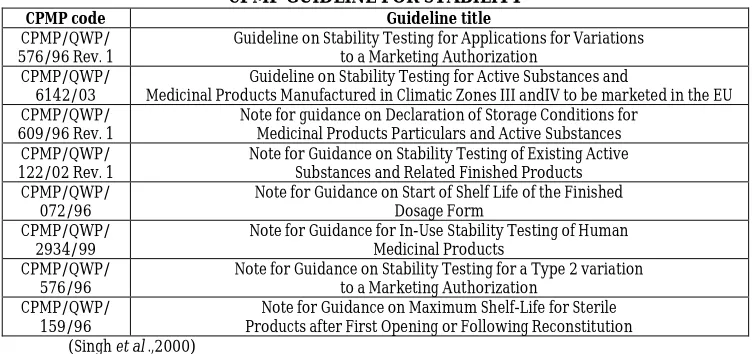
Series of guidelines related to stability testing have also been issued by the Committee for Proprietary Medicinal Products (CPMP) under the European Agency for the Evaluation of
Medicinal Products (EMEA) to assist those seeking marketing authorization for medicinal products in European Union. These are below:
CPMP GUIDLINE FOR STABILITY
CPMP code Guideline title
CPMP/QWP/ 576/96 Rev. 1
Guideline on Stability Testing for Applications for Variations to a Marketing Authorization
CPMP/QWP/ 6142/03
Guideline on Stability Testing for Active Substances and
Medicinal Products Manufactured in Climatic Zones III andIV to be marketed in the EU CPMP/QWP/
609/96 Rev. 1
Note for guidance on Declaration of Storage Conditions for Medicinal Products Particulars and Active Substances CPMP/QWP/
122/02 Rev. 1
Note for Guidance on Stability Testing of Existing Active Substances and Related Finished Products CPMP/QWP/
072/96
Note for Guidance on Start of Shelf Life of the Finished Dosage Form
CPMP/QWP/ 2934/99
Note for Guidance for In-Use Stability Testing of Human Medicinal Products
CPMP/QWP/ 576/96
Note for Guidance on Stability Testing for a Type 2 variation to a Marketing Authorization
CPMP/QWP/ 159/96
Note for Guidance on Maximum Shelf-Life for Sterile Products after First Opening or Following Reconstitution (Singh et al .,2000)
CLIMATIC ZONES FOR STABILITY TESTING For the purpose of stability testing, the whole world has been divided into four zones (I - IV) depending upon the environmental conditions the pharmaceutical products are likely to be subjected to during their storage. These conditions have been derived on the basis of the mean annual temperature and relative humidity
data in these regions. Based upon this data, long-term or real-time stability testing conditions and accelerated stability testing conditions have been derived. . The break-up of the environmental conditions in each zone and also the derived long-term stability test storage conditions, as given by WHO have also been presented.
Following are the climatic zones into which word is divided for stability testing
Climatic Zone
Climate/ Definition
Major Countries
/Region
I Temperate
United Kingdom Northern Europe
Russia United states
II Subtropical and Mediterranean
Japan Southern
Europe
India
Iva Hot and humid Iran
Egypt
IVb Hot and very Humid
Brazil Singapore
Stability testing conditions (zone I and II) Long term conditions :25°C ±2°C /60%RH±5% Accelerated conditions :40 °C ±2°C /75%RH±5% Intermediate conditions : 30°C ±2°C /65%RH±5%
Stability testing conditions (zone III and IV) Long term conditions: 30 °C ±2 °C /65%RH±5%RH
Accelerated conditions: 40 °C ±2 °C /75%RH±5% Intermediate conditions: no intermediate conditions
International climatic zones and climatic conditions (WHO,1996)
Climatic Condition Zone I
Temperature
Zone II Temperature
Zone III Temperature
Zone IV Temperature
Mean annual
temperature 20 °C 21.6 °C 26.4 °C 26.7 °C
Mean kinetic
temperature 20°C 22 °C 27.9 °C 27.4 °C
Mean annual relative
humidity 42% 52% 37% 76%
Derived storage condition(for real time
studies)
21 °C /45%RH 25 °C /60%RH 30 °C /35%RH 30 °C
/70%RHS
PROTOCOL FOR STABILITY TESTING
The protocol for stability testing is a pre-requisite for starting stability testing and is necessarily a written document that describes the key components of a regulated and well-controlled stability study. Because the testing condition is based on inherent stability of the compound, the type of dosage form and the proposed container-closure system, the protocol depends on the type of drug substance or the product. A well designed stability protocol should contain the following information.
Batches
Stability studies at developmental stages are generally carried out on a single batch while studies intended for registration of new product or unstable established product are done on first three production batches, while for stable and well established batches, even two are allowed. If the initial data is not on a full scale production batch, first three batches of drug product manufactured post-approval should be placed on long-term studies using the same protocol as in approved drug application. Data on laboratory scale batches obtained during development of pharmaceuticals are not accepted as primary stability data but constitute supportive information. In general, the selection of batches should constitute a random sample
from the population of pilot or production batches (Singh et al., 2000).
Containers and closures
The testing is done on the product in immediate containers and closures proposed for marketing. The packaging materials include aluminium strip packs, blister packs, Alu-Alu packs, HDPE bottles etc. This may also include secondary packs, but not shippers. Products in all different types of containers/closures, whether meant for distribution or for physician and promotional samples, are to be tested separately. However, for bulk containers, testing in prototype containers is allowed, if it simulates the actual packaging (Singh et al., 2000).
Orientation of storage of containers
Sampling time points
Frequency of testing should be such that it is sufficient to establish the stability profile of the new drug substance. For products with a proposed shelf life of at least 12 months, the testing frequency at the long-term storage condition should be every 3 months over the first year, every 6 months over the second year and annually thereafter throughout the proposed shelf life expiration date. In the case of accelerated storage conditions, a minimum of three time points, including the initial and end points, for example, 0, 3, and 6 months is recommended. When testing at the intermediate storage condition is necessary as a result of significant change at the accelerated storage condition, a minimum of four testpoints, including the initial and final time points, is recommended, for example, 0, 6, 9 and 12 months.
In case the same product of different strengths, multiple sizes, etc is required to be tested, reduced stability testing plans can be worked out, which involves less number of test points. The reduced testing plans are based on bracketing and matrixing statistical designs. Bracketing is the design of a stability schedule such that only samples on the extremes of certain design factors, e.g., strength, package size, are tested at all time points as in a full design. On the other hand, matrixing involves testing of a subset of the total number of possible samples for all combinations at a specific time point. Subsequently, another subset of samples for all factor combinations is tested. The factors that can be matrixed include batches, strengths with identical formulation, container sizes, fill sizes, and intermediate time points.
Test Schedule for stability testing of new products
Environment Sampling time points(month) Method and climatic zone
25°C/60% RH 3, 6, 9, 12, 18, 24,36 Long term for zones I and IV 30°C/35% RH 3, 6, 9, 12, 18, 24,36 Long term for zones III
30°C/65% RH 3, 6, 9, 12, 18, 24,36 Long term for zone IVa, or intermediate condition for zones I and II
30°C/75% RH 3, 6, 9, 12, 18, 24,36
Long term for zone IVa, or intermediate condition for zones I
and II
40°C/75% RH 3,6 Accelerated condition for all zones
Sampling Plan
Sampling plan for stability testing involves, planning for the number of samples to be charged to the stability chambers and sampling out of the charged batch so as to cover the entire study. The first step should be the development of the sampling time points followed by the number of samples needed to be drawn at each pull point for complete evailuation of all test parameters and finally adding up to get the total number of samples. For example there would be a requirement of about 100 tablets per pull out in a long term or accelerated stability studies including 10 each for assay, hardness and moisture determination, 6 each for dissolution and disintegration and 50 for friability. This multiplied by the total number of pull outs will give the total number of tablets required for a
study. This is followed by the development of a sampling plan, which includes the selection of the containers representing the batch as a whole but in an unbiased manner. A stratification plan has been suggested whereby from a random starting point every nth container is taken from the filling or packaging line (n is chosen such that the sample is spread over the whole batch). (Singhet al., 2000).
Test storage conditions
The storage conditions to be selected are based upon the climatic zone in which the product is intended to be marketed or for which the product is proposed to be filed for regulatory approval. General recommendations on the storage conditions have been given by ICH are:
Recommended stability storage conditions for various products in Zone I-IV
Product Zone Accelerated Intermediate Long-term
Solid oral dosage forms,solids for reconstitution,dry and lyophilized powders in
glass vials
ZoneI/II
ZoneIII/IV
40°C/75% RH
40°C/75% RH 30°C/65% RH
---
25°C/60% RH
30°C/65% RH
Liquids in glass bottles,vials , or sealed glass ampoules , which provide an impermeable
ZoneI/II 40°C/ambient humidity 30°C/ambient humidity
---
barrier to water loss ZoneIII/IV 40°C/ambient humidity 30°C/ambient humidity Drug products in semi
permeable and permeable containers,large volume
parenterals(LVPs), small volume parenterals(SVPs), opthalmics, otics, and nasal sprays packaged in semi permeable containers, such as plastic bags, semi rigid
plastic containers, ampoules, vials and bottles with or without droppers/ applicators,
which may be susceptible to water loss
ZoneI/II
ZoneIII/IV
40°C/NMT25%RH
40°C/NMT25%RH
25°C/40% RH
25°C/40% RH
Drug products intended to be stored at
refrigerator temperature
ZoneI/II
ZoneIII/IV
25°C/60% RH or 25°C/ambient humidity
for liqud products
25°C/60% RH or 30 °C /65%RH,whichever is available 25°C/ambient
humidity or 30°C /ambient humidity for
liquid products , whichever is available
5°C ±3°C with monitoring but not control of humidity
Stability storage conditions for drug products intended to be
stored at freezer temperature
ZoneI-IV 5 °C ±3 °C ambient humidity
-20 °C ±5 °C
(ICH Q1A(R2).2003)
Test parameters
The stability test protocol should define the test parameters that would be used for evaluation of the stability samples. The tests that monitor the quality, purity, potency, and identity which could be expected to change upon storage are chosen as stability tests. Therefore appearance, assay, degradation products, microbiological testing, dissolution, and moisture are standard tests performed on stability test samples. Microbiological tests include sterility, preservative efficacy and microbial count as applicable e.g. for liquid injectable preparations. The batches used for stability study must meet all the testing requirements including heavy metals, residue on ignition, residual solvents etc. Some of these are required at the time of product release but not required to
be repeated during stability testing. Other tests like enantiomeric purity, particle size and polymorphic form etc have also been discussed in ICH guidance Q6A.
Test methodology
It is always recommended to follow the procedures given in the official compendia, as the results obtained using the official tests, in general find better acceptance. If alternate
methods are used, they are required to be duly validated. However, the assay of the drug should be carried out using a stability-indicating method, established by carrying out stress tests on the drug under forced decomposition conditions. This method should be validated for specificity, accuracy, precision and linearity, in the range to which the drug is expected to fall during stability studies. For the assay of degradation products, the validated method should also include the limits of detection/quantification. The methods reported in literature should be used after confirming reproducibility and carrying out minimal validation, say of linearity, range, etc. It is always recommended to prepare a standard test protocol (STP) for each test (Singh et al., 2000; Ali et al., 2008).
Acceptance criteria
quantitative terms e.g., moisture pick-up, viscosity, particle size, assay, degradation products, etc. and pass or fail for qualitative tests e.g., odour, colour, appearance, cracking, microbial growth, etc. These acceptance criteria should also include individual and total upper limits for degradation products. ICH guideline Q3B(R2) related to impurities in new drug products addresses degradation products in new drug formulations. The degradation products of the active or interaction products from the active ingredients and excipients and/or active and container component should be reported, identified, and/or qualified when the proposed thresholds are exceeded. The reporting threshold of impurities is based upon the intended dose. If the maximum daily dose is less than or equal to 1gm, the limit is 0.1% and if greater than 1, the limit is 0.05%. The identification threshold of impurities is between 1.0-0.1% for the maximum daily dose ranging between 1mg and 2gm.
STABILITY TESTING METHODS (Bajaj sanjay et al., 2012)
Stability testing is a routine procedure performed on drug substances and products and is employed at various stages of the product development. The major aim of pharmaceutical stability testing is to provide reasonable assurance that the products will remain at an acceptable level of fitness/quality throughout the period during which they are in market place available for supply to the patients and will be fit for their consumption until the patient uses the last unit of the product. Stability testing procedures have been divided into four type:
(a)Accelerated stability testing
In accelerated stability testing the samples are subjected to stress, refrigerated after stressing, and then assayed simultaneously. Because the duration of the analysis is short, the likelihood of instability in the measurement system is reduced in comparison to the real-time stability testing. Further, in accelerated stability testing, comparison of the unstressed product with stressed material is made within the same assay and the stressed sample recovery is expressed as percent of unstressed sample recovery. For statistical reasons, the treatment in accelerated stability projections is recommended to be conducted at four different stress temperatures. However, for thermolabile and proteinaceous components, relatively accurate stability projections are obtained when denaturing stress temperatures are avoided.
The concept of accelerated stability testing is based upon the Arrhenius equation (1) and modified Arrhenius equation (2):
ƖnK=ƖnA+∆E
RT (1)
where K = degradation rate/s, A = frequency
factor/s, ΔE =activation energy (kJ/mol), R = universal gas constant (0.00831 kJ/mol), T=absolute temperature (K)
Ɩog(k2/ k1)= - Ea/2.303R(1/T2-1/T1) (2)
where k1 and k2 are rate constants at temperatures T1 and T2expressed in degree kelvins; Ea is the activation energy; R is the gas constant.
These equations describe the relationship between storage temperatures and degradation rate. Using Arrhenius equation,projection of stability from the degradation rates observed at high temperatures for some degradation processes can be determined.
(b)Real-Time stability testing
Real-time stability testing is normally performed for longer duration of the test period in order to allow significant product degradation under recommended storage conditions. The period of the test depends upon the stability of the product which should be long enough to indicate clearly that no measurable degradation occurs and must permit one to distinguish degradation from inter-assay variation. During the testing, data is collected at an appropriate frequency such that a trend analysis is able to distinguish instability from day-to-day ambiguity.
(c)Cyclic temperature stress testing
Cyclic temperature stress tests are designed on knowledge of the product so as to mimic likely conditions in market place storage. The period of cycle mostly considered is 24 hours since the diurnal rhythm on earth is 24 hour, which the marketed pharmaceuticals are most likely to experience during storage. The minimum and maximum temperatures for the cyclic stress testing is recommended to be selected on a product by-product basis and considering factors like recommended storage temperatures for the product and specific chemical and physical degradation properties of the products. It is also recommended that the test should normally have 20 cycles.
(d)Retained sample stability testing
for at least one batch a year are selected. If the number of batches marketed exceeds 50, stability samples from two batches are recommended to be taken. At the time of first introduction of the product in the market, the stability samples of every batch may be taken, which may be decreased to only 2% to 5% of marketed batches at a later stage. In this study, the stability samples are tested at predetermined intervals i.e. if a product has shelf life of 5 years, it is conventional to test samples at 3, 6, 9, 12, 18, 24, 36, 48, and 60 months.
CONDUCT OF STABILITY STUDIES
The stability study is conducted by keeping the drug substance or the product in their proposed final packs (e.g. Aluminium strip, blister pack, Alu-Alu pack, HDPE container etc.), or prototype containers in the case of bulk drugs, in sufficient numbers in the stability chambers set at appropriate storage conditions as per the protocol. The samples are then withdrawn, as per the stability protocol, at the prescribed sampling intervals and are then analyzed by a suitable method. The sampling should preferably be from unopened container. As far as possible the samples are placed for testing as soon as they have been prepared and analyzed without delay after they have been withdrawn. Delay in placing the samples and analysis of withdrawn samples is known to affect the results. However, if there is an unavoidable delay, then the samples are frozen until they are subjected to analysis. In order to minimize the effect of day-to-day variability on the results, the following two approaches are followed. Samples are drawn in replicate. One of the samples is tested and others are kept at temperatures sufficiently low to prevent further drug loss and then all the samples are subjected to analysis on the same day at the end of study (i.e after withdrawl of the last sample) (Ali et al., 2008) and Second approach is to freeze the initial samples till the expiration period and test them at appropriate times by using them as internal standards in the assays (Ali et al., 2008).
PRESENTATION AND RECORDING OF STABILITY DATA
Stability data is recorded in an organized, comprehensive and cumulative format. The stability data table is the means for reporting the results of the stability study in a concise format for ease of review and interpretation. The data is recorded in a proper tabular format and all-encompassing information on a batch is recorded at one place. Similar sheets are
prepared for each batch. When, it is not possible to collect a sample exactly at the designed time (i.e., 3, 6, 9, 12 month, etc.), the sample may be withdrawn conveniently, and the actual time of collection should be indicated in the format sheet. The data can be grouped by storage condition and time interval to present the stability as a function of time for each environmental condition studied. Data can be presented in multiple tables taking care that it is easily interpretable. In addition, a graphical presentation of stability data versus time for the test data can be used to illustrate trends in data and may be helpful for data evaluation. A graphical presentation of the data, however, cannot replace the tabular presentation for a regulatory filing. The results of the statistical analysis, wherever appropriate and analysis of impurities should also be discussed. (Singh et al., 2000).
Mean kinetic temperature
The Mean kinetic temperature is the single calculated temperature at which the total amount of degradation over a particular period is equal to the sum of the individual degradations that would occur at various cycles of higher and lower temperature. It is an isothermal storage temperature that simulates the non isothermal effects of storage temperature variation. The MKT takes into account seasonal and daily temperature variations during a year. It expresses the cumulative thermal stress undergone by a product at varying temperatures during storage and distribution. The concept of MKT is applied in order to provide assurance that the actual storage conditions will not affect adversely the stability
and shelf life of the product. This is based upon the fact that the degradation rate constants are temperature dependent. A controlled room temperature maintained thermostatically t o the usual working environment of 20°C to 25°C results in a mean kinetic temperature calculated to be not more than 25°C. This concept is applied to pharmacies, hospitals, distribution and storage areas and vehicles.
and relates degradation rate constants at different temperatures to the activation energy. The FDA recommends the method of entering both the individual highest and the lowest temperatures (rather than averages) in the equation for the calculation of MKT. This results in entering 104 data points, in contrast to USP’s 52 points. If temperatures are electronically recorded at many times during a day and all the values are used in the calculation of MKT, then there is no difference between the USP and FDA method (Kommanaboyina et al., 1999).
Estimation of Shelf Life
The shelf life is determined from the data obtained from the long term storage studies. The data is first linearized and test for goodness of fit is applied. The linearized data is then analyzed to see that the slope and the intercepts are matching. For determination of significance of difference in case of slope or intercept, statistical tests like t-test should be applied. The data is available in the form of only five data points i.e. 0, 3, 6, 9 and 12 months, either pooled from the three batches or from the three individual batches if they are not fit for pooling. In case data is not fit for pooling, stability estimates are to be made on the worst batch. The shelf life/expiry date is determined from the regression line of this five point data based on calculation of 95% one-sided confidence limit. For reading the expiry date, 90% drug concentration is considered as the lowest specification limit and the point where the extension line cuts the 95% confidence limit line is taken as an expiry date. Because shelf life derived from the intersection of the lower 90% confidence bound and 90% potency value has a 95% confidence level, therefore there is only a 5% chance that our estimate of the shelf life will be too high (Ali et al., 2008). For new drugs, it is a general practice to grant only two-year expiry initially, which is based on satisfactory one year long-term and 6 months accelerated stability data. The expiry date for third and later years is allowed only on production of real -time data for the subsequent years (Singh et al., 2000). Most pharmaceutical products are characterized by only one shelf life. However, in some cases a product may have two e.g. a freeze-dried (lyophilized) protein product may have only 1 shelf life, say 2 years, for the product stored in the dry condition and a 2 shelf life, say 2 days, for the product when it has been reconstituted with the appropriate vehicle and is ready for injection (Carstensen et al., 2000) .
Conformance period
The conformance period is determined from the intersection of the lowest (or highest) acceptable value of the stability parameter and the 95% confidence bound of the regression line. Shelf life assigned to a product is equal to, or less than, the. conformance period and is usually a convenient rounded off number (e.g. 7 days, 1 month, 1 year, 18 months, or 2, 3, or 5 years). e.g. if for 3 separate pharmaceutical products we obtained conformance periods of 13.2, 26.1 and 39.4 months, we would probably assign shelf lives of 12, 24 and 36 months to the 3 products. The difference between conformance period and the assigned shelf life is that conformance period provides an extrastability reserve (Carstensen et al., 2000).
CONCLUSION
Stability studies are essential to yield quality products. It is essential that stability tests are carried out according to the guidelines so that recommended storage conditions and shelf life can be included on the label to ensure that the medicine is safe and effective throughout its shelf life. Therefore, the stability tests should be carried out following proper scientific principles and after understanding of the current regulatory requirements and as per the climatic zone.
REFERENCES
1. Ali J, Khar RK and Ahuja A. Dosage form and design.3rd ed. Delhi. Birla Publications Pvt. Ltd. 2008;100-123 2. Agarwal Vipul and Sharma Devesh.
Stability testing of active pharmaceutical ingredient. Journal of pharmaceutical and scientific innovation. 2012;1(2):18-23.
3. Bracketing and matrixing designs for stability testing of new drug substances and products—Q1D. (ICH), International Conference on Harmonization. 2002
4. Carstensen JT and Rhodes CT. Clin Res Drug Reg. Affairs. 1993;10:177-185
5. CPMP. Guideline on stability testing: Stability testing of existing active substances and related finished products. CPMP/QWP/122/02, 2003. 6. Bardin C, Astier A, Vulto A, Sewell G,
conference. Annales Pharmaceutiques Francaises. 2011;69:221-231.
7. ICH Q1A (R2). Stability testing guidelines: Stability testing of new drug substances and products. ICH Steering Committee, 2003.
8. ICH Q1B. Guidance for Industry: Photostability testing of new drug substances and products. CDER, US FDA, 1996
9. ICH Q3B (R2). Impurities in new drug products. ICH Steering Committee, 2003.
10. ICH Q6A. Specifications: Test procedures and acceptance criteria for new drug substances and new drug products: chemical substances. ICH Steering Committee, 1999.
11. Kommanaboyina B and Rhodes CT. Trends in stability Testing , with Emphasis on Stability During Distribution and Storage. Drug Dev Ind Pharm. 1999;25:857-867
12. Singh S. Drug Stability Testing and Shelf-life Determination According to International Guidelines. Pharm. Technol. 1999;23:68-88
13. Singh S. Stability testing during product development in Jain NK Pharmaceutical product development CBS publisher and distributors. India, 2000;272-293
14. Sanjay Bajaj, Dinesh Singla and Neha Sakhuja. Stability Testing of Pharmaceutical Products. Journal of Applied Pharmaceutical Science. 2012;2 (3):129-138.