R E S E A R C H
Open Access
Situation prediction of large-scale Internet
of Things network security
Wenjun Yang
1,2, Jiaying Zhang
1,2*, Chundong Wang
1,2and Xiuliang Mo
1,2Abstract
The Internet of Things (IoT) is a new technology rapidly developed in various fields in recent years. With the continuous application of the IoT technology in production and life, the network security problem of IoT is
increasingly prominent. In order to meet the challenges brought by the development of IoT technology, this paper focuses on network security situational awareness. The network security situation awareness is basic of IoT network security. Situation prediction of network security is a kind of time series forecasting problem in essence. So it is necessary to construct a modification function that is suitable for time series data to revise the kernel function of traditional support vector machine (SVM). An improved network security situation awareness model for IoT is proposed in this paper. The sequence kernel support vector machine is obtained and the particle swarm optimization (PSO) method is used to optimize related parameters. It proves that the method is feasible by collecting the boundary data of a university campus IoT network. Finally, a comparison with the PSO-SVM is made to prove the effectiveness of this method in improving the accuracy of network security situation prediction of IoT. The experimental results show that PSO-time series kernel support vector machine is better than the PSO-Gauss kernel support vector machine in network security situation prediction. The application of the Hadoop platform also enhances the efficiency of data processing.
Keywords:Network security, Situation prediction, Sequence correlation, Support vector machine
1 Introduction
With the popularity of the Internet of Things and the rapid development of cloud computing, security issues become increasingly prominent. Security vul-nerabilities and security incidents are increasing
not-ably. Network security incidents have occurred
occasionally such as network worms, hackers drag-ging databases, 0-day exposure, and privacy data leakage. Network security is becoming the focus of many nations, enterprises, and individuals. China set up the Central Internet Security and Informatization Leading Group in February 2014, which indicated that the government had put network security on the national strategic position [1].
The Internet of Things (IoT) is a new technology rapidly developed in recent years. With the development of com-munication technology, IoT devices have made good
development in smart cities, wireless sensing, cloud com-puting, and many other fields. However, with the popular-ity of Internet of Things devices, securpopular-ity and privacy issues have become increasingly prominent [2–6]. Due to increasingly serious problems of IoT network security, network security situation awareness of IoT comes into being and gradually becomes the focus of the network se-curity field. By assessing the operating status of the net-work in real-time and promptly predicting the problems before the security incidents occur, the network security situation awareness can help the administrators make the right decisions [7].
Utilizing the characteristic of situational factors that are randomness, time-sequence, and complexity, an im-proved network security situation awareness model for IoT is proposed in this paper. Considering the close rela-tionship between the network security situation and time, we agree that situation prediction of network se-curity is a kind of time series forecasting problem in es-sence [8]. A modification function is constructed that is suitable for time series data to revise the kernel function
© The Author(s). 2019Open AccessThis article is distributed under the terms of the Creative Commons Attribution 4.0 International License (http://creativecommons.org/licenses/by/4.0/), which permits unrestricted use, distribution, and reproduction in any medium, provided you give appropriate credit to the original author(s) and the source, provide a link to the Creative Commons license, and indicate if changes were made.
* Correspondence:[email protected]
1Key Laboratory of Computer Vision and System, Ministry of Education,
Tianjin University of Technology, Tianjin 300384, China
2Tianjin Key Laboratory of Intelligence Computing and Novel Software
of traditional support vector machine. The sequence ker-nel support vector machine is obtained and the particle swarm optimization method is used to optimize related parameters. It proves that the method is feasible by col-lecting the boundary data of a university campus net-work. Finally, a comparison with the PSO-SVM is made to prove the effectiveness of this method in improving the accuracy of network security situation prediction.
The main contributions of our work are listed as follows:
1) We propose an improved network security situation awareness model for IoT based on PSO-time series kernel support vector machine.
2) We employ a sequence kernel support vector machine and the particle swarm optimization to optimize related parameters, improving the accuracy of network security situation prediction. 3) The experimental results show that PSO-time series
kernel support vector machine is greatly effective.
1.1 Roadmap
The rest of this paper is organized as follows. First, we survey related work in Section 2. Then, we introduce the design of network security situation prediction of IoT in Section 3. We describe the system implementation and report evaluation results in Section 4. Finally, we con-clude our work in Section 5.
2 Related work
The concept of situational awareness originated from the military field which requires an understanding of the strengths and weaknesses of the enemy in order to make the right decisions on the battlefield. In 1988, Endsley [9] gave the definition of situational awareness for the first time, which was the perception of environmental el-ements with respect to time and/or space, the compre-hension of their meaning, and the projection of their status after some variables had changed. In 1999, Bass [10] first proposed the concept of Cyberspace Situation Awareness, which aimed at using the SA for the network management and network security to improve the cogni-tive ability of administrators to shorten the decision time.
There were many groundbreaking researches in the field of network security situation awareness [11]. After analyzing the concept of network situational awareness, Bass [12] proposed a framework for network security situation based on multi-sensor data fusion technology. By reasoning to identify the intruders’identity and locate intrusion goals, it was a good way to assess the security status of the network.
A prediction method combined with the quantitative and qualitative of network security situation based on
the cloud was proposed by Lei Xuan [13]. The future situation was predicted by combining the current trend with the prediction rules mining from history evolve-ment data.
After the assessment of current network security situ-ation, You and Ren [14, 15] proposed different predic-tion models based on a neural network. By using the advantage of a neural network in dealing with nonlinear problems, they implement the accurate forecast of the network security situation.
A complex network-based network security situation prediction mechanism was proposed by Li [16]. Using the model of Markov, we can not only trace the dynamic behavior of the numerical fluctuations in the security situation but also predict security state effectively.
Chen [17] proposed a prediction method of network security situation based on the algorithm of IHS_LSSVR. An improved Harmony Search (IHS) algorithm is used to optimize the parameters of least squares support vec-tor machine and then to forecast the network security status.
The related principles of the proposed method are de-scribed below.
3 Network security situation prediction of IoT 3.1 Data analysis initial normalization based on Hadoop
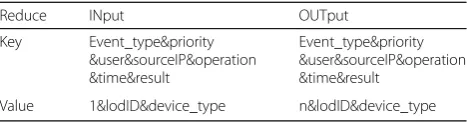
several raw log, logID origID record raw logs, and semi-colons to separate the Map Reduce input and output of the details in Table1, as shown in Table2
Firewall logs can reflect network traffic, and the log aggregation of traffic abnormal classes is mainly ex-tracted from the firewall logs and related to connection classes. Similar configuration to polymerization with the management, traffic exception class log aggregation also need to increase the count origID and attribute, the role of the same, and Map Reduce the input and output of the details such as Table3, shown in Table4.
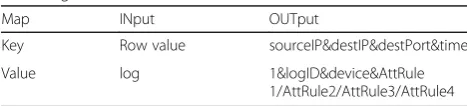
Network attack is usually in a variety of network secur-ity equipment in the log traces of attack [18], according to the above design, log aggregation rules and attribute char-acteristics to aggregation of attack mode, increase the count, origID, and mode three attributes. Graphs of input and output details are shown in Table5and6.
Through clustering algorithm, this node initializes the firewall and IDS logs through Hadoop and builds a com-prehensive and accurate data source for the subsequent chapters of this article, based on the prediction of log files.
3.2 Situation prediction model based on sequence kernel support vector machine
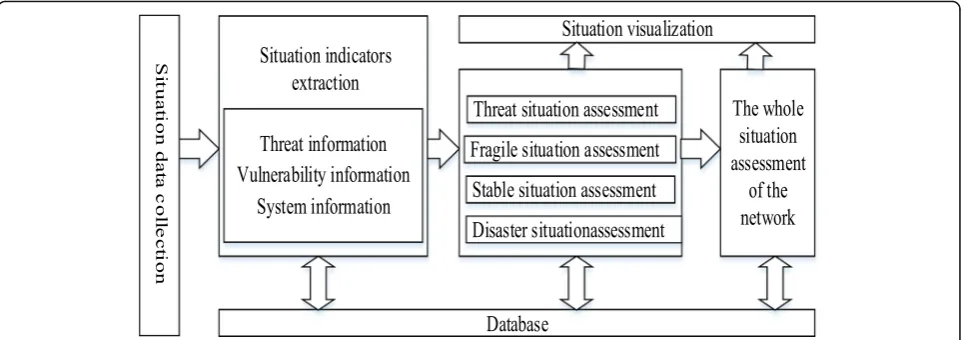
On the basis of different levels, different information sources, and different needs, this paper proposed a net-work security situation prediction model based on se-quence kernel support vector machine as shown in Fig.1.
In the model, the whole situation of the network is di-vided into four first-class indicator situations: threat situation, fragile situation, stable situation and disaster situation [19]. Each first-class indicator situation is de-scribed by several secondary indicators. We use the T-S fuzzy neural network (FNN [20]) method, which makes secondary indicators as input and first-class indicator situation as output to get the threat situation, fragile situation, stable situation, and disaster situation, respect-ively. Finally, the analytic hierarchy process (AHP) is used to decide the relative weight of each first-class indi-cator situation, thus the whole situation of the network is obtained [21].
Finally, the PSO-sequence kernel support vector ma-chine is used to deal with the value of the whole situ-ation; thus, we get the prediction results of the future
state of the network. Situation prediction of network se-curity can help network administrators have a good un-derstanding of network status. For network attacks, administrators can release network security warning timely.
3.3 Support vector machine
Support vector machine (SVM) is a general and effective machine learning method based on statistical learning theory [22]. It has many obvious advantages in the study of complex nonlinear prediction. The regression func-tion of network security situafunc-tion predicfunc-tion based on support vector machine is as follows:
Set up network security situational training sample is {xi,yi},i= 1, 2,…n, Wherexiandyirepresent input vectors
and output values. nis the training sample number. The prediction idea of SVM is to find a nonlinear mapping from input to output and to map data into high dimen-sional feature space. In this feature space, the training samples are predicted by prediction equationf(x).
f(x)is defined as follows:
f xð Þ ¼wφð Þ þx b;φ:Rn→G;w∈G ð
1Þ
Wherewis the weight vector andbis the bias vector. SVM solves the optimization problem as follows:
minJ ¼1 2k kw
2þCXn
i¼1
ξþξ
ð Þ ð2Þ
Constraint conditions are as follows:
yi−wxi−b≤εþξi
wxiþb−yi≤εþξi
ξi≥0;ξi≥0 8
<
: ð3Þ
where Cis the penalty parameter, ξi and ξi are slack variables,εis insensitive loss function.
Table 1Manages the Map phase input output for the configuration class log
Map INput OUTput
Key Row value Event_type&priority &user&sourceIP &operation&time &result
Value log 1&logID&device_type
Table 2Manage the Reduce phase input output for the configuration class log
Reduce INput OUTput
Key Event_type&priority &user&sourceIP&operation &time&result
Event_type&priority &user&sourceIP&operation &time&result
Value 1&lodID&device_type n&lodID&device_type
Table 3The MAP phase input and output of the traffic exception class log
Map INput OUTput
Key Row value sourceIP&sourcePort &destPort&time&protocol
εis defined as follows:
Lε f xð Þi;yi
¼ jf xð Þ−i yij−ε;jf xð Þ−i yij>ε
0; otherwise
ð4Þ
By introducing Lagrange multipliers, the nonlinear prediction problem is transformed into the optimization problem as follows:
L¼1
2ω
Tω
þcX
k
i¼1 ζiþζi
−X k
i¼1
aiðζiþε−yiþf xð Þi Þ
−Xk i¼1
aiζi þε−yiþf xð Þi −
Xk
i¼1
ηiζiþηiεi
ð5Þ
Whereaiandαi are Lagrange multipliers.
According to the KKT condition, the support vector machine prediction problem can be solved by solving the dual problem in formula (2), that is
f xð Þ ¼Xni¼1 αi−α
i
k xð ;xiÞ þb ð6Þ
Constraint conditions are as follows:
∂bL¼0⇒Xl
i¼1 αi−α
i
¼0 0≤αi;αi <c;i¼1;2;⋯;l
∂ωL¼0⇒ω¼
Xl i¼1 αi−α
i
Φð Þxi 8
> < >
: ð7Þ
wherek(x,xi) is the kernel function of the support
vec-tor machine, describing the inner product of the high di-mensional feature space.
As the Gauss kernel function is better than other ker-nel functions, this paper uses the Gauss kerker-nel function as the kernel function of support vector machine. Gauss kernel function is defined as follows:
k xð ;xiÞ ¼ exp kx−xik
2
σ2
!
ð8Þ
Bringing Eq. (8) into Eq. (6), the final expression of the SVM prediction model is as follows:
f xð Þ ¼Xni¼1 αi−α
i
exp kx−xik
2
σ2
!
þb ð9Þ
whereσis the width of the Gauss kernel function.
3.4 Support vector machine based on time sequence kernel
Network security situation prediction is closely related to time. But the Gauss kernel function cannot reflect the time correlation. By fusing the Gauss kernel function with temporal correlation, we can improve the trad-itional support vector machine.
In order to fuse the Gauss kernel function with tem-poral correlation, the definition of the window, modified kernel function, and time sequence kernel function is given.
3.4.0.1 Definition 1 The input space is divided into m sub-windows according to the time points, that is,
T= {T1,T2,…,Tm−1,Tm,}. The definition of the window
function is as follows:
gTsð Þ ¼x
ωis ; x∈Ts
ω
is ; otherwise
ð10Þ
where, mis the number of sub-windows, which is re-lated to time characteristics of the learning task. ωisand
ω
isare weight parameters, which represent the time cor-relation between two points to be predicted in the data set. If the two points to be predicted are close to each other in time characteristics (for example less than the threshold θ, they belong to the same sub-window and the kernel function has a larger weight. The values ofωis
andωisare related to the level of the window and the ra-dius of the window. In general, in the same sub-window, ωisshould be greater thanωis.
3.4.0.2 Definition 2 By modifying Gauss kernel func-tion with a window funcfunc-tion, we get the modified kernel function.
Table 4The Reduce phase input and output of the traffic exception class log
Reduce INput OUTput
Key sourceIP&sourcePort&dest Port&time&protocol sourceIP&sourcePort&dest Port&time&protocol Value Sum(inpackage)&sum (outpackage)&sum(sent) &sum(recevice)&1&logID&device Sum(inpackage)&sum (outpackage)&sum(sent) &sum(recevice)&n&logID &device
Table 5The Map phase input and output of the attack class event log
Map INput OUTput
Key Row value sourceIP&destIP&destPort&time
Value log 1&logID&device&AttRule 1/AttRule2/AttRule3/AttRule4
Table 6The Reduce phase input and output of the attack class event log
Reduce INput OUTput
Key sourceIP&destIP&destPort&time sourceIP&destIP&destPort&time
Value 1&logID&device&AttRule1/ AttRule2/AttRule3/AttRule4
FTsð Þ ¼x f xð ÞgTsð Þx ð11Þ
wheref(x)is the Gauss kernel function.
The modified kernel function judges if the two points to be predicted are in the same window by a window function. Then, we get the modified value and function.
3.4.0.3 Definition 3 The time sequence kernel function can be defined after the window function and modified kernel function. The time sequence kernel function is as follows:
FTð Þ ¼x XL
i¼1FTsð Þx ð12Þ
where L is the level of the window.
The choice of the number of window layer and the ra-dius of the sub-window should improve the support vec-tor machine prediction ability greatly.
3.5 Parameters optimization of support vector machine
The network security situation prediction model based on SVM is sensitive to the parameters. The accuracy of SVM prediction is determined by the choice of parame-ters. The parameters affecting the accuracy of SVM pre-diction include the penalty factor C, the width of the kernel functionσand the insensitive loss functionε. The value of C is too large or too small will produce the phenomenon of over learning or less learning.σ is used to control the complexity of the optimal solution of the nonlinear problem in SVM. The value ofσis too large or too small will reduce the generalization ability of SVM.ε is the expectation of error in training. It determines the number of support vectors and the computational complexity of SVM. Therefore, the particle swarm optimization algorithm is used to optimize the three
parameters in this paper. Particle swarm optimization al-gorithm is an optimization alal-gorithm based on swarm intelligence. It uses a particle which has no quality and no volume as an individual and provides simple action rules for each particle. Thus the whole particle swarm exhibits complex characteristics. Finally, the optimal so-lution is found through the collaboration between indi-viduals. In this paper, the particle swarm optimization algorithm is used to optimize the three parameters of SVM. We construct a three-dimensional solution space.
c, σ, and ε are respectively represented as one-dimensional of three-one-dimensional space. The specific working process of the particle swarm algorithm is as follows. Setting fitness function isF. F is defined as the average error of the forecast data. Randomly construct the initial population which consists of i particles. Give all particles initial position W1iand initial speed V1i. Ac-cording to the formula (13) and (14), the optimal solu-tion could be found.
Vðkþ1Þ
i ¼ωiVki þc1γ1 pbest−Wki
þc2γ2 gbest−W
k i
ð13Þ
Wðkþ1Þ
i ¼Wki þVðikþ1Þ ð14Þ
pbest is the optimal position of the particle, gbest is the
optimal position of population,kis iteration,c1andc2are
learning factors,ωis inertia weight,γ1andγ2are the
ran-dom numbers between 0 and 1.
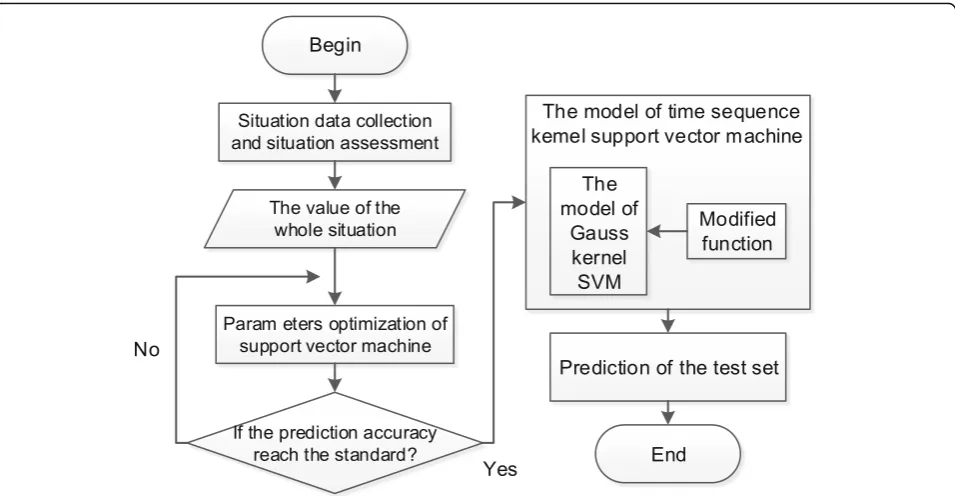
3.6 Network security situation prediction process based on PSO-time sequence kernel function support vector machine
The network security situation prediction process based on PSO-time sequence kernel function support vector machine is shown in Fig.2.
4 Experiment and analysis 4.1 Experimental data set
In order to verify the reasonability of the method in this paper, the related data of a campus network are col-lected as the experiment data. The topological structure of the campus IoT network is shown in Fig. 3. Experi-ment raw data are the attack information by Snort, data flow information by Netflow, vulnerability information by Nessus and asset performance information by Sigar. The rich data source provides a reliable guarantee for the simulation experiment.
In this study, we acquired 360 data from March 1, 2015, to May 31 (90 days and 4 times daily samples)
from the university as the training data. According to the steps and algorithms of 3.1, we obtained the value of the whole situation of the network. Then, the model of PSO-sequence kernel support vector machine was trained by the obtained values of the network. The 120 data which was from June 1, 2015, to June 30 (30 days and 4 times daily samples) were acquired as the test data.
4.2 Experiment and analysis of the network security situation prediction
For the prediction model of time series kernel support vector machine, the embedding dimension was set as
Fig. 2The network security situation prediction process based on PSO-time sequence kernel function support vector machine
seven by trial and error. That is using the previous week’s data to predict the network security situation in the coming day. The prediction model is the time se-quence kernel support vector machine optimized by the particle swarm. The parameters of the particle swarm are shown in Table7.
4.3 The results of network security situation prediction
In order to verify the feasibility and effectiveness of PSO-time series kernel support vector machine, we compared the predictive value of PSO-time series kernel support vector machine with the actual security situation value and the predictive value of PSO-Gaussian kernel support vector machine.
4.3.1 Analysis of experimental results of network security situation prediction in a certain day
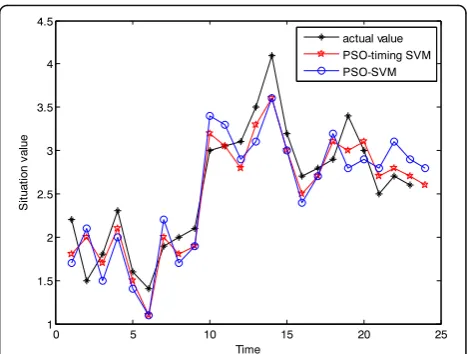
The PSO-time series kernel function support vector ma-chine and PSO-Gauss kernel function support vector machine were used to predict the network security situ-ation in a certain day of June. The results were shown in Fig.4.
The relevant parameters were as follows.c is 100,σis 15, ε is 0.001, window radius is 30, window weight pa-rameters wereω1sis 1,ω1s= 0.9.
In order to reflect the prediction results of the two forecasting methods in the same parameter intuitively, the partial relative errors of a certain day in June were shown in Table8.
4.3.2 Analysis of experimental results of network security situation prediction in a certain week
The PSO-time series kernel function support vector ma-chine and PSO-Gauss kernel function support vector machine were used to predict the network security situ-ation in a certain week of June. The results were shown in Fig.5.
The relevant parameters were as follows.Cis 500,σis 50,εis 0.001, window radius were 1 and 3.
The first layer of the window weight parameters was thatω1sis 0.6 andω1sis 0.4.
The second layer window weight parameters were as follows:
ω2sis 0.4 andω1sis 0.3.
The relative error of a certain week in June between the actual value of the network situation and the pre-dictive value of two kinds of forecasting methods are shown in Table9.
The experimental results show that PSO-time series kernel support vector machine is better than the PSO-Gauss kernel support vector machine in network secur-ity situation prediction. And during the week, the net-work security situation value of weekend was higher
than normal, so network administrators should
strengthen the network protection in time.
From the above results, it is feasible to predict the net-work security situation based on the PSO-time series ker-nel function support vector machine. Compared with the PSO-Gauss kernel support vector machine, the PSO-time
Table 7The setting table of particle swarm parameters
Particle swarm parameters Default
Population size 25
The initial inertia weightω1 0.8
Termination inertia weightω2 0.3
Learning factorc1=c2 2
The scope ofc (0.1, 5000)
The scope ofσ (0.001, 1)
The scope ofε (0.001, 10)
Velocity interval of particle (0, 0.5)
Fig. 4Situation comparison of a certain day in June
Table 8Partial relative error of a certain day in June
Relative error PSO-time series kernel SVM PSO-Gaussian kernel SVM
1 18.18 22.73
3 5.56 16.67
4 8.69 13.04
5 6.25 12.50
8 10.00 15.00
9 9.52 9.52
18 6.91 10.34
19 11.76 17.65
21 8.00 12.00
series kernel support vector machine has great advantages in network security situation prediction.
4.4 System time performance analysis.
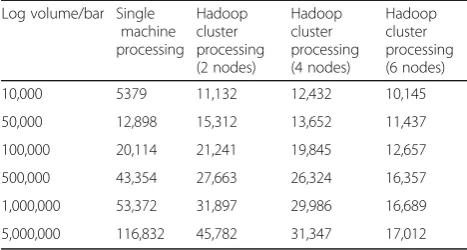
Network security situational awareness system for pre-dicting equipment log of this article is based on the Hadoop big data processing platform, in order to verify the Hadoop platform to handle large amounts of log time performance, in this article, the experiment will be treated as a traditional single log spent time comparing with Hadoop cluster processing time spent, dealt with different levels of the log data; the time it takes is shown in Table10.
Table 10 shows that when the log data level is less than 50,000, the single-machine processing capability is better than the processing power of the Hadoop cluster. But as the growth of the log magnitude cluster around the time grows smaller, the rise in single machine pro-cessing time spent is almost in a straight line, and the in-crease in the number of nodes in the cluster processing efficiency is also higher. The efficient operation makes the log quantity of network security device more and more obvious, and the quiet of the single-machine pro-cessing mode is more and more prominent. Therefore, the design of this paper is based on the big data platform
to deal with the security log system has strong practical significance.
5 Summarize
There is an in-depth study of the existed network security situation prediction achievement in this paper. For the characteristic of situational factors which are randomness, time-sequence, and complexity, we propose a network se-curity situation prediction method based on PSO-sequence kernel support vector machine. A modification function which is suitable for time series data is con-structed to revise the kernel function of traditional sup-port vector machine. Then the sequence kernel supsup-port vector machine is obtained and the particle swarm optimization is used to optimize related parameters. By building an experimental environment and using the ob-tained values of the situation, it is verified that the method in this paper is feasible and effective. Simulation results show that the method in this paper has high accuracy for the prediction of the network security situation, thus it can give network administrators useful help in making timely and effective decisions. In the future development of Internet of Things technology, the network situational awareness prediction method proposed in this paper can be applied to many scenarios, such as the communication field, cloud computing field and smart city construction field. I hope the research results presented in this paper can contribute to the development of Internet of Things network security. In the next step, the focus will be on the situation visualization research of network security.
Acknowledgements
Our work was supported by the General Project of Tianjin Municipal Science and Technology Commission under Grant No.15JCYBJC15600, the Major Project of Tianjin Municipal Science and Technology Commission under Grant No.15ZXDSGX00030, and NSFC: The United Foundation of General Technology and Fundamental Research (No.U1536122). The authors would like to give thanks to all the pioneers in this field and also gratefully acknowledge the helpful comments and suggestions of the reviewers, which have improved the quality of this paper.
Table 9Relative error of a certain week in June
Relative error PSO-time series kernel SVM PSO-Gaussian kernel SVM
1 22.22 33.33
2 7.69 23.08
3 9.52 14.29
4 11.11 22.22
5 4.17 4.17
6 3.67 3.33
7 3.70 11.11
Fig. 5Situation comparison of a certain week in June
Table 10Compare the time to log in different modes (unit: millisecond)
Log volume/bar Single machine processing
Hadoop cluster processing (2 nodes)
Hadoop cluster processing (4 nodes)
Hadoop cluster processing (6 nodes)
10,000 5379 11,132 12,432 10,145
50,000 12,898 15,312 13,652 11,437
100,000 20,114 21,241 19,845 12,657
500,000 43,354 27,663 26,324 16,357
1,000,000 53,372 31,897 29,986 16,689
Authors’contributions
WY contributed to the design and implementation of the study and writing part of the paper. JZ and CW conducted analysis and simulation experiments and XM supplemented the manuscript. Final draft read and approved by all authors.
Authors’information
Wenjun Yang, School of Computer Science and Engineering, Tianjin University of Technology. He received a Master's Degree from Northeastern University in 2004. His research interests include Internet and information security. Email:[email protected]
Funding
There is no financial support for this study.
Availability of data and materials
The datasets used and/or analyzed during the current study are available from the corresponding author on reasonable request.
Competing interests
The authors declare that they have no competing interests.
Received: 24 January 2019 Accepted: 26 July 2019
References
1. http://www.cac.gov.cn/2014-02/27/c_133148354.htm
2. Christos Stergiou, Kostas E. Psannis, Byung-Gyu Kim, Brij Gupta. Secure integration of IoT and cloud computing [J]. Future Gen Comp Sy, 2016. 3. Stergiou C, Psannis K E, Gupta B B, et al. Security, privacy & efficiency of sustainable cloud computing for big data & IoT [J]. Sust Comput, 2018. 4. A lightweight mutual authentication protocol based on elliptic curve
cryptography for IoT devices [M]. Inderscience Publishers, 2017.
5. Aakanksha Tewari,B.B. Gupta. Security, privacy and trust of different layers in Internet-of-Things (IoTs) framework [J]. Future Generation Computer Systems, 2018.
6. Vasileios A. Memos,Kostas E. Psannis,Yutaka Ishibashi,Byung-Gyu Kim,B.B. Gupta. An Efficient algorithm for media-based surveillance system (EAMSuS) in IoT smart city framework [J]. Future Generation Computer
Systems,2018,83.
7. X. Zhang, Z. Yang, Y. Liu, et al., Toward efficient mechanisms for mobile crowdsensing [J]. IEEE Trans Veh Technol66(2), 1760–1771 (2017) 8. W. Juan, Study on index system in network situation awareness [J]. Comp
App lications.27(8), 1907–1909 (2007)
9. M.R. Endsley, Design and evaluation for situation awareness enhancement [C]. Proc Human Factors Soc Annu Meet, 97–101 (1988)
10. Tim Bass, Dave Gruber. A glimpse into the future of ID [EB/OL].USENIX .16, 1999
11. L. Gong, W. Yang, D. Man, et al., iPil: improving passive indoor localisation via link-based CSI features [J]. Int J Ad Hoc Ubiq Com23(1-2), 36–45 (2016) 12. T. Bass, Intrusion detection systems and multi-sensor data fusion: creating
cyberspace situational awareness [J]. Commun ACM43(4), 99~105 (2000) 13. Lei Xuan. Prediction of network security situation based on cloud [J].
ICCCT2010, 2010
14. Ma-Yan Y. Prediction Method for Network Security Situation Based on Elman Neural Network [J]. Comput Sci. 2012;39(6):61-60.
15. R. Wei, RBFNN- based prediction of networks security situation [J]. Computer Engineering and Application (2007)
16. Li Fang wei. Network security situation prediction mechanism based on complex network [J]. Computer Application Research, 2014
17. C. Hong, Method of network security situation prediction based on IHS_ LSSVR [J]. Comp Eng Appl50(23), 91–94 (2014)
18. C. Xiang, P. Yang, C. Tian, et al., Calibrate without calibrating: an iterative approach in participatory sensing network [J]. IEEE Trans Parall Distr Syst
26(2), 351–336 (2015)
19. L. Gong, W. Yang, D. Man, et al., WiFi-based real-time calibration-free passive human motion detection [J]. Sensors15(12), 32213–32229 (2015) 20. C.T. Lin, C.M. Yeh, S.F. Liang, et al., Support-vector-based fuzzy neural
network for pattern classification [J]. IEEE Trans Fuzzy Syst14(1), 31–41 (2006)
21. Chun dong Wang, Li Yue. Situation assessment of network security based on T-S fuzzy neural network [J]. J Comput Inf Syst, 2015, 11:16: 5999~6006 22. Z. Yang, C. Wu, Z. Zhou, et al., Mobility increases localizability: a survey on
wireless indoor localization using inertial sensors [J]. Acm Comput Surv
47(3), 1–34 (2015)
Publisher’s Note