R E V I E W
Open Access
The balance model for teaching linear
equations: a systematic literature review
Mara Otten
1*, Marja Van den Heuvel-Panhuizen
1,2,3and Michiel Veldhuis
1,4Abstract
This paper reports a systematic literature review of the balance model, an often-used aid to teach linear equations. The purpose of the review was to reportwhysuch a model is used,whattypes of models are used, andwhenthey are used. In total, 34 peer-reviewed journal articles were analyzed, resulting in a comprehensive overview of described rationales for using the balance model, its appearances, situations in which it was used, and the gained learning outcomes. Some trends appeared about how rationales, appearances, situations, and learning outcomes are related. However, a clear pattern could not be identified. Our study shows that this seemingly simple model actually is a rather complex didactic tool of which in-depth knowledge is lacking. Further systematic research is needed for making informed instructional decisions on when and how balance models can be used effectively for teaching linear equation solving.
Keywords:Algebra, Teaching linear equations, Balance model
Introduction
A substantial component of learning algebra is learning to solve algebraic equations. Within the algebra curricu-lum, solving linear equations is one of the foundational topics in which students make the transition from rea-soning with numbers to rearea-soning with unknowns (e.g., Filloy & Rojano, 1989). Similarly, early algebra has been described as a “shift from thinking about relations among particular numbers and measures towards think-ing about relations among sets of numbers and mea-sures, from computing numerical answers to describing and representing relations among variables” (Carraher, Schliemann, & Schwartz, 2007, p. 266). Solving linear equations as a basic skill (Ballheim,1999) is a substantial part of the middle school mathematics program (Hunt-ley & Terrell, 2014). However, many students do not achieve mastery of this basic skill and experience diffi-culties in learning the concepts and skills related to solv-ing equations (e.g., Kieran,2007).
Solving linear equations means that the values of the unknown quantities have to be found based on the equality of two given mathematical expressions—one on
each side of the equal sign. The essence of an equation is that these mathematical expressions represent the same value (Alibali, 1999), which makes equality a key concept in solving linear equations (e.g., Bush & Karp, 2013) and understanding equality one of the main conceptual demands associated with equation solving (Kieran,1997; Kieran, Pang, Schifter, & Ng,2016). Students need to understand that in an equation, the expressions on both sides of the equal sign have the same value and that this equality should always be maintained in the process of solving an equation (e.g., Kieran et al., 2016).
Misconceptions related to the concept of equality in linear equation solving are well documented. These mis-conceptions are particularly reflected in students’ inter-pretations of the equal sign. Instead of perceiving it as a relational symbol meaning “is the same as,” students often have an operational view of the equal sign, that is, they view it as a sign to “do something” or to “ calcu-late the answer” (e.g., Knuth, Stephens, McNeil, & Alibali, 2006). For example, when solving the problem 8 + 4 = __ + 5, a common mistake is adding the num-bers on the left side of the equation and putting a 12 in the blank (Falkner, Levi, & Carpenter, 1999). Such interpretation of the equal sign can begin in the elementary grades and can persist through middle
© The Author(s). 2019Open Access This article is distributed under the terms of the Creative Commons Attribution 4.0 International License (http://creativecommons.org/licenses/by/4.0/), which permits unrestricted use, distribution, and reproduction in any medium, provided you give appropriate credit to the original author(s) and the source, provide a link to the Creative Commons license, and indicate if changes were made.
* Correspondence:[email protected]
1Freudenthal Group, Faculty of Social and Behavioural Sciences, Utrecht
school (e.g., Alibali, Knuth, Hattikudur, McNeil, & Stephens, 2007).
One way to help students gain conceptual understand-ing in equation solvunderstand-ing is through the use of models as
“ways of thinking about abstract concepts” (Warren & Cooper,2009, p. 77). Such didactical models can be seen as representations of mathematical problem situations in which the essential mathematical concepts and aspects of the problem situation are reflected, and through which the concrete situation is connected to the more formal mathematics (Van den Heuvel-Panhuizen,2003). By first being amodel of a concrete situation where the model is very closely related to a specific problem and later evolving to a model for similar problems that are situated in another context, the model can be applied for solving all kinds of new problems (Streefland,2003).
In mathematics education, several didactical models are used to give students access to particular mathemat-ical concepts, such as the number line or the bar model for teaching fractions. The balance model is another commonly used didactical model. This model is often used to support students’ understanding of linear equa-tion solving. Characteristic of the balance model is that its form serves as a model for its function in solving lin-ear equations: the balance can be used to refer to the situation of equality of the expressions on the two sides of an equation. The philosopher and mathematician Gottfried Wilhelm Leibniz (1646–1716) already made this connection when he mentioned the relation between equality in a mathematical situation and a balance with equal things on both sides (Leibniz,1989).
In the context of a larger research project on algebraic reasoning, we wanted to find indications for setting up a teaching sequence on linear equation solving. We searched for information about the use of the balance model as a possible aid to assist students in developing understanding of solving linear equations. The diverse and scattered picture we got from this initial search prompted us to investigate this more systematically. Therefore, we planned to carry out a systematic review of the literature of how the balance model turns up in the large body of research and professional articles that has been published about teaching linear equation solv-ing. With this review, we aimed at answering the follow-ing research question: What role does the balance model play in studies on teaching linear equation solving?
In general, to learn more about a didactical model for teaching students (mathematical) concepts, it is essential to gain insight in various important aspects of a model. The specific way of representing the model is important to take into account, but also information related to pos-sible reasons for choosing this particular model and tim-ing of ustim-ing the model in a teachtim-ing and learntim-ing trajectory contribute to getting a complete picture of
how the model can be used. Lastly, to be able to evaluate the use of a didactical model for fostering students’ con-ceptual understanding, it is important to incorporate students’ learning outcomes as well. To determine the role balance models play in studies on teaching linear equation solving, we looked into what authors reported about why such a model is used, what types of models are used, when they are used, and what learning out-comes are associated with its use. Knowing this can be helpful for teachers, researchers, and developers of in-structional material for making informed decisions about choosing the balance model for teaching linear equation solving.
Method
Article search and selection
For selecting articles for the review, we searched in 93 peer-reviewed research journals in the areas of mathem-atics education, educational sciences, pedagogics, devel-opmental psychology, special education, and technology in education. The search was conducted in Scopus and ERIC for articles in English. The search query consisted of terms such as equation*, equal sign*, equality, equiva-lence, balanc*, algebra*, mathematic*, unknown*, and solv*, and combinations thereof (see Additional file1for the complete search queries). There was no limit with regard to the date of publication.
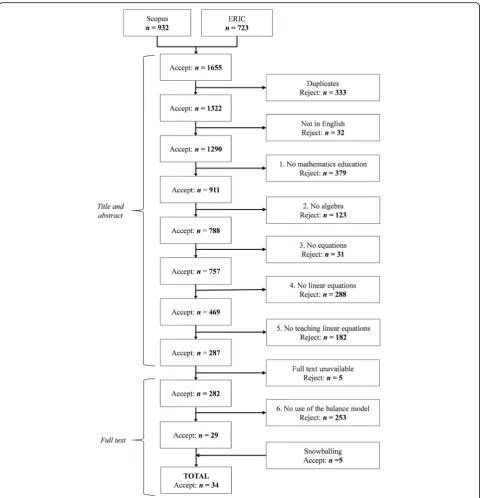
The search, conducted in March 2017, resulted in 932 hits in Scopus and in 723 hits in ERIC, together resulting in 1655 hits (see Fig. 1). After merging, 333 duplicates were identified and removed, resulting in 1322 articles from 92 journals. Thirty-two articles were removed either because they, despite our search query, turned out to be not in English, or because they did not originate from peer-reviewed journals (e.g., were book chapters), resulting in 1290 articles.
Data extraction
For each of the 34 articles, information was extracted re-lated to the rationales and the limitations of using the balance model, the appearances of the model, the situa-tions in which the model was used, and students’ learn-ing outcomes. Information was extracted in case at least one sentence of the article was devoted to either of these four categories. After the inventory of all rationales (in 26 articles) and appearances (in 34 articles), patterns
model for teaching linear equation solving were dis-cussed in 19 articles. These different aspects of the reviewed articles are summarized in Table1.
Results
Why was the balance model used?
Rationales for using the balance model were provided in 26 articles. Three main classes of rationales could be identified, which were all related to the specific features of the context of the balance model. Articles constituting the Equality class of rationales all directly referred to using the balance to enhance students’understanding of the concept of equality. Direct references to equality are directly focused on the mathematical equality, by em-phasizing the analogy between the balance model and equality in an equation. Articles in the remaining two classes of rationales made more indirect references to using the balance model for enhancing students’ under-standing of equality. Indirect references to equality are, for example, offering students physical experiences when manipulating a balance model and thus feel, through the experience of balancing, the concept of equality. Such articles that made a reference to previous or concurrent physical experiences related to the balance model fell in the Physical Experiences class of rationales. Articles that fell into the Models and Representations class of ratio-nales referred to the use of models and representations for enhancing students’conceptual understanding in lin-ear equation solving. Finally, limitations of using the bal-ance model for teaching linear equation solving were also extracted.
Rationales related to the equality concept
A majority of 15 articles (three from the same research project) mentioned rationales for using the balance model related to the concept of equality. It was often stated that understanding the concept of equality can be enhanced by making use of the model of a balance (e.g., Gavin & Sheffield, 2015; Leavy et al.,2013; Mann,2004; Taylor-Cox, 2003; Warren et al., 2009). Because both sides of a balance model are of equal value and thus ex-changeable, the model was described as being very suit-able for demonstrating the idea of equality or equilibrium (Figueira-Sampaio et al.,2009) and quantita-tive sameness (e.g., Warren & Cooper, 2005). In line with this, several authors referred to the use of the balance model to enhance the understanding of the equal sign as a symbol for representing equality (e.g., Vlassis,2002; Warren & Cooper,2009). Accordingly, the balance model has often been described as suitable to demonstrate the strategy of doing the same thing on both sides of the equation, in which emphasis on the con-cept of balance is crucial (e.g., Andrews & Sayers, 2012; Figueira-Sampaio et al.,2009; Marschall & Andrews,2015),
thereby helping students in forming, according to Vlassis (2002), a mental picture of the operations they have to apply. Another mentioned advantage of the balance model is the possibility to keep track “of the entire numerical relationship expressed by the equa-tion while it is being subjected to transformaequa-tions” (Linchevski & Herscovics, 1996, p. 52), which makes it suitable for demonstration of the cancelation of identical terms on both sides of the equation (see also Filloy & Rojano, 1989).
Rationales related to the physical experiences
The second class of rationales that was identified, mentioned in 11 articles (all from different research pro-jects), was related to learning through physical experi-ences. In several articles, a reference was made to previous physical experiences related to maintaining bal-ance. Araya et al. (2010) argued that the process of maintaining balance has a primary biological basis and is therefore common physical knowledge for all human be-ings. Through using the balance model, this biologically primary knowledge can be connected to the abstract idea of maintaining equality in an equation. Others em-phasized the similarity between the model and a teeter-totter (or see-saw) and referred to children’s (playing) experiences with this object (Alibali, 1999; Kaplan & Alon, 2013).
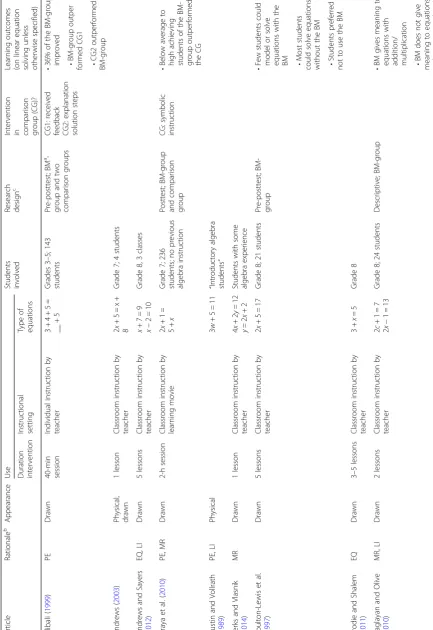
Table 1 Overview of articles in which the balance model (BM) was used for teaching linear equations Article Rational e b App earan ce Use Student s involved Researc h design c Interve ntion in com parison group (CG)? Learning outcom es (on linear equat ion solving unless otherwi se specifie d) Duration interven tion Instructional setting Type of equations Alibal i ( 19 99 ) PE Drawn 40-m in sessio n Individ ual instruction by teacher 3 + 4+ 5= __ + 5 Grades 3 – 5; 143 student s Pre-pos ttest; BM a -group and two comparison groups CG 1: received feed back CG 2: explanation solu tion step s • 36 % of the BM-group improve d • BM-group out per formed CG1 • CG2 outperformed BM-group Andrews ( 2003 ) Phy sical, draw n 1 lesson Classroom instruction by teacher 2 x +5 = x + 8 Grade 7; 4 students Andrews and Sayers ( 2012 ) EQ, LI Drawn 5 lessons Classroom instruction by teacher x +7 =9 x − 2= 1 0 Grade 8, 3 class es Araya et al. ( 2010 ) PE, MR Drawn 2-h se ssion Classroom instruction by learning movie 2 x +1 = 5+ x Grade 7; 236 student s; no previou s algebra instruction Posttes t; BM-group and comparison group CG : symb olic inst ruction • Be low ave rage to high achi eving students of the BM-group out performed the CG Austin an d Vollrat h ( 1989 ) PE, LI Phy sical 3 w +5 = 1 1 “ Introductory alg ebra student s ” Berk s and Vlasnik ( 2014 ) MR Drawn 1 lesson Classroom instruction by teacher 4 x +2 y =1 2 y =2 x +2 Student s with som e algebra exper ience Bou lton-Lew is et al. ( 1997 ) Drawn 5 lessons Classroom instruction by teacher 2 x + 5 = 17 Grade 8; 21 students Pre-pos ttest; BM-group • Fe w students could mod el or solv e equation s with the
BM •Most
student s could solv e eq uations without the BM • Student s pre ferred not to use the BM Brod ie and Shal em ( 2011 ) EQ Drawn 3 – 5 le ssons Classroom instruction by teacher 3+ x = 5 Grade 8 Cag layan and O live ( 2010 ) MR, LI Drawn 2 lessons Classroom instruction by teacher 2 c +1= 7 2 x − 1=1 3 Grade 8; 24 students Descriptive; BM-group • BM giv es meaning to equation s with addit ion/
multiplication •BM
Table 1 Overview of articles in which the balance model (BM) was used for teaching linear equations (Co ntinued) Article Rational e b App earan ce Use Student s involved Researc h design c Interve ntion in com parison group (CG)? Learning outcom es (on linear equat ion solving unless otherwi se specifie d) Duration interven tion Instructional setting Type of equations Ngu and Phan ( 2016 ) Drawn 45-m in lesson Individ ual instruction she et with BM n /2 = 7 x − 9= 4 Grade 7; 63 students Pre-pos ttest; BM-group and compari-son group CG : solv ing eq uations with inve rse ope rations • BM -group improve d from pre-to post test • CG improve d more than BM-group • Positive relation betwee n pe rformanc e on proced ural knowle dge and performance on conce ptual know ledge for CG but not for BM-group Ngu, Phan, Yeung , and Chung ( 2018 ) Drawn Two 40-m in lessons Individ ual instruction she et with BM 3 x +1 = 2 x +8 6 − q =1 0 Grades 8 – 9; 29 student s Pre-pos ttest; BM-group and compari-son group CG : solv ing eq uations with inve rse ope rations • BM -group improve d from pre-to post test • CG improve d more than BM-group • Higher cogn itive load for BM-group than CG Orlov ( 1971 ) PE Phy sical 2 years Classroom instruction by teacher 5 x − x+ 2 = 2x +6 Grade 8; 200 st udent s Repeat ed measu res; BM-group an d com-parison group CG : exper iment al progr am without BM • BM -group, especially average an d above -average st udent s, outpe rforme d CG Perry , Berch , and Singlet on ( 1995 ) PE Phy sical 1 lesson Individ ual instruction by teacher 3 + 4+ 5= __ + 5 Grades 4 – 5; 56 student s Pre-pos ttest; BM-group and compari-son group CG : only verb al inst ruction • BM -group outpe rforme d CG Raym ond and Leinenb ach ( 2000 ) Drawn 26 lessons Classroom instruction by teacher x +4 =2 x + 3 Grade 8; 120 st udent s Descriptive; BM-group • BM inst ruction leads to be tter performance than te xtbook
instruction •Large
Table 1 Overview of articles in which the balance model (BM) was used for teaching linear equations (Co ntinued) Article Rational e b App earan ce Use Student s involved Researc h design c Interve ntion in com parison group (CG)? Learning outcom es (on linear equat ion solving unless otherwi se specifie d) Duration interven tion Instructional setting Type of equations War ren and Coope r ( 2009 ) EQ, PE, MR Phy sical; draw n 5 years Classroom instruction by teacher ? +2= 5 ? − 3= 6 Grades 2 – 6; 220 – 27 0 student s; Descriptive; BM-group • BM enh anced understanding of language an d symbo ls • Student s cou ld generalize balan ce method for simple equations • Older students could ge neralize the balance method for all operations War ren, Mollins on, and Oestrich ( 2009 ) EQ, MR Phy sical, draw n Classroom instruction by teacher 5 + 1= 2+ 4 Kindergarten Empty cells indicate that this information was not provided in that article aBM Balance model bEQ = rationales related to the equality aspect, PE = rationales related to the physical experiences, MR = rationales related to learning through model s and representations, LI = limitation of using the balance model cInformation about the research design was only included for articles in which the effect of the balance model on students ’ learning outcomes was evaluated
d“Balance
abstract mathematical thought, because it represents an intermediate degree between immediate sensory data and mathematical abstraction. In this same line, Fyfe et al. (2015) recommended a sequence based on fading concreteness, where instruction begins with concrete material and fades into abstract mathematical symbols. The real-time feedback some models provide about being in balance, which allows students to verify the results of their manipulations and their reasoning pro-cesses and as such to construct knowledge, was also deemed important (Austin & Vollrath, 1989). When combined with social experiences, physical experiences were also said to contribute to the construction of knowledge (Figueira-Sampaio et al., 2009), for example, because it creates shared meaning between teacher and students (Perry et al.,1995).
Rationales related to learning through models and representations
The third class of rationales, mentioned in eight articles (four from the same research project), included a more general argumentation and referred to learning through the use of models and representations. According to Filloy and Rojano (1989), models such as the balance model can provide an opportunity to semantically and syntactically set a foundation for linear equation solving. Here, the meaning of equality and algebraic operations can first be derived from the context, while after stu-dents have gone through a process of abstraction, mean-ing at syntactic level is linked to this meanmean-ing of the context. Researchers involved in the Australian Early Algebraic Thinking Project (Cooper & Warren, 2008; Warren & Cooper, 2009) argued that, through models,
mathematical ideas are presented externally as concrete material, by iconic representations, language, or symbols, while comprehension of these ideas occurs internally, in mental models or internal cognitive representations of mathematical ideas underlying the external representa-tions. From this point of view, mathematical understand-ing is determined by the number and strength of the connections in the student’s internal network of repre-sentations. Also the use of multiple representations in teaching abstract mathematical concepts or strategies was advocated (e.g., Berks & Vlasnik, 2014), because experiencing different modes of representation and mak-ing connections between and within these different modes of representation could enhance deep mathemat-ical understanding (Suh & Moyer, 2007). The sense-making function of representations was elaborated on by Caglayan and Olive (2010), who reasoned that students can make sense of abstract symbolic equations through connecting this symbolic equation with the equation as expressed by its representation.
Also other reasons for using representations of the balance model were suggested. For example that it can create a shared language base which students can use when explaining their solutions (Berks & Vlasnik, 2014; Warren et al.,2009; Warren & Cooper, 2005) or that it is supposed to lower students’ cognitive load during equation solving processes (see Araya et al., 2010). The latter contrasts with Boulton-Lewis et al. (1997) who hy-pothesized an increased processing load caused by the use of concrete representations. This might depend on the students’ experience and the type of equation prob-lems they have to solve: if students do not really need the help of a concrete representation of the balance
model anymore and they still have to use it, this could indeed increase processing load.
Limitations of the balance model
Limitations of the balance model were described in eight articles (all from different research projects). In her well-known article, Vlassis (2002) described how eight-grade students were taught formal linear equation solving by making use of the balance model and concluded that although the balance model was able to provide students an “operative mental image” (p. 355) of the to-be-applied equation solving strategies, this model also had some shortcomings. For example, the model was not helpful for equations containing negative numbers or for other equations that are “detached from the model” (p. 354) and that no longer refer to a concrete model. Also, several other articles referred to the restricted possibil-ities the model has to represent equations with negative quantities or subtractions (e.g., Filloy & Rojano, 1989; Linchevski & Herscovics, 1996). As soon as negative values are involved, such as in the case of the equation x+ 5 = 3, or equations with subtraction, such as 2x−3 = 5, the solution is difficult to express in terms of physical weight which makes it difficult to construct meaning for these equations (Caglayan & Olive,2010).
Discussion of the findings regarding why the model was used
Although the three classes of rationales all have unique characteristics based on which they can be differentiated, they are also interrelated. The most often mentioned rationale was related to equality; understanding equality is regarded as one of the main conceptual demands asso-ciated with linear equation solving (e.g., Kieran et al.,
2016). Inherent properties of the balance were con-nected to the concept of equality and the strategies that can be applied while maintaining the balance. The two remaining rationales were less often mentioned. These rationales contained indirect references to using the bal-ance model for enhancing students’ understanding of equality in an equation, through referring to learning through physical experiences or to learning through models and representations.
knowledge is built up from the very pervasive physical ex-periences we have with balancing from a young age on (Gibbs Jr,2006), through walking without falling, standing up and sitting down, or holding objects of different weights (Alessandroni,2018). Furthermore, the other arti-cles in this class of rationales stressed the contribution of concurrent physical experiences with the balance model to the learning of linear equations. Through manipula-tion of the model, students explore how to maintain its balance; these strategies for maintaining the bal-ance of the model could later be connected to strat-egies for maintaining equality in an equation. This is also in line with embodied cognition theory: offering students opportunities to revitalize the basic perceptuo-motor knowledge through making use of a model of a balance through which they can imagine (or experience anew) the situation of balancing, could be beneficial for supporting students’ understanding
of equality in an equation and therefore for teaching linear equation solving.
informal, context-related solution methods and the more formal ones, and in this way to stimulate students to come to higher levels of understanding (e.g., Van den Heuvel-Panhuizen,2003).
What types of balance models were used?
Three types of appearances of the balance models came forward in the reviewed articles: physical, virtual, and drawn balance models. Physical balance models are con-crete balance scales. On these scales, students can repre-sent equations by placing real objects, standing for knowns and unknowns, on both sides of the model. Characteristic for these models is that they are dynamic, which means the students can operate on them and get real-time feedback on their actions. In virtual bal-ance models, the balbal-ance is implemented in a digital environment. These models are mostly dynamic, in that sense that the balance tilts in response to stu-dents’ (digital) manipulations and in this way gives real-time feedback. In drawn balance models, a sche-matic version of a balance is presented on paper or on the blackboard. The representations of these bal-ance models are static: students cannot manipulate them and cannot receive real-time feedback. Whereas in most articles only one type of appearance of the balance model was used, in other articles different types appeared (e.g., Figueira-Sampaio et al., 2009) or a sequence of different appearances was presented, starting with the use of a physical model followed by a drawn balance model (e.g., Fyfe et al., 2015).
Physical balance models
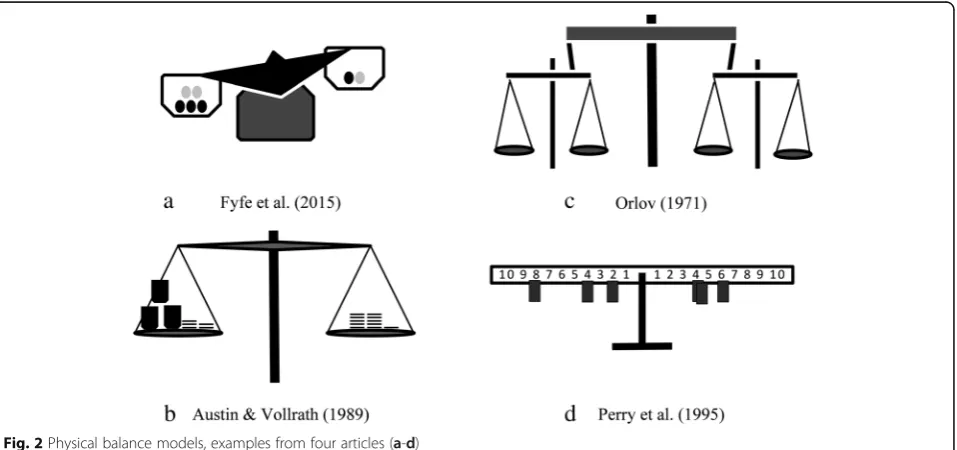
Physical balance models appeared in 14 articles (three from the same research project). We drew schematic versions of several of these physical balance models. These drawings are shown in Fig. 2. The balance dis-played in Fig.2a was used by Fyfe et al. (2015) to repre-sent, for example, 3 + 2 = 1 + 1 + __. Here, students could put three red and two yellow bears on the left side and one red and one yellow on the right, and then add the missing number to get the scales to balance (for similar models, see also, e.g., Warren et al.,2009). In Austin and Vollrath’s balance model (1989; Fig. 2b), the equation 3x+ 5 = 11 is portrayed by, on the left side, three con-tainers with unknown content and five washers and 11 washers on the right side (for similar models, see also, e.g., Andrews,2003). A more complex example of a bal-ance scale was utilized by Orlov (1971; Fig. 2c). His model contains four scales, two on each side. For ex-ample, by putting a weight on the left tray of the left part of the scale, the left arm of the balance scale goes up. In this way, negative numbers and unknowns can also be handled by this model. The last type of described phys-ical balance model is a balance model in which the
distance of the objects to the fulcrum can be adapted to represent linear equations such as 8 + 4 + 2 = 4 + 4 + __ (Perry et al., 1995; Fig. 2d; for a similar model, see also Smith,1985). Here, all objects have the same weight, but by putting them at a particular position on the beam they represent a particular value.
Virtual balance models
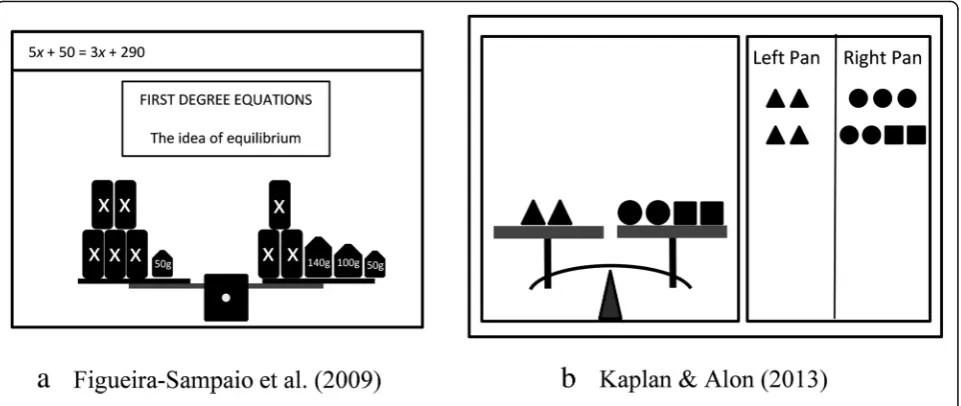
Virtual balance models appeared in three articles (from different research projects). Drawings of the used virtual balance models are shown in Fig. 3. Most of these models display a balance scale quite similar to the phys-ical balance models. However, the digital environment enables more possibilities in representations and func-tions of the model.
In the digital model used by Figueira-Sampaio and colleagues (2009; Fig. 3a), the equation 5x+ 50 = 3x+ 290 is represented by cans with the letter X depicting the unknowns, and small labeled weights (e.g., 50 g, 100 g) depicting the numbers (for a similar model, see also Suh & Moyer, 2007). Here, while students manipu-late the virtual balance scale, the corresponding equation is shown in formal algebraic symbols, which makes the link between these manipulations and the changes in the corresponding symbolic equation explicit. A further type of virtual balance model was found in the article of Kaplan and Alon (2013; Fig.3b). In this model, students can explore relationships between different shapes of un-knowns and find new equations based on given ones. For example, on the basis of the equations▲▲=●●● and▲▲=●●■■, a third equation can be created.
Drawn balance models
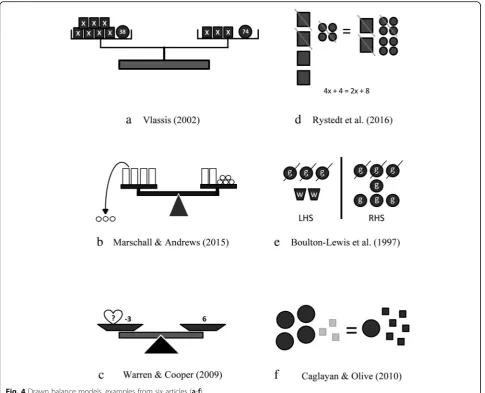
Drawn balance models appeared in 26 articles (four and three from the same research projects). Drawings of the used drawn balance models are shown in Fig.4. Here, it is noticeable that some drawn balance models are depicted more realistically (Fig. 4a–c) and others more schematically (Fig. 4d–f), with pictures of objects or symbolic expressions to represent the knowns and unknowns.
expanded, respectively decomposed way, leading to the equation 5n+ 3n+ 11 = 5n+ 11 + 39. In this way, students can see that the terms 5nand 11 appear on both sides of the equation, which can cancel each other out. In the bal-ances of Marschall and Andrews (2015; Fig. 4b) and Warren and Cooper (2009; Fig.4c), equations with nega-tive values and subtractions can also be represented. In Fig. 4b, the subtraction in the equation 4x−3 = 2x+ 5 is represented by an arrow going down from one of the scales, so that the action of“taking away”is made visible. Alternatively, in Fig.4c, a minus sign is included.
Another way in which drawn balance models appeared in the articles is as an abstract drawing. Here, the bal-ance functions as a metaphor to point students’ atten-tion to the concept of equality. In Rystedt and colleagues (2016, Fig. 4d), the equation 4x+ 4 = 2x+ 8 is repre-sented with boxes for unknowns and dots for numbers. In articles in which such a metaphorical use of the bal-ance model was present (e.g., Caglayan & Olive, 2010), this use was often accompanied by the instruction that
the balancein the equation had to be maintainedwhen
solving the equation (Boulton-Lewis et al., 1997), or by gestures representing a balance scale (Rystedt et al.,2016). The use of a drawn balance model, especially for models with an abstract drawing, often went together with the use of manipulatives. For example, in the model of Boulton-Lewis and colleagues (1997; Fig.4e), the schematically no-tated equation 2x+ 3 = 7 is represented by two white cups and three green counters on the left-hand side (indi-cated by LHS) and seven green counters on the right-hand side (indicated by RHS), while other colored cups and counters are used to represent subtractions or negative unknowns and numbers (for a similar ap-proach, see, e.g., Suh & Moyer, 2007). Another ex-ample is the drawn balance model used by Caglayan and Olive (2010; Fig. 4f), where in the equation 4x− 3 =x+ 6 the “−3” is represented by gray tiles instead of black ones. Moreover, the equal sign is directly represented in this model.
Discussion of the findings regarding the types of used balance models
Drawn models appeared the most and virtual models the least, while the use of a physical model was often followed by the use of a drawn model. When looking into the relationship between the rationales and the ap-pearances of the models, it seems that the use of a phys-ical balance model most often goes together with rationales related to learning through physical experi-ences and the equality aspect. For the virtual models, all rationales appear more or less equally often, and the drawn balance models go most often together with the equality aspect rationale and rationales related to learn-ing through models and representations. Except for
rationales related to learning through physical experi-ences, the remaining two classes of rationales most often go together with the use of a drawn balance model. The drawn model appears to be the most flexible model, which means that it was used with all classes of rationales.
Although all three appearances of the model have the balance as a basic concept, they differ in their nature. Whereas the physical balance model and partly the vir-tual balance have a dynamic nature and as such can pro-vide real-time feedback to the students about their actions, the drawn balance model is static. Drawn models, either presented on paper or on the blackboard, can nonetheless be extended with dynamic aspects by using manipulatives. For all three types of appearances of the model it applies that most models consist at least of a fulcrum, a horizontal balancing beam, and on both sides a scale. In addition to this configuration of the bal-ance model, in other models, extra features are added. Through the addition of these features, the reach of the balance model is extended to represent a wider range of problems. For example, the additional scales in the phys-ical model of Orlov (1971; Fig. 2c), the arrow going down from the scales of the drawn balance model in the article of Marschall and Andrews (2015; Fig.4b), and the different colored manipulatives added to the drawn model of Boulton-Lewis and colleagues (1997; Fig. 4e) are all examples of variations of the balance model allowing the representation of negative numbers and unknowns. Such additional features provide a solution for the restricted possibilities that this model has (e.g., Vlassis, 2002), for example by allowing for the represen-tation of equations with negative quantities or subtrac-tions. In fact, this flexibility of the balance model is exactly how models should work. When used as didacti-cal models (Van den Heuvel-Panhuizen, 2003), models should be flexible and not only suitable for solving one type of equation. One way of ensuring this flexibility is by allowing for adaptations without losing its primary function. However, bearing in mind the concept of
model of … - model for … (Streefland, 2003), didactical
models are not meant as a tool that everlasting has to be used for problem solving at a concrete, context-connected level. Instead, the idea is that in a later phase of the learning process, when a basis is laid for solving linear equations and the students have to solve more dif-ficult equations, the student’s thinking can still be sup-ported by, and related to, the model without concretely representing the equation in a physical model.
When was the balance model used?
grade level of the students involved, the duration of the intervention with the model, the type of equation prob-lems that students worked on, and the type of instruc-tion that was provided to the students.
Grade levels and intervention duration
The balance model was used to teach linear equation solving to students from Kindergarten to Grade 9. Stu-dents up to Grade 6, who do not have previous experi-ence with algebra, had their first encounter with linear equations through the balance model, which came for-ward in different studies (e.g., Warren & Cooper,2005). In studies with students from Grades 7–9, who already have some basic experience with linear equation solving (with the exception of the seventh-grade students in the study by Araya et al., 2010), the balance model was in-troduced as a tool for solving equations (Vlassis, 2002) or used to illustrate the balance method (i.e., perform the same operations on both sides of the equation; Ngu & Phan, 2016). The duration of the interventions in which the balance model was used was also very diverse. The shortest interventions comprised one ac-tivity or one lesson (e.g., Figueira-Sampaio et al., 2009; Rystedt et al., 2016), while in other studies the balance model was integrated in a multiple-year teaching trajec-tory (e.g., Orlov,1971; Warren & Cooper,2009).
Type of equation problems
With very young students (e.g., Kindergarten, Grades 1– 2), the balance model was mostly used for exploration of the first ideas of equality and the equal sign (e.g., Taylor-Cox, 2003; Warren et al., 2009). Students’ task was for example to weigh different objects to find out which were the same and which were different. For somewhat older students (e.g., Grades 3–6), the balance model was for example used to assist them in solving simple addition problems such as 8 = __ + 3 (e.g., Leavy et al.,2013). Here, eight objects were put on the left side of the balance and three objects on the right side, and the students’task was to figure out what they could do to make both sides equal. The model was also used to introduce algebraic symbols to students without prior al-gebra experience, so that they could link the model to the abstract symbols. Then students’ task was for ex-ample to manipulate the objects on the scales in such a way that they could determine the weight of the un-known object, while in the meantime in the digital envir-onment the corresponding symbolic equation was shown (e.g., Figueira-Sampaio et al., 2009, see Fig. 3a; Suh & Moyer, 2007). In research with students with some algebra experience (i.e., from Grade 7 on), students’ task was for example to represent symbolic equations by making use of the balance model and to
use this representation to transform and solve the equa-tions (Caglayan & Olive, 2010; see Fig. 4f). Or students’ task was to solve an equation by making use of a physical balance model, while subsequently to repre-sent the equation and the solution steps symbolically (Andrews, 2003). There were also articles in which two balance models with different unknowns were presented simultaneously to create a system of equations and to evoke the algebraic strategy of substitution (e.g., Austin & Vollrath, 1989; Berks & Vlasnik, 2014). Here, students’ task was to combine the information of the equations to find the values of the unknowns.
In most studies, students’ task was to determine the value of the unknown(s). However, there were also arti-cles in which the main purpose was to discover different possibilities to maintain the balance of the model, with-out focusing on finding values of unknowns. For ex-ample, in the study by Kaplan and Alon (2013), the goal was to create multiple balanced scales and to analyze the relationships between unknowns (see Fig.3b). Also in other articles, the balance model was used to discover different possibilities to maintain equality (Orlov, 1971) or to discover which “legal moves” (Raymond & Leinenbach, p. 288) could be made without disturbing the balance.
Lastly, there were large varieties between studies con-cerning maintaining the balance model when teaching equations. For example, in Warren and Cooper (2005), first a physical balance model and later a drawn balance model were used to model equations containing positive values and additive operations (e.g.,? + 7 = 11). After some lessons, these students also solved equations con-taining subtraction (e.g.,? – 4 = 13), but these equations were not represented with the balance model. In other studies, the use of the balance model was maintained lon-ger during the learning process. For example, one of the teachers in the study by Marschall and Andrews (2015) did not only use the model for teaching equations con-taining positive values and addition, but extended the use of the model to represent equations such as 4x–3 = 2x+ 5 (see Fig.4b; for using the model for other type of equa-tions, see also, e.g., Boulton-Lewis et al.,1997, see Fig.4e; Orlov,1971, see Fig.2c).
Type of instruction
students working with the physical balance model in Figueira-Sampaio et al., 2009), while during individual instruction, students more often got opportunities to actively work with the balance model themselves (e.g., Suh & Moyer, 2007).
Discussion of the findings regarding when the balance model was used
In what situations the balance model was used was very diverse in the different studies. For what equation prob-lems the balance model was used appeared to be related to students’experience with solving linear equations. For students up to Grade 6, without previous experience with algebra, most tasks concentrated around exploring the basic ideas of balance and solving simple equations (e.g., 8 = __ + 3), which went hand in hand with the rationale that such activities can be beneficial for devel-oping understanding of equality and a relational under-standing of the equal sign. Physical and virtual balance models were relatively often used to teach linear equa-tion solving to students without prior algebra experi-ence. In most of these studies, equations only contained positive values and additive operations. The studies con-ducted with students without prior experience in general underpinned the use of the balance model for teaching linear equation solving more thoroughly than studies with students with some algebra experience. The ration-ale that was relatively often mentioned in relation to teaching students without prior algebra experiences is the rationale related to the physical experiences, which fits the using of the physical balance model to teach these students. This also aligns with the common trend of using concrete materials for teaching young students rather than for teaching older students and with re-search showing that the use of concrete materials in mathematics education is in particular beneficial for chil-dren aged 7–11, in the mathematical domains of fractions and algebra (Carbonneau, Marley, & Selig,2013).
With regard to studies conducted with students with prior algebra experience (in general students from Grades 7 and higher), students’tasks when working with the balance model were most often to model, to trans-form, and to solve equations by means of the balance model. Also in these studies, the rationale related to the equality aspect was most prominent. On the contrary, most of the studies in which no rationale for using the model was provided were also conducted with students with prior algebra experience. Most studies in which a limitation of using the balance model was mentioned involved these students. Drawn balance models were mostly used to teach students with prior algebra experi-ence and in more than half of these studies, students were also taught equations containing negative values and subtraction.
Learning outcomes
Nineteen articles evaluated students’ learning outcomes related to the use of the balance model. The research de-sign of these studies and the most important learning outcomes are summarized in Table1. Most studies were descriptive in nature and less than one-third of the stud-ies used a pre-posttest design combined with a compari-son group. As described in “When was the balance model used?”section, the studies showed large variations as regards the age and algebra experience of the students in their sample, the duration of the intervention, the tasks students worked on, and the type of instruction students received. Similar variations were detected upon examining the learning outcomes of the different studies. For example, Araya et al. (2010) found very positive re-sults of using a learning movie with a drawn balance model in Grade 7 with students without prior algebra experience. These students outperformed students in the comparison group who received symbolic linear equa-tion solving instrucequa-tion. Also, Suh and Moyer (2007) re-ported positive effects of using balance models to teach third-grade students linear equation solving. Contrast-ingly, Boulton-Lewis et al. (1997) found that eighth-grade students had difficulties with modeling and solving linear equations when making use of the balance model. These students preferred not to use the model. The studies by Ngu and colleagues (2015), 2016, 2018) con-sistently showed similar or lower performances for Grade 7–9 students who used the method of performing the same operations on both sides of the equation— which was taught by making use of an instruction sheet with the balance model—compared to students who used the inverse method—which was taught as by refer-ring to the change side, change sign-rule—for solving equations. In this latter approach, in which for example x−4 = 6 becomes x= 6 + 4, students can conceptualize the inverse operation of−4 becoming + 4 as a means to preserve the equality of equations. Therefore, the under-standing of this inverse principle at a structural level is considered to be very relevant for students’ learning of algebraic thinking (see, e.g., Ding, 2016). Interesting to notice here is that, although viewed superficially, the bal-ance method differs from the inverse method, this latter method bears much resemblance to“doing the same on both sides.” When taking the example of x−4 = 6, then this rule means that on both sides 4 has to be added. This makes x−4 + 4 = 6 + 4, which after simplifying re-sults into x= 6 + 4. In other words, the main difference between “doing the same things on both sides” and
study when authors refer to the use of the balance model, they also refer to the inverse method. This indi-cates that there has not been much research in which both approaches have been put in relation or contrasted. The large variation between studies in which the balance model was used and the lack of studies with an experimental research design make it very difficult to draw unequivocal conclusions about the effects of using the balance model on students’learning outcomes. Nevertheless, some trends can be identified. Overall, most mixed and negative results are found for studies with somewhat older students (Grades 7– 9) who already had some (basic) experience in solving linear equations (e.g., Ngu, Phan, Yeung, & Chung, 2018; Vlassis, 2002). The main reasons for this finding could be that the balance models in these studies, which were all drawn, were used for teaching a broad range of equations, including more difficult equations such as equations containing negative numbers and unknowns (e.g., Boulton-Lewis et al., 1997; Caglayan & Olive, 2010; Vlassis, 2002). In general, more positive results were found for studies conducted with younger stu-dents (e.g., Suh & Moyer,2007; Warren & Cooper,2005) or with students without prior knowledge on equation solving (e.g., Araya et al.,2010). In these studies, more often a phys-ical model (e.g., Perry et al., 1995; see Fig.2d) or a virtual model (e.g., Figueira-Sampaio et al., 2009; see Fig.3a) was used, which in some cases in later stages was followed by a drawn model (e.g., Warren & Cooper, 2005). In most of these studies, the balance model was used to teach linear equations containing only positive values and addition. However, there were some exceptions. For example, Orlov (1971) found positive results for teaching different types of linear equations (including negative values and subtraction) to eighth-grade students by making use of a physical balance model (see Fig.2c).
Discussion of the learning outcomes
Overall, the balance model seems to have more positive effects on learning outcomes related to linear equation solving for (younger) students without prior knowledge on linear equation solving. A possible explanation might be that for younger students, the balance model is used for laying a conceptual basis for linear equation solving, while for older students, who already have such a basis in solving linear equations, the model is more often used to revitalize this basis. Younger students have their first experience with exploring the concept of equality and with linear equation solving by means of the balance model. The tasks of older students when working with the balance model are more often to model, to trans-form, or to solve equations. In other words, the balance model then is used to revitalize their knowledge on lin-ear equation solving and assist in solving all kinds of new equations. Warren and Cooper (2005) provide an
example of using the balance model to support students in solving equations containing subtraction. In their teaching sequence, they first used a physical model to let students develop understanding of the concept of equal-ity as“balance”and the strategy of doing the same things on both sides. Later, students could use this strategy for solving symbolically notated problems on paper, which also contained subtraction.
Conclusions
Our systematic review reveals a rather kaleidoscopic image of the balance model as an aid for teaching linear equations. The findings on why a balance model was used, what types of models were used, when they were used, and what learning outcomes were associated with its use, are diverse. Nevertheless, we could identify some trends within this scattered picture. Physical and virtual balance models were more often mentioned in the arti-cles for teaching students during their first encounter with linear equation solving. Also, authors of these arti-cles were more explicit about their rationales for using the balance model, with most rationales related to the equality aspect and students’ physical experiences. The equations taught to these students mostly only contained positive values and addition, and these studies in general reported positive effects of using the balance model on students’ learning outcomes of linear equation solving. Drawn balance models were more often used for stu-dents who already had some previous algebra experi-ence. Additional features (such as manipulatives) were often added to these models, so that a wider range of problems could be represented, such as equations with negative values and subtraction. Articles in which drawn balance models were used were less explicit about their reasons for using the balance model, and in general re-ported more mixed and negative effects of using the bal-ance model on teaching linear equation solving. However, it is important to note that within these trends, there were still many differences between studies, for example concerning the duration of the intervention and the type of instruction provided to the students.
documents. Furthermore, we decided to do the review on articles in which the balance model was used for teaching linear equation solving and leave out other mathematical topics in which the balance model could be used. Lastly, a limitation that also should be men-tioned is that our study only focused on the balance model and we did not compare it with other often used methods for helping students to solving linear equations such as the change side change sign-rule. Clearly, more research is necessary in this respect.
Our study was meant to create an overview of the role the balance model plays in teaching linear equation solv-ing that might provide teachers, researchers, and devel-opers of instructional materials with a source for making informed instructional decisions. Our analysis of the 34 peer-reviewed journal articles shows that there exists a considerable diversity in the rationales for using the model, the appearances of the model, the situations in which the model is used, and the found learning out-comes. This offers many possibilities for making use of the balance model. However, at the same time, our study reveals a clear lack of in-depth knowledge about when which type of balance models can be used effectively. For gaining this knowledge, more research is necessary, in particular (quasi-) experimental studies, allowing to investigate the effects of using models of different ap-pearances (e.g., physical, virtual, and drawn models, with or without additional features such as added scales or the use of manipulatives) and the effects of different sit-uations of using the model (e.g., for students with or without prior algebra experience, a short-time use of the model or a more extensive intervention, with one type of instruction or another) on students’ learning outcomes. To provide a more theoretical grounding for the use of the balance model as an aid for teaching linear equa-tions, it is important that the type of model that is used and the situations in which it is used are explicitly re-lated to the rationales for using them. In summary, we can conclude that the balance model, which at first sight may seem to be a rather simple model—and maybe therefore is often used to teach students linear equation solving—is actually a rather complex model, of which still a lot has to be discovered to be used optimally in education.
Additional file
Additional file 1:Search queries. (DOCX 20 kb)
Acknowledgements
Not applicable.
Authors’contributions
The design of the study and the formulation of the research questions was done by all authors. Mara Otten conducted the systematic search procedure,
the selection of articles, and the first analysis of the articles of which the findings were continuously discussed with Marja van den Heuvel-Panhuizen and Michiel Veldhuis. All authors participated in writing and revising the manuscript and approved the final version.
Funding
This work was supported by a grant from the Netherlands Initiative for Education Research (NRO: Project 405-14-303) for the Beyond Flatland-project.
Availability of data and materials
All data generated or analyzed during this study are included in this published article [and its supplementary information files].
Competing interests
The authors declare that they have no competing interests.
Author details
1Freudenthal Group, Faculty of Social and Behavioural Sciences, Utrecht
University, PO Box 80140, 3508 TC Utrecht, The Netherlands.2Freudenthal
Institute, Faculty of Science, Utrecht University, Utrecht, The Netherlands.
3Nord University, Bodø, Norway.4iPabo University of Applied Sciences,
Amsterdam, The Netherlands.
Received: 15 April 2019 Accepted: 9 August 2019
References
References marked with an asterisk indicate studies included in the systematic literature review.
Abrahamson, D. (2017). Embodiment and mathematics learning. In K. Peppler (Ed.
),The SAGE encyclopedia of out-of-school learning(pp. 247–252). Thousand
Oaks: SAGE Publications, Inc..
Alessandroni, N. (2018). Varieties of embodiment in cognitive science.Theory &
Psychology, 28, 227–248.https://doi.org/10.1177/0959354317745589.
*Alibali, M. W. (1999). How children change their minds: Strategy change can be gradual or abrupt.Developmental Psychology, 35, 127–145. doi:https://doi. org/10.1037/0012-1649.35.1.127.
Alibali, M. W., Knuth, E. J., Hattikudur, S., McNeil, N. M., & Stephens, A. C. (2007). A longitudinal look at middle-school students’understanding of the equal sign and equivalent equations.Mathematical Thinking and Learning, 9, 221–247. https://doi.org/10.1080/10986060701360902.
Alibali, M. W., & Nathan, M. J. (2012). Embodiment in mathematics teaching and learning: Evidence from learners’and teachers’gestures.Journal of the
Learning Sciences, 21, 247–286.https://doi.org/10.1080/10508406.2011.611446.
*Andrews, P. (2003). Opportunities to learn in the Budapest mathematics classroom. International Journal of Science and Mathematics Education, 1, 201–225. doi:https://doi.org/10.1023/B:IJMA.0000016874.07706.5a. *Andrews, P., Sayers, J. (2012). Teaching linear equations: Case studies from
Finland, Flanders and Hungary. The Journal of Mathematical Behavior, 31, 476–488. doi:https://doi.org/10.1016/j.jmathb.2012.07.002.
Antle, A. N., Corness, G., & Bevans, A. (2013). Balancing justice: Comparing whole body and controller-based interaction for an abstract domain.International Journal of
Arts and Technology, 6, 388–409.https://doi.org/10.1504/IJART.2013.058285.
*Araya, R., Calfucura, P., Jiménez, A., Aguirre, C., Palavicino, M. A., Lacourly, N., ..., Dartnell, P. (2010). The effect of analogies on learning to solve algebraic equations. Pedagogies: An International Journal, 5, 216–232. doi:https://doi. org/10.1080/1554480X.2010.486160.
*Austin, J., Vollrath, H. J. (1989). Representing, solving, and using algebraic equations. Mathematics Teacher, 82(8), 608–612. Retrieved fromhttp://www. history.didaktik.mathematik.uni-wuerzburg.de/vollrath/papers/053.pdf Ballheim, C. (1999). Readers respond to what’s basic.Mathematics Education
Dialogues, 3, 11.
Barsalou, L. W. (2008). Grounded cognition.Annual Review of Psychology, 59, 617– 645.https://doi.org/10.1146/annurev.psych.59.103006.093639.
*Berks, D. R., Vlasnik, A. N. (2014). Working the system. Mathematics Teacher, 107, 542–546. doi:https://doi.org/10.5951/mathteacher.107.7.0542.
solving linear equations. The Journal of Mathematical Behavior, 16, 379–397. doi:https://doi.org/10.1016/S0732-3123(97)90014-6.
*Brodie, K., Shalem, Y. (2011). Accountability conversations: Mathematics teachers’ learning through challenge and solidarity. Journal of Mathematics Teacher Education, 14, 419–439. doi:https://doi.org/10.1007/s10857-011-9178-8. Bush, S. B., & Karp, K. S. (2013). Prerequisite algebra skills and associated misconceptions
of middle grade students: A review.The Journal of Mathematical Behavior, 32, 613– 632.https://doi.org/10.1016/j.jmathb.2013.07.002.
*Caglayan, G., Olive, J. (2010). Eighth grade students’representations of linear equations based on a cups and tiles model. Educational Studies in Mathematics, 74, 143–162. doi:https://doi.org/10.1007/s10649-010-9231-z.
Carbonneau, K. J., Marley, S. C., & Selig, J. P. (2013). A meta-analysis of the efficacy of teaching mathematics with concrete manipulatives.Journal of Educational
Psychology, 105, 380–400.https://doi.org/10.1037/a0031084.
Carraher, D. W., Schliemann, A. D., & Schwartz, J. (2007). Early algebra is not the same as algebra early. In J. J. Kaput, D. W. Carraher, & M. Blanton (Eds.),
Algebra in the early grades(pp. 235–272). Mahwah: Lawrence Erlbaum
Associates/National Council of Teachers of Mathematics.
*Cooper, T. J., Warren, E. (2008). The effect of different representations on years 3 to 5 students’ability to generalise.ZDM, 40, 23–37. doi:https://doi.org/10.1 007/s11858-007-0066-8.
Ding, M. (2016). Opportunities to learn: Inverse relations in U.S. and Chinese textbooks.Mathematical Thinking and Learning, 18, 45–68.https://doi.org/10.1 080/10986065.2016.1107819.
Falkner, K. P., Levi, L., & Carpenter, T. P. (1999). Children's understanding of equality: A foundation for algebra.Teaching Children Mathematics, 6(4), 232– 236 Retrieved fromhttps://eric.ed.gov/?id=EJ600209.
*Figueira-Sampaio, A. S., Santos, E. E. F., Carrijo, G. A. (2009). A constructivist computational tool to assist in learning primary school mathematical equations. Computers & Education, 53, 484–492. doi:https://doi.org/10.1016/j. compedu.2009.03.012.
*Filloy, E., Rojano, T. (1989). Solving equations: The transition from arithmetic to algebra. For the Learning of Mathematics, 9(2), 19–25. Retrieved fromhttp:// www.jstor.org/stable/40247950?seq=1#page_scan_tab_contents
*Fyfe, E. R., McNeil, N. M., Borjas, S. (2015). Benefits of“concreteness fading”for children's mathematics understanding. Learning and Instruction, 35, 104–120. doi:https://doi.org/10.1016/j.learninstruc.2014.10.004.
*Gavin, M. K., Sheffield, L. J. (2015). A balancing act: Making sense of algebra. Mathematics Teaching in the Middle School, 20, 460–466. doi:https://doi. org/10.5951/mathteacmiddscho.20.8.0460.
Gibbs, R. W., Jr. (2006).Embodiment and cognitive science. New York: Cambridge University Press.
Huntley, M. A., & Terrell, M. S. (2014). One-step and multi-step linear equations: A content analysis of five textbook series.ZDM, 46, 751–766.https://doi.org/1 0.1007/s11858-014-0627-6.
*Jupri, A., Drijvers, P., Van den Heuvel-Panhuizen, M. (2014). Difficulties in initial algebra learning in Indonesia. Mathematics Education Research Journal, 26, 683–710. doi:https://doi.org/10.1007/s13394-013-0097-0.
*Kaplan, R. G., Alon, S. (2013). Using technology to teach equivalence. Teaching Children Mathematics, 19, 382–389. doi:https://doi.org/10.5951/
teacchilmath.19.6.0382.
Kieran, C. (1997). Mathematical concepts at the secondary school level: The learning of algebra and functions. In T. Nunes & P. Bryant (Eds.),Learning and
teaching mathematics: An international perspective(pp. 133–158). East Sussex:
Psychology Press.
Kieran, C. (2007). Learning and teaching algebra at the middle school through college levels. Building meaning for symbols and their manipulation. In F. Lester (Ed.),Second handbook of research on
mathematics teaching and learning(Vol. 2, pp. 707–762). Charlotte:
Information age publishing.
Kieran, C., Pang, J., Schifter, D., & Ng, S. F. (2016).Early algebra: Research into its
nature, its learning, its teaching. New York: Springer (open access eBook).
https://doi.org/10.1007/978-3-319-32258-2.
Knuth, E. J., Stephens, A. C., McNeil, N. M., & Alibali, M. W. (2006). Does understanding the equal sign matter? Evidence from solving equations.
Journal for Research in Mathematics Education, 37, 297–312.https://doi.org/1
0.2307/30034852.
*Leavy, A., Hourigan, M., McMahon, Á. (2013). Early understanding of equality. Teaching Children Mathematics, 20, 246–252. doi:https://doi.org/10.5951/ teacchilmath.20.4.0246.
Leibniz, G. W. (1989). To queen Sophie Charlotte of Prussia, on what is independent of sense and matter (1702). In R. Ariew & D. Garber (Eds.), (Eds., Trans.),Philosophical essays(pp. 186–192). Indianapolis: Hackett Publishing Company.
*Linchevski, L., Herscovics, N. (1996). Crossing the cognitive gap between arithmetic and algebra: Operating on the unknown in the context of equations. Educational Studies in Mathematics, 30, 39–65. doi:https://doi. org/10.1007/BF00163752.
*Mann, R. L. (2004). Balancing act: The truth behind the equals sign. Teaching Children Mathematics, 11(2), 65–70. Retrieved fromhttps://www.nctm.org/ Publications/teaching-children-mathematics/2004/Vol11/Issue2/Balancing-Act_-The-Truth-behind-the-Equals-Sign/
*Marschall, G., Andrews, P. (2015). Polish teachers’conceptions of and approaches to the teaching of linear equations to grade six students: An exploratory case study. Research in Mathematics Education, 17, 220–238. doi:https://doi. org/10.1080/14794802.2015.1107498.
*Ngu, B. H., Chung, S. F., Yeung, A. S. (2015). Cognitive load in algebra: Element interactivity in solving equations. Educational Psychology, 35, 271–293. doi: https://doi.org/10.1080/01443410.2013.878019.
*Ngu, B. H., Phan, H. P. (2016). Comparing balance and inverse methods on learning conceptual and procedural knowledge in equation solving: A cognitive load perspective. Pedagogies: An International Journal, 11, 63–83. doi:https://doi.org/10.1080/1554480X.2015.1047836.
*Ngu, B. H., Phan, H. P., Yeung, A. S., Chung, S. F. (2018). Managing element interactivity in equation solving. Educational Psychology Review, 30, 255–272. doi:https://doi.org/10.1007/s10648-016-9397-8.
Núñez, R. E., Edwards, L. D., & Matos, J. F. (1999). Embodied cognition as grounding for situatedness and context in mathematics education.
Educational Studies in Mathematics, 39, 45–65.https://doi.org/10.1023/A:1
003759711966.
*Orlov, K. (1971). Experimental verification of the use of the mathematical balance in secondary teaching. Educational Studies in Mathematics, 3, 192–205. doi:https://doi.org/10.1007/BF00305448.
*Perry, M., Berch, D., Singleton, J. (1995). Constructing shared understanding: The role of nonverbal input in learning contexts. Journal of Contemporary Legal Issues, 6, 213–235. Retrieved fromhttp://heinonline.org/HOL/Page?handle= hein.journals/contli6&div=14&g_sent=1&casa_token=lB1QPO7tHvMAAAAA: tm46P4ljNPW_1Y7w-ZEQf50oJ8FjP-cJj2aw9Td9ppqiUv-bN74-NS1yWW6 Gpsk8w8ZGUe8W&collection=journals
*Raymond, A. M., Leinenbach, M. (2000). Collaborative action research on the learning and teaching of algebra: A story of one mathematics teacher's development. Educational Studies in Mathematics, 41, 283–307. doi:https:// doi.org/10.1023/A:1004091631981.
*Rystedt, E., Helenius, O., Kilhamn, C. (2016). Moving in and out of contexts in collaborative reasoning about equations. The Journal of Mathematical Behavior, 44, 50–64. doi:https://doi.org/10.1016/j.jmathb.2016.10.002. *Smith, L. R. (1985). Mathematics on the balance beam. School Science and
Mathematics, 85, 494–498. doi:https://doi.org/10.1111/j.1949-8594.1985.tb09653.x. Streefland, L. (2003). Learning from history for teaching in the future.Educational
Studies in Mathematics, 54, 37–62.https://doi.org/10.1023/B:EDUC.
0000005236.36499.fc.
*Suh, J., Moyer, P. S. (2007). Developing students’representational fluency using virtual and physical algebra balances. Journal of Computers in Mathematics and Science Teaching, 26(2), 155–173. Retrieved fromhttps://
digitalcommons.usu.edu/cgi/viewcontent.cgi?article=1031&context=teal_ facpub
*Taylor-Cox, J. (2003). Algebra in the early years. Young Children, 58(1), 14–21. Retrieved fromhttp://oldweb.naeyc.org/journal/btj/200301/Algebra.pdf Van den Heuvel-Panhuizen, M. (2003). The didactical use of models in realistic
mathematics education: An example from a longitudinal trajectory on percentage.Educational Studies in Mathematics, 54, 9–35.https://doi.org/10.1 023/B:EDUC.0000005212.03219.dc.
*Vlassis, J. (2002). The balance model: Hindrance or support for the solving of linear equations with one unknown. Educational Studies in Mathematics, 49, 341–359. doi:https://doi.org/10.1023/A:1020229023965.
*Warren, E., Cooper, T. J. (2005). Young children’s ability to use the balance strategy to solve for unknowns. Mathematics Education Research Journal, 17, 58–72. doi:https://doi.org/10.1007/BF03217409.
*Warren, E., Mollinson, A., Oestrich, K. (2009). Equivalence and equations in early years classrooms. Australian Primary Mathematics Classroom, 14(1), 10–15. Retrieved fromhttps://eric.ed.gov/?id=EJ855964
Wilson, M. (2002). Six views of embodied cognition.Psychonomic Bulletin &
Review, 9, 625–636.https://doi.org/10.3758/BF03196322.
Publisher’s Note