S T U D Y P R O T O C O L
Open Access
Patch-augmented rotator cuff surgery
(PARCS) study
—
protocol for a feasibility
study
Jonathan A. Cook
1,2*, Naomi Merritt
2, Jonathan L. Rees
2, Joanna C. Crocker
3,4, Sally Hopewell
1, Melina Dritsaki
1,
David J. Beard
2, Amar Rangan
2,5, Cushla Cooper
2, Lucksy Kottam
5, Dair Farrar-Hockley
2, Michael Thomas
6,
Robert Earle
2and Andrew J. Carr
2Abstract
Background:A rotator cuff tear is a common disabling shoulder problem. Symptoms include pain, weakness,
lack of shoulder mobility and sleep disturbance. Many patients require surgery to repair the tear; however, there is a high failure rate. There is a pressing need to improve the outcome of rotator cuff surgery and the use of patch augmentation to provide support to the healing process and improve patient outcomes holds new promise. Patches have been made using different materials (e.g. human/animal skin or intestine tissue, and completely synthetic materials) and processes (e.g. woven or a mesh). However, clinical evidence on their use is limited. The aim of the patch-augmented rotator cuff surgery (PARCS) feasibility study is to determine, using a mixed method approach, the design of a definitive randomised trial assessing the effectiveness and cost-effectiveness of a patch to augment surgical repair of the rotator cuff that is both acceptable to stakeholders and feasible.
Methods: The objectives of this six-stage mixed methods feasibility study are to determine current practice, evidence and views about patch use; achieve consensus on the design of a randomised trial to evaluate patch-augmented rotator cuff surgery; and assess the acceptability and feasibility of the proposed design. The six stages will involve a systematic review of clinical evidence, two surveys of surgeons, focus groups and interviews with stakeholders, a Delphi study and a consensus meeting. The various stakeholders (including patients, surgeons, and representatives from industry, the NHS and regulatory bodies) will be involved across the six stages.
Discussion:The PARCS feasibility study will inform the feasibility and acceptability of a randomised trial of the
effectiveness and cost-effectiveness of a patch-augmented rotator cuff surgery. Consensus opinion on the basic design of a randomised trial will be sought.
Trial registration:Not applicable.
Keywords:Feasibility study, Randomised trial, Rotator cuff tear, Shoulder surgery, Tissue scaffold, Surgical mesh, Dermal matrix
* Correspondence:[email protected]
1Centre for Statistics in Medicine, Nuffield Department of Orthopaedics,
Rheumatology and Musculoskeletal Sciences, University of Oxford, Oxford, UK
2NIHR Oxford Biomedical Research Centre, Nuffield Department of
Orthopaedics, Rheumatology and Musculoskeletal Sciences, University of Oxford, Oxford, UK
Full list of author information is available at the end of the article
Background
Clinical problem
Rotator cuff conditions relate to the tendons and mus-cles surrounding the shoulder joint. They account for up to 70% of shoulder pain problems and are the third most prevalent musculoskeletal disorder after lower back and neck pain [1, 2]. A severe but common rotator cuff problem is a rotator cuff tendon tear. Symptoms include pain, weakness, lack of shoulder mobility and sleep dis-turbance. Initial management is conservative and in-cludes rest with simple pain management through paracetamol and non-steroidal anti-inflammatory drugs, often followed by an injection of corticosteroid into the subacromial space between the acromion process of the shoulder blade and the rotator cuff tendons below [3]. Physiotherapy involving strengthening and stretching ex-ercises may also be used [4]. Approximately 40% of pa-tients will continue to experience pain despite conservative management [5, 6], and many will require surgery to repair a tear in the rotator cuff.
Surgery for rotator cuff repair
Surgical repair of the rotator cuff seeks to attach the tendon to the bone to allow the tear to heal and improve patient out-comes. Around 9000 rotator cuff repairs are performed each year in the NHS in England, at a cost of £6628 per operation (£60 million per year), and this number is continuing to grow [2,7]. There is substantial variation in surgical practice, which includes the type of surgery (open or arthroscopic), surgical techniques (for example the use of anchors and type of su-ture), and type and duration of ancillary conservative treat-ment (including corticosteroid injections, physiotherapy, rest, advice and analgesia) [8]. Rotator cuff surgery can have mixed outcomes for patients [2]. It has a high failure rate (25–50% [9–11] within 12 months) and is expensive, invasive and in-convenient to patients. Re-operation is also sometimes neces-sary. Although there are different views about the key drivers of the health outcome, a number of factors are consistently re-lated to poor outcomes, particularly increasing age and in-creasing tear size [12]. Four of the top 10 treatment uncertainties for common shoulder problems from a priority setting partnership for surgery for common shoulder prob-lems’involving patients, carers and clinicians [13] concerned rotator cuff tears. There is, therefore, a pressing need to pro-gress surgical options for rotator cuff repairs and to improve tendon healing and outcomes for patients [14].
A number of unsuccessful surgical approaches have been tried to improve the outcome of rotator cuff repair [2, 11, 15, 16]. The United Kingdom Rotator Cuff Trial (UKUFF) trial found that minimally invasive (arthro-scopic) surgery had no extra benefit over open surgery [17]. An updated systematic search revealed six more tri-als comparing two surgical interventions [18–23]. These RCTs were single centre and were relatively small and
mainly included participants with full thickness rotator cuff tears and with small and medium rotator cuff tears. One further ongoing study was identified [24]. There was no evidence that the use of suture anchors or alternate methods of suturing improve healing rates. Attention has recently focused on improving the biology of the torn tendon at the time of surgery and for the critical 8–12-week period after surgery, when effective healing is needed [25]. Repairs commonly fail due to poor tis-sue and bone quality or inadequate fixing of the ten-don to the bone, allowing the tenten-don to pull away from the bone.
Patch-augmented rotator cuff surgery
A promising, under-evaluated area for further assess-ment is the use of a patch to provide a support structure or ‘scaffold’ for the repair, to improve the fixing of the tendon to the bone and tendon healing [26, 27]. These implants are also referred to as an extracellular or acel-lular matrix (when made from human or animal cells) or as a graft (e.g. an allograft, autograft or xenograft, de-pending on the source material used to manufacture the patch). The patch is surgically sutured on top of the tendon-to-bone repair to strengthen the repair and aid tendon healing, thereby reducing the likelihood of failure and improving patient outcomes. [28]
randomised controlled trial (RCT) before widespread adoption of these medical devices for rotator cuff sur-gery. However, the design and feasibility of such a trial is not clear. Key uncertainties about the design and con-duct of such a trial include the types of patches that are in clinical use in the NHS, which should be evaluated in a trial, which patients would benefit most, how the sur-gery should be delivered and which outcomes should be measured.
Study design
Aim and objectives
The aim of this study (PARCS) is to determine the de-sign of a definitive randomised trial assessing the effect-iveness and cost-effecteffect-iveness of a patch to augment surgical repair of the rotator cuff tendon that is both ac-ceptable and feasible.
The specific objectives are to:
1. Review existing evidence to identify candidate patches for use in a randomised trial and the evidence relating to their clinical use,
2. Determine current practice in the NHS relating to the use of patches to augment rotator cuff repair, 3. Assess the acceptability of a trial assessing patch
augmented rotator cuff repair to patients and surgeons, 4. Assess the feasibility of a trial of patch-augmented
rotator cuff repair,
5. Achieve consensus on the key elements of the design of a definitive randomised trial to assess the use of patches to augment rotator cuff repair, 6. Confirm the scope of the health economic
evaluation required in the trial to appropriately assess its cost-effectiveness,
7. Identify areas for further relevant research related to patch-augmented rotator cuff surgery.
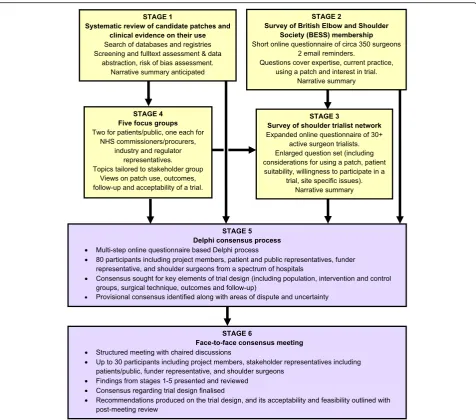
PARCS is a mixed methods feasibility study consisting of six stages. The design of each stage is given below. As this proto-col pertains to stages 2–6 only, a very brief summary of stage 1 is provided. The consensus methods approach adopted builds on the work by the IDEAL Collaboration for evaluating surgical innovation and devices in early-stage and randomised trial assessments [35] and adapts the methodology used for achieving expert consensus in guideline development and de-velopment of core outcome sets [36–38] to the broader scope of trial design, see Fig.1for a summary flow diagram.
Stage 1: Systematic review of candidate patches and related clinical evidence
A systematic review of the surgical management of rota-tor cuff repair with augmentative patch will be per-formed. This protocol is available elsewhere [39].
Stages 2 and 3: Surveys of surgical practice, acceptability and feasibility of a randomised trial
The main objective of the two surveys together is to as-certain current NHS clinical practice relating to the use of patches to augment rotator cuff repair and practical issues related to conduct of a trial in this area.
British Elbow and Shoulder Society (BESS) membership survey (stage 2)
The aim of this survey is to identify current UK clinical practice and gather information on surgeon opinion re-lating to the factors that influence their choice of patch and patient suitability. This survey will also explore the interest in participating in a RCT of patch augmented rotator cuff repair. An invite to participate in this online survey will be sent to all surgeon members of the British Elbow and Shoulder Society (BESS). The main mechan-ism of approaching potential participants will be via the BESS society email list; the invite will be sent out by the BESS office to avoid unnecessary sharing of personal data with the PARCS team. Information about the study and a hyperlink to the relevant survey will be provided. Reminder emails will be sent to the entire sample in a similar manner. The survey will be delivered online using the Bristol Online Survey (BOS) tool or an equiva-lent system [40]. Surgeon members of BESS attending the 2017 annual meeting will be offered an opportunity to complete the survey during the meeting. A member of the PARCS study team will provide verbal and, where appropriate, written study information. If the surgeon is agreeable, they will be given access to the online survey for completion at the meeting. Prior to finalising, the survey will be piloted internally amongst the study inves-tigators and a number of external individuals as appro-priate. The survey is anticipated to take approximately 10 min to complete and is available in Additional file1. The BESS membership includes approximately 350 clin-ically active shoulder surgeons. There is no minimum number of responses required. The response rate will be defined as the number of responding participants di-vided by the number of eligible people invited. The stat-istical analysis will be descriptive only. Responses will be summarised quantitatively or narratively, as appropriate (e.g. using Microsoft Excel and/or Stata).
Survey of shoulder surgeon trialists (stage 3)
are trial active and, therefore, most likely to participate in a randomised controlled trial of patch-augmented ro-tator cuff surgery. A network of surgeon trialists who have participated in previous NHS-based shoulder surgi-cal trials will be invited to take part. This will include surgeons who acted as principal investigator for the UKUFF, CSAW and UKFroST trials [2, 41,42]. At least 30 research active orthopaedic shoulder surgeons will be invited to take part. This is considered large enough to meet the aim of this component of the project and en-sure that a range of surgeons and centres are included. To be eligible, an individual will need to be a practicing orthopaedic shoulder surgeon who is currently, or has previously been, an investigator for a RCT of shoulder surgery, i.e. experienced in recruitment, trial treatments and completion of case report forms. Eligible
minimum number of responses required. The survey data will be analysed in a similar manner to the stage 3 survey.
Stage 4: Focus groups
Focus groups allow participants to speak freely about their concerns and offer their views about the existing and proposed evaluation of a new approach to surgical treatment. They are particularly useful for helping to identify issues that resonate with lay people and the pub-lic at large in matters of healthcare [43, 44]. Focus groups are widely used in health services research.
Using a number of focus groups, we aim to access a broad range of stakeholder views and opinions on the acceptability of the use of patches in the augmentation of rotator cuff repair and the trial design options that may be used to test them. Themes and issues identified from the surgeon survey (stages 2 and 3) will help to form topics for discussion if findings are available when this stage is ongoing.
Members will be recruited to separate focus groups, each reflecting the various key stakeholders:
A. Patients/public (including carers) with current or previous rotator cuff or other shoulder problems. This included but was not limited to those who had undergone rotator cuff surgery
Two focus groups will be conducted, one each in two regions of England (Thames Valley in the south and Tees Valley in the north)
B. Representatives from Industry
C. Other stakeholder representatives, including regulatory bodies, commissioners and the NHS such as those involved in research delivery and procurement of surgical equipment
Group A is considered to be the key stakeholder group. However, the introduction of patches into the NHS has regulatory and cost implications; therefore, it is relevant to include the views and opinions of groups B and C in the study. Potential participants will be invited and recruited using various avenues.
Consultant orthopaedic surgeons (and PARCS Study Management Group members) based at the Nuffield Orthopaedic Centre, Oxford and the James Cook Uni-versity Hospital, South Tees, will approach potential pa-tient participants though outpapa-tient and physiotherapy clinics. Study staff may also contact patients previously known to study clinical investigators at the two sites. If patient/public uptake is low, poster advertisement in the local community may also be used, and if necessary, the geographical area extended. Local or national websites set up to increase public and patient involvement in clinical research may also be utilised. Other stakeholders
and individuals with relevant experience and knowledge will be identified, approached and invited to participate directly. This may be through professional or personal acquaintance. If necessary, the technique of snowballing may be utilised, i.e. respondents may be asked to pass on information to other potential participants [45]. A balance of men and women within each focus group will be aimed for.
Each focus group will aim to involve four to eight par-ticipants and will be held at the Botnar Research Centre, University of Oxford (Oxford, Thames Valley, UK), the South Tees Institute of Learning, Research and Innovation (Middlesbrough, Tees Valley, UK), or where possible, at a location better suited to participants (e.g. their place of work or by teleconference). Focus groups sessions will last for a maximum of 2 h. There will be breaks of at least 15 min per hour of discussion. Refresh-ments will be provided during the focus group session.
Focus groups will be facilitated by a trained member of the PARCS study team. Discussions will be audio re-corded, and one or two observers will take notes to aid in the transcription of audio files and analysis. Partici-pants will provide their written consent prior to audio recording. Any identifying information appearing in focus group transcripts will be replaced with a pseudo-nym as soon as possible following transcription to min-imise risk of participant identification.
Ahead of the focus group session, potential partici-pants will be provided with a study information sheet (specifically tailored to their stakeholder group) that de-scribes the aim of the focus group, what taking part will involve and the consent procedure. Depending on indi-vidual preference, this information will be supplied by hand, email or post. Written informed consent will be obtained. As soon as they are confirmed, arrangements for the focus group (date, time and location) will be provided.
During the focus group session, the aim of the focus group and the PARCS project will be briefly introduced and participants will be asked to consider a number of relevant issues, scenarios or vignettes. Key items of in-formation about the possible trial design options, such as the different kinds of patches available, the choice of study arms, most appropriate outcome measures and methods of data collection (e.g. biopsy, patient question-naires, site visits), will be raised. The way in which this information is delivered, and the level of detail consid-ered, will likely be adapted according to participant group.
to place the completed ‘background information form’ and will be instructed to place the envelope in a box as they leave.
If it is not feasible to conduct a focus group meeting, or for all individuals to make the same date and location, po-tential participants may be offered an individual or, as a subset of all participants, a separate face-to-face or tele-phone interview instead. Participants will have the right to leave requests for information unanswered if they wish. We will reassure these participants and inform them that there will be no adverse consequences from this and are free to withdraw themselves at any time.
Data collected at the focus groups (stage 4) will be analysed alongside data collection using thematic ana-lysis [46]. The emphasis of the anaana-lysis will be on the ac-ceptability of the proposed trial and on factors that might facilitate or impede such acceptability. Thematic content analysis will be carried out by three members of the PARCS study team (CC, NM JCC) and will consist of the following steps:
(1) Familiarisation with the focus group transcript, (2) Coding the transcript text under relevant themes, (3) Agreeing a thematic framework,
(4) Applying the framework to subsequent focus group transcripts,
(5) Interpreting and summarising the data within each theme,
(6) Drawing out implications for trial design and stages 5 to 6 of the feasibility study (JAC will also be involved in this step).
Coding will be both deductive (guided by the themes included in the focus group topic guides) and inductive (allowing the emergence of unanticipated themes and sub-themes). Steps 3 and 4 will be iterative, i.e. the the-matic framework may be refined or modified and re-applied to transcripts as the analysis progresses. Changes to the thematic framework will require agreement of all members involved in steps 1–5.
Stage 5: Delphi study
A Delphi study to develop a consensus on the best way to design a clinical trial of patch-augmented rotator cuff surgery will be conducted. The Delphi method is a structured process of obtaining information from a group of experts using a series of related questionnaires, each one refined using respondents’ feedback from a previous version [47]. Delphi is a well-known and in-creasingly common method used in the clinical setting to establish a consensus [43, 47, 48]. A multi-stage on-line Delphi survey consisting of at least two but no more than three rounds will be conducted. The survey will be
developed and conducted using the BOS System or an equivalent [40].
Participants involved in stages 2 to 4 of the PARCS Study will be invited to take part in stage 5 according to stakeholder group and background. Given the nature of the study, there has been no formal sample size calcula-tion but around 50–80 are anticipated. There are gener-ally no accepted guidelines for the optimal sample size needed to achieve consensus in a Delphi studies [49]. This sample size was based on previous experience of conducting this type of survey and anticipated attrition rates at each round. Substantial loss from the initial to final round is not unusual [48,50].
Where appropriate, stakeholders who have relevant experience but did not take part in previous stages may be invited to participate. These potential participants will be identified and recruited using a similar approach as described in stages 3 and 4. Electronic confirmation of consent will be obtained.
Delphi study participants will have their name and contact email address entered in to the suryey system [40]. An email will be sent to each participant containing a personalised link that enables access for survey com-pletion. Findings from stages 1 to 4 will determine the design elements to be included in the first round of the Delphi survey. Two versions of the survey will be used one for patient and public stakeholders and one for pro-fessional (e.g. surgeons, researchers) stakeholders. The former version will have a subset of the full set of ques-tion which are most pertinent to this stakeholder group and will be presented using more accessible language and avoiding as far as possible technical terminology.
suggested by participants in round one of the Delphi survey will be reviewed at least two members of the PARCS study team. The wider project team will be con-sulted if there is any uncertainty or to decide if an add-itional element should be added.
Participants will receive a summary of the findings from the previous round in subsequent rounds. They will be asked to reflect on their own responses and also the collated responses. Participants will then score each design element. The final set of proposals, areas of provisional consensus and remaining disagreement and uncertainty will then be brought forward to the consen-sus meeting in stage 6 and used as the basis for discussion.
Where necessary, at each round of this Delphi survey, non-responders will receive a maximum of two reminder messages. The final reminder will contain a specific deadline for survey closure [51]. Each survey will take approximately 20 min to complete.
Scores (range 1–5) from each round will be calculated as a percentage of the total responses. We will define consensus for the content of the design elements pro-posal as > 70% of responses rating the element 4 or greater and not more than 15% of responses rating the element 1. Median and ranges will also be produced for the scores. We will explore similarities and differences across stakeholder groups. Textual responses will be summarised narratively.
Stage 6: Consensus meeting
Findings from stages 1–5 will feed into, and inform the structure of, a 2-day face-to-face meeting where the final consensus on an acceptable and feasible trial design for a definitive randomised trial to assess the effectiveness and cost-effectiveness of a patch to augment surgical re-pair of the rotator cuff tendon will be sought. This meet-ing will involve a range of stakeholders (includmeet-ing patient and public representatives, surgeons and trialists who took part in stages 2–5 of the study). Participants will be selected for invite based on their perspectives, ex-perience and background. This will be done in order to ensure a range of stakeholder groups are represented and individuals from different backgrounds and experi-ences (e.g. surgeons who do currently use patches to augment rotator cuff repair along with those who would be potentially willing to do so for a trial). To ensure a robust decision is made, approximately 30 stakeholders will take part in this meeting.
Ahead of the consensus meeting, participants will be sent a summary of findings from earlier stages of the project. Patient and public representatives will be reim-bursed for expenses and compensated for their time in line with current NIHR INVOLVE guidelines on pay-ment and recognition for public involvepay-ment [52]. The
meeting will be structured to ensure key areas of uncer-tainty and/or disagreement are identified. Consensus on key elements of the trial design: patient eligibility, inter-vention and control definitions, surgeon requirements, outcomes and target difference will be sought. Draft guidance, options and recommendations for a rando-mised trial assessing patch-augmented rotator cuff sur-gery will be developed from previous work updated in light of the findings from previous stages.
A post-meeting report will be drafted and circulated to participants for their review and comments. The report will detail the key design decisions and will be divided into sections on methods, study design issues (e.g. the definition of comparison groups) and special topics (e.g. allowable variation in surgical technique).
Project management and adherence to regulatory requirements
The investigators will ensure that this study is conducted in accordance with relevant regulations and with the Good Clinical Practice. The study will be conducted in accordance with the current approved protocol, relevant regulations and standard operating procedures. The in-dependent Study Steering Committee (SSC) will oversee study conduct and progress. A potential participant will be allowed as much time as they wish (within the con-straints of the project timelines) to consider the infor-mation, and the opportunity to ask questions. At all stages of the study, it will be clearly stated that a partici-pant is free to withdraw themselves and/or their re-sponse data at any time where it can be identified and removed (this is not likely to be feasible for responses to stages 4–6). There will be no adverse consequences or impacts on future care if this is done.
The study will comply with the Data Protection Act, which requires data to be anonymised as soon as it is practical to do so. Following publication of our findings, anonymised individual participant data (as far as is feas-ible according to the nature of the data) will be perman-ently archived. Anonymised data may be shared with legitimate internal and external researchers. The chief investigator will act as the data custodian for this study.
The investigators will also ensure that this study is conducted in accordance with the principles of the Dec-laration of Helsinki.
Progress to date
Discussion
Rotator cuff tears are a relatively common problem, and the number of operations to repair them is likely to grow in developed countries over the foreseeable future as the population ages. Despite benefits for many pa-tients, the operation does not provide sustained benefit for a substantial minority. The augmentation of the op-eration with a patch seems promising with some evi-dence of clinical benefit. However, which patients might benefit most and the extent of such a benefit is unclear particularly in what might be described as a typical pa-tient. Furthermore, there is key uncertainty regarding the available patches, the clinical evidence on their use and the views of key stakeholders particularly patients and surgeons on their use. When the prospect of con-ducting a large multicentre randomised trial to evaluate their use is considered, it is clear that a preparatory re-search would be highly valuable to inform the design of such a study and indeed if it is feasible to conduct. Fur-thermore, various trial design options are possible and it is not clear a priori which is most appropriate.
The main strengths of the study design are the planned systematic involvement of a variety of different stakeholder groups and the use of multiple quantitative and qualitative methodologies, in order to seek to pro-duce the most informed output from the study. The main weaknesses of the study are the relatively slow and more time-consuming nature of the overall study com-pared to simpler feasibility study designs. Participants in stages 2–6 may not be fully representative of all stake-holders or reflect the full range of viewpoints and per-spective. For example, surgeons who use patches in their clinical practice may have been more likely to participate in the stage 2 and 3 surveys. This could limit the generalizability and applicability of the findings.
The PARCS feasibility study seeks to address this gap in knowledge and seeks to take an inclusive approach with a variety of research methodologies utilised to in-form the feasibility and acceptability of a randomised trial in this area. Specifically, one that would evaluate the effectiveness and cost-effectiveness in the context of the NHS in the UK is in mind. It is hoped that this study might lead to the funding and conduct of such a study.
Additional files
Additional file 1:PARCS BESS Membership Survey. (PDF 156 kb)
Additional file 2:PARCS Surgeon Trialists Survey. (PDF 102 kb)
Abbreviations
BESS:British Elbow and Shoulder Society; BOS: Bristol Online Survey; CSAW: Can Shoulder Arthroscopy Work?; EU: Europe/European; HRA: Health Research Authority; IDEAL: Idea, Development, Exploration, Assessment, Long-term follow-up; MHRA: Medicines and Healthcare products Regulatory Authority; NHS: National Health Service; RCT: Randomised controlled trial;
SSC: Study Steering Committee; Stata: Data Analysis and Statistical Software; UK: United Kingdom; UKFRoST: United Kingdom Frozen Shoulder Trial; UKUFF: United Kingdom Rotator Cuff Trial; USA: United States of America
Acknowledgements
The authors would like to acknowledge the independent Study Steering Group for their contribution to refinement of the PARCS feasibility study’s protocol. Rod Taylor (chair), Elaine Nicholls and Hanna Bjornsson, Tony Batten and Rodney Benson.
Funding
This feasibility study was funded by the NIHR Health Technology Assessment Programme (15/103/03). JCC is partly funded by the NIHR Oxford Biomedical Research Centre (NIHR-BRC-1215-20008). The research was also supported by the National Institute for Health Research (NIHR) Oxford Biomedical Research Centre. The views expressed are those of the author(s) and not necessarily those of the NHS, the NIHR or the Department of Health. The funding body had no role in the design of the study and the collection, analysis and interpretation of data; in writing the manuscript; or in the decision to submit manuscripts for publication.
Availability of data and materials
Not applicable.
Authors’contributions
JAC is the principle investigator of the project and along with AJC developed the initial project proposal idea. JLR, DJB, AR, CC, LK, SH, MD, JCC, DF-H and RE were grant holders and helped refine the proposal and subse-quent protocol. NM is the project coordinator and helped translate the pro-posal into a protocol and refine the methodology. All authors read and approved the final manuscript.
Ethics approval and consent to participate
This feasibility study was reviewed and approved to proceed by the University of Oxford Joint Research Office (JRO) study classification group (ref: PID13023). The JRO determined that the PARCS study falls outside of the definition of research that requires Health Research Authority (HRA) ethical approval and is therefore was not subject to the Department of Health’s Research Governance Framework for Health and Social Care (2005). It does not therefore require further assessment or approval prior to
commencement. Informed Consent will be sought from participants as detailed in the main body of this paper.
Consent for publication
Not applicable.
Competing interests
Andrew Carr has applied for a patent that will be considered as part of this work. We have carefully designed a robust research strategy that incorporates substantial independent input throughout to ensure no other individual, whether they be within or out the project team, can have undue influence on the process. Amar Rangan has received educational and research grants from DePuy Ltd. outside the scope of this work. The authors declare that they have no conflict of interest.
Publisher’s Note
Springer Nature remains neutral with regard to jurisdictional claims in published maps and institutional affiliations.
Author details
1Centre for Statistics in Medicine, Nuffield Department of Orthopaedics,
Received: 17 May 2018 Accepted: 6 December 2018
References
1. Linsell L, Dawson J, Zondervan K, Rose P, Randall T, Fitzpatrick R, et al. Prevalence and incidence of adults consulting for shoulder conditions in UK primary care; patterns of diagnosis and referral. Rheumatology (Oxford). 2006;45(2):215–21.https://doi.org/10.1093/rheumatology/kei139. 2. Carr AJ, Cooper CD, Campbell MK, Rees JL, Moser J, Beard DJ, et al. Clinical
effectiveness and cost-effectiveness of open and arthroscopic rotator cuff repair [the UK Rotator Cuff Surgery (UKUFF) randomised trial]. Health Technol Assess. 2015;19(80):1–218.https://doi.org/10.3310/hta19800. 3. Buchbinder R, Green S, Youd JM. Corticosteroid injections for shoulder pain.
Cochrane Database Syst Rev. 2003;1:CD004016.https://doi.org/10.1002/ 14651858.cd004016.
4. Goldgrub R, Cote P, Sutton D, Wong JJ, Yu H, Randhawa K, et al. The effectiveness of multimodal care for the management of soft tissue injuries of the shoulder: a systematic review by the Ontario Protocol for Traffic Injury Management (OPTIMa) collaboration. J Manip Physiol Ther. 2016;39(2): 121–39.e1.https://doi.org/10.1016/j.jmpt.2016.01.002.
5. van der Windt DA, Koes BW, Boeke AJ, Deville W, De Jong BA, Bouter LM. Shoulder disorders in general practice: prognostic indicators of outcome. The British journal of general practice : the journal of the Royal College of General Practitioners. 1996;46(410):519–23.
6. Chaudhury S, Gwilym SE, Moser J, Carr AJ. Surgical options for patients with shoulder pain. Nat Rev Rheumatol. 2010;6(4):217–26.https://doi.org/10.1038/ nrrheum.2010.25.
7. Judge A, Murphy RJ, Maxwell R, Arden NK, Carr AJ. Temporal trends and geographical variation in the use of subacromial decompression and rotator cuff repair of the shoulder in England. Bone & Joint Journal. 2014;96-B(1): 70–4.https://doi.org/10.1302/0301-620X.96B1.32556.
8. Dunn WR, Schackman BR, Walsh C, Lyman S, Jones EC, Warren RF, et al. Variation in orthopaedic surgeons’perceptions about the indications for rotator cuff surgery. J Bone Joint Surg Am. 2005;87(9):1978–84.https://doi. org/10.2106/jbjs.d.02944.
9. Kulkarni R, Gibson J, Brownson P, Thomas M, Rangan A, Carr AJ, et al. BESS/ BOA patient care pathways: subacromial shoulder pain. Shoulder & Elbow. 2015;7(2):135–43.https://doi.org/10.1177/1758573215576456.
10. Galatz LM, Ball CM, Teefey SA, Middleton WD, Yamaguchi K. The outcome and repair integrity of completely arthroscopically repaired large and massive rotator cuff tears. J Bone Joint Surg Am. 2004;86-A(2):219–24.
11. Matthews TJ, Hand GC, Rees JL, Athanasou NA, Carr AJ. Pathology of the torn rotator cuff tendon. Reduction in potential for repair as tear size increases. J Bone Joint Surg Br. 2006;88(4):489–95.https://doi.org/10.1302/ 0301-620x.88b4.16845.
12. Rashid MS, Cooper C, Cook J, Cooper D, Dakin SG, Snelling S, et al. Increasing age and tear size reduce rotator cuff repair healing rate at 1 year. Acta Orthop. 2017;88(6):606–11.https://doi.org/10.1080/17453674.2017. 1370844.
13. Rangan A, Upadhaya S, Regan S, Toye F, Rees JL. Research priorities for shoulder surgery: results of the 2015 James Lind Alliance patient and clinician priority setting partnership. BMJ Open. 2016;6(4):e010412.https:// doi.org/10.1136/bmjopen-2015-010412.
14. Boileau P, Brassart N, Watkinson DJ, Carles M, Hatzidakis AM, Krishnan SG. Arthroscopic repair of full-thickness tears of the supraspinatus: does the tendon really heal? J Bone Joint Surg Am. 2005;87(6):1229–40.
15. Coghlan JA, Buchbinder R, Green S, Johnston RV, Bell SN. Surgery for rotator cuff disease. Cochrane Database Syst Rev. 2008;1:CD005619.https://doi.org/ 10.1002/14651858.CD005619.pub2.
16. Papalia R, Franceschi F, Zampogna B, D'Adamio S, Maffulli N, Denaro V. Augmentation techniques for rotator cuff repair. Br Med Bull. 2013;105:107– 38.https://doi.org/10.1093/bmb/lds029.
17. Carr AJ, Rees JL, Ramsay CR, Fitzpatrick R, Gray A, Moser J, et al. Protocol for the United Kingdom Rotator Cuff Study (UKUFF): a randomised controlled trial of open and arthroscopic rotator cuff repair. Bone and Joint Research. 2014;3(5):155–60.https://doi.org/10.1302/2046-3758.35.2000270. 18. Abrams GD, Gupta AK, Hussey KE, Tetteh ES, Karas V, Bach BR Jr, et al.
Arthroscopic repair of full-thickness rotator cuff tears with and without acromioplasty: randomized prospective trial with 2-year follow-up. Am J
Sports Med. 2014;42(6):1296–303.https://doi.org/10.1177/ 0363546514529091.
19. van der Zwaal P, Thomassen BJ, Nieuwenhuijse MJ, Lindenburg R, Swen JW, van Arkel ER. Clinical outcome in all-arthroscopic versus mini-open rotator cuff repair in small to medium-sized tears: a randomized controlled trial in 100 patients with 1-year follow-up. Arthroscopy. 2013;29(2):266–73.https:// doi.org/10.1016/j.arthro.2012.08.022.
20. MacDonald P, McRae S, Leiter J, Mascarenhas R, Lapner P. Arthroscopic rotator cuff repair with and without acromioplasty in the treatment of full-thickness rotator cuff tears: a multicenter, randomized controlled trial. J Bone Joint Surg Am. 2011;93(21):1953–60.https://doi.org/10.2106/jbjs.k. 00488.
21. Mohtadi NG, Hollinshead RM, Sasyniuk TM, Fletcher JA, Chan DS, Li FX. A randomized clinical trial comparing open to arthroscopic acromioplasty with mini-open rotator cuff repair for full-thickness rotator cuff tears: disease-specific quality of life outcome at an average 2-year follow-up. Am J Sports Med. 2008;36(6):1043–51.https://doi.org/10.1177/0363546508314409. 22. Boehm TD, Werner A, Radtke S, Mueller T, Kirschner S, Gohlke F. The effect
of suture materials and techniques on the outcome of repair of the rotator cuff: a prospective, randomised study. J Bone Joint Surg Br. 2005;87(6):819– 23.https://doi.org/10.1302/0301-620x.87b6.15638.
23. Gartsman GM, O'Connor DP. Arthroscopic rotator cuff repair with and without arthroscopic subacromial decompression: a prospective, randomized study of one-year outcomes. J Shoulder Elb Surg. 2004;13(4): 424–6.
24. MacDermid JC, Holtby R, Razmjou H, Bryant D, Canada J. All-arthroscopic versus mini-open repair of small or moderate-sized rotator cuff tears: a protocol for a randomized trial [NCT00128076]. BMC Musculoskelet Disord. 2006;7:25.https://doi.org/10.1186/1471-2474-7-25.
25. Nixon AJ, Watts AE, Schnabel LV. Cell- and gene-based approaches to tendon regeneration. J Shoulder Elb Surg. 2012;21(2):278–94.https://doi.org/ 10.1016/j.jse.2011.11.015.
26. Barber FA, Burns JP, Deutsch A, Labbe MR, Litchfield RB. A prospective, randomized evaluation of acellular human dermal matrix augmentation for arthroscopic rotator cuff repair. Arthroscopy. 2012;28(1):8–15.https://doi.org/ 10.1016/j.arthro.2011.06.038.
27. Ferguson DP, Lewington MR, Smith TD, Wong IH. Graft utilization in the augmentation of large-to-massive rotator cuff repairs: a systematic review. Am J Sports Med. 2016.https://doi.org/10.1177/0363546515624463. 28. Wong I, Burns J, Snyder S. Arthroscopic GraftJacket repair of rotator cuff
tears. J Shoulder Elb Surg. 2010;19(2 Suppl):104–9.https://doi.org/10.1016/j. jse.2009.12.017.
29. Thangarajah T, Pendegrass CJ, Shahbazi S, Lambert S, Alexander S, Blunn GW. Augmentation of Rotator Cuff Repair With Soft Tissue Scaffolds. Orthop J Sports Med. 2015;3(6):2325967115587495.
30. Smith RD, Carr A, Dakin SG, Snelling SJ, Yapp C, Hakimi O. The response of tenocytes to commercial scaffolds used for rotator cuff repair. Eur Cell Mater. 2016;31:107–18.
31. Hakimi O, Murphy R, Stachewicz U, Hislop S, Carr AJ. An electrospun polydioxanone patch for the localisation of biological therapies during tendon repair. Eur Cell Mater. 2012;24:344–57 discussion 57. 32. Iannotti JP, Codsi MJ, Kwon YW, Derwin K, Ciccone J, Brems JJ. Porcine
small intestine submucosa augmentation of surgical repair of chronic two-tendon rotator cuff tears. A randomized, controlled trial. J Bone Joint Surg Am. 2006;88(6):1238–44.https://doi.org/10.2106/jbjs.e.00524.
33. Mori D, Funakoshi N, Yamashita F. Arthroscopic surgery of irreparable large or massive rotator cuff tears with low-grade fatty degeneration of the infraspinatus: patch autograft procedure versus partial repair procedure. Arthroscopy. 2013;29(12):1911–21.https://doi.org/10.1016/j.arthro.2013.08.032. 34. Shea KP, McCarthy MB, Ledgard F, Arciero C, Chowaniec D, Mazzocca AD.
Human tendon cell response to 7 commercially available extracellular matrix materials: an in vitro study. Arthroscopy. 2010;26(9):1181–8.https:// doi.org/10.1016/j.arthro.2010.01.020.
35. Williamson PR, Altman DG, Blazeby JM, Clarke M, Devane D, Gargon E, et al. Developing core outcome sets for clinical trials: issues to consider. Trials. 2012;13:132.https://doi.org/10.1186/1745-6215-13-132.
36. Core outcome measures for rotator cuff disorders. http://www.comet-initiative.org/studies/details/361. Accessed 21/04/2016.
38. Sinha IP, Smyth RL, Williamson PR. Using the Delphi technique to determine which outcomes to measure in clinical trials: recommendations for the future based on a systematic review of existing studies. PLoS Med. 2011; 8(1):e1000393.https://doi.org/10.1371/journal.pmed.1000393.
39. Greenall G, Carr A, Beard D, Rees J, Rangan A, Baldwin M, et al. Systematic review of the surgical management of rotator cuff repair with an augmentative patch: a feasibility study protocol. Systematic reviews. 2018;7: 187.https://doi.org/10.1186/s13643-018-0851-1.
40. Online Surveys.https://www.onlinesurveys.ac.uk/. Accessed 21/04/2016. 41. Beard D, Rees J, Rombach I, Cooper C, Cook J, Merritt N, et al. The CSAW
study (can shoulder arthroscopy work?) - a placebo-controlled surgical intervention trial assessing the clinical and cost effectiveness of arthroscopic subacromial decompression for shoulder pain: study protocol for a randomised controlled trial. Trials. 2015;16:210.https://doi.org/10.1186/ s13063-015-0725-y.
42. United Kingdom Frozen Shoulder Trial (UK FROST).http://www.nets.nihr.ac. uk/projects/hta/132601. Accessed 21/04/2016.
43. Jones J, Hunter D. Consensus methods for medical and health services research. BMJ. 1995;311(7001):376–80.
44. Kitzinger J. Qualitative research. Introducing focus groups. BMJ. 1995; 311(7000):299–302.
45. Braun V, Clarke V. Successful qualitative research : a practical guide for beginners. Los Angeles: SAGE; 2013.
46. Green J, Thorogood N. Thematic content analysis. In: Qualitative methods for health research. 3rd ed: SAGE Publications Ltd; 2014. p. 209–18. 47. Murphy MK, Black NA, Lamping DL, McKee CM, Sanderson CF, Askham J,
et al. Consensus development methods, and their use in clinical guideline development. Health Technol Assess. 1998;2(3):i-iv):1–88.
48. Cuthbertson BH, Campbell MK, MacLennan G, Duncan EM, Marshall AP, Wells EC, et al. Clinical stakeholders’opinions on the use of selective decontamination of the digestive tract in critically ill patients in intensive care units: an international Delphi study. Crit Care. 2013;17(6):R266.https:// doi.org/10.1186/cc13096.
49. Kirkham JJ, Boers M, Tugwell P, Clarke M, Williamson PR. Outcome measures in rheumatoid arthritis randomised trials over the last 50 years. Trials. 2013; 14:324.https://doi.org/10.1186/1745-6215-14-324.
50. Kearney A, Williamson P, Young B, Bagley H, Gamble C, Denegri S, et al. Priorities for methodological research on patient and public involvement in clinical trials: a modified Delphi process. Health Expectationsn/a-n/a.https:// doi.org/10.1111/hex.12583.
51. Edwards PJ, Roberts I, Clarke MJ, Diguiseppi C, Wentz R, Kwan I, et al. Methods to increase response to postal and electronic questionnaires. Cochrane Database Syst Rev. 2009;3:MR000008.https://doi.org/10.1002/ 14651858.MR000008.pub4.