* Correspondence:stuebs@ informatik.uni-hamburg.de Department of Computer Science, University of Hamburg, Hamburg, Germany
Abstract
OpenDISCO is an open-source framework for decentralized simulation and security assessment of distributed power grid control. By incorporating security assessment directly into the control algorithms’implementation process, the proposed framework aims to enable the rapid development of new control strategies. It provides a modular structure, enabling engineers and researchers to define own stress conditions and to simulate predefined cyber-attacks, thereby enabling continuous evaluation during the integration into existing power systems. A demo setup is presented, comprising a micro grid simulation and implementing a Controller-Hardware-in-the-Loop configuration.
Keywords:Smart grid, Demo, Security framework, Open-source
Introduction
The decentralization of Smart Grids is an ongoing transformation. For novel Smart Grid appliances, e.g. distributed control algorithms (DCAs), IT security is a core re-quirement and needs to be considered already in the development phase.
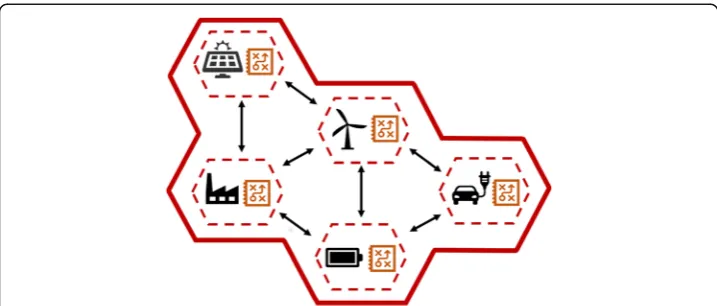
Prospectively, millions of new regenerative energy resources and electric cars need to be coordinating additionally to the existing power grid, to match supply and demand. The development of innovative DCAs is one possible contribution in the direction of a resilient Smart Grid. While decentralization of control algorithms can help avoiding single-point-of-failures and improve the system’s resilience, as depicted in Fig. 1, its complexity increases. The OpenDISCO framework is a tool for assisting the develop-ment of resilient Smart Grid control despite these challenges.
Related work
Power grid functionality has traditionally been implemented in a centralized way. Current research shows alternative solutions based on DCAs for many of these appli-cations, realized by so-called decentralized Virtual Power Plants (Stübs, 2018) and implementing grid functionality like Demand Response (Sakurama & Miura, 2017), Frequency-Load Control (Dong,2016) and Power System State Estimation (Etemad & Lahouti,2016).
The integration of Controller-Hardware-in-the-Loop (CHIL) into a Smart Grid valid-ation environment has been thoroughly tested (Andrén et al., 2013) and several Cyber-Physical Energy System (CPES) testbeds exist (Cintuglu et al.,2017). Verification of DCAs is a well-researched topic among wireless sensor networks (Wang & Bagrodia,
2011). However, a truly decentralized framework has not been developed and we aim to contribute to this development with a security assessment framework for the Smart Grid.
OpenDISCO framework
The proposed framework aims to accompany the development cycles of any DCA for CPES by describing an interface for an advanced resilience assessment. Three main properties, namely a modular structure, the distributed execution, stress condition simulation, build the core of the framework:
a) Modular Structure
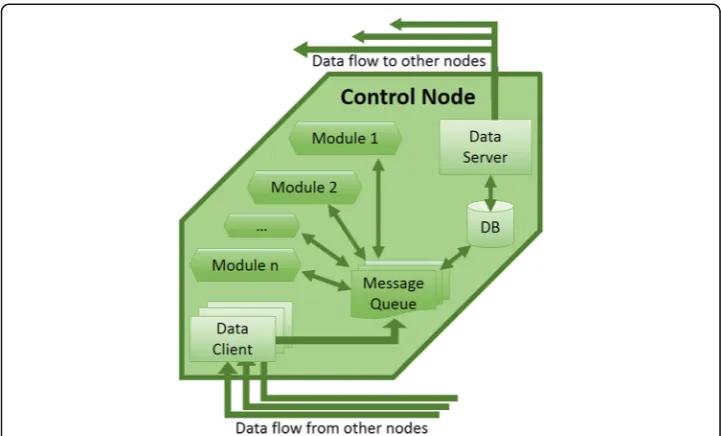
Smart Grid engineers can independently develop modules to be executed by the OpenDISCO framework, that can implement the DCA’s logical structure, as shown in Fig.2. Thanks to the modularity of the framework, it is easy to introduce a new or dif-ferent DCA in the code. Modules are required to implement an event-driven interface, thus granting interoperability with simulation tools. The modularity mechanism is built upon a message queue and an event-driven operation: When a message or event arrives at the control node, it is sent to the central message queue and is then available for processing by the framework’s modules.
b) Distributed Execution
Each control node can be either simulated or executed in a distributed environment with a preconfigured topology. Message exchange between the control nodes is implemented using the publisher-subscribe concept. The communication network’s topology is either
realized in hardware or simulated. Thereby different topologies can be used for evaluation, for example ring topology, fully meshed topology or an incomplete mesh.
c) Stress Condition Simulation
The framework includes an XML based attack description language, which allows to implement various attacker models. By creating designated attack simulation modules for the control nodes, it is possible to describe denial-of-service attacks and connectiv-ity malfunctions, such as dropping or delaying messages, changing reported measure-ments and control commands, or even disconnecting from and re-connecting to the evaluated micro-grid. An additional feature is support for probabilistic and/or orches-trated attack behavior.
Case study
The presented case study shows a decentralized frequency-load control algorithm in an islanded micro grid (Nguyen et al., 2017). Each distributed energy resource (DER) is equipped with a control node, which implements a single node of the DCA and is responsible for commanding the DER. The power generating part of the DER is simulated in a digital real-time simulator, while the control nodes com-municate in a communication network, shown in Fig. 3. The algorithm’s task is to react to deviations in the micro grids electrical frequency from the nominal value of 50 Hz. The algorithm is realized as a distributed averaging consensus, requiring the control nodes to communicate and then act collectively. In the evaluated sce-nario, each control node can only communicate with its direct neighbors, imple-menting a locality-aware ICT topology.
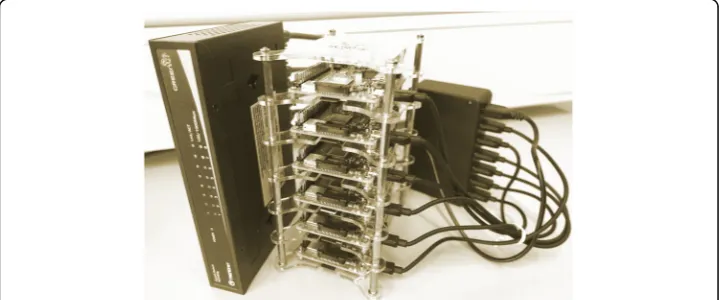
The evaluation of the connection between the digital real-time simulator and the control nodes was realized by implementing a cluster of Raspberry Pi embedded sys-tems, as pictured in Fig.4.
Demo setup
The demo setup uses a physical Raspberry Pi cluster as pictured in Fig.4 and powered by a 230 V, 60 W power hub, providing low voltage DC via USB to the Ethernet switch and embedded devices, which are mounted on a rack. Implementing a CHIL configur-ation, each Raspberry Pi functions as the controller of a DER in the simulated CPES, in this case an islanded micro grid. The interconnection between the embedded devices utilizes Ethernet and TCP/IP. The connection from a displaying computer to the cluster is managed by a dedicated Raspberry Pi and realized via IEEE 802.11 wireless protocol with WPA2 password authentication. The managing Raspberry Pi then redirects incoming Wi-Fi connections via Ethernet, if requested, to any of the Raspberry Pi computers. When connected to the demo setup, the effect of DoS
Fig. 3Structure of the communication and power flow in the example micro grid
attacks on the implemented control algorithm’s performance can be displayed and evaluated on any connected device.
Results and discussion
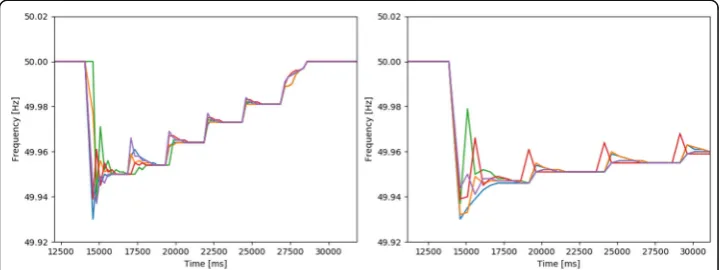
For the current evaluation, we investigated only attacks against the availability of the test setup’s communication. The attacker is assumed to be able to deliberately suppress or delay messages between control nodes. Figure 5a shows the default reaction of the evaluated system to a disturbance, where-as a simulated denial-of-service attack as depicted in Fig.5bcan be detected immediately.
In the context of the Smart Grid and DER, neither benevolence nor soundness of the communication partners can be generally assumed, although encrypted connections and public key management schemes can provide certainty of the identities and authorizations of other nodes. Nonetheless, contributing nodes can be malfunctioning or even malicious, whilst maintaining valid credentials.
Presented research indicates that decentralized detection and reaction strategies are a worthwhile contribution to improve robustness of distributed systems and might become a necessity in future, increasingly complex Smart Grid infrastructures.
Conclusion
The OpenDISCO framework is an easily extendable open-source tool for assessment of distributed control algorithms (DCAs). It enables Smart Grid researchers and engineers to simulate and continuously verify control strategies during development. The prototype implementation is freely available (Stübs et al.,2018) and includes example DCA, sample ICT topologies and a custom attack description language as well as various predefined attacker models.
Abbreviations
CHIL:Controller-Hardware-in-the-Loop; CPES: Cyber-Physical Energy System; DCA: Distributed Control Algorithm; DER: Distributed Energy Resource; DoS: Denial of Service; ICT: Information Communication Technology
Funding
This work was funded by Germany’s Federal Ministry of Economics and Energy (BMWi). Publication costs for this article were sponsored by the Smart Energy Showcases - Digital Agenda for the Energy Transition (SINTEG) program.
Competing interests
No competing interests arise. The proposed solutions and software are free and open-source (Stübs et al.,2018). No commercial products are currently planned from this research.
Publisher’s Note
Springer Nature remains neutral with regard to jurisdictional claims in published maps and institutional affiliations.
Published: 10 October 2018
References
Andrén F, Lehfuß F, Strasser T (2013) A development and validation environment for real-time controller-hardware-in-the-loop experiments in smart grids. Int J Distributed Energy Resour Smart Grids 9(1):27–50
Cintuglu MH et al (2017) A survey on smart grid cyber-physical system testbeds. IEEE Commun Surv Tutorials 19(1):446–464 Dong L (2016) Decentralized load frequency control for an interconnected power system with nonlinearities, American
Control Conference (ACC). IEEE, Boston
Etemad RH, Lahouti F (2016) Resilient decentralized consensus-based state estimation for smart grid in presence of false data, International Conference on Acoustics, Speech and Signal Processing (ICASSP). IEEE, Shanghai
Nguyen TL et al (2017) Agent based distributed control of islanded microgrid—real-time cyber-physical implementation, Innovative Smart Grid Technologies Conference Europe (ISGT-Europe). IEEE PES, Torino
Sakurama K, Miura M (2017) Communication-based decentralized demand response for smart microgrids. IEEE Trans Ind Electron 64(6):5192–5202
Stübs M (2018) IT-security in self-organizing decentralized virtual power plants: student research abstract, Proceedings of the 33rd Annual ACM Symposium on Applied Computing. ACM, Pau
Stübs M, Kevin K, Laskow D (2018) OpenDISCO source code. https://git.informatik.uni-hamburg.de/OpenDISCO/OpenDISCO-framework. [Online; accessed 12-June-2018]