S H O R T R E P O R T
Open Access
Field efficacy of Porcilis® PCV M Hyo versus
a licensed commercially available vaccine
and placebo in the prevention of PRDC in
pigs on a French farm: a randomized
controlled trial
Eric Pagot
1, Martial Rigaut
2, David Roudaut
2, Luca Panzavolta
2, Rika Jolie
3*and Didier Duivon
2Abstract
Background:A controlled, randomised, and blinded trial performed on a conventional French farrow-to-finish farm compared the efficacy of a one-shot bivalent ready to use vaccine, Porcilis® PCV M. Hyo (group PCVM), to that of two commercial vaccines (Ingelvac® Circoflex® + Ingelvac® Mhyo, group ICIM), and to a placebo (group CTL), in preventing the health and economic impacts of Porcine Respiratory Disease Complex (PRDC).
Material & Methods:In this small-scale clinical study, all piglets in each group were administered the vaccine/ placebo at weaning age (27 days old). Piglets from either of the three groups were bled at regular intervals from 3 weeks of age until slaughter, in order to assess the infection by the main PRDC infectious agents:Mycoplasma hyopneumoniae, PCV2 and PRRSV. Performance, lung checks and slaughter data were collected and analysed. Results:PCV2 viremia was significantly reduced in both vaccinated groups as compared to the placebo group. Lung lesion score was significantly lower in group PCVM, as compared to groups CTL and ICIM. Average daily weight gain during the finishing period was not significantly different between both vaccinated groups and was significantly higher than in the placebo group (849 g/d in the latter). Carcass results provided a numerical advantage to PCVM group, through improved part of production eligible for premium payment, and superior farmer income; this was a trend and did not reach significance.
Conclusion:The one-shot bivalent vaccine Porcilis® PCV M Hyo proved to be efficacious and convenient to use in a field context of active PCV2 andM. hyopneumoniaeinfections.
Keywords:PCV2,Mycoplasma hyopneumoniae, Vaccine, Randomised controlled field trial
Background and regional context
The term Porcine Respiratory Disease Complex (PRDC) describes pneumonia of multiple, combined causal factors (environmental, management and infectious risk factors play variable roles), resulting in clinical disease and reduced growth over the finishing phase of pig farming (15 to 20 weeks of age) [1]. This multifaceted respiratory condition in fattening pigs can be controlled through the efficient prevention and correction of the
relevant risk factors identified by the practitioner of the corresponding farm. In Western France (Brittany), where 60% of the national swine production is concentrated, PRDC components have been extensively studied, regarding both non-infectious [2] and infectious [3] risk factors. The former cross-sectional study evidenced that-under French farming conditions, pneumonia and pleuritis risk factors are mostly different, except for an inappropriate ventilation programme [2]. Regarding in-fectious risk factors, the respective part of pathogens in PRDC can vary with geographic locations, for instance most of France, with the exception of its Western part, * Correspondence:[email protected]
3MSD Animal Health, 2 Giralda Farms, Madison, NJ 07940, USA
Full list of author information is available at the end of the article
is free of PRRS, while Switzerland is free ofMycoplasma
hyopneumoniae. For Western France, pathogens found
to have a prominent role in PRDC were: Mycoplasma
hyopneumoniae, Porcine Reproductive and Respiratory Syndrome Virus (PRRSV) and Swine influenza virus (SIV) H1N1, with porcine circovirus type 2 (PCV2) seeming less dominant in the pneumonia-like gross le-sions, although it might play a role [2]. Extensive pleuri-tis lesions were solely found significantly associated with
the combination of Actinobacillus pleuropneumoniae
serotype 2 and PRRSV. In well-performing French farms, the ventilation programme is checked daily by the farmer, and controlled on a monthly basis by trained technicians. The control of infectious risk factors is mostly performed through vaccination (see [4] for a re-view). However, even though vaccination against enzo-otic pneumonia is widely implemented, pneumonia-like
lesions frequency and detection of M. hyopneumoniae
remain elevated [5]. Also, it has been assessed that, under Brittany’s farming conditions, there is a significant (p< 0.001) negative correlation between pneumonia score and growth [6], with a 0.7% loss of average daily weight gain (ADWG) for each point of pneumonic lung score increase (“Madec”lung scoring is performed on a 1–28 scale) [7]. Farmers are aware of these facts and are therefore eager to challenge the respiratory disease vac-cine strategy implemented in their farm in order to benefit from any possible improvement of PRDC control.
Several vaccines against respiratory/systemic infectious agents, which have been evaluated by the European medi-cines agency (EMA), have recently reached the European market. Among those is, the first ready-to-use bivalent
vaccine against PCV2 and Mycoplasma hyopneumoniae,
Porcilis® PCV M Hyo, with efficacy data published by EMA in its European public assessment report.1
The present clinical study provides further evidence of the field efficacy of this vaccine.
Case farm and trial setting
In December 2014, a conventional 450-sow French farrow-to-finish swine farm with no history of clinical PCV2-associated disease was suggested by its practi-tioner to our clinical study team as being eligible for a
field trial on PCV2 and Mycoplasma hyopneumoniae
vaccine efficacy. The farm is located in Brittany, in a high-density farming area (Côtes-d’Armor). A pilot sur-vey was implemented to assess the circulation of PCV2 andM. hyopneumoniaein the herd.
PCV2 serology (in-house test, Laboratory for Diagnostic Solutions Intervet Boxmeer, the Netherlands) was per-formed on fifteen piglets of three age classes: 4, 12 and 22 weeks of age. Seropositivity rate was found to be in-creasing with age, i.e. 28–35%, 38–80% and 67–89%
respectively, which was suggestive of an active post-weaning PCV2 circulation (the herd did not vaccinate sows against PCV2).
M. hyopneumoniae serology (IDEXX M. hyo Ab Test) was performed on fifteen 21-week old pigs, of which 87% were found positive. Although enzootic pneumonia vaccination was routinely performed at weaning on this farm, such high seropositivity rate is strongly suggestive of active M. hyopneumoniae infection in the fattening period, on a one-site production system [8]. Further-more, a lung check was performed at the slaughterhouse in December 2014, which confirmed that 83% of the 23 controlled pigs had pneumonia lesions, a mean lung le-sion score (LLS) of 8.4 (‘Madec’scoring method, on 28, see [6]) and a median LLS of 8.0. Together, these results supported an active M. hyopneumoniae infection in the fattening unit.
The PRRS status of the farm had been recently deter-mined by the farm veterinarian, with seropositive sows and pigs becoming infected from 10 weeks of age on-wards. PRRSV infection was controlled in the female herd by priming gilts (quarantine) with a modified live vaccine, and boosts at regular intervals with an inacti-vated vaccine. Serology performed during the trial later confirmed that all piglets seroconverted by 14 weeks of age (data not shown). The same was true for
Haemophi-lus parasuis (all pigs seroconverted by week 22), while no seroconversion was measured against Actinobacillus
pleuropneumoniae, nor SIV (H1N1, H1N2 and H3N2). Taken together, these results evidenced the presence of PRDC, in compliance with both its clinical expression and the association of pathogens described by Fablet et
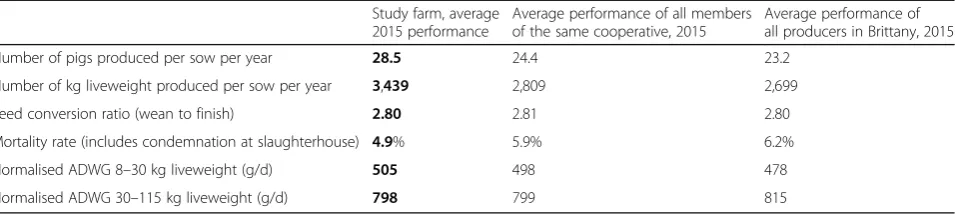
al. in Western France [2]. This farm was among the bet-ter half of the farms belonging to the same production cooperative (see Table 1), and the producer accepted his practitioner’s suggestion to add PCV2 valence to the pig-lets’vaccination schedule and to compare two options to
vaccinate concurrently against M. hyopneumoniae and
PCV2: a one-shot bivalent ready-to-use (RTU) and a combination of two commercial vaccines applied in two separate injections. This trial was to be carried out ac-cording to a controlled, randomised, and blinded design, upon completion of the informed consent form by the farmer.
three of the selected piglets (one per treatment group) of comparable girth (corpulence) were further selected for blood sampling and received an additional ear tag, of a different shape and colour. Individual identification of each included piglet allows considering the animal as a statistical unit.
On day 0 (10th of March 2015), all piglets were injected according to their allocated group; blood sam-pling was also performed. After these procedures, piglets were placed back in their pen of origin, irrespective of their treatment group.
– Group CTL (control): piglets (n= 165) were injected in the neck with saline as placebo (2 ml, via the intramuscular route).
– Group PCVM: piglets (n= 166) were injected in the neck with the one-shot bivalent RTU vaccine Porcilis® PCV M Hyo (2 ml, via the intramuscular route).
– Group ICIM: piglets (n= 167) were injected with both vaccines Ingelvac® CircoFLEX® and Ingelvac® M Hyo, in compliance with the product’s specifications2: two injections (1 and 2 ml,
respectively) were administered via the IM route on the same side of the neck of the piglets.
All vaccine injections, blood sampling and weighing manipulations of piglets/pigs were performed by trained investigators, from a dedicated intervention team. All other farm routines were performed-without change, by stockmen.
Assessment of vaccine efficacy
To assess the efficacy of vaccination, the following pri-mary parameters were used: for PCV2 protection, PCV2
viremia (quantitative PCR genomic load); for M.
hyopneumoniae infection, lung lesion score (LLS) at slaughter; for both pathogens, average daily weight gain (ADWG) over the finishing period (pigs were individu-ally weighed on the farm before departure to slaughter, on the 15th and 16th of July). The secondary efficacy parameters included overall ADWG and mortality
(between vaccination and slaughter, including total condemnation).
At inclusion, there were no statistically significant differences in the sex ratio of pigs within each group (p= 0.998, Pearson Chi-square), nor in live-weight (p= 0.578, least-square means). On this farm, piglets are routinely weaned at 28 days of age, then spend 2 weeks in a nursery room before entering pre-fattening for a 5-week period. At 11 weeks of age, they are transferred to the finishing rooms. At this age, there were no significant differences in average live-weight between groups (p= 0.534, analysis of variance). There was, however, a significant difference be-tween groups for the average daily weight gain (ADWG) over that finishing period: PCVM group had a significantly higher ADWG than the CTL group (p= 0.011, analysis of variance). These results are detailed in Table 2.
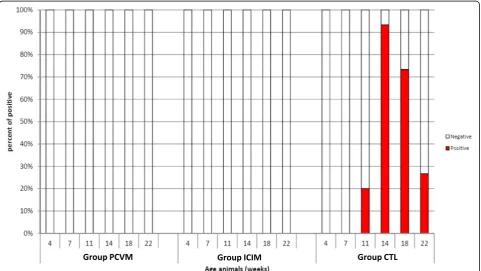
To assess PCV2 viremia, one piglet per litter in each group was bled at regular intervals (4, 7, 11, 14, 18 and 22 weeks of age). Testing was performed at the Labora-tory for Diagnostic Solutions Intervet Boxmeer, the Netherlands, with an in-house quantitative PCR (detec-tion limit of 2 log10 copies per μl DNA extract). No PCV2 genome was found in the blood of piglets from PCVM and ICIM groups, at any age sampled. Con-versely, in CTL group, PCV2 viremia appeared in 20% of the sampled 11-week old piglets and was detectable in 94% of 14-week old piglets (see Fig. 1). Area Under the Curve (AUC) value was 14.0 (group CTL), 0.2 (group PCVM) and 0.5 (group ICIM). AUC was highly signifi-cantly lower in each vaccinated group as compared to the CTL group (in each case,p< 0.0001, Anova).
Lung check was performed at the slaughterhouse for a subset of pigs in each group (55 to 69 pigs per group).3
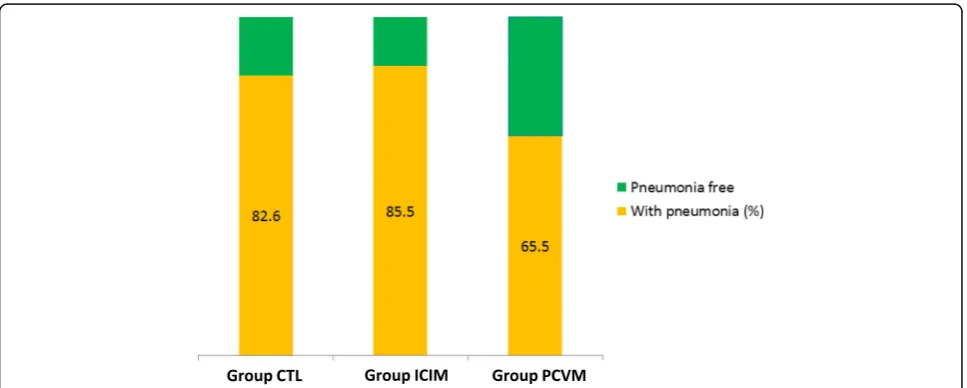
Lung scoring was performed individually according to the method established by Goodwin [9]. The mean lung lesion score of group PCVM was found to be lower, with a significant difference (p= 0.007, Kruskal-Wallis test, see Fig. 2), compared with the 2 other groups. Also, the proportion of lungs with pneumonic lesions was signifi-cantly higher in both group CTL and group ICIM, as
compared to group PCVM (p= 0.021, Pearson
Chi-square, see Fig. 3). Taken together, these results are in
Table 1Comparative performance results for the trial farm, with reference to the production cooperative it belongs to, and to swine producers in the same region (farm's data are in bold)
Study farm, average 2015 performance
Average performance of all members of the same cooperative, 2015
Average performance of all producers in Brittany, 2015
Number of pigs produced per sow per year 28.5 24.4 23.2
Number of kg liveweight produced per sow per year 3,439 2,809 2,699
Feed conversion ratio (wean to finish) 2.80 2.81 2.80
Mortality rate (includes condemnation at slaughterhouse) 4.9% 5.9% 6.2%
Normalised ADWG 8–30 kg liveweight (g/d) 505 498 478
favour of the use of multivalent vaccines/vaccine pro-grammes in prevention of PRDC. Under the condition that the selected valences are adapted to the local com-bination of the pathogens implied in PRDC, this trial adds-up to the growing body of evidence of the efficacy of this intervention, as has recently been demonstrated
in Germany [10] against PCV2 and M. hyopneumoniae
or Korea [11] against PCV2 and PRRSV, with a more limited number of primary parameters.
Slaughter data were sent by the slaughterhouse to the farmer under an electronic format (Microsoft Excel® tabs) and were compiled with the farmer’s agreement. These complete data provided secondary parameters: mortality rate (which includes full carcass condemnation
at the slaughterhouse), average age at slaughter, average net carcass weight (excluding the condemned pieces), average amount of quality premiums for which the farmer was eligible and average per-pig income (calcula-tion includes vaccina(calcula-tion costs). These data are detailed in Table 3. Statistical significance was not reached be-tween any groups for any of these parameters. There was however a trend for improved revenue paid to the farmer in group PCVM (p= 0.08), through a larger num-ber of pigs eligible for a premium (p= 0.07). A larger number of pigs in the trial may have resulted in statis-tical significance. This latter observation is in parallel with the recent assessment of the antimicrobial meta-phylaxis in fattening pigs affected by PRDC in PRRS-free
Table 2Numeric data, results, and statistical analysis for each trial group, measures performed over the production period
Weight at inclusion (kg) (number included)
Weight at transfer to fattening (kg)
Weight before departure (kg)
ADWG, nursery (g/d)
ADWG, fattening (g/d)
Mortality rate incl. condemnations (number of dead pigs)
Group CTL 6.80 (165) 29.56 96.9 438 849.6a 2.4% (4)
Group PCVM 6.79 (166) 28.96 99.0 426 880.6b 6.0% (9)
Group ICIM 6.66 (167) 29.14 97.9 432 867.2ab 3.6% (4)
Total (498) NC NC NC NC NC
pvalue 0.578 0.534 0.193 0.424 0.011 0.218
Test used Anova Anova Anova Anova Anova Chi-square
Values with different letters within the same column are statistically significantly different
NCnot calculated
herds [12], where growth retardation was only compen-sated in the lighter pigs in the studied cohort, i.e. where the intervention has limited positive impact in terms of animal health as well as of financial benefit.
Conclusion
Pigs in the control group presented an elevated PCV2 viremia between 11 and 22 weeks of age. Upon slaughter, more than 80% of them presentedM. hyopneumoniae-like lung lesions, with average LLS of 5.9. These elements con-firm that both PRDC pathogens were actively circulating in the trial farm. A highly significant prevention of PCV2 viremia was observed in both vaccinated groups.
Compared to the group ICIM, the group PCVM had significantly better outcome regarding the frequency of
pneumonia (−20%) and LLS (3.1 vs. 6.3). Furthermore, the group PCVM also produced an improved ADWG in fattening (+13 g/d), carcasses quality premium (+1,8 € cts/kg) and average per-pig income (+2,6€); these favor-able results neared significance. In this field trial, Porci-lis® PCV M Hyo proved to be efficacious in protecting piglets against both PCV2 viremia and the impact ofM.
hyopneumoniae infection, in a context of active PRDC and PCV2 infection.
Endnotes 1
This EPAR is freely available online on the website of EMA: http://www.ema.europa.eu/ema/index.jsp?curl=pages/ medicines/veterinary/medicines/003796/vet_med_000307.js p&mid=WC0b01ac058008d7a8.
Fig. 2Average lung lesion score (scoring according to Goodwin) in each trial group, in a subset of 179 pigs, from the 498 pigs included
2
For CircoFLEX®, see at http://www.ema.europa.eu/docs/ en_GB/document_library/EPAR_-_Product_Information/vet erinary/000126/WC500062388.pdf. For Ingelvac® M. Hyo, see French SPCs at http://www.ircp.anmv.anses.fr/rcp.aspx?-NomMedicament=INGELVAC+M.HYO
3
Due to social contemporary social disruption at the time of the trial, slaughterhouse of destination of some batches has been changed at the last minute, without the lung check personnel being warned. Some animals have been missed, in each trial group.
Abbreviations
ADWG:Average daily weight gain; AUC: Area under the curve; LLS: Lung lesion score; PCR: Polymerase chain reaction; PCV2: Porcine Circovirus type 2; PRDC: Porcine respiratory disease complex; PRRS: porcine reproductive and respiratory syndrome; PRRSV: Porcine reproductive and respiratory syndrome virus; RTU: Ready-to-use; SIV: Swine influenza virus
Acknowledgements
The authors are grateful to the farm owner and his stockmen, for agreeing to engage in the trial and for working in good cooperation with the investigation team, and to Evelyne Gaillard, DVM, in charge of the health supervision of the trial farm, for helping with the implementation of the trial and the interpretation of most results.
Funding
MSD Animal Health France funded the study.
Availability of data and material
The data that support the findings of this study are available from Eric Pagot, but restrictions apply to the availability of these data, which were used under license for the current study, and so are not publicly available. Data are however available from the authors upon reasonable request and with permission of Rika Jolie (corresponding author).
Authors’contributions
DD was Clinical Research Manager; RM, RD and PL participated in animal manipulations and data collection; PE was investigator of the study, wrote results section, performed the statistical study; DD, RM and JR wrote the manuscript; JR reviewed the manuscript and wrote the conclusion. All authors read and approved the final manuscript.
Competing interests
With the exception of the primary author, all other authors of this case report are employees from the company sponsor.
Consent for publication
All authors consent to the publication of the present manuscript.
Ethics approval and consent to participate
An owner consent was completed by the farmer prior to the enrolment of his animals in the study. This study was conducted in compliance with the Good Clinical Practice Guidance Document #85, May 9, 2001 (VICH GL9).
Author details
1
Zoopole Développement-CTPA, Ploufragan, France.2MSD Santé Animale, 7, rue Olivier de Serres - Angers Technopole C.S. 17144, 49071 Beaucouzé cedex, France.3MSD Animal Health, 2 Giralda Farms, Madison, NJ 07940, USA.
Received: 18 October 2016 Accepted: 20 December 2016
References
1. Brockmeier SL, Halbur PG, Thacker EL. Chapter 13: Porcine Respiratory Disease Complex. In: Brogden KA, Guthmiller JM, editors. Polymicrobial Diseases. ASM Press: Washington; 2002.
2. Fablet C, Dorenlor V, Eono F, Eveno E, Jolly JP, Portier F, Bidan F, Madec F, Rose N. Noninfectious factors associated with pneumonia and pleuritis in slaughtered pigs from 143 farrow-to-finish pig farms. Prev Vet Med. 2012;104(3–4):271–80. 3. Fablet C, Marois-Créhan C, Simon G, Grasland B, Jestin A, Kobisch M, Madec F,
Rose N. Infectious agents associated with respiratory diseases in 125 farrow-to-finish pig herds: a cross-sectional study. Vet Microbiol. 2012;157(1–2):152–63. 4. Chae C. Porcine Respiratory Disease Complex: Interaction of vaccination and
porcine circovirus type 2, porcine reproductive and respiratory syndrome virus andMycoplasma hyopneumoniae. Vet J. 2016;212:1–6.
5. Fablet C, Marois C, Dorenlor V, Eono F, Eveno E, Jolly JP, Le Devendec L, Kobisch M, Madec F, Rose N. Bacterial pathogens associated with lung lesions in slaughter pigs from 125 herds. Res Vet Sci. 2012;93(2):627–30. 6. Pagot E, Pommier P, Keïta A. Relationship between growth during fattening and
pulmonary lung lesions at the slaughterhouse in swine. [in French]Rev Méd Vét. 2007;158(5):253–59. http://www.revmedvet.com/2007/RMV158_253_259.pdf 7. Madec F, Kobisch M. Lung lesion scoring of finisher pigs at the slaughterhouse
[in French]. Journées de la Recherche Porcine. 1982;14:405–12.
8. Giacomini E, Ferrari N, Pitozzi A, Remistani M, Giardiello D, Maes D, Alborali GL. Dynamics of Mycoplasma hyopneumoniae seroconversion and infection in pigs in the three main production systems. Vet Res Commun. 2016;40(2):81–8. 9. Goodwin RF, Hodgson RG, Whittlestone P, Woodhams RL. Some
experiments relating to artificial immunity in enzootic pneumonia of pigs. J Hyg (Lond). 1969;67(3):465–76. http://www.ncbi.nlm.nih.gov/pmc/articles/ PMC2130744/pdf/jhyg00097-0090.pdf.
10. Herbich E, Heissenberger B, Ladinig A, Griessler A, Ritzmann M, Weissenbacher-Lang C, Hennig-Pauka I. Field trial on the simultaneous vaccination against porcine circovirus type 2 (PCV2) and Mycoplasma hyopneumoniae. Tierarztl Prax Ausg G Grosstiere Nutztiere. 2013;41(5):279–88. Article in German. 11. Park C, Seo HW, Han K, Chae C. Comparison of four commercial one-dose
porcine circovirus type 2 (PCV2) vaccines administered to pigs challenged with PCV2 and porcine reproductive and respiratory syndrome virus at 17 weeks postvaccination to control porcine respiratory disease complex under Korean field conditions. Clin Vaccine Immunol. 2014;21(3):399–406. http://cvi.asm.org/ content/21/3/399.full.pdf+html Erratum in:Clin Vaccine Immunol. 2014;21(7):1021. 12. Ramirez CR, Harding AL, Forteguerri EB, Aldridge BM, Lowe JF. Limited
efficacy of antimicrobial metaphylaxis in finishing pigs: A randomized clinical trial. Prev Vet Med. 2015;121(1–2):176–8.
Table 3Parameters measured at slaughterhouse, for a subset of each treatment group
Number of lung checks
Average lung score (on 55)
Frequency of pneumonic lungs (%)
Age at slaughter (d)
Net carcass weight (kg)
Quality premium (€cent per kg)
Income per piga (€/head)
Group CTL 69 5.9a 82.6a 187.1 90.6 13.5 139.6
Group PCVM 55 3.1b 65.5b 184.5 91.6 14.1 141.6
Group ICIM 55 6.3a 85.5a 185.6 91.0 12.3 139.0
pvalue NC 0.007 0.021 0.162 0.246 0.071 0.082
Test used NA Kruskal-Wallis Pearson Chi-2 Kruskal-Wallis Anova Anova Anova
Values with different letters within the same column present a statistically significant difference
a
Vaccination cost included
NCnot calculated