Analysis of predictability
and accountability transparency practices
and FTA on trade growth in selected countries
of the Asia‑Pacific region: a descriptive‑causal
approach
Rosalyn Perkins
*, Mary Caroline Castaño and Condrad Montemayor
1 Background
Trade policy is a vital tool in structuring the rules of the international trade and impor-tant to nation’s trade performance and at the same time serves as a crucial instrument in securing regional growth. To exemplify this key function in the international trade system, trade policy utilizes two critical policy measures: transparency practices and free trade agreement (FTA) (Collins-Williams and Wolfe 2010; Badinger 2008). Transparency refers the “degree to which trade policies and practices, and the process by which they are established, are open and predictable” (Collins-Williams and Wolfe 2010, p. 552). Consistently, FTA is a policy measure that diminishes trade barriers among trading part-ners and facilitates easier flow of trade and investment in each set of conditions agreed by the parties (Fukunaga 2015). While extant literature portrays transparency and FTAs
Abstract
Generally, trade policies exclude provision for predictability and accountability as transparency measures and facilitates trade consensus that enhance market access, reduce trading costs, and promote cooperation. In analyzing the trajectories on transparency, free trade agreement (FTA), and trade growth, many scholars investigate international trade norms on how countries play a proactive role to increase competi-tion and improve transparency but limited in scope on the inter-linkages between these three variables that contribute to trade and economic growth. This paper intends to address this missing link by examining the causal relationships between the two transparency measures, FTA, and trade growth from a sample of 15 countries in the Asia-Pacific region using panel regression analysis. Results show a significant impact in trade growth affected by a percent changed in predictability and FTA measures. While increase in trade disputes, i.e., less accountability transparency measure tends to decrease trade growth. By determining the effects of transparency practices and FTAs in the international trade arena, the study concludes that these trade policy tools are important parameters to boost trade growth.
Keywords: Accountability, FTA, Predictability, Trade growth, Trade policy, Transparency
Open Access
© The Author(s) 2018. This article is distributed under the terms of the Creative Commons Attribution 4.0 International License (http://creat iveco mmons .org/licen ses/by/4.0/), which permits unrestricted use, distribution, and reproduction in any medium, provided you give appropriate credit to the original author(s) and the source, provide a link to the Creative Commons license, and indicate if changes were made.
RESEARCH
as essential elements for economic growth which force firms to create clear and open trade policies (see Lejárraga and Shepherd 2013; Plummer and Tafti 2014; Turnes and Ernst 2015; Fukunaga 2015), the inter-linkages between transparency practices and FTA in relation to trade growth are considerably missing in the existing literature.
The Asia-Pacific region have considerably noted the increasing level of demand of transparency practices and free trade consensus policy measures within trade partners and non-trade partners as nations function as implementer of trade policy. Trade vol-ume in the region has been accelerating fast over the last few decades. The “growth rate of Asian export was 13% while imports increased by 9%, over 50% of export are carried out within the region and provided about 40% of global growth in 2012 (Nasreen and Anwar 2014, p. 83). Asia’s merchandise trade growth has amounted to US $14 trillion in 2011.” While global imports, “the region’s share grew from 16% in 1985 to 23% in 1995 and more to 30% in 2013” (Kawai and Wignaraja 2014, p. 4). Transparency practices refer to predictability on the one hand, which indicates the degree of reliable and essen-tial macroeconomic information, credible of finding in advance the relevant informa-tion to appropriate internal and external stakeholders supported by the advanced data and information; and on the other hand, accountability that presents clear responsibil-ity of every country to safeguard private and principled public interest on trade, abil-ity to adhere, act and enforce policy measures; and supply reliable information to all stakeholders.
This missing information on the inter-linkages of these policy measures will discount the advantage or benefits of increasing growth in trade and weaken the trade policy in implementing policy measures crucial for higher trade growth and for economic per-formance. In this paper, we question: how does trade policy address these transpar-ency practices and FTA to trade growth when nations in Asia-Pacific region pursue for increasing this growth performance. Using panel regression analysis, covering a 17-year period from 2000 to 2016 from a sample of 15 countries in the Asia-Pacific region, we show how the trade policy in terms of transparency practices and FTA to possibly influ-ence a positive increase to trade growth when giving provision to implement trade pol-icy measures, specifically the function of predictability, accountability, and FTA policies to growth in trade.
2 Literature review
This section reviews the extant literature on the two aspects of transparency such as pre-dictability and accountability practices and FTA trade policy measures. The discussion also explains how these measures are driving tools for growth. Transparency applies to the count of interconnected efforts, enclosing how policy is nurtured and implemented. Also, transparency can signify different things to various groups and perhaps essential for various causes (Williams 2015) and explain the “release of information by institu-tions that is relevant to evaluating those instituinstitu-tions” (Florini et al. 2000, p. 5). Thus, transparency is the obtainability of information about an institution or actor authorizing external actors to oversee the internal functioning or accomplishments of that institu-tion (Grimmelikhuijsen and Meijer 2012). Further, transparency has been developed to impart information among border management agencies, traders, international manu-facturers, importers, and international governments (Turnes and Ernst 2015). Transpar-ency functions well in the trading process to which translucTranspar-ency supplements more aims in dispensing information as well as escalating ideas on the aim of trading policy rules (Collins-Williams and Wolfe 2010).
unpredictability regarding a firm’s operations and decreases the advantages of interna-tional trade (Šimáková 2014).
The increase predictability transparency of trade policy is an essential contribution of trade agreement that have long been accepted by policy-makers (Osnago et al. 2015). Handley (2014) unveils that unpredictability generates an alternative of holding to enter new trade opportunity over future circumstances of trade, based on the paradigm of trade with heterogeneous firms, consequently persuading businesses to hold back in international trade activities. The uncertainty of a trade policy shift performs as an oper-ating cost to go into foreign trade and hence disadvantage effect on trade (Osnago et al. 2015). What is missing here is the understanding of predictability in trade policy that simplify the safety of tariff shift and to reduce uncertainty and operating cost to venture in foreign market that foster growth in trade.
The transparency, which is one of the regarded fundamental rules in trading system, reduces trade transaction costs due to uncertainty of exchange rate that affects export and import activities and eliminates disputes caused by non-transparent trade poli-cies. Transparency measures are key instruments for improving trade policy in sustain-ing effective trade rules and obligations and in the same way the FTA measure, which have revealed the rising direction toward expansion. While transparency measures in the form of predictability and accountability represent as important instruments to enhance trade policy, the FTA measure also constitutes as an essential instrument to advance trade policy that foster economic collaboration and integration in the sphere of international trade and contribute for trade liberalization. The FTA includes provisions to facilitate trade and investment and to enhance transparency in trade and investment relations (Fukunaga 2015) and to diminish tariff and non-tariff barriers among others. Notwithstanding as a latecomer to the FTA scene, significantly, economic growth in the region has manifested at the top of global and regional trade agreement. The increas-ing trade flows and the ignitincreas-ing of FTAs includincreas-ing Asian nations are plainly a regional response to the expanding global trend, while Doha Round negotiations have not suc-cessfully produced a multilateral trade round (Kim 2015). Kawai and Wignaraja (2010) documented the four main factors that induced the current growth of FTA initiatives in Asia such as intensifying market-driven economic integration in Asia; European and North American economic integration; the slow-moving development in the WTO Doha Round dialogue; and the 1997–1998 Asian financial crisis. The Asia-Pacific region began highlighting FTAs as an instrument for trade policy, and its emergence has a sig-nificant impact on region’s trade.
The views in the theoretical literature remain that trade policies influence the coun-tries’ economic standing and enduring trade flows. The predictability and accountability transparency and FTAs literature have perceived important evolution addressing adop-tion results and carrying out policies. The studies reveal that predictability and account-ability transparency are effectively introduced functioning as trade policy instruments, and the importance and compliance of the guidelines have remained progressively valued and appeared highly regarded (see Collins-Williams and Wolfe 2010). In the soundness structure of trade industries show that first, predictability will reduce any unpredict-able barriers to the entry of trade activities into new markets and more receptive and responsive to trade policy restrictions. Second, accountability transparency will increase trust of foreign investors to enter new trade ventures as well as increase responsibility of country to ward off protectionism, which is often the cause of disputes and to act on the binding trade policy commitments at the national level. Finally, the FTAs utilization increases economic cooperation among traders in the region and widens the gateway to international market that will heighten growth and increase economic development. The trade policy provision for the FTAs utilization promotes sustainable exchange of goods effecting to increase trade flows. Study shows that the rise of FTAs, to strive for their own bilateral and multilateral trade policies, comes from big economies such as Japan, People’s Republic of China (PRC), and the Republic of Korea. ASEAN members are also prompted into FTAs to increase its trade activity (Kawai and Wignaraja 2010).
scholars the significant effect of the interconnections of the transparency measures and FTA utilization that impact trade growth. Collins-Williams and Wolfe (2010) state that the provision of trade policy for transparency measures can provide assertiveness for countries relating to what business trade collaborators perform in the global market. While the FTA as an important instrument of trade policy (Badinge 2008; Kawai and Wignaraja 2010) can reduce costs and increase access to international market, FTAs transpose market structure by way of healthy competition, freer trade, and stable com-mercial agreement. The analysis of the relationships between transparency practices, FTA, and trade growth that consider their significance on the stability of international trade and sustainable growth thus obtains at unbiased conclusions.
Equally important, trade activity and trade flows are affected by predictability and accountability transparency and FTA: First, the empirical literature of several studies shows different descriptions on the effects of unpredictability of exchange rate on the level of trade. For instance, Dell’Ariccia (1999) investigates the impact of exchange rate instabilities using several measures on trade, and the results show that the exchange rate uncertainty has a minimal but significantly negative impact on trade and both nominal and real exchange rate measures are highly connected. Moreover, various studies con-ducted exchange rate unpredictability and its effects find that unpredictability reduces trade (see Broda and Romalis 2003). The authors’ analysis did not present a negative relationship between exchange rate unpredictability and trade when time-varying coun-try fixed effects were permitted (Clark et al. 2004).
Second, on the accountability transparency indicator, the study presents that there has been a dramatic rise of disputes that urge transparency demand in the WTO. For instance, Wolfe and Halle (2011, p. 7) emphasize that, “country members are account-able for their overall WTO commitments and obligations to govern trading practice in order to prevent disputes among trading partners, to establish transparent practice, and to foster international trade welfare.” The country disputants who progressively implore transparency accountability proposes non-compliance with WTO obligations under-mines and decreases trade flows (Baccini 2014). Bown and Reynolds (2015) create a category of fundamental facts of the degree of trade output which was influenced by policies with which cause dispute on WTO obligation. Their empirical results find that there is a large fluctuation of status on affected trade with a range of summarized com-modities on WTO conflicts.
rise to roughly a 100% increase in member nations’ bilateral trade in comparison with non-member nations from their initiation within 10-year periods.
Subsequently, the predictability and accountability transparency practices and FTA are essential trade policy measures that provide benefits in international trade system, decrease uncertainty of unexpected rate change, prevent protectionist restrictions, and enhance regional trade and economic cooperation. In the next section, we will converse what trade policy measures may take after, and the model specification for its assess-ment and analysis.
3 Methodology
The paper seeks to examine causal relationships between predictability and accountabil-ity practices and FTA and trade growth using panel data of countries affected by several factors during the period 2000–2016. We examined the relationship among variables, that is at once a descriptive claim regarding practical data and a causal claim regarding the relationship between independent and dependent variables. Cooper and Schindler (2001) describe that the descriptive approach of research is to collect data regarding cur-rent occurring situation, while causal approach explains the causes and effect between two or more parameters. Our approach implies that we have a good conceptual rea-son to assume that there is a causal relationship between independent and dependent variables.
incorporating its component in regression equations. Nevertheless, the estimation pro-cedure dealing with panel data is more complex that utilized in time series. The crucial factor in panel data estimation appears to be the degree of heterogeneity. It is important to realize that all the individuals in a panel may not have the same property that is they may not be all stationary or non-stationary. Using the Im, Pesaran, and Shin (IPS) tests, the variables are tested using the null hypotheses that all series are non-stationary pro-cesses and alternative that a fraction of the series in the panel are assumed to be station-ary (Gujarati 2011). Further, cointegration test of the parameters is needed to evaluate whether the model is valid for policy formulation. The Pedroni test is used in this study to test whether spurious regression occurs because of the presence of non-stationarity. Pedroni proposed several tests for cointegration in panel data model that allow consid-erable heterogeneity.
The panel data modeling considers three models to address: pooled OLS regression, fixed effect model (FEM) or least square dummy variable (LSDV) and random effect model (REM) and to test which of these three models had the powerful estimators, we employed a devise by Hausman which is incorporated in EVIEWS 7. The null hypoth-esis in the Hausman test is that three models do not differ substantially. If the computed Chi-square value exceeds the critical Chi-square value for the given df and the level of significance, it can be concluded that the REM is not appropriate because the random error terms are probably correlated with one or more regressors. In this case, FEM is preferred than REM.
4 Model specification
The economic model on trade growth is:
where T is trade growth, P is predictability transparency computed as percentage change in exchange rate (ER), A is accountability transparency computed as percentage change in number of disputes (ND) and FTA is free trade agreement computed as percentage change in number of free trade agreement (NFTA).
Since most of the parameters identified in the conceptual framework were not quan-tifiable in nature, indicators of these parameters at national level are used in testing the empirical model. In this study, the measure of ER, ND, and NFTA follows a percentage change measurement. In a proper term:
Percentage change in ER is computed as:
where %ER is percentage change in ER, ER1 is ER in the current year and ER0 is ER
in the previous year. Predictability is indicated by exchange rate. The exchange rate is predictable when the shift in exchange rate tends not to switch sign across the differ-ent sample periods and unpredictable when the shift bends sign across the differdiffer-ent sample periods. Also, when exchange rate changes over time, it typifies the level of
(1) T =f(P,A, FTA)
(2) %ER= ER1
−ER0
ER0
unpredictability. Moreover, the measure of number of disputes and number of FTAs signed and in effect follows the same percentage measurements:
The percentage change in ND is computed as:
The percentage change in NFTA is computed as:
Regarding the trade growth, a dependent variable, this paper uses indicators for cap-turing trade growth changes. Initially, trade is measured by the import plus export divided by GDP.
Then, trade growth is computed as:
To test the relationships between transparency, FTA, and trade growth, this article uses a panel data analysis comprising 15 countries from 2000 to 2016. The assessing framework employs three models to explain the effect of the indicators on trade growth and to identify which model shows the powerful estimation for policy formulation. The relationship between independent and dependent variables is measured by a panel regression model in which the common pooled, fixed effects, random effects, and mod-els for all predictors of trade growth commonly embodied in the panel regression model specifications. The assessment of the effect on trade growth caused by changes in the predictability (ER), accountability (ND), and free trade agreement (NFTA) is based on this specification.
The fixed effect model (FEM) is estimated to cross-check the heterogeneity that may exist among the 255 observations. The term fixed effect is caused by the fact that while the intercept may differ across countries, the intercept does not vary over time that is time invariant. FEM considers the heterogeneity that exists as it allows each country to have its own intercept value, thereby introducing intercept dummies.
The model for FEM is:
where D2i=1 for country 2 , 0 otherwise; D3i= 1 for country 3, 0 otherwise; and so
on….i is cross-sectional unit; t is time; TG is growth rate; ER is percentage change in exchange rate; ND is percentage change in number of disputes; NFTA is percentage change in number of free trade agreements); μ is the error term. In the FEM, 254 dum-mies will be used to represent 15 countries to avoid the dummy variable trap (perfect collinearity). The first country will be treated as the benchmark or reference category. The random effect model (REM) suggested the expression of the said ignorance through the disturbance term, subject to a stochastic random error component and to account for the lack of representation and knowledge on the dummy variables. The individual (3)
%ND= ND1 −ND0
ND0
×100
(4)
%NFTA= NFTA1
−NFTA0
NFTA0
×100
(5)
T = T1−T0 T0
.
(6) TGit=β1+β2D2i+β3D3i· · · +β254D254i+β255ERit+β256NDit
differences of each country are being reflected in the error term. REM considered both the time-series and cross-sectional component. The REM assumed that β1i is a random variable with a mean value of β1 and the intercept of any cross-sectional unit is expressed as β1i=β1+εi where ɛi is a random error term with mean 0 and variance δ2ε.
The random effect model:
where ωit= ɛi+ μit; ɛi is the cross section or the country-specific error term, which is the
combined time-series and cross-sectional component i is cross-sectional unit; t is time; TG is growth rate; ER is percentage change in exchange rate; ND is percentage change in number of disputes; NFTA is percentage change in number of free trade agreements; μ is the error term. The common pooled regression (CPR) is considered to capture the aggregate effect of the regressors and assumed that the regressors are non-stochastic or if stochastic are uncorrelated with the error term. In CPR model, cross-sectional and time-series nature of the data is neglected.
The model for pooled regression:
i=1, 2,. . ., 15,t=1, 2,. . ., 17 , where i is the cross-sectional unit; t is time; TG is
growth rate; ER is percentage change in exchange rate; ND is percentage change in num-ber of disputes; NFTA is percentage change in numnum-ber of free trade agreements; μ is the error term.
5 Results and discussions
We based our examination on the econometric analysis of panel regression model using dataset of volume of trade, exchange rates, number of disputes, and number of FTAs signed and in effect for 15 countries in the Asia-Pacific region comprising a period of 17 years. Subsequently, we discuss the econometric results on the relationships between transparency, FTA, and trade growth.
Since the data are panel, estimation of the causal relationship utilizes common pooled regression, fixed effect model, and random effect model. The estimation starts with a panel unit testing, we performed to test if the variables taken collectively were station-ary. The obtained annual data of merchandise trade, exchange rate, the number of dis-putes, and free trade agreement signed and in effect are from WB, WTO, and ADB for each of the 15 selected countries of the Asia-Pacific region. These countries include: Australia, Brunei, Cambodia, China, Indonesia, Japan, Lao PDR, Malaysia, Myanmar, Philippines, South Korea, Thailand, Singapore, Vietnam, and New Zealand (ASEAN + 5) and are chosen to represent sample with varied trade performance and economic devel-opment. They are first plotted at levels and are observed for the trending patterns that they exhibited. The data series demonstrated fluctuating trends which characterized non-stationary variables at levels. However, plotting at first difference, all the variables are found to be stationary.
Table 1 shows the unit root test utilizing Im, Pesaran, and Shin (IPS). At levels, all vari-ables were deemed non-stationary as shown in the probabilities which exceeded the 5% level of significance. However, probability values were almost zero after first differencing, (7)
TGit=β1it+β2ERit+β3NDit+β4NFTAit+ωit
(8)
thus exhibiting a stationary or stochastic trend. We performed regression on the vari-ables, and since the variables were integrated of the same order, the regression results are levels remained fit.
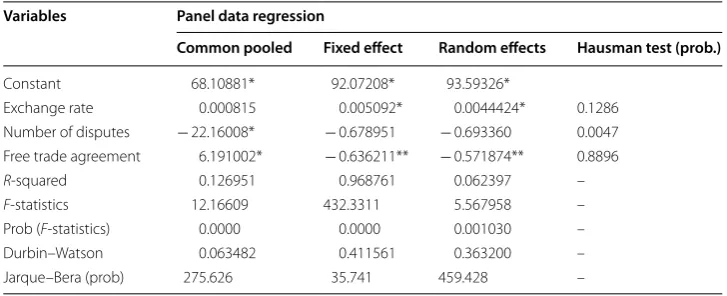
We performed panel regressions to properly account the heterogeneity of the data. Three regression models were tested to determine which of the model was applicable to use as trade policy model. The common pooled regression assumed that the regressors are non-stochastic or if stochastic are uncorrelated with the error term. It is also pre-sumed that the error term satisfies the usual classical assumptions (Gujarati 2011). The results of the common pooled regression show that the accountability (ND) and FTA are significantly related to trade growth while the predictability (ER) is not significantly related to trade growth. The fixed effect model is estimated to cross-check the hetero-geneity that may exist among the 255 observations. This model allows each country to have its individual intercept value. The term fixed effect is caused by the fact that while the intercept may differ across countries, the intercept does not vary over time that is it time invariant. This process is done by introducing differential intercept dummies. The dummies for the countries and the time are represented as D2–D15 and T16–T32, respectively. The exchange rate that represents predictability transparency exerts posi-tive result and statistical significance on trade growth at 1%, while the FTA exerts a neg-ative result and statistical significance on trade growth at 5%.
The intercept values or the dummy variables accounted the differences in the exchange rate, number of disputes, free trade agreement, and growth in trade of each selected country. To account for the lack of representation and knowledge on the dummy vari-ables, random effect model suggested the expression of the said ignorance through the disturbance term, subject to a stochastic random error component. The individual dif-ferences of each country are being reflected in the error term. The results of the random effect model show that the predictability (ER) and free trade agreement are statistically significance on trade growth at 1 and 5%, respectively.
The performed econometric estimation of the relationship between trade policy meas-ures and trade growth is based on the model presented in Table 2 that supports a greater extent to infer the effects of transparency practices and FTA on trade growth in inter-national trade. The econometric estimation is essential to manage for the number of parameters that affect the variables advantages, and its intention is to examine whether trade growth is influenced by the changes in indicators such as exchange rate, number of disputes, and number of FTA signed and in effect considering determinants of trade have been appropriately directed.
Table 2 presents the panel data regression analysis. The results show that predict-ability and accountpredict-ability have a significant relationship with trade growth. Using OLS
Table 1 Summary of panel unit root test using the Im, Pesaran, and Shin
Variables At level Probability At 1st difference Probability
Trade growth (merchandise trade) − 1.29880 0.0970 − 5.19925 0.0000
Exchange rate − 3.19170 0.0007 − 2.92431 0.0017
Number of disputes − 0.20253 0.5803 − 4.41812 0.0000
estimation, results show that, first, predictability measured in exchange rate has a signifi-cant positive impact on trade growth, as the increase change by 1% it tends to increase in trade growth by 0.005%. Second, accountability transparency practices measured in the number of disputes have a negative impact on trade growth. The increase in the number of disputes tends to lower trade growth by 0.679%. Third, FTA measured in number of FTAs signed and in effect showed a negative effect on trade growth. Considering collec-tively the ASEAN + 5 countries, an increase in FTA by 1% tends to increase by 6.19% in
trade growth. However, in measuring FTA by individual country to trade growth result shows a negative effect. Some countries with less utilization of FTA have a negative impact to trade growth. Furthermore, results show that the impact of transparency prac-tices and FTA on trade growth in the selected countries of the Asia-Pacific region was heterogeneous. Thus, in forecasting trade, transparency practices as trade policy meas-ures are factors that must be considered. Policies directed toward exchange rate must be reviewed and carefully formulated. Finally, as this paper reveals, countries must be more open to free trade agreements utilization as its effects to growth in trade is considerable.
The Jarque–Bera result shows the coefficient of 35.741, thus showing normally distrib-uted residuals. This result exhibits that the model is statistically significant and valid for trade policy formulation. Also, restricted test of the two models had been performed to test which model is best suited for policy formulation.
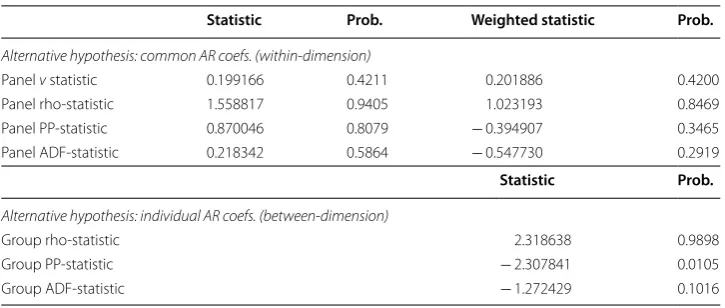
The Pedroni procedure was applied to validate the long-term equilibrium relationship among panel data variables. The result shows in Table 3 that the group PP-statistics was statistically significant at 5% level. The result suggests that this could not be a sufficient measure for long-term equilibrium. The result could have been evidenced by individual cointegration test performed.
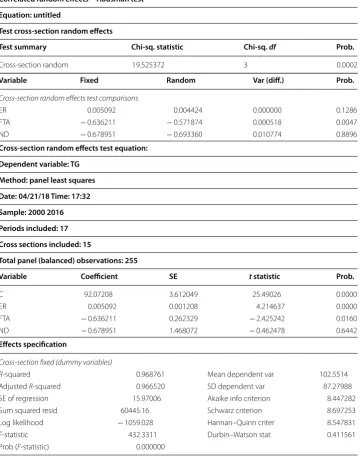
Finally, Hausman test (Table 4) was used to determine the appropriate model to use for policy formulation. The null hypothesis of the Hausman test is that FEM and REM do not differ substantially. The Hausman test indicates that the null hypothesis that REM is the fitted model is rejected; therefore, FEM is the fitted model.
The study had determined that predictability, accountability transparency practices and FTA were significantly affecting trade growth. The findings showed that, first, the
Table 2 Panel data regression
**Significant at 5%; *significant at 1%
Variables Panel data regression
Common pooled Fixed effect Random effects Hausman test (prob.)
Constant 68.10881* 92.07208* 93.59326*
Exchange rate 0.000815 0.005092* 0.0044424* 0.1286
Number of disputes − 22.16008* − 0.678951 − 0.693360 0.0047 Free trade agreement 6.191002* − 0.636211** − 0.571874** 0.8896 R-squared 0.126951 0.968761 0.062397 – F-statistics 12.16609 432.3311 5.567958 –
Prob (F-statistics) 0.0000 0.0000 0.001030 –
Durbin–Watson 0.063482 0.411561 0.363200 –
predictability aspect of transparency practices is a significant parameter to increase trade growth. Our result shows that trade growth increases by a percent changed in predict-ability; hence, this aspect of transparency reduces unpredictability on different factors affecting trade activity. In addition, the relation between predictability and trade growth is driven by validated causality, in which predictability helps raise trade growth, thus reduces unpredictability. In fact, several scholars attest that predictability, as one aspect of transparency practices, exhibits as an essential factor for international trade flows (Helble et al. 2009; Lejárraga and Shepherd 2013). Meanwhile, various studies conducted exchange rate unpredictability and its effects find that unpredictability reduces trade (see Broda and Romalis 2003). Šimáková (2014) states that the effect of change in exchange rate reveals that higher exchange rate unpredictability steers to higher trade cost, and it subsequently will decrease international trade. Further, Hooper and Kohlhagen (1987) attest that in the event of movements in exchange rates are volatile it signifies unpredict-ability regarding a firm’s operations and decreases the advantages of international trade. Nicita (2013) mentions that according to UNCTAD 2013, the exchange rate represents a vital function in the nation’s trade flows; the comparative evaluations of currencies and their unpredictability frequently have essential effect on global trade and the whole eco-nomic standing and accomplishment (Nicita 2013). The increase predictability transpar-ency of trade policy is an essential contribution of trade agreement that have long been accepted by policy-makers (Osnago et al. 2015). Second aspect of transparency practices is the accountability that we found to have an important influence on trade growth. This aspect of transparency practices constricts countries from implementing protection-ist trade policy rules and reduces the number of disputes among trade partners. The increase number of disputes brought against by trading partners or of WTO members indicates weak practice of transparent accountability, on the enforcement against vio-lators and non-compliance of its commitment on trade terms under WTO obligations (see Dong and Jayakar 2013). The transparent accountability practice of government’s implementation of trade policy measures and compliance of international treaties under the WTO context is an important aspect to avoid escalation of disputes on trade policy measures among trading partners. Lastly, the FTA policy measures exhibits significant effect on trade growth. The increase utilization of FTA supports the countries aspiration to expand its trading activities by diminishing tariff barriers, open new foreign entrance
Table 3 Pedroni cointegration residual test
Statistic Prob. Weighted statistic Prob.
Alternative hypothesis: common AR coefs. (within-dimension)
Panel v statistic 0.199166 0.4211 0.201886 0.4200
Panel rho-statistic 1.558817 0.9405 1.023193 0.8469
Panel PP-statistic 0.870046 0.8079 − 0.394907 0.3465
Panel ADF-statistic 0.218342 0.5864 − 0.547730 0.2919
Statistic Prob.
Alternative hypothesis: individual AR coefs. (between-dimension)
Group rho-statistic 2.318638 0.9898
Group PP-statistic − 2.307841 0.0105
for trade, and strengthen trade and economic collaboration. As Baldwin (1993) mentions that the rapidly increasing FTAs will eventually contribute to trade liberalization and by conforming to FTA rules will drive traders to pressure regimes to coordinate the rules existing in FTAs. Thus, the rising proliferation of FTAs and its utilization can be a wel-fare enhancing for trade system.
Moreover, study found that there is a significant relationship between trade growth and predictability transparency and FTA. The exchange rate that represents predicta-bility transparency exerts positive result and statistical significant relationship to trade growth at 1% level and the number of FTAs signed and in effect exerts negative result and statistical significant relationship to trade growth at 5% level. While findings show
Table 4 Hausman test
Correlated random effects—Hausman test
Equation: untitled
Test cross-section random effects
Test summary Chi-sq. statistic Chi-sq. df Prob.
Cross-section random 19.525372 3 0.0002
Variable Fixed Random Var (diff.) Prob.
Cross-section random effects test comparisons
ER 0.005092 0.004424 0.000000 0.1286
FTA − 0.636211 − 0.571874 0.000518 0.0047
ND − 0.678951 − 0.693360 0.010774 0.8896
Cross-section random effects test equation:
Dependent variable: TG
Method: panel least squares
Date: 04/21/18 Time: 17:32
Sample: 2000 2016
Periods included: 17
Cross sections included: 15
Total panel (balanced) observations: 255
Variable Coefficient SE t statistic Prob.
C 92.07208 3.612049 25.49026 0.0000
ER 0.005092 0.001208 4.214637 0.0000
FTA − 0.636211 0.262329 − 2.425242 0.0160
ND − 0.678951 1.468072 − 0.462478 0.6442
Effects specification
Cross-section fixed (dummy variables)
R-squared 0.968761 Mean dependent var 102.5514
Adjusted R-squared 0.966520 SD dependent var 87.27988
SE of regression 15.97006 Akaike info criterion 8.447282
Sum squared resid 60445.16 Schwarz criterion 8.697253
Log likelihood − 1059.028 Hannan–Quinn criter 8.547831
F-statistic 432.3311 Durbin–Watson stat 0.411561
no significant relationships between trade growth and accountability transparency measures, hence, the study fails to reject the null hypothesis that there is no significant relationship between trade growth and accountability. Table 5 shows the statistic test that the p value of 0.6442 exceeds 5% significance level regarding accountability meas-ured in number of disputes. This result is noticeable as it shows that not much of the selected countries in the Asia-Pacific region have number of disputes recorded within the period covered in this paper—in this case only 7 countries out of 15 countries have dispute issues as respondents which may have a contributing factor on the result. With regard to this effect, countries with less transparent practices and fewer utilization of FTA measure may find it hard to pursue growth in trade.
The findings show significant results that guarantee a country’s preference of trade measures and reforms strategies to reduce opacity and increase bilateral consensus in trade policy in the conditions of withstanding international trade. In effect, these can collectively have significant positive results on continuous trade growth. Though the study is limited to aspects of transparency, namely Predictability and Accountability, and Free Trade Agreement that emerge from Trade Policy, findings show that their influ-ence on trade flows has a substantial importance to increase growth and advance the economic development of the countries in the region. Nevertheless, there appears to be a further scope of Trade Policy for the country to increase trade growth by considering other aspects and predictors such as trade openness, FDI, terms of trade, and any other factors affecting trade.
In the recent decade, Asia economies have considerably liberalized foreign trade authorities with the substructure of the WTO. The economic growth fueled by the growing in size of trade and investment in the region despite the various results of the performance of nations become visible in recent years. These comprise the results of global financial crisis in 2008–2009, the risk of protectionism, the tenacity of remain-ing behind-the-border regulatory barriers, the failure to conclude WTO multilateral trade negotiations, and corresponding exclusion of small- and medium-sized enterprises (Kawai and Wignaraja 2014). These global issues prompted Asia economies to embark on various inventiveness, economic collaborations and integration in the sphere of trade and investment, innovation, and became interdependent among each other. An essential element of the regions’ policy reaction must do with an advance trade policy focused on FTA to underpin the enabling of Asia-Pacific region and transparency which is believed to furnish good governance (de Graaf and van der Wal 2010). The extant literature shows that efforts to investigate the impact of trade agreements and economic cooperation on trade growth are exerted. Among them is the evaluation of the level of economic
Table 5 Fixed effect
Variable Coefficient SE t statistic Prob.
C 92.07208 3.612049 25.49026 0.0000
ER 0.005092 0.001208 4.214637 0.0000
FTA − 0.636211 0.262329 − 2.425242 0.0160
integration, the transfer of trade and commodities, resources and people between trade partner nations (Kawai and Wignaraja 2014).
6 Conclusions
The study finds that the two transparency aspects and free trade agreement policies are widely commencing to generate good results, i.e., increasing trade growth. The results uncover the deepening importance of transparency practices and free trade consensus utilization in the international trade and economic development. The magnifying useful-ness of these trade policies should not be ignored. They are regarded a beneficial trade policy tools not just in advancing competition and improving transparency, but also in robust transparent practices of predictability and accountability and productive utiliza-tion of free trade agreements in making internautiliza-tional trading process to share trade with other countries.
The evidence shows that higher predictability and accountability transparency prac-tices in trade policy measures and increased in free trade consensus have an impact on trade growth upshot. The thorough practices of these two aspects of transparency and the increasing number of FTAs are significant factors to combat the difficult challenges of opacity and a determinant to intensify market-driven economic integration, respec-tively. These trade policies will help to achieve the sustainability of increase growth in trade. In the lack of transparency practices in aspiring policy change, international trade unpredictability and imbalances will emerge that could weaken growth, and this is highly detrimental to countries in the Asia-Pacific region’s trade activity. However, trade policy change that adheres deeply to transparency practices raises long-term favorable impact to trade growth and economic performance of the countries in the region. It reduces the risks of bigger disorders to the trading system and increases sustainability to the region’s trade flows and boosts trade growth.
The increase in trade activity is fostered by the key elements. Those are predictability and accountability transparency practices, and the number of FTAs signed and in effect. The role of international trade organizations, regimes, and policy-makers in this matter is essential as trade policy is vital to channel for the international trade market for mod-ern govmod-ernance. It has been revealed in this empirical work that predictability aspect of transparency and the increase in free trade agreement have a significant contribu-tion to trade growth. The result appears to imply that transparency practices and FTA policy will not steer to significant and crucial trade flows reductions, and rather they will push forward the Asia-Pacific region as the leading trade giant to continue to thrive in the world—succeeding both trade growth and economic performance. The empirical model suggests that transparency is a contributing factor for growth as well as free trade agreement in the selected countries of the Asia-Pacific region. Therefore, for a country to increase growth in trade, the policy must be directed toward increasing transparency practices and induce free trade agreement in their trading activity.
in trade where correspondingly increase in trade growth is a feature of increase in trans-parency and FTA collectively while decrease in trade growth is a feature of decrease in transparency measure specifically the accountability and lesser utilization of FTA.
Nevertheless, the econometric findings may not be enough to guarantee the region’s trade policy measures to increase growth in trade particularly in the context of account-ability transparency as the result shows that accountaccount-ability has no significant relation-ship to trade growth. It will be considerably worthwhile for future research to investigate the same trade policy issue and to consider other indicators on accountability measures that may represent a significant relationship to trade growth. The study also suggests the need for further thorough research to derive conclusions about the impact and relation-ship between transparency aspects and FTA policy and trade growth.
Authors’ contributions
RP is involved in conception and design of the study, acquisition of data, performed analysis and interpretation of data, wrote draft manuscript and revised it critically for important intellectual content. MCC supervised development of work and manuscript evaluation. CM helped to evaluation and revision of the manuscript. All authors read and approved the final manuscript.
Acknowledgements
The authors gratefully appreciate Jenny Beb Ebo for the technical help on this paper. We highly acknowledged Exequiel Cabanda for the comments and suggestions on the previous drafts of this paper. We are also very grateful for the com-ments and suggestions of the editor and anonymous reviewer.
Competing interests
The authors declare that they have no competing interest.
Availability of data and materials
The datasets and appendices supporting the conclusions of this paper are presented in the additional supporting files.
Consent for publication Not applicable.
Ethics approval and consent to participate Not applicable.
Funding Not applicable.
Publisher’s Note
Springer Nature remains neutral with regard to jurisdictional claims in published maps and institutional affiliations.
Received: 3 May 2018 Accepted: 8 May 2018
References
Anderson JE, Yotov YV (2016) Terms of trade and global efficiency effects of free trade agreements, 1990–2002. J Int Econ 99:279–298
Baccini L (2014) Cheap talk: transaction costs, quality of institutions, and trade agreements. Eur J Int Relat 1:80–117 Badinge RH (2008) Trade policy and productivity. Eur Econ Rev 52(5):867–891
Baier SL, Bergstrand JH (2007) Do free trade agreements actually increase members’ international trade?. J Int Econ 71(1):72–95
Baldwin R (1993) A domino theory of regionalism (No. w4465). National Bureau of Economic Research, Cambridge, MA Bown CP, Reynolds KM (2015) Trade flows and trade disputes. Rev Int Organ 10(2):145–177
Broda C, Romalis J (2003) Identifying the effect of exchange rate volatility on trade (Unpublished manuscript). Chicago: GSB
Clark P, Tamirisa N, Wei SJ, Sadikov A, Zeng L (2004) Exchange rate volatility and trade flows-some new evidence. IMF Occasional Paper. 235
Collins-Williams T, Wolfe R (2010) Transparency as a trade policy tool: the WTO’s cloudy windows. World Trade Rev 9(04):551–581
Cooper DR, Schindler PS (2001) Business research method. McGraw-Hill, Singapore
Dell’Ariccia G (1999) Exchange rate fluctuations and trade flows: evidence from the European Union. IMF Econ Rev 46(3):315–334
Florini A, Birdsall N, Flynn S, Haufler V, Lipton D, Morrow D, Sharma S (2000) Does the invisible hand need a transparent glove? The politics of transparency. In: World Banks annual conference on development economics, pp 163–184 Free Trade Agreements., from https ://aric.adb.org/fta-count ry. Retrieved 4 April 2018
Frieden JA (2002) Real sources of European currency policy: sectoral interests and European monetary integration. Int Org 56(04):831–860
From IMF—International Monetary Fund Home Page. http://www.imf.org/exter nal. Retrieved 23 July 2015 Fukunaga Y (2015) ASEAN’s leadership in the regional comprehensive economic partnership. Asia Pac Policy Stud
2(1):103–115
Ghosh S, Yamarik S (2004) Are regional trading arrangements trade creating? An application of extreme bounds analysis. J Int Econ 63(2):369–395
Grimmelikhuijsen S, Meijer A (2012) The effects of transparency on the perceived trustworthiness of a government organization: evidence from an online experiment. J Public Adm Res Theory. https ://doi.org/10.1093/jopar t/mus04 8 Gujarati DN, Porter DC (2011) Econometria Básica-5. AMGH Editora, São Paulo
Handley K (2014) Exporting under trade policy uncertainty: theory and evidence. J Int Econ 94(1):50–66
Helble M, Shepherd B, Wilson J (2009) Transparency and regional integration in the Asia Pacific. World Econ 32:479–508 Hooper P, Kohlhagen SW (1987) The effect of exchange rate uncertainty on the prices and volume of international trade.
J Int Econ 8(4):483–511
http://www.asean .org/resou rces/2012-02-10-08-47-55/asean -stati stics , http://www.asean .org/resou rces/2012-02-10-08-47-55/asean -stati stics . Retrieved 23 July 2015
http://www.wto.org/engli sh/trato p_e/serv_e/gats_factfi ctio n12_e.htm. www.wto.org/engli sh/trato p_e/serv_e/gats_ factfi ctio n12_e.htm. Retrieved 27 July 2015
https ://data.world bank.org/indic ator/NE.TRD.GNFS.ZS. Retrieved 4 April 2018
https ://aric.adb.org/macro indic ators ?categ ory=6&sel_count ry=13&frequ ency=5. Retrieved 4 April 2018 https ://www.wto.org/engli sh/trato p_e/dispu _e/dispu _by_count ry_e.htm. Retrieved 4 April 2018
Kawai M, Wignaraja G (2010) Free trade agreements in East Asia: a way toward trade liberalization? ADB Briefs. No.1, p 1–8 Kawai M, Wignaraja G (2014) Trade policy and growth in Asia. Asian Development Bank Institute (ADBI), Tokyo, No. 495, p
1–26.
Kim SY (2015) Regionalisation in search of regionalism: production networks and deep integration commitments in Asia’s PTAs. In: Trade cooperation: the purpose, design and effects of preferential trade agreements, pp 134–164 Lejárraga I, Shepherd B (2013) Quantitative evidence on transparency in regional trade agreements. OECD Trade Policy
Papers, No. 153. OECD Publishing, Paris
Lindstedt C, Naurin D (2010) Transparency is not enough: making transparency effective in reducing corruption. Int Polit Sci Rev 31(3):301–322
Mansfield ED, Reinhardt E (2008) International institutions and the volatility of international trade. Int Org 62(04):621–652 Nasreen S, Anwar S (2014) Causal relationship between trade openness, economic growth and energy consumption: a
panel data analysis of Asian countries. Energy Policy 69:82–91
Nicita A (2013) Exchange rates, international trade and trade policies. Int Econ 135:47–61
Ocampo JA (2015) A post-2015 monitoring and accountability framework. Department of Economic & Social Affairs, New York
Osnago A, Piermartini R, Rocha N (2015) Trade policy uncertainty as barrier to trade. WTO Staff Working Paper Plummer MG, Tafti A (2014) Transparency in International Trade Policy. In: The Oxford handbook of economic and
institu-tional transparency, p 166
Šimáková J (2014) Extended gravity model of international trade: an empirical application to Czech trade flows. In: Proceedings of the 14th international conference on finance and banking. Silesian University, School of Business Administration, Karviná, pp 416–421
Turnes PB, Ernst R (2015) A framework for transparency in international trade. Invest Eur Dir Econ Empresa 21(1):1–8 Williams A (2015) A global index of information transparency and accountability. J Comp Econ 43(3):804–824 Wolfe R, Halle M (2011) Did the protectionist dog bark? Transparency accountability, and the WTO during the global
financial crisis. Stockholm, Sweden. Policy report 01, p 1–16
WTO Glossary—transparency. www.wto.org/engli sh/thewt o_e/gloss ary_e/trans paren cy_e.htm-2k-2011-08-25-cache d. Accessed 14 July 2015