DOI 10.1007/s13173-012-0089-z
O R I G I NA L PA P E R
Parallel transitive closure algorithm
C. E. R. Alves· E. N. Cáceres · A. A. de Castro Jr. · S. W. Song · J. L. Szwarcfiter
Received: 4 December 2011 / Accepted: 24 August 2012 / Published online: 25 September 2012 © The Brazilian Computer Society 2012
Abstract Using the BSP/CGM model, withpprocessors, where p n, we present a parallel algorithm to com-pute the transitive closure of a digraph D with n vertices andm edges. Our algorithm uses logp +1 communica-tion rounds if the input is an acyclic directed graph labeled using a linear extension. For general digraphs, the algorithm requirespcommunication rounds in the worst case. In both cases, O(M/p)local computation is performed per round, where M is the amount of computation needed to compute a sequential transitive closure of a digraph. The presented algorithm can be implemented using any sequential algo-rithm that computes the transitive closure of a digraph D.
This work was partially supported by CNPq Proc. Nos. 30.1652/09-0, and CNPq, FUNDECT-MS and CAPES.
C. E. R. Alves
Universidade São Judas Tadeu, São Paulo, SP, Brazil e-mail: [email protected]
E. N. Cáceres (
B
)Universidade Federal de Mato Grosso do Sul, Campo Grande, MS, Brazil
e-mail: [email protected]
A. A. de Castro Jr.
Universidade Federal de Mato Grosso do Sul, Ponta Porã, MS, Brazil
e-mail: [email protected]
S. W. Song
Universidade de São Paulo, São Paulo, SP, Brazil
S. W. Song
Universidade Federal do ABC, Santo André, SP, Brazil e-mail: [email protected]
J. L. Szwarcfiter
Universidade Federal do Rio de Janeiro, Rio de Janeiro, RJ, Brazil e-mail: [email protected]
We have implemented the algorithm using the Warshall tran-sitive closure algorithm on two Beowulf clusters using MPI. The implementation results show its efficiency and scalabil-ity. It also compares favorably with other parallel implemen-tations. The worst case (communication rounds) for a digraph was derived through an artificially elaborated example. How-ever, in all our test cases, the algorithm never requires more than logp +1 communication rounds and presents very promising implementation results. The algorithm also can be applied to anyn×nmatrix that represents a binary relation.
Keywords Transitive closure · Parallel algorithms· Scalable algorithms·BSP/CGM algorithms
1 Introduction
There are many problens where we need to answer reacha-bility questions. That is, can one get from cityAto cityDin one or more roads? The computation of the transitive closure of a directed graph can solve the above problem and it is fundamental to the solution of several other problems, such as shortest path and ancestor relationship problems. Several variants of the transitive closure problem exist [8].
The problem of computing the transitive closure of a directed graph (digraph) was first considered in 1959 by Roy [18]. Since then, a variety of sequential algorithms to solve this problem have been proposed. The basic sequential solu-tions usually employ the adjacency matrix of the digraph, considered as a Boolean matrix. Using this approach, War-shall [23] presented anO(n3)algorithm.
computation of transitive closures can be done asymptoti-cally faster by matrix multiplication techniques
Parallel algorithms for this problem have been presented for PRAM [11,13], for arrays, trees and meshes of trees [15], for highly scalable multiprocessors [20,21], for BSP/CGM [5,7,20], and for other architectures [2,8,12,14,16,17]. The aproaches used by these algorithms include single and all pairs shortest paths [8,12], breadth first search [5], matrix multiplication and path decomposition [7]. Some of these algorithms were implemented on hypercubes [12], cluster of workstations [5,7] FPGAs [2] and GPGPUs [3,10,14].
In this paper, we present a parallel algorithm to com-pute the transitive closure of a digraph using the BSP/CGM model withpprocessors each withn2/plocal memory. One of the big issues when designing BSP/CGM algorithms is the number of communication rounds. If the input graph is an acyclic digraph with its vertices labeled with a so-called linear extension our algorithm requires logp+1 commu-nication rounds and uses O(n3/p)local computation. For general digraphs, the algorithm requiresprounds. The main idea of the algorithm is the partitioning of the digraph into p pieces and the construction of a local transitive closure for each one of these pieces. These local transitive closures can be obtained by any sequential transitive closure algo-rithm. We have implemented the algorithm using the well-known Warshall’s [23] transitive closure algorithm. Besides the fact that it uses more local computation time than other algorithms, it is very easy to deal with the communica-tion between the processors in this algorithm. Without the linear extension labeling, we can no longer guarantee the bound of logp+1 communication rounds and usesp com-munication rounds in the worst case. Nevertheless, in our experiments, all the test graphs required less than logp+1 communication rounds. We also present a particularly elabo-rated example where the algorithm uses more thanO(logp) communication rounds to solve the transitive closure prob-lem. The algorithm was tested with two Beowulfs parallel computers, each with 64 nodes, using the MPI library. The obtained speedups indicate efficiency and scalability of the algorithm. The execution times of our algorithm are better than other parallel implementations such as [3,14,16,17]. Preliminary versions of the results (for acyclic graphs and general digraphs) presented in this paper have appeared in [4] and [1].
2 Notation, terminology and computational model
LetD = (V,A)be a digraph, with vertex set V and edge setA,|V| =n and|A| =m. LetS ⊆ V. Denote byD(S) the digraph formed exactly by the (directed) edges of D, having at least one of its end points inS. IfQis a path inD denote its length by|Q|. If Dis acyclic, alinear extension
L of Dis a sequence{v1, . . . , vn}of its vertices, such that
(vi, vj)∈ A⇒i< j.
The transitive closureof D is the digraph Dt, obtained fromDby adding an edge(vi, vj), if there is a path fromvi
tovjinD, for allvi, vj ∈V.
In this paper, we use the BSP/CGM (Bulk Synchronous Parallel/Coarse Grained Multicomputer) Model [6,22]. Let N be the input size of the problem. A BSP/CGM computer consists of a set of p processors P1, . . . ,PpwithO(N/p)
local memory per processor and each processor is connected by a router that can send/receive messages in a point-to-point fashion. A BSP/CGM algorithm consists of alternating local computation and global communication rounds separated by a barrier synchronization. The termcoarse grainedmeans the size of the local memory is much larger thanO(1). Dehne et al. [6] define “much larger”’asN/p p.
In a computing round, we usually use the best sequen-tial algorithm in each processor to process its data locally. We require that all information sent from a given processor to another processor in one communication round be packed into one long message, thereby minimizing the message over-head. Each processorpisends/receives at mostO(N/p)data
in each communication round. In the BSP/CGM model, the communication cost is modeled by the number of communi-cation rounds, which we wish to minimize.
3 The parallel algorithm for transitive closure
Algorithm 1 below is a parallel algorithm [4] for constructing the transitive closure of D, with n vertices and m edges, using pprocessors, where 1 ≤ p ≤n. It uses a sequential algorithm to compute the transitive closure in each processor. The following proposition asserts the correctness of the algorithm.
Theorem 1 If the input digraph D is acyclic and labeled with a linear extension L of D, Algorithm 1 computes the transitive closure of D. Moreover, it requires at most 1+
logp iterations of Step 2.
Proof Denote by Di the digraph D at the end of thei-th
subgraph of Di, it follows that all edges of the transitive
closureDit(Sj)ofDi(Sj)also belong toDit, and hence toD0t.
Consequently, in order to show that the algorithm correctly computes the transitive closureDt0ofD0, it suffices to show that every edge ofD0t is also an edge of someDit(Sj).
With this purpose, let (v, w) ∈ A(Dt0). We show that
(v, w) ∈ A(Dti(Sj)), for some i,j. Because (v, w) is an
edge ofD0t,D0contains a pathz1, . . . ,z, fromv = z1to w=z. For eachk, 1≤k≤, denote byP(zk)the
proces-sor to whichzk is assigned. Because the assignment of the
vertices to the processors obeys a linear extension order-ing, it follows that P(z1), . . . ,P(z) is a non-decreasing sequence. Therefore, vertices assigned to a same processor are consecutive in the sequence. Consequently, after com-pleting the first iteration of Step 2, we know thatD1contains av−wpathQ1, formed solely by (a subset of) vertices of z1, . . . ,z, assigned to distinct processors. Hence|Q1| ≤ p. If|Q1| =1 then(v, w)∈ A(Dt1(sj)), implying the
correct-ness of the algorithm. Otherwise, letzk−1,zk,zk+1be three consecutive vertices in Q. Let P(zk) = j. Consequently,
(zk−1,zk), (zk,zk+1) ∈ A(D1(Sj)). The latter means that
at the end of the second iteration of Step 2,(zk−1,zk+1)∈ A(D2). Consequently,D2contains av−wpathQ2, formed by a subset of vertices of Q1satisfying|Q2| = |Q1|/2 . By induction, it follows that |Qlog|Q1|+1| = 1, that is,
(v, w) ∈ A(Dtlog|Q1|+1 (Sj)), as required. Moreover, no
more than 1+ logp iterations of Step 2 are needed. We now analyze the complexity of the algorithm. Basi-cally, the algorithm consists of at most 1+ logp parallel computations of a sequential transitive closure algorithm. We employ a sequential algorithm whose complexity is the prod-uct of the number of vertices and edges of the digraph [9,19]. Consider a worst case example, whereDconsists of a single path. ThenDtis a complete acyclic digraph. In this case, each processor j may compute the transitive closureDt(Sj)of a
digraphD(Sj), where|V(D(Sj))| =nand|A(Dt(Sj))| =
(n/p)(n −n/p) = O(n2/p). Since at most 1+ logp iterations are required, the overall complexity isO(n3logp p).
Finally, observe that each processor handles at most O(n2/p)directed edges. Therefore, the algorithm fits into the BSP/CGM model.
If the vertices of the digraphDare not labeled with a lin-ear extension, the bound of logp+1 communication rounds, however, is no longer valid. In fact, there exist cases where more than logp +1 communication rounds are required. For instance, consider p = 4 and a graph that is the fol-lowing linear list ofn =16 vertices (each labeled with two digits): 11 → 31 → 41 → 21 → 32 → 12 → 42 → 33→ 22→ 43 →13 → 23→ 34→ 14 → 24→ 44. Assume that each vertex labeled with digitsi j is stored in processor i. It can be shown that Algorithm 3 will need more than log 4+1=3 communication rounds. The above is
an elaborated example. In practice, however, this algorithm behaves efficiently, as shown in our experiments.
Corollary 1 For a general digraph, Algorithm 1 computes correctly the transitive closure of the input digraph. More-over, it requires at most O(p)communication rounds.
4 An implementation of the transitive closure BSP/CGM algorithm
Consider a digraph D = (V,E) where |V(D)| = n and|E(D)| =m. Let us apply Warshall’s algorithm to this digraph. Let the vertices be 1,2, . . . ,n. The input to the algo-rithm is ann×nBoolean adjacency matrixMofD, that is, the entryMi,jis 1 if there is a directed edge from vertexito
vertex j and 0 otherwise. Warshall’s algorithm consists of a simple nested loop that transforms the input matrix M into the output matrix. The main idea is that if entries Mi,k and
Mk,jare both 1, then we should setMi,jto 1. This following
describes this method. The complexity isO(n3), as already mentioned.
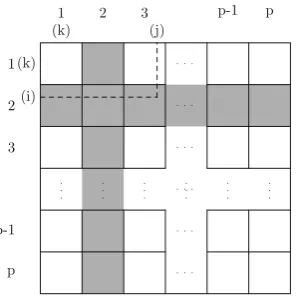
Fig. 1 MatrixMpartitioned intop horizontalandp vertical stripes
partition and store the rows and columns of the adjacency matrixMin thepprocessors as follows. Divide the adjacency matrixMintophorizontal andpvertical stripes. Assume for simplicity thatn/pis an integer, that is,ndivides pexactly. Each horizontal stripe has thusn/prows. Likewise each ver-tical stripe hasn/pcolumns. This is shown in Fig.1. Consider processors numbered as 1,2, . . . ,p. Then processorqstores the horizontal stripeq and the vertical stripeq. Notice that each adjacency matrix entry is thus stored in two processors. Observe the following property of the way the matrixM is stored in the processors. BothM[i,k]andM[k,j]for any kare always stored in a same processor (see Fig. 1). This makes the test indicated at line 5 of the algorithm very easy to perform. If bothM[i,k]andM[k,j]are equal to 1 then M[i,j]must also be made equal to 1. In this case, the update of M[i,j]may be done immediately if it is also stored in processorq. Otherwise, the update will be done in the next communication round.
5 Experimental results of Algorithm 3
We implemented Algorithm 3 on two Beowulf clusters clus-ter of 64 nodes. The first one (B1) consisting of low cost microcomputers with 256MB RAM, 256MB swap memory, CPU Intel Pentium III 448.956 MHz, 512KB cache. The nodes are connected through a 100 Mb fast-Ethernet switch. The second one (B2) consisting of 256 processors (64 nodes with 4×2.2 GHz Opteron Cores) with 8 GB RAM per node. All nodes are interconnected via a Foundry SuperX switch using Gigabit ethernet. Our code is written in standard ANSI C using the MPI library.
The test inputs consist of randomly generated digraphs where there is a 20% probability of having an edge between two vertices. We tested graphs withn =480, 512, 960, 1,024, 1,920, 2,048, 4,096 and 6,144 vertices. In all the tests the number of communication rounds required were less than logp.
(a)
(b)
Fig. 2 Execution times for various input sizes—B1
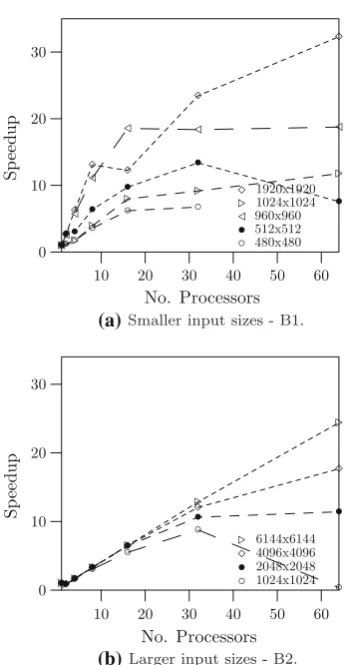
The times obtained for different problem sizes are shown in Figs.2and3, while the corresponding speedups are shown in Fig.4. Notice the speedup curve (B1) for the input size of 1,920×1,920. It presents two ascending parts with different slopes. The first ascending part of the speedup can be seen to be superlinear. This is due to the memory swap overhead which is more severe for the sequential case (p=1) which has to store the entiren×ninput matrix. On the other hand, the parallel cases deal with input matrices of smaller size n/p×n/p.
Using only one processor of Bewoulf B1 and the input size of 1,920×1,920 our implementation takes 1,614.60 s to compute the transitive closure, while Bewoulf B2 takes 70.95 s for the input size 2,048×2,048. As Fig.4shows, in both Bewoulfs the algorithm is scalable.
For comparison purposes, we have used the Bewoulf B1 since it uses a configuration that is similar to the other implementations [16,17]. Our implementation (Bewoulf B1) also considers input matrices that include the same input sizes used in [16,17], namely, 480×480, 960×960, and 1,920×1,920.
(a)
(b)
Fig. 3 Execution times for various input sizes—B2
were connected through a 10 MB Ethernet switch, and they used the PVM library (version 3.4.6.). They present tables and charts where the algoritms were executed with 36 work-processes (more than one process in each node).
Our implementation results using Beowulf B1 achie-ved better execution times. In particular we observe the 1,920×1,920 case where our implementation obtains very substantial speedups. We observe that in our tests we have used the MPI library with just one process in each node and our nodes were connected with a faster network.
We also considered matrices with equivalent sizes as those used in [3,14] (Beowulf B2). Our implementation results are competitive.
6 Conclusion
We have described a parallel algorithm for computing the transitive closure of a digraph, using p processors. Algo-rithm 1 is suitable for the BSP/CGM model. It employs at most 1+ logp iterations of a sequential transitive closure algorithm if the vertices of the digraph are labeled using a linear extension. For general digraphs, the algorithm requires pcommunication rounds in the worst case.
(a)
(b)
Fig. 4 Speedups for various input sizes
Using the algorithm of Warshall to compute the local tran-sitive closures we implemented the algorithm with MPI on Bewoulfs. It can also be viewed as a parallelized version of Warshall’s algorithm. In fact, any other sequential transitive closure algorithm could be applied.
Although in theory for general digraphs the algorithm no longer guarantees theO(logp)bound on the number of com-munication rounds, all the graphs we tested used at most logp+1 communication rounds. The implementation results are very promising and show the efficiency and scalability of the proposed modified algorithm, and compare favorably with other parallel implementations.
References
1. Alves C, Cáceres E Jr, de Castro A, Song S, Szwarcfiter J (2003) Efficient parallel implementation of transitive closure of digraphs. In: Proceedings of the EuroPVM/MPI 2003. Lecture Notes in Com-puter Science, vol 2840. Springer, Berlin, pp 126–133
3. Buluç A, Gilbert JR, Budak C (2010) Solving path problems on the GPU. Parallel Comput 36(5–6):241–253
4. Cáceres EN, Song SW, Szwarcfiter JL (2002) A parallel algorithm for transitive closure. In: Proceedings of the 14th IASTED inter-national conference on parallel and distributed computing and sys-tems, Cambridge, USA, pp 114–116
5. Cáceres EN, Vieira CCA (2007) Bsp/cgm algorithms for the transi-tive closure problem. In: Proceedings of the 2007 high performance computing and simulation conference (HPCS 2007), Prague, Czech Republic, pp 718–723
6. Dehne F (1999) Coarse grained parallel algorithms. Algorithmica 24:173–426
7. Gibbons A, Pagourtzis A, Potapov I, Rytter W (2003) Coarse-grained parallel transitive closure algorithm: path decomposition technique. Comput J 46(4):391–400
8. Grama A, Kumar V, Gupta A, Karypis G (2003) An introduction to parallel computing: design and analisys of algorithms, 2nd edn. Addison-Wesley, Boston
9. Habib M, Morvan M, Rampon JX (1993) On the calculation of transitive reduction–closure of orders. Discrete Math 111:289–303 10. Harish P, Narayanan P (2007) Accelerating large graph algorithms on the gpu using cuda. In: High performance computing 2007. Lecture Notes in Computer Science, vol 4873. Springer, Berlin, pp 197–208
11. JáJá J (1992) Introduction to parallel algorithms. Addison-Wesley, Boston
12. Jenq J, Sahni S (1987) All pairs shortest paths on a hypercube mul-tiprocessor. In: Proceedings of the 1987 IEEE international confer-ence on parallel processing, pp 713–716
13. Karp RM, Ramachandran V (1990) Handbook of theoretical com-puter science, vol. A, chap. 17. MIT Press/Elsevier, Cambridge, pp 869–941
14. Katz GJ Jr, Kider JT (2008) All-pairs shortest-paths for large graphs on the gpu. In: Proceedings of the 23rd ACM SIG-GRAPH/EUROGRAPHICS symposium on graphics hardware. ACM, New York, pp 47–55
15. Leighton F (1992) Introduction to parallel algorithms and archi-tectures: arrays–trees–hypercubes. Morgan Kaufmann Publishers, Burlington
16. Pagourtzis A, Potapov I, Rytter W (2001) Observations on parallel computation of transitive and max-closure problems. In: Cotro-nis Y, Dongarra J (eds) Proceedings Euro PVM/MPI 2001. Lec-ture Notes in Computer Science, vol 2131. Springer, Berlin, pp. 249–256
17. Pagourtzis A, Potapov I, Rytter W (2002) Pvm computation of the transitive closure: the dependency graph approach. In: Kran-zlmuller D et al (ed) Proceedings Euro PVM/MPI 2002. Lecture Notes in Computer Science, vol 2474. Springer, Berlin, pp 217–225 18. Roy B (1959) Transitivité et connexité. C R Acad Sci Paris
249:216–218
19. Simon K (1988) An improved algorithm for transitive closure on acyclic digraphs. Theor Comput Sci 58:325–346
20. Tiskin A (2001) All-pairs shortest paths computation in the bsp model. In: Proceedings of the ICALP. Lectures Notes in Computer Science, vol 2076. Springer, Berlin, pp 178–189
21. Toptsis A (1991) Parallel transitive closure for multiprocessor. In: Proceedings of the international conference on computing and information. Lecture Notes in Computer Science, vol 497. Springer, Berlin, pp 197–206
22. Valiant LG (1990) A bridging model for parallel computation. Commun ACM 33:103–111