O R I G I N A L A R T I C L E
Open Access
Wage subsidies in developing countries as a
tool to build human capital: design and
implementation issues
Rita Almeida
1*, Larry Orr
3and David Robalino
2**Correspondence: [email protected]; [email protected] 1LCSHE, The World Bank, 1818 H St NW, Washington, DC 20433, USA 2HDNSP, The World Bank, 1818 H St NW, Washington, DC 20433, USA Full list of author information is available at the end of the article
Abstract
This paper reviews international experiences with the implementation of wage subsidies and develops a policy framework to guide their design in developing countries. The evidence suggests that, if the goal is only to create jobs, wage subsidies are unlikely to be an effective instrument. Wage subsidies, however, could have a role in helping first-time job seekers or those who have gone through long-periods of unemployment or inactivity, to gain some work experience and in the process build skills and improve their employability. If these ?learning? effects are large enough, the social benefits of wage subsidies could outweigh their cost. When wage subsidies are designed with these objectives in mind, there are important implications in terms of eligibility and targeting, how the subsidy is set, its duration, and the types of conditionalities on employers and beneficiaries. Given uncertainty regarding their impact, in all cases, programs should be piloted and evaluated prior to full scale implementation.
JELs: J2, J3, J6
Keywords: Wage subsidies; Learning by doing; Skills; Unemployment
1 Introduction
Wage subsidies, payments to employers or workers that reduce the cost of labor or increase take-home pay, are increasingly being adopted or considered by developing countries as one component of their labor market policy (ILO and World Bank 2012). Wage subsidies were common during the recent financial crisis as a means to maintain employment levels (Banerji et al. 2014). In several countries they are used to promote the integration into the labor market of specific groups of workers, including youth and women (Almeida et al. 2012). When present, wage subsidies can account for over 20 percent of spending on active labor market programs, similar to OECD countries (OECD 2003).
Most of the evaluations of wage subsidy programs focus on high income countries and have shown a large variation in results. Neumark (2013) recently summarized the litera-ture concluding that, in general, targeted hiring credits have likely been ineffective (see also Bartik 2001; Dickert-Conlin and Holtz-Eakin 2000; Katz 1998)1.
The consensus seems to be that wage subsidies can increase employment levels, but also induce considerable substitution and windfall effects. The few evaluations in developing
© Almeida et al.; licensee Springer. This is an Open Access article distributed under the terms of the Creative Commons Attribution License (http://creativecommons.org/licenses/by/2.0), which permits unrestricted use, distribution, and reproduction in any medium, provided the original work is properly credited.
countries corroborate the effects on employment but do not look at substitution and windfall effects. At the same time, there is some evidence showing that by facilitating access to jobs, wage subsidies can have a long term effect on individuals? human capital and employability (see Heckman et al. 2002). The social benefits of this increase in human capital could, in principle, outweigh the cost of the subsidies.
In this paper we review international experiences with the implementation of wage sub-sidies and outline a policy framework to guide their design in developing countries. We argue that the main rationale for wage subsidies in these countries would be giving job opportunities to workers who would otherwise remain unemployed or take jobs that do not exploit their potential productivity. These are workers whoseexpectedproductivity is too low relative to the ?market? wage associated with a given vacancy. This is the wage that employers are willing to pay and the average worker who qualifies for the vacancy is willing to accept, given labor and social insurance regulations. The expected productiv-ity of some job-seekers, for instance youth, can be below this wage because of the lack of work experience or because they are not able to signal to the employer that they have the necessary skills (e.g., they do not have diplomas that certify their skills or the diplo-mas they have are not trustworthy). In the absence of wage subsidies these workers are likely to face long spells of inactivity or unemployment that reduce their human capital, or take on jobs that will not realize their potential productivity. Wage subsidies, in this case, have the potential to increase workers? employability through ?learning by doing? and by training opportunities associated with having a job. Workers could acquire both ?hard? (occupational) skills and ?soft? skills, such as motivation and appropriate work-place behavior. These dynamic effects could make a temporary subsidy have a permanent effect on workers? productivity and through this channel the structure of employment and the unemployment rate.
The paper starts by developing a simple model that captures some of these ideas and suggests some general principles in terms of design. The two sections that follow review some of the empirical evidence on the impact of wage subsidies on labor markets, and develop a typology of design and implementation options based on lessons from interna-tional experiences. We then use this typology to make some proposals about how to setup (or reform) wage subsidy programs in developing countries. The last section summarizes the main issues and conclusions.
2 Wage subsidies as an instrument to improve human capital and labor markets opportunities
We refer to wage subsidies as any transfer from the government that is able to reduce the cost of labor and/or increase take-home pay. Hence, there are many types of wages subsidies depending on who the payee is (employers or workers); how the transfer is made (social security contributions, taxes, or direct transfers); or eligibility and targeting criteria (all workers, new entrants, youth). There are, of course, also differences in the administrative arrangements used to implement wage subsidies (see Section 3). Regard-less, wage subsidies can affect the cost of labor and take home pay and therefore the supply and demand of labor.
less than the amount of the subsidy and the rest is captured by the employer. In the extreme case where the demand for labor is infinitely inelastic there are no changes in take home pay or employment, and all the subsidy is captured by employers. But if wages are rigid downward, who receives the subsidy matters. If wage subsidies are paid to work-ers labor supply will increase and labor demand might not increase enough thus creating unemployment.
An important limitation of the static model is that it implies that effects on employ-ment and wages persist only as long as the subsidy is paid. Many wage subsidies are paid only for a fixed period (often one or two years) after a worker is hired. If this is the case, time-limited wage subsidies do little to change persistently the employment rates of beneficiaries. At the same time, making the subsidy long-term or permanent can be unaffordable. In addition, there can be losses, because part of the subsidies go to work-ers who would have been hired anyways (the ?windfall? effect). And, when not all workwork-ers have access to the wage subsidy, there can be substitution effects (subsidized workers replace non-subsidized workers) that further reduce employment effects. For these rea-sons, under the optics of the static model, wage subsidies are often dismissed as an ineffective or inefficient policy tool for reducing unemployment.
However, if workers are able to learn and acquire skills from the work they do (?learn-ing by do(?learn-ing?) the balance of social costs and benefits can be different2. In this case, by contributing to build human capital, a job can have a value that goes beyond the employer and the individual (see World Bank 2013). Similarly, if the skills of unemployed individ-uals depreciate over time, long unemployment spells can reduce human capital. In this case, the main objective of wage subsidies would not be to create short-term jobs, but to increase individuals? human capital and employability and therefore their future labor market opportunities.
Wage subsidies could be considered when, in their absence, certain individuals, par-ticularly those with no or little work experience, might not be able to access jobs that can use and expand their skills3. Employers might prefer to hire experienced workers or,alternatively, offer wages that become too low relative to the prospective candidates? reservation wages. Workers therefore would remain unemployed or take on lower pro-ductivity jobs that pay more but for which they are overqualified and where they have few learning opportunities. This would not only reduce the accumulation of human capital over time but also affect employment levels and the structure of employment.
To fix these ideas we present a simple model where employers and workers make deci-sions about whether to offer/accept a job at a given wage. The model does not aim to describe equilibrium in the labor market or derive welfare implications of wage subsidies. It simply illustrates how learning on the job could justify the use of wage subsidies. In the model, workers differ in their initial level of human capitalyiand work experience, and employers in the maximum level of productivityqjof the jobs they offer. This is the pro-ductivity generated by workers who have learned the ?trade of the business?. At that time,
yi=qj. In addition, we assume that workers? human capital evolves over time according to:
yi(t)= q
j
yi i
1+it
yi (1)
they have the sameyi andi) can diverge over time depending on the jobs they have. Individuals in more productive, and supposedly more demanding, jobs learn more.
The ratioaij=qi/yican be interpreted as individuals? learning potential in a given job, or the inverse of their ?readiness? for the job. It captures the set of technical, cognitive, and non-cognitive skills that individuals possess relative to those needed by the job (see World Bank 2013). We notice that, in principle, there is always a jobjfor which the individual can operate, from the start, with maximum productivity and where, therefore, there is no learning (aij=1).
When an employer and a worker are matched, they agree on a wagewithat splits gross profits, or total output net of non-labor costs. In a dynamic setting, the present value of profits accrued by the employer is given by:
πij= L
t=1
yia
i 1+it
ij −wi−αjqj
(1+r)t (2)
where L is the planning horizon of the employer, andαjis a parameter defining the fixed costs of the job4. These fix costs are assumed to increase with the productivity of the job.
The profits equation can be simplified to:
π=yiHij−
wi+αjqj
G (3)
whereHij=H(aij,r,i,L)gives the present value of future learning for individualiin job j, andG=G(r,L)is the annuity factor used to discount wages and other costs at a rater. From the last expression it is clear that, for a given job, there is a minimum level of initial human capital and learning abilities that the employee needs to have in order to generate positive profits with positive wages. Ifyiandiare too low, even the high learning potentialaijwill not compensate. For instance, ifi = 0 andyi < αjqj there cannot be positive profits. Using wage subsidies to force contracts and create jobs in this case would not make economic sense.
But there are also cases where individuals with adequate levels of human capital and learning abilities, workers who have the right basic skills or diplomas, can be exclude from jobs of typejif they do not have work experience (or if they cannot signal that they have the right skills). This is because employers, at a given market wage, might prefer to hire workers who can start operating at maximum productivity right away. Clearly, inexperienced individuals such as youth graduating from university could compensate for their learning needs (or the need to prove themselves) by accepting a wage cut relative to the experienced worker. Unfortunately, as discussed below, these wage cuts might not be always viable.
For employers to be indifferent between hiring an inexperienced worker i and a experi-enced worker for job j, the wagewineeds to be low enough so that the following equality holds:
yiHij−
wi+αjqj
G>qjG−
wj+αjqj
G (4)
where the second part of the expression is the maximum profit that an employer can achieve by hiring a worker with a level of human capital yi = qj, who doesn?t need additional learningaij=1
The wage cut is then given by:
wj−wi
>qj−yi Hij
G (5)
It can be shown, however, that the wage cut might not be accepted if the reservation wage of the individual is affected, at least in part, by the availability of lower productivity jobs that would pay more ? even if they imply less or no learning. To see this, assume that the division of gross profitsqj
1−αj
is mediated by the parameterβj(a measure of the relative bargaining power of workers and employers) in a way thatwj=qj
1−αj
βj. This being the case, and after some simplification, the wage cut condition can be re-written as:
wi=1−αjβj+
Aij−aij aij
qj (6)
whereAij=Hij/G
The worker will take the wage cut if the jobkthat matches its productivity(qk=yi) pays a lower wage. Like in the case of a higher productivity job that wage is given by:
wik =(1−αk) βkyi
The condition for taking the higher productivity job therefore is:
1−αjβj+Aij−aij aij
yiaij> (1−αk) βkyi (7)
which can be simplified to:
1−αjβj aij +
Aij−aij
> (1−αk) βk aij
(8)
This condition holds if the parameters defining costs structures and bargaining power for the two jobs are the sameαj=αk andβj=βkand ifAij>aij. But this is not always the case. Depending on the expected level of learning and the difference between the job?s maximum productivity and the individual?s human capital,Aij can be lower thanaij. To the extreme, if no learning is possible,Aij=1, the inequality would not hold (in this case a wage subsidy would not be effective either). In addition, in a more general situation, the parameters defining costs structures and bargaining power are unlikely to be the same. For instance, it is reasonable to think that in lower productivity jobs fixed costs would be lower and in that case1−αjβj< (1−αk) βk.
In these cases, a wage subsidy could be set so that equation (8) holds. Under the assump-tion that costs structures and bargaining power are the same between jobs, the wage subsidysijwould be given by:
Sij=
aij−Aij
yij (9)
Thus the wage subsidy would be a function of the individual?s human capital and the difference between the ?learning potential? of the job minus the ?effective learning? in a given period of time. Clearly, not all jobsjwould qualify. In some cases,aij−Aijmight be too high and the subsidy too expensive, either because the maximum productivity of the job is too high relative to the individual?s human capital, or because learning abilities for the job are too low.
into account human capital might exclude jobs with high learning potential. One way to proceed would be to set the wage subsidy as a fractionsof ?negotiated? wages5.
This wage would be, presumably, close to the reservation wage of individuals and thus reflect their human capital. The fractionswould then implicitly define the set of jobsj
that are ?feasible? for a given individual, meaning jobs where the subsidy would be enough to get employers to participate, given their assessment of individuals learning potential.
s> aij−Aij
1−αjβj (10)
In summary, at any level of human capital, workers might not find jobs that suit their skills/diplomas because of the lack of work experience and/or difficulties signaling these skills (long-term unemployment can also bring observed skills below their potential6). Their reservation wages are likely to be higher than the wage offers they receive to com-pensate for their learning needs. In part, this is because lower productivity jobs could pay more. But other factors (not taken into account in our simple model) such as family sup-port or expectations about fair wages for a given set of skills can also increase reservation wages. Workers would then prefer to wait and remain unemployed seeking for better job offers, or eventually settle in lower productivity jobs where there would be less learning7. Clearly, one can argue that rational individuals would understand that they are better off over the long term by taking the higher productivity jobs and accepting the lower wages. They could, for instance, borrow to help support the period of on the job training at low pay and then repay the loan when their salaries increase. But even if individuals had the right foresight, access to credit is often not an option, particularly, among worker with no job history or who have been through long periods of unemployment.
Under these circumstance wage subsidies could be considered as an instrument to facil-itate access to jobs and promote learning and improve individuals? employability. The social benefits they generate would not be linked to the short-term jobs they create, but the human capital that would accumulate as a result of these jobs.
The implication is that countries considering the adoption of wage subsidies should clearly define the objectives and expectations. Without learning effects, wage subsi-dies are unlikely to be effective. If, on the contrary, the goal is to give individuals work experience and promote learning, their design and implementation should be adapted accordingly. Our analysis suggests three important elements that need to be considered: a) targeting wage subsidies to workers who need and can benefit from the work experience and learning (which implies that the identification should be with the program sponsor and not employers); b) setting the wage subsidy in proportion to negotiated wages ? not in absolute value or as a negative income tax; and c) give the subsidy to individuals, not particular sets of employers, who then are allowed to seek the jobs that better match their skills.
3 Evidence of the impact of wage subsidies on labor markets
such as their impact on product markets through displacement effects9or the informal economy10.
Economists have typically resorted to two methods to determine the effects of employ-ment subsidies on employemploy-ment and earnings. First, they have used inferences based on estimates of the elasticity of labor demand to estimate the effects of a given change in the labor costs on the expected change in employment. Second, and an arguably bet-ter approach to measuring results, they have used experimental or quasi-experimental methods.
Some of the main results come from the U.S. and provide mixed evidence about the effectiveness of wage subsidies as tools to foster job creation. The U.S. has enacted four wage subsidy programs: the New Jobs Tax Credit of the 1970s, the Work Opportuni-ties Tax Credit (formerly Targeted Jobs Tax Credit), the Earned Income Tax Credit, and on-the-job training under the Job Training Partnership Act. As summarized in Neumark (2013), some of the studies evaluating these programs suggest that hiring credits are inef-fective (Hamersma 2008; Bartik 2001; Dickert-Conlin and Holtz-Eakin 2000; Katz 1998). This seems to be the case at least for programs that target the disadvantaged. There is much less evidence regarding more-broadly targeted or non-categorical hiring credits that explicitly try to boost job creation in the aggregate. Recently, Neumark and Grijalva (2013) explore an extensive set of state hiring credits and find that these broader programs were effective in promoting employment creation during the Great Recession.
Two studies attempted to estimate the effect of New Jobs Tax Credit (NJTC) on overall employment. Bishop (1981) found that the NJTC increased employment in construction and retail by 150,000 to 670,000, or about .2 - .8 percent11.
Katz (1998) estimates that the Targeted Jobs Tax Credit (TJTC) increased the employ-ment of disadvantaged 23?24 year olds by 3.4 percentage points, or 7.7 percent in the late 1980s. This estimate suggests that 40 to 52 percent of the jobs getting TJTC sub-sidies reflected net employment additions for economically disadvantaged 23?24 year olds at a cost of USD 1,500 (1991 dollars)per net job created. Katz (1998) concluded that temporary, non-categorical, incremental subsidies have some potential for stimulating employment growth. However, using different methods, Bishop and Montgomery (1993) estimated that only about 25 percent of the subsidized jobs under TJTC represented net new job creation for young workers, with the remaining 75 percent representing windfalls to youth who would have been hired in the absence of the subsidy. Thus, Bishop estimated a much higher cost per net new job created, in the range of USD 5,000 to USD 11,500. He did find that young workers did not displace older workers. More recently, researchers have taken a stronger position on the limited effectiveness of the NJTC (Bartik and Bishop 2009; Bishop 2008; Bartik 2001).
The final U.S. wage subsidy, the on-the-job training subsidy under the Job Training Partnership Act (JTPA) has been evaluated by many authors (see Heckman et al. 1997; Bloom et al. 1997; and Orr et al. 1996). Orr et al. (1996) found that an employment strategy built around a 6-month subsidy of half the worker?s wage did not significantly increase the earnings of youth or adult men, but raised women?s earnings by about 15 percent over a 30-month period12. The effect was especially pronounced for women receiving welfare, whose earnings were nearly 50 percent higher than they would have been in the absence of the program. The study also found that a six-month on-the-job training subsidy under the U.S. Job Training Partnership Act increased the earnings of adult men by 6?10 percent and adult women by about 16 percent in the two-year period after the subsidy ended.
These evaluations all focused on the effects of wage subsidies on employment (and, in the case of JTPA, earnings). This focus may miss an important effect of such programs on wages. As Katz (1998) notes, if the elasticity of supply of labor is .4 and the demand elastic-ity is -.5, in the comparative static model described earlier in this paper a 10 percent wage subsidy will lead to a 2 percent increase in employment, but a 5.6 percent increase in wage rates. Chetty et al. (2011) suggests that the appropriate elasticity of supply for assessing responses to temporary tax changes (which includes most wage subsidies) is about .75. This value, together with a demand elasticity of -.5, would imply that a 10 percent wage subsidy would lead to a 3 percent increase in employment and a 4 percent increase in wage rates. While there is considerable uncertainty about the values of these elasticities, even in the U.S. and especially for narrowly defined groups of workers, these calculations suggest that greater attention should be paid to the potential effects of wage subsidies on wage rates.
A number of other wage subsidy evaluations, of varying quality, have been conducted in developed countries other than the U.S. The Working Tax Credit (WTC) is a UK program that is similar in structure to the U.S. EITC13. Blundell (2006) evaluated an earlier ver-sion of WTC called the Working Families Tax Credit (WFTC), which was in effect from 1999?2003, for lone parents only (the counterparts of the U.S. welfare population). He found that over the period 1999?2003, the WFTC increased lone parents? labor supply by 3.5 ? 4.0 percentage points, or about the same as Hotz et al. (2006) found for the U.S. EITC. Although the WFTC was substantially more generous than the EITC, Blundell argues that its incentive effects were reduced by its interactions with other subsidies, such as the UK housing allowance, which substantially increased the already high marginal tax rate under the WFTC.
In 1998, the UK also enacted a targeted wage subsidy for youth, similar to the JTPA on-the-job training program in the U.S. Under the New Deal for Young People (NDYP), workers age 18 to 24 who had been claiming Job Seeker?s Allowance (unemployment com-pensation) for six months or more are entitled to a voucher for a subsidy to prospective employers of 60 pounds per week for up to six months. At 18?20 months after program entry, Dorsett (2006) found that the wage subsidy reduced unemployment among youth by as much as 20 percentage points, relative to the other options available to them under the NDYP (subsidized education and training or short-term employment in the voluntary sector or with an environment-focused organization).
minimum wage or the payroll tax subsidy when those policies changed with workers just above that level. They found that increases in the minimum wage reduced employ-ment, but found no evidence of increased employment when the payroll tax subsidy was increased. Crepon and Desplatz (2002) used firm data to estimate the effects of different levels of the payroll tax on total employment at the firm level. They found that larger sub-sidies were indeed correlated with faster growth in total employment (in cross-section), but their data did not allow them to distinguish between growth in low-wage jobs and growth in high-wage jobs.
Goos and Konings (2007) also used firm data to evaluate the payroll subsidies for man-ual workers in Belgium, and found significant effects on employment. A careful analysis of the Finnish payroll subsidy for older, low-wage workers by Huttunen et al. (2010) found mixed results: the subsidy had no significant effect on employment or the probability of leaving a job, but produced a 2 percent increase in the hours of work for employees in the industrial sector (but not the service sector) by increasing the probability that a part-time worker would become full-part-time by 7 percent. At the same part-time, the subsidy reduced hourly earnings of industrial workers by 2 percent, just offsetting the effect of the increase in hours on earnings.
Several authors have studied the effects of wage subsidies in Sweden. Sianesi (2004), Carling and Richardson (2004), Fredriksson and Johansson (2008), and Forslund et al. (2004) evaluated variants of a program that provided employer subsidies of up to 50 per-cent of earnings for firms that hired the long-term (more than 6 months) unemployed. All found that the subsidies reduced unemployment among this group.
A few studies also emphasize design issues. There is some evidence, for instance, sug-gesting that limiting the duration of the subsidy may be an effective way to increase program success. Limited period hiring subsidies have, for example, had positive impacts on workers? employability in Sweden (Sianesi 2004) and Germany (Jirjahn et al. 2009, and Bernhard et al. 2008). In their review, Martin and Grubb (2001) find hiring subsidies to be more effective than public training measures or public works; however, the impact of programs varies depending on the design.
Most of these studies do not distinguish between the employment effects while the wage subsidy is being received, as predicted by the static model, and the longer-term employment effects generated by greater work experience and, therefore, higher produc-tivity, as predicted by the dynamic model discussed in the previous section. However, the studies cited earlier, by Orr et al. (1996), Bell et al. (1999), strongly imply that the employment effects of wage subsidies persist long after the subsidy expires. In another study Heckman et al. (2002) posit a model of ?learning by doing? in which time spent working increases human capital and contrast it with a model of ?on-the-job training?, which entails a tradeoff between working and training and, therefore, forgone earn-ings. Using changes in earnings induced by changes in the structure of the U.S. Earned Income Tax Credit (EITC), they show that under a model of learning by doing, the EITC increases workers? lifetime earnings, whereas under the formal training model, the EITC actually reduces earnings, once the tradeoff between work and training is taken into account14.
example, using data for youth in the U.K., Bell et al. (1999) estimate that, while there is no statistically significant effect of work experience on earnings in the first 9 months of work, 10?12 months of work experience increases the hourly wage by nearly 10 percent.
As Bell et al. (1999) note, some analysts argue that wage subsidies to the long-term unemployed may also have beneficial general equilibrium effects. The argument is essen-tially that the long term unemployed are ?outsiders? in the labor market. They exert little downward pressure on nominal wages (which in these models is a function of unemploy-ment). By transforming ?outsiders? into ?insiders? the equilibrium rate of unemployment is lowered because effective labor supply is higher.
Even though the evidence in developing countries is still thin, it suggests that the suc-cess of wage subsidies depends on context. For example, in Slovakia, wage subsidies do not appear to have increase employment or earnings among beneficiaries (Lubyova and Ours 1999). In Poland the results were even less encouraging: male beneficiaries of wage subsidies were less likely to be employed. This is likely to be explained by a stigma effect where beneficiaries are perceived by the employers as inferior workers than otherwise identical workers (Kluve et al. 1999).
However, wage subsidies seem to have worked better among welfare beneficiaries in Argentina. Indeed, in the Proempleo experiment discussed in the next section, receipt of a wage subsidy voucher ? with or without training ? significantly increased wage employment in the first 18 months after random assignment by 8?9 percentage points and reduced reliance on workfare by a similar amount for women and youth (younger than 30). In spite of this, most employers did not take up the wage subsidy even though they ended up hiring the workers who had a voucher15.
Wage subsidies also seem to be effective tools for increasing the employment of skilled youth in contexts of high taxation of formal labor. For example, in Morocco, early evi-dence shows that the program Idmaj was effective in placing beneficiaries into jobs. Furthermore, the program also had positive effects on the quality of jobs, assessed by hav-ing social security coverage and by the level of earnhav-ings (see World Bank 2012). However, while wage subsidies seemed to be cost-effective in Morocco and Argentina, the costs are likely to be underestimated.
In Turkey, Betcherman et al. (2010) looked at the effects of two employment subsidy schemes and showed that these led to significant net increases in registered jobs in eligible provinces (5?13 percent for the first program and 11?15 percent for the second) but that there were substantial windfalls. An important effect was, however, the increased social security registration of firms and workers rather than boosting total employment and economic activity. In general, studies suggest that a 10 percentage point reduction in the tax-wedge (the difference between the cost of labor and take home pay) could increase employment between 1 and 5 percentage points (see Nickell 2003; Kugler and Kugler 2009; and (Rutowski: ?Labor Taxes and Employment in ECA.?, Unpublished).
Yet, in South Africa, the impact of the wage subsidy persisted even one and two years after the allocation (see Levinsonhn et al. 2013). The impact was relatively large: those in the treatment group where 7.4 percentage points more likely to be in wage employment. This suggests that the subsidy had important dynamics impacts on youth.
This overview does not purport to be an exhaustive catalog of wage subsidy evaluations. It nonetheless illustrates several important points. First, such policies are likely to have relatively modest impacts on employment on the order of 5 percentage points or less. This is certainly a positive contribution for groups with high unemployment, but it seems clear that wage subsidies will not, by themselves, solve the problem. Second, both theory and the empirical results suggest that substitution and windfall effect can be important and therefore should receive more attention in evaluations. Third, wage subsidies can, potentially, facilitate learning and improve beneficiaries? labor market opportunities. And, finally, the wide variation in design and target groups of the subsidies tested, together with the likely idiosyncratic, country-specific economic contexts within which they were implemented, means that one cannot confidently extrapolate these results to a new pro-gram in a different country. To be confident of the effects of any new wage subsidy, it should be pilot tested and carefully evaluated in the context within which it is intended to operate.
4 Review of design and implementation arrangements
Design of a wage subsidy program involves decisions with respect to a number of policy parameters. Different combinations of parameters yield markedly different programs. In this section we examine those policy choices and the different incentives they imply.
4.1 The payee
An important choice to be made is whether the wage subsidy is to be paid to the employer or the worker. As noted above, if labor markets are perfectly competitive and wages are flexible downward, the employment and wage rate effects should be invariant with the choice of payee. But these are strong conditions that likely do not hold in developing countries. If wages are in fact inflexible downward for social or institutional reasons, a wage subsidy paid to workers is more likely to create unemployment than add employ-ment. In such circumstances, the value of a subsidy paid to workers would be almost entirely captured by the existing workforce. The choice of payee depends, then, on factors like the elasticities of supply and demand and, especially, the flexibility of wages that may vary across countries. It seems likely that in developing countries with a large informal sector the elasticity of the supply of low-skilled labor to the formal sector is quite high, simply because any significant increase in compensation (including subsidies) in the for-mal sector can draw large numbers of workers out of the inforfor-mal sector. If wage rates in the formal sector are flexible downward, this will lead to large employment effects in that sector whether the subsidy is paid to workers or employers. If wages are inflexible downward, payments to employers will lead to employment gains, whereas payments to workers will result in unemployment and a large deadweight loss in the form of a windfall to incumbent workers.
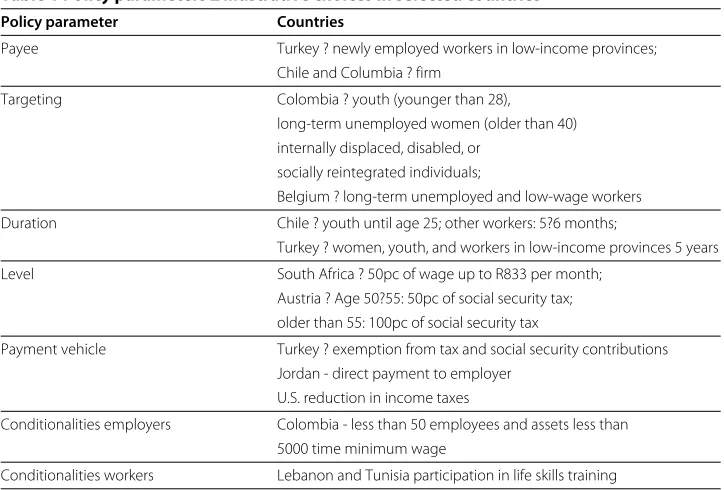
Employment Subsidy in Chile ? the subsidy is split between employer and worker (see Table 1).
4.2 Targeting
Eligibility for the subsidy can range from broadly inclusive to narrowly restrictive. In some countries, wage subsidies cover all low-wage or low-income workers. Frequently, how-ever, the target population is limited to newly-hired unemployed workers in certain age groups ? for example, Turkey, South Africa, Colombia, and Chile all subsidize newly-hired youth, and Colombia and Chile subsidize workers over the age of 40 or 50. The eligibility age for youth varies from less than 26 to less than 36. Subsidies for unemployed workers are sometimes targeted on the long-term unemployed (usually defined as out of work for 12?18 months). Wage subsidies can also be targeted to certain regions of the country (as in Turkey) or industries, in an effort to stimulate employment in the targeted sectors.
While narrow targeting of the subsidy almost certainly reduces the budgetary cost of the program and maximizes the benefits to the favored group, those benefits are likely to come at the expense of other groups. The wage differential between the targeted group and other workers with similar skills gives employers an incentive to substitute the former for the latter ? an incentive that will almost certainly affect hiring decisions and that may be strong enough to induce employers to lay off unsubsidized workers in order to hire subsidized workers. If all workers at a given skill level are subsidized, substitution is more difficult because it would change the skill mix of the employer?s workforce.
Of course, substitution is not always undesirable. If the policy objective is to help first-time job seekers or the long-term unemployed, subsidies to these groups are intended to induce employers to hire them instead of the more experienced or more recently employed workers they would normally hire. One simply must be cognizant of the
Table 1 Policy parameters ? illustrative choices in selected countries
Policy parameter Countries
Payee Turkey ? newly employed workers in low-income provinces;
Chile and Columbia ? firm
Targeting Colombia ? youth (younger than 28),
long-term unemployed women (older than 40) internally displaced, disabled, or
socially reintegrated individuals;
Belgium ? long-term unemployed and low-wage workers
Duration Chile ? youth until age 25; other workers: 5?6 months;
Turkey ? women, youth, and workers in low-income provinces 5 years
Level South Africa ? 50pc of wage up to R833 per month;
Austria ? Age 50?55: 50pc of social security tax; older than 55: 100pc of social security tax
Payment vehicle Turkey ? exemption from tax and social security contributions Jordan - direct payment to employer
U.S. reduction in income taxes
Conditionalities employers Colombia - less than 50 employees and assets less than
5000 time minimum wage
incentives created by the subsidy and be sure that they are consistent with the policy objective.
4.3 Duration
Wage subsidies are either paid indefinitely, so long as the worker remains eligible, or are time-limited. Time-limited subsidies are usually targeted on newly hired workers who were previously unemployed (sometimes within a demographic or geographic class). For example, Colombia subsidizes firms that hire women over the age of 40 who have been unemployed at least 12 months. Common durations for time-limited subsidies are six months to two years. There are several different rationales for time-limited subsidies. In some cases, they are used as a countercyclical measure to combat a rise in unemployment. The ?learning-by-doing? theory also justifies temporary subsidies after which workers are expected to have acquired sufficient skills to make them productive enough for finding employment on an unsubsidized basis. If this is the case, time-limiting the subsidy is one way to achieve the employment effects of wage subsidies while greatly reducing windfall effects. As noted above, however, if the learning-by-doing hypothesis does not hold true, or if the duration of the subsidy is not sufficient to significantly enhance the worker?s skills, time-limited subsidies create only a temporary employment effect and, at the same time, create a perverse incentive for ?churning? ? letting workers go when their subsidy expires and replacing them with new subsidized workers.
4.4 Payment vehicle
Wage subsidies are typically paid in one of three ways: through the tax system, through the social security system, or as direct programmatic payments to the employer or worker. For example, Turkey forgives both the worker?s and employer?s social security and health insurance contributions for newly hired recipients. If paid through the tax system, wage subsidies usually take the form of a refundable credit: workers? taxes are reduced by the amount of the subsidy, and if these taxes are less than the subsidy, the difference is paid as a tax refund. If administered through the social security system, the subsidy usually takes the form of a reduction in the employer?s and/or worker ?s social security contribution. Other programs set up their own reporting and payment system, and make direct subsidy payments to the employer or (less often) the worker. Clearly, piggybacking on an existing system lowers the administrative costs of the subsidy program, but may also lock the program into some other features of the existing system, such as periodicity of payment and rules for counting income or earnings.
4.5 Vouchers
not claim subsidies for a large proportion of their eligible employees, this could improve the take-up rate of the subsidy. It would also have the desirable effect of assuring that all potential employers are aware of the worker?s eligibility for the subsidy.
4.6 Conditionalities
Subsidies can include conditionalities on employers and beneficiaries. In the first case, the two main goals are to reduce substitution effects and to provide incentives to increase contracts? length. Substitution effects can be reduced if employers are not allowed to dis-miss workers for a given period after having hired a subsidized worker. The subsidy can also be conditioned on extending the length of the employment contract after the subsidy expires. Several of the OECD programs use this type of conditionalities on employers (see Banerji and Robalino 2009).
In the case of beneficiaries the goal is to reduce windfall effects, by attracting those who are really facing difficulties in finding a job and gaining work experience. This can be achieved, for example, by requiring beneficiaries to participate in job-related training, either before or after being hired, in order to qualify for the subsidy. The well known Jovenes programs in Latin America always combine the equivalent of a wage subsidy with training. More recent programs legislated in Lebanon and Tunisia also attach training to the wage subsidy.
Receipt of wage subsidies is, of course, conditional on work in the subsidized job; this is usually seen as one of the main advantages of wage subsidies over income transfers.
4.7 Reporting requirements
To administer the subsidy, the government must collect two types of information: that required to determine the eligibility of individuals (initial and ongoing) and that required to determine the amount of the subsidy. Where eligibility relates only to employment status ? e.g., industry, hours of work, or wage rate ? this information can be provided relatively easily by the employer. Some eligibility characteristics, such as receipt or dura-tion of social insurance or unemployment benefits or immigradura-tion status, can be obtained from government records, possibly within the same agency that administers the subsidy. More detailed individual characteristics like income pose more difficult administrative problems. If eligibility is based on annual income in the prior calendar year, this infor-mation can be obtained through the tax system, as is done for wage subsidies in the U.S., U.K., and Chile. Subsidies based on annual income are, however, extremely unrespon-sive to short-term changes in income. If, for example, a worker loses their job in March, it may be a full year before the the tax return for that year is available to document that loss. Unfortunately, more frequent income reporting, which can take the form of regular monthly reports from the employer or periodic (e.g., every 6 months) redetermination of eligibility, probably involving the worker, can be quite burdensome for employer, worker, and government alike. Reporting requirements to determine ongoing eligibility and the amount of the subsidy will also vary with the complexity of the subsidy. In the simplest case, once eligible, workers retain eligibility as long as they are employed by the same employer and the subsidy is determined by their wages. In these cases, employer earnings reports are sufficient to determine ongoing eligibility and the amount of the subsidy.
ages out of the subsidized group ? an event that can be predicted from the outset. Only if ongoing eligibility is based on factors that may change over time ? such as income or wage rate ? will ongoing reporting be required for eligibility purposes.
If the subsidy is based on earnings and eligibility is based on factors that either don?t change over time or change predictably, like age, the only ongoing reporting requirement is employer-reported earnings. Employers have an incentive not to underreport earnings, because that would reduce the subsidy. Moreover, if there is a tax on earnings, they also have an incentive not to overreport earnings, because that would increase workers? tax liability and workers would complain. In any case, if there is already some system in place to verify employers? reporting of earnings for tax purposes, that system may suffice for purposes of the wage subsidy.
5 Designing wage subsidies in developing countries
As discussed in Section 3, if the goal is mainly to create short-term jobs wage subsidies are unlikely to be the most efficient instrument. Their impact on employment rates is small and there can be important substitutions and windfall effects16 Also, in the case of developing countries, the problem often is not unemployment but underemployment: individuals, including with higher levels of education, working in low productivity jobs (see Cho et al. 2012). Wage subsidies, however, could have role as a means to give indi-viduals work experience in a given occupation and build skills and human capital. In this case, and if well designed, the dynamics effects of wage subsidies could compensate for implementation costs. In this section we discuss key policy choices that would need to be considered along some of the dimensions described above in order to achieve this objective.
5.1 Eligibility criteria
Perhaps the most fundamental policy choice in adopting a wage subsidy in developing countries is the definition of the target population. If, as we have argued, the role of the subsidy is allow individuals to gain work experience and build skills, the more obvious beneficiaries should be first-time job seekers or those trying to find jobs after long peri-ods of inactivity or unemployment. In developing countries, youth and women are two groups which are more likely to be in one of these three states. Depending on the con-text, governments can also target individuals with certain education levels or in certain regions. But, by definition, earnings would not be a criteria to target the subsidies. In all cases, it would be desirable that the subsidy be relatively narrowly targeted, for several reasons. First, this will limit the cost of the subsidy and/or allow a more generous, and therefore likely more effective, subsidy. Second, narrower targeting is likely to increase the employment effect for the targeted class because the demand for a small subset of the labor force is more elastic than the demand for a broader class of labor. Finally, a narrow class is less likely to substitute for other workers and also reduce windfall effects.
difficult to verify and therefore more prone to falsification. Even the common criterion of unemployment is likely to be hard to verify in countries with a large informal sector. In a new program, the problem of verification is likely to be compounded by a deluge of appli-cations descending on an inexperienced program staff. Regardless of the criteria, clear specification of the documentation to be required should be established at the outset.
5.2 Defining the subsidy
The amount and structure of the subsidy will have important implications for its effec-tiveness as a policy tool and for its cost. An obvious threshold condition is that the subsidy be large enough to make it profitable for the employer to hire the worker. Operationaliz-ing this criterion is more difficult. One benchmark against which wage subsidies can be assessed is the non-wage cost of labor. If the subsidy does not offset a substantial fraction of the non-wage cost of labor, it may not be worthwhile for the employer to hire subsi-dized workers. The structure of the subsidy will also influence the employer?s decisions about whether to hire subsidized labor and, if so, which workers.
A fixed subsidy will tilt the employer?s incentives toward hiring the lowest-wage work-ers, because it offsets a larger proportion of their earnings. As discussed in Section 2, a proportional subsidy will be more neutral across wage levels. On balance, we believe that this is a better policy, especially if the wage subsidy is intended to help new labor market entrants, like high school and college graduates, who may be higher skilled. Of course, it is also possible to set different subsidy rates for different classes of workers, as several of the countries described earlier in this paper have done. But this again can limit the set of jobs to which individuals can apply. Subsidies can be too small for higher productivity jobs with more learning potential.
5.3 Duration
A further critical feature of the subsidy is its duration. If the objective of the program is to give certain types of worker more work experience and on-the-job training in an effort to build up their skills to the point where they can be employed on an unsubsidized basis, the duration of the subsidy must be carefully calibrated. As discussed above durations adopted across countries range between 6 and 24 months. Subsidies below six months are unlikely to achieve skills learning objectives. After one year, on the other hand, the core skills demanded by a given job are like to have been acquired.
5.4 Conditionalities
As discussed above, subsidies can include conditionalities on employers and beneficiaries. In the case of employers, countries could consider imposing restrictions on the dismissal of workers in order to reduce substitution effects. They can also condition the subsidy on extending the length of the employment contract after the subsidy expires. Because of monitoring and enforcement reasons, however, it is unclear that the benefits of these conditionalities outweigh the costs.
5.5 Making payments
Making timely, accurate payments is one of the fundamental responsibilities of the man-agers of a subsidy program. The simpler the subsidy calculation formula, the easier it is to achieve this goal. Subsidies that take the form of a reduction in an existing payroll tax or contribution will occur automatically and are as accurate as the underlying tax or contri-bution. The same applies to subsidies that are fixed as a proportion of negotiated wages (up to a maximum).
In both cases, the agency in charge of managing the subsidy can make payments to the employer based on its reports to the social security (see next sub-section). This implies that employers do not receive payments ex-ante; they are reimbursed for part of the labor costs that they have incurred.
5.6 Enforcement and verification
As with any benefit system, wage subsidies must be accompanied by a rigorous monitor-ing system to prevent and/or detect fraud and abuse. The monitormonitor-ing system must ensure both that each employee for whom the subsidy is claimed is not only eligible for the sub-sidy but is actually working, that the claimed wages are being paid, and that the data used to determine the amount of the subsidy are accurate. The principal tools available for compliance monitoring include documentation requirements; cross-checks against other government records; and in-person audits with employers or workers.
The difficulty of the monitoring task will be strongly influenced by the complex-ity of the subsidy. Perhaps the simplest eligibilcomplex-ity requirements to verify are those that can be checked against existing records (e.g., those based on age, education, or participation in an existing program). For example, it should be relatively easy to deter-mine whether a worker is receiving unemployment compensation and, if so, for how long. It will be much more difficult to establish the employment status of workers not receiving unemployment compensation, especially in the presence of a large informal sector.
Documentation of earnings for computation of the subsidy is likely to be straightfor-ward - if the subsidies only apply to formal wage employment. Nearly all countries, even in the developing world, have some form of earnings tax or social security contribution based on earnings. The subsidy claimed must be consistent with the earnings reported in this system. Thus, verification of earnings for subsidy purposes can rely on the existing monitoring system. In the simplest case, where the subsidy is simply a reduction in this tax or contribution, it automatically falls within that system. Of course, this means that monitoring of wage subsidy compliance is only as good as the monitoring of the exist-ing system. In designexist-ing a wage subsidy, policy makers should look closely at the existexist-ing monitoring safeguards and, if necessary, strengthen them.
for the front-line staff. While a case could be made for decentralized administration of certain kinds of wage subsidies, central administration, with clear lines of authority and accountability, is probably generally preferable. Local administration can lead to lax administration and/or outright fraud.
5.7 Governance and links to other programs
Wage subsidies can be administered in a number of different ways ? by a free-standing agency; as part of some larger labor-related agency, such as that responsible for labor regulation; or through the existing tax or social security system. The choice will depend in large part on institutional factors within the country.
To maximize their impact, wage subsidies might also need to be linked to other active labor market programs such as training, counseling, intermediation and job search assistance17. For this reason, a natural entry point to receive wage subsidies are pub-lic employment services agencies (see Robalino and Sanchez-Puerta 2009). In principle, these agencies can become ?one-stop shops? where job-seekers register. The agency then connects job-seekers with different service providers under specific contracting and pay-ment systems. Some of these service providers can be responsible for linking beneficiaries of wage subsidies with employers and monitoring the implementation of the program (see below).
5.8 Monitoring and evaluation
Subsidy administrators and policy makers need to know, in real time, whether the subsidy is being implemented as intended. At least in theory, a subsidy system should automati-cally generate a flow of data ? the information used to determine eligibility and that used to determine the amount of the subsidy. These data can be used to answer important questions about the program. As we will see, however, they will be much more useful if augmented by other data collection efforts.
be used to locate workers for the interview. At the same time, employer data could be drawn and merged with the employee data.
Finally, it will be important to know the distribution of subsidy payments across firms. Several studies have found that participation in employer subsidies is highest among large firms, and that many small firms are unaware of the subsidy. Subsidy administrators need to know whether this is true in their case and if it is, to take corrective actions to inform nonparticipating companies. It will also be important to know the distribution of the sub-sidy across industries and geographic or political regions, since uneven distribution may run counter to national development goals. To the extent that data on firm size, location, and industry are not already available from government records, it is relatively easy to collect it from firms claiming the subsidy. In sum, for management purposes, a subsidy program needs not only a system for generating descriptive statistics from data flowing in from eligibility determinations and subsidy payments, but should also collect ancil-lary data from sample surveys of workers and firms, to answer questions that go beyond simple descriptions of subsidies paid and their recipients.
The program monitoring system is intended to provide ongoing feedback to subsidy administrators about the operation of the system in real time. But because the manage-ment information system is focused on subsidy recipients, it cannot provide information on post-program outcomes or measure the impacts and cost-effectiveness of the subsidy. For these purposes, separate data collection and analysis is needed. By ?impact?, we mean the difference between subsidy recipients? actual outcomes and what would have hap-pened in the absence of the subsidy. Many different methods exist to measure impacts. It is well beyond the scope of this paper to go into the strengths and limitations of the various evaluation approaches; here, we simply emphasize a few main points:
Programs should be tested on a small scale before being implemented nationally. If done correctly, such a pilot test will allow not only estimation of the impact of the subsidy on recipients? employment and earnings, but will also provide a pretest of implementation procedures.
Once implemented, every program should be subjected to periodic impact evaluations, to determine whether the program is achieving its objectives.
Rigorous program evaluation will nearly always involve collecting outcome data (e.g., employment and earnings) on a control or comparison group of individuals not receiving the subsidy and on subsidy recipients no longer receiving the subsidy. If such data are not available from existing administrative systems, special surveys will be needed. Evaluation methods based on a randomly assigned control group provide the strongest measures of program impact. Where random assignment is not possible, ?difference-in-difference? measures or comparative interrupted time series models are often the strongest available alternative.
5.9 Communication
limited. The experience of the U.S. with the New Jobs Tax Credit in the late 1970s is instructive. In a Department of Labor survey conducted just after the end of the first tax year in which the credit applied, only 34 percent of the firms interviewed said that they knew about the new tax credit (which was scheduled to expire at the end of that year) (Perloff and Wachter 1979). Although nearly 90 percent of firms with more than 500 employees had heard of the tax credit, only 27 percent of small firms (those with 0?9 employees) had heard of it. Similar results were found by Lamberts (1993) in Belgium and by van Nes et al. (1998) in the Netherlands. Developing countries are likely to be dealing with firms more like the latter than the former. Moreover, many of the workers one would like to reach in developing countries are in the informal sector, where the government has little or no communication with workers.
To overcome these barriers to communication, the government will need to publicize the wage subsidy through as many and diverse channels as possible. Written communi-cations to employers and workers should be supplemented with a public media campaign via newspapers, radio, and flyers placed in locations that are likely to be frequented by targeted workers. Presentations to business and civic groups on the new benefit are also likely to be useful in getting the word out.
6 Conclusions
The main goal of this paper has been to discuss the rationale for wage subsidies in developing countries and suggest possible options in terms of design and implementation. One of the conclusions is that if the main goal of government is to create short-term jobs, wage subsidies might not be the most effective instrument. In general the effects of wage subsidies on employment rates are modest and there can be important substitution and windfall effects. If the goal is to create jobs rapidly, public works and services where subsidized jobs are created directly by the government are probably a more effective alternative. (See Subbarao et al. 2012).
A more promising function of wage subsidies in developing countries would be to allow workers to acquire skills that improve their employability and labor market opportunities through work experience and on the job-training. Some of the evidence reviewed in the paper suggest that, at least in the case of certain groups such as youth, the effect wage subsidies persist after they expire. In this case, wage subsidies would need to be targeted to first time job seekers or to workers who have experienced long periods of unemployment or inactivity.
Endnotes
1Neumark (2013) and Neumark and Grijalva (2013) discuss the evidence in the United
States of using hiring credits to encourage employers to create new jobs. They find evidence that hiring credits focused on the disadvantaged were ineffective but that, in the context of the recovery from the Great Recession, broader credits may be effective. Some specific types of hiring credits ? including those targeting the unemployed and those that allow states to recapture credits when job creation goals are not met ? appear to have succeeded in boosting job growth. But some credits appear to increase hiring without increasing employment (or at least not in the same proportion), suggesting that these credits can lead to labor churning.
2There is a large literature on the effects of work experience on productivity and
earnings (see Mincer 1974) which we do not attempt to summarize here.
3For other theoretical models where signaling and recall expectation play a role
see Rodriguez-Planas (2009) and for an empirical application Rodriguez-Planas (2013).
4Here we assume that wages do not adjust automatically with changes in the level of
productivity. One way to think about it is that they remain constant during the duration of the contract.
5In practice this is not difficult to do. Employers would know that they would receive a
given percentage of whichever wage they agree to pay ? probably up to a maximum (see section on design and implementation).
6Layard (1997), and Bell et al. (1999) argue that wage subsidies to the long-term
unemployed may have beneficial general equilibrium effects because working increases their human capital and also their earnings.
7Regulations on minimum wages can also prevent wage cuts but then the solution
would not be a wage subsidy but a change in the regulation. 8For comprehensive reviews of the literature see Phelps (2004).
9Firms that employ subsidized workers may have a competitive advantage in the
product market because one of their inputs is subsidized. If their business expands at the expense of businesses with fewer or no subsidized workers, the subsidized workers are said to displace unsubsidized workers. As with substitution, displacement offsets the effects of the subsidy on aggregate employment but amplifies the employment effect for the subsidized class, raising much the same questions for policymakers.
10Since wage subsidies are paid only in the formal economy, they increase the net wage
differential between the formal economy and the informal economy. This will have the effect of inducing some workers to leave the informal economy to take jobs in the formal economy. Since the informal economy is quite large in most developing countries, this could be a sizable effect. If there is a large supply of workers in the informal economy the supply of low-skill labor will be quite elastic, leading to a situation where employment gains (in the formal sector) are large, but there is little effect on wage rates and most of the monetary value of the subsidy is captured by employers. There may be little effect on aggregate employment, including the informal sector, but the quality and productivity of jobs may increase.
11The other study, Perloff and Wachter (1979), estimated an impact of 3 percent, based
on a relatively simple comparison of employment gains by firms that knew about the credit and firms that did not. This estimate almost certainly overstates the impact of the credit because firms with growing employment had a much stronger incentive to learn about the credit than firms with declining employment, since the credit only applied to employment in excess of 102 percent of the previous year. Bishop (1981) employed much stronger controls for selection bias.
12Although the study did not estimate directly the impact of on-the-job training on
employment, it did find that, for all women in JTPA about four-fifths of the impact of the program on earnings was due to increased employment.
14Heckman and co-authors investigate the impact of wage subsidies on skill
formulation. They analyze two prototypical models of skill formation: (a) a
learning-by-doing model and (b) an on-the-job training model. In general the authors find different results for the two models bearing different implications of wage subsidies on skill formation. On-the-job training models predict that wage subsidies reduce skill formation. Learning-by-doing models predict the opposite. The provisional evidence favors the learning-by-doing model. Findings show that EITC increased the long term wages of participants with low levels of education.
15For a discussion see Galasso et al. (2004). The authors show that in Argentina the
government?s response to the crisis of implementing a work requirement as a
precondition for receipt of the Jefes transfers and offering a wage subsidy to employers produced effects. The wage subsidy appears to have been largely an incidental provision aimed at recruiting employers to provide jobs for those subject to the work requirement. By 2008 more than 80 percent of the beneficiaries were working in some type of
employment project. The program apparently drew a large number of workers from the informal sector because the Jefes transfer was higher than the (sub-minimum) wages attainable there. A more deliberate implementation of wage subsidies in Argentina occurred in the late 1990s, when a randomized experiment (Proempleo) was conducted to measure the effects of wage subsidies and wage subsidies plus training on
employment and earnings.
16If in a given context, for instance an economic slowdown, the goal is to protect
and/or create jobs rapidly, interventions that increase aggregate demand or public works and services where the government creates jobs directly are probably a better option. (see Banerji et al. 2014).
17For evidence on the positive impact of these combined programs see Orr et al.
(1996), Katz (1998), and Cockx et al. (1998).
Competing interests
The IZA Journal of Labor Policy is committed to the IZA Guiding Principles of Research Integrity. The authors declare that they have observed these principles.
Acknowledgements
We are very grateful to the Editor for multiple comments and suggestions on an early version. The paper also immensely beneficiated from the comments of two anonymous referees. This word was produced under the overall strategic guidance of Arup Banerji, Sector Director at the World Bank, whom we also thank for comments.
Responsible editor: David Neumark
Author details
1LCSHE, The World Bank, 1818 H St NW, Washington, DC 20433, USA.2HDNSP, The World Bank, 1818 H St NW,
Washington, DC 20433, USA.3Associate, Institute for Healh and Social Policy School of Health Policy and Management, The Johns Hopkins University, Baltimore, Maryland, USA.
Received: 8 November 2013 Accepted: 1 March 2014 Published:
References
Almeida R, Arbelaez J, Honorati M, Kuddo A, Lohmann T, Ovadiya M, Pop L, Sanchez-Puerta M, Weber M (2012) Improving access to jobs and earnings opportunities: the role of activation and graduation policies. World Bank Human Development Discussion paper.
Banerji A, Robalino D (2009) Addressing the employment effects of the financial crisis: the role of wage subsidies and reduced work schedules. World Bank, Washington, DC. ©World Bank. https://openknowledge.worldbank.org/handle/ 10986/11717 License: CC BY 3.0 Unported
Banerji A, Newhouse D, Pacci P, Robalino D (2014) Working through the crisis: jobs and policies in developing countries during the great recession. World Bank, Washington DC
Bartik TJ (2001) Jobs for the poor: can labor demand policies help? Russell Sage Foundation, New York
Bartik TJ, Bishop JH (2009) The job creation tax credit: dismal projections for employment call for a quick, efficient, and effective response. Economic Policy Institute Briefing Paper No. 248, Washington, DC
Bell B, Blundell R, Van Reenen J (1999) Getting the unemployed back to work: the role of targeted wage subsidies. International Tax and Public Finance 6(3): 339?360
Bernhard S, Gartner H, Stephan G (2008) Wage subsidies for needy job-seekers and their effect on individual labour market outcomes after the German reforms (No. 2008, 21). German Federal Employment Agency. IAB discussion paper. https://www.econstor.eu/dspace/bitstream/10419/32748/1/608391123.pdf