Original Research Article.
54 |P a g e Int J Med Res Prof.2018 Jan; 4(1); 54-60. www.ijmrp.com
Awareness of Vitamin D Deficiency Among Type 2 Diabetes Mellitus
Saudi Adults in Saudi Arabia
Eman Ghalib Alharbi
1*, AlJoharah Mohammed ALMazrou
1, Fai Salem A Alkhelaiwi
2,
Hasna Sulaiman Alkahmous
2, Malak Furaih Alrasheedi
2, Amnah Saleem ALSarheed
2,
Munirah Mohammed Alabdulwahab
2, Nedaa Hassan Al-Ghazal
21MBBS, Intern, 2MBBS, Medical Student, College of Medicine,
Almaarefa Colleges for Science & Technology (MCST), Riyadh, Kingdom of Saudi Arabia.
ABSTRACT
Objectives: To assess the level of awareness of vitamin D deficiency among T2DM Saudi Adults in Saudi Arabia.
Background: Vitamin D (25 hydroxyvitamin) has been linked to the association with developing or worsening a lot of chronic diseases, one of the most important is diabetes militate.
Methods: This is a cross sectional study that aims to assess the level of awareness of vitamin d deficiency among T2DM in Saudi adults in Saudi Arabia and to estimate the percentage of T2DM in Saudi adults taking vitamin D supplements. vitamin D deficiency awareness was assessed in a sample of 316 Saudi National, aged above 18, both genders and having type 2 diabetes using an electronic survey sent by social media
“WhatsApp”.
Results: The results showed that 96.4% of females and 96.9% of males have heard about vitamin D, and 44.6% from participants have heard about vitamin D from healthcare professionals, 28.5% from media, and only 26.9% from relatives and friends. The study aimed to evaluate the knowledge, and as the results showed a variable knowledge between males and females. We found most of the males are depending on the sun exposure for vitamin D, while females
were depending on vitamin D supplements, while a small group of the sample has no idea about the sources.
Conclusion: Regarding to the results we found that diabetic patient with type 2 need to their awareness and improve their health. They should be advised from their doctors about it and start a prophylactic doses of vitamin D.
Keywords: Vitamin D, Deficiency, Diabetes, Awareness, Riyadh.
*Correspondence to:
Eman Ghalib Alharbi,
MBBS, Intern, College of Medicine,
Almaarefa Colleges for Science & Technology (MCST), Riyadh, Kingdom of Saudi Arabia.
Article History:
Received: 02-11-2017, Revised: 26-11-2017, Accepted: 11-12-2017 Access this article online
Website:
www.ijmrp.com
Quick Response code
DOI:
10.21276/ijmrp.2018.4.1.013
INTRODUCTION
25-hydroxyvitmain D deficiency is defined as less than 20ng/ml (<50nmol) and its deficiency is associated with developing or worsening a lot of chronic diseases, one of the most important is diabetes mellitus.1 Many types of researches suggest that vitamin
D may play a role in insulin resistance; the role of vitamin D is regulation of calcium absorption and bone metabolism. In addition, vitamin D deficiency has risk factors such as obesity, aging, lifestyle and low physical activity and many metabolic syndromes including type 2 diabetes. Low serum 25-hydroxyvitamin D (25(OH)D) has been shown to correlate with increased risk of type 2 diabetes. Small, observational studies suggest an action for vitamin D in improving insulin sensitivity and/or insulin secretion.2
There is some evidence that there are physiological interactions between vitamin D, IGF-1, and its binding proteins IGFBP-1 and IGFBP-3. Variations in circulating IGF-1 and its binding proteins are associated with variations in glycaemia and may interact with vitamin D status to influence metabolic syndrome risk. It also becomes clear that polymorphisms in the VDR gene may be
associated with insulin resistance, insulin secretion, and fasting glucose concentrations, suggesting that vitamin D is likely to contribute to glucose metabolism.3 The prevalence of vitamin D
deficiency in patients with diabetes and pre-diabetes is high. As the treatment of vitamin D deficiency is cheap and safe, it may be an effective method of preventing diabetes. Some cross-sectional and epidemiological studies have shown the role of vitamin D deficiency in increasing the incidence of diabetes, but the results of interventional studies with vitamin D on insulin sensitivity were inconstant.4 However, despite being vitamin D deficiency a
LITERATURE REVIEW
A prospective, cross sectional study was done at the Security Forces Hospital in Riyadh, Saudi Arabia, 2011. Aim of the study was to examine the awareness, knowledge, and attitudes regarding vitamin D and its sources among Saudi Arabian children. A 200 children precipitated in his study (one hundred were vitamin D deficient and one hundred were healthy children). Their age ranged from 2 to 17 years. Each participant was interviewed regarding awareness, knowledge, and attitudes to vitamin D using short-answer questions and multiple -choice questions. In children<10 years interviews were done with the parents. Results showed that 50% of the patients and 70% of the healthy children had knowledge of vitamin D and its health implications. Most participants were able to mention other source of vitamin D. Only 68.75% of the patients, compared to 88.8% of the healthy children, named the sun as a source of vitamin D. 28% of the patients were aware of the sources of vitamin D, and 64% of the healthy subjects were also aware of the sources.5
A cross sectional study was carried out in Riyadh, Saudi Arabia, in 2016. Aim of the study was to investigate the knowledge and practice about vitamin D deficiency among people who live in Riyadh, Saudi Arabia. An online questionnaire was used to collect data. Participants ages ranged from (18-60). Most participants (98.4%) have heard of vitamin D either from health care provider, friends or media. Regarding sun exposure only 46.4% of participants reported that they like being exposed to sunlight during the day. Majority of participants 93.1% know that vitamin D has an important role in bone health. 3.2% of participants do not know the sources of vitamin D, while 91% of them reported the sun as a main source of vitamin D. This study found that there is poor practice regarding sun exposure, inadequate knowledge toward vitamin D effects on other body systems. This study emphasized the importance of establishing a continued education programs to the public about vitamin D importance.6
A cross-sectional study was conducted among adults aged 20-40 years in Sharjah, UAE. Participants were selected from public places using convenience sampling method. They were subjected to a self-administered questionnaire. The majority of the adults demonstrated significant lack of knowledge and poor practices towards vitamin D and its deficiency. Therefore, attempts to increase the awareness about this issue are required through establishing educational campaigns targeting the general public in Sharjah, UAE.7
A cross-sectional study was carried out during the period from 1, March 2016 to 30, September 2016. A total of 439 subjects aged 20–45 years, attending five randomly selected primary healthcare centers were selected using a systemic random sampling procedure. Data were collected by personal interview using a predesigned questionnaire. The majority (70.6%) of the participants had normal Vitamin D level, 24.8% had deficient level and 4.6% had insufficient level. The prevalence of diabetes mellitus among the studied population was 12.1%. Diabetes mellitus was more prevalent among cases of Vitamin D deficiency as it affects 16.3% of them and 10.3% of participants with normal Vitamin D level with statistically significant difference.8
Abulmoein E published on May 6 2016 a cross-sectional retrospective study about the awareness of vitamin D deficiency in Jeddah, Saudi Arabia. The aim of his study was to assess the awareness, perception, and understanding of vitamin D deficiency
among families living in Jeddah, Saudi Arabia .A total of 1752 parents of children aged from 2 to 18 were included. Samples were divided into two groups (746 were highly educated and 491 were low educated). The results showed that majority have heard about vitamin D, 82.9% fail to identify the best time for sun exposure. This study recommended improving health education about vitamin D among public population.9
A pre-designed questionnaire regarding the knowledge about vitamin D was administered by Yousef .S on 2015. Blood samples were collected and serum 25hydroxyvitamin D (25(OH)D was measured from a total of 1188 boys (15.1 ± 2.2 years) and 1038 girls (15.1 ± 2.0 years). The results showed that a high percentage of boys answered correctly than girls regarding the knowledge about sun exposure questions. The percentages of girls were significantly higher regarding vitamin D sources questions. Boys had a higher prevalence and frequency of sun exposure than girls. Vitamin D deficiency was significantly higher in girls than boys (47.0% versus 19.4.0%). They recommended that the awareness of vitamin D and sunlight exposure in children needs to be improved by provision of trained physicians and school teachers. Creating more areas where girls can uncover freely during routine works and outdoor activities will help increase their vitamin D levels.10
OBJECTIVES
1. To assess the level of awareness of vitamin D deficiency among T2DM Saudi Adults in Saudi Arabia.
2. To estimate the percentage of T2DM Saudi Adults taking vitamin D supplements.
METHODS
A cross-sectional study, it was carried out between July and November 2017. A total of 316 participated in the study. An invitation message will be sent to the participants using social media (via WhatsApp) to participate in this study with a link to the survey. They were asked about demographic variable such as age, gender, marital status and educational status was graded as Primary school/Intermediate school, high school and university, and detailed questionnaire was used to obtain basic data regarding awareness, knowledge, sources, health benefits and practice of sun exposure of vitamin D. Ethical approval was obtained from Al-Maarefa Colleges Research Committee. Sample size for the study calculated based on estimating the
awareness among a Canadian population.11 Anticipating an
awareness of 29% with an absolute precision of ± 5% and confidence level of 95%, the minimum sample size required for the study was observed to be, the minimum sample size required for this study will be 316.
Inclusion Criteria
Saudi National, aged above 18, both genders and having type 2 diabetes. Statistical analysis was coded for entry and analysis using SPSS Statistical Package for the Social Sciences (SPSS) version 24 software. The results were presented in tables as frequencies and percentages
RESULTS Demographic Profile
56 |P a g e Int J Med Res Prof.2018 Jan; 4(1); 54-60. www.ijmrp.com
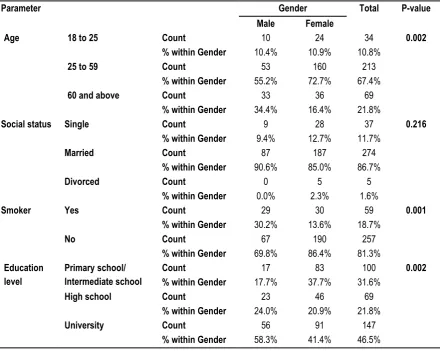
as 72.7% and 55.2% from females and males participants are having 25 to 59 years old, respectively. However, no relationship between them in regards to social status, as 85% from females and 90.6% from males are married. Results showed that 86.4% from females and 69.8% from males are not smokers (statistically
significant difference, with p value less than 0.05). Later, results showed 41.4% from females are having university degree, while the rest of them having high school degree and less. However, 58.3% from males are having university, and the rest was having high school and less.
Table 1: Participants demographic profile (n=316)
Parameter Gender Total P-value
Male Female
Age 18 to 25 Count 10 24 34 0.002
% within Gender 10.4% 10.9% 10.8%
25 to 59 Count 53 160 213
% within Gender 55.2% 72.7% 67.4%
60 and above Count 33 36 69
% within Gender 34.4% 16.4% 21.8%
Social status Single Count 9 28 37 0.216
% within Gender 9.4% 12.7% 11.7%
Married Count 87 187 274
% within Gender 90.6% 85.0% 86.7%
Divorced Count 0 5 5
% within Gender 0.0% 2.3% 1.6%
Smoker Yes Count 29 30 59 0.001
% within Gender 30.2% 13.6% 18.7%
No Count 67 190 257
% within Gender 69.8% 86.4% 81.3%
Education level
Primary school/ Intermediate school
Count 17 83 100 0.002
% within Gender 17.7% 37.7% 31.6%
High school Count 23 46 69
% within Gender 24.0% 20.9% 21.8%
University Count 56 91 147
% within Gender 58.3% 41.4% 46.5%
Table 2: Participants information about vitamin D (n=316)
Parameter Gender Total P-value
Male Female
Heard about Vitamin D
Yes Count 93 212 305 0.820
% within Gender 96.9% 96.4% 96.5%
No Count 3 8 11
% within Gender 3.1% 3.6% 3.5%
Table 3: Participants information about vitamin D (n=316)
Source of Information Gender Total P-value
Male Female
Health care professional
Count 44 92 136 0.686
% within Gender 47.3% 43.4% 44.6%
Media Count 27 60 87
% within Gender 29.0% 28.3% 28.5%
Relatives and friends
Count 22 60 82
Fig 1: Prevalence of participants if heard about vitamin D (n=316)
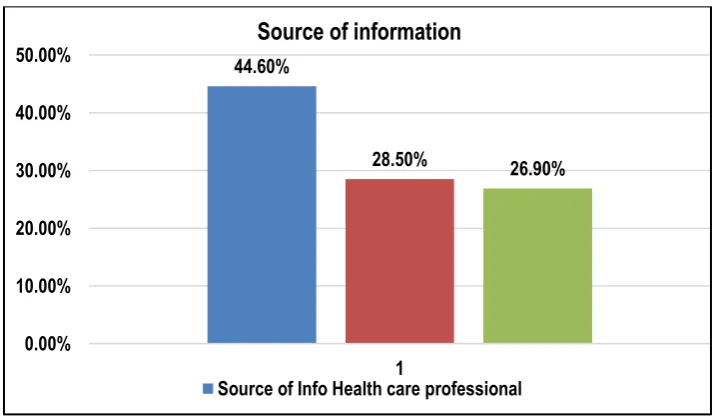
Figure 2: Source if information about vitamin D (n=316)
To assess the level of awareness of vitamin D deficiency among T2DM Saudi Adults in Saudi Arabia
To discover the awareness of vitamin D deficiency, table 2 showed that no relationship between males and females that if they heard or not about vitamin D (p value more than 0.05). However, 96.4% and 96.9% from females and males respectively heard about vitamin D.
To investigate the source of information about vitamin D, results showed that there was no statistically significant relationship between females and males in regards to the source of information. In more details, 44.6% from participants heard about vitamin D from healthcare professionals, 28.5% from media, and only 26.9% from relatives and friends.
The sun exposure profile investigated in table 4. Accordingly, no statistically significant relationship between genders towards there like going to sun exposure or not, and if use parasol to shade from sun. however, relationship between gender and sunscreen use, frequency of using sunscreen, and thoughts about exposure to sunlight if it enough or not.
In details, only 58.2% and 63.5% from females and males like being exposed to sun. However, 86.8% from females are not using parasol, and as well as 86.5% from males. To protect from sun, 74.5% from females are using sunscreen, and 92.7% from
males are using sunscreen with higher percentage. As well as, males are higher in frequency for using sunscreen less than 2 days per week with 89.6% and only 78.6% for females. Lastly, 65% from females think that they are not exposed to sun light in enough quantity; however 42.7% from the males think that they have enough exposure to sunlight.
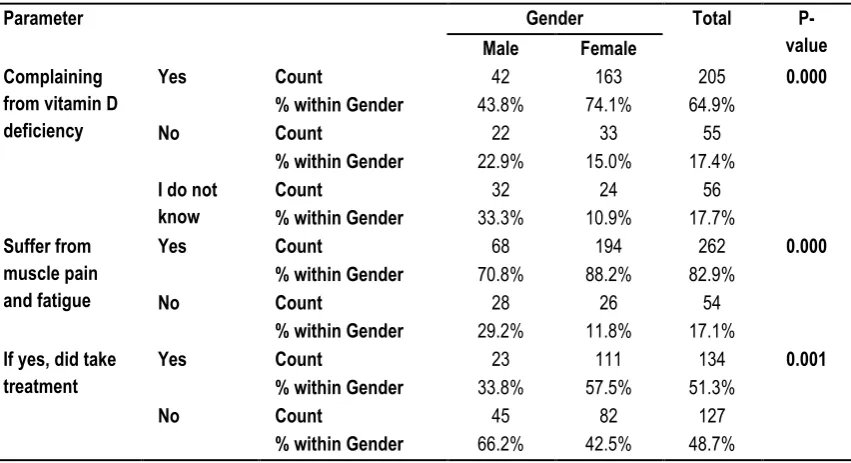
In table 5, relationship between males and females towards signs and symptoms for vitamin D deficiency was exist. As females that complaining from vitamin d deficiency are higher than males who have suffering from it (74.1% compared to 3.8%). As well as suffering from muscle pain and fatigue was higher in females (88.2%). Finally, from who have suffering from such disease, females might seen have higher awareness towards disease, since 57.5% are taking treatment, while only 33.8% from males are taking treatment.
Third part: to estimate the percentage of T2DM Saudi Adults taking vitamin D supplements.
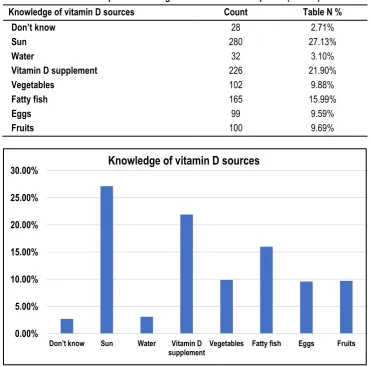
In last table, 21.9% from participants are taking vitamin D supplement. Only 2.7% from the participants have no knowledge about the sources of vitamin D. 27.1%of the participants agreed that sun was a source for vitamin D, and about 9% from them agreed that either vegetables and eggs and fruits are suitable source for vitamin D.
Yes
97%
No
3%
Heard about Vitamin D
Yes No
44.60%
28.50% 26.90%
0.00% 10.00% 20.00% 30.00% 40.00% 50.00%
1
Source of information
58 |P a g e Int J Med Res Prof.2018 Jan; 4(1); 54-60. www.ijmrp.com Table 4: Participants sun exposure profile (n=316)
Parameter Gender Total
P-value
Male Female
Like going to sun exposure
Yes Count 61 128 189 0.27
% within Gender 63.5% 58.2% 59.8%
No Count 30 86 116
% within Gender 31.3% 39.1% 36.7%
I do not know
Count 5 6 11
% within Gender 5.2% 2.7% 3.5%
Use parasol to shade from sun
Yes Count 13 26 39 0.479
% within Gender 13.5% 11.8% 12.3%
No Count 83 191 274
% within Gender 86.5% 86.8% 86.7%
I do not know
Count 0 3 3
% within Gender 0.0% 1.4% 0.9%
Sunscreen use Yes Count 2 47 49 0.000
% within Gender 2.1% 21.4% 15.5%
No Count 89 164 253
% within Gender 92.7% 74.5% 80.1%
I do not know
Count 5 9 14
% within Gender 5.2% 4.1% 4.4%
Frequency of using sunscreen
Everyday Count 4 28 32 0.043
% within Gender 4.2% 12.7% 10.1%
<2 days/week
Count 86 173 259
% within Gender 89.6% 78.6% 82.0%
>2 days/week
Count 6 19 25
% within Gender 6.3% 8.6% 7.9%
Think have enough exposure to sunlight
Yes Count 41 52 93 0.000
% within Gender 42.7% 23.6% 29.4%
No Count 37 143 180
% within Gender 38.5% 65.0% 57.0%
I do not know
Count 18 25 43
% within Gender 18.8% 11.4% 13.6%
Table 5: Signs and symptoms for Vitamin D deficiency profile (n=316)
Parameter Gender Total
P-value
Male Female
Complaining from vitamin D deficiency
Yes Count 42 163 205 0.000
% within Gender 43.8% 74.1% 64.9%
No Count 22 33 55
% within Gender 22.9% 15.0% 17.4%
I do not know
Count 32 24 56
% within Gender 33.3% 10.9% 17.7%
Suffer from muscle pain and fatigue
Yes Count 68 194 262 0.000
% within Gender 70.8% 88.2% 82.9%
No Count 28 26 54
% within Gender 29.2% 11.8% 17.1%
If yes, did take treatment
Yes Count 23 111 134 0.001
% within Gender 33.8% 57.5% 51.3%
No Count 45 82 127
Table 6: Participants knowledge of vitamin D sources profile (n=1032)
Knowledge of vitamin D sources Count Table N %
Don’t know 28 2.71%
Sun 280 27.13%
Water 32 3.10%
Vitamin D supplement 226 21.90%
Vegetables 102 9.88%
Fatty fish 165 15.99%
Eggs 99 9.59%
Fruits 100 9.69%
DISCUSSION
With the strong relation between vitamin D deficiency and
diabetes mellitus, the public’s awareness regarding this relation is
an important aspect to take inconsideration to be able to maintain a normal level and prevent the complications that can happen since it is a common presentation to have vitamin D deficiency although we are in a sunny country like Saudi Arabia. 316 type 2 diabetic patients participated in this study, the majority were ranging between 25 to 59 years old, married, non-smoker, and half the sample had university degree.
Majority of the sample have heard about vitamin D, and half of them have heard about it from health care professionals, which was similar to the study done in Riyadh where most participants (98.4%) have heard about it either from health care provider, friends or media.4 And in other cross-sectional retrospective study
conducted by Abulmoein E which showed that majority of their sample have heard about vitamin D.5
More than half the population like being exposed to the sun, and
the majority don’t use parasol to shade sunlight, despite only small
sample that actually uses sun screen less than twice a week. What seems to be interesting is that more than half the samples think that they are not exposed to sunlight enough. Which may indicate that people may not have enough information regarding sun exposure. Which is a similar finding to the cross-sectional retrospective study that was conducted by Abulmoein E in Jeddah.5 In our study a high percentage of diabetic males were
found to be thinking that they are exposed to sun enough unlike the diabetic females where more than half the sample think they
are not exposed to sun enough, which is a similar finding to the study that was conducted by Yousef S in 2015 where the Boys had a higher prevalence and frequency of sun exposure than girls.6 Which can be common finding since most girls cover up
their body when going out with hijab so they have less chances for sun exposure.
The majority of our sample that suffered from vitamin D deficiency was diabetic females, and the most common complain that they had were muscle pain and fatigue. More than half the diabetic female sample was taking supplements, unlike the males. Which indicated that the awareness regarding vitamin D was higher in diabetic females than males.
Sun had the highest percentage regarding the source of vitamin D, but what is most important is that a good number pointed supplements, fatty fish, vegetable, eggs, and water as a source for
vitamin D. while some don’t know any source for vitamin D which indicates that the public require more knowledge regarding vitamin D sources, as it could be a main reason for vitamin D deficiency.
LIMITATIONS
This study was conducted in a small sample, with a close-ended questionnaire, and the information that was gathered was limited.
RECOMMENDATIONS
Increasing the knowledge of the public especially who suffer from diabetes is an important aspect that should be focused on to increase their awareness and improve their health. They should
0.00% 5.00% 10.00% 15.00% 20.00% 25.00% 30.00%
Don’t know Sun Water Vitamin D
supplement Vegetables Fatty fish Eggs Fruits
60 |P a g e Int J Med Res Prof.2018 Jan; 4(1); 54-60. www.ijmrp.com
be advised to visit the doctor to explain to them the importance of vitamin D and start them on prophylactic doses of vitamin D as initial step to solve this issue, and to try to add an education clinic for the patients or refer them more frequently to the health educator in the same hospital since high percentage in this study had their knowledge from health care practitioners. Encourage community campaigns more frequently to increase the awareness regarding the relation between vitamin D and diabetes and correct the wrong ideas in the public, and using social media as an important way to reach as much as possible from the public. Increase the education in schools to increase the knowledge in all age groups, and to design out-door areas for women to be able to uncover and to be exposed to sun more frequently.
CONCLUSION
It was predicted that there is a relation between type 2 diabetes mellitus and vitamin D deficiency since there is high percentage of type 2 diabetic patients suffering of vitamin D deficiency in our population. Our study aimed to evaluate awareness of Vitamin D deficiency among type 2 diabetes mellitus patients in Saudi Arabia. According to the data that were collected patients showed variable awareness about vitamin D importance. Most of them have heard about vitamin D, and half of them have heard about it from health care professionals which highlighted the lack of public knowledge about vitamin D. Regarding sun exposure more than half the samples think that they are not exposed to sunlight enough which may indicate that people may not have enough information regarding sun exposure .Our results also showed that males think they are exposed to sunlight more than females which indicate that diabetic female population need more education and motivation regarding sun exposure . The majority suffered of vitamin D deficiency were diabetic females. More than half the diabetic female sample were taking supplements, unlike the males which indicate that the awareness regarding vitamin D is higher among diabetic females than males. Regarding vitamin D sources most of patients knew that the sun is a source of vitamin D, while some of them also had more answers regarding the sources of vitamin D like egg, fish, vegetables etc. while some patients have no idea about vitamin D sources which indicate the lack of vitamin D sources and importance among some diabetic patients. As the data showed some diabetic patients need more education regarding vitamin D sources, importance and complications of vitamin D deficiency especially among diabetic patients.
REFERENCES
1. Medscape; Vitamin D Deficiency and Related Disorders; Available at: http://emedicine.medscape.com/article/128762-overview
2. Hurst P, Stonehouse W, Coad J. Vitamin D supplementation reduces insulin resistance in South Asian women living in New Zealand who are insulin resistant and vitamin D deficient –
a randomised, placebo-controlled trial. Br J Nutr. 2010 Feb; 103 (4): 549- 55. doi: 10.1017/S0007114509992017.
Epub 2009 Sep 28.
3. Forouhi N, Luan J, Cooper A. Baseline Serum 25-Hydroxy Vitamin D Is Predictive of Future Glycemic Status and Insulin
Resistance. American Diabetes Association2008;57(10):2619–25.
4. Hoseini S, Aminorroaya A, Iraj B , Amini M. The effects of oral vitamin D on insulin resistance in pre-diabetic patients. J Res Med Sci. 2013 Jan; 18(1): 47–51.
5.Alshamsan.Fatimah,Bin-Abbas.Bassam.Knowledge, awareness, attitudes and sources of vitamin D deficiency and sufficiency in Saudi children. Saudi Medical Joural,2016; 37(5): 579–583. 6. Babelghaith.D.Saleem, Syed Wajid,AL-Zaaqi.A.Meshal, Al-Malki.S.Ahmad, Al-Amri.D.Faisal, Alfadly Saeed, Sultan Alghadeer, Alarifi.N.Mohammed. Knowledge and practice of vitamin D deficiency among people lives in Riyadh, Saudi Arabia-A cross-sectional study. Biomedical research ,international journal of medical sciences,2017; 28(7);3114-18.
http://www.alliedacademies.org/articles/knowledge-and-practice- of-vitamin-d-deficiency-among-people-lives-in-riyadh-saudi-arabiaa-crosssectional-study.pdf
7. Salmanpour VA et al. Vitamin D deficiency: knowledge and practices among the adult population in Sharjah, United Arab Emirates. Arch Osteoporos. 2016;11:15. doi: 10.1007/s11657-016-0269-0. Epub 2016 Mar 30.
8. Nagah Mohamed Abo Fetoh, Mohamed Mousa Abd El-Mawgod, Nesreen A. Mohammed, Hanan Saleh A. Alruwaili, Entsar Owaid M. Alanazi. Irritable Bowel Syndrome among Medical and Non-Medical Northern Border University Students, Kingdom of Saudi Arabia: A cross Sectional Study. Open Journal of Gastroenterology Vol.6 No.6. DOI: 10.4236/ojgas.2016.66024 9. Al-Agha AE, Alorabi SH, NoorSaeed SM, Shalabi NM (2016) Awareness of Vitamin D and its Deficiency in Jeddah Population, Saudi Arabia. J Comm Pub Health Nurs 2:120.
10. Al-Saleh Y, Al-Daghri N, Khan N. Vitamin D status in Saudi school children based on knowledge. BMC Pediatrics201515:53. 11. Boland S, Irwin JD, Johnson AM. A survey of university students' vitamin D-related knowledge.J Nutr Educ Behav. 2015 Jan-Feb;47(1):99-103.
[
Source of Support: Nil. Conflict of Interest: None Declared.
Copyright: © the author(s) and publisher. IJMRP is an official publication of Ibn Sina Academy of Medieval Medicine & Sciences, registered in 2001 under Indian Trusts Act, 1882. This is an open access article distributed under the terms of the Creative Commons Attribution Non-commercial License, which permits unrestricted non-commercial use, distribution, and reproduction in any medium, provided the original work is properly cited.
Cite this article as: Eman Ghalib Alharbi, AlJoharah Mohammed ALMazrou, Fai Salem A Alkhelaiwi, Hasna Sulaiman Alkahmous, Malak Furaih AlRashidi, Amnah Saleem ALSarheed, Munirah Mohammed Alabdulwahab. Awareness of Vitamin D Deficiency Among Type 2 Diabetes Mellitus Saudi Adults in Saudi Arabia. Int J Med Res Prof. 2018 Jan; 4(1):54-60.