Implementing the General Education
Development (GED) Program in First
Nations Communities: Struggles for Power
Tracy Shields, Wayne Melville
Lakehead UniversityThis paper describes an ethnographic case study of eleven First Nations adult learners in a Northern Ontario community attempting to earn secondary school equivalency through the General Education Development (GED) program. The paper maintains a focus on the power differentials at work in both the learners' prior educational endeavours and their experiences while working inside of the GED program. Based on the data, we argue that, despite appearances to the contrary, First Nations learners are subjected to a system of education that is failing to empower those learners to take advantage of educational opportunities that are available in mainstream Canadian society.
Cet article décrit une étude ethnographique de cas auprès de onze apprenants adultes autochtones qui tentent, dans une communauté du Nord de l’Ontario, d’obtenir une équivalence d’études secondaires par des cours de formation générale (GED). Plus précisément, l’article porte sur les écarts systémiques de pouvoir qui entrent en ligne de compte tant dans les études préalables des apprenants que dans leurs expériences avec le programme GED. En s’appuyant sur les données, nous affirmons que, même si les apparences peuvent laisser supposer le contraire, les apprenants autochtones sont soumis à un système d’éducation qui ne réussit pas à les doter des compétences nécessaires pour saisir les possibilités éducatives offertes par la société canadienne.
Background
although few have been allotted adequate funding for this, much less for community operated secondary education (Shields, 2013). As evidenced by low graduation rates and equivalencies of First Nations education, not much, it seems, has changed since the last residential school closed in Saskatchewan in 1996 (Anishinabek Nation, 2015).
Education for First Nations learners today is deeply affected by the education systems that preceded it. In 2004, 51% of First Nations populations did not hold a secondary school diploma compared to 31% of the wider population (Statistics Canada, 2004). More recently, Sheila Fraser, the Canadian Auditor-General from 2001 to 2011, has stressed concerns for First Nations students who are often at-risk in their studies. In her 2010 report to the Parliament of Canada, she noted that First Nations students are lagging 28 years behind mainstream society (Fraser, 2010). According to the report, this education gap represents the proportion of First Nations people living in communities with a high school diploma compared with the overall Canadian population. In this background review, we are exploring the scholarship of power differentials that may prevent First Nations students from realizing their own learning potential. Misunderstandings about the Ontario teacher education program design by community leaders, billeting of First Nations teens in large cities as a solution for their secondary school education needs, and residual effects of residential schooling all have the potential to influence individualized learning for elementary, secondary, and adult First Nations students.
Many Indigenous learners in Canada have been raised by survivors of residential schools, parents who inherently do not trust the education system to instruct their children because of their own negative experiences with mainstream systems of education (Greenway, 2002). Numerous residential school survivors did not have parental role modelling, and have had children who are challenged with cultural norms that belie those seen in the media and wider society (Truth and Reconciliation Commission of Canada, 2015). Although the residential schooling experiences are outside of the scope of this article, a description is included here as a portrayal of the power engagements that have occurred in the last century when an Indigenous education problem has been addressed by a mainstream education solution.
In 1920, the superintendent of Indian Affairs in Canada, Duncan Campbell Scott, enacted the Canadian Federal Government’s “assimilation policy.” This policy included legislation that forbade traditional ceremonies, banned celebrations, prohibited the speaking of Indigenous languages, and muzzled spiritual leaders. Residential schools were used to promote the assimilation of “Indians” into mainstream society (Berger, 1991). The Act made it illegal for “Indians” to refuse to send their children to residential schools (Indian Act, n.d.). This provision of the Act was enforceable through a jail term (Indian Act, n.d.; Chrisjohn & Young, 1997). In speaking to justify the Act to the Canadian public, Scott’s famous words helped to sow the seeds of attitudes that continue to echo through Canadian society today:
I want to get rid of the Indian problem.… Our objective is to continue until there is not a single Indian in Canada that has not been absorbed into the body politic and there is no Indian question, and no Indian Department, that is the whole object of this Bill. (Duncan Campbell Scott, cited in Chrisjohn & Young, 1997, p. 42)
Truth and Reconciliation Commission in 2015 agreed, echoing a statement by Chief Justice McClaughlin who referred to the residential school experience as “cultural genocide” (Truth and Reconciliation Commission of Canada, 2015, p. 370). Residual effects of residential schooling have since been passed down through three generations, as First Nations communities struggle to move forward.
The effects of residential schooling are not the only challenge imposed on First Nations learners as they attempt to struggle with the provincial curriculum that they will be expected to participate in at some point in their education. Most remote communities have their own elementary schools that assume some responsibility for teaching provincial curriculum up to the end of Grade 8, despite the fact that the Education Act in Ontario does not apply on reserves (Sec. 93, Constitution Act, 1867). These schools are operated by Chief, Council, and Education Coordinators in the communities (Shields, 2012). Although some communities have secondary schools, most do not. Many students are billeted out in local and not so local cities while they attend urban mainstream high schools (Ministry of Education, 2012). Learners arrive in urban cities at ages of 13 to 15 to be boarded out in homes (Shields, 2012). On the surface, billeting might seem to be a reasonable solution to an otherwise complex education dilemma for First Nations youth, albeit a second imposed application of mainstream solutions by the Government of Canada. The logistics of this arrangement is also beyond the scope of this article, although its effects are not. A third mainstream solution meant to address the education needs of First Nations students in Canada is the hiring of provincially credentialed teachers in the First Nations communities themselves.
Teachers graduating from education programs as certified teachers arrive in remote communities looking for teaching positions (Ontario College of Teachers, 2015). Teachers in Ontario are trained to teach in one of the following contexts: primary, junior kindergarten to Grade 6; junior intermediate, Grades 4 to10; or senior intermediate, Grades 8 to 12 (Ontario College of Teachers, 2015). This is important because the skills of primary teachers are only evaluated up to the end of Grade 6 as a requirement for graduation from the university education programs that offer their credentialing (Lakehead University, 2015). Teachers that are hired by Chief and Council arrive into remote First Nations communities, where the credentialing rules are perhaps less understood by the communities who hire elementary-trained teachers to teach anywhere from junior kindergarten to Grade 8 (Agbo, 2001). Provincial teacher credentialing in these First Nations communities is not mandatory because reserves are not legally situated inside the provinces (Sec. 93, Constitution Act, 1867). This situation has the potential to result in learners being taught Grade 7 and 8 material, where the groundwork of conceptual understanding of secondary material is developed in preparation for secondary school, by teachers who have not been credentialed to teach the material (Ontario College of Teachers, 2015). The status quo as outlined above might be seen as the third example of a mainstream solution to education issues applied to First Nations learners when an education system, meant to be protected by law, is implemented in a community void of legal protection. In this study, we wanted to learn from the informants how these imposed experiences impacted the informants’ education aspirations, particularly in the area of mathematics.
Educational Profiles
(2001) points to the hidden curriculum that must be addressed if educators hope to improve the system for all students. In this study, we looked at the alignment of teacher education programs to the delivery of education for the early education experiences of the informants. Additionally, we explored the General Education Development (GED) program delivery for more recent signs of hidden curriculum and power discontinuity. McLaren (2002) defines the hidden curriculum as “the unintended outcomes of the schooling process” (p. 212), which, more often than not, stands in the way of success for First Nations peoples and the marginalized. McLaren (2002) sees the hidden curriculum as referring to the kinds of learning students obtain from the atmosphere and organizational design of the school and classrooms, as well as from the attitudes and behaviours of the teachers and administrators. According to Agbo (2001), western education is responsible for promoting “hidden” behaviours and values that harm First Nations students. He implies that the hidden curriculum sets up First Nations students to be seen as failures, and argues that students do not succeed when they are viewed as such. For the purposes of this study, we examined hidden curriculum in school culture and program design. We explored the interview and observational data for residential school residues, effects of billeting out as teens, and the equivalencies of the informants’ elementary education as compared with the curriculum they were expected to engage in when they arrived in both secondary school and the GED upgrading program.
Agbo (2002) suggests that the self-centred worldview of western education is damaging to the epistemology of First Nations students. Foucault (1981) counters that education is a means to engage with power for the student and educators, as “any system of education is a political way of maintaining or modifying the appropriation of discourses, along with the knowledges and powers that they carry” (p. 64). He writes that “it is not possible for power to be exercised without knowledge, it is impossible for knowledge not to engender power” (Foucault, 1980a, p. 52). In as much as Agbo (2001) and McLaren (2002) see the hidden curriculum harming First Nations by oppressing their ability to gain knowledge, Foucault (1980a) contends that “power must be analysed as something which circulates, or as something which only functions in the form of a chain… Power is employed and exercised through a netlike organisation… Individuals are the vehicles of power, not its points of application” (p. 98). Indeed, for the purposes of the GED program, the informants certainly believed from the onset that they were about to engage in a knowledge/power relationship. Following Foucault (1980a), the students in this study were not objects of oppression but people who were actively taking a part in their acquisition of knowledge and power.
In one participatory study of a Mohawk community, Agbo (2001) observed that Band members in many First Nations communities do not have the proficiency to measure the overall achievements of their schools. He argued that in 1996 the highest grade of any Education Coordinator in the community was that of Grade 8. He contended that “everybody and nobody seem to be in charge of schooling for children in some band-operated schools” (p. 297). Agbo (2002) concluded that education for First Nations students will remain “mediocre” (p. 297) until the Federal Government commits fully to the funding, resources, and support required for a full jurisdictional transfer. We engage with Foucault (1980a) to examine the relations between community members and wider society while observing that the community has power in relation to the selection of the GED program initially.
is one of power. As the learners had requested to participate in an upgrading program meant to provide them with credentialing necessary for employment, the authors argue that optimism for knowledge/power procurement is high. When Foucault’s knowledge/power bond begins to sever, in that the learners gained knowledge but “not enough” to pass the GED exams, the informants expressed their frustrations to the interviewer. The article does not offer solutions to the upgrading needs of Indigenous learners. It is instead offered as a study example of what did not work for many of the informants and to provide reasons as to why the GED mainstream solution to upgrading is not an amicable fit for this particular First Nations community. The article offers the experiences of the informants of one community, at a time when many communities are considering, and engaging with, the GED program with anticipation of a high level of success.
The Study
This study investigated the issues and underlying factors that have influenced the prior and current education experiences of the students involved, as well as the knowledge/power relationship that results when a mainstream, white solution is imposed on a First Nations community. In order to respect the cultural differences of the informants from that of mainstream society, an ethnographic approach was chosen to drive the study. Eisenhart (2001) writes that personal, first-hand involvement in the lives of the informants is essential to ethnographic approaches. This study used a case study approach incorporating several methods to provide a deep understanding of the effects of the GED program in the lives of the informants over an extended period of time (Creswell, 2009). The study used an ethnological case study approach through semi-structured interviews, observations, and artefacts. Observations were made by the teacher (tutor) as the informants progressed through the program. The teacher (tutor) was Tracy Shields, the first author for this article. Semi-structured interviews approximately 30 minutes in length gave insight into prior educational experiences that the students had, upon which they had an opportunity to reflect over several years. A small, homogeneous sample of 11 upgrading student informants was chosen through a selection process determined by the community’s Chief and Council (Neuman, 2006). The informants were chosen by Chief and Council through poster dissemination. The interview data that were collected consisted of the responses to 11 semi-structured interviews with student informers attending the GED program. These questions reflected open-ended, pre-defined questions about the prior educational challenges of the informants. Questions posed to the informants asked them to describe: their education experiences in their elementary school years; their education experiences in their secondary school years; and the support they received, both at home and at school, for their education. Determining the focus for these interviews was essential because it established the boundaries for the inquiry (Lincoln & Guba, 1985). Parallel to the students’ past education experiences were their present experiences of learning through the GED program. We considered artefacts that have been ethically cleared, such as evaluations that represented the preliminary grade level achievements of the students, and positioned with Ontario provincial curriculum documents. Daily encounters were recorded by audiotape, including the struggles and frustrations that served as impediments to the knowledge and power transfers from the mathematics tutor to some learners. The informants checked both the collected interview and observational data and the analysis for clarity and accuracy.
students felt that they did not succeed in prior experiences with education. We coded all of the data using index cards to search for common themes. Consistency was adhered to throughout the collection process and two categories emerged (Richards & Morse, 2007). The interviewer and the informants determined each interview location mutually. The interviewer tailored the questions, and the order in which the questions were asked, to each participant (Neuman, 2006). Elaboration was supported and encouraged in a conversational exchange that used the interview questions as a basis for discussion. The interviewer asked open-ended questions with frequent probes. Both the participant and the interviewer controlled the actual length of the interview. The interviewer adjusted to the participant’s use of language and other norms. The social context of the interview was considered when interpreting the interview and observational data. For instance, some interviews took place inside of the classroom while other students were on lunch or gone for the day, some took place in the office, and some outside in a vehicle. Privacy for the interview setting was the predominant consideration for the setting. The core questions were the same for all informants. The program was a pilot project initiated by the community to meet upgrading and qualification needs for community members.
Context: The GED Program
The GED program is an internationally accepted Grade 12 equivalency program with standardized testing protocols that lead to a diploma. Initially developed by the American Council on Education (ACE) for the United States Armed Forces Institute to support the re-integration of veterans into society when they returned from World War II, the program evolved into 5 examinations that provide opportunities for students to demonstrate their academic credential equivalency (Kurens, 2010). The GED program is used across North America to address the upgrading needs of learners. In the mathematics portion of the upgrading program, there is an implied understanding, through the content supplied in the workbooks, that students have completed the equivalent of Ontario’s Grade 8 curriculum in their elementary education. The GED program was delivered to the community in the study over a three and a half month period, with additional tutoring provided to students who did not pass the first set of exams and agreed to study toward a supplemental exam set.
husband’s work with First Nations issues in northern Canada, Tracy’s pedagogy is steeped in her belief in the ability of all people to learn mathematics.
In addition to the Coordinator and the Director, two community elementary school teachers were hired by the community Band and Council to teach the science and literacy components of the exams. Throughout the program, the Director provided the class with everything that the Coordinator and teachers requested to fully support the learning of the students; for example, he paid for babysitting where required and the students were paid for each session they attended. Work habits were not evaluated as criteria for continuation of living allowances. The class swiftly became a strong unit that was motivating for everyone. This was demonstrated by the students’ interactions with one another, their strong work ethic inside of the classroom, and in their willingness to ask for assistance where needed.
Teaching Mathematics
The community is situated on a large lake 200 km north of an Ontario city; the 1,189 residents reside on 3,940 hectares of lands held in reserve for Indians. Of this population, 400 are community residents (Aboriginal Affairs and Northern Development Canada, 2011). Eleven councillors and the Chief make up the Band Council. There are eighteen community members who work in programs supported by Health Canada, the Ministry of Community Services, and the Union of Ontario Indians. The GED program was held daily in the community’s recreation centre. The Coordinator tracked attendance, and communicated the students’ needs to the Director.
The initial mathematics evaluation of the GED program tested: addition, subtraction, multiplication, and division of two digit numbers; mathematics symbols used up to the end of Grade 8; properties of simple geometric figures; and a basic understanding of algebra. Most students did well on the addition and subtraction of two digit numbers, with multiplication establishing a close second. Many students did not know the various symbols for division (such as “/”). After working one-on-one with several students who were missing this rudimentary information, Tracy found it necessary to work with the class as a whole to make certain that everyone understood that “4 over 5” means “4 divided by 5.” Many did not understand the reason for “x” in an equation. Most were not able to find the perimeter or area of a rectangle, and only one participant was able to draw a right-angled triangle. The students were scheduled to write their GED exams 14 weeks after beginning their course. Tracy was given assurances by the Director of the program that all students would be given opportunities to re-write if they did not pass, but that many of the supports would not be able to continue beyond the 14 week period due to financial constraints. Tracy reported feeling apprehensive about the elementary mathematics skills of the participants and the reasonableness of the exam set in such a short period of time. Nevertheless, she conveyed a determination to use her 27 years of related teaching experience to help move the students to a place where possibility for success dominated the learning environment.
Data and Analysis
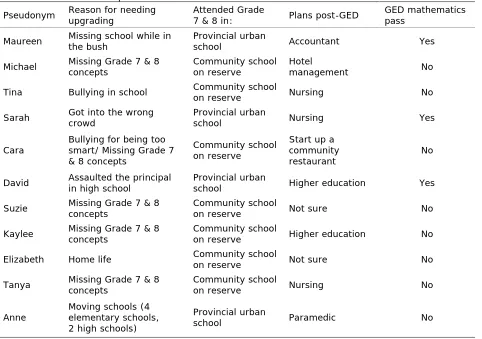
The interview data speaks clearly to the challenges that the students faced in pursuit of their education, and to their resilience in the face of adversity. Table 1 delineates the reasons why each informant was in need of upgrading, whether they attended Grade 7 and 8 in urban or community schools, their plans for post-GED program, and their mathematics GED exam results.
In particular, three students spoke of issues around their home, school, and community lives. The interview and observational data indicated that these issues impacted feelings of power/powerlessness for the informants, feelings that played out inside of the classroom as they attempted to move forward with their learning. They identified challenges such as their home life, not being taught beyond Grade 5, as well as high school boarding out and transfer issues. It should be noted from Table 1 that missing Grade 7 and 8 concepts was only listed as one reason for needing upgrading for students who attended elementary school in their communities. Additionally, of the seven informants that attended elementary school in their community, five listed their reason for needing upgrading as missing Grade 7 and 8 concepts. In the following interview excerpts, all informants have been provided with pseudonyms.
Early Life Experiences
Early life experiences played a crucial role in influencing the students’ attitudes toward their education. At the outer limits, issues of domestic violence by residential school survivors living in her home prevented Elizabeth from learning, thus employing feelings of powerlessness while attempting to engage with her early learning:
Cara recalled returning from the provincial system in the city to her community school in Grade 4, feeling smarter than her classmates because she was ahead in her work:
I was looking forward to math in elementary school. But they kept giving us the same work over and over again. They would give us the same worksheets. I felt smart at first until I finally figured out why they were handing us the same sheet. I felt like I was being laughed at, being played with … like with my emotions, making me think I can do this at the blink of an eye but meanwhile it was the same paper.
The knowledge/power relationship that the informants believed they were enjoying in elementary school began to break down with student transfers to secondary school. In Cara’s case, she came to accept a doctor’s diagnosis of her learning that was based on testing what, to her, was common sense. At the age of 15, Cara was in Grade 7 when she was transferred to high school:
I was sent for the transitional program. I passed Grade 9 and went there until Grade 11. I did not feel comfortable there … In Grade 9 there is a doctor that goes to all the schools and checks the First Nations because that a lot of First Nations have problems when they come from their communities to the city. He gave me a test with blocks and ducks and you had to see how fast you could do it. I felt like
Table 1
Informant educational profiles
Pseudonym Reason for needing upgrading Attended Grade 7 & 8 in: Plans post-GED GED mathematics pass
Maureen Missing school while in the bush Provincial urban school Accountant Yes
Michael Missing Grade 7 & 8 concepts Community school on reserve Hotel management No
Tina Bullying in school Community school on reserve Nursing No
Sarah Got into the wrong crowd Provincial urban school Nursing Yes
Cara Bullying for being too smart/ Missing Grade 7 & 8 concepts
Community school on reserve
Start up a community
restaurant No
David Assaulted the principal in high school Provincial urban school Higher education Yes
Suzie Missing Grade 7 & 8 concepts Community school on reserve Not sure No
Kaylee Missing Grade 7 & 8 concepts Community school on reserve Higher education No
Elizabeth Home life Community school on reserve Not sure No
Tanya Missing Grade 7 & 8 concepts Community school on reserve Nursing No
Anne Moving schools (4 elementary schools, 2 high schools)
Provincial urban
a chimpanzee. The questions were common sense. The test was a half hour long. I was told that it takes me a long time to comprehend things and that I understand better when people show me, not tell me how to do things. Maybe it is hard for me when people talk too fast.
During the interview process, Tracy asked Cara if she agreed with the doctor’s diagnosis. Cara admitted to relinquishing the power she felt in Grade 4 after her experience with the doctor, Cara replied, “Yes, I think he is right.” This answer flew in the face of Cara’s account that she was bullied at the beginning of Grade 4 because “I was the smartest one.”
Michael had a similar experience when he grasped that he had been misled about his own knowledge/power acquisition after transferring schools:
I was transferred into high school because of my height and age. I was 13. The boarding out was alright but it would have been better if I had my mother there to get me up and stuff like that. Coming from a reserve into a big city was basically culture shock. I didn’t catch on right away in high school. I thought I was doing good but then when they tested me I was at a Grade 6 level. It was messed up.
These students recalled events that they believed directly impacted their capacity for staying in school. Elizabeth spoke of beatings that she felt took place as a result of the effects of residential schooling, while Cara’s experiences speak of teachers in her community that gave her the same worksheets over and over, presumably putting their qualifications to be teaching at her grade level in question. Finally, Michael cited billeting as troublesome to his high school experience. Most expressed that their ability to learn was compromised because of various degrees of powerlessness over their education. These early experiences in education appeared to adversely impact the knowledge and power relationships for the informants.
The GED Classroom
habits was discussed both inside Tracy’s classes and in workshops set up by the Director. One-on-one learning in the GED program provided transition for students who had disengaged from the lessons and discussions. One-on-one learning was powerful and liberating for student learning because it helped to fill conceptual gaps and procedural proficiencies, while building trust through bonding.
When asked for written anonymous feedback six weeks into the GED program, Tracy found that the students were honest, some asking her to slow down, and others asking to work in groups of four instead of the horseshoe formation that one participant had requested at the beginning of our sessions together. Some asked for more one-on-one time while others expressed appreciation for their learning. Many enthusiastically told her that they had never been taught directly the concepts contained in mathematics. Tracy believed that when all of the students offered to come to the city for her to deliver additional lessons closer to her home, they were demonstrating optimism in their ability to learn what they needed to pass the exams. These students pooled their vehicles and travelled to the city on their own (unpaid) time for the tutoring sessions to take place. The Director found a classroom where Tracy could teach and paid for their lunch. In the community, Tracy provided a suggestion box at the back of the class every day. During class time the students largely set the pace. Scaffolding quickly became complex because their learning curves were different. Tracy continued assessing for the purpose of providing feedback for the students. She gave them license to write these assessments whenever they felt they were prepared to write them. The students were given many opportunities for formative feedback with these assessments. Tracy felt that deviation from more formal test situations, similar to those with which students had already established a negative relationship, would strengthen their achievement through a transfer of power over their own learning. Additionally, she hoped to provide optimum opportunity for positive impacts on their relationship with classroom norms. She knew not only that the exams were looming but also that the students could not tackle problems without mastering the required procedural competencies. To complicate matters, grasping procedures seemed to require strong conceptual understanding for most of the students. Having taught mathematics to mainstream students out of high school, older adults, and at-risk students for many years, Tracy understood that older adults and at-risk students, who had battled with feelings of powerlessness in their education, generally relied heavily on conceptual understanding. These students often have difficulty working with mathematics that they are not able to conceptualize (Kajander, Zuke & Walton, 2008). Eight of the eleven students admitted that they needed a strong conceptual understanding before they could learn the procedure involved. Based on this insight, Tracy developed conceptual groundwork in all topic areas. She did this by providing visual aids and hands on activities wherever possible to build concepts in geometry and algebra. Additionally, she attempted to provide problems that held meaning for the students and that would lead into the GED exam bank questions.
answer was correct, Tina looked up and said “but I don’t know how to do it.” Never in her 27 years of teaching mathematics had Tracy encountered a similar situation and felt that she needed to reflect on what Tina was really saying. Tracy announced to the class the following day that there were two individuals in the class who did not believe that they understood concepts that they indeed did. Tracy believed that Tina and Kaylee were exhibiting indicators of learning too much, too quickly. It was Tracy’s observation that both Tina and Kaylee were engaging with new knowledge and power that they were understanding, but not internalizing. When Tina was interviewed, she expressed shock that she had been included in Tracy’s list of two students. As the full impact of her power acquisition, she began to speak up in class far more often after the interview, even openly challenging the strongest student in the class.
Transitioning: From upgrading to testing
The exam schedules were inflexible, intensifying the impact of all of the issues identified in our study. Under the GED guidelines, students were forced to write all of their exams in all subjects over a two-day period.
Cracks in some of the factors that mirrored student motivation began to emerge shortly before Tracy was instructed by the Director to begin teaching directly to old GED exams. Attendance was becoming an issue for the first time. Cara preferred to work at home when she did not have the one-on-one time she felt she needed. Kaylee complained openly that they were not being paid when they were late for sessions. Michael grumbled that he was not being allowed to go on the Internet. Eleven weeks in, it was time to drop everything they were doing to study directly for the exam. Tracy’s efforts to develop conceptual understanding were trumped by the need to focus on the procedural.
Many of the students seemed incapable of doing work at home. Overcrowded housing seemed to be the predominant reason with six of the eleven having young children at home to return to after class. For this reason, these students valued their classroom time, concentrating fully on their work while in an environment conducive to learning. Tracy decided that it would be sensible to set up a mathematics “marathon” of sorts, where students would be introduced to the exams over a five day period. In this way, she hoped to have them attempt the exams, and, after marking, take up the questions together in detail before giving them an opportunity to attempt each exam a second time. Her main concern was that students, who were moving forward with their comprehension, thus enjoying increased knowledge and power, would be alarmed at their initial exam results and react by removing themselves from the program. Tracy asked the Coordinator to set up five consecutive days over a long weekend.
Maureen, worked through four mock exams, and had the opportunity to write them twice. Although all of the marks were well below passing on the first attempt, they were above passing on the second. At the next regular session, Tracy handed out copies of all of the exams and solutions to the missing students. She noted that the gap between those who had attended the marathon and those who had not was discernible and altered the tone inside of the classroom. Four students, sensing the power imbalance, quit attending classes. Three students, feeling powerless to pass, did not write the exam. Two students talked throughout much of the exam time until the GED examiner told them if they did not stop, they would have to leave. Cara later told Tracy that she did not do any calculations. She guessed at most of the answers, which were largely multiple-choice. It was Tracy’s view that talking during the exam and guessing at the answers were attempts to regain power that may be lost if they had tried their best during the exam periods.
Students who wrote but who did not obtain the required mark for a GED pass on their mathematics examination were given a second opportunity to write the exam. Tracy returned to the community to tutor the students. One student attended the first day and did not return; Michael appeared once, briefly, promising to come back. He did not. Cara stayed and worked diligently one-on-one with Tracy. They ran out of time. Cara was unsuccessful the second time and did not show up for the sessions that led up to the third exam, for which five students had registered. When Tracy asked her why, Cara told her: “I am fed up because I didn’t pass.” Anne expressed similar frustrations when she was asked why she did not show up for the third set of sessions: “I guess I feel frustrated because I didn’t pass. I think that is why.” Anne, appeared to confirm Foucault’s (1980a) argument when she disengaged because she was no longer able to perform power.
Discussion
Struggles for power seemed to drive the analysis in the study at every turn. The interviews revealed that rebellion was the choice of many of the informants as they attempted to defend themselves from otherwise powerless circumstances in their early education. Throughout the study, Tracy implemented many of the measures she had used in her teaching of at-risk students in the past. She felt this was warranted because all of the students have come from at-risk backgrounds in that they did not graduate from secondary school with their peers. McLaren (2002) would see the students as “spitting in the eye” of the system when they rebelled, in a desperate attempt to take back the power they held at the beginning of the program. Sadly, history may have repeated itself in this regard when the GED students who were not successful with the exam discontinued their efforts despite being offered extensive tutoring. Foucault’s (1980a) argument that knowledge produces power is evidenced by Cara and Anne’s frustrations at testing that confirmed that they did not have an acceptable amount of knowledge to pass the exams. It could be argued that the GED program, working through external sources of power, is itself a form of oppression through which any responsibility for failure can be attributed to the students—not the program.
appropriate to their credentialing (Ontario College of Teachers, 2015). Indeed, these three students represented the target group for which the GED program is intended. For the remaining eight students, they were given three and a half months to complete approximately eight years of education.
Agbo (2002) argued that students are critically impacted by their learning culture. What was the impact of not mastering Grade 8, or even Grade 6, academic competency on the students’ first weeks of high school at 14 years of age in a strange city, living without their family in someone else’s home? The learners were billeted out in the city, believing they were about to learn what they needed to provide them with a powerful future. Instead, they found that there was no opportunity to engage with power from the onset. There was little in the secondary system for many of the participants, and they blamed themselves for their subsequent rebellion.
That all of the students dedicated themselves to the GED program every day, all day, for close to three months before attendance became an issue is nothing short of miraculous, and speaks to their character and will to continue against all odds. These students are people to be admired. That Tracy was backed by her educational and experiential background and tried her best should not be disputed. That Tracy was guilty of encouraging the students to engage with Foucault’s relationship between knowledge and power, knowing that the time frame was likely far too short for them to pass their GED exam is another paper for another time. One cannot help but wonder what long-term effects were experienced by the five students who wrote but did not pass the exams—another failure in their life experience. Certainly, despite being offered additional tutoring without program supports, the students did not return with the same level of motivation that they had displayed early in the program. In fact, the last four tutoring sessions leading up to their supplementary exams were unattended. This observational data alone indicates that the process of being asked to do too much, too quickly, shut down their willingness to further engage in any knowledge/power interactions from that point. Foucault (1980a) argued that power is something that needs to be constantly performed rather than achieved. When asked to study the exam banks, eight of the informants no longer saw themselves as participants in power sharing. For these informants, all engagement necessary to perform was ultimately seen as futile. This study needs to be disseminated because the community likely did not understand all of the elements involved when they agreed to implement the GED program. If funding is the impediment for a program length that will better promote knowledge/power acquisition for First Nations adult learners in similar circumstances, both the funders and the communities need to be informed.
Conclusion
Euro-western solution on a First Nations issue once again has resulted in the slamming shut of the door of possibilities and power for the informants in this study. Clearly, applying Foucault’s knowledge/power relationships provides insights that all power is not within the exclusivity of Government, but that mainstream society has a role to play as well. We need to support and achieve best practices in education that secure promising futures for all children.
References
Aboriginal Affairs and Northern Development Canada. (2011). Aboriginal demographics from the 2011
national household survey. Retrieved from
https://www.aadnc-aandc.gc.ca/DAM/DAM-INTER-HQ-AI/STAGING/texte-text/abo_demo2013_1370443844970_eng.pdf
Alston-O’Connor, E. (2010). The Sixties scoop: Implications for social workers and social work education.
Critical Social Work. 11(1), 53-61.
Agbo, S. (2001). Enhancing success in American Indian students: Participatory research at Akwesasne as part of the development of a culturally relevant curriculum. Journal of American Indian Education
40(1), 31-55.
Agbo, S. (2002). Decentralization of First Nations education in Canada: Perspectives on ideals and realities of Indian control of Indian education. Interchange, 33(3), 281-302.
doi:10.1023/A:1020945418910
Anishinabek Nation. (2015). About Indian residential schools. Indian Residential Schools
Commemoration Project. Retrieved from
http://www.anishinabek.ca/irscp/irscp-about-residential.asp
Berger, T. R. (1991). A long and terrible shadow: White values, Native rights in the Americas. 1492-1992. Vancouver, BC: Douglas and McIntyre.
Chrisjohn, R., & Young, S. (1997). The circle game: Rethinking the Indian residential school experience in
Canada. Penticton, BC: Theytus.
Creswell, J. (2009). Research design: Qualitative, quantitative, and mixed methods approaches. Thousand Oaks, CA. Sage.
Dei, G. J. S. (2003). Schooling and the dilemma of youth disengagement. McGill Journal of Education,
38(2), 241-257.
Deyhle, D., & Swisher, K. (1997). Research in American Indian and Alaska Native education: From assimilation to self-determination. Review of Research in Education, 22, 113-194.
doi:10.2307/1167375
Eisenhart, M. (2001). Educational ethnography past, present, and future: Ideas to think with. Educational
Researcher 30(8), 16-27. doi:10.3102/0013189X030008016.
Foucault, M. (1980a). Prison talk. In C. Gordon (Ed.), Power/Knowledge (pp. 37–52). Brighton, United Kingdon: Harvester.
Foucault, M. (1980b). Two lectures. In C. Gordon (Ed.), Power/Knowledge (pp. 80–105). Brighton, United Kingdom: Harvester.
Foucault, M. (1981). The order of discourse. In R. Young (Ed.), Untying the text: A post-structuralist
reader (pp. 48-79). London, United Kingdom: Routledge, Kegan and Paul.
Fraser, S. (2010). Opening statement to the standing senate committee on First Nations peoples: Indian and Northern Affairs Canada—Education program and post-secondary student support. Office of the
Auditor General of Canada. Retrieved from
http://www.oag-bvg.gc.ca/internet/English/oss_20100512_e_33879.html
Government of Canada (2015a). Aboriginal affairs and Northern development Canada. Retrieved from http://www.aadnc-aandc.gc.ca/eng/1100100015644/1100100015649
Greenway, N. (2002). Racism and Aboriginal schooling. In BC Teachers Federation Aboriginal Education (Ed.), Beyond words: Creating racism-free schools for Aboriginal learners (pp. 3-6). Retrieved from https://bctf.ca/uploadedFiles/Public/AboriginalEducation/BeyondWords(1).pdf
Haviland, J. M., & Kahlbaugh, P. (1993). Emotion and identity. In M. Lewis & J. M. Haviland (Eds.),
Handbook of emotions (pp. 327–339). New York, NY: Guilford.
The Indian Act. (n.d.). The Indian Act. Retrieved from
http://indigenousfoundations.arts.ubc.ca/home/government-policy/the-indian-act.html.
Kajander A., Zuke C., & Walton. G. (2008). Teaching unheard voices: Students at-risk in mathematics.
Canadian Journal of Eduction 31(4), 1039 -1064.
Kurens, J. (2010, May 18). Poor preparation, confusion lead many to fail GED test. Gotham Gazette. Retrieved from http://www.gothamgazette.com/index.php/city/521-poor-preparation-confusion-lead-many-to-fail-ged-test
Lakehead University. (2015). Department of undergraduate studies in education and department of Aboriginal education (EDUC) courses listing. Retrieved from
http://navigator.lakeheadu.ca/~/Catalog/ViewCatalog.aspx?pageid=viewcatalog&catalogid=20&topi cgroupid=9653
Lincoln, Y.S., & Guba, E.G. (1985). Naturalistic inquiry. Beverly Hills, CA: Sage.
McLaren, P. (2002). Life in schools: An introduction to critical pedagogy in the foundations of
education. Boston, MA: Pearson.
McPherson, D., & Rabb, D. (2010). Indian from the inside. Jefferson, NC: McFarland & Company. Mendelson, M. (2006). First Nations peoples and postsecondary education in Canada. Ottawa, ON:
Caledon Institute of Social Policy. Retrieved from www.caledoninst.org/publications/PDF/595ENG.pdf
Ministry of Education. (2012). Education of Aboriginal students. Annual Report of the Office of the
Auditor General of Ontario. Retrieved from
http://www.auditor.on.ca/en/reports_en/en12/305en12.pdf
Neuman, W.L. (2006). Social research methods: Qualitative and quantitative approaches (6th ed.), New
York, NY: Pearson.
Ontario College of Teachers. (2015). Your qualifications. Retrieved from http://www.oct.ca/members/know-your-college/your-qualifications
Richards, L., & Morse, J. M. (2010). ReadMe First for a User’s Guide to Qualitative Methods. Thousand Oaks, CA: Sage.
Rowlands, S. & Carson, R., (2004). Our response to Adam, Alangui and Barton’s: A comment on Rowlands & Carson “Where would formal, academic mathematics stand in a curriculum formed by ethno-mathematics: A critical review”. Educational Studies in Mathematics, 56, 329-342.
doi:10.1023/B:EDUC.0000040370.10717.82
Shields, T.J. (2012). Issues and underlying factors relating to the graduation rates of Aboriginal
students from mathematics programs. Saarbrücken, Germany: Lap Lambert Academic Publishing.
Shields, T.J. (2013). Identity and learning of mathematics for adult First Nations students. Journal of
Educational and Training Studies, 2(1), 63-72.
Statistics Canada. (2004). A profile of Canada’s North American Indian population with legal Indian
status. Ottawa, ON. Retrieved from:
http://www.aboriginalroundtable.ca/sect/stscan/NAI_Status_e.pdf
Truth and Reconciliation Commission of Canada. (2015). TRC findings. Retrieved from http://www.trc.ca/websites/trcinstitution/index.php?p=890
Woods, D. (2006). Coping with math anxiety: A workshop for students. Retrieved from http://www.austincc.edu/math/documents/Coping_With_Math_Anxiety.pdf
Zembylas, M. (2003). Emotions and teacher identity: A poststructural perspective. Teachers and
Tracy Shields has been working with marginalized learners for 30 years. She began by teaching at Seneca
College in their electronics department full time for eleven years, working with college students from Toronto’s most impoverished district. After returning to university to earn her electrical engineering degree, Ms. Shields wrote workbooks for teachers based on the software program Multisim for National Instruments. These workbooks continue to be used globally, including throughout China. Most recently, she has worked with Indigenous learners from remote communities comparing three different upgrading programs in the process. Her masters and doctoral research is in the area of cross-cultural partnership organizations and the empowerment of adult learners. Ms. Shields boasts an extensive understanding of the practical characteristics of marginalized learning, both through her experience and graduate work. She holds a master’s in education. Ms. Shields is expected to graduate from Lakehead University’s doctoral education program in March of 2016. Ms. Shields has presented papers at conferences in Grahamstown, South Africa, Busan, Korea, Herceg Novi, Montenegro, Kunming, China, Halifax, Canada, and St. Catherines, Canada, predominantly in the area of mathematics education for marginalized people. She currently teaches in and directs the upgrading program for Confederation College out of Geraldton, Canada.
Dr. Wayne Melville, a leading expert in science education, has been a faculty member at Lakehead