Isolation and purification of host specific
bacteriophages against human pathogen
from sewage environment
Badrunnisa.S
1, Maya Jose
21,2
Department of Microbiology, Krupanidhi Degree college, Bangaluru, Karnataka, India.
Abstract: Bacteriophages are viruses that infect bacteria. The bacteriophage injects its nucleic acid into the bacterium once attached. The viral nucleic acid is then replicated and incorporated into its protein capsid. The escape of mature viruses from the host cell cause stress on the plasma membrane which leads to death of the bacterium. Bacteriophages are more specific than common drugs, that make them use harmless not only to the host organism, but also to other beneficial bacteria, like gut flora thereby reducing the chances of opportunistic infections. The phage therapy would be expected to give rise to few side effects, as opposed to drugs, and would not stress the liver. Pure cultures were obtained by streaking the organisms on different selective media incubated at 37ºC for 18hrs. A total of six cultures of bacteria were isolated from the sewage water, sampled from the Sewage Treatment plant located at jinke Park, Bangalore. Based upon the colony morphology, biochemical characterization and growth on the selective media, the isolates were identified as Escherichia coli, Salmonella typhi, Shigella spp, Vibrio parahaemolyticus, Pseudomonas aeruginosa, Klebsiella spp. Out of six different isolates, four were found sensitive to the bacteriophages. It was found that the each of the four is olated pathogenic bacteria were able to infect its host respectively. The results of the study suggest the host specific bacteriophages against human pathogens can be readily isolated from sewage eco systems. In addition, these phages have been found to be viable even after 3-4 weeks of isolation, when stored at 4oc in amber or opaque brown containers. This provides an excellent opportunity for the long lasting phages to be used for the prophylaxis of bacterial infections and for the treatment of the bio films
Key words: Escherichia coli, bacteriophage, phage therapy
I. INTRODUCTION
A virus is an agent that is reproduces inside the cells of living hosts. When infected by a virus, thousands of identical copies of the original virus are produced by the host, at an extraordinary rate. More than 2,000 species of viruses have been discovered. Viruses require a specific host cell for its replication so called obligate intracellular parasites [1-4]. Viruses cause disease in plants and animals, and also infect prokaryotes and eukaryotes. Viruses that infect prokaryotes are known as bacteriophages, or phages, Bacteriophages are viruses that infect bacteria. Bacteriophages only reproduce inside bacterial cells. Phages attach to the surface of their host cell by structures called tail fibers. The bacteriophage injects its nucleic acid into the bacterium once attached. The viral nucleic acid is then replicated and incorporated into its protein capsid [1]. The escape of mature viruses from the host cell cause stress on the plasma membrane which leads to death of the bacterium. Bacteriophages consist of nucleic acid (RNA or DNA) surrounded by a protein coat or capsid. Some phages have elaborate structures for attaching to the bacterial surface and injecting nucleic acid into the cytoplasm [1,5,7]. Most bacteriophages are lytic, that is, each infection leads to the production of new virions and lysis of the cell.
1.1 Phage Therapy:
Phages are found useful to eliminate pathogens like Campylobacter and Listeria or to reduce bacteria causing food spoilage [3-7]. In agricultural practice phages were used to fight pathogens like Campylobacter, Escherichia and Salmonella. Recently the phage therapy approach has been applied to systemic and even intracellular infections. Phage therapy can be used as alternative to conventional antibiotic treatments against bacterial infection. Resistance developed by bacteria against phage is more easier to overcome than resistance to antibiotics. Bacteriophages specifically target only one or a few strains of bacteria. This targeting property of bacteriophages reduces the chance of killing useful bacteria when fighting an infection. Some evidence prove the ability of phages to travel to a required site including the brain, where the blood brain barrier can be crossed and multiply in the presence of an appropriate bacterial host, to combat infections such as meningitis. In some cases patient’s immunity can, mount an immune response to the phage [2-3]
II. MATERIAL AND METHODS
Sewage sample was collected from sewage treatment plant, Jinke Park, Bangalore. Sewage sample is selected as a source for the isolation of the microorganisms because sewage contains the organic matter required for the growth of the bacteria and it is a rich source for the isolation of bacteria . The sample should be collected carefully in such a way that;
The sewage is not exposed to sunlight directly as it may cause some biochemical reactions within bacterial cells and bacteriophages may get deactivated . Hence, sewage sample should be collected in dark color reagent bottle.
The dark colored bottle used for the collection of the sewage sample should be filled only to ¾th of the bottle. DO NOT collect the sewage sample without wearing gloves and don’t dip the bottle completely in the sewage for collection.
Wash the hands thoroughly after collection of the sewage sample so as to protect yourself from the infection.
2.1 Serial dilution of the sample:
Serial dilution is done in order to isolate the microorganisms on different general and selective media. Serial dilution decreases the load of microorganisms with the increase in the dilution rate . 9 ml of sterile distilled water was pipette into 6 culture tubes and was kept for autoclaving. After autoclaving, the culture tubes were taken into laminar air flow and 1ml of the sewage sample was added into first culture tube and was labeled as stock. The first tube was mixed well and 1 ml from the stock was added to the second culture tube and was labeled as 10-1. The tube was mixed well and again 1 ml of the solution was transferred into the third tube and labeled as 10-2. The contents of the third tube were mixed well and 1 ml of the sample was added to the fourth tube aseptically, mixed well and was labeled as 10-3. 1 ml of the sample from the 10-3 to the fifth tube and the contents were mixed well and the fifth tube was labeled as 10-4. Again 1 ml of the sample was added to the sixth tube, mixed well and labeled as 10-5. Three different selective media were used and 0.1 ml of the sample from the serially diluted tubes was plated onto the plates using spread plate technique [8-10]. The dilutions which were plated on to the selective media are; Salmonella Shigella Agar (Peptic digest of animal tissue 15.000G/L,Proteose peptone 5.000G/L,
Dextrose 1.000G/L, Lead acetate 0.200G/L,Sodium thiosulphate 0.080G/L, Agar 15.000G/L, Final pH ( at 25°C) 7.0±0.2) : - Stock & 10-1.
Thiosulphate Citrate Bile salts Sucrose Agar (Proteose peptone 10.000G/L, Yeast extract 5.000G/L,Sodium thiosulphate 10.000G/L,Sodium citrate 10.000G/L, Bile 8.000G/L,Sucrose 20.000G/L,Sodium chloride 10.000G/L,Ferric citrate 1.000G/L,
Bromo thymol blue 0.040G/L,Thymol blue 0.040G/L,Agar 15.000,Final pH ( at 25°C) 8.6±0.2): - 10-1 & 10-2. Urinary Tract Infection Agar( Peptic digest of animal tissue 15.000G/L,
Chromogenic mixture 26.800 G/L,Agar 15.000G/L,Final pH ( at 25°C) 6.8±0.2): - 10-2 & 10-3.
The plates were inoculated with the respective dilutions on selective media, incubated at 37oc for overnight. The pure cultures were obtained by streaking the organisms on different selective media.
2.2 Biochemical characterization of the isolated culture:
Biochemical characterization was done to confirm the microorganisms isolated and pure cultured. Only partial biochemical characterization tests were performed such as Indole test, Methyl Red- Voges Proskauers test, Citrate utilization test, Gelatin Hydrolysis test, TSI test (Triple Sugar Iron test) . The different media required for the tests were prepared using distilled water; pH was adjusted accordingly and was autoclaved [10-13].
2.2.1 Gram’s staining:
with decolorizing solution, but then take on the color of the second dye, saffranin are called Gram Negative. Bacterial culture was smeared on to the clean dust and grease free slide and was heat fixed. The smear was flooded with the primary stain crystal violet for 1 minute. After 1 minute, the smear was washed with distilled water and smear was flooded with the iodine solution for 1 minute. After 1 minute, the iodine was washed with distilled water and 95% of ethanol was added to the smear for 30 seconds and again washed with the distilled water. Now, secondary stain safranin was flooded to the smear for 1 minute and washed off with the distilled water. The smear was dried off completely and was observed under oil immersion microscope.
2.2.2 Demonstration of Bacteriophages:
The isolation and demonstration of phages in sewage sample were carried out as per the method described by spencer [4-5, 14-17], ( 5 ml of Mueller hinton broth was prepared, autoclaved and inoculated with the respective organisms. The tubes were incubated at 37oc overnight. 5 ml of overnight culture was added to the 150 ml of Mueller hinton broth in a sterile shake flask together with each of the different bacterial strains in purified isolates and shaken for 2-3 hours. 200 ml of raw sewage was filtered through normal filter paper to remove debris and add to the contents of the flask (150 ml + 5 ml). This mixture was incubated at 25oc for 2-3 hours and then further incubated overnight without shaking. This mixture was centrifuged at 5000 rpm for 30 minutes and filtered through Millipore Membrane Filter (0.22µ). The filtrate was collected in a sterile amber bottle. The filtrate was spotted onto lawns of the bacterium prepared with Mueller hinton agar. The plates were incubated 25oc overnight and examined for the appearance of clear zone of lysis (plaques).
2.2.3 Purification and Mass Multiplication of Bacteriophages:
Materials from the center of the lysis zones were scrapped off using a sterile inoculation loop and transferred to fresh sterile Mueller hinton broth containing the appropriate organism and incubated overnight for about 18 hours at 25oc . The next day, mixture was centrifuged at 5000 rpm for 30 minutes and filtered through Millipore Membrane Filter (0.22 µ). The filtrate was collected in sterile amber bottle. The phage assay was again carried out as mentioned before [17-19]. All the phage lysates were stored at 4oc.
III. RESULTS
A total of six cultures of bacteria were isolated from the sewage water, sampled from the Sewage Treatment plant located at jinke Park, Bangalore. Based upon the colony morphology, biochemical characterization and growth on the selective media, the isolates were identified as Escherichia coli, Salmonella typhi, Shigella spp, Vibrio parahaemolyticus, Pseudomonas aeruginosa, Klebsiella spp. Out of six different isolates, four were found sensitive to the bacteriophages. The bacteriophages isolated belonged to the Genera: Salmonella typhi, Escherichia coli, Pseudomonas aeruginosa, Klebsiella spp.
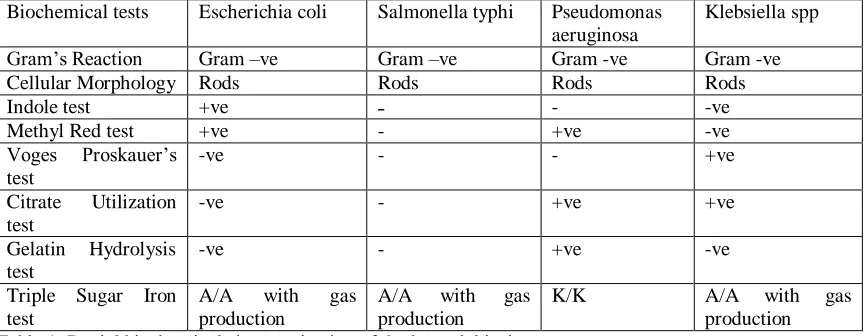
On gram staining the isolates were found out to be gram negative, rod shaped in scattered form. The result of the biochemical characterization is shown in the table below. Results of biochemical tests have included with only those isolates which have shown specificity against bacteriophages.
Biochemical tests Escherichia coli Salmonella typhi Pseudomonas aeruginosa
Klebsiella spp
Gram’s Reaction Gram –ve Gram –ve Gram -ve Gram -ve
Cellular Morphology Rods Rods Rods Rods
Indole test +ve ˗ - -ve
Methyl Red test +ve - +ve -ve
Voges Proskauer’s test
-ve - - +ve
Citrate Utilization test
-ve - +ve +ve
Gelatin Hydrolysis test
-ve - +ve -ve
Triple Sugar Iron test
A/A with gas production
A/A with gas production
K/K A/A with gas
production Table 1: Partial biochemical characterization of the bacterial isolates
Figure 01. Phage for (a) salmonella (b) pseudomona Aeurginosa (c) E. coli (d) Klebsiella
(a) (b)
(c) (d)
Figure 02. Host Specificty test against (a) salmonella (b) pseudomona Aeurginosa (c) E. coli (d) Klebsiella
(c) (d)
IV. DISCUSSION
This study, isolated the bacteriophages against the human pathogens such as Salmonella typhi, E. coli, Klebsiella, Pseudomonas aeurginosa. The host range of bacteria was determined by spot test (Armon and Kott, 1993).
It was found that the each of the four isolated pathogenic bacteria were able to infect its host respectively. The bacteriophage for Salmonella was able to infect Salmonella bacterium only but not Klebsiella, Pseudomonas and E. coli. Phages for Escherichia coli were able to infect E. coli only and phages for Klebsiella were able to infect Klebsiella only. Many bacteriophages show high specificity for their receptors and show little or no interaction with receptors [4, 19, 22]. The host specificity forms the basis of phage typing methods for indentification of bacterial species.
The bacteriophage for Pseudomonas was able to infect not only its host bacterium but also was able to infect Klebsiella. This showed that Pseudomonas phage is having a broad host range of infection. It is known that some bacteriophages do infect a range of bacterial species productively. Numerous studies have revealed the presence of large numbers of virus particles in aquatic and other eco systems [5-8]. These observations can partially be explained by the existence of broad- host- range bacteriophages
The study suggest the host specific bacteriophages against human pathogens can be readily isolated from sewage eco systems. Present findings are supporting with the works done by Jensen et.al (1998) [9, 23]. They had isolated broad-host-range lytic bacteriophages from sewage. In addition, these phages have been found to be viable even after 3-4 weeks of isolation, when stored at 4oc in amber or opaque brown containers. This provides an excellent opportunity for the long lasting phages to be used for the prophylaxis of bacterial infections and for the treatment of the bio films .
Further study require on the following:
Isolation of bacteriophages from Sea Water as it’s a rich source of many bacterial species and a comparison study can be done with isolates of bacteriophages from Sewage and Sea water which shows more Specificity and Efficiency in Infection.
The study pertained to the bacteriophages can further carried out along with electron micrograph to elaborate the structure of bacteriophages.
By varying the nutrients constituents the media used while isolating the bacteriophages and purification steps, comparative study can be carried which will give information of the ability of infection of bacteriophages at different varied concentration of nutrients in the media [24].
V. CONCLUSION
VI. REFERENCES
[1] Beaudin, Rene. N: Deresaro, Danielle. R, Debralu. L & Barbaro, Susan. E (2007). Isolation of Bacteriophage from Sewage Sludge and
Characterization of it’s Bacterial Host Cell Rivier Academic Journal, vol 3, 1:1-8.
[2] Carlton, R. N (1999). Phage Therapy: Past History and Future Prospectus Archium Immunologiae Therapiae experiments, 47: 267-274
[3] Duckworth DH, Gulige PA (2002). “Bacteriophages: Potential Treatment for Bacterial Infections”. BioDrugs 16(1): 57-62.
[4] Mahadevan M.Sunder, Nagananda G.S, Arijit Das, Sourav Bhttacharya and Sundeep suryan(2009)Isolation of host-specific bacteriophages
from sewage against human pathogens.Asian journal of Boitechnology,1:163-170).
[5] Baleht, Aldona & Smith, Raymond (1994). Pseudomonas aeruginosa: Infections and Treatment. Informa Health Care. Pp 83 -84.
[6] Bergh, G. Borsheim, G. Brathak, & N. Heldal (1989). High abundance of viruses found in aquatic environments. Nature 340:467 -468.
[7] Breed, R. S; Mttray, E. G. D & Smith, N. R (1957). Bergey’s Manual of Determinative Bacteriology, 7th Edition, pp: 35, wilkins Co,
Baltimore.
[8] Doring G. Pier GB (2008). “Vaccines and Immunotherapy Against Pseudomonas aeruginosa”. Vaccine 25(8): 1011-24.
[9] Ellen, C. Jensen, Holly S. Schrader, Brenda Rieland, Thomas C. Thompson, Kit W. lac, Kenneth W. Wickerson and tylere A. Kokjo hn
(1998). Prevelance of the Broad Host Range lytic Bacteriophages of Spacrotilcus natans, E. coli, P.A Applied and Environmenta l Microbiology, pp. 575-580.
[10] Flint, S.J; Enquist, L.W; Krug, R. M; Raeaniello, V.R and Shalka, A. M (2000). Principles of Virology, 1:3-15, ASM Press; Washington.
[11] Fuhrman, J.A and C.A Suttle (1993). Viruses in marine planktonic systems oceanography, 6:51-63.
[12] Guttman, B; Raya, R and Kutter, R (2005). Basic phage biology in: Bacteriophages: Biology and Applications, CRC Press, Bosca Rutan
FL, 29-66.
[13] Harrigan, W,F and Mc Cancer, M.E (1996). Laboratory methods in Microbiology, pp.51, Academic press, New York.
[14] Harshey, R.M (1998). Phage Mu. P. 193-234. Inr. Callender (ed), The Bacteriophages, vol 1. Olenum Press, New York.
[15] Hayer, W. (1968). The genetics of bacteria and their viruses, 2nd ed. Blackwell Scientific Publications ltd, London , United kingdom.
[16] Henner, K.P and M Simon (1995). Significance of Bcateriophages for controlling bacterioplankton growth in a mesotrophic lake, Appl
Environ. Microbial. 61:333-340.
[17] Hidake, T (1971). Isolation of Marine Bacteriophages from Sea Water. Bulletin of Japanese Society of Scientific Fischerier, Kagoshinihn
University, vol 37, 12:1199-1206.
[18] Johnson, R.M (1968), J. Arizona Acad, sci, 5:28-33.
[19] Kannan, M (2002). Laboratory Manual in General Microbiology, pp:117-119, Panima Publishing Corporations, New Delhi.
[20] Kriss, A.E and Rukina, E.A (1947). Rept. U.S.S.R Aead, sci 57:833-836.
[21] Machigan MT, Martinko JM (2006). Brock Biology of Microorganisms (11th ed). Pearson.
[22] Marsh, p, and E.M.H Wellington (1994). Phage Host Interactions in Soil. FEMS Microbial E. coli 15:99-108.
[23] Pedro’s- Alico;C, (1993). Diversity of Bacterioplankton. Trends E coli. Vol 8:86-90.