© 2017 AJAST All rights reserved. www.ajast.net
Crop Disease Identification Using a Feature Extraction HOG Algorithm
J.Jeya Priyankha
1and K.Suresh kumar
21UGStudent, Department of Electronics and Communication Engineering, IFET College of Engineering, Villupuram, India.
2Senior Assistant Professor, Department of Electronics and Communication Engineering, IFET College of Engineering, Villupuram, India.
Article Received: 21 March 2017 Article Accepted: 30 March 2017 Article Published: 02 April 2017
1.INTRODUCTION
Agriculture is the important source of the income in India. Agriculture sector plays a strategic role in the process of economic development of a country. It has already made a significant contribution to the economic prosperity of advanced countries and its play vital role in the economic development of less developed countries. Agriculture helps to gather the basic needs of human and their society by providing food, clothing, shelters, medicine and recreation. Agricultural development is multidirectional having galloping quickly and rapid extend with respect to time and space. After green revolution, farmers started using increase cultural practices and agricultural inputs in severe cropping systems with laborers intensive programmes to enhance the manufacturing potential per unit land, time and input.
Agriculture is mainly depends on economic growth in India. Most of India families are immigration for most important work is agricultural. Gross domestic product in India, agricultural contribution about 16%. Agricultural production is not only rice. Agricultural product also includes rice, Wheat, potato, tomato, onion, mangoes, sugarcane, beans, cotton, etc. All people and Animal play food essential role of living in this world. Based on agriculture experts, India had been ranked seventh in term of agriculture process. According to census, 56.6% of people are mainly working in agriculture. Agriculture also plays an important role in the industry. Agricultural product also includes rice, wheat, potato, tomato, onion, mangoes, sugarcane, beans, cotton, etc. All people and animal play food essential role of living in this world. Based on agriculture experts, India had been ranked seventh in term of agriculture process.
Industry need ray material such as cotton, sugar; tobacco, etc. is supplying from agriculture. Many countries interact with other countries, because, agricultural produce the importing and exporting the product. Agriculture is also used for improving soil structure and reduces pollution. Crop diseases are important contributor to decrease the agricultural yield
and increase the agricultural economic loss. Compared to farmers, computer vision is able to find the diseases accurately and have less time to detect. There are various approaches used for identifying and classifying the crop diseases. Crop disease identification is very essential to improve agricultural yield.
2. LITERATURE SURVEY
Various algorithms and technique used for crop disease identification. Sushil R. Kamlapurkar proposed approach used to identifying plant leaf diseases. In this paper feature extraction used for Gabor filter and after performing feature extraction, classified the plant leaf diseases using artificial neutral network. The main disadvantage of this paper is computational complexity [1].
Surender Kumar and Rupinder Kaur proposed another approach to identifying the plant diseases; this paper is use segmented the infected part using based on threshold value, based on the edge, based on similarities and dissimilarities region segmentation done. After performing segmentation, extracted the feature using the color occurrence method, gray level co-occurrence matrices. Classified the crop diseases using linear and nonlinear filter [2].
Sasirekha and Swetha proposed approach to identify the various leaf diseases using data mining techniques. Data mining technique has various disadvantages. There are securities issues occur in data mining technique and occur the privacy issue. The main drawback of data mining technique has provided inaccurate information about the operation [3]
Malvika Ranjan, Manasi Rajiv weginwar, Neha Joshi, Prof. A. B. Ingole proposed approach for detected and classified the leaf diseases. This paper extracted the feature by converting RGB format in hue saturation. From the hue, saturation value extracted the future. Based on the feature classified the leaf diseases using artificial neutral network [4]. A B S T R A C T
Crop diseases may lead to severe agricultural yield. Hence classification and identification of crop diseases is essential to improve the agricultural yield. Various methods have been proposed to identifying the crop diseases, but the accuracy is considered to be issue over all the researches performed so far. In proposed system, the image is taken, preprocessing the image. The preprocessed image is subjected to K means clustering to get infected part of the leaf. The infected part is subjected to morphological processing to expanding the infected area. The infected part of leaf is subjected to histogram of oriented gradient (HOG) algorithm to extract the features. SVM classifier is used to identify and classify the diseases based on the extracted feature.
© 2017 AJAST All rights reserved. www.ajast.net Prof. Sanjay B. Dhaygude, Mr. Nitin P. Kumbhar proposed
the approach, extracted feature using the color co-occurrence method and evaluation diseases using texture statistics [5].
Loyce Selwyn Pinto, Argha Ray, M. Udhayeswar Reddy, Pavithra Perumal, Aishwarya proposed the approach used to separate the infected part using K means clustering algorithm. After feature extraction classified the diseases using SVM [6].
Jagadeesh D. Pujari Rajesh Yakkundimath Abdulmunaf S.Byadgi proposed the approach used to extract the feature using gray level occurrence matrix and classifying the crop diseases using nearest neighborhood classifier in classification algorithm [7].
P.Revathi, M.Hemalatha proposed the approach used to segment the infected part of image using edge detection. Classifying the diseases using Homogeneous Pixel Counting technique for Cotton Diseases Detection (HPCCDD) [8].
Amandeep Singh, Maninder Lal Singh proposed the approach used to convert RGB image into HSI image and then segmented the infected part using morphological operation. Comparison the training set to classifying the crop diseases [9].
Jayamala K. Patil, Raj Kumar was proposed the approach used to separate the infected part using threshold based segmentation technique and classifying the diseases using Self-Organizing Map (SOM) neural network classifier [10]. These are various technique to find the crop diseases technique. Compared to existing technique the accuracy is very high in proposed system. In proposed system increase PSNR value of image, it is provide a high quality to find the diseases.
3. PROPOSED SYSTEM
Block diagram shows the step involved in to classify the crop diseases. The first stage is image was captured by digital camera, then performing preprocessing, the preprocessing used two steps, there is image enhancement used to highlight the certain feature in that image and convert RGB to CIELAB, this conversion used for the uniformly distributed the color or intensity and then segmented the infected part only using k mean clustering algorithm, after performing morphological processing, it's used for increase the size of infected part.
After performing the morphological processing extracted the extracted the features using histogram of oriented gradient (HOG) algorithm, extracted the feature from dilated image. After classifying crop diseases based on a comparing training database into test image using the SVM classifier. The main purpose of used to k mean clustering is improving the accuracy of image identifying diseases compared to other segmentation algorithm and increase quality that image that means that increase the PSNR value of the image. SVM classifier is efficiently used to large number of dataset and easy to implement the SVM classifier compared to other classifier technique.
Calculate
Accuracy
Fig.1. Block diagram for proposed system
4. STEPS INVOLVED IN PROPOSED SYSTEM 1) Image Capturing
Digital camera used capturing the infected leaves. Captured image must be having RGB format. To take the input as sunflower leaf and identifying the diseases.
2) Image Preprocessing
Image preprocessing considered two steps a. Image enhancement, b. Transformation.
a. Image enhancement
Captured image enhancement using contract stretching. It used to highlight the certain feature present in that image. Advanced image enhancement technique is used to improve the accuracy of operation. It is also used to uniformly distribute to the intensity value.
b. Transformation
© 2017 AJAST All rights reserved. www.ajast.net offer information about color range from green to red, be part
offer information about color range from blue to yellow.
L=O.2126*R+0.7152*G+0.0722*B
A=1.4749*(0.2213*R-0.3390*G+0.1177*B)+128 B=0.6245*(0.1949*R+0.6057*G-0.8009*B)+128
The L part cannot give perfect information. So, removed L part. A and B part taken account for further processing. A and B component taken account for further processing.
3) Segmentation and Morphological Process
Separating only infected part from leaves. K means clustering used for the segmentation purpose. There are two clustering points-set, based on the clustering point grouped separately only the infected part. Step involved in K means clustering. These step involved in k means clustering are:
a) Set the cluster values
b) Every pixel of image assigns minimum distance between cluster
c) Recomputed the cluster value by taking average of pixel value
d) Step 2.and 3 do again until there is no change in cluster value
These are the following step used in K mean clustering segmentation algorithm to segment only infected part.
(a) (b)
Fig 2: (a) infected leaf (b) separate the infected part using k means clustering
Morphological Processing
Infected part of the image is expanded using dilation in morphological technique. Dilation process is used to compare the neighborhood pixel and replace the maximum intensity value.
4) Feature Extraction
After performing the segmentation process to extract the feature using histogram of oriented gradient. Step involved in finding HOG is given below:
a) Divide the image into cells the segmented image. b) Calculate the gradient and magnitude of each cell c) Mapping the binning based value of gradient and
magnitude
d) Block normalization
e) Compute the feature like mean, skewness contract, entropy, homogeneity, and kurtosis.
a. Mean
It is a measure the average value of the element in the image array dimension. It is measure average value of element in the segmented image.
Mean=(sum of pixel value)/(total number of pixel)
b. Skewness
It is an evaluate of the probability of the asymmetry region. Skewness=(third moment of mean)/(standard deviation^3) This is formula for finding skewness of the infected leaf of segmented part.
c. Contract
It is measure the intensity difference between a pixel and its neighbor pixel over the whole image.
d. Entropy
It is measure the average value of all pixel value in that image.
e. Homogeneity
It is measure the closeness distribution in image diagonal to image diagonal.
f. Kurtosis
It is used to measure of the probability distribution of a true valued unsystematic variable.
Kurtosis=(fourth central moment)/(standard deviation^4)
5) Classification
Support vector machine is used to identifying and classifying the crop diseases in sunflower leaf. SVM is following the principle of hyperplane. Hyperplane is used to divide into two classes based on the training dataset. Identifying and classifying the diseases in very accurate manner compared to other machine learning algorithm classifier.
6) Calculate Accuracy
Formula used to calculate the accuracy is given below Accuracy=[(no of right prediction)/(total no of sample present)]*100
This formula is used to calculate accuracy of prediction of each disease as given as input. Compared to existing system, proposed system can be predicted the diseases in very accurately.
5. EXPERIMENTAL RESULT
The feature parameter like skewness, contract, entropy, homogeneity and mean, kurtosis is used to classification of diseases.
MATLAB is used to implement and stimulating the proposed system and find the accuracy of prediction of diseases. In this paper find the power mildew, rust, leaf spot of the diseases in sunflower leaf. In this paper also predicted whether sunflower leaf is healthy leaf cannot affected by any diseases and infected leaf.
Input image:
© 2017 AJAST All rights reserved. www.ajast.net
Preprocessing image:
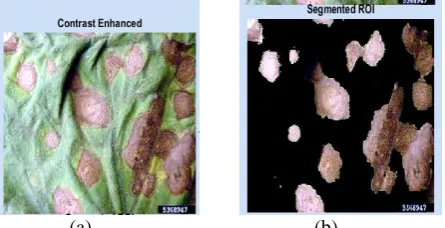
Highlight the feature present in image
Segmented image:
Segmented the image based on the similar colour present in that image using K means clustering. It is work effectively compared to other segmentation algorithm.
Feature extraction:
Feature extraction using a histogram of oriented gradient (HOG) algorithm.
Classification and calculate accuracy:
6. CONCLUSION
In this paper, we can conclude that image processing is used to identification and classify the diseases in a very accurate manner. To improve the accuracy by using various advanced enhancement techniques. The SVM classifier is able to classifying the diseases in better accuracy. To take input as video image, processing the input using HOG algorithm and identify the diseases
REFEENCES
[1] Sushil.R.Kamlapurkar, “Detection of plant leaf diseases using image processing approach”, International journal of
scientific and research publication, volume 6, issue2,
February 2016.
[2] Surrender Kumar Rupinder Paur, “Plant disease detection using image processing-a review”, International journal of
computer application, volume 124-no 16, august 2015.
[3] N.Sasirekha, N.Swetha, “An identification of variety of leaf diseases using various data mining techniques”,
International journal of advanced research in computer and
communication engineering, vol.4, issue 10, October 2015.
[4] Malvika Ranjan, Manasi Rajiv Weginwar, Neha Joshi, A.B.Ingole, “Detection and classification of leaf diseases using artificial neural network”, International journal of
technical and applications, May-June 2015.
[5] Sanjay B.Dhaygude, Nitin P.Kumbhar, “Agricultural plant leaf disease detection using image processing”,
International journal of advanced research in electrical,
electronics and instrumentation engineering, vo.2, issue1,
January 2013.
[6] Loyce Selwyn Pinto, Argha Ray, M.Udhayeswar Reddy, Pavithra Perumal, Aishwarya, “Crop diseases classification using texture analysis” IEEE international conference on
recent in information communication technology, May
20-21, 2016, India.
[7] Jagadeesh. D, Pujari Rajesh, Yakkundimath, Abdulmunaf S.Byadgi, “Identification and Classification of Fungal disease Affected on Agriculture/Horticulture Crops using Image Processing Techniques” 2014 IEEE International Conference on Computational Intelligence and Computing Research.
[8] P.Revathi, M.Hemalatha, “Classification of Cotton Leaf Spot Diseases Using Image Processing Edge Detection Techniques”, 2012 - International Conference on Emerging Trends in Science, Engineering and Technology.
[9] Amandeep Singh, Maninder Lal Singh, “Automated Color Prediction of Paddy Crop Leaf using Image Processing” 2015
IEEE International Conference on Technological
Innovations in ICT for Agriculture and Rural Development (TIAR 2015).
[10] Jayamala K. Patil, Raj Kumar, “Advanced in image processing for detection of plant diseases”, Journal of Advanced Bioinformatics Applications and Research ISSN
0976-2604 Vol 2, Issue 2, June-2011, pp 135-141.
[11] Asma Akhtar, Aasia Khanum, Shoab Ahmed Khan and Arslan Shaukat, “Automated Plant Disease Analysis (APDA): Performance Comparison of Machine Learning Techniques”,
11th International Conference on Frontiers of Information
Technology, 2013.
[12] Dheeb Al Bashish, Malik Braik, Sulieman Bani-Ahmad, “A Framework for Detection and Classification of Plant Lead and Stem Diseases”, 2010 International Conference on
© 2017 AJAST All rights reserved. www.ajast.net [13] Manisha A. Bhange, H.A.Hingoliwala, “Detection of
Bacterial Blight on Pomegranate Leaf”, International Journal on Recent and Innovation Trends in Computing and
Communication, Volume: 3 Issue: 6, ISSN: 2321-8169 3682 -
3685, PP 3682-3685, June 2015.
[14] Bindushree H B, Sivasankari G.G, “Detection of Plant Leaf Disease Using Image Processing Techniques”,
International Journal of Technology Enhancements and
Emerging Engineering Research, Vol 3, Issue 04, ISSN:
2347-4289, PP 125-128.
[15] http://data.worldbank.org/indicator/NV.AGR.TOTL.ZS,
Last accessed: 31 March, 2016.
[16] "CIA Factbook: India". CIA Factbook. Central Intelligence Agency. Archived from the original on 11 June
2008. Retrieved 2008-06-10.
[17] Staff, India Brand Equity Foundation Agriculture and
Food in India Accessed 7 May 2013.
[18] http://www.isec.ac.in/Sunflower-Production.pdf, Last accessed: 31 March, 2016.
[19] Sanjay B. Dhaygude, Nitin. P.Kumbhar “Agricultural plant Leaf Disease Detection Using Image Processing”,
International Journal of Advanced Research in Electrical,
Electronics and Instrumentation Engineering Vol. 2, Issue
1,PP 599-602, ISSN: 2278 – 8875,, January 2013.
[20] Rupesh G. Mundada, V.V.Gohokar, “Detection and Classification of Pests in Greenhouse Using Image Processing”, IOSR Journal of Electronics and
Communication Engineering (IOSR-JECE), Volume 5, Issue
6, PP 57-63, Mar. - Apr. 2013.
[21] S. Arivazhagan, R.Newlin Shebiah, S.Ananthi, S. Vishnu Varthini, “Detection of unhealthy region of plant leaves and classification of plant leaf diseases using texture features”,
AgricEngInt: CIGR Journal Vol. 15, No.1, pp.211-217,