A Comparative Analysis of Digital Image
Processing Techniques on Real Time Traffic
Control Systems
1
Detty M Panicker, 2 Radhakrishnan B
1 P.G Student, Department of Computer Science and Engineering
Baselios Mathews II College of Engineering, Lake View, Muthupilakkadu, Sasthamcotta Kollam, Kerala, India
2
Asst. Professor, Department of Computer Science and Engineering
Baselios Mathews II College of Engineering, Lake View, Muthupilakkadu, Sasthamcotta Kollam, Kerala, India
Abstract -Traffic control is considered as one of the fastest developing technologies in the world. In India with the growing number of vehicles, traffic jam at junctions has become a serious issue. Normally Traffic police, Timers, Electronic sensors are used to control the traffic jam. But nowadays, image processing techniques are used to control traffic. This paper discuss about the various traffic control techniques and their comparisons. In order to reduce the traffic problems real time traffic control system using image processing is very advantageous.
Keywords -Traffic light, Image Processing, Image Matching, Edge Detection,Background Subtraction.
1. Introduction
In modern life we have to face many problems, one of which is traffic congestion becoming more serious day by day. As we know the population of the city and number of cars is increasing day by day, the simplest way for controlling a traffic is to use traffic light with sensors. Traffic lights play a very significant role in traffic control and regulation on a daily basis. The traffic lights that are used nowadays comprise of three lights: Red for stop, Yellow for wait and Green for go. Users are made to wait for the signal to change from red to yellow and then from yellow to green. In another way electronic sensors are used to detect vehicles, and produce signal for traffic control, but time is being wasted by a green light on an empty road. In doing so, the images for each lane from the traffic are taken and it processed simultaneously on the basis of image processing. Images taken from the
camera are processed in a step by step approach. Such as Image Enhancement, Image Segmentation, Morphological operation, Vehicle Detection and Vehicle Counting methods. And decision is passed as to which lane should be given how much amount of time and which should be the highest priority.
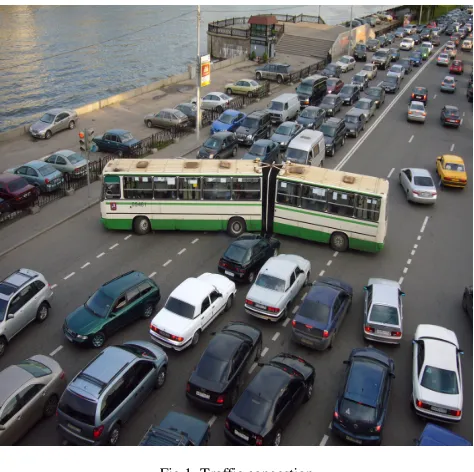
Fig 1. Traffic congestion
various techniques and its related research work. Section III presents the application of different techniques in traffic light control system. Section IV presents the comparison of real time traffic control system using image processing and Section V presents Conclusion.
2. Literature Review
Techniques
There are different image processing techniques used for detecting and counting vehicles. A web camera is placed on highways nearby traffic lights that captures the still images of the road where the traffic need to be controlled. Then the captured images are compared with a reference image. The traffic is governed according to this percentage of matching. In another technique, captured images undergoes some morphological operations to get the count. The traffic is governed according to this vehicle count. In vehicle detection several methods like Edge detection, Background subtraction, Optical Flow, Segmentation, Frame differing..etc are used and in vehicle counting Gaussian mixture model(GMM) and Blob analysis are used.
2.1 Vehicle Detection
Vehicle detection is a fundamental component of image-based traffic monitoring system. There are different types of techniques for vehicle detection.
2.1.1. Edge Detection
Edge detection refers to the process of locating and identifying sharp discontinuities in a digital image. The discontinuities are abrupt changes in pixel intensity which characterize boundaries of objects in a particular image. Classical methods of edge detection involves convolving the image with an operator, which returns values of zero in uniform regions otherwise it is constructed to be sensitive to large gradients in the image .
Chandrasekhar. et.al. [1] presents a traffic control method by using edge detection. The captured images are compared with a reference image. Edge based matching is the process in which two representatives of the same objects are paired together and any edge or its representation on one image is compared and evaluated against all the edges on the other image. Edge detection of reference and the real time images has been done using the Canny edge operator. Then these edge detected images are matched and accordingly the traffic durations can be set[2].
Kavya. P Walad. et.al. [3] presents the existing traffic light control system and their drawback and image processing techniques. Many edge detection techniques have been developed for extracting edges from a digital image. There are two different edge detection operators in image processing. Gradient based classical operators like Robert, Sobel , Prewitt operator and Laplacian based operators like canny detection. Edge detection technique specially addresses the problem of image enhancement. The canny edge detection algorithm gives best performance even in noise condition compare to other first order edge detection.
P. Srinivas. et.al. [4] discuss about canny edge detection. It works by first smoothing the images and finds the image gradient to highlight regions with high spatial derivatives. Then tracks along these regions to suppress any pixel that doesn’t satisfies the maximum level. Finally, through hysteresis, it uses two thresholds to detect strong and weak edges. Here it includes the weak edges in the output only if they are connected to strong edges.
2.1.2. Background Subtraction
Background subtraction method is used in segmentation. The basic of background subtraction method is it initiates the background first and subtracts the current frame from background frame.
Meru. A.V et.al. [5] outlines different vehicle detection techniques. In this paper foreground is vehicles and background is road. It provides better output than optical flow method and frame differing method. Background subtraction algorithm detect the vehicles in each of the four way road.
|fg(x,y)-bg(x,y)|>Th (1)
In Eq. (1), fg(x,y) is the foreground pixel frames. bg(x,y) is the background pixel frames. Th is the threshold level value.
Mahesh C. Pawaskar et.al.[6] presents frame difference in background subtraction. In this method, the current frame is simply subtracted from the previous frame and if the difference in pixel values for a given pixel is greater than a threshold (Th), the pixel is considered part of the foreground . For a variety of dynamic environment, it has strong adaptability, but it is generally difficult to obtain a complete outline of moving objects, liable to appear the empty phenomenon, as a result the detection of such moving objects is not accurate.
to calculate the image optical flow field. And clustering is done according to the optical flow distribution characteristics of image. In method we get the complete movement information and detect the moving object from the background environment better, however, a large quantity of calculation, sensitivity to noise, poor anti-noise performance, make it not suitable for real-time demanding occasions.
2.1.3. Traffic Queue Detection Algorithm
Fathy M. et al. [8] proposed a method based on applying the combination of noise insensitive and simple algorithms on a number of sub-profiles (a one-pixel-wide key-region) along the road. The proposed queue detection algorithm consists of motion detection and vehicle detection operations, both based on extracting edges of the scene, to reduce the effects of variation of lighting conditions. To reduce the computation time, the motion detection operation continuously operates on all the sub-profiles, but the vehicle detection is only applied to the tail of the queue.
Alok T. et al. [9] Discussed about Algorithm which measure basic queue parameters such as period of occurrence between queues, the length and slope of occurrence.
2.1.4. Morphological Operations
Morphology is a broad set of image processing operations that process images based on shapes. The morphological operations apply a structuring element to input images and creating an output image of the same size. In a morphological operation, the value of each pixel in the output image is based on a comparison of the corresponding pixel in the input image with its neighbours. Bharti. Sharma et.al.[10] presented differential morphological profile in automatic vehicle detection from traffic images. Mathematical morphology has been applied to a wide variety of practical problems such as noise filtering, Image segmentation, shape detection, decomposition, pattern recognition. Differential Morphological Profile (DMP) is used to create a feature vector from a single image. For closing and opening reconstructions, dilation and erosion morphological operations are used.
2.1.5. Segmentation
Pradip Singh Maharjan et.al.[11] presents BLOB segmentation for vehicle detection. Thresholding method was used to convert the gray scaled image to binary
image. After background subtraction several background pixels that have similar intensity level with object pixels are seen , so multilevel thresholding with two threshold values T1 and T2 were used. If the pixels intensity value p(x,y)>T2, it is considered as an object, otherwise it is background. After thresholding, the result is inverted; the black background is converted into white color whereas the white portion or detected objects are represented by black color. After morphological operation on the binary image, the vehicles are clearly distinguished. Edges of the objects are sharp and smooth hence vehicles could be detected easily and counted. The images was scanned from top to bottom for detecting the presence of Binary Large Objects (BLOB).
S. Siddharthy et al. [12] have used both region growing based background subtraction approaches for detecting the object by image segmentation algorithm using FPGA (where FPGAs are well suited for the implementation of fixed point digital signal processing algorithms).
2.2 Vehicle Counting
Counting of vehicles is important for the traffic control system. Counting process is done for each of the four way road.
Hyeok Jang et.al.[13] discuss Gaussian Mixture Background Model for vehicle counting. To extract objects, the Gaussian Mixture Background Model is used to separate the foreground and background. Gaussian Mixture Model proposed by Stauffer is used for detecting unexpected situations in case of external environmental changes. In theory, it is possible to model a background with one Gaussian distribution when the single background has a certain degree of brightness. However, the brightness of a background varies gradually over time. Thus, the adaptive Gaussian distribution is used for modeling this. If there exists a pixel value that does not belongs to a Gaussian distribution for background, then it is foreground. When there are K Gaussian distributions, the collection of pixel samples for background will be { X1…..Xt }.
, , and , represent the weighted value, mean value and covariance matrix of i th Gaussian Model when the time is t hours .
η means probability density function and it can be expressed as shown in Eq. (3).
G. Salvi et.al.[14] presents Blob analysis for vehicle counting. In the blob detection model, foreground pixels are grouped in the current frame, together by utilizing a contour detection (CD) algorithm. The CD algorithm groups the individual pixels into disconnected classes, and then finds all contours surrounding each class. Then these classes are marked as Candidate Blob . These Candidate Blob (CB) are then checked by their size and then small blobs are removed from the algorithm to reduce false detections. The blob analysis module is one of the most important stages in the pipeline. This module receives as input the Candidate Blob with position, and compares with the blobs in the current video frame and identifies which CB in the current frames belong to the same vehicle. The positions of the CB, in current frames, are compared using the k-Means clustering. The moving vehicle is counted when it passes the base line within the ROI.
3. Application
Vikramaditya Dangi et.al. [15] Propose the way to implement an intelligent traffic controller using real time image processing techniques. The image sequences from a camera are analyzed using various edge detection and object counting methods to obtain the most efficient technique. Subsequently, the number of vehicles at the intersection is evaluated and traffic is efficiently managed. The paper also proposes to implement a real-time emergency vehicle detection system. In case an emergency vehicle is detected, the lane is given priority over all the others. The key point in this paper is the edge detection technique. The authors have given the comparison of various edge detection techniques and conclude that canny edge detection is the best method for edge detection. V. Parthasarathi1 et.al.[16] discuss vehicle detection and counting. To obtain vehicle detection the current frame and the Background frame are converted to gray scale and the images are compared and subtracted to obtain presence of objects on the road. Morphological operations such as dilate & erode are carried out to remove the additional noise in the image and this image
is further enhanced and it is converted to binary image .This image is then filtered using Gaussian filter to obtain the vehicles on the road. Then count the number of vehicles. To achieve these sets of connected pixels are labeled which are vehicles & they are marked with a bounding box.
Koller et al. [17] proposes a method which analyse traffic scenes. The information related to scene is used to optimize traffic flow during busy period, identify stalled vehicles and accidents and making the decision of an autonomous vehicle controller. They use kalman filter which used to extract vehicle trajectories from sequence of images. Symbolic reasoned based on dynamic belief network. The symbolic language on the road gives the information about traffic events such as vehicle lane changes and stalls.
4. Issues and Challenges
• Edge detection techniques helps to find the
traffic density. Depending on the application different edge detection operators are available. Some are sensitive to certain types of edges, speed and efficiency may differ, sensitiveness to noise differs, localization and orientation sensitivity differs according to operator. In these cases a quantitative evaluation of performance requires use of images where true edges are known. Canny edge detection gives best performance even in noise condition compare to other first order edge detection. And canny edge detection is costlier, takes more computation time and high response to weak edges than other operators [2].
• Basic process such as edge detection generally requires a neighbourhood of at least 9 pixels to be examine before an output pixel value computation. Thus, the no of pixel memory assesses is ready 10 times that is given by the basic pixel processing rate [18].
• In background subtraction, optical flow method
is more complex and more calculations are needed. It doesn't produce better output for the traffic control system [5].
• In Frame differencing method pixel by pixel
• Histogram-seeking method may be difficult to identify significant peaks and valleys in a image. In thresholding method, Prior probabilities and
Object/Background distributions might not be known.
Table1: Comparison of different techniques in traffic control
5. Conclusions
In this paper we discussed about the existing traffic control system and their drawback. To overcome from those drawbacks we can build a flexible traffic light control system based on traffic density. To find the traffic density edge detection techniques can be used. Gaussian based edge detection is sensitive to noise. The canny edge detection gives best performance even in noise condition compare to other first order edge detection and more costly as compared to Sobel, Prewitt and Robert’s operator. Improve the performance of background subtraction, Traffic Queue Detection Algorithm, segmentation, morphological operation etc. A best edge detection algorithm is necessary to provide an errorless solution or fuzzy logic, morphological based edge detection technique for regulating traffic light system
based on traffic density to save the time and to reduce operating cost.
References
[1] Chandrasekhar. M, Saikrishna. C, Chakradhar. B, Phaneendra Kumar. P & Sasanka. C ,” Traffic Control Using Digital Image Processing “International Journal of Advances in Electrical & Electronics Engineering (IJAEEE) , volume-2, issue-5, 2013.
[2] Pallavi Choudekar, Sayanti Banerjee, Prof.M.K.Muju,” Real Time Traffic Light Control Using Image Processing “,Indian Journal Of Computer Science And Engineering (IJCSE), Vol. 2 No. 1, P6-10.
[3] Kavya P Walad, Jyothi Shetty,” Traffic Light Control System Using Image Processing”,International Journal
Techniques Methods Advantages Disadvantages
Edge Detection
Robert
First order edge detection, used for image segmentation, Simplicity, less computation time,2*2 mask, responds to edges running at ±45º
High Sensitive to noise, inaccurate, not compatible for modern
technology,
Sobel
First order edge detection, used for image segmentation,3*3 mask, respond to edges running in vertical and horizontal direction
Computation time is high and noise sensitivity is less as compared to Robert operator
Prewitt
First order edge detection, used for image segmentation, Similar to Sobel operator, 3*3 mask ,smoothes edge region
Suitable for noiseless image
Canny
Second order edge detection, used for image enhancement, Suitable for step edge, Smoothes noise ,non-sensitive to noise
High computation time, sensitive to weak edges, complex process
Background Subtraction
Optical Flow Good performance
More calculations needed. It doesn’t produce better output for the traffic control system.
Frame Differencing
Pixel by pixel subtraction done. Easy to implement.
Less calculation needed.
It is generally fails in detecting relevant pixel information from some types of moving objects. It is not applicable for complex systems.
Background Elimination
It initiates the background first and subtracts the current frame from background frame.
Of Innovative Research In Computer And Communication Engineering.Vol.2,Special Issue 5,October 2014.
[4] P.Srinivas1 ,Y.L. Malathilatha, Dr. M.V.N.K Prasad,” Image Processing Edge Detection Technique used for Traffic Control Problem”, International Journal of Computer Science and Information Technologies, Vol. 4 (1) , 2013, 17 – 20.
[5] Meru A.V., Mujawar I.I,” Computer Vision Based Vehicles Detection And Traffic Control For Four Way Road “International Journal Of Current Engineering And Scientific Research (IJCESR)Volume-2, Issue-6, 2015.
[6] Mahesh C. Pawaskar, N. S.Narkhede and Saurabh S. Athalye” Detection of Moving Object Based On Background Subtraction”, International Journal of Emerging Trends & Technology in Computer Science (IJETTCS), Volume 3, Issue 3, May-June 2014. [7] Trupti A. Chopkar , Shashikant Lahade, “Real Time
Detection of Moving Object Based On FPGA, International Journal of Scientific Engineering and Research (IJSER), Volume 3 Issue 11, November 2015.
[8] Fathy M, Siyal K,”Real-time image processing approach to measure traffic queue parameters “,Vision, Image and Signal Processing, IEEE Proceedings ,Volume:142, Issue 5.
[9] Alok T, Kumar M, Kumar L, Kumar S,” Image Processing Applied To Traffic Queue Detection Algorithm”, International Journal of Applied Engineering Research (IJAER),Vol.7, (2012).
[10] Bharti Sharma, Vinod Kumar Katiyar, Arvind Kumar Gupta, Akansha Singh,” The Automated Vehicle Detection of Highway Traffic Images by Differential Morphological Profile “Journal of Transportation Technologies, 2014, 4, 150-156.
[11] Pradip Singh Maharjan, Ajay Kumar Shrestha,” Automatic Vehicle Detection And Road Traffic Congestion Mapping With Image Processing Technique”, International Journal for Computer Applications (IJCA), Vol 114- No.16, March 2015. [12] Siddharthy S, “Detecting the object by Image
Segmentation Algorithm using FPGA”, International Journal of VLSI and Signal Processing Application, Vol.2, Issue 1, Feb 2012.
[13] Hyeok Jang, In-Su Won, and Dong-Seok Jeong,” Automatic Vehicle Detection and Counting Algorithm “,IJCSNS International Journal of Computer Science and Network Security, VOL.14 No.9, September 2014.
[14] G. Salvi,” An Automated Vehicle Counting System Based on Blob Analysis for Traffic Surveillance “, International Conference on Image Processing, Computer Vision, and Pattern Recognition (IPCV), 2012,1-6.
[15] Vikramaditya Dangi, Amol Parab, Kshitij Pawar & S.S Rathod "Image Processing Based Intelligent Traffic Controller", Undergraduate Academic
Research Journal (UARJ), ISSN : 2278 – 1129, Volume-1, Issue-1, 2012.
[16] V. Parthasarathi1, M. Surya, B. Akshay, K. Murali Siva and Shriram K. Vasudevan,” Smart Control of Traffic Signal System using Image Processing”, Indian Journal of Science and Technology, Vol 8(16), 64622, July 2015.
[17] D. Koller, J. Weber, T. Huang, J. Malik, J. Ogasawara, G. Rao, and S. Russell, “Towards robust automatic traffic scene analysis in realtime,” in Proc. 12th International Conference on Computer Vision and Image Processing., 1994, vol. 1, pp. 126–131. [18] Sidhu J, Verma B, Dr Sardan H. K., “Real time
image processing design issues”, National conference on computational instrumentation 2010, CISCO Chandigarh.
[19] http://www.peterkovesi.com/projects/ Phase Based Feature Detection and Phase Congruency/
[20] https://en.wikipedia.org/wiki/
Author Profile
Radhakrishnan Bis working as Asst.
Professor in computer science
department. He has more than 14 years experience in teaching and has published papers on data mining and image processing. His research interests include image processing, data mining, image mining.