Improved LEACH Protocol Based on K-Means Clustering
Algorithm for Wireless Sensor Network
1
Pratiksha Saheb,
2Dr. Kanika Sharma
1,2NITTTR, Chandigarh, India
Abstract
Wireless sensor network encompasses of distributed autonomous tiny sensor devices that cooperatively works within a specified environmental conditions and detects several physical parameters such as vibration, temperature, pressure, motion, and sound for a number of applications. Network life maximization becomes a primary concern for designing a wireless sensor network. Effective clustering methods are used to protect the valuable battery energy of the sensor nodes and improvise the network longevity. LEACH is furthermost widespread clustering and routing arrangements that can be used to accomplish the sensor network. In this paper, we illustrate an enhanced variant of LEACH protocol which utilizes K-means clustering calculation for choosing better cluster heads. And also deliberates residual energy as an additional parameter. Our proposed arrangement tries to make symmetric clusters and by lessening the normal intra-cluster distance for enhances the system lifetime.
Keywords
Wireless Sensor Network, Hierarchical Clustering Schemes, LEACH Protocol, K-means Algorithm, Network Lifetime Maximization
I. Introduction
With the advancement of versatile mobile internet, embedded computing and remote sensor communications innovation, an assortment of components of the sensor nodes, which constitute remote sensor systems (WSNs), has exhilarated in various individuals’ consideration. Every sensor in WSNs, which constitutes the entire systems, has the capacity of correspondence by setting the parameters to accomplish the interaction of the outside environment [1-2].
WSNs are formed by numerous sensor nodes in self-organized, self-configured, and numerous multi-hop ways. Its capacity is to gather and comprehend outside environmental condition data through the mutual cooperation manner common amongst sensors and send the information to the base station by distributed systems and numerous deviations [3-5]. It is fundamentally portrayed by arbitrary deployment, unattended operation, limited battery storage, small size, data centrality, small packet size, scalability, harsh environmental conditions and unreliable communication. Given those characteristics, the most widespread applications of WSN are medical health care monitoring, environmental monitoring, urban terrain tracking and civil structure monitoring, smart building, control, and smart grid and energy control systems, security and surveillances, transportations and logistics and object localization and tracking [6-7].
WSNs have distinctive target outlines from conventional WSNs. The previous has numerous sensor hubs existing, in which hub energy utilization and ecological variables may prompt communication systems interference, while the last concentrates on route improvement and resource management,
as to accomplish most extreme transmission capacity usage, keeping up a specific quality of service [8-9].
For saving a significant amount of energy, a WSN is divided into several disjoint and non-overlapping groups to decrease the cluster overhead and then saves energy utilization. Clustering algorithm based on matrices such as mobility, the strength of hub or energy level select a few hubs as cluster heads. Each cluster head broadcasts their role to their member nodes and aggregate the sensed data and transmit towards the base station. For the most part, the effective clustering techniques have several objectives, for instance, they may give fault tolerance, load balancing, adaptation to non-critical failure, maximize system lifetime longevity or connectivity [10-11]. Furthermore, clustering algorithms offer other advantages like scalability, reducing the routing overheads by data aggregation and moderating communication bandwidth.
In LEACH or Low-Energy Adaptive Clustering Hierarchy is described by Heinzelman et al [12-14]. It is suitable for dense WSN for homogenous setting and essentially senses the data and sends it to the base station. LEACH work on the round basis makes clusters of sensors by arbitrarily chose sensors as cluster heads. Since the sink node is regularly far away, the cluster heads must spend huge energy for this transmission. To overcome this problem, LEACH uses a randomized rotation of cluster heads to equally circulate the energy among the sensors in the system. LEACH algorithm is based on the localized coordination to facilitate scalability and robustness for dynamic systems. Consequently, it can lessen the energy depletion and capable to maintain an even distribution of energy throughout the sensors to increase the network longevity [15].
To improve the LEACH protocol, in this article we describe a K-means clustering to create uniform clusters and significantly reduces the intracluster distance between the cluster heads and its member nodes. We also optimise the selection of cluster head on the basis of residual energy parameter. In LEACH protocol cluster head selection performed on the basis of random selection consequently, low energy node can be select as a cluster head and lead more energy consumption[16-17].
Fig. 1: Clustering Architecture
II. LEACH Protocol
LEACH (Low-Energy Adaptive Clustering Hierarchy) is clustering and routing protocol introduced by Heinzelman et al [18][21]. The communication architecture of LEACH protocol consists of basically two phases set up phases and steady state phase. Set phase itself divided into three sub phases.
Advertisement phase. •
Cluster setup phase •
Broadcast schedule phase •
Fig. 2: LEACH Phases
Advertisement sub phase:
• In the Advertisement stage, sensor nodes autonomously decide to be clustered by picking an irregular number in the range of 0 and 1. On the off-chance that the created arbitrary number is less than a threshold T(n)? at that point, sensor nodes turn into a cluster head just for one round.
(1)
P = the Desired level of CHs, r = Current round,
G = Set of nodes that have been chosen as CH in the last (1/P) rounds.
Cluster setup sub-phase:
• After every node resolved to be cluster head in the current round, it instructs the neighboring nodes by communicating advertisement packet. The neighbor nodes which would prefer not to be cluster head, pick the packet with strongest received signal strength and in the group setup stage, they join to the cluster head utilizing a CSMA protocol. The system sets the ideal number of clusters in view of a couple of parameters, for example, network topology, the cost of communication and calculation operations (Generally CHs characterize to 5% of system nodes).
Broadcast schedule sub phase:
• In the broadcast schedule sub phase the cluster head knows the quantity of member’s node and develops a TDMA plan, picks a CDMA code arbitrarily and communicates this data to its member’s nodes.
Steady state phase:
• This stage is longer than the past stage, and empowers the gathering of sensor information. Utilizing the TDMA multiplexing schedule, members transmit their gathered information for their own particular slots. Aggregated information collected by cluster head send to the base station.
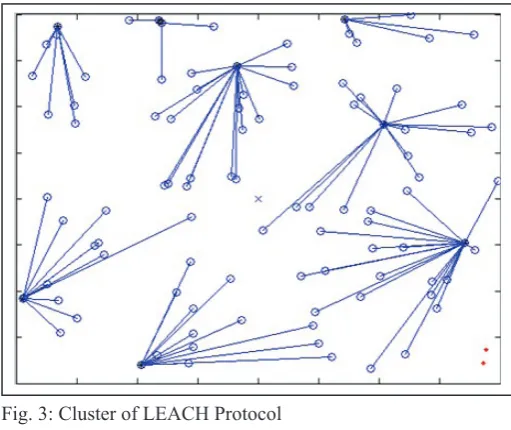
The arbitrarily made clusters by LEACH may not be preferably perfect. For instance, numerous cluster head might be put close to each other which this diminish the effectiveness of clustering and the cluster members must send to cluster heads situated a long way from them. Furthermore, clusters generated by LEACH are uneven and cluster head is not situated in the center point of cluster member nodes. Such clusters increment the aggregate transmission distance amongst nodes and the cluster head and this makes more energy be devoured in the intra-cluster communications. To overcome this problem those should be selected as cluster head which is near to the center of the cluster. Intra cluster distance of ith cluster can be calculated by the following equation as given below [19-20]:
(2)
Sj = jth sensor node Chi = jth cluster head
Besides, the LEACH protocol does not consider the sink position in cluster head election process lastly a node might be chosen as cluster head which devours more energy to communicate with the sink.
III. K- Means Clustering
Clustering of sensor hubs is one of the paramount approaches that can optimize the lifetime of the entire system by aggregating information to the cluster head. K-means is an unsupervised learning algorithm for data clustering introduced by MacQueen in 1967. It delivers a specific number of clusters from information and tries to limit the following objectives [22-23]:
(3)
Where ‖xj – ci ‖ = Indicate the distance between a data point and the cluster center .
Algorithm Steps:
Place input as per the specific criteria to algorithm is number 1.
of K groups (Clusters)
Assign K initial centers to arbitrarily K groups. 2.
Calculate the distance between the every data points from the 3.
centers includes to them in the closest center points. When all points have been assigned, recalculate the positions 4.
of the K centers.
Repeat Steps 2 and 3 until convergence. This yields a 5.
separation of the points into clusters from which the metric to be limited can be determined.
Updating the centers by the following formula 6.
(4)
Convergence is obtained when there is no longer variation 7.
in cluster center.
IV. Energy Dissipation Model
Fig. 4: Energy Dissipation Model
A. Network Model
Various clustering algorithm has distinctive application condition, furthermore, the energy demonstrates additionally has its own particular qualities and shortcomings. There is 100m × 100m sensing area where the 100 sensor nodes are dispersed. LEACH algorithm used first order radio transmission energy model. The model considers the assumptions as per the following:
The position of the base station is stationary, and the sensor 1.
field is a long way from the base station.
Transmitting and receiving energy consumption in every 2.
transmission is equal.
Nodes in the sensor field are homogenous. 3.
The communication channel has no deviation, which 4.
guarantees the consistency of the energy utilization of the each transmission sides.
All the nodes are stationary in the sensor field. 5.
Communicate between the nodes the base station based on 6.
a single hop.
B. Energy Dissipation Model
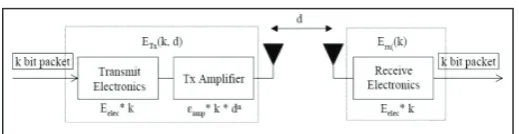
In the enhanced LEACH algorithm, we utilize the same radio communication energy consumption demonstrate as utilized as a LEACH protocol. This model comprises of two sections: transmitting energy consumption model and receiving energy consumption model. As per the radio communication energy dissipation model, we realize that when sending k bit information, sensor hubs will expand the underneath energy:
ETx (k,d) = ETx-elect(k) + ETx-amp(k,d) (5)
ETx (k,d) = Eelec× k + ԑfs× k × d2 If d ≤ d
o (6)
ETx (k,d) = Eelec× k + ԑmp× k × d4 If d ≥ d
o (7)
do = Threshold distance, Eelec = Electronic energy
ԑfs = Parameter for free space model ԑmp = parameter for multi path model
= (8)
To receive a k bit data radio dissipates energy as follows:
ERx(k) = ERx-elec(k) = Eelec× k (9)
V. Proposed Approach
While choosing cluster heads, LEACH protocol chooses cluster head as per the arbitrary number the nodes produces and the threshold, while did not take the rest of the energy into account, which may get about the nodes with low energy to be selected as a cluster head, in this way getting premature death of clusters and influencing the lifetime of networks. We present the residual energy parameters based on the LEACH protocol that is:
(10)
Where
(11)
Ei = Residual energy of every node of ith round
Er = Average energy of node ith round
ER = Total residual energy ith round
Calculating the average energy of rest node as given below:
(12)
ri = Current round
rmax = Maximum round of network simulation
remaining energy to be cluster heads, which can shape an enhanced cluster heads, staying away from the sudden premature death of the system lifetime and optimize the system longevity.
VI. Simulation and Analysis
To assess and enhance LEACH protocol, we have simulated and examined the LEACH protocol and enhanced LEACH protocol regarding the number live nodes in each round, total energy consumption of the network and network longevity, and made a comparison. We use MATLAB 2015a for simulations and analysis. There are 100 sensor nodes deployed in the Wireless Sensor Network, in the range of 100m × 100m sensing region. The following parameter settings are given as follows:
Fig. 5: Cluster Generated in our Proposed Algorithm
Table 1: Simulations Parametres
Specification Data Total sensor node 100
Size of network 100 × 100 m2
Base stationslocation (50,50) The probability of cluster heads /% 10 Initial energy level 0.5J
Data length 4000 bits
Eelec 50nJ/bit
ԑmp 0.0013pJ/bit/m4
ԑfs 10pJ/bit/m2
Data aggregation (EDA) 5nJ/bit/Signal
Fig. 6: Number of Alive Nodes on the Basis Number of Rounds
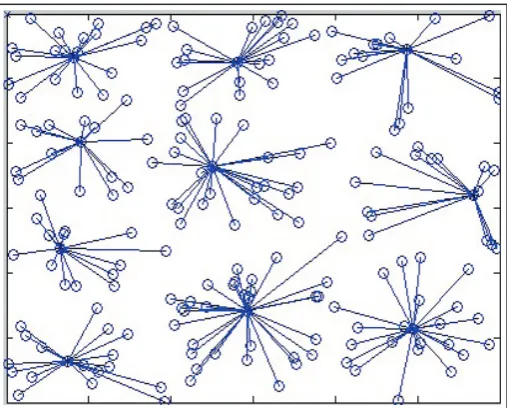
Fig. 5 illustrates the clusters generated by our proposed algorithm. The generated clusters are symmetric and significantly reduce the intra cluster distance between the nodes and the cluster head which leads the balanced energy consumption of nodes with improved network lifetime.
Fig. 6 & 7 demonstrates that both the protocol is compared to the basis of a number of live nodes. The number of alive nodes reflects the network dynamics and stability in some degree of extent. We deliberate the residual energy of nodes, which distribute the load of the entire system evenly and favorable for improved network longevity and stability of the system.
Fig. 7: Energy Depletion on the Basis of Number of Rounds
VII. Conclusion
We abridge our article is to addresses the accompanying points: Optimization of energy utilization of a system and, the expansion of network life span. To begin with, we will address the issue of augmenting the system lifetime by arranging optimal partitioning under imperative constrained, cluster arrangement. Effective clustering diminishes the energy utilization of the sensor nodes because they exchange their information through one or more cluster head to the base station. In this paper, we illustrate an enhanced variant of LEACH protocol which utilizes K-means clustering calculation for choosing better cluster heads and produced symmetric clusters to reduce the energy consumption of nodes. Optimal cluster head selection is another important challenge and directly affects the network longevity. In our improved LEACH protocol, residual energy is also taken as a parameter during the selection of cluster head which helps in network maximization and enables the global management of the network. Proposed approach gives significantly improved results over conventional LEACH protocol.
References
[1] Wenliang Wu, Naixue Xiong, Chunxue Wu,“Improved clustering algorithm based on energy consumption in wireless sensor networks”, IET Journals, Vol. 6, Issue 3, pp.47-53, 2017.
[2] Abbasi, A.A., Younis, M.,“A survey on clustering algorithms for wireless sensor networks”, Pattern Recognition Letters, Science Direct, Elsevier, Computer Communications, Vol. 30, No. 14, pp. 2826–2841, 2007.
[3] H. Wang, Nazim Agoulmine, Maode Ma,“Network lifetime optimization in wireless sensor networks”, IEEE Journal on Selected Areas in Communications, Vol. 28, No. 7, pp. 1127–1137, 2010.
[5] Heinzelman, W.B., Chandrakasan, A.P., Balakrishnan, H., “An application-specific protocol architecture for wireless micro sensor networks”, IEEE Transactions on Wireless Communications, Vol. 1, No. 4, pp. 660-670, 2002. [6] Lindsey, S., Raghavendra, C.S.,"PEGASIS: Power-efficient
gathering in sensor information systems", IEEE Aerospace Conference Proceeding., pp. 48–59, 2002.
[7] Tilak, S., Abu-Ghazaleh, N.B., Heinzelman, W., "Infrastructure tradeoff for sensor networks", WSNA02, Atlanta, Georgia, 2002.
[8] Li, J., Gao, H.,"Survey on sensor network research", Journal of Computer Research and Development, Vol. 45, No. 1, pp. 1–15, 2008.
[9] Pottie, G., Kaiser, W.,“Wireless integrated network sensors”, Communications of the ACM, Vol. 43, No. 5, pp. 551–558, 2000.
[10] OssamaYounis, Sonia Fahmy,“HEED: A hybrid energy efficient distributed clustering approach for ad-hoc sensor networks”, IEEE Transactions on Mobile Computing, Vol. 3, No. 4, pp. 366-379, 2004.
[11] S. Soro, W. B. Heinzelman,“Cluster head election techniques for coverage preservation in wireless sensor networks,“Ad-hoc Networks”, Vol. 7, No. 5, pp. 955-972, 2009.
[12] Heinzelman, W. R., Chandrakasan, A., Balakrishnan,“Energy Efficient Communication Protocol for Wireless Sensor Network”, IEEE 33rd Hawaii International Conference on System Sciences, 2000.
[13] V. Gungor et al.,“Industrial wireless sensor networks: Challenges, design principles, and technical approaches”, IEEE Transactions on Industrial Electronics, Vol. 56, No. 10, pp. 4258–4265, 2009.
[14] W. Xu, et al.,“Distributed optimal rate-reliability-lifetime trade-off in time-varying wireless sensor networks”, IEEE Transactions on Wireless Communications, Vol. 13, No. 9, pp. 4836–4847, 2014.
[15] Peryasamy, S., Khara, S. Thangavelu, S.,“Balance cluster head selection based on modified K-means in a distributed wireless sensor network”, International journal of distributed sensor network, pp. 1-11, 2016.
[16] Thai T. Vu, Viet D. Nguyen Hien M. Nguyen,“An Energy Aware Routing Protocol for Wireless Sensor Network based on K-means Clustering”, Springer, Advances in Electrical Engineering and Related Science, No. 6, pp. 297-306, 2014.
[17] Anindita Ray, Debashis De,“Energy Efficient Clustering Hierarchy Protocol for Wireless Sensor Network”, IEEE Communication and Industrial Application (ICCIA), pp.1-4, 2012.
[18] Ridouane El Ali Choukri Abdellatif Kobane Mohammed El Koutbi,“An Energy –Aware Clustering Approach based on the K-means method for Wireless Sensor Network”, Springer, The International Symposium on Ubiquitous, pp. 325-337, 2016.
[19] Anindita Ray, Debasis De.,“Energy efficient clustering protocol based on K-means (EECPK-means)-midpoint algorithm for enhanced network lifetime in wireless sensor network”, IET Wireless Sensors System, Vol. 6, pp. 181-191, 2016.
[20] Elkamel Rabiaaa, Baccar Nourab, Cherif Adnenec, “Improvements in LEACH based on K-means and Gauss algorithms”, The International Conference on Advanced Wireless, Information and Communication Technologies
(AWICT 2015), pp. 460-467, 2015.
[21] LI XingGuo, WANG JunFeng, Bai LinLin.,“LEACH Protocol and its Improved Algorithm in Wireless Sensor Network”, International Conference on Cyber-Enabled Distributed Computing and Knowledge Discovery, pp. 418- 422, 2016.
Mrs. Pratiksha Saheb is currently pursuing M.E National Institute of Technical Teachers Training and Research, Chandigarh India. She has completed her B.E from Pt. Ravi Shankar University Raipur, India. She is having 5.8 years of teaching experience.