REMOVAL OF NiI(II) FROM SPIKED
SOLUTIONS USING NATURAL ADSORBENT
– A METHOD OF FLOW TECHNIQUES
Dr R V Ramana Murthy and Dr G Venkateswara Rao Department of Chemistry, Mrs A V N College, Visakhapatnam 530 001.
ABSTRACT
Discharge of heavy metals from metal process industries is known to have adverse effects on the environment. Conventional treatment technologies for removal of heavy metals from aqueous solutions are non-economical and generate huge quantities of chemical sludge. Bio-sorption of heavy metals by chemically inactive non-living biomass of microbial of plant origin is an innovative and technology of these pollutants from aqueous solutions.
The operating conditions such as pH, dose required, initial metal concentrations and treatment performance are presented, recovery adsorbent was also discussed. The efficiency of fixed bed system depends on the initial concentration of influent rate and bed height. The effects of parameters on the adsorption of Ni(II) on PPP were examined. A simpler approach to fixed bed adsorption has been proposed by Hutchin which is called bed – depth - service time (BDST). Model service time with parameters, initial concentrations, flow rate and bed heights. A bed height of 3.0 cm having 2.0 g adsorbent was used, to study the effects of initial metal ion concentration. The metal ion concentration varied from 20 - 40 ppm and flow rate of 10 ml/min, at required pH. The effects of flow rate on adsorption of Ni(II) was studied with 20 ppm of Ni(II) solution was allowed to pass through the column of an adsorbent 3.0 cm at different flow rates. Effects of metal initial concentration of 20 ppm, flow rate of 10 ml/min, bed heights contains different weights were used to study.
Key words: Pongami Pinneta Pricarp (PPP), Heavy metals, Wastewater treatment, Removal,
Advanced techniques
Introduction
Nickel used in electroplating industry, in the making of coins, chemical reagents, alloys preparation, nickel compounds, house wear utensils, machine parts, preparation of stainless steel, spare parts in automobiles, leather and textile industries.
and 0.8 % to underground injection.
Nickel (II) is well known toxic heavy metal, which pose serious threat to the fauna and flora of receiving water bodies when discharged from industrial wastewaters. Nickel (II) present in the effluents of silver refineries, electroplating, zinc base casting and storage battery industries. Kadirvelu et al., 2000a. As it resists corrosion even at high temperature, it can also be used in gas turbines, rocked engines and distillation plants. It is also used in coinage and costume jewelry. Skin contact with nickel causes a painful disease called ‘nickel itch’ which leads to death, reported Abbasi and Soni, 1990. In India acceptable limit of nickel in drinking water is 0.01 mg/lit and for discharge of industrial wastewater is 2.0 mg/ lit, Kadirvelu, 1998. At higher concentrations, nickel (II) causes cancer to the lungs, nose and bones. Dermatitis (nickel itch) is the most frequent effect of exposure to nickel, such as coins and costume jewelry. Nickel carbonyl [Ni (Co)4] has been
estimated as lethal in humans at atmospheric exposures of 30 ppm for 30 min, Namasivayam and Ranganathan, 1994. Acute poisoning of nickel (II) causes headache, dizziness, nausea, tightness of the chest, chest pain, shortness of breath, dry cough, cyanosis and extreme weakness. Parker, 1980. The toxic nature of fish, crops and algae was also reported David, 1977. Perennial toxicity associated with nickel chloride exposure on female rats was also reported, Kate Smith et al., 1993.
The main object of present work was to evaluate the feasibility of using natural adsorbents from waste materials for the removal of nickel (II) from aqueous solutions and industrial wastewaters by using batch mode and fixed bed study. The influence of experimental conditions such as contact time, metal ion concentration, adsorbent dosage and pH effects were studied. Experimental results are analyzed to provide an adsorption mechanism. This method was applied for the removal of Ni (II) from synthetic aqueous solutions and industrial wastewaters.
Column Study
The efficiency of a fixed bed system depends on the initial concentration of the influent, flow rate and bed height. The effects of these parameters were examined. A simpler approach to fixed bed absorbent has been proposed by Hutchin’s (Equation-1) (1973) which is called Bed-Depth-Service-Time (BDST) model which correlates service time ‘t’ with the parameters are initial
metal ion concentration, flow rate and bed height.
Effects of Metal Ion Concentration on Ni (II) Adsorption
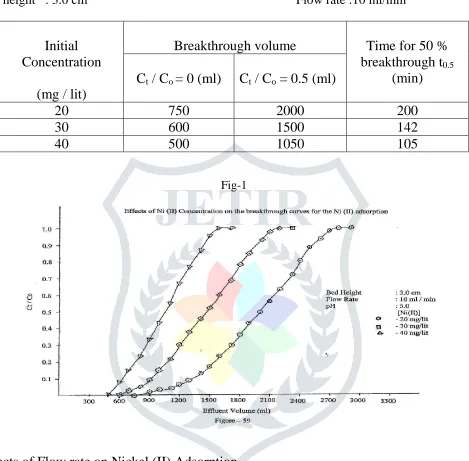
A bed height of 3.0 cm of the weight 2.2 g of the adsorbent was used to study the effects of initial metal ion concentration. The initial Ni (II) concentrations were varied from 20 to 40 mg/l at constant bed height of 3.0 cm and flow rate of 10 ml/min and adjusted pH 5.0. The efficiency of the fixed bed method depends on the shape of the breakthrough curves obtained by plotting (Ct /
Co) vs effluent volume or time. Breakthrough volume is defined as the maximum volume of effluent
required to reach Ct / Co = 0 or Ct / Co = 0.5 (ml) (50% breakthrough). The plots of Ct / Co vs
effluent volume for different Ni (II) concentrations are shown in Fig- 1. The plots are traditional ‘S’ shape but the steepness of the curve varies with the concentrations of nickel (II). The breakthrough volumes at Ct / Co = 0 for nickel (II) concentrations of 20, 30 and 40 mg/ l were found
to be 750, 600 and 500 ml respectively. The time for 50 percent breakthrough (t0.5) decreased from
Table -1
Breakthrough Volumes for nickel (II) Adsorption for different Concentrations
Particle size : 0.800 mm Initial pH : 5.0
Bed height : 3.0 cm Flow rate :10 ml/min
Initial
Concentration
(mg / lit)
Breakthrough volume
Time for 50 %
breakthrough t
0.5(min)
C
t/ C
o= 0 (ml)
C
t/ C
o= 0.5 (ml)
20
750
2000
200
30
600
1500
142
40
500
1050
105
Fig-1
Effects of Flow rate on Nickel (II) Adsorption
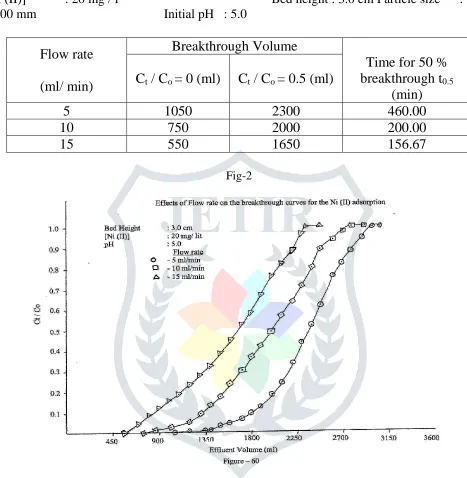
The effects of flow rate was examined by changing the flow rates from 5 to 15 ml/min, keeping the bed height and initial Ni (II) concentrations kept constant at 3.0 cm and 20 mg/ l respectively and adjusted pH 5.0. Fig- 2 shows the sigmoidal “S” type plot of Ct / Co vs volume
and Table- 2 gives the breakthrough volumes and corresponding times required for saturation of half of the column. The difference between breakthrough volumes at Ct / Co = 0 for 5 and 15 ml
Breakthrough Volume for Ni (II) Adsorption for different Flow Rates
[Ni (II)] : 20 mg / l Bed height : 3.0 cm Particle size : 0.800 mm Initial pH : 5.0
Flow rate
(ml/ min)
Breakthrough Volume
Time for 50 %
breakthrough t
0.5(min)
C
t/ C
o= 0 (ml)
C
t/ C
o= 0.5 (ml)
5
1050
2300
460.00
10
750
2000
200.00
15
550
1650
156.67
Fig-2
Effects of Bed height on Nickel (II) removal
The studies were conducted by varying the bed heights from 2.2 to 3.8 cm having the adsorbent weights 1.62, 2.20 and 2.84 g, keeping flow rate and initial nickel (II) concentrations kept constant at 10 ml/ min and 20 mg/ lit respectively and adjusted pH 5.0. The ‘S’ shape plots of Ct / Co vs volume are given in Fig - 3. The breakthrough volumes recorded in Table- 3, it is evident
Table -3
Breakthrough volumes for Ni (II) adsorption for different bed heights
[Nickel (II)] : 20 mg / l Flow rate : 10 ml / min Initial pH : 5.0 Particle size : 0.800 mm
Bed height
(cm)
Breakthrough volume
Time for 50 % break
through t
0.5(min)
C
t/ C
o= 0 (ml)
C
t/ C
o= 0.5 (ml)
2.2
400
1060
106
3.0
750
2000
200
3.8
1100
2780
278
Fig-3
Application of BDST model
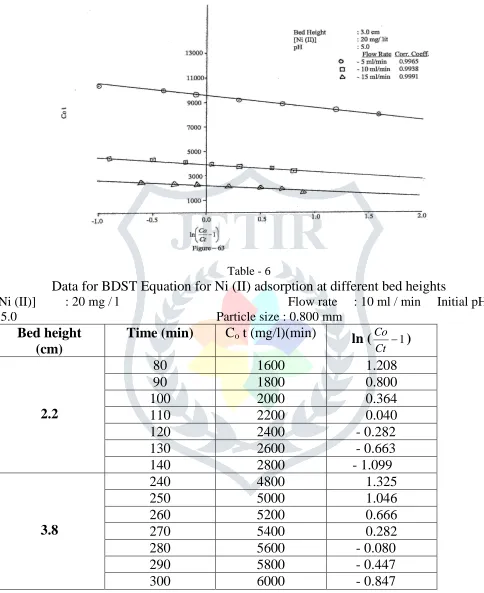
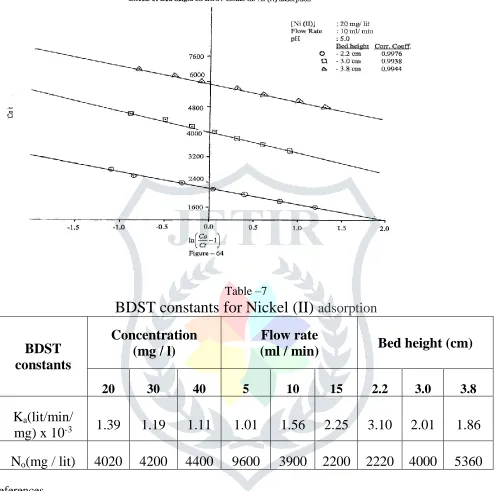
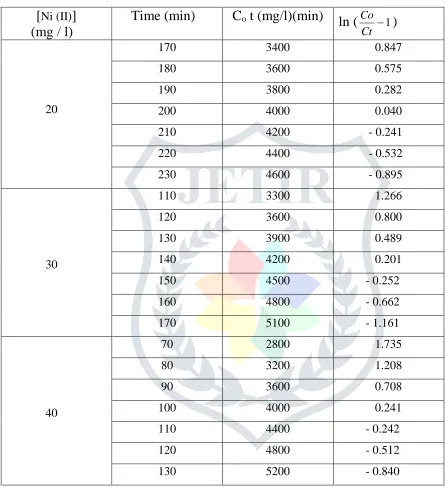
As predicted from Hutchin’s equation (1973) for BDST (Equation-1), the plot of Co t vs ln
[(Co/Ct) - 1] should be a straight line. The data for BDST equation are given in Tables- 4, 5 and 6
for different Ni (II) concentrations, different flow rates and different bed heights respectively. The plots of Co t vs ln [(Co/Ct) - 1] are linear (Fig- 4, 5 and 6) obeying Hutchin’s equation. The constants
Ka and No, namely the rate constant of adsorption and adsorption capacity respectively were
obtained from the slope and intercepts of the plots (Fig - 4, 5 and 6) and are listed in Table-7. It is evident from the values that increase in initial concentration of Ni (II) solution from 20 to 40 mg/ lit, increased the adsorption capacity from 4020 to 4400 mg/ lit and decreased the rate constant from 1.39 x 10⁻³ to 1.11 x 10⁻³ lit / min / mg. Similar behavior has been observed by Ranganathan
and Namasivayam 1998.
At fixed influent concentration and bed heights, smaller flow rate of 5 ml/ min showed better adsorption capacity of 9600 mg/ l than 10 and 15 ml/min. The Kavalues in Table -7 shows that
higher flow rates saturate the bed more quickly than slower flow rates. From the results obtained for different bed heights, it is evident that increase in bed height form 2.2 to 3.8 cm the breakthrough volumes at Ct /Co = 0 increased from 400 to 1100 ml and No from 2220 to 5360 mg/ l. Increase in
Data for BDST Equation for Ni (II) Adsorption at different Concentrations
Flow rate : 10 ml/ min Bed height : 3.0 cm Particle size : 0.800 mm Initial pH : 5.0
[
Ni (II)]
(mg / l)
Time (min)
C
ot (mg/l)(min)
ln (
1Ct Co
)
20
170 3400 0.847
180 3600 0.575
190 3800 0.282
200 4000 0.040
210 4200 - 0.241
220 4400 - 0.532
230 4600 - 0.895
30
110 3300 1.266
120 3600 0.800
130 3900 0.489
140 4200 0.201
150 4500 - 0.252
160 4800 - 0.662
170 5100 - 1.161
40
70 2800 1.735
80 3200 1.208
90 3600 0.708
100 4000 0.241
110 4400 - 0.242
120 4800 - 0.512
Fig-4
Table – 5
Data for BDST equation for Nickel (II) Adsorption at different Flow Rates
[Ni (II)] : 20 mg / l Initial pH : 5.0
Bed height : 3.0 cm Particle size : 0.800 mm
Flow rate
(ml / min)
Time (min)
C
ot (mg/l)(min)
ln (
1Ct Co
)
5
400.00
8000.0
1.586
420.00
8400.0
1.208
440.00
8800.0
0.708
460.00
9200.0
0.323
480.00
9600.0
- 0.080
500.00
10000.0
- 0.447
520.00
10400.0
- 1.099
15
86.67
1733.40
0.995
93.33
1866.70
0.754
100.00
2000.00
0.489
106.67
2133.40
0.201
Table - 6
Data for BDST Equation for Ni (II) adsorption at different bed heights
[Ni (II)] : 20 mg / l Flow rate : 10 ml / min Initial pH : 5.0 Particle size : 0.800 mm
Bed height
(cm)
Time (min)
C
ot (mg/l)(min)
ln (
1Ct Co
)
2.2
80
1600
1.208
90
1800
0.800
100
2000
0.364
110
2200
0.040
120
2400
- 0.282
130
2600
- 0.663
140
2800
- 1.099
3.8
240
4800
1.325
250
5000
1.046
260
5200
0.666
270
5400
0.282
280
5600
- 0.080
290
5800
- 0.447
Fig-6
Table –7
BDST constants for Nickel (II)
adsorption
BDST
constants
Concentration
(mg / l)
Flow rate
(ml / min)
Bed height (cm)
20 30 40 5 10 15 2.2 3.0 3.8
K
a(lit/min/
mg) x 10
-31.39
1.19
1.11
1.01
1.56
2.25
3.10
2.01
1.86
N
o(mg / lit)
4020
4200
4400
9600
3900 2200 2220 4000
5360
References
1. Chakravarti AK, Chowdhury SB, Chakrabarty S, Chakrabarty T and Mukherjee DC (1995). Liquid
membrane multiple emulsion process of Chromium(VI) separation from wastewaters. Colloids Surf. A: Physicochem. Eng. Aspects 103,59.
2. Dahbi S, Azzi M and Guardia M (1999). Removal of Hexavalent Chromium from wastewaters by bone
charcoal. Fresenius J. Anal. Chem.363, 404.
3. Hutchin RA (1973). New method simplifies design of activated carbon system. Chem. Engg. 80, pp
133-138.
4. Kongsricharoern N, Polprasert C (1996). Chromium removal by a bipolar electrochemical precipitation
7. Mousumisen, Manisha GD and Pradeep Roy Chowdary K (2005). Biosorption of Cr(VI) by non living fusarium Sp. Isolated from soil. IIT, New-Delhi.
8. Kannan N and Raja Kumar A (2003). Suitability of various indigenously prepared activated carbons for
adsorption of Mercury(II) ions. Toxicol. Env. Chem., 84 (1-4): pp 7-19.
9. Pagilla K and Canter LW (1999). Laboratory studies on remediation of Chromium contaminated soils. J.
Environ. Eng. 125(3), 243.
10.Ranganathan K and Namasivayam C (1998). Utilization of waste Fe(III)/Cr(III) hydroxide for the removal
of Cr(VI) and Fe(II) by fixed bed system. Hungerian Journal of Industrial Chemistry, 26, pp 169-172.
11.Seaman JC, Bertsch PM and Schwallie L (1999). In-situ Cr(VI) reduction within coarse-textured,
oxide-coated soil and aquifer system using Fe(II) solutions. Environ. Sci. Technol. 33, 938.
12.Sawada A, Mori K, Tanaka S, Fukushima M and Tatsumi K (2004). Removal of Cr(VI) from contaminated
soil by electrokinetic remediation. Waste Management. 24(5), pp 483-490.
13.Srinivasan K and Geetamani G (2004). Studies on Chromium(VI) removal by activated Tamarind Nut
Carbon. Oriental Journal of Chemistry, Vol.20(2), pp 335- 340.
14.Tiravanti G, Petruzzelli D and passion R (1997). Pretreatment of tannery wastewaters by an ion-exchange
process for Cr(III) removal and recovery. Water Sci. Technol. 36, 197.
15.Vasanty M, Sangeeta M and Kavita C (2003). Removal of Chromium from aqueous solutions using a
mixture of flyash and activated carbon, Indian J. Environmental Protection 23(12): pp 1321-1325.
16.Zhou X, Korenaga T, Takahashi T, Moriwake T and Shinoda S (1993). A process monitoring/controlling
![Table – 5 Data for BDST equation for Nickel (II) Adsorption at different Flow Rates [Ni (II)] : 20 mg / l Initial pH : 5.0](https://thumb-us.123doks.com/thumbv2/123dok_us/1382438.1648881/7.612.69.519.67.675/table-equation-nickel-adsorption-different-flow-rates-initial.webp)