IJIRT 148938
INTERNATIONAL JOURNAL OF INNOVATIVE RESEARCH IN TECHNOLOGY100
Enhanced Distributed Energy Efficient Clustering
Protocol
Paramveer kaur
1, Neelam Chouhan
2 1,2Golden College of Engineering and Technology Gurdaspur, India
Abstract-Today WSN is highly approached technology that used to interact several sensor nodes corresponding to at least common application. The WSN is affected by the problem of energy dissipation of the sensor node that collects and report the specific data to application monitoring node. The main reason to develop WSN network is to maximize the lifetime of the batteries that are constrained by the nodes during transmission. The clustering mechanism is the best and most efficient one to resolve the issue with the requirement of energy in WSN. In clustering the network is divided into smaller clusters and each cluster includes one cluster head and members. It is very much useful for reducing the energy dissipation and enhancing the lifetime of the network. In this paper we propose new clustering protocol
Enhanced DEEC(distributed Energy Efficient
Clustering ) along with priority queue to balance the energy in the WSN network and prolonging the lifetime of the network. The simulation results revealed the performance of the proposed technique is better than existing protocol DEEC. Result improvement of 20% is observed through the proposed mechanism. Proposed system uses DEEC along with priority queue to save from packet drop. The dropped packet first of all stired within the priority queue from where it is fected and given to next cluster head having sufficient energy for transmission. In addition distance between the nodes and cluster head is also considered to reduce the energy consumption during transmission of packets. Energy consumed during overall packet transmission, packet drop ratio, number of packets transmitted to the base station and cluster head are considered parameters. In addition nodes becoming dead at various intervals or rounds are also obtained through the proposed simulation.
Index terms- WSN, DEEC, Energy Consumption, Packet Drop Ratio, Packets to base station, packet to cluster head
I.INTRODUCTION
The present world needs a few innovations to satisfy their normal work. WSN is that innovation which
IJIRT 148938
INTERNATIONAL JOURNAL OF INNOVATIVE RESEARCH IN TECHNOLOGY101
area is separated into littler one. [4]With this strategy,sensor nodes don't require coordinate correspondence with the base station. In each cluster, there is a group head which gathers the information from all the network nodes and after that transmits that information to the base station. The cluster head is chosen based on greatest energy of the hub. The hub which has highest energy is chosen for group head. Essentially just Cluster head is in charge of the correspondence in the network. Cluster head needs more energy for the information total and transmitting the information. [5]So after transmission of the information, its energy lessens and the hub which has second highest energy is chosen for cluster head. There is such a significant number of clustering conventions which decreases the energy utilization as well as upgrade the network lifetime. [6]These conventions are LEACH, HEED, DEEC, EDEEC, SEP and so on. These conventions are group based convention and a considerable measure of work has been finished with these conventions. LEACH is the primary convention which came into the presence in the grouping convention. DEEC is likewise a group based convention in which bunch head is chosen in light of the remaining energy of the sensor nodes and the normal energy of the network. EDEEC is the upgraded adaptation of the DEEC convention and requires a heterogeneous network. LEACH is the homogeneous network.[7] In this paper, we studied Distributed Energy Efficient Clustering (DEEC) protocol by evaluating dead nodes for network lifetime, energy consumption and energy balancing and later new clustering protocol has been introduced which is the modified form of DEEC and it further improves the performance.
Protocols used to conserve energy of the networks can be homogeneous or heterogeneous in nature. LEACH is a homogeneous protocol
This paper is organized as follows. Section 2 given the related work which has been done on cluster-based routing protocols. Section 3 provides the details of the proposed system. Section 4 shows the simulation results of the cluster-based routing protocols. The paper is finally concluded in section 5.
1. Earlier Work 2.1 DEEC
[7][8]A distributed multilevel clustering algorithm for heterogeneous wireless sensor networks is considered with following characteristics
The cluster head is elected by a probability based on the ratio between the amount residual energy present at each node and the average energy of the network.
The lifetime of a cluster head is decided according to its initial energy and residual energy. So always the nodes with high initial and residual energy has a better chance to become a CH.
DEEC is implemented based on the concepts of LEACH algorithm. The role of cluster head is rotated among all nodes of the network to uniformize the energy dissipation.
Two levels of heterogeneous nodes are considered in this algorithm to achieve longer network lifetime and more effective messages than other classical clustering algorithms. It also works better for multilevel heterogeneous
networks.
In DEEC, all the nodes must have the idea about total energy and lifetime of the network. Average energy of the network is used as the reference energy.
2.2 LEACH
[9]–[11]Low-energy adaptive clustering hierarchy (LEACH) is a TDMA-based MAC convention which is coordinated with clustering and a basic directing convention in Wireless sensor systems (WSNs). The objective of LEACH is as follows
To bring down the energy utilization required to make and keep up groups with a specific end goal to enhance the life time of a remote sensor arrange.
Drain is a various levelled convention in which most hubs transmit to Cluster heads, and the bunch heads total and pack the information and forward it to the base station (sink).
Every hub utilizes a stochastic calculation at each round to decide if it will end up being a bunch head in this round.
IJIRT 148938
INTERNATIONAL JOURNAL OF INNOVATIVE RESEARCH IN TECHNOLOGY102
Nodes that have been cluster heads can't movetoward becoming bunch sets out again toward P rounds, where P is the coveted rate of bunch heads. From that point, every hub has a 1/P likelihood of turning into a group head once more.
Toward the finish of each round, every hub that is not a group head chooses the nearest bunch head and joins that bunch.
The cluster head then makes a calendar for every hub in its group to transmit its information. All hubs that are not group heads just speak with the bunch head in a TDMA mold, as indicated by the calendar made by the group head. They do as such utilizing the base energy expected to achieve the bunch head, and just need to keep their radios on amid their schedule opening.
The DEEC protocol is modified in the proposed paper for minimum distance handling and priority queue.
2.3. Priority Queue
[12], [13]Priority queue is maintained in order to store the packets in case congestion is high. The priority queue is a queue which holds the jobs with priority number. The CH having minimum energy is giving highest priority for storing the packets. Least priority packets are dropped if queue becomes full. Subsequently packet drop ratio is decreased. Priority Queue is maintained to receive the packets transferred through nodes. Using priority queue reduces the packet drop ratio. Hence more packets are transferred from nodes to CH and from CH to BS. Rather dense network is considered in which Intra-cluster correspondences are performed at lower power level and just those cluster heads are permitted to seek cluster head determination, which have remaining energy over an edge level.
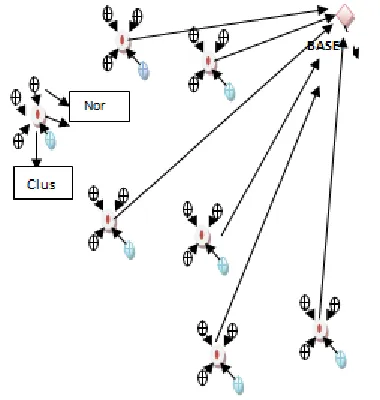
The proposed system consists of advance, normal and super nodes. Distance handling mechanism is associated with the system to reduce energy consumption. The structure of the proposed model is given as follows:
Figure1(Structure of Proposed Model)
Figure 2(Structure of Proposed Model) Flow Chart
IJIRT 148938
INTERNATIONAL JOURNAL OF INNOVATIVE RESEARCH IN TECHNOLOGY103
Figure 3(Flow Chart of proposed System)2. EXPERIMENTAL RESULTS
Simulation is conducted in MATLAB. The simulation results are obtained up to round 5000. Number of dead nodes is evaluated at interval of 5 in rounds. Energy consumed is evaluated on an average and maintaining fixed area of 100*100. Packets are transferred towards cluster head and then cluster head transfer the data towards base station.
Figure 4: Plots from the simulation showing LEACH DEEC TDEEC Proposed
DEAD NODES
Table1: Indicate dead nodes through LEACH, DEEC, TDEEC, proposed
Figure 5: Indicate dead nodes through LEACH, DEEC, TDEEC, Proposed
PACKETS TO BASE STATION
PROTOCOLS ROUNDS 1000
PACKET TO
BASE STATION
ROUNDS 2000
PACKET TO
BASE STATION
LEACH 1000 2000
DEEC 2000 4000
TDEEC 3000 6000
IJIRT 148938
INTERNATIONAL JOURNAL OF INNOVATIVE RESEARCH IN TECHNOLOGY104
Table 2: Packet to base station through LEACH,DEEC, TDEEC, Proposed
Figure 6: Packet to base station through LEACH, DEEC, TDEEC, Proposed
ENERGY CONSUMPTION
Table 3: Energy Consumption through LEACH, DEEC,TDEEC, Proposed
Figure 7: Energy Consumption through LEACH, DEEC, TDEEC, Proposed
THROUGHPUT
Table 4: Throughput through LEACH, DEEC, TDEEC, Proposed
Figure 8: Throughput through LEECH, DEEC, TDEEC, Proposed
In this segment, we examine the execution of LEACH, DEEC, TDEEC, EDEEC and contrast the execution of DEEC and that of different conventions. In our re-enactments, we consider arbitrary organization of 100 sensor hubs in a square field of measurement 100 M x 100 M. The base station is situated at the middle and it can be at the most extreme separation of 70 roughly from any hub. The underlying vitality of a typical hub is set as E0 ¼ 0:5 J. In spite of the fact that this esteem is subjectively taken for re-enactment reason, yet this does not influence the conduct of our simulation. Results indicate better performance of EDEEC in almost every aspect. The performance of LEECH is obtained to be least and can be improved using distance reduction mechanisms. Number of dead nodes, energy consumption, throughput and packets to base stations are considered parameters. The DEEC protocol can also be enhanced by using dense network of nodes to reduce energy consumption and subsequently enhance throughput.
3. CONCLUSION
In Proposed paper the analysis performance of optimal energy aware routing protocols is considered. DEEC is found to optimal but requires improvement to match the performance with other algorithms. In order to accomplish that task priority queues are used and result has been improved and performance is enhanced by the factor of 20%. In this paper, we have suggested modified DEEC protocol with the priority queue in which number of data transmitted to the base station is more as compared to the existing DEEC. In the existing DEEC, priority queue is not
PROTOCOL S
ENERGY CONSUMPTION (JOULE) AT 1000 ROUNDS
ENERGY CONSUMPTIO N (JOULE) AT 3000 ROUNDS
LEACH 95 285
DEEC 85 255
TDEEC 78 234
Proposed 65 195
PROTOCOLS THROUGHPUT
AT 2000
ROUNDS
THROUGHPUT
AT 4000
ROUNDS
LEACH 20 40
RLEACH 21 42
SLEACH 65 130
IJIRT 148938
INTERNATIONAL JOURNAL OF INNOVATIVE RESEARCH IN TECHNOLOGY105
taken so packet drop ratio is high and less messagestransmitted. In future, same dense network can be implied upon SEP, EDEEC and other cluster based protocols.
REFERENCES
[1] B. Pati, J. L. Sarkar, and C. R. Panigrahi, “ECS: An Energy-Efficient Approach to Select Cluster-Head in Wireless Sensor Networks,” Arab. J. Sci. Eng., vol. 42, no. 2, pp. 669–676, 2017. [2] S. Hasan, Z. Hussain, and R. K. Singh, “A
Survey of Wireless Sensor Network,” vol. 3, no. 3, pp. 1–6, 2013.
[3] R. Grewal and P. G. Scholar, “A Survey on Proficient Techniques to Mitigate Clone Attack in Wireless Sensor Networks,” pp. 1148–1152, 2015.
[4] A. Preethi, E. Pravin, and D. Sangeetha, “Modified balanced energy efficient network integrated super heterogeneous protocol,” 2016 Int. Conf. Recent Trends Inf. Technol. ICRTIT 2016, 2016.
[5] T. Of, “A C OMPARATIVE S TUDY OF C LUSTERHEAD S ELECTION A LGORITHMS IN W IRELESS S ENSOR,” vol. 2, no. 4, pp. 153–164, 2011.
[6] R. Kumar, “Evaluating the Performance of DEEC Variants,” vol. 97, no. 7, pp. 9–16, 2014. [7] B. Elbhiri, S. Rachid, S. El Fkihi, and D.
Aboutajdine, “Developed Distributed Energy-Efficient Clustering (DDEEC) for heterogeneous wireless sensor networks,” 2010 5th Int. Symp. I/V Commun. Mob. Networks, ISIVC 2010, pp. 1–4, 2010.
[8] P. Saini and A. K. Sharma, “E-DEEC - Enhanced distributed energy efficient clustering scheme for heterogeneous WSN,” 2010 1st Int. Conf. Parallel, Distrib. Grid Comput. PDGC - 2010, pp. 205–210, 2010.
[9] D. Izadi, J. Abawajy, and S. Ghanavati, “An alternative clustering scheme in WSN,” IEEE Sens. J., vol. 15, no. 7, pp. 4148–4155, 2015. [10]V. Midasala, S. Nagakishore Bhavanam, and P.
Siddaiah, “Performance analysis of LEACH protocol for D2D communication in LTE-Advanced network,” 2016 IEEE Int. Conf. Comput. Intell. Comput. Res. ICCIC 2016, pp. 2–4, 2017.
[11]R. Grewal, J. Kaur, and K. S. Saini, “A survey on proficient techniques to mitigate Clone attack in wireless sensor networks,” Souvenir 2015 IEEE Int. Adv. Comput. Conf. IACC 2015, pp. 1148–1152, 2015.
[12]L. Karim, N. Nasser, T. Taleb, and A. Alqallaf, “An efficient priority packet scheduling algorithm for Wireless Sensor Network,” 2012 IEEE Int. Conf. Commun., pp. 334–338, 2012. [13]R. Mahidhar and A. Raut, “A Survey on