Approaches, Challenges and Framework of Age
Invariant Face Recognition
1
Seyyed Mohammad Hossein Dadgar; 2 Hanieh Maleki
1
Young Researchers and Elite club, Central Tehran Branch, Islamic Azad University, Tehran, Iran
2
Central Tehran Branch, Islamic Azad University, Tehran, Iran
Abstract - Content-based image retrieval that retrieves images based on their visual content has expanded rapidly in recent years and is transformed into an important research issue. One of the main branch image retrieval is retrieval of human face that its aim is to explore and extract facial images in a database that match a reference image or a series of key words. Face recognition is very useful in security issues compared to other biometric components due to no need for cooperation. That's why a lot of research has been done on a variety of face recognition methods. Changes in illumination, occlusion and pose are the main problems that researchers have ever faced. While the issue of aging, which is one of the important issues, especially on documents, passports and police records is less considered compared to other factors effective on face recognition. This article has dealt with this issue. In this paper the framework of AIFR that includes three main stages of feature extraction, dimension reduction and face matching has been examined. The latest methods of AIFR have been reviewed and suggestions are provided for the future works.
Keywords - Image retrieval, Biometric, Face recognition, Aging.
1. Face Recognition and the Problem of Aging
ontent-based image retrieval that retrieves images based on their visual content has expanded rapidly in recent years and is transformed into an important research issue. Content-based image retrieval retrieves the images in a database that match the query image. One of the main branch image retrieval is retrieval of human face that its aim is to explore and extract facial images in a database that match a reference image or a series of key words. Face retrieval is an active subject of research that covers other fields such as image and video processing, pattern recognition, face retrieval, computer vision, machine learning and neural networks.
Faces plays a major role in identifying people and showing their feelings in the society. The human ability to recognize faces is remarkable, we can recognize thousands of faces in my life and at a glance identify familiar faces even after years of separation. Face recognition is an important topic in applications such as security systems, control of credit card and identification of criminals. For example, the ability to model a certain face and distinguish it from a large number of stored face models improve criminals’ identification.
Face recognition by computer systems is one of the most common and useful applications of image analysis. Face
recognition is a method for identification and or verification of people's identity. In the process of identification based on facial recognition, an unknown person's face image is compared with the images contained in the database. Ideally, the system gives specified identity. In the process of verifying the identification person's face image is compared with one of the images that unknown person claims in database. System provides a value for similarity of the two images. Of course, this value should reach the thresholds for the approval or rejection of identity.
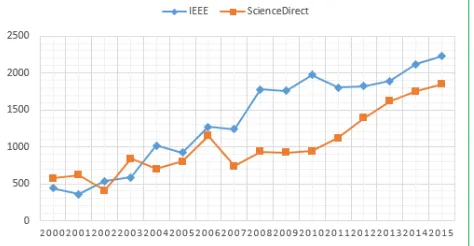
The trend in research on face recognition is shown in Fig. 1 and the number of related articles is reflecting the fact that over time the importance of this topic increased regularly. The graph below suggests that facial recognition is still one of the main concerns in the field of machine learning and research efforts increased day by day to improve it.
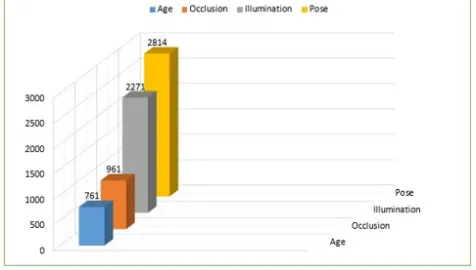
aging (the interval between shots), occlusion (partially occluded) and pose (head angle to the camera).
Because of 3D structure of face direct light source can make strong shades that highlight certain features or reduce them. Since dealing with a variety of lighting is central topic in computer vision, several approaches have been proposed for illumination invariant face recognition [1]. In [2], an approach is investigated in which changes in illumination can affect the performance of some face recognition methods. In [3], mapping method expands the edge and define a new approach. In line edge mapping where lines of face are extracted and combined in parts and then lines are organized. Linear subspaces presented in [4] notes that by combining several linear methods, performance can be further improved.
Fig 1. The trend in research on facial recognition
In many scenarios face recognition, the pose of the probe and gallery images is different. For example, the gallery image might be from front and the probe image might be a 3/4 view captured from a camera in the corner of a room [1]. In [5] a framework is provided for recognizing faces with lots of 3D pose variations, using the parametric linear space to display any well-known person in the gallery. Then, [6] proposed the use of the backlight to achieve more strength and stability in order to solve the problem of pose variation in face recognition.
One of the drawbacks of face recognition is its failure to identify partially occluded images. One way to deal with it is using local methods. In general, these techniques divide face into different parts, and then use voting space to find the best matching [1]. In [7] In order to deal with this problem, each face image is divided into k different local sections. Each of these sections are modeled using a Gaussian distribution that considers the localization error. The proposed probabilistic approach in [7] is only able to identify faces partially occluded. While [8] proposed an approach retrieve the occluded section and occluded sections of the input images are detected using
auto-associative neural network. In addition, a method that is able to cope with occlusion and illumination changes is presented in [9]. They presented a perfect approach for face detection in challenging conditions by prominent feature extraction.
The effect of aging is one of the important issues, especially on documents, passports and police records that compared to other factors in facial recognition has received less attention; in this paper is that issue is addressed. Aging and its effects on face is a complex process that effects texture and shape of the face, such as skin color and wrinkles. Aging affects in different ways based on different age intervals; most of changes in the face due to aging, grew up as a teenager, happens before eighteens. In addition, the effect of aging after eighteen is along with more texture changes and less shape changes. Most works focus on estimating the age [13-16] and simulation of age [17-19]. For example, [13], proposes automatic age estimation or so called AGES (Aging Pattern Subspace). The basic idea is to model the aging pattern, which is defined as the sequence of a particular individual's face images sorted in time order, by constructing a representative subspace. [14], an educational manifold project for the extraction of face aging properties and to design a locally adjusted robust regression for learning and prediction of human age. [15], present a theory and practical computations for visual age classification from facial images, based on cranio- facial changes in feature-position ratios, and on skin wrinkle analysis. [16], developed a Bayesian classification of age difference that classifies images of faces of individuals based on age differences and verification of face is done over advancing the age. Since age separated face images invariably differ in illumination and pose, it proposed pre-processing methods to minimize such variations. [17], provided a dynamic and combined model for aging. The hybrid model indicates faces in any age group with a hierarchical AND - OR graph. In which and nodes decompose a face into parts to describe details (e.g. hair, wrinkles, etc.) crucial for age perception and Or nodes represent large diversity of faces by alternative selections. [18], proposes a new face aging model, which learns long term face aging patterns from partially dense aging databases. [19], proposes an E-cosmetic function for digital images based on physics and physiologically-based image processing.
progress in the past few decades on facial recognition, AIFR remains as a major challenge. The difficulty with this issue largely arises from the fact that changes on person's face appeared or caused by the aging process over time [20]. Recently, several hybrid approaches are provided to improve AIFR [20, 21, 22, 23,24 and 25]. For example, [21] has offered a two-stage approach in which in the first phase, a new feature descriptor called maximum entropy feature descriptor (MEFD) is used for describing features is used to extract the features of the testing and training faces; in the second stage, the new matching method called identity factor analysis (IFA) is presented to estimate the probability that two faces have the same underlying identity. The appearance of a person varies significantly over time and lead to significant within the class changes; hence, the key to tackle this problem is to separate the variation caused by aging from the person-specific features that are stable. In [20] a new way called Hidden Factor Analysis (HFA) is proposed. The approach to separate the changes caused by the aging on unique features of the individual, uses a probabilistic model with two latent factors: an identity factor that is age-invariant and an age factor affected by the aging process. [22], offered a 3D modeling method for changing of face of and show how it is used to compensate the changes to improve face detection function. [23], proposed a diagnostic model for the face detection and its adaption to the changes that occur during the life of one person. [24], introduces a new method that reduces the dimension and obtain topology features for classification of model. [25], models the aging process using complex models with strong parametric assumptions.
Fig 2.Expansion of research on factors affecting the faces recognition in the IEEE database
In order to assess whether the proposed method work well when dealing with one or a combination of these challenges, there are several facial image databases. Each database is designed to address the specific challenges and covers a wide range of scenarios. For example, if a person needs to have a large gallery and probe, FERET [10]
provides a good testing framework, while CMU [11] is useful for changes in illumination and pose. Finally, AR Faces [12] is the only database that provides of natural closed images. There are two well-known databases for AIFR: MORPH [40] and FGNET [41]. FGNET is a relatively small database consisting of 1002 images of 82 different people in ages ranging from zero (before 12 months) to 69 years. MORPH database has two separate data sets: Album 1 and Album 2. Album 1 of MORPH included only 1690 images from 625 different people. Album 2 of MORPH is largest data sets available for aging. This data set consists of approximately 78000 to 20000 different people faces taken at different ages. Compared with the datasets of album 1 of MORPH, data set of album 2 of MORPH has two desirable features: (1) A large number of people, and (2) a large number of face images taken at different ages, so the data set of album 2 of MORPH is used in all the papers.
Table 1. Information about two databases: MORPH and FGNET
Database #subjects #images
Average #images at different ages
per subject
FGNET 82 1002 12
MORPH-Album1 625 1690 2.7
MORPH-Album2 20000 78000 3.9
2. Age Invariant Face Recognition
Framework
often in real-world applications. After feature extraction and dimension reduction, feature vectors are smaller; face matching operation carried out in the third stage.
Fig 3. The overall architecture of AIFR
2.1. Feature Extraction
Face recognition is operated based on extracted feature vectors. The feature vector refers to the output of feature extraction algorithm, primary inputs of which are pixel intensity values. These values are considered as the basic features of the image. Then, feature extraction operation is performed based on the method being used. This action aims to create new features containing the salient information of the image. The space of features is changed by the expressed feature extraction. This means that the space of features varies from first features, or the intensity values for each pixel, to the space of new features that have been created by extracting feature. LBP (Local Binary Pattern) [28, 29, 30] is presented to describe the texture of binary images. The operator produces a binary number for each pixel regarding the label of neighboring pixels 3 × 3. Labels are obtained by thresholding the neighboring pixels with the central pixel value. Then, these labels come together in rotation manner and form an 8-bit number.
Fig 4. How to calculate the features of local binary pattern [30]
First LBP operator is limited to small neighboring and lack of control over large scale images. So this operator is presented by development over neighboring as a circle with radius of R pixel on P pixel [28]. The operator is shown as LBPP, R and it produces the maximum of 2P various value, consistence with 2P created pattern with P pixel existing on radius of neighborhood R.
Fig 5. LBP operator with radiuses and the number of different neighbors
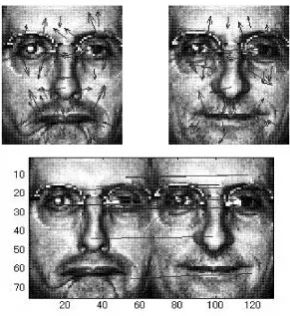
SIFT (Scale Invariant Feature Transform) [31, 32] is one of the most remarkable descriptors of features that are applied in many applications. This algorithm detects features as the floating point resisting size changes, rotation, and the illumination changes of the background. This method which is based on image gradient is so-called SIFT. In the method, the input image is periodically convoluted with Gaussian functions to obtain the smoothed samples. Then, the smoothed images are subtracted consecutively to obtain the images of DOG (Difference of Gaussians). The obtained images of DOG (Difference of Gaussians) are examined and the local minimum and maximum points are considered as selected points. By local maximum and minimum points, we mean those points that have maximum or minimum values in two dimensions of space and one dimension of scale compared to their neighbors. To calculate the feature vector, initially, the gradient direction related to the image from which the selected point of interest has been extracted, is calculated. Then the direction of the area around the central pixel with the rotation equaling the gradient direction of the central pixel is corrected.
Fig 6. Extracting features by making use of SIFT [32]
added to the appropriate histogram which is the nearest in terms of location and direction. Finally, an equalization step is executed on the feature vector.
Fig 7. The method of the block and cell formation around a point to calculate descriptor HOG [34]
MEFD (Maximum Entropy Feature Descriptor) [21] is learning-based coding scheme to convert binary patterns into specific codes. Unlike many handcrafted encoders, in this approach the encoder is specifically trained using a set of training face images such that the frequency of output codes distributes as evenly as possible; this maximizes the discriminative ability in terms of maximum entropy. The pattern space is quantized using a decision tree. This decision tree grows in a greedy manner such that, at each split step, it extends the best node to maximize the entropy of the code distribution.
Fig 8. Decision tree on coding scheme [21]
2.2. Dimension Reduction
Data bases which have many dimensions despite available opportunities, Create a lot of computational challenges. One of the problems of the data having a lot of dimensions is that all features of data are not critical to find latent knowledge of data in most cases.so, data reduction has remained a significant issue in many contexts. Methods based on Feature extraction map a multidimensional space into a space with fewer dimensions. In fact, by combining the values of existing features, they create fewer features so that these features
have all (most of) the information in their basic features. PCA (Principal Component Analysis) [26] and LDA (Linear Discriminant Analysis) [27] regarding the reduction of dimensions have been frequently used.
Principal Component Analysis is based on this assumption that the data of M*N -dimensional matrix can be indicated by indicated by the maximum of P perpendicular vectors in which p is the minimum of M and N. The aim of this method is that the data become independent as much as possible and it looks for orthogonal vectors to meet these demand as much as possible. In this method, at first, the covariance matrix of data is calculated. Then, the matrix of vectors and eigenvalues is calculated. The matrix of Special vectors are the orthogonal vectors causing the subspace of a feature. By transferring data to the subspace, data become independent. Transferring data to the sub-space has this important advantage that by transferring data, simpler data storage in less volume will be possible.
In linear discriminant analysis, the data of each class are used to split the data. This method aims to approximate the data of each class to the new created subspace and to distance the data of different classes. In other words, the between-class scatter matrix of data should be maximized and within-class scatter matrix of data should be minimized. To achieve this goal, both the between-class and within-class scatter matrixes are formed. Between-class scatter matrix is the covariance matrix of the subtraction of each class mean and the total mean and it indicates distance and dispersion between classes. Within-class scatter matrix is the covariance matrix of the subtraction and the data mean of the same class and it represents the extent of the scattering of each class data. To obtain the maximum distance between the different classes and to obtain more proximity of each class data, (between-class dispersion / within class dispersion) matrixes must be maximized. This action is taken by calculating the vectors and the eigenvalues of this matrix. Then, the obtained eigenvalues are used to transfer data to the subspace created by them.
2.3. Face Matching
HFA considers a linear generative model presenting an image of the face as a linear combination of three components: identity component, age component and a noise term which would allow actual observations to deviate from model space. In particular, the age component and identify component are respectively generated from the underlying age factor and identity factor through linear transformation.
In IFA instead of asking what the identity is, asks whether the gallery and probe sample are from the same identity.
3. Age Invariant Face Recognition
Approaches
Present methods for AIFR are divided into two classes, modeling methods for making age invariant model and feature extraction based methods. These two types of methods have common principles in which comparison of two images in the same age is handled by using relations which after applying to image, age effects will be increased or decreased. There are many restrictions in modeling methods because of need to more information related to image. In sum this class of methods is not practical because image age should be recognized as one of necessary parameters.
3.1. Modeling Methods for Making Age Invariant Model
Park et al [22] presented a 3D aging modeling method for face changes and they show that how compensation for age changes is used for improving performance of face recognition. AIFR is a complicated process that is influenced by 3D face shape and texture. These changes of texture and shape weaken efficiency of automatic face recognition systems. 3D shape and texture of images has lower correlation towards 2D shape and texture. Since 3D imaging towards 2D imaging needs spending higher cost and also availability to 2D images of people is easier, in this method, a solution is presented in which 3D model is extracted of 2D images. In this method, after modeling and estimating person age, at first face is detached from image and then pose correction is performed and in this way, when probe image is taken to estimated age of gallery image, they will be compared. They achieve feature vector in images of 2D face by using AAM (Active Appearance Model) [35, 36]. PCA+LDA [26, 27, 37, 38], is used for dimension reduction. FaceVACS [39] was used for face matching.
Fig 9. Connection process of 3D model by using graphical model [22]
Li et al [23] proposed a discriminative model to address face matching in the presence of age variation and they believe among the available local feature descriptors, SIFT [31,32] and LBP [28,29,30] have been shown to be the most effective for object recognition. Based on their reported successes in face recognition literature, they choose both of them as feature descriptors in developing age invariant face recognition algorithm. The SIFT feature descriptor quantizes both the spatial location and orientation of image gradient within an S*S sized image patch, and computes a histogram in which each bin corresponds to a combination of specific spatial location and gradient orientation. Aggregation of histogram places is weighed by spectral range and descending Gaussian function. They use the extended LBP and MLBP till describe face in multiple scales. By calculating LBP descriptors, they were calculated in four radius {1, 3, 5, 7}.Although both SIFT and LBP methods were applied successfully in face recognition before Lee et al research, but matching and the method which they made in this article is newer for face recognition challenge. Presenting SIFT structure shows two main parts: Extracting key point and feature descriptors; but Lee et al did not do extracting key points so that instead they put a regular grid on face. They define life span invariant recognition data of a face with help of MLBP through directions of edges in face.
Chen et al [25] using complex models with strong parametric assumptions to model the aging process and they handle this action by using a data based method. Furthermore, they present an encryption framework which called CARC (Cross-Age Reference Coding). LBP method with high dimensions is used for extracting features, it means each image is divided into four in four cells and it extracts a 59 dimension local binary pattern from each cell. PCA+LDA is used for dimension reduction. They use cosine similarity for recognition of
face images to achieve matching scores among face images.
3.2. Feature extraction based methods
Appearance related to the face of a person changes considerably which resulted in important internal changes. Hence affording key over separating made change by senility is among special features of a person which are constant.
Fig 11. Illustration of the HFA based age-invariant face recognition system [20]
Gong et al in 2013 [20] believe that among all descriptors of present local feature, HOG [33, 34] is one of the most successful cases. So they used HOG in their experiment as feature descriptor. For each face image, at first they divide it into set of overlapping patches and then they apply HOG descriptor on each patch to extract the HOG features. The extracted HOG features from all the patches are concatenated together to form a long feature vector for further analysis. They consider a new approach which called HFA (Hidden Factor Analysis). The basic idea of HFA is to decompose facial features into identity components and age components based on this model, which are respectively generated from the identity factors and age factors. Whole details of algorithm presented by them can be summarized as follows [20] : At the training stage, the training faces are first grouped according to their identities and ages, followed by feature extraction on each image. With each training face represented by HOG feature, they reduce the dimension of these features with slicing, PCA and LDA. Finally, HFA models are adapted independently on each of the sliced features of the dataset, obtaining a set of model parameters for each slice. At the testing stage, the matching score of the given face pair (one from probe and the other one from gallery) is computed by first going through feature extraction and dimension reduction steps the same as training, then
estimating the identity latent variables for each slice of the two face features. The final matching score is given by the cosine distance of the concatenated identity features.
Gong et al in 2015 [21] presented a two-stage method in which in first stage, a new feature descriptor called maximum entropy feature descriptor (MEFD) is used for describing features is used to extract the features of the testing and training faces; in the second stage, the new matching method called identity factor analysis (IFA) is presented to estimate the probability that two faces have the same underlying identity. Whole details of presented algorithm by them can be summarized as follows: It extracts MEFD features for each face image; Extracted MEFD features have high dimensions, so they will be divided into several equal slices and PCA + LDA is applied to each slice for dimension reduction. IFA model is applied to each slice for achieving matching score. Matching score of all the slices are combined to obtain a final decision using the sum rule.
extracting topology features, 3- Classifying data collection by using the combination of polynomial distribution. It uses LBP method for extracting features and also the combination of polynomial distribution is used for classifying AIFR.
4. Conclusion and Recommendations
Face recognition can be considered recognition of a very complex object, where the detected object is the face. Solving this problem is even more strict, because search for objects is done among objects belonging to the same class. Moreover, in most cases, more than one visible image is not available to train the system and various problems arise when the images were not obtained under controlled conditions. In this study it was aimed to review the challenges, concepts and methods provided for AIFR.
Table 2. Discussed method data about AIFR
Rank 1 recogni tion accura cy reporte d (%) Database (#individ uals; # images) in probe and gallery Face match er Dim ensio nalit y redu ction Features extracti on Approach 76.2 FGNET (82;82) IFA PCA + LDA MEFD Gong et al. (2015)
[21] MORPH- 94.59
album2 (10000;2 0000) 69.0 FGNET (82;82) HFA PCA + LDA HOG Gong et al. (2013)
[20] MORPH- 91.14
album2 (10000;2 0000) 47.50 FGNET (82;82) Combi nation of Multip le LDA- based classif iers MFD A MLBP + SIFT Li et al.
(2011)
[23] MORPH- 83.90
album2 (10000;2 0000) 37.40 FGNET (82;82) Face VACS from Cognit ec PCA AAM
Park et al. (2010)
[22] MORPH- 79.80
album2 (10000;2 0000) 48.96 FGNET (82;82) Maxi mum KRB F LBP Bouchaffr
a et al.
83.80 MORPH-album2 (10000;2 0000) a-posteri ori probab ility using a mixtur e of multin omial distrib ution (2014) [24] 92.80 MORPH-album2 (10000;1 0000) cosine simila rity PCA + LDA high-dimensi onal LBP Chen et al. (2014) [25]
In the first part the importance and necessity of face recognition is stated, face recognition accuracy is usually limited with big within the class changes by the factors like pose, illumination, occlusion and aging. So, the most of the works that done on face recognition aim to compensate changes that reduce the effectiveness of face recognition. Of course, aging compared to other factors such as pose, illumination and occlusion is less considered; in this paper the problem of aging is addressed. In order to evaluate methods suggested several face image databases are built, each database was specifically designed to address different challenges. Two database of MORPH [40] and FGNET [41] are provided for AIFR.
In the second part, the framework of AIFR is evaluated that is composed of three main stages. In the first stage, normalized face image is sent feature extraction module to find the key features that are supposed to be used for face recognition; the output of feature extraction algorithms is the feature vector. The extracted feature vector has very high dimension so in the second stage we have dimension reduction. In the third stage, face matching is performed for face detection.
implementation and can easily be combined with existing feature descriptor for better face recognition performance. In the feature matching stage, [20], it is aimed to estimate the identity-related component as the age invariant features; thus the cosine distance of the identity components of the gallery sample and the probe sample for direct classification. While [21], provided a new probabilistic matching framework called “IFA” that estimates that probability of two faces for same identity; therefore, its matching framework is better and experimental results also indicate it.
By examining and comparison of methods the following questions can be asked: What features should be extracted to improve AIFR? Are feature selection methods effective in this regard?
Selecting a subset of the features, is identifying and selecting a subset of useful features of primary data collection and is an important issue in analysis of relationship in terms of classification and modeling, which is used in reduction dimensions of the feature set. By provided methods for feature selection, we can increase the accuracy of face detection.
References
[1] Andrea F. Abate, Michele Nappi, Daniel Riccio, Gabriele Sabatino, “2D and 3D face recognition: A survey”, Pattern Recognition Letters, vol. 28, no. 14, pp.1885–1906, 2007.
[2] Adini. Y, Moses. Y, Ullman. S,”Face recognition: The problem of compensating for changes in illumination direction”, IEEE Trans. Pattern Anal. Machine Intell, vol. 19, no. 7, pp.721–732, 1997.
[3] Gao.Y, Leung. M.K.H, “Face recognition using line edge map”, IEEE Trans. Pattern Anal. Machine Intell, vol. 24, no. 6, pp.764–779, 2002.
[4] Belhumeur, Peter N., Hespanha, Joa˜o P., Kriegman, David, “Eigenfaces vs. fisherfaces: Using class specific linear projection”, IEEE Trans. Pattern Anal. Machine Intell, vol. 19, no. 7, pp.711–720, 1997.
[5] Okada. K, von der Malsburg. C, “Pose-invariant face recognition with parametric linear subspaces”, In: Fifth IEEE Internat. Conf. on Automatic Face and Gesture Recognition, pp. 64–69, 2002.
[6] Gross. R, Matthews. I, Baker. S, “Eigen light-fields and face recognition across pose”, In: Proc. Fifth IEEE Internat. Conf. on Automatic Face and Gesture Recognition, pp. 1–7, 2002.
[7] Martinez. A.M, “Recognizing imprecisely localized, partially occluded, and expression variant faces from a single sample per class”, IEEE Trans. Pattern Anal. Machine Intell, vol. 24, no, pp.748–763, 2002.
[8] Kurita. T, Pic. M, Takahashi. T, “Recognition and detection of occluded faces by a neural network classifier with recursive data reconstruction”, In: IEEE Conf. on
Advanced Video and Signal Based Surveillance, pp. 53– 58, 2003.
[9] Sahbi, Hichem, Boujemaa, Nozha, “Robust face recognition using dynamic space warping”, In: Biometric Authentication, Internat. ECCV 2002 Workshop Copenhagen, pp. 121–132, 2002.
[10] Phillips. J.P, Moon. H, Rizvi. A.S, Rauss. P.J, “The FERET evaluation methodology for face-recognition algorithms”, IEEE Trans. Pattern Anal. Machine Intell, vol. 22, no. 10, pp. 1090–1104, 2000.
[11] Sim. T, Baker. S, Bsat. M, “The CMU pose, illumination, and expression database”, IEEE Trans. Pattern Anal. Machine Intell, vol. 25, no. 12, pp. 1615– 1618, 2003
[12] Martinez. A.M, “Recognizing imprecisely localized, partially occluded, and expression variant faces from a single sample per class”, IEEE Trans. Pattern Anal. Machine Intell, vol. 24, no. 6, pp. 748–763, 2002. [13] Xin Geng, Zhi-Hua Zhou, and Kate Smith-Miles,
“Automatic age estimation based on facial aging patterns,” IEEE Trans. Pattern Anal. Mach. Intell., vol. 29, no. 12, pp. 2234–2240, 2007.
[14] Guodong Guo, Yun Fu, Charles R. Dyer, and Thomas S. Huang, “Image-based human age estimation by manifold learning and locally adjusted robust regression,” IEEE Transactions on Image Processing, vol. 17, no. 7, pp. 1178–1188, 2008.
[15] Young H. Kwon and Niels Da Vitoria Lobo, “Age classification from facial images,” in In Proc. IEEE Conf. Computer Vision and Pattern Recognition, 1999, pp. 762–767.
[16] Narayanan Ramanathan and Rama Chellappa, “Face verification across age progression,” IEEE Transactions on Image Processing, vol. 15, no. 11, pp. 3349–3361, 2006.
[17] Jin-Li Suo, Song Chun Zhu, Shiguang Shan, and Xilin Chen, “A compositional and dynamic model for face aging,” IEEE Transactions on Pattern Anal. Mach. Intell., vol. 32, no. 3, pp. 385–401, 2010.
[18] Jin-Li Suo, Xilin Chen, Shiguang Shan, andWen Gao, “Learning long term face aging patterns from partially dense aging databases,” in International Conference on Computer Vision , 2009, pp. 622–629.
[19] Norimichi Tsumura, Nobutoshi Ojima, Kayoko Sato, Mitsuhiro Shiraishi, Hideto Shimizu, Hirohide Nabeshima, Syuuichi Akazaki, Kimihiko Hori, and Yoichi Miyake, “Image based skin color and texture analysis/synthesis by extracting hemoglobin and melanin information in the skin,” ACM Trans. Graph., vol. 22, no. 3, pp. 770–779, 2003.
[20] D. Gong, Z. Li, D. Lin, J. Liu, X. Tang, “Hidden Factor Analysis for Age Invariant Face Recognition”, in International Conference on Computer Vision , 2013. [21] D. Gong, Z. Li, D. Tao, J. Liu, X. Li, “A Maximum
[22] Unsang Park, Yiying Tong, and Anil K. Jain, “Age-invariant face recognition,” IEEE Trans. Pattern Anal. Mach. Intell., vol. 32, no. 5, pp. 947–954, 2010.
[23] Zhifeng Li, Unsang Park, and Anil K. Jain, “A discriminative model for age invariant face recognition,” IEEE Transactions on Information Forensics and Security, vol. 6, no. 3-2, pp. 1028–1037, 2011.
[24] D. Bouchaffra,” Nonlinear Topological Component Analysis: Application to Age-Invariant Face Recognition”, IEEE TRANSACTIONS ON NEURAL NETWORKS AND LEARNING SYSTEMS, 2014. [25] B-C. Chen, C-S. Chen, and W. H. Hsu, “Cross-Age
Reference Coding for Age-Invariant Face Recognition and Retrieval”, Springer International Publishing Switzerland, pp.768-783, 2014.
[26] M. Turk, A. Pentland, “Eigenfaces for Recognition, Journal of Cognitive Neurosicence”, Vol. 3, No. 1, pp. 71-86, 1991.
[27] Peter N. Belhumeur, Jo ˜a o P. Hespanha, and David J. Kriegman, “Eigenfaces vs. fisherfaces: Recognition using class specific linear projection,” IEEE Trans. Pattern Anal. Mach. Intell., vol. 19, no. 7, pp. 711–720, 1997. [28] T.Ojala, M.Pietik, T.Maenpa, “Multiresolution
gray-scale and rotation invariant texture classification with local binary patterns,” IEEE Trans. Pattern Anal. Mach. Intell., vol. 24, no. 7, pp. 971–987, 2002.
[29] T.Ahonen, A.Hadid, M. Pietikäinen, “Face recognition with local binary patterns”, Springer Berlin Heidelberg, pp. 469-481, 2004.
[30] T.Ahonen, A.Hadid, M. Pietik, “Face description with local binary patterns: Application to face recognition,” IEEE Trans. Pattern Anal. Mach. Intell., vol. 28, no. 12, pp. 2037–2041, 2006.
[31] D. G. Lowe, "Distinctive image features from scale-invariant keypoints," International journal of computer vision, vol. 60, pp. 91-110, 2004.
[32] E.Takikawa, S.Lao, M.Kawade, B-L.Lu, “PERSON-SPECIFIC SIFT FEATURES FOR FACE RECOGNITION”, IEEE International Conference on Acoustics, Speech and Signal Processing, 2007.
[33] N. Dalal and B. Triggs, "Histograms of oriented gradients for human detection," in Computer Vision and Pattern Recognition, pp. 886-893, 2005.
[34] A.Albiol, D.Monzo, A.Martin, J.Sastre, “Face recognition using HOG–EBGM”, Pattern Recognition Letters, vol.29, no.10, pp.1537-1543, 2008.
[35] M.B. Stegmann, “The AAM-API: An Open Source Active Appearance Model Implementation,” Proc. Int’l Conf. Medical Image Computing and Computer-Assisted Intervention, pp. 951-952, 2003.
[36] T.F. Cootes, G.J. Edwards, and C.J. Taylor, “Active Appearance Models,” IEEE Trans. Pattern Analysis and Machine Intelligence, vol. 23, no. 6, pp. 681- 685, June 2001.
[37] M. Turk and A. Pentland, “Face recognition using eigenfaces”, In Computer Vision and Pattern Recognition, pages 586–591, 1991.
[38] X. Wang and X. Tang, “A unified framework for subspace face recognition”, IEEE Trans. Pattern Anal. Mach. Intell., vol. 26, no. 9, pp. 1222–1228, 2004. [39] “FaceVACS Software Developer Kit, Cognitec Systems
GmbH,” http:// www.cognitec-systems.de, 2010. [40] Karl Ricanek Jr. and Tamirat Tesafaye, “Morph: A
longitudinal image database of normal adult age-progression,” in FG, 2006, pp. 341–345.
[41] FG-NET Aging Database, http://www.fgnet.rsunit.com/.
Authors -
Seyyed Mohammad Hossein Dadgar is a master researcher in computer science at the university of azad central tehran branch. His research interests include computer vision, neural networks, and image captioning. he received a bachelor in hardware engineering from Isfahan university of technology, a masters in computer science in 2009 and 2016, respectively.
![Fig 7. The method of the block and cell formation around a point to calculate descriptor HOG [34]](https://thumb-us.123doks.com/thumbv2/123dok_us/1330817.1641373/5.612.57.298.437.536/fig-method-block-cell-formation-point-calculate-descriptor.webp)
![Fig 9. Connection process of 3D model by using graphical model [22]](https://thumb-us.123doks.com/thumbv2/123dok_us/1330817.1641373/6.612.344.534.583.673/fig-connection-process-d-model-using-graphical-model.webp)
![Fig 11. Illustration of the HFA based age-invariant face recognition system [20]](https://thumb-us.123doks.com/thumbv2/123dok_us/1330817.1641373/7.612.57.553.208.366/fig-illustration-hfa-based-age-invariant-face-recognition.webp)