e-ISSN: 2278-067X, p-ISSN: 2278-800X, www.ijerd.com
Volume 10, Issue 6 (June 2014), PP.52-59
Multiarea Environmental Dispatch with Emission Constraints
using Hybrid Intelligence Algorithm
D. P. Dash
*, S. Das
*, J. Pattanaik
†*
Electrical Engineering Department, Orissa Engineering College, Bhubaneswar †Power Engineering Department, Jadavpur University, Kolkata
Abstract:- This paper presents the combination of Gravitational search Algorithm and Sequential Quadratic Programming based optimization (GSA-SQP) algorithm to solve complex economic emission load dispatch (EELD) problems of thermal generators of power systems. EELD is an important optimization task in fossil fuel fired power plant operation for allocating generation among the committed units such that fuel cost and emission level are optimized simultaneously while satisfying all operational constraints. It is a highly constrained multiobjective optimization problem involving conflicting objectives with both equality and inequality constraints. In this paper, multi-objective hybrid GSA method has been proposed to solve EELD problem. Numerical results of three test systems demonstrate the capabilities of the proposed approach. Results obtained from the proposed approach have been compared to those obtained from non dominated sorting genetic algorithm-II and strength pareto evolutionary algorithm 2.
Keywords:- Economic Emission Load Dispatch, GSA, SQP and Valve Point Loading.
I.
INTRODUCTION
The multiobjective generation dispatch in electric power system generally treats economy and emission impact as competing objectives which requires some form of conflict resolution to arrive at a solution. The optimization of nonlinear multiobjective economic emission load dispatch is to generate optimal amount of generating power from the fossil fuel based generating units in the system by minimizing the fuel cost and emission level simultaneously by satisfying all constraints. The increased concern over environmental protection and the passage of the U.S. Clean Air Act amendments of 1990 forced the utilities to modify their operation strategies for generation of electrical power not only at minimum generation cost but also at minimum pollution level [1-3]. However, the objective of minimum cost of generation will not provide minimum pollution level and objective of minimum emission does not provide minimum cost of generation.
The major parts of electric power generation are fossil-fired plants, which use coal, oil, gas or combinations thereof as the primary energy resource and produce atmospheric emissions whose nature depend on the type of fuel and its quality. Coal produces particulate matter such as ash and gaseous pollutants such as carbon dioxide (CO2), sulfur dioxide (SO2) and oxides of nitrogen (NOx). It causes damage to materials by
reducing visibility as well as causing global warming. The emission dispatching option is an attractive alternative in which both fuel cost and emission is to be minimized [4-8].
This article proposed the hybridization of Gravitational search and SQP based methods which are robust and reliable algorithms for solution of the economic and emission load dispatch (EELD) problems. This approach is applied to six unit thermal power system to obtain the best compromising solution. The results confirm the potential and effectiveness of the promising proposed algorithm compared to other intelligent method like NSGA II and SPEA 2 [9-13] methods.
The present formulation treats Economic Environmental Dispatch (EED) problem as a multi-objective mathematical programming problem, which attempts to minimize both cost and emission simultaneously while satisfying equality and inequality constraints.
II.
PROBLEM
STATEMENT
M
m N
i i i im i im i i i i gi
i P a bP cP d e P P
f
1 1
min 2
1 sin (1)
where ai , bi , ci , di , ei are the cost curve coefficients of ith unit, Pim is the output power of ith unit at time m, min
i
P
is the lower generation limits for ith unit, N is number of generating units, M is the number of hours in the time horizon.Emission:Thermal power stations are major causes of atmospheric pollution because of high concentration of pollutant they cause. In this study, nitrogen oxides (NOx) emission is taken as the selected index from the viewpoint of environment conservation. The amount of emission from each generator is given as a function of its real power output [14], which is the sum of a quadratic and an exponential function. The total emission in the system can be expressed as:
M
m N
i i i im i im i i im gi
i P P P P
f
1 1
2
2 exp (2)
where i,i,i,i,i are emission curve coefficients of ith generator.
A. Constraints
Real Power Balance Constraints: The total real power generation must balance the predicted power demand plus the real power losses in the transmission lines at each time interval over the scheduling horizon.
N
i im Dm Lm
M m P P P 1
0 (3)
Real Power Operating Limits
M m N i P P
Pimin im imax (4)
B. Determination of Generation Levels
In this approach, the power loadings of first (N − 1) generators are specified. From the equality constraints in Eq. (3) the power level of the Nth generator (i.e., the remaining generator) is given by the following expression:
1 1 N i im Lm DmNm P P P m M
P (5)
The transmission loss
P
Lm is a function of all the generators including that of the dependent generator and it isgiven by: 1 1 1 1 2 1 1 2 N i N
i NN Nm
N
i Ni im Nm
jm ij im
Lm P B P P B P B P m M
P (6)
Expanding and rearranging, Eq. 6 becomes
M
m
P
P
B
P
P
P
P
B
P
B
N i N i im N i jm ij im Dm Nm N i im Ni NmNN
0
1
2
1 1 1 1 1 1 1 12 (7)
III.
PRINCIPLE
OF
MULTI-OBJECTIVE
OPTIMIZATION
Minimize: T
PgiSubject to: g
Pi 0 , h
Pgi 0where, g is the equality constraint representing the power balance and h is the inequality constraint representing the generation capacity and power emission constraints.
IV.
GRAVITATIONAL
SEARCH
ALGORITHM
Gravitational Search Algorithm (GSA) is a recently developed, new heuristic search algorithm proposed by Rashedi et al. It is a stochastic optimization population based search algorithm motivated by Newton's law of gravity and mass interaction. According to the proposed algorithm, agents are assumed to be objects that their performances are measured by means of masses. The whole agents pull each other by the gravitational attraction force and this force induces the movement of the agents globally towards the agents with heavier masses. In GSA, each mass has four particulars: its position, its inertial mass, its active gravitational mass and passive gravitational mass. The position of the mass equaled to a solution of the problem and its gravitational and inertial masses are specified using a fitness function. This method has been successfully applied in solving various non-linear functions. The obtained results confirm the high performance and efficiency of proposed method in these problems. GSA has a flexible and well-balanced mechanism to enhance exploration and exploitation abilities.
V.
SEQUENTIAL
QUADRATIC
PROGRAMMING
Sequential quadratic programming (SQP) [7] is widely used to solve practical optimization problems. It outperforms every other nonlinear programming method in terms of efficiency, accuracy and percentage of successful solutions. The method closely mimics Newton’s method for constrained optimization just as is done for unconstrained optimization. At each major iteration, an approximation is made of the Hessian of the Lagrange function using Broyden-Fletcher-Goldfarb-Shanno (BFGS) quasi-Newton updating method. As the objective function to be minimized is nonconvex, SQP requires a local minimum for an initial solution. In this paper, SQP is used as a local optimizer for fine-tuning of the better region explored by AI. For each iteration, a QP is solved to obtain the search direction which is used to update the control variables. QP problem can be described as follows:
k dk dk KdkF
2
1
subject to the following constraints: gi
k
g
k
dk 0i
1
,....,
m
e
k
k
k 0i g d
g
i
m
e
1
,...,
m
wherek
: the Hessian matrix of the Lagrangian function at thek
th iterationk
d
: the search direction at thek
th iteration,
k: the real power vector at thek
th iteratione
m
: number of equality constraints;m
: number of constraints
F
g
L , ,
where
is the vector of Lagrangian multiplier.k
is calculated using quasi-Newton formula given by the following expression:k k k
k k k k
k k
k k k k
S S
S S
S q
q q
1
where,
k k k
S 1
1, 1
, 1
k k k k
k L L
q
For each iteration of the QP sub-problem the direction
d
k is calculated using the objective function. Thek k k k d
1
VI.
PROPOSED
HYBRID
APPROACH
The proposed hybrid method uses the property of the GSA, which can give a good solution even when the problem has many local optimum solutions at the beginning and at last SQP, which has a local search property that is used to obtain the final solution.
Step 1: Initialization
When it is assumed that there is a system with N (dimension of the search space) masses, position of the ith mass is described as follows. At first, the positions of masses are fixed randomly.
)
,...
,...,
(
1i id ini
x
x
x
X
for, i=1,2,...,N (10) Where,x
id is the position of the ith mass in dth dimension.Step 2: Fitness Evaluation of all agents
In this step, to execute for all agents at each iteration and best and worst fitness are computed at each iteration as
follows:
(
)
min
(
)
} ,..., 1 {t
fit
t
best
j N j
(11)( ) max ( )
} ,.,.... 1 { t fit t worst j N j
(12)
Where
fit
j(
t
)
is the fitness of the jth agent of iteration t,best
(
t
)
andworst
(
t
)
are best (minimum) and worst (maximum) fitness of all agents.Step 3: Compute the Gravitational Constant (G (t))
In this step, the gravitational constant at iteration t (G (t)) is computed as follows: ( ) exp( )
0
T t G
t
G (13)
Step 4: Update the Gravitational and Inertial Masses
The gravitational and inertial masses are updated for each iteration as follows:
Mai Mpi Mii Mi, i=1,2...,N (14)
) ( ) ( ) ( ) ( ) ( t worst t best t worst t fit t
mi i
(15)
where fiti(t) is the fitness of the ith agent at iteration t.
) ( ) ( ) ( 1 t m t m t M N j j i i (16)
where Mai is the active gravitational mass of the ith agent, Mpi is the passive gravitational mass of the ith agent,
Mii is the inertia mass of the i th
agent, Mi(t) is the mass of the ith agent at iteration t.
Step 5: Calculate the Total Force
In this step, the total force acting on the ith agent
(
F
d(
t
))
i is calculated as follows: F (t) rand Fijd(t)
i kbestj
j j
d
i
(17)
where randj is a random number between interval [0,1] and kbest is the set of first K agents with the best fitness
value and biggest mass. The force acting on the ith mass from the jth mass at the specific iteration t is described according to the gravitational theory as follows:
)) ( ) ( ( ) ( ) ( ) ( ) ( )
( x t x t
t R t M t M t G t
F dj id
ij aj pi
d
ij
(18)where Rij(t) is the Euclidean distance between ith and jth agents
)
||
)
(
),
(
Step 6: Calculation the Acceleration and Velocity
In this step, the acceleration and
(
a
id(
t
))
and velocity(
v
id(
t
))
of the ith agent at iteration t in dth
dimension are calculated through law of gravity and law of motion as follows:
) (
) ( )
(
t M
t F t
a
ii d i d
i (19)
) ( )
( )
1
(t rand v t a t
v d
i d
i i d
i
where randi is the random number between interval [0,1]. Step 7: Update the Position of Agents
In this step the next position of the ith agents in dth (xid(t1))dimension are updated as follows:
)
1
(
)
(
)
1
(
t
x
t
v
t
x
id id id (20)Step 8: Repeat
In this step, steps from 2 to 7 are repeated until the iterations reach the stopping criteria.This value is the global solution of the optimization problem. Solution of EED problem is used again in SQP method to get the fine tune of optimal solution.
VII.
SIMULATION
AND
RESULTS
The proposed algorithm has been applied to a test system with two hydro plants and four thermal plants whose characteristics and load demand are given in the reference no. [15]. Transmission loss formula coefficients are also given in the [15]. In the search process, water availability constraint of each generator and power balance constraints are satisfied. All the algorithms have been implemented in MATLAB 7 on a PC (Pentium-IV, 80 GB, 3.0 GHz).
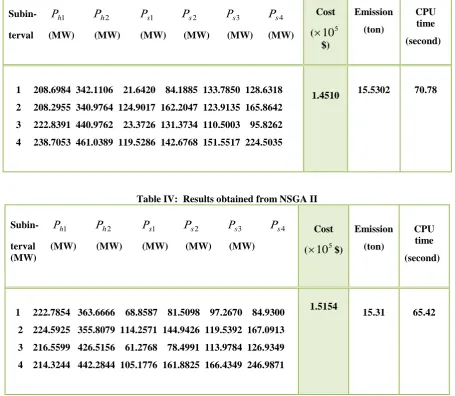
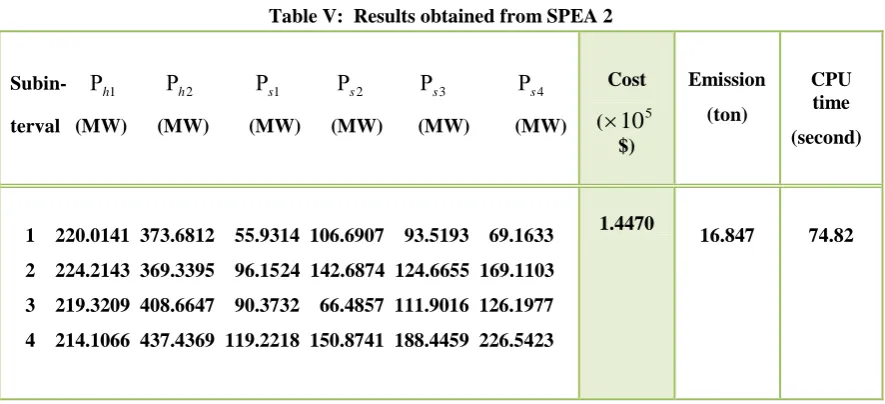
At first fuel cost and emission objectives are minimized individually, usually GSA is used to explore the extreme points of the tradeoff surface. In GSA, parameters are set for simulation: G0= 0.10; 100 ,Maximum Iteration =200 and No.of agent= 100 respectively for this system. Table 1 and Table 2 show the results corresponding to minimum cost and minimum emission respectively using HGSA. In order to show the effectiveness of the proposed HGSA, NSGA-II [15] and SPEA2 [16] have been applied to solve this problem. In NSGA-II and SPEA2, the population size, maximum number of generations, crossover and mutation probabilities have been selected as 50, 20, 0.9 and 0.2 respectively. Results obtained from proposed HGSA are compared with those obtained from NSGA-II and SPEA2 which are shown in Table 4 and Table 5 respectively.
Table I: Results obtained from minimum cost dispatch using HGSA
Subin-
h1
h2
s1
s2
s3
s4terval (MW) (MW) (MW) (MW) (MW) (MW)
Cost
(
10
5$)Emission
(ton)
CPU time
(second)
1 203.9308 390.2665 20.3598 116.9936 118.6575 69.8771
2 214.8976 367.1722 99.2748 163.2068 199.7235 83.0383
3 233.8747 342.5052 120.5530 149.4603 123.9475 52.5581
4 225.9710 485.4104 120.3860 172.8833 222.0177 112.4474
1.0405
Table II: Results obtained from minimum Emission dispatch using HGSA
Subin-
h1
h2
s1
s2
s3
s4terval (MW) (MW) (MW) (MW) (MW) (MW)
Cost
(
10
5$)
Emission
(ton)
CPU time
(second)
1 225.8448 346.4268 59.1227 80.6248 94.4369 112.6025
2 204.2791 415.1411 99.4410 109.8165 100.6414 198.2062
3 206.3630 379.1909 75.3078 103.1934 84.7221 174.1563
4 241.8294 448.1700 124.2912 136.5360 119.8365 267.0817
1.7578
13.5006 212.4844
Table III: Results obtained from minimum Economic Emission dispatch using HGSA
Subin-
h1
h2
s1
s2
s3
s4terval (MW) (MW) (MW) (MW) (MW) (MW)
Cost
(
10
5$)
Emission
(ton)
CPU time
(second)
1 208.6984 342.1106 21.6420 84.1885 133.7850 128.6318
2 208.2955 340.9764 124.9017 162.2047 123.9135 165.8642
3 222.8391 440.9762 23.3726 131.3734 110.5003 95.8262
4 238.7053 461.0389 119.5286 142.6768 151.5517 224.5035
1.4510 15.5302 70.78
Table IV: Results obtained from NSGA II
Subin-
h1
h2
s1
s2
s3
s4terval (MW) (MW) (MW) (MW) (MW) (MW)
Cost
(
10
5$)Emission
(ton)
CPU time
(second)
1 222.7854 363.6666 68.8587 81.5098 97.2670 84.9300
2 224.5925 355.8079 114.2571 144.9426 119.5392 167.0913
3 216.5599 426.5156 61.2768 78.4991 113.9784 126.9349
4 214.3244 442.2844 105.1776 161.8825 166.4349 246.9871
1.5154
Table V: Results obtained from SPEA 2
Subin-
h1
h2
s1
s2
s3
s4terval (MW) (MW) (MW) (MW) (MW) (MW)
Cost
(
10
5$)
Emission
(ton)
CPU time
(second)
1 220.0141 373.6812 55.9314 106.6907 93.5193 69.1633
2 224.2143 369.3395 96.1524 142.6874 124.6655 169.1103
3 219.3209 408.6647 90.3732 66.4857 111.9016 126.1977
4 214.1066 437.4369 119.2218 150.8741 188.4459 226.5423
1.4470
16.847 74.82
VIII.
CONCLUSIONS
In this paper, economic environmental dispatch problem has been formulated as multi-objective optimization problem with competing fuel cost and emission objectives. Results obtained from the proposed approach have been compared with those obtained from strength pareto evolutionary algorithm 2 and nondominated sorting genetic algorithm-II. It is seen from the comparison that the proposed approach provides a competitive performance in terms of solution as well as computation time. The proposed multi-objective GSA is simple, robust and efficient. It does not impose any limitation on the number of objectives and can be extended to include more objectives.
REFERENCES
[1]. A. A. El-Keib, H. Ma, and J. L. Hart, “Economic Dispatch in View of the Clean Air Act of 1990”, IEEE Trans. on Power Syst., Vol. 9, pp. 972-978, May 1994.
[2]. J. Nanda, D. P. Kothari and K. S. Lingamurty, “Economic Emission Load Dispatch through Goal Programming Technique, IEEE Trans. Energy Conversion, Vol. 3, pp. 26-32, 1988.
[3]. J. S. Dhillon, S. C. Parti and D. P. Kothari, “Stochastic Economic Emission Load Dispatch”, Electric Power Syst. Res., Vol. 26, pp. 186-197, 1993.
[4]. D. Srinivasan, C. S. Chang, and A. C. Liew, “Multiobjective Generation Scheduling using Fuzzy Optimal Search Technique”, IEE Proceedings CGeneration,Transmission and Distribution, Vol. 141, pp. 233-242, 1994.
[5]. A. Farag, S. Al-Baiyat, and T. C. Cheng, “Economic load dispatch multiobjective optimization procedures using linear programming techniques”, IEEE Trans. On Power Syst., Vol. 10, pp. 731-738, May 1995.
[6]. D. Srinivasan, and A. Tettamanzi: “An evolutionary algorithm for evaluation of emission compliance options in view of the clean air act amendments”, IEEE Trans. on Power Syst., Vol. 12, pp. 152-158, Feb. 1997.
[7]. P. T.Boggs and J.W.Tolle,“Sequential Quadratic Programming”,In Acta Numerica, pp.1-51,1995. [8]. C. A. C. Coello, “A comprehensive survey of evolutionary-based multiobjective optimization
techniques”, Knowledge and Information Systems, Vol. 1, pp. 269- 308, 1999.
[9]. D. A. V. Veldhuizen and G. B. Lamont, “Multiobjective evolutionary algorithms: Analyzing the state-of-the-art”, IEEE Trans. on Evol. Comput., Vol. 8, pp. 125- 147, 2000.
[10]. K. Deb, A. Pratap, S Agarwal, and T. Meyarivan, “A fast and elitist multiobjective genetic algorithm: NSGA-II”, IEEE Trans. on Evol. Comput., Vol. 157, pp. 182-197, 2002.
[11]. B.V. Babu, and B. Anbarasu, “Multi-Objective Differential Evolution (MODE): An Evolutionary Algorithm for Multi-Objective Optimization Problems (MOOPs)”, In Proc. of the Third International Conference on Computational Intelligence, Robotics, and Systems (CIRAS-2005), December 2005. [12]. M. A. Abido, “Environmental/Economic Power Dispatch using Multiobjective Evolutionary
Algorithm”, IEEE Trans. on Power System, Vol. 18, pp. 1529-1537, November 2003.
[14]. M. Basu, “A simulated annealing-based goal attainment method for economic emission load dispatch of fixed head hydrothermal power systems”, International Journal Electrical Power and Energy Syst., Vol. 27, pp. 147-153, 2005.
[15]. M. Basu, “Dynamic economic emission dispatch using non-dominated sorting genetic algorithm-II,” International Journal of Electrical Energy & Energy Systems, Vol.30, pp.140-149, 2008.