Prototype of Web2-based system for Quality
Assurance Evaluation Process in Higher education
Institutions
Mahmoud S. Kandil 1, Ahmed E. Hassan 1, Aziza S. Asem 2, Mohamed El-hoseny Ibrahim 2
1Mansoura University, Faculty of Engineering,
2Mansoura University, Faculty of Computer Science & Information Systems
1
[email protected]
,
2
[email protected]
,
Abstract-- The process of quality assurance in higher
education is a complex process requiring many of the arrangements. This process consists of several stages; the most important stage is the evaluation.
This paper provides the unified modeling language diagrams (UML) for the quality assurance evaluation process in any higher education institution. Also, the prototype implementation of this system is discussed. Our work in this paper is based on the Egyptian (QAAP) Quality Assurance and Accreditation Project. There are three stages for the evaluation process: self-evaluation stage, external evaluation stage, and peer reviewing stage. Our system focuses on the first and the second stage. Finally, the implementation of the system is provided
Index Term-- Quality assurance, evaluation process, Higher education institution, QAAP, UML
I. INTRODUCTION
Quality assurance is a planned and systematic review process of an institution or program to determine whether or not acceptable standards of education, scholarship, and infrastructure are being met, maintained and enhanced. A tertiary institution is only as good as the quality of its teaching staff—they are the heart of the institution that produces its graduates, its research products, and its service to the institution, community, and nation. Accreditation is a process of self-study and external quality review used in higher education to scrutinize an institution and/or its programs for quality standards and need for quality improvement. The process is designed to determine whether or not an institution has met or exceeded the published standards (set by an external body such as a government, national quality assurance agency, or a professional association) for accreditation and is achieving its mission and stated purpose. The process usually includes a self-evaluation, peer reviews and site visits. Success results in accreditation of a program or an institution [13].
All countries have some kind of quality assurance mechanism in place, although they differ significantly in terms of purpose, focus and organisation. Quality evaluation is only an internal responsibility of higher education institutions in some countries where no national agency exists, e.g. in Austria, Switzerland, the French community of Belgium, Germany and Slovenia. In many countries there is an obligation for universities to have their own quality evaluation system and a body at national level responsible for the organisation and stimulation of this process, e.g. in
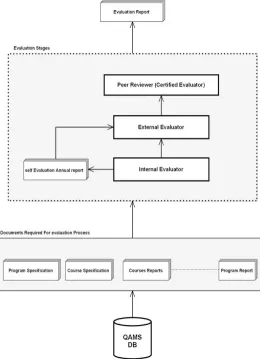
The evaluation has to lead to concrete measures if to be considers valid and valuable. There should be a long-term strategic plan for the evaluation so that the institutions know what to expect. Every university has the responsibility to make a plan and program for the evaluation of quality [2]. In our country (Egypt), the quality evaluation process for any higher education institution (HEI) consists of three stages: self-evaluation, external / internal evaluation, and peer reviewing evaluation as shown at figure1 [17]. At figure1, The QAMS DB refers to the database of the quality assurance management system according to [1].
II. EVALUATION STAGES
When evaluating the institutions means judging the strategies, goals, plans, systems, methods and the organisations that the institutions use to secure and dev elop the quality devices are ―evaluate to develop‖ and ―quality is a journey not a destination‖ [2].
To maintain and improve quality, higher education institutions have to evaluate themselves, which is the first step in the evaluation process. The next step is external (sometimes called internal) evaluation, which includes a visit of the external evaluation commission that issues a report with recommendations [5]. The final step is the peer reviewing / the site-visit evaluation.
Our system (Quality Assurance Evaluation System or QAES) focuses on the first two stages for two reasons. The first reason is that the major (if not all) of Egyptian higher education institutions try to be enrolled in QAAP now because it is a new trend in Egypt. The second reason is that the third stage is based on the two other stages and if the institution success to precede the first two stages it will be able to transfer to the third stage easily.
Self-evaluation means that a unit or an organisation appraises its own activities, their prerequisites and outcomes. Self-evaluation is a way of collecting information on the evaluation target and a tool for HEIs to improve their activities. Self-evaluation can be undertaken on the organization's own initiative or at the behest of an external body [4].
The next step in the evaluation process is external evaluation , which includes a visit of the external evaluation commission that issues a report with recommendations. Tasks of the external evaluation commission will be: to overview the contents of the self- evaluation report, to visit the higher education institution, which is the object of external evaluation, and to form an evaluation report with recommendations. A dialogue between the evaluators and the evaluated institution has to be present [5].
External evaluator is an external experienced person in the field of specialization who is invited to review the structure and content of a programme, its relevance to the Intended learning outcomes (ILOs), the standards and appropriateness of student assessments and attainment against the specification, and evaluating the existing learning resources and whether or not they satisfy the programme requirements. The institution is responsible for specifying the evaluators’ role and appointing them [7].
I. THE FEATURES OF QUALITY ASSURANCE
EVALUATION SYSTEM (QAES)
Our main idea is to create an automated system to help every one who deals with the evaluation process of any institution. The biggest problem that may face the institution during the quality evaluation process is how to generate its
self evaluation report. Also, during the internal (external) evaluation stage it is required from the evaluator to generate the evaluation report in a specific format. This may take several time and many efforts to be finished. Another difficult that may face the evaluation team is appropriate tool that is required to connect them with each other in some tasks. The evaluation process also must contain the recommendation report from the evaluators' point of view. The all of these processes will be executed automatically with our system. The quality assurance evaluation system QAES is our designed system. The input and output for the system can be illus trated at fig. 2.
The inputs of the system are all documents required for the evaluation process as the institution data, staff data, students' data, buildings data …etc.
The main outputs of the system are:
1. The self-evaluation annual report of the
institution.
2. The internal / external evaluation report.
3. The recommendation report.
There are also a lot of related outputs for the system that the evaluation team may use it to communicate during the evaluation process. These outputs includes visit time table that is created by the president of the evaluation team to determine each evaluation task and its period.
The system also provides a lot of services for the evaluation team as:
1. Allow the president to determine each
team member tasks
2. Allow the team member to agree,
disagree, or comment on these tasks.
3. Allow evaluators to upload their daily
notes about the evaluation process.
4. Allow the president to update any report
of any member and inform the member.
5. president can generate and print the
pre-visit report.
6. Allow to all members to print all
evaluation reports and update their data at any time.
7. Allow each member of the team to view
the report of the other members about the same
institution.
8. Allow the team to communicate in
writing the final evaluation report for the institution at
the same time.
II. UML DIAGRAMS FOR THE QAES
The Unified Modeling Language (UML) is a
standard language for specifying, visualizing, constructing, and documenting the artifacts of software systems, as well as for business modeling and other non-software systems. The UML represents a collection of best engineering practices that have proven successful in the modeling of large and complex systems. The UML is very important parts of developing object oriented software and the software development process. The UML uses mostly graphical notations to express the design of software projects. Using the UML helps project teams communicate, explore potential designs, and validate the architectural design of the software [1].
A. Use-case Diagram
A use case is a set of scenarios that describing an interaction between a user and a system. A use case diagram displays the relationship among actors and use cases. The two main components of a use case diagram are use cases and actors. An actor is represents a user or another system that will interact with the system you are modeling. A use case is an external view of the system that represents some action the user might perform in order to complete a task.
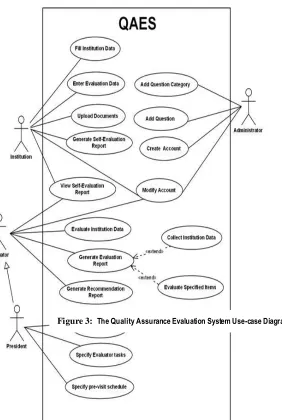
Figure3 represents the use-case diagram for QAES. This diagram contains 3 actors:
1. Institution: the institution actor refers to the person who is responsible for entering the institution data required for the evaluation process. This actor will:
1. Fill the institution form with required data
as institution location.
2. Enter the evaluation data as the institution
mission.
3. Upload the required documents.
4. Generate and view the self-evaluation
report automatically by the system.
5. Modify the account data.
The system allows this actor also can update and modify any
data and view the evaluator recommendation during and
after the evaluation process.
2. Administrator: administrator is the actor that controls the whole system. This actor will:
1. Create new account.
2. Modify existing account data.
3. Add new evaluation criteria for both
institution and evaluators.
4. Add evaluation features.
3. Evaluator: the evaluator is considered to be the main actor in our system. Evaluator will perform the main tasks that the system is created for. As you see in the following figure, there are two types of evaluator:
a. President: this actor represents the president of the evaluation team of any institution. This actor can:
1. Create the visit time table of the
institution and send it automatically to the team
members.
2. Specify the evaluation tasks for every
member and send these tasks to their member.
3. Create the pre-visit schedule for the
evaluation process.
b. Member: the member actor represents the evaluator that is a member of an evaluation team for an
institution.this actor will shares a set of tasks with the
president of the evaluation team as:
1. View the self-evaluation report of the
institution.
2. Evaluate the institution data.
3. Generate the evaluation report.
4. Generate the recommendation report
and sends it to the institution.
Fig. 3. T he Quality Assurance Evaluation System Use-case Diagram
B. Class Diagram
This part shows the main classes that are used to build the
QAES using the class diagram that is shown at figure 4.
There is an abstract class called evaluator class. This class
has a set of methods that represent its object operations as
Generate_evaluation_report(), Print_documents(), and
Recommebdation_report(). The evaluator class is called
superclass because it contains two subtypes (president
evaluator subtype and member evaluator subtype). The
president evaluator has the attributes ID, Name, Institution
ID, Email, and telephone and perform the following
operations: Generate_time_table(), Specify_tasks(),
Check_member_reports(). The Member evaluator h as the
same attributes as the president evaluator but he will
perform different operations as : Accept his tasks that has
been determined by the president evaluator or comment on it
and sends the comment again to the president by the
Accept_tasks() method. He also will generate the daily
report about his work during the evaluation process in the
institution by Daily_report() method.
Another class is called the Task class which is used to
represent the set of tasks that the evaluators will do during
the evaluation process. This class contains the attributes:
Task_ID, Institution_ID, Start_time, and End_time and
contains also two methods: Complete_Task() which will be
used to check either the task is completed successfully or
not and Task_reslt() which will be used to return the result
of task to the final report.
The last class is the Institution class that contains the
institution information (Name, Location, number of staff,
and number of students) as its attributes and contains also
asset of methods that represents its operation as:
1.
uploadfile() method: which allow the institution toupload its documents and files required for the
evaluation process. Figure 3: The Quality Assurance Evaluation System Use-case Diagram
2.
fillformdata() method: witch allow the institution to fill the required data (descriptive data) about itself.3.
viewrecommendation() method: this methodreturns the comments and recommendation from the
evaluators (president or member) to the institution in
order to modify and develop itself.
4.
modify_data() method: allows to institutio n tomodify and update its data, files, and documents to
meet the evaluators recommendations.
There are three relationships between classes in figure4. The
first one is the relationship between the Member evaluator
and the Task. This relation means that each member will
perform many tasks. The second relationship between
President Evaluator and task means that the President will
determine a set of tasks for each member evaluator. The
third one is the evaluator-institution relationship that means
each evaluator (President or member) will evaluate one or
more institution.
III. IM PLEM ENTATION
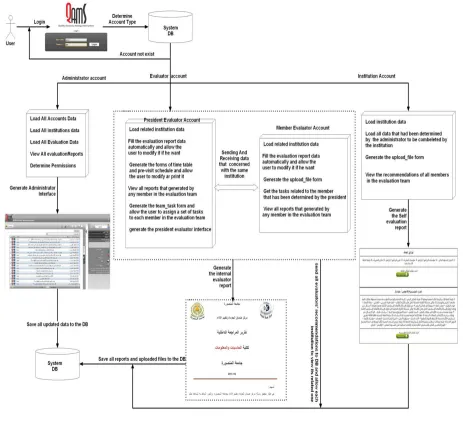
The QAES prototype is a web2-based system which is be
used now in the Quality Assurance Center - Mansoura
University – Egypt during the institutions evaluation. The
prototype implementation is concentrated on the PHP and
Ajax web technique. The data base is created by using
MySQL DBMS. The system contains a set of screens
according to the user who deal with it as administrator,
institution, or evaluator. Figure 5 shows a general view for
the system implementation and outputs .
IV. CONCLUSION
The urgent need for development requires us to deal with quality assurance using modern technology. One such technology is to build systems based on the computer to manage quality assurance, especially in higher education institutions. The most important point in quality assurance in higher education is the process of quality assessment. Therefore, we must develop a system to manage the process of assessing the quality assurance system enables users to easily complete the evaluation process. Building such a system would reduce a lot of fuss, time, and effort on both of the institutions that fall within the evaluation process and the evaluation team during the evaluation of this institution. It would also provide an appropriate environment for the rapid exchange of information and views between members of the evaluation team and also the rapid development in the institution's performance.
REFERENCES
[1] A.E.Hasan and Others, "A Computer-based Quality Assurance Management System For Higher Education", CIS Mansoura -Egypt, 2008
[2] John C. Friend-Pereira and others, "European Student Handbook on Quality Assurance in Higher Education ", ESIB Chair, 2002.
[3] Tian Belawati and Am in Zuhairi," T he Practice of a Quality Assurance System in Open and Distance Learning: A case study at Universitas T erbuka Indonesia (T he Indonesia Open University)", International Review of Research in Open and Distance Learning, March – 2007.
[4] Finnish Higher Education Evaluation Council, "Audits of Quality Assurance Systems of Finnish Higher Education Institutions" , Audit Manual for 2005–2007
[5] Armand Faganel and Slavko Dolinšek," Quality Management Systems in Higher Education",
[6] The National Quality Assurance and Accreditation Committee – Egypt," Developmental engagement ' Site-
Visit guidelines' ", adapted version of QAA handbook for egypt,2007
[7] Dr. Mohsen Elm ahdy Said and others ," GUIDELINES AND T EMPLAT ES FOR INT ERNAL QUALIT Y ASSURANCE SYST EM IN HIGHER EDUCAT ION INSTITUTIONS (Annex E) ", egypt,2007
[8] CHEA president, "International T HE VALUE OF ACCREDIT AT ION: FOUR PIVOT AL ROLES ", CHEA Institute for Research and Study of Accreditation and Quality Assurance , May 2003
[9] The U.S. Environm ental Protection Agency (EPA)," EPA Requirements for Quality Management Plans ", EPA/240/B-01/002, March 20
[10] Karen K. Schultz, PhD and David Latif, PhD," T he Planning and Implementation of a Faculty Peer Review T eaching Project ", American Journal of Pharmaceutical Education, USA, 2006 [11] OECD/ IMHE, "REVIEW OF HIGHER EDUCAT ION INST IT UTIONS IN REGIONAL DEVELOPMENT ", OECD, Paris- France, 2008
[12] European Com m ission TEMPUS, "Bringing out the best in education ' Enhancing quality in higher education: a Tempus survey'", T EMPUS CONFERENCE, Cairo, May 2008 [13] Peter Materu, "Higher Education Quality Assurance in
Sub-Saharan Africa Status, Challenges, Opportunities, and Promising Practices ", Library of Congress Cataloging-in-Publication Data, USA, 2007
[14] Methodologies for Web Information System Design , Peter Barna, Flavius Frasincar, Geert-Jan Houben, and Richard Vdovjak Technische Universiteit Eindhoven PO Box 513,
NL-5600 MB Eindhoven, The Netherlands
wwwis.win.tue.nl/~houben/respub/itcc2003a.pdf
[15] Designing Online Informat ion Systems for Portfolio-Based Assessment: Design Criteria and Heuristics, Terence Love Curtin University, Perth, WA, Australia, Trudi Cooper Edith
Cowan University, Perth, WA, Australia
jite.org/documents/Vol3/v3p065-081-127.pdf
[16] AN INFORMAT ION SYST EMS DESIGN T HEORY FOR
WEB-BASED EDUCATION , David Jones, Shirley Gregor, Teresa Lynch, Faculty of Inform atics and Com m unication Central Queensland University Rockhampton, Australia, 4701
wesrac.usc.edu/wired/bldg-7_file/isdt.pdf
[17] A computer design For T he Qualit y Assurance Evaluation Process In Higher Education Institution, M.S.Kandel and others, 2009, 1st International Conference, JW Marriott, Mirage City, Cairo, Egypt, December 8-10, 2009.
Mahmoud Kandel Obtained his B. Sc. 1961, in Power and Electric Machines "Very Good". Faculty of engineering, Alexandria University, Egypt. M. Sc. 1964, Faculty of Science, Manchester University, England . Entitled " Digital analysis of the stability of the multi-machine power systems".
Ph. D. 1967 , Institute for Science and Technology,
Manchester, England Entitled "Discriminative
Performance of Impedance Measuring Protection " . He worked as Dean of the Faculty of Engineering, Mans oura University, 1994- 1997. Executive director of the Center for quality assurance and certification, University of Mansoura, 2005-2008. Adviser to the President of the University for strategic planning and accreditation 2008-now.
Ahmed Hasan Ph. D. in Computer Engineering, December 2004 Department of Computer
Science and Electrical Engineering, West Virginia
University, USA. Dissertation Title: Architectural Level Software Risk Assessment.
Master of Engineering in Computer Engineering, December 2000, Department of Electrical and computer Engineering, Stevens Institute of Technology, NJ, USA.
M. Sc. Electrical Engineering in ―Artificial Intelligence Applications in power Systems‖, August 1992, Department of Electrical Eng., Faculty of Engineering, Elmansoure University, Egypt.
Thesis Title: Expert System and Artificial Data Base for Protection of Transmission System of Power System.
B.Sc. in Electrical Engineering (Power System): Electrical Power System Department, Faculty of Engineering, Menofia University, Egypt
Aziza Kasem PhD - Philosophy in Engineering - College of Engineering -
Alexandria University - 1996
the College of Education - Mansoura
University - 1988
Diploma in General - in education - the College of Education - Mansoura
University - 1984
M.Sc. - in Engineering - University of
Nottingham, England - 1981
Bachelor - Engineering (ONE )- Higher Institute of industrial M ansoura University – 1973.
Mohamed El-hoseny Obtained his B. Sc. 2006 in Information systems "Excellent". Faculty of Computer Sciences and Information Systems, M ansoura University, Egypt. Premaster in Information systems 2007, Faculty of Computer Sciences and Information System, M ansoura University, Egypt.
Prepare master now in information systems in Quality Assurance M anagement System For Higher education Institutions. Now working as teaching assistant, faculty of computer sciences and Information systems , M ansoura University, Egypt .