Study and Analysis of Reactive Power in Wind
Farm for Reducing Distribution Losses Using
Genetic Algorithm
Satvinder Singh
Assistant Professor, Department of Electrical Engg. YMCA University of Science & Technology, Faridabad, India
Nitin Goel
Assistant Professor, Department of Electrical Engg. YMCA University of Science & Technology, Faridabad, India
Pawan Kumar
Instructor, Department of Electrical Engg.
YMCA University of Science & Technology, Faridabad, India
Abstract— This paper presents the optimization of reactive power in wind form for reducing distribution losses. For this purpose a Wind Farm comprising Doubly Fed Induction Generation (DFIG) wind turbines is purposed as a continuous reactive power source to support system voltage control due to reactive power control capability of doubly fed induction generator. The genetic algorithm is utilized to find the optimize value of reactive power in wind farm for reducing the losses. The objective function is to minimize the real power losses of the system and minimize the deviation of the bus voltage is achieved.
Keyword- Doubly fed Induction Generator, Grid connected wind farm, Genetic Algorithm.
I. INTRODUCTION
II. SYSTEM MODEL AND CONTROL
The model of DFIG consisting of a pitch controlled wind turbine and an induction generator [1]. The stator of the DFIG is directly connected to the grid, while the rotor is connected to a converter consisting of two back-to-back PWM inverters, which allows direct control of the rotor currents. Direct control of the rotor currents allows for variable speed operation and reactive power control thus DFIG can operate at a higher efficiency over a wide range of wind speeds and help provide voltage support for the grid. These characteristics make the DFIG ideal for use as a wind generator
.
Fig.1 shows the DFIG Configuration.Fig.1 Configuration of DFIG
A. DFIG Capability Limits Curve
The stator active and reactive power can be expressed as a function of stator current and rotor current [1]
In the PQ plane, (1) represents a circumference centered at the origin with radius equal to the stator rated apparent power. Equation (2) represents a circumference centered at s/Xs, 0] and radius equal to 3 XM US IR / XS
.
Therefore, given the stator and rotor maximum allowable currents IS max and IRmax , the DFIG capability limits are obtained. Fig.1 shows the composed curve for the DFIG capability limits. Additionally, the steady state stability limit of the DFIG is taken into account, which represented as vertical line at the [-3 U2s /Xs, 0], coordinate. It’sFig.2. DFIG capability limits curve
In Fig.2, The DFIG can be able to operate at any point in the intersecting area within the given limits. From this figure, one can observe that when the available active power is far from its maximum, the amount of available reactive power is high. The large reactive power control capability of the DFIG making it possible to use DFIG as the continuous reactive power source to support system voltage control.
B. Wind Farm Model
In this paper, a wind farm model is developed with n DFIG wind turbines connected in parallel. As a result, the total active and reactive power output of the wind farm equal to the sum of the active and reactive power generated by each of the DFIG wind turbine in the wind farm:
Where PWF represents the active power output of the wind farm, QWF represents the reactive power output of the wind farm, Pgi represents the generated active power of each DFIG and Qgi represents the generated or absorbed reactive power of each DFIG.
In this paper, it’s assumed that the wind speed at each DFIG is the same and all of the available active power in wind farm is fed into the distribution network.
III. PROBLEM FORMULATION
In this section, wind farm reactive power output optimization has been modeled as a multi objective, non differentiable optimization problem. In the proposed optimization algorithm, the objective function consists of two terms: 1) the real power losses of the system, 2) the deviation of the bus voltage.
Due to the DFIG operational requirements, the minimization of the objective function is subjected to the following constraints:
4) Node voltage magnitude limits:
5) Distribution line limits:
6) Radial structure of the network.
IV. GENETIC ALGORITHIM BASED REACTIVE POWER OUTPUT OPTIMISATION
Genetic Algorithm is a family of computational models inspired by evolution. These algorithms encode a potential solution to a specific problem on a simple chromosome. And apply recombination operators to these structures so as to preserve critical information. Genetic algorithms are often viewed as function optimizers although the range of problems to which genetic algorithms have been applied is quite broad an implementation of a genetic algorithm begins with a population of typically random chromosomes. One then evaluates these structures and allocates reproductive opportunities in such a way that those chromosomes which represent a better solution to the target problem are given more chances to reproduce than those chromosomes which are poorer solutions the goodness of a solution is typically defined with respect to the current population. Then GA operators are performed to obtain the new child offspring; the operators are:
1. Selection 2. Crossover, 3. Mutation,
.
V. SIMULATION RESULTS
For modeling of a dynamic system, the system should be fully defined. After building each component, integrate them into a complete model of the system. A three feeder distribution system is used as shown in the Fig. 3 with a base voltage of 0.69 KV. Total system load is 28.7MW and 17.3MVAR. A small wind farm comprising 10 DFIG wind turbines of 900kW, with a power installed of 9MW is connected at node 12 through a rated 23/0.69 kV transformer.
Fig. 3 Single line diagram of three feeder system
A. Available Active and Reactive Power in Wind Farm
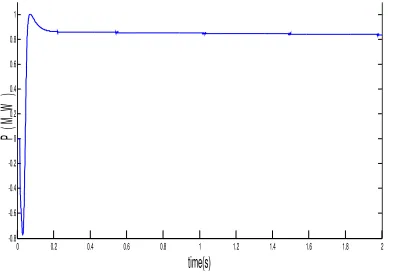
A three feeder distribution system is modelled in MATLAB with a Wind farm connected at the 12th node and its simulation results are presented. The active power and reactive power output are in MW Shown in Fig. 4 & 5
0 0.2 0.4 0.6 0.8 1 1.2 1.4 1.6 1.8 2 -0.8
-0.6 -0.4 -0.2 0 0.2 0.4 0.6 0.8 1
time(s)
P
(M
W
)
Fig.4 Active power output of Wind farm
0 0.2 0.4 0.6 0.8 1 1.2 1.4 1.6 1.8 2 -0.5
0 0.5 1 1.5
time(s)
Q
(M
V
A
R
)
B. Results of Optimization
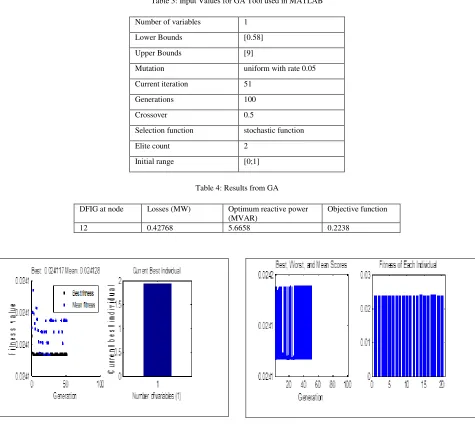
The Reactive power output of the DFIG is used as control variable in Genetic algorithm. The objective function which includes minimization of losses and improvement of voltage profile is calculated by means of Genetic algorithm. The Table 3 shows the input values for the optimization toolbox in MATLAB while Table shows the results after optimization through genetic algorithm. Whereas the plot of Best Fitness, Best Individual, Max Constraint and Range are drawn by MATLAB Optimization toolbox.
Table 3: Input Values for GA Tool used in MATLAB
Number of variables 1
Lower Bounds [0.58]
Upper Bounds [9]
Mutation uniform with rate 0.05
Current iteration 51
Generations 100
Crossover 0.5
Selection function stochastic function
Elite count 2
Initial range [0;1]
Table 4: Results from GA
DFIG at node Losses (MW) Optimum reactive power
(MVAR)
Objective function
12 0.42768 5.6658 0.2238
Fig 6 Best Fitness, Best Individual, Max Constraint and Range drawn for test system
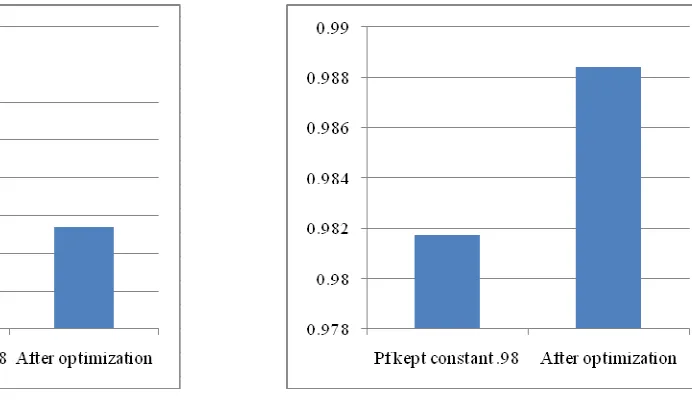
Fig.7: Power losses of the distribution system Fig. 8: Minimum nodal voltage of the distribution system
Comparison between the minimum nodal voltage of the system when the power factor of the wind farm is kept constant at .98 and nodal voltage of the system after optimization is shown in Fig. 8.
VI. CONCLUSIONS
In this paper the losses and nodal voltage of the system after optimization were compared with the losses and nodal voltage of the system when power factor of wind farm is kept constant. The losses in the system were 0.43368 MW when the power factor of wind farm is kept constant at 0.98. Comparing the two losses, it can be concluded that losses in the system were reduced after optimization. Minimum nodal voltage of the system after optimization was 0.9884 p.u. and Minimum nodal voltage of the system when power factor of wind farm is kept constant at 0.98 was 0.9817 p.u. Comparing the two voltages, it can be concluded that voltage deviation in the system was reduced after optimization. From the results obtained for the test system, it can be concluded that Wind farm made up of DFIG can act as a continuous reactive power source to support system voltage and reduce the losses of the system.
ACKNOWLEDGEMENT
The authors would like to thank Prof. (Dr.) P.R. Sharma Chairman and Faculty Members, Department of Electrical Engineering, YMCA University of Science and Technology, Faridabad, for many valuable suggestions.
REFERENCES
[1] J.J. Zhao, X. Li, J.T. Hao, C.L. Zhang and J.P. Lu, “Wind Farm Reactive Power Output Optimization for Loss Reduction and Voltage Profile Improvements”, IEEE Conference on Power Electronics and motion control, Wuhan, pp. 1089-1095, July 2002.
[2] Wei Xiwen, Qiu Xiaoyan, Xu Jian and Li Xingyuan, “Reactive Power Optimization in Smart With Wind Power generator”, IEEE
Conference on Power and Energy Engineering, Chengdu, pp. 1-4, April 2010.
[3] L. Krichen, H. Hadj Abdallah, A. Ouali, “Genetic Algorithms for Optimal Reactive power Compensation of a Power system with wind
generators based on Artificial Neural Networks”, Journal of Electrical systems, pp. 1-12, 2007.
[4] Tao Jin, Zeng Xiangjun, Zhang Ping and Feng Kaihui, “Improved Genetic Algorithm Application in Reactive Power Optimization of Wind
Farm”, The International conference on Electrical Engineering, pp. 1-4, 2009.
[5] A. Tapia , G. Tapia, J.X. Ostolaza, “Reactive power control of wind farms for voltage control applications,” Renewable Energy, vol.29, no.3, pp.377–392, 2004.
[7] Clovis Bosco Mendonca Oliveira, Manoel Firmino de Medeiros Jr. and Jose Tavares de Oliveira, “New Method based in Particle Swarm Optimization for Power Factor Remote Control and Loss Minimization in Power Systems with Wind Farms Connected”, IEEE International conference on Intelligent System Applications to Power Systems, Curitiba, pp. 1-6, Dec 2009.
[8] S. N. Singh, Jacob Ostergaard and Bharat Singh, “Reactive Power Capability of Unified DFIG for Wind Power Generation”, IEEE Power
and Energy Society General Meeting, pp. 1-7, Sep 2010.
[9] Gary L. Johnson, “Wind Energy Systems”, Electronic Edition, 2006.
[10] Texas Comptroller of Public Accounts, “The Energy Report”, Ch-11, May 2008.
[11] World Wind Energy Association, “World Wind Energy Report 2009”, March 2010.
[12] Global Wind Energy Council, “Indian Wind Energy Outlook 2009”, Sep 2009.
[13] Leonardo Energy, Copper Development Association, “Power Quality and Utilization Guide;
[14] The Need Project, “Intermediate Energy Info book”, www.NEED.org
[15] Leda-Ioanna Tegou, Heracles Polatidis, and Dias A. Haralambopoulos, “Distributed Generation with Renewable Energy Systems: The
spatial dimension for an autonomous Grid”, Conference of the European Regional Science Association, France, pp. 1-20, Aug 2007.