Original Research Article.
Exposure to Violence among Physicians Working at the Primary Care in the
Kingdom of Bahrain
Aalaa Abushaqrah
1, Fatema Alherz
2*, Fatema Shaikh Ali
3, Nawara Bahzad
4, Basma Alsaffar
51Medical Doctor, MBBS, Primary Care Physician, Isa Town Health Center, 2*Medical Doctor, M.D, Primary Care Physician, Halat Bu Maher Health Center, 3Medical Doctor, M.D, Primary Care Physician, East Rifaa Health Center, 4Medical Doctor, M.D, Primary Care Physician, Budaiya Health Center, 5Medical Doctor, M.D, Primary Care Physician,
Primary Care Directorate, Ministry of Health, Kingdom of Bahrain.
ABSTRACT
Background: Violence against healthcare workers is a critical problem, regardless of its form. It has a range of physical and psychological outcomes, affecting their health and productivity. Published studies about the prevalence of violence among primary physicians in Bahrain were lacking.
Aim: To increase awareness of the primary care physicians on how to deal with patient’s violence in the primary care setting. Methods: A cross-sectional study was conducted on primary care physicians working at local health centers in the kingdom of Bahrain. All physicians were included in the study (344). Results: More than two thirds of the respondents were exposed to at least one episode of violence against them at a certain time in their practice (87%). The majority of the respondents were females, between (35-44) years of age and consultant family physician. Respondents reported that long waiting time, refusing patient requests and substance abuse were the most common reasons for violence. Verbal abuse was the most reported abuse form (95.6%). The perpetrators of violence were reported as the patients themselves followed by patient's family members. Three quarters of the physicians reported negative feelings, like anger, irritability and poor concentration after the violent attacks.
Conclusion: Violence in primary care settings is not an uncommon phenomenon. Policies and strategies need to be introduced for prevention and management of workplace violence, enhance incident reporting and follow-up on reported events as well as providing adequate physical and psychological support to victims of health workplace violence.
Keywords: Violence, Primary Care, Family Physician.
*Correspondence to:
Dr. Fatema Alherz, M.D, Primary Care Physician, Halat Bu Maher Health Center, Primary Care Directorate,
Ministry of Health, Kingdom of Bahrain. Article History:
Received: 10-05-2018, Revised: 07-06-2018, Accepted: 24-07-2018 Access this article online
Website:
www.ijmrp.com
Quick Response code
DOI:
10.21276/ijmrp.2018.4.4.024
INTRODUCTION
The World Health Organization (WHO) has defined violence as “the intentional use of physical force or power, threatened or actual, against oneself, another person, or against a group or community that either results in or has a high likelihood of resulting in injury, death, psychological harm, mal-development, or deprivation’’.1 Workplace violence is confined in violent acts
against workers occurring at the work site”.2
Moreover, violence can be perpetrated through numerous methods such as physical, sexual, verbal abuse, emotional, psychological violence and others.3 Universal studies pointed to
high number of victims among healthcare workers.6 Around 90%
of healthcare workers have experienced violent incidents at work, 70-80% of the aggregate percentage were nurses and doctors.4 In
USA, around 75% of emergency physicians agreed that they had at least one verbal threat in the period of one year.5
Another study was done in Australia in 2005 showed that 63.7% of the participants had faced violence in the previous 12 months.6
The study also concluded that the most common types of violence were “low level” violence, which means verbal abuse (42.1%), belongings damage/theft (28.6%) and threats (23.1%).6 Another
finding of the study was that a smaller proportion of general practitioners had experienced “high level” violence, such as sexual harassment (9.3%) and physical abuse (2.7%).6
Similar results were found in a study done in Palestine in 2012. It demonstrated that the majority of the respondents (80.4%) were exposed to violence in the previous year.7
In the Gulf region; particularly in Saudi Arabia a study done in 2011, found that more than two thirds of respondents (67.4%) experienced some form of violence in the previous 12 months.8
primary care physicians on how to deal with patient’s violence in the primary care setting.
The main objectives of this study were: 1. To estimate the prevalence of exposure to any type of violence among primary care physicians in Kingdom Of Bahrain, 2. To identify the types and sources of violence experienced by primary care physicians in Kingdom Of Bahrain and 3. To identify possible factors associated with workplace violence as perceived by primary care physicians in Kingdom Of Bahrain.
METHODS
This cross-sectional study was conducted on primary care physicians working at the 26 Primary health care in the kingdom of Bahrain. The study population composed of all family physicians and general practitioners practicing in the primary care (n=344). Residents of the Family practice residency program (FPRP) were excluded from the study.
Data was collected using a questionnaire. This questionnaire used
was a validated questionnaire adopted from an Australian study about violence at the workplace. The initial approval was obtained from the original author to use it and to perform some modifications on it according to the situation in the primary care. A hard copy of the questionnaire was submitted to the physician’s hand-by-hand.
The questionnaire was written in English and composed of several sections that include: Demographic characteristics, including gender, age, information about the physician’s medical education and career experience. In addition, it included the physician’s perceptions and feelings about violence, the physician’s experience about work-related violence, the effects of violence on the physician and The physician’s education and training about violence.
Ethical approval for the study was granted by the ethical research committee of the primary care in the ministry of health in Bahrain. The data for this study were entered and analyzed using the Statistical Package for Social Services version 23 (SPSS).
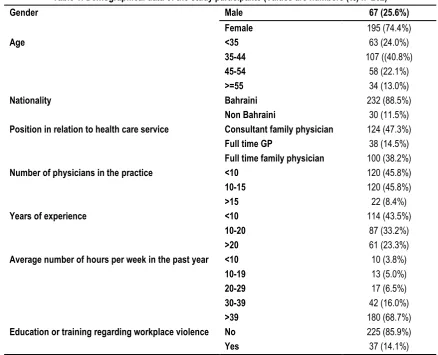
Table 1: Demographical data of the study participants (Values are numbers (%) n=262)
Gender Male 67 (25.6%)
Female 195 (74.4%)
Age <35 63 (24.0%)
35-44 107 ((40.8%)
45-54 58 (22.1%)
>=55 34 (13.0%)
Nationality Bahraini 232 (88.5%)
Non Bahraini 30 (11.5%)
Position in relation to health care service Consultant family physician 124 (47.3%)
Full time GP 38 (14.5%)
Full time family physician 100 (38.2%)
Number of physicians in the practice <10 120 (45.8%)
10-15 120 (45.8%)
>15 22 (8.4%)
Years of experience <10 114 (43.5%)
10-20 87 (33.2%)
>20 61 (23.3%)
Average number of hours per week in the past year <10 10 (3.8%)
10-19 13 (5.0%)
20-29 17 (6.5%)
30-39 42 (16.0%)
>39 180 (68.7%)
Education or training regarding workplace violence No 225 (85.9%)
Yes 37 (14.1%)
RESULTS
Of the 305 questionnaires distributed, 262 were returned. The response rate was 86%. The majority of the respondents were females 195 (74.4%). Most of them were between (35-44) years of age (40.8%). Forty seven percent of the respondents were consultant family physician. (Table 1)
More than half of the respondents (68.7%) work for more than 39 hours per week in the past year. Moreover, about (85.9%) of the physician practicing in the primary care did not receive any previous education or training regarding workplace violence.
Regarding the types of violence that the physician were exposed to during their practice; 228 of the physicians (87%) reported exposure to any kind of violence during their work in the health sector with almost (95.6%) of them reported verbal abuse and about (54.4%) of them were subjected to threats. (Table 2) While only (28.9%) of the respondents revealed exposure to slander during their practice.
The perpetrators of violence were reported by (82.9%) of the physicians as the patients themselves followed by (40.8%) of the physicians reported them as patient's family members.
The primary care physicians recognized several contributing factors for violence attacks. A list of possible causes was offered to them in the questionnaire. Long waiting time came in first place (64.9%). The second most often cited reason was refusing to patient requests (61.8%), followed by substance abuse (41.7%).
Respondents reported other reasons of violence, including psychiatric disorders in the patients (33.8%), dissatisfaction with medical management (32.9%), patient's health condition (11.4%) were chosen in that order. Some physicians added other factors (19.3%), such as patient's level of education, and lack of knowledge about the new appointment system in the primary care in Bahrain, inappropriate doctor's communication skills, absence of laws that protect physicians. (Table 3).
Table 2: Types of violence (values are numbers (%))
No Yes Total
Have you faced any kind of violence during your work in the health sector?
34 (13.0%) 228 (87.0%) 262 (100%)
In the past, were you subjected to verbal abuse? 10 (4.4%) 218 (95.6%) 228 (100%)
In the past, were you subjected to threats? 104 (45.6%) 124 (54.4%) 228 (100%)
In the past, were you subjected to slander? 162 (71.1%) 66 (28.9%) 228 (100%)
In the past, were you subjected to property damage or theft? 186 (81.6%) 42 (18.4%) 228 (100%)
In the past, have you been subjected to stalking? 213 (93.4%) 15 (6.6%) 228 (100%)
In the past, were you subjected to physical abuse? 217 (95.2%) 11 (4.8%) 228 (100%)
In the past, were you subjected to sexual harassment? 210 (92.1%) 18 (7.9%) 228 (100%)
In the past, were you subjected to sexual abuse? 228 (100%) 0 (0%) 228 (100%)
Table 3: Contributing factors for violence attacks (Values are numbers (%) n=228)
Psychiatric disorders 77 (33.8%)
Substance abuse 95 (41.7%)
Dissatisfaction with medical management/outcome 75 (32.9%)
Long waiting time 148 (64.9%)
Refused patient request (e.g. denied work certificate) 141 (61.8%)
Patient’s health condition 26 (11.4%)
Other factors 44 (19.3%)
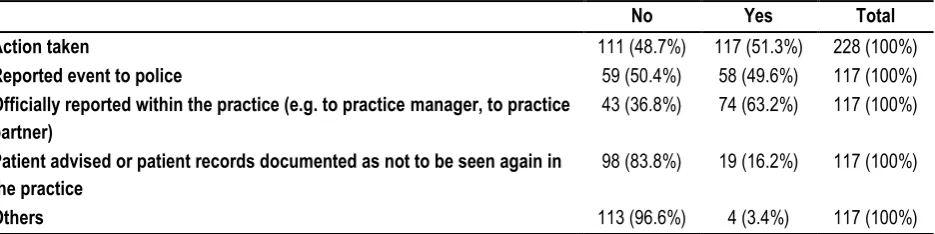
Table 4: Types of actions taken
No Yes Total
Action taken 111 (48.7%) 117 (51.3%) 228 (100%)
Reported event to police 59 (50.4%) 58 (49.6%) 117 (100%)
Officially reported within the practice (e.g. to practice manager, to practice partner)
43 (36.8%) 74 (63.2%) 117 (100%)
Patient advised or patient records documented as not to be seen again in the practice
98 (83.8%) 19 (16.2%) 117 (100%)
Others 113 (96.6%) 4 (3.4%) 117 (100%)
Regarding any taken actions following violence episodes (Table 4), around half of the primary care physicians (48.7%) revealed that they neither sought help nor accessed any resources regarding workplace violence. The other half (51.3%) did take some sort of action. About (63.2%) of the physicians who took action reported the incident within the practice, (49.6%) reported the incident to police, (16.2%) asked not to see the patient again in the practice.
About the consequence of violence attacks on the physicians; the consequence reported by the physicians in order of frequency were as follow: feeling irritable and angry (79.4%), difficulty concentrating (61.8%), thinking about the incident when they didn't mean to (46.1%), trying not to think about the episode
(30.3%), having panic attacks (18.4%), re-experiencing aspects of the incident (17.5%), trying not to talk about the incident (14.5%) and other consequences (10.1%) that include crying, thinking about leaving the job, being aggressive toward patients, and having depressive episodes.
Subsequently, chi-square test was performed to examine the association between respondent's characteristics and exposure to violence.
The analysis found no association between physician's characteristics; gender, age, nationality, and years of experience. The physician's position in the practice was the only significant factor (weak association) in the prevalence of abuse (p-value 0.059), with (50%) of consultant family physicians reported being involved in violence episodes. The next highest prevalence of violence was that of family physicians (36.8%), and the last one was of general practitioners (13.15%).
DISCUSSION
The prevalence of violence observed in this study was high; approximately more than two thirds of respondents were exposed to at least one episode of violence against them at a certain time in their practice.
Studies conducted in developed and developing countries vary in their quantitative approximation of the numbers of physicians who were exposed to violent acts, but all agreed on the high number of violent acts against them. An American study conducted in 2005 concluded that 76% of the physicians were exposed to at least one violent act during the last year.5
In the Australian study, the majority (63.7%) of GPs surveyed had been subjected to some form of violence within the previous year.6
In a Saudi study, named “violence exposure among health care professionals in Saudi public hospitals” conducted in 2011, 67.4% of the health care workers were exposed to some form of violence in the previous 12 months.8
This study showed no significant association in the prevalence of violence between gender. In the Saudi study, male physicians (73.7%) had a significantly higher percentage of violence exposure than females.8
The study results were consistent with other studies in Egypt and Lebanon as there were no significant differences in the overall violence experienced between males and females were found. 9,10
Consultant family physicians were the highest to be exposed to violence, which could be explained by the longer duration of work in the field. While we expect the consultant family physicians to have the lowest level of violence due to long work experience. Other studies revealed different results in terms of relation of physicians experience and exposure to violence; as they described prevalence and specified time frame in questionnaires. In the Saudi study, respondents who had less years of experience in the health sector were two times more likely to be victims of violent episodes than those who had higher years of experience.8
In the Australian study, General practitioners reporting high level violence were more likely to be female, to be younger in age, and to have less years of experience as a general practitioner.6
Our data is comparable to data from studies conducted in other countries in terms of verbal abuse. For instance, studies in Australia, New Zealand and the USA also point out that verbal abuse is the most prevalent form of violence against health care workers.6,11,12 As per our study, 44% of physicians had
experienced verbal abuse in the past. In Japan 31.8% of physicians were verbally abused; while in New Zealand, the percentage reached 15%.11,13
Regarding the identity of the perpetrator, physicians reported that the patients were on top of the list, followed by the patient’s family
member, person accompanying patient other than the family and others, in comparison with the American study, the result was similar, as 89% of assaults came from the patient, 9% from a family member, and 2% from a friend of a patient.5
Although our study did not explore the perceived reasons for violence, family physicians hypothesize that the high level of violence against them can be explained in the following order by long waiting time, refused patients requests, substance abuse, psychiatric disorders, and dissatisfaction with medical management.
Similar results were identified in the Saudi study. It included: "excessive waiting time", "overcrowding", "unmet patients demands", and "shortage of staff".8
In Palestinian study, the high level of violence against health care workers was elaborated by Different reasons based on the existing situation of public services including: shortage of staff, inappropriate working conditions, frequent unavailability of medicines and supplies, overcrowded hospitals, delays in receiving care, and unmet patient needs/expectations.7
Moreover, the low percentage of reporting violence by physicians in the appropriate channels in our study (51.3%) was similar to previously mentioned in Saudi and Palestinian studies.
The respondents in our study attributed their reluctance to reporting to lack of clear procedures for reporting and the absence of management encouragement to report.
In conclusion, this survey suggests that violence in primary care settings is not an uncommon phenomenon, with the majority of the incidents were in the form of verbal abuse; however, there is a significant incidence of physical assault as well. Accordingly, the risk of workplace violence is a significant occupational hazard facing physicians in the primary care, particularly due to frequent contact with patients or their guardians. In addition, violence has a negative impact on patient care and health professionals' performance.
RECOMMENDATIONS
This study employed a comprehensive approach to identify the prevalence, consequences and potential risk factors for workplace violence against physicians in the primary care in Bahrain. Policies and strategies need to be introduced for prevention and management of workplace violence, enhancement of incident reporting and follow-up on reported events as well as providing adequate physical and psychological support to victims of health workplace violence.
This study is the first formal study of exposure of violence among physicians in the primary care in the kingdom of Bahrain. We acknowledge that the response rate for this survey was high (86%), and our study included all primary health care physicians in all regions so this result could be generalized to the whole health center sector in kingdom of Bahrain.
This study had some limitations. The study was limited to violence exposure in governmental health centers.
Nevertheless, the findings have implications for the private hospitals as well. This study did not include other health care providers, who may have had significantly different experiences with workplace violence. As with all survey studies, this study was based on self-report and the abusive encounters were not corroborated with administrative data.
Moreover, the study used a retrospective self-reporting approach in data collection. This method depends on the ability of the participants to recall events in the past, which might have potential recall biases.
Time frame was not considered in the questionnaire which added a limitation to the study.
Subjective opinion of the primary care physicians regarding the contributing factors for violence attacks was assessed in the questionnaire which could affect the accuracy of that specific question. Violence attacks were assessed in the questionnaire which could affect the accuracy of that specific question.
ACKNOWLEDGEMENTS
Dr. Adel AlSayyad, Dr. Mohammed Mandeel
REFERENCES
1. WHO; Definition and typology of violence.
http://www.who.int/violenceprevention/approach/definition/en/. Accessed November 25, 2015.
2. Safety and Health Topics | Workplace Violence. https://www.osha.gov/SLTC/workplaceviolence/. Accessed November 25, 2015.
3. Department Name. Types of Violence and Abuse | Violence Prevention Initiative. http://www.gov.nl.ca/VPI/types/. Accessed November 25, 2015.
4. Merecz D, Rymaszewska J, Mo_cicka A, Kiejna A, Jarosz-Nowak J. Violence at the workplace--a questionnaire survey of nurses. Eur Psychiatry 2006; 21: 442-450.
5. Kowalenko T, Walters BL, Khare RK, Compton S. Workplace violence: A survey of emergency physicians in the state of Michigan. Ann Emerg Med. 2005; 46(2): 142-147. doi:10.1016/j.annemergmed.2004.10.010
6. Magin, P. J., Adams, J., Sibbritt, D. W., Joy, E., & Ireland, M. C. (2005).Violence in healthcare – Research Experiences of occupational violence in Australian urban general Violence in healthcare – Research, 183(7), 2–6.
7. Kitaneh M, Hamdan M. Workplace violence against physicians and nurses in Palestinian public hospitals: a cross-sectional study. BMC Health Serv Res. 2012;12(1):1-9.
8. Algwaiz WM, Alghanim SA. Violence exposure among health care professionals in Saudi public hospitals. A preliminary investigation. Saudi Med J. 2012;33(1):76-82.
9. Abbas MA, Fiala LA, Abdel Rahman AG, Fahim AE: Epidemiology of workplace violence against nursing staff in Ismailia Governorate. Egypt. J Egypt Public Health Assoc 2010, 85:29–43.
10. Deeb M: Workplace Violence in the Health Sector – Lebanon Country Case Study. Geneva: ILO/ICN/WHO/PSI Joint Programme on Workplace Violence in the Health Sector; 2003. 11. C. Gale, B. Arroll, and J. Coverdale, “Aggressive acts by patients against general practitioners in New Zealand: oneyear prevalence,” New Zealand Medical Journal, vol. 119, no. 1237, article U2050, 2006.
12. S. M. Kansagra, S. R. Rao, A. F. Sullivan et al., “A survey of workplace violence across 65 U.S. emergency departments,” Academic Emergency Medicine, vol. 15, no. 12, pp. 1268–1274, 2008.
13. M. Arimatsu, K. Wada, T. Yoshikawa et al., “An epidemiological study of work-related violence experienced by Physicians who graduated from a Medical School in Japan,” Journal of Occupational Health, vol. 50, no. 4, pp. 357–361, 2008.
[
Source of Support: Nil. Conflict of Interest: None Declared.
Copyright: © the author(s) and publisher. IJMRP is an official publication of Ibn Sina Academy of Medieval Medicine & Sciences, registered in 2001 under Indian Trusts Act, 1882. This is an open access article distributed under the terms of the Creative Commons Attribution Non-commercial License, which permits unrestricted non-commercial use, distribution, and reproduction in any medium, provided the original work is properly cited.