e-ISSN: 2278-7461, p-ISSN: 2319-6491
Volume 5, Issue10 (Nov. 2016 PP: 01-08)
Irrigation impact study with treated urban wastewater
(STEP-ONA) Boumerdes) on soils and legumes. Effects of heavy metals
MESSAOUD –BOUREGHDA* Mohamed-Zine
1, AKSAS Hamouche
2LOUHAB Krim
31- Laboratory of food Technology –FSI-university of boumerdes-Algeria 2- Laboratory of food Technology –FSI-university of boumerdes-Algeria 3- Director of Laboratory of food Technology –FSI-university of boumerdes-Algeria.
Abstract:- The reuse of treated waste water is one of the solutions that will facilitates the use of municipal wastewater treated as new source of supply while reducing the evacuation of polluted effluents into the receiving waters (sea)The treated water contains nutrients (nitrogen, phosphorus and potassium) and trace elements (iron, copper, manganese, zinc.) Which are beneficial for crops increased yields. Economically; the use of treated wastewater enables farmers to make savings on the costs of water and fertilizers. In our study it is to estimate the feasibility of the urban wastewaters project in Algeria (in the coastal area of Boumerdes) based on the risks associated a potential heavy metals accumulation in crops.The study of the accumulation of trace metallic elements (MTE) revealed the presence of Ni, Zn, Cu, Cr and the level of the root part; it is the same with aerial part (stem) except chromium in irrigated soil by treated water. It is also noted at the leaf level and fruit, the presence of the MTE is undetectable in its totality unless zinc.The result leads to the following conclusions:-The Treated wastewater from urban wastewater Treatment Station- Boumerdes present a physicochemical quality conform to the FAO(Food and Agriculture Organization) standard, which encourages the reuse of this water in the irrigation domain and may have several positive effects especially on soil fertility and crop productivity-The quantification of the levels of heavy metals shows that their presences mainly in treated wastewater are low to make a health problem.So we may conclude that the differences of the levels of (MTE) in the plant studied depends on the quality and composition of irrigation water, physical and chemical properties of soil and the absorptive capacity of each element, by the plant
Keywords: wastewater, treated water, recycling, crops, fertilizers, heavy metals,ONA-Boumerdes
I.
INTRODUCTION:
The volume of wastewater from domestic, industrial and commercial increased with the population, urbanization, improved living conditions and economic development [1]. In urban areas of many developing countries, peri-urban and urban agriculture depends, at least to some extent, treated wastewater, as a water source for irrigation. Wastewater can be an asset in the case of a agricultural reuse because initially a water saving is effected and as a consequence lowering overuse of the groundwater[2]The quality of wastewater and specific characterizations with which the water arrives at the treatment plant vary greatly. In poor countries, in extreme cases, the water source takes the form of diluted raw sewage, even if it is considered illegal [3]
However, the quality of waste water used and the nature of its use vary greatly, both between regions within a country. In many low-income countries in Africa, Asia, and Latin America, wastewater tend to be used as this[4]. This provides farmers with nutrient-enriched water [5][6] after an effective and inexpensive wastewater treatment[7]. In some countries such as Senegal and Pakistan, farmers prefer to use waste water even when drinking or treated water is available, because they make higher profits by using wastewater. Because sewage can be a more reliable source, both in terms of availability and volume. In these cases, it also allows them to grow more than once a year, sometimes up to 3 harvests per year, depending on the type of crop.In Pakistan, farmers utilizing wastewater earn about US $ 300 per year more that those using fresh water[8]. Furthermore the use of waste water can be income generating for farmers, and also provides jobs and revenue for the merchants who sell the product in urban and peri-urban agricultural areas.
www.ijeijournal.com Page | 2 situation and indicates that at least 20 million hectares of land would be irrigated in the world with wastewater partially treated or untreated, primarily to produce vegetables and rice[15]
Moreover wastewater constitutes one of the major hydric resources used for urban agriculture in developing countries. The phenomenon extends throughout the world and concerns both China and India the majority of large cities of Saharan Africa and Latin America and, it became a common practice in many parts of Japan [16]. The biggest reuse projects have been developed in the western and the eastern regions of United States, the Mediterranean region, Australia, South Africa and semi-arid areas of South America and South Asia. Many reports show the scientific and socio-economic developments related to this problematic]. One of them recently established by the International Institute for Water Resources Management in the World Summit of the water in Stockholm, provides a comprehensive assessment of the situation and indicates that at least 20 million hectares would be irrigated in the world with wastewater partially treated or untreated, primarily to produce vegetables and rice [17] There is currently a wide range of treatment technologies that can be used for recovery and reuse of wastewater [18]. Many of these technologies have been developed and implemented. They are implanted with wastewater treatment plants so as to have clean water with desired. quality for the agricultural use
The waste water is contaminated with the micro elements like lead (Pb), copper (Cu), zinc (Zn), boron (B), cobalt (Co) chromium (Cr), arsenic ( As), molybdenum (Mo), manganese (Mn), etc. many of whom are not essential and with time could be toxic to plants, animals and humans [19][20]. Therefore in the long term untreated wastewaters lead to a significant accumulation of heavy metals in soil [21] [22][23] and in vegetables and cereals and their transfer into the food chain could cause potential health risks for consumers[24][25]. Through this study which is based on a series of physico-chemical analysis of raw sewage from urban origin which are sent to the wastewater biological treatment plant (WBTP) of Boumerdes and the treated water leaving the WBTP and we will try to reuse in agriculture and assess the impact of water reuse on agricultural irrigation and checking the accumulation of heavy metals in the soil and crops
II. EXPERIMENTAL
2.1. Experimental site:
The study was carried out in the Boumerdes area. This area is characterized by a Mediterranean climate, temperate, monthly average temperatures of 11 ° C for the coldest month (January) and 34 ° C for the warmest month (July).the tests were realized in springtime and , the area of culture was built on a surface of 2 m2 ,near the from urban wastewater Treatment Station - Boumerdes.The raw water coming from -Boumerdes-city station undergoes a classical biological treatment, as shown in Figure :1.The selection of soil samples was carried out in different plots in a systematic way at a depth of 0-30 cm.
2.2. Sampling of plants:
Four types of plants samples has been made. The first sampling concerned the root portion of the plant only, the second is a sampling of the stem, while the third sampling involves a Levy of leaves and the last sampling is carried at the fruit.The collected plants are washed extensively with distilled water (to remove fine soil particles remaining glued). The different parts of the plant (stems, leaves and roots) are separated and dried in an oven at a temperature of 75 ° C for 72h. The resulting sample is crushed with a mortar to a fine powder [26].
Soil samples are dried at a temperature of 75 ° C in an oven for 72 hours. To separate the fine soil (fraction smaller than 2 mm), the samples were sieved with a sieve with round holes of 2 mm diameter and are then analyzed .We irrigated the different samples with waste water, treated water and at last potable water. And we use Furrow irrigation - water is applied between ridges (eg level and graded furrows, contour furrows, corrugations, etc
2.2. 1.Operating conditions:
- Volume of irrigation water = 150 ml / 3 days.
- Decantation time of the water in the sedimentation basin: 12 hours.
- Sample the soil used for the seeds to level of the treatment plant focused on 5 different points across a surface of 2 m2.
3. Results and discussion 3.1. Soil Characterization:
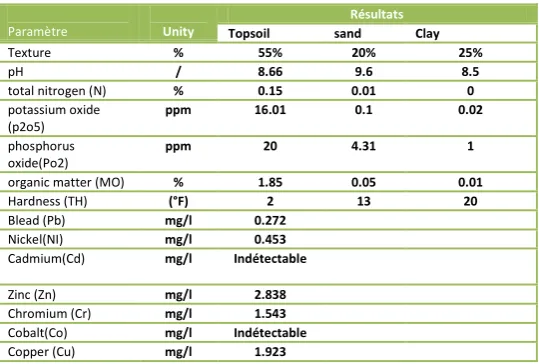
The soil was analyzed to determine its mineral composition including heavy metals; the analytical results are presented in tables 1 and 2.
Table 1: mean values of the physical parameters Of the waste and purified water
Physico_chemical
parameters Unity
Résults
wastewa ter
Treated water
pH / 7.26 - 7.19 Température °C 20-18 Conductivity µS/cm 1420.95 1264.52
MES mg/l 221.21 11.5 Chimical oxygen
demandOD
mg/l 311.87 32.42
Biologic Oxygen demandé
mg/l 218.12 13.62
Table 2: mean values of the chemical parameters of soil
Paramètre Unity
Résultats Topsoil sand Clay
Texture % 55% 20% 25%
pH / 8.66 9.6 8.5
total nitrogen (N) % 0.15 0.01 0
potassium oxide (p2o5)
ppm 16.01 0.1 0.02
phosphorus oxide(Po2)
ppm 20 4.31 1
organic matter (MO) % 1.85 0.05 0.01
Hardness (TH) (°F) 2 13 20
Blead (Pb) mg/l 0.272
Nickel(NI) mg/l 0.453
Cadmium(Cd) mg/l Indétectable
Zinc (Zn) mg/l 2.838
Chromium (Cr) mg/l 1.543
Cobalt(Co) mg/l Indétectable
Copper (Cu) mg/l 1.923
According To these results, the soil has a texture more or less silty 55% with 20% sand and 35% clay. It contains a medium quantity of OM (organic matter) and major nutrients :( total nitrogen, available phosphorus and in exchangeable potassium). In addition, the sand is very poor in any fertilizing elements. The pH is generally slightly basic (8.5 -9.6).
It is observed the presence of copper, lead, nickel and zinc at various low concentrations .NB: the analyzes of heavy metals carried on the full sample of soil.
For the characteristics of the sampled soils. The pH is considered the main chemical parameter controlling the bioavailability of heavy metals in soil. The average pH (25 ° C) lands irrigated by groundwater vary from 8.36 to 8.59, while that of land irrigated by wastewater is in the value range from 8.29 to 8.84. This shows that wastewater brought to the soil did not decrease the Ph of this soil, but on the contrary, they have significantly increased. The alkaline Ph restricts the passage of heavy metals from the solid phase (the soil) to the plant. It reflects, as the given the presence of clays and silts, the calcareous nature of the ground.
www.ijeijournal.com Page | 4 The fertilizer value of the liquid effluents is characterized by its principal elements (nitrogen (N), phosphate (P), and potassium (P). The concentrations of N and P in the treated wastewater can vary significantly depending on the source and wastewater process treatment.
The assay results of the fertilizing elements such as nitrogen and these derivative, phosphate and potassium are shown in the figure: 3a and 3b.
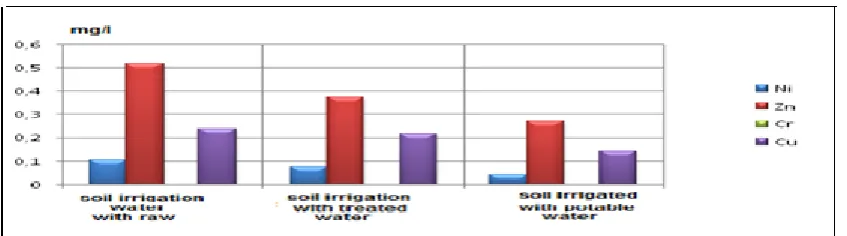
The analysis of metals trace elements (MTE) is realized by atomic adsorption spectrophotometer. The results of these analyzes are presented in figure: 2.
To studying the feasibility and assess the impact of using wastewater on the soil and plant beans, and see the effect of agricultural practices on the accumulation and the transfer of heavy metals in the system (water- soil-plant) .We proceed to sowing bean seeds; using two types of water compared to a reference, for it different experiments have been conducted on the same conditions. ; Finally was a quantified concentration of metals in the system components. The monitoring began with a seed that has been done manually. The first bean plants germinated after five days of planting. Samples collected from bean plants are made after 45 days later.
Before beginning our tests we considered interesting and useful to further work to determine the concentration of heavy metals in different waters (waste waters, purified water and drinking water and the results are shown in the Figure:2.
3.3. Analysis of sample soil
MTE were determined on soil samples (dried, ground and digested) has the depth 0-30 cm soil after measured using an atomic absorption spectrophotometer. We determined some heavy metals in soil at different step as shown in Figure: 4From the results obtained, there is a complete absence of Co and Cd in the soil before and after the irrigation, but there is some concentration of Pb, Ni, Zn, Cr and Cu. These chemical Elements in soil depth (0-30 cm), this variability is based on the quality of water for irrigation and chemical substance research(figure:3).
Table 3.a: nutrients in the wastewater and
the treated water Table 3.b: Results of the analyzes of the fertilizer value Of 3 types of water
amples fertilizing value
N P K
Used water 61.18 5.115 26.91 Purified water 22.86 2.6 26.66 Tap water 3.31 <0.025 3.35
Figure 3: MTE evolution in soil of studies in function of Water Type Éléments
fertilisants
Résultats (mg/l) Eau brute Eau épurée
Nitrogen Total Kjeldahl
41.63 13.83
Ammonia 19.55 9.03 Nitrites 0.126 0.108 Nitrates 4.55 6.22 Phosphates 5.115 2.6
Potassium 26.91 26.66
www.ijeijournal.com Page | 5 3.4. Effect of irrigation with waste water on the plants
All samples of different plant parts were washed, dried, ground and screened then ashed. Metal determination is made by atomic absorption spectrometry
Analysis of heavy metals in different parts of bean plants watered aves raw sewage and treated water (purified) compared to tap water, are presented for each of the bean plant
We find that Zn is the element most bioavailable in soil with concentrations between 2.83 mg / l and 3.13 mg / l, followed by Cu with concentrations ranging between 1.92 mg / l and 1 , 99 mg / l, with Cr content between 1.54 mg / l and 2.1 mg / l. The bioavailability of Ni and Pb is relatively low. , The importance of concentrations found in this study is in the following order: Zn> Cu> Cr> Ni> Pb.
Part root (root) figure: 4
Aerial part (stem) figure:5
Aerial part (leaves) figure:6
3.5.Transfer of MTE contained in the water toward the plant:
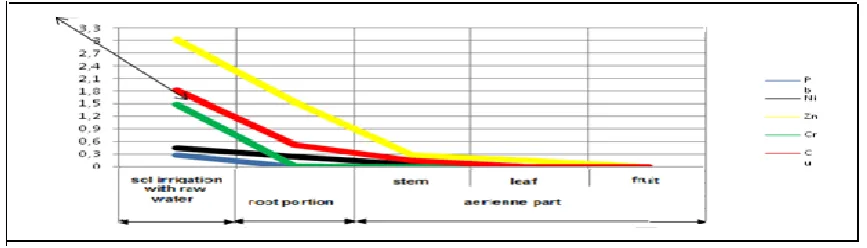
The content of heavy metals and their transfers in the soil and in different parts of the bean plant was studied and the results of these analyzes are presented in the following figures:
Use of raw wastewater (figure: 7) Use of treated water (figure: 8) se of potable water (figure: 9)
Figure 4:MTE Evolution of in the root part of the plant based on type of water irrigation
Figure5: MTE evolution in stem of studies in function of Water Type
www.ijeijournal.com Page | 6 The study of the accumulation of MTE indicated the presence of Ni, Zn, Cu, Cr and at the root part, it same is true for the aerial part (stem) Except chromium (undetectable) in irrigated soil by treated water and drinking water, is also observed that the leaves and fruits, the presence of MTE in their totality are undetectable except for zinc. This study also revealed the absence of Pb, Cd, Co in the aerial part because Pb remains fixed to the ground and consequently does not penetrate into the plants, while for Cd and Co are undetectable either in the soil or for all 3 water types.
According to concentrations, the abundance of metals in bean cells can be categorized in decreasing order: Aerial part: Zn> Cu> Ni> Cr.
Rot Part: Zn> Cu> Ni> Cr.
III.
CONCLUSION
Experiments with wastewater, and treated water by a conventional biological treatment and drinking water as a witness gave results in conformity with the FAO standard and it appears that the physico-chemical quality is not dangerous for consumer. We also worked with and the resulsts allow us to give the following results .These results are promising for the future of the irrigation of seasonal crops and depending on the nature of our soil.
Figure 7: Transfer of MTE in the (waste-water plant-soil) system
Figure 8:Transfer of ETM in (the treated-water plant-soil) system
This promotes its reuse in the irrigation fields.The purified water can have several positive effects notably on soil fertility and crop production on condition they comply with” WHO” recommendations for crop irrigation while drinking waters receive no nutritional intake to the plant The purified water used in agriculture indicated the presence of copper, lead, nickel and zinc at various concentrations that are respectively 0.093 mg / l and 0.05 mg / l, 0.042 mg / l, 0303 mg / l, but do not exceed the limit levels for waters for irrigationWe can conclude that the risk posed by heavy metals depends on their potential toxicity and the level of exposure (concentration, duration); Moreover, some are good for the growth of plants. Thus it is noted that the concentrations of the majority of heavy metals in domestic treated water are too weak to be a real public health problem, whatever the intended reuse, even if it is agricultural.So we can conclude that differences in levels of BAT in the studied plants depend on the quality and composition of irrigation water, physical and chemical properties of soil and the absorptive capacity of each element by the plant. Although the metal concentration in wastewater mostly treated is low, irrigation may ultimately lead to the accumulation of these elements in the soil that can caused subsequently, the risk for the development of plants. Which encourages us to say that the treated municipal wastewater can be safely used for irrigation of crops seasonal, we note that the (Ni, Zn, Cu and Cd). remain fixed in depth , all the more so the diffusion of heavy metals into the depth of the soils investigated, depend primarily on the clay particle content, which argues for our approach, knowing that the clay content in our land of study is 25%[26].
IV.
ACKNOWLEDGEMENTS
The authors are thankful to the laboratory of food Technology University of boumerdes and the Laboratory of “office Algerian de l’assainissement -Algeria, for all the help it bring us to the realization of this work.;
REFERENCES
[1] Bouchouata O., Jaafar B., Bounakhla M., Doukkali A., Attarasi B. (2011), Study of heavy metal contamination of irrigation water and vegetable crops in the area M'nasra (Gharb, Morocco). La science en liberte.Editions Mersenne .3, N° 1110063
[2] Qadira M., Wichelnsc D., Raschid-Sallyd L., McCornickb P.G., Drechseld P., Bahrid A., Minhas PS. (2010), The challenges of wastewater irrigation in developing countries. Agric. Water Manag.
[3] Samaleh I.A., Egueh W.Alieh M., Djibril A. (2015), Evaluation of metal pollution in agricultural soil irrigated by the waste water of the city of Djibouti; Science et environment 17-369
[4] Huibers F.P., Moscoso O., Durán A., Lier J., van B. (2004), The use of waste water in cochabamba, Bolivia: a degrading environment.CABI Publishing Book: Wastewater use in irrigated agriculture.econfronting the livelihood and environmental realities. Chapter12.
[5] Faruqui N.I., Scott C.A., Raschid-sally L. (2004)., Confronting the realities of waste water in irrigated agriculture: lessons learned and recommendations.,book: Wastewater Use in Irrigated Agriculture. chapter1
[6] Ullah H., Khan I., Ullah I. (2011), Impact of sewage contaminated water on soil, vegetables and underground water of peri-urban Peshawar , Pakistan. Environ. Monit. Assess. Epub. 2220-3410
[7] Ghosh A.K., Bhatt M.A., Agrawal H.P, (2012). Effect of long-term application of treated sewage water on heavy metal accumulation in vegetables grown in northern India. Environ. Monit. Assess. 1841025-1036
[8] Feigin A., Ravina I., Shalhev J., Irrigation with Treated Sewage Effluent. Management for Environmental Protection. Advanced Series in Agricultural Sciences. 17. Springer-Verlag. (1991) 224
[9] Ensink J.H.J., Mahmood T. (2004), Van der Hoek W., Raschid-Sally L., Amera-singhe F.P., A nation-wide assessment of wastewater use in Pakistan: an obscure activity or a vitally important one, Water. Policy, 6 1-10.
[10] Sachan S., Singh S.K., Srivastava P.C. (2007), Buildup of heavy metals in soil-water-plant continuum as influenced by irrigation with contaminated effluent. J. Environ. Sci. Eng 49 293-296
[11] Murtaza G., Ghaffour A .,Kadir M. (2008), Accumulation and implication of cadmium ,cobalt and manganese in soils and vevetebles irrigated with city effluent, journal of the sciences of food and agriculture 88.100-107
[12] Shuval, H.I., Adin A., Fattal B., Rawitz E., Yekutiel P. ( 2006), Wastewater irrigation in developing countries. World Bank Technical Paper51
[13] FAO. (2003) Irrigation avec les eaux usées traitées. manuel d'utilisation. Organisation des Nations Unies pour l'Alimentation et l'Agriculture. Bureau Régional pour le Proche Orient et Bureau sous-régional pour l'Afrique du Nord
www.ijeijournal.com Page | 8 [15] IWMI. Drivers and characteristics of wastewater agriculture in developing countries - results from global
assessment. International Water Management institute (2008)200-437.
[16] .Laaziri A., Hasnaoui. (2015), KHALIS M., Preliminary study of the heavy metals impact on vegetable crops in the region of Meknes-Tafilalet. International Journal of Innovative Research in Advanced Engineering 2. 2349-2163
[17] Ogoshi M., Suzuki Y., ASANO T. (2001), Water reuse in Japan. Water Science and Technologie. 43.1017-23
[18] Sharma, R.K., Agrawal M., Marshall F., Heavy metal contamination of soil and vegetables in suburban areas of Varanasi, India. Ecotoxicol. Environ. Safety , 66(2)(2006) 258-266
[19] .Kabata A., Pendias., H , ( 2010). Book :Trace elements in soils and plants. Fourth Edition - CRC Press Book, London
[20] Anderson, J ., All. A, (2001). Step approach to international guidelines for water recycling. Water Science and Technology
[21] Kanwar J.S., Sandha M.S, (2000). Waste water pollution injury to vegetable crops, a review. Agric. Review 21133-136
[22] Naik S.K., Das D.K,(2010) . Evaluation of Various Zinc Extractants in Lowland Rice Soil under the Influence of Zinc Sulfate and Chelated Zinc, J. Commun. Soil. Sci. Plant. Anal. 41 122-134
[23] Yadav A., Yadav P.K., Shukla D.N . ( 2013), International Journal of Scientific and Research Publications, Investigation of Heavy metal status in soil and vegetables grown in urban area of Allahabad, Uttar Pradesh, India ISSN 2250-3153.3.9.
[24] Benlkhoubi, N., Saber S., Lebkiri, A., Rifi E., fahimeE. (2011), Accumulation of heavy metals in irrigated agricultural soils by the waters of hydraulic basin of Sebou in city of Kenitra (Morocco) ] s. International Journal of Innovation and Applied Studies. 12 334-341.
[25] Dère C., Lamy I., van Oort F., Baize C ., Cornu S . (2006),Comptes Rendus Geoscience, Trace metal inputs reconstitution and migration assessment in a sandy Luvisol after 100 years of massive irrigation with raw wastewaters. 338. 565–573
[26] Singh S., Sachan S.K., Srivastava P.C. (2007), Buildup of heavy metals in soil-water-plant continuum as influenced by irrigation with contaminated effluent. J. Environ. Sci. Eng 49293-296.