TECHO MINING HELMET
SANGEETHA.P
,
POOJAA.K,
PRINCY SHAKILA ROSHINI .S 1,2,3STUDENTINFORMATION TECHNOLOGY,
Sri Venkateswara College of Engineering, Chennai, India
________________________________________________________________________________________________________
Abstract : A classic model of the smart helmet has been developed for the mining industry in order to detect hazardous events in the mining environment. The developed prototype is able to sense the quality of air, humidity, removing the helmet by miner, and crash of an object on head. The air quality is determined by the saturation level of the dangerous gas such as carbon monoxide. The removal of helmet by miner is also considered as one of the unsafe event and it is detected by using Infrared (IR) sensor. The crash of an object on head is determined using pressure sensor. According to head and neck injury criteria, if the force excreted on head exceeds 34 psi, it is considered to be a hazardous. Implementation consists of two modules- the helmet module and reporting (or monitoring) module. The helmet module includes ARM7 microcontroller in conjunction with various sensors and ZigBee, while reporting module includes ZigBee at the receiving end and raspberry pi controller. An automated e-mail alert generation system is also developed in a reporting module of proposed system, it generates and delivers an automated alert e- mail to authorized personnel, if a miner has experienced hazardous event.
________________________________________________________________________________________________________
1.INTRODUCTION
India is a country, which is renowned for its extensive and distinct mineral reserves and big mining businesses. India produces about eighty eight minerals, out of which it has four minerals related to fuel, ten minerals that is of kind metals, fifty minerals that is of non-metallic in nature and remaining twenty four includes minor minerals . As of 2014 Apr India has over three hundred Billion Tonnes coal holds. Generation of coal in the year 2012 and 2014 remained at five hundred and forty Million Tonnes and five hundred and fifty seven Million Tonnes respectively . In mining industry personnel casualty of workers is common. Supervisors will be held accountable for all the wounds that take place below their management, and thus they need to consider the probable unsafe circumstances. The issue that we are addressing in this work is to develop a prototype of a safety helmet so as to assure extra safety alertness among mine workers. At the point while they are on job with machinery which produces loud noise, being alert to ones surroundings will typically be difficult. In the mining work place, the workers lean towards taking out several of their safety accessories as the accessory may be too weighty, hot or annoying to work with. The mining helmet is one of the safety accessories which they never tend to remove. The mining helmets have no intelligence adjoined to it to let workers know when he or his associate worker has experienced a dangerous event. In this way the motivation of the project is to specialise a current protective helmet for mine workers to make it still safer and technologically advanced by including a sensors, microcontrollers and wireless communicating capabilities.
2.LITERATURE SURVEY
3.SYSTEM ARCHITECTURE
The proposed system architecture is shown in figure 1; it includes helmet section and monitoring section. The helmet section has a sensor network which includes the sensors like- gas sensor for hazardous gas detection, in our case; it detects carbon monoxide concentration, an Infrared (IR) sensor to detect the removal of helmet by the miner. Pressure sensor is used to detect the fall of an object on the miners head and humidity sensor to check the humidity of the mining environment. Data processing module (ARM7 LPC2148) collects the sensed data and alerts the particular miner who has encountered the hazardous event. Data is transmitted through the wireless node with the help of ZigBee module. To inform the other miner that his co- worker is encountering a dangerous situation, he will be given alert through the ZigBee wireless transmission by flashing a helmet light for few times. Through the wireless transmission, data is also sent to the ground monitoring station, where it uploads data to the cloud for graphical visualization and also it generates alert message to the authorized personnel regarding the detected hazardous event.
Figure 1: System architecture
3.1.AIR QUALITY SENSOR
In coal mines, air pollution is primarily caused by the discharge of particulate matter (atmospheric pollutant) and a gas consists of methane (CH4), sulphur dioxide (SO2), and nitrogen oxides (NO2), in addition to carbon monoxide (CO). When humans are exposed to these toxic gases, it could cause negative response on their well-being. These uneven proportions of air deterioration gases and suspended particulate matter; surges respiratory disorder like asthma, cardiovascular problems, and chronic bronchitis. In this project the concentration of CO is measured using MQ7 sensor, it is a digital sensor, it only produces binary values as outputs,i.e. 1 indicates CO gas is detected and 0 indicates CO gas not detected.
3.2 IR SENSOR
To recognize whether a mine worker has removed his protective helmet or not, a helmet removal technique based on infrared ray sensor is used. An Infrared sensor is laid out to transmit a continual signal from one end, if the signal is obstructed, then it means that the miner is wearing a helmet else he is not wearing it.
import RPi.GPIO as IO import time
IO.setwarnings(False) IO.setmode(IO.BCM)
IO.setup(2,IO.OUT) #GPIO 2 -> Red LED as output IO.setup(3,IO.OUT) #GPIO 3 -> Green LED as output IO.setup(14,IO.IN) #GPIO 14 -> IR sensor as input
while 1:
if(IO.input(14)==False): #object is near IO.output(3,True) #Green led ON IO.output(2,False) # Red led OFF
The above code represent python program for helmet removal sensor.
3.3 PRESSURE SENSOR
In order to detect strike of on object on miners head and its severity, a pressure sensor is used. Pressure is nothing but force applied on an object per unit area, according to brain and neck injury criteria [12] 25 psi (pound per square inch) of pressure on head causes moderate injury and 34 psi of pressure causes severe injury for head. In this project, MPS- 2000 pressure sensor is used to detect pressure, which is UART and 8 bit data output sensor.
3.4 WIRELESS TRANSMISSION
In order to communicate among various nodes ZigBee module is used, it is certified to IEEE 802.15.4 standards . Figure 2 shows the connectivity of ZigBee to ARM 7 microcontroller (helmet section) and to Raspberry PI module (monitoring section). A ZigBee module is used in our implementation because its signal band has the capability to penetrate through walls and it works okay in mines. With ZigBee we can also build a larger mesh network, access points and routers can also be realized. Wi-Fi is frequently used in mines for communicating, however it needs cabling all over the mine to build routers, that can be impaired. ZigBee based devices can be constructed to work in various network topologies being star, cluster tree, mesh and light mesh, are most frequently used topologies.
Figure 2: Wireless transmissions through ZigBee node
CC2500 RF module is used in this project for wireless communication between helmet section and reporting section. It provides a simple to use radio frequency communication at 2.4 GHz. A baud rate of 9600 is used to transmit and receive data and this RF module does not require no extra coding and any extra hardware to work in half duplex mode i.e. communications in both direction are possible, but just one at same time.
3.5 DATA PROCESSING UNIT
The project is mainly divided into two sections; helmet section and monitoring section, ARM7 LPC2148 microcontroller (see Annexure) is used as a data processing unit in helmet section, it is a 32 bit 12MHz and 64 pin microcontroller. ARM 7 is a Reduced Instruction set Computing (RISC) based architecture, it means that it require significantly fewer transistor than the typical processor in average computers. This approach reduces the cost, heat dissipation and power usage. The LPC2148 incorporates 512 KB flash memory system both for code and data storage. It also has a SRAM data memory of 32 Kbytes and 10 bit analog to digital converter. The code for helmet section is written in embedded C language using keil μVision3 IDE. Later on building the source code, .hex file will be automatically generated in the project folder. .hex file will be used to burn the controller LPC2148. Flash magic is a tool used for burning the .hex files to LPC2148 microcontroller. From now onwards whenever the microcontroller is started, it gets loaded with the code which is dumped. In monitoring section Raspberry pi is used as a controller, which runs on Raspbian operating system. The receiving end of the ZigBee is connected to Raspberry pi controller; the data is received through ZigBee in the form of serial communication. The received sensor data is directly uploaded to ThingSpeak cloud for graphical visualization. This section also consists of an automatic alert e -mail generation system, where an automatic e-mail will be generated and sent to authorized personnel if the sensor values are out of the specified range.
Since the underground is very dark sites, the workers will be provided with a protective helmet with an inherent light in it. Considering the normal working condition in the underground mines, alerting the user about the hazardous event is a tough process. Alerting the miners about hazardous event with an alarm or speaker would not work as they will be working with machinery that generates loud noise. So the idea is to use an existing mining light on the helmet to alert the miner by blinking it for few times. By this way one can easily identify the location of the miner who is experiencing a dangerous event Monitoring section also contains alerting unit, where a python code is written to generate and deliver an automatic e-mail to authorized personnel if the sensed sensor values are out of specified range.
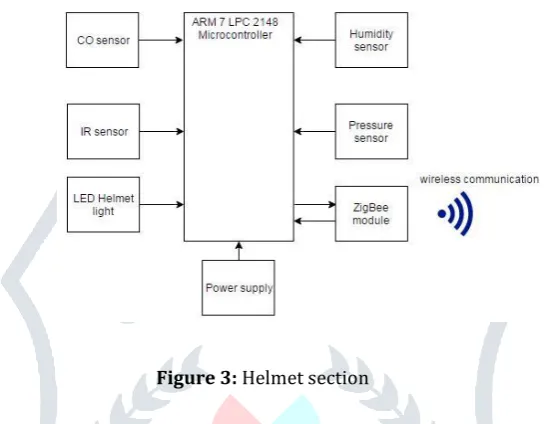
Figure 3: Helmet section
Figure 3 represents the helmet section of the design. Here in this section, it consists of four sensors carbon monoxide sensor, humidity sensor, IR sensor and pressure sensor. These sensors senses environment for data. The sensed data will be received by ARM 7 LPC 2148 microcontroller, microcontroller converts sensed data into digital format with the help of 10 bit ADC. It matches data from 0 to 1023. The matched data will be converted into string and is sent wirelessly to monitoring section.
Figure 4: Monitoring section
Figure 4 represents the monitoring section. It consists of ZigBee module, Raspberry pi controller. The data from the helmet section is received wirelessly by ZigBee module. This data is collected by Raspberry pi controller and the data will be uploaded to ThingSpeak cloud for graphical representation. Simultaneously the data will be monitored by raspberry pi module and if it finds that the sensed data is out of specified range, then an automatic alert e- mail is generated and will be delivered to authorized personnel.
Initially every helmet will be given a helmet ID (in our case helmet ID is 123) which is a fixed value. Since any of the miners can take up and wear any of the helmets from the store room, every working day while miner picks up a helmet, his ID (miner ID) will be attached to the helmet. Now the helmet will be configured to work according to the range specified in his user ID shows collection of data at the reporting section. Reporting section continuously keeps on collecting the data and uploads the data to cloud, in our case data will be uploaded to the Thing Speak cloud for graphical visualization. This reporting section also generates an alert e-mail for the authorized personnel if the sensor values are out of range for the specified user ID.
Figure 5: Alert message in mail inbox
5. CONCLUSION AND FUTURE WORK
A prototype of intelligent mine safety helmet is developed that is competent to recognize various kinds of unsafe situations in the mining industries such as carbon monoxide gas accumulation, miner removing the helmet, and crash detection (situation where mines is collided by something on his head). An IR sensor is used to check whether the miner has removed his helmet or not. Another hazardous event is determined as an accident where mine worker is collided by an item against his head with a pressure surpassing a value of 34 psi (Head and Neck Injury Criteria value of 1000). A pressure sensor was used to determine the force experienced on the miners head. If the sensor value exceeds that of 34 psi (234.6 KPa), then it indicates a miner has experienced a severe collision on his head. And hence with the help of pressure sensor we can determine the severity of the impact or collision on head. In order to conform that the system works according to the requirements specified, it was broadly tested. A couple of attributes of the system can be enhanced. To increase more human interference and to enhance the signal range and signal strength an additional antenna can be added. To allow faster sensor data processing, the system processing speed can be enhanced. The infrared sensor can be tweaked to work just inside the safety helmet by not provoking due to internal reflections. The system can be enhanced by adding extra measuring equipment to check the worker’s heart rate and blood pressure.
[1].Makeinindia.com
[2] Nitin Agarwal, Anshul Kumar Singh “SMART HELMET”, International Research Journal of Engineering and Technology, volume 2, issue 2, May 2015.
[2].[3] Kumar and G. P. Hancke, “Energy efficient environment monitoring system based on the IEEE 802.15.4 standard for low cost requirements”, IEEE Sensors Journal, vol. 14, no. 8, pp. 2557-2566, Aug. 2014.