R E S E A R C H A R T I C L E
Open Access
A comparative evaluation of the effect of
internet-based CME delivery format on
satisfaction, knowledge and confidence
Vernon R Curran
*, Lisa J Fleet, Fran Kirby
Abstract
Background:Internet-based instruction in continuing medical education (CME) has been associated with favorable outcomes. However, more direct comparative studies of different Internet-based interventions, instructional methods, presentation formats, and approaches to implementation are needed. The purpose of this study was to conduct a comparative evaluation of two Internet-based CME delivery formats and the effect on satisfaction, knowledge and confidence outcomes.
Methods:Evaluative outcomes of two differing formats of an Internet-based CME course with identical subject matter were compared. A Scheduled Group Learning format involved case-based asynchronous discussions with peers and a facilitator over a scheduled 3-week delivery period. An eCME On Demand format did not include facilitated discussion and was not based on a schedule; participants could start and finish at any time. A retrospective, pre-post evaluation study design comparing identical satisfaction, knowledge and confidence outcome measures was conducted.
Results:Participants in the Scheduled Group Learning format reported significantly higher mean satisfaction ratings in some areas, performed significantly higher on a post-knowledge assessment and reported significantly higher post-confidence scores than participants in the eCME On Demand format that was not scheduled and did not include facilitated discussion activity.
Conclusions:The findings support the instructional benefits of a scheduled delivery format and facilitated asynchronous discussion in Internet-based CME.
Background
Larger numbers of physicians are using the Internet to locate and seek medical information and it has been suggested that one of its greatest benefits is as a tool for professional development [1-3]. Internet-based learning has become an increasingly popular approach to medical education [4-6] and Internet-based continuing medical education (CME) has grown steadily in the recent past [7,8]. The Internet has expanded opportunities for the provision of a flexible, convenient and interactive form of CME that has fulfilled the requirements of busy prac-titioners who have difficulty attending formal education sessions [9,10].
Internet-based CME has been associated with favor-able outcomes across a wide variety of learners, learning contexts, clinical topics and learning outcomes [5]. According to Wearne, [8] these programs can vary in style, content, relevance, reliability, authorship and spon-sorship, and hence educational quality. A variety of Internet technologies, instructional methods and presen-tation formats are being used to provide both asynchro-nous and synchroasynchro-nous forms of Internet-based CME [2]. Internet-based CME is commonly offered, although not exclusively, through the use of learning management systems (LMS) and web conferencing systems. A learn-ing management system is software for deliverlearn-ing, track-ing and managtrack-ing Internet-based education and often includes features for learning assessment and online col-laboration (e.g. chat, discussion board and e-mail). Web conferencing systems can facilitate synchronous
* Correspondence: [email protected]
Professional Development & Conferencing Services, Faculty of Medicine, Memorial University, St John’s, Canada
presentations via the Internet. Participants are con-nected with other participants through their computer and can view real-time presentations while interacting with a presenter over a standard telephone line or Voice over Internet Protocol (VoIP) audio technology. Some systems also include whiteboards, chat and polling fea-tures. In a systematic review of Internet-based CME lit-erature, Cook et al.[5] found that Internet-based instruction addresses a wide range of topics with most interventions involving tutorials for self-study or virtual patients, and over a quarter requiring online discussion with peers, instructors or both.
The main benefits of Internet-based CME include: improved access, convenience and flexibility; reduced tra-vel expenses and time; adaptability to learning styles; just-in-time learning; and an interactive multimedia for-mat [5,6,11,12]. Curran and Fleet’s [2] review of Internet-based CME evaluation literature found that physicians are generally satisfied with it and in some instances more satisfied than with traditional CME formats. Wutoh et al. [11] also reviewed the evaluation literature and con-cluded that Internet-based CME is as effective in impart-ing knowledge as traditional formats of CME. Cook et al.’s [5] systematic review found that Internet-based learning is educationally beneficial and can achieve results similar to those of traditional instructional meth-ods. This review also suggested that effective learning outcomes appeared to be associated with cognitive inter-activity, peer discussion, on-going access to instructional materials and practice exercises [5].
It has been suggested that further research comparing Internet-based interventions against no-intervention comparison groups is of little value [5]. Further research in the field should investigate elements of Internet-based CME that could make it more effective and efficient, such as specific instructional methods, presen-tation formats, and approaches to implemenpresen-tation [5]. According to Cook et al. [5] examining how to effec-tively implement Internet-based instruction must involve research directly comparing different Internet-based interventions. Curran and Fleet [2] have also suggested the need to examine in greater detail the nature and characteristics of those Internet-based learning technol-ogies, environments and systems which are most effec-tive. There are limited comparative studies of this nature reported in the Internet-based CME literature [2,5]. In one study, Beal et al. [13] compared the effec-tiveness of different curriculum delivery strategies (e.g., e-mail versus web site) and duration of delivery in pro-viding Internet-based CME. They found no significant difference in knowledge, confidence and communication by curriculum delivery strategy.
A number of other studies have examined the specific use of both asynchronous technologies (e.g., e-mail,
discussion boards) and synchronous technologies (e.g., Web conferencing) for facilitating Internet-based CME and the results have been generally mixed [2]. A num-ber of authors report findings on the effectiveness of Internet-based CME facilitated by way of electronic mail or online discussion boards, however do not com-pare these approaches to other Internet-based interven-tions [14-17]. In one study, live CME participants made very little use of either e-mail or telephone to contact faculty, however 85% of online CME participants signed on at some point in time during web conferencing ses-sions [6]. Guan et al. [18] examined physicians’ partici-pation in online learning discussions, perceptions of online social closeness, and barriers and motivators to participation. Lack of time and peer response were given as the main reasons for low participation in learn-ing discussions. Weir et al. [19] also studied the effec-tiveness of an e-mail based discussion forum using clinical cases as stimulus material. Message postings from 27 participants were most frequent during the first of four weeks and lowest during the second. Curran et al. [20] examined the nature of the interactions and col-laborative learning characteristics exhibited in Internet-based CME that included asynchronous, text-Internet-based computer discussion. The results suggested that the nat-ure of participation consisted primarily of independent messages with a minimal amount of learner-to-learner interaction [20].
The purpose of the study described in this paper was to conduct a comparative evaluation of two differing Internet-based CME delivery strategies and the effect of a scheduled delivery format and facilitator-led asynchro-nous discussion instructional strategy on satisfaction, knowledge and confidence outcomes.
Methods
Two formats of an Internet-based CME course entitled
Emergency Medicine (EM) (Trauma Cases) have been offered via the MDcme.ca web portal (Table 1). Both formats were developed using a proprietary Internet-based learning management system. The instructional design of the Scheduled Group Learning (SGL) format was based on participation in case-based asynchronous discussions with peers and a facilitator over a scheduled delivery period, and review of online learning tutorials and resources. The SGL format was offered over a three week period and participants were required to log-in and access the course at least twice over the scheduled duration and review discussion postings. The eCME On Demand instructional format was based mainly on prin-ciples of self-directed learning. This course format was not scheduled so participants could start and finish at any time. An asynchronous discussion board was avail-able, however the discussion was not facilitated. Partici-pants in the On Demand format were required to complete post-assessments to receive CME credit, how-ever there was no requirement to post messages. Both formats were designed around case-based learning prin-ciples and learning objectives and subject matter was identical. Both formats were also offered free of charge and courses were promoted through the MDcme.ca web portal, web sites of other MDcme.ca consortium part-ners, the MDcme.ca newsletter distributed by e-mail messaging, and by promotion at professional confer-ences and meeting. The SGL format was offered 9 times
between February 2004 and October 2006, and On Demand was made available between June 2006 and September 2008.
Pre-to-post evaluation designs were applied to both course formats. Participants were self-selecting and restricted to licensed physicians (e.g., family medicine or specialists) and postgraduate residents. Participants in both formats were asked to complete an identical parti-cipant satisfaction survey, and pre-post knowledge and pre-post confidence assessment instruments. The satis-faction survey was comprised of 10 evaluative state-ments rated along a 5-point Likert scale (1 = Strongly Disagree to 5 = Strongly Agree). The survey was designed to evaluate several areas, including: content; design (navigability/process); and satisfaction with online discussions and interaction. Participants were also asked to complete pre and post-tests immediately prior to and after completion of a course, respectively. The pre and post-knowledge assessment was comprised of 5 identical one-best answer (A-type) MCQ items (1 key and 3 dis-tractors), for a maximum score of 5. The knowledge assessment was intended to measure participants’ gen-eral knowledge of the subject matter covered in the courses. The pre and post-confidence assessment was comprised of 5 identical self-efficacy statements rated along a 5-point Likert scale (1 = Strongly Disagree to 5 = Strongly Agree), for a maximum score of 25. The confidence assessment was intended to measure partici-pants’ self-reported confidence in the clinical manage-ment of emergency trauma cases (e.g.,I am confident in my ability to recognize the importance of complications in elderly patients with rib fractures; I am confident in my ability to discuss the approach to management of a dorsal dislocation of the PIP joint). The pre and post-assessment instruments were available on-line using the quiz tool function of the learning management system.
Ethics approval was received from the Human Investigations Committee, Memorial University of Newfoundland.
Results
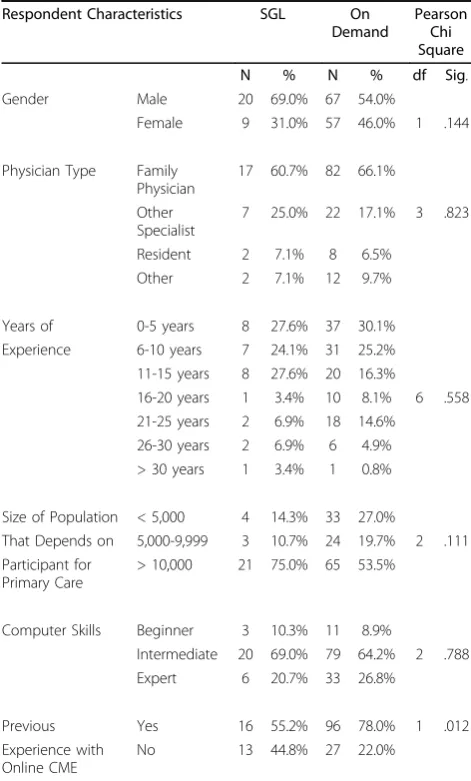
Table 2 summarizes the participant characteristics for both the SGL (N = 29) and the On Demand (N = 124) Internet-based CME formats. Groups were comparable across the majority of characteristics. The majority of participants in both formats were male (69.0% SGL vs 54.0% On Demand), family physicians (60.7% SGL vs 66.1% On Demand) and reported experience of 10 years or less (51.7% SGL vs 55.3% On Demand). The majority of participants in both formats also reported practicing in communities with a population greater than 10,000 (75.0% SGL vs 53.5% On Demand) and indicated com-puter skills to be of an intermediate level (69.0% SGL vs 64.2% On Demand). Pearson Chi Square analysis Table 1 Internet-based CME Formats
Format I: Scheduled Group Learning (SGL)
case-based, asynchronous discussions with peers and a facilitator (expert)
online learning tutorials and resources offered over a scheduled delivery period
Format II: eCME On Demand
asynchronous discussion board available, however discussion was not facilitated
online learning tutorials and resources self-directed learning design
indicated that the On Demand group had a significantly higher proportion of participants reporting previous online CME experience (p = .012).
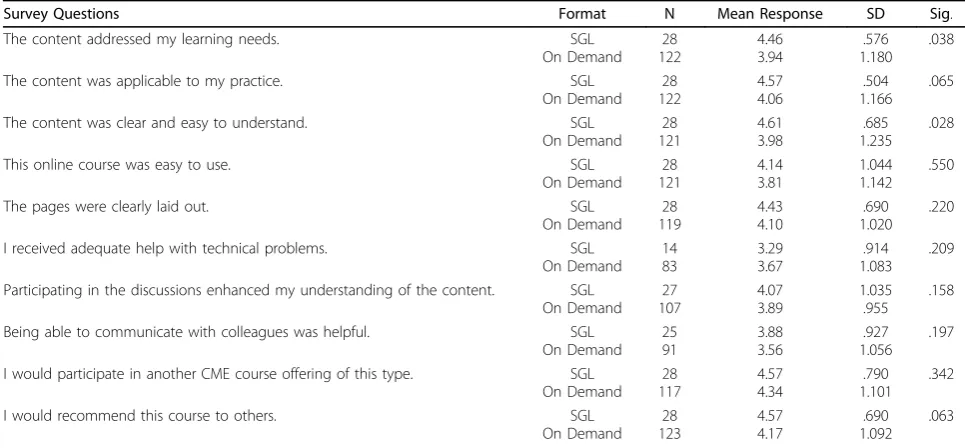
Table 3 summarizes satisfaction ratings across the two formats. A total of 28 respondents from the SGL format completed the satisfaction survey while 124 from the eCME On Demand format responded. The ratings suggest respondents were very satisfied with the Internet-based instruction, regardless of format. Participants in both formats reported very positive overall mean scores for“The content was applicable to my practice” (M = 4.57 SGL vs M = 4.06 On Demand) and “I would participate in another CME course offer-ing of this type” (M = 4.57 SGL vs M = 4.34 On Demand). An independent t-test analysis indicated that participants in the SGL format reported significantly higher mean ratings for items related to learning needs (p = .038) and clarity of content (p = .028) at the p < .05 probability level.
Table 4 summarizes the overall mean pre and post-knowledge assessment scores. A total of 13 participants in the SGL format completed both pre and post-knowl-edge assessments while 74 participants from the On Demand format completed both assessments. Partici-pants in the SGL format reported an overall mean pre-knowledge score of 2.38 and a post-pre-knowledge score of 4.08. Participants in the On Demand format reported an overall mean pre-knowledge score of 1.72 and a post-knowledge score of 3.08. A paired samples t-test ana-lyses indicated a significant pre to post-knowledge increase (p = .000) for both course formats at the p < .05 probability level.
Table 5 summarizes the results of an independent samples t-test comparing the pre and post-knowledge assessment results between formats. Participants in the SGL format performed significantly higher at the p < .05 probability level on both the pre (p = .012) and post-knowledge assessment (p = .008) than participants in the On Demand format.
Table 6 summarizes the overall mean pre and post-confidence assessment scores. A total of 13 participants completed both the pre and post-confidence assess-ments in the SGL format while 73 participants com-pleted both assessments in the On Demand format. Participants in the SGL format reported an overall mean pre-confidence score of 17.23 and a post-confidence score of 21.62. Participants in the On Demand format reported an overall mean pre-confidence score of 18.51 and a post-confidence score of 17.81. A paired samples t-test analysis indicated that only participants in the SGL format reported a significant increase (p = .005) in pre to post-confidence scores at the p < .05 probability level.
Table 7 summarizes the results of an independent samples t-test comparing the pre and post-confidence assessment results between formats. Participants in the SGL format reported significantly higher post-confi-dence scores (p = .039) than participants in the On Demand format at the p < .05 probability level.
Discussion
The findings indicate that an Internet-based CME for-mat involving facilitated asynchronous discussion activ-ity and a delivery schedule over a three week time period resulted in more positive learning outcomes in comparison to an Internet-based CME format which was not based on a learning schedule and did not involve facilitated discussion activity. Participants in the SGL format reported significantly higher mean satisfac-tion ratings for items related to Internet-based CME
“meeting learning needs”and “content being clear and easy to understand”. Participants in this format also per-formed significantly higher on a post-knowledge Table 2 Participant Characteristics
Respondent Characteristics SGL On
Demand
Pearson Chi Square
N % N % df Sig.
Gender Male 20 69.0% 67 54.0%
Female 9 31.0% 57 46.0% 1 .144
Physician Type Family Physician
17 60.7% 82 66.1%
Other Specialist
7 25.0% 22 17.1% 3 .823
Resident 2 7.1% 8 6.5%
Other 2 7.1% 12 9.7%
Years of 0-5 years 8 27.6% 37 30.1%
Experience 6-10 years 7 24.1% 31 25.2%
11-15 years 8 27.6% 20 16.3%
16-20 years 1 3.4% 10 8.1% 6 .558
21-25 years 2 6.9% 18 14.6%
26-30 years 2 6.9% 6 4.9%
> 30 years 1 3.4% 1 0.8%
Size of Population < 5,000 4 14.3% 33 27.0%
That Depends on 5,000-9,999 3 10.7% 24 19.7% 2 .111 Participant for
Primary Care
> 10,000 21 75.0% 65 53.5%
Computer Skills Beginner 3 10.3% 11 8.9%
Intermediate 20 69.0% 79 64.2% 2 .788
Expert 6 20.7% 33 26.8%
Previous Yes 16 55.2% 96 78.0% 1 .012
Experience with Online CME
assessment and reported significantly higher post-confi-dence scores than participants in the On Demand for-mat. The higher level of online CME experience reported by participants in the On Demand format did not appear to affect learning outcomes of this group.
A primary limitation of this exploratory study is related to generalization. This was a study of the use of particular Internet-based learning technologies, delivery methods and learning approaches. As well, the subject matter of the courses was related to a very specific clini-cal area. The results must be viewed and interpreted in this context. The two course formats were offered at dif-ferent time periods and it is possible that historical
factors may have influenced the outcome measures and/ or participants’knowledge and attitudes may have chan-ged during this time. Another limitation to the study was the difference in participant numbers between the two course formats. Registration for the SGL format was limited to 20 participants per course offering in order to foster enhanced facilitator interaction with participants. There was no limitation in registration for the On Demand course format. It is possible that the difference in the number of registrants between the course formats may have influenced the overall mean scores reported in the results. However, a comparison of participant char-acteristics did not indicate any significant differences Table 4 Overall Pre to Post-Knowledge Change
Format N Mean Score
(out of 5)
SD Sig.
SGL Pre-CME 13 2.38 .768 .000
Post-CME 13 4.08 1.115
On Demand Pre-CME 74 1.72 .958 .000
Post-CME 74 3.08 .962
Table 3 Satisfaction Ratings by Format*
Survey Questions Format N Mean Response SD Sig.
The content addressed my learning needs. SGL
On Demand 28 122
4.46 3.94
.576 1.180
.038
The content was applicable to my practice. SGL
On Demand 28 122
4.57 4.06
.504 1.166
.065
The content was clear and easy to understand. SGL
On Demand 28 121
4.61 3.98
.685 1.235
.028
This online course was easy to use. SGL
On Demand 28 121
4.14 3.81
1.044 1.142
.550
The pages were clearly laid out. SGL
On Demand 28 119
4.43 4.10
.690 1.020
.220
I received adequate help with technical problems. SGL
On Demand 14 83
3.29 3.67
.914 1.083
.209
Participating in the discussions enhanced my understanding of the content. SGL On Demand
27 107
4.07 3.89
1.035 .955
.158
Being able to communicate with colleagues was helpful. SGL
On Demand 25 91
3.88 3.56
.927 1.056
.197
I would participate in another CME course offering of this type. SGL On Demand
28 117
4.57 4.34
.790 1.101
.342
I would recommend this course to others. SGL
On Demand 28 123
4.57 4.17
.690 1.092
.063
* Satisfaction survey was comprised of 10 evaluative statements rated along a 5-point Likert scale (1 = Strongly Disagree to 5 = Strongly Agree).
Table 5 Pre to Post-Knowledge Change Between Formats
Knowledge Assessment
N Mean Score (out of 5)
SD Sig.
Pre-CME SGL 13 2.38 .768 .012
On Demand 74 1.72 .958
Post-CME SGL 13 4.08 1.115 .008
On Demand 74 3.08 .962
Table 6 Overall Pre to Post-Confidence Change
Format N Mean Score
(out of 25)
SD Sig.
SGL Pre-CME 13 17.23 2.127 .005
Post-CME 13 21.62 5.378
On Demand Pre-CME 73 18.51 4.634 .505
Post-CME 73 17.81 7.501
Table 7 Pre to Post-Confidence Change Between Formats
Confidence Assessment
N Mean Score (out of 25)
SD Sig.
Pre-CME SGL 13 17.23 2.127 .120
On Demand 73 18.51 4.634
Post-CME SGL 13 21.62 5.378 .039
between the study groups in terms of gender, physician type, years of experience, population size and computer skills. As well, a large number of participants did not complete both pre and post-knowledge and confidence assessments. The study results only represent matched scores for participants completing both pre and post assessments. Participants were not required to complete both pre and post assessment instruments to receive course credit.
Basing course completion around a schedule and sup-plementing instruction with a case-based asynchronous discussion board activity may have been key motiva-tional factors in the SGL format and hence contributed to the positive learning outcomes. This finding is sup-ported in previous research by Fordis et al. [6] who found that Internet-based CME participants often com-pleted learning activities over several sessions. These researchers also reported that exposure to an educa-tional activity (e.g., online discussion) combined with multi-session use of online materials may indicate an advantage of sequential reinforcement with Internet-based education [6]. It is likely that the increased inter-activity and collaborative learning experiences afforded by an asynchronous discussion activity led by a facilita-tor, and subsequent opportunities for reflection on prac-tice because of the scheduled nature of the learning, may have contributed to greater learning benefits.
The role of the facilitator in the SGL format was also not examined in detail and it is likely that the way in which the discussion board activities were facilitated may have influenced the learning outcomes for the par-ticipants in this format. Previous research does suggest that the level of asynchronous discussion participation by both facilitators and other participants in Internet-based CME is related to individual learner participation [27]. The findings of this study do highlight the signifi-cance of facilitated discussion and the important role of facilitation in fostering positive learning outcomes in Internet-based CME.
This study focused mainly on the effect of scheduled learning and asynchronous learning activities, however it is possible that synchronous instructional and communi-cative interaction facilitated through the use of real-time Web conferencing systems could also afford similar ben-efits. Future research should examine the comparative effectiveness and benefits of asynchronous versus syn-chronous interaction on similar learning outcome mea-sures. A useful area for further research would also be to explore how “blended approaches” to Internet-based CME delivery, combining both asynchronous and syn-chronous formats, might be used effectively. It would also be beneficial for future studies to examine the effect of participation in differing Internet-based formats on subsequent physician practices and behavior. How can
Internet-based CME and associated technologies be used effectively to not only foster meaningful learning, but also support and foster knowledge transfer and practice change?
Conclusions
The purpose of this study was to conduct a comparative evaluation of two differing Internet-based CME delivery strategies and the effect of a scheduled delivery format and facilitator-led asynchronous discussion instructional strategy on satisfaction, knowledge and confidence out-comes. A Scheduled Group Learning (SGL) Internet-based CME format facilitated learning that incorporated participation in case-based asynchronous discussions with peers and a facilitator over a scheduled delivery period. An eCME On Demand Internet-based CME for-mat was not scheduled so participants could start and finish at any time. The results of the study indicate that the SGL format resulted in more positive learning out-comes in comparison to the On Demand format. Parti-cipants in the SGL format reported significantly higher mean satisfaction ratings, performed significantly higher on a post-knowledge assessment and reported signifi-cantly higher post-confidence scores. The findings from this study support the instructional benefits of a sched-uled delivery format and facilitated asynchronous discus-sion in the delivery of Internet-based CME.
Acknowledgements
Development of the content forEM (Trauma Cases)was funded by the Atlantic Canada Opportunities Agency (ACOA), Atlantic Innovation Fund. ACOA also supported delivery of this content in the SGL format. The content was re-formatted for On Demand delivery by the Online Development Team of Professional Development & Conferencing Services (PDCS), Faculty of Medicine, Memorial University and supported by the MDcme Consortium.
Authors’contributions
VC led the conceptualization of the study design, participated in data analysis and led the preparation of the manuscript. LF led data collection and analysis, and participated in drafting the manuscript. FK helped to draft the manuscript. All authors read and approved the final manuscript.
Competing interests
The authors declare that they have no competing interests.
Received: 20 July 2009
Accepted: 29 January 2010 Published: 29 January 2010
References
1. Bennett NL, Casebeer LL, Kristofco R, Collins BC:Family physicians’ information seeking behaviors: a survey comparison with other specialties.BMC Medical Informatics and Decision Making2005,5:9. 2. Curran V, Fleet L:A review of evaluation outcomes of web-based continuing medical education.Medical Education2005,39:561-67. 3. Casebeer L, Bennett N, Kristofco R, Carillo A, Centor R:Physician internet
medical information seeking and on-line continuing education use patterns.Journal of Continuing Education in the Health Professions2002, 22(1):33-42.
5. Cook DA, Levinson AJ, Garside S, Dupras DM, Erwin PJ, Montori VM: Internet based learning in the health professions.Journal of the American Medical Association2008,300(10):1181-1196.
6. Fordis M, King J, Ballantyne C, Jones P, Schneider K, Spann S, Greenberg SB, Greisinger AJ:Comparison of the instructional efficacy of Internet-based CME with live interactive CME workshops: a randomized controlled trial. Journal of the American Medical Association2005,294(9):1043-1051. 7. Olson CA, Shershneva MB:Setting quality standards for web-based
continuing medical education.Journal of Continuing Education in the Health Professions2004,24(2):100-11.
8. Wearne S:Trapped in the net? What to look for in a web based CPD program.Australian Family Physician2008,37(10):845-8.
9. Casebeer LL, Strasser SM, Spettell CM, Wall TC, Weissman N, Ray MN, Allison JJ:Designing tailored Web-based instruction to improve practicing physicians’preventive practices.Journal of Medical Internet Research2003,5(3):e20.
10. Sly JL, Lombardi E, Kusel M, Sly PD:Piloting a web-based continuing professional development program for asthma education.International Journal of Medical Informatics2006,75(10-11):708-13.
11. Wutoh R, Boren SA, Balas A:eLearning: a review of Internet-based continuing medical education.Journal of Continuing Education in the Health Professions2004,24(1):20-30.
12. Zeiger RF:Toward continuous medical education.Journal of General Internal Medicine2005,20(1):91-4.
13. Beal T, Kemper KJ, Gardiner P, Woods C:Long-term impact of four different strategies for delivering an on-line curriculum about herbs and other dietary supplements.BMC Medical Education2006,6:39.
14. Ryan D, Waterson R:Transforming continuing education materials for on-line learning.Journal of Telemedicine and Telecare2000,6(4 Suppl 2):64-66. 15. Marshall JN, Stewart M, Ostbye T:Small-group CME using email
discussions: can it work?.Canadian Family Physician2001,47:557-563. 16. Chan DH, Leclair K, Kaczorowski J:Problem-based small-group learning
via the Internet among community family physicians: a randomized controlled trial.MD Computing: Computers in Medical Practice1999, 16(3):54-58.
17. Sargeant JM, Purdy RA, Allen MJ, Nadkami S, Watton L, O’Brien P: Evaluation of a CME problem-based learning discussion.Academic Medicine2000,75(10 Suppl):S50-S52.
18. Guan J, Tregonning S, Keenan L:Social interaction and participation: formative evaluation of online CME modules.Journal of Continuing Education in the Health Professions2008,28(3):172-9.
19. Weir E, Stieb DM, Abelsohn A, Mak M, Kosatsky T:Design, delivery and evaluation of an email-based continuing professional development course on outdoor air pollution and health.Medical Teacher2004, 26(2):166-73.
20. Curran V, Kirby F, Parsons E, Lockyer J:Discourse analysis of computer-mediated conferencing in World Wide Web-based continuing medical education.Journal of Continuing Education in the Health Professions2003, 23(4):229-38.
21. Merriam SB, Caffarella RS, Baumgartner LM:Learning in adulthood: a comprehensive guideSan Francisco (CA): Jossey-Bass, 3 2007. 22. Jonassen DH, Myers JM, McKillop AM:From constructivism to
constructionism: learning with hypermedia/multimedia rather than from it.Constructivist learning environmentsEnglewood Cliffs (NJ): Educational Technology PublicationsWilson BG 1996, 93-106.
23. Reeves TC, Oakley JR:Alternative assessment for constructivist learning environments.Constructivist learning environmentsEnglewood Cliffs (NJ), Educational Technology PublicationsWilson BG 1996, 191-202. 24. Graham M, Scarborough H:Computer mediated communication and
collaborative learning in an undergraduate distance education environment.Australian Journal of Educational Technology1999, 15(1):20-46.
25. Jonassen D, Davidson M, Collins M, Campbell J, Haag BB:Constructivism and computer-mediated communication in distance education.American Journal of Distance Education1995,9(2):7-26.
26. McAlpine I:Collaborative learning on-line.Distance Education2000, 21(1):66-80.
27. Curran VR, Lockyer J, Kirby F, Sargeant J, Fleet L, Wright D:The Nature of the Interaction between Participants and Facilitators in On-line Asynchronous Continuing Medical Education Learning Environments. Teaching and Learning in Medicine2005,17(3):240-246.
Pre-publication history
The pre-publication history for this paper can be accessed here:http://www. biomedcentral.com/1472-6920/10/10/prepub
doi:10.1186/1472-6920-10-10
Cite this article as:Curranet al.:A comparative evaluation of the effect of internet-based CME delivery format on satisfaction, knowledge and confidence.BMC Medical Education201010:10.
Submit your next manuscript to BioMed Central and take full advantage of:
• Convenient online submission
• Thorough peer review
• No space constraints or color figure charges
• Immediate publication on acceptance
• Inclusion in PubMed, CAS, Scopus and Google Scholar • Research which is freely available for redistribution