
R E S E A R C H
Open Access
Complex host genetics influence the microbiome
in inflammatory bowel disease
Dan Knights
1,2,3,4*, Mark S Silverberg
5†, Rinse K Weersma
6†, Dirk Gevers
2, Gerard Dijkstra
6, Hailiang Huang
7,
Andrea D Tyler
5, Suzanne van Sommeren
6,8, Floris Imhann
6,8, Joanne M Stempak
5, Hu Huang
9, Pajau Vangay
9,
Gabriel A Al-Ghalith
9, Caitlin Russell
3,10, Jenny Sauk
10, Jo Knight
11, Mark J Daly
2,12,13, Curtis Huttenhower
2,14and Ramnik J Xavier
2,3,10*Abstract
Background:Human genetics and host-associated microbial communities have been associated independently with a wide range of chronic diseases. One of the strongest associations in each case is inflammatory bowel disease (IBD), but disease risk cannot be explained fully by either factor individually. Recent findings point to interactions between host genetics and microbial exposures as important contributors to disease risk in IBD. These include evidence of the partial heritability of the gut microbiota and the conferral of gut mucosal inflammation by microbiome transplant even when the dysbiosis was initially genetically derived. Although there have been several tests for association of individual genetic loci with bacterial taxa, there has been no direct comparison of complex genome-microbiome associations in large cohorts of patients with an immunity-related disease.
Methods:We obtained 16S ribosomal RNA (rRNA) gene sequences from intestinal biopsies as well as host
genotype via Immunochip in three independent cohorts totaling 474 individuals. We tested for correlation between relative abundance of bacterial taxa and number of minor alleles at known IBD risk loci, including fine mapping of multiple risk alleles in the Nucleotide-binding oligomerization domain-containing protein 2 (NOD2) gene exon. We identified host polymorphisms whose associations with bacterial taxa were conserved across two or more cohorts, and we tested related genes for enrichment of host functional pathways.
Results:We identified and confirmed in two cohorts a significant association betweenNOD2risk allele count and increased relative abundance of Enterobacteriaceae, with directionality of the effect conserved in the third cohort. Forty-eight additional IBD-related SNPs have directionality of their associations with bacterial taxa significantly conserved across two or three cohorts, implicating genes enriched for regulation of innate immune response, the JAK-STAT cascade, and other immunity-related pathways.
Conclusions:These results suggest complex interactions between genetically altered host functional pathways and the structure of the microbiome. Our findings demonstrate the ability to uncover novel associations from paired genome-microbiome data, and they suggest a complex link between host genetics and microbial dysbiosis in subjects with IBD across independent cohorts.
* Correspondence:[email protected];[email protected]
†Equal contributors
1Department of Computer Science and Engineering, University of Minnesota, Minneapolis, Minnesota 55455, USA
2Broad Institute of Harvard and MIT, Cambridge, Massachusetts 02142, USA Full list of author information is available at the end of the article
Background
Crohn’s disease (CD) and ulcerative colitis (UC), collect-ively known as inflammatory bowel disease (IBD), have long been known to have genetic risk factors due to in-creased prevalence in relatives of affected individuals as well as higher concordance rates for disease among mono-zygotic versus dimono-zygotic twins. The sequencing of the hu-man genome and subsequent large-cohort genetic studies has revealed a complex set of polymorphisms conferring varying levels of risk. Extensive analyses of these loci re-vealed that impaired handling of commensal microbes and pathogens is a prominent factor in disease develop-ment [1]. For example, genetically driven impaired func-tion of NOD2 in the sensing of bacterial products like lipopolysaccharide may cause an increase in bacteria that produce those products. Involvement of the JAK-STAT pathway in immune responses, and involvement of the IL-23-Th17 pathway in microbial defense mechanisms, are also possible links between impaired immune response and imbalances in bacterial assemblage [1-3]. These gen-etic findings are in line with separate, independent tests of microbial shifts associated with IBD. Shifts in taxonomic composition and metabolic capabilities of the IBD micro-biome are both now beginning to be defined [4-9]. Deter-mining the extent and nature of host genome-microbiome associations in IBD is an important next step in under-standing the mechanisms of pathogenesis. Despite the documented independent associations of IBD with herit-able host immune deficiencies and with microbial shifts, there has been limited study of the co-association of com-plex host genetic factors with microbial composition and metabolism in IBD patients or other populations [9-17], and the mechanisms of host-microbiome disease pathways are largely unknown.
Using three independent cohorts comprising 474 adult human subjects with IBD aged 18 to 75 years, we tested known IBD-associated host genetic loci for enrichment of association with gut microbiome taxonomic composition. Cohorts were located near Boston (USA), Toronto (Canada), and Groningen (the Netherlands), with 152, 160, and 162 subjects, respectively. The cohorts contained 62.5%, 14.3%, and 63.5% CD cases with the remainder cases of UC, and 31.5%, 11.3%, and 53.1% biopsies from inflamed sites, re-spectively (detailed summary statistics by cohort and biopsy location in Figures S1 and S2 in Additional file 1). The To-ronto cohort contained 70.6% biopsies from the pre-pouch ileum in subjects with previous ileo-anal pouch surgery; all remaining samples were from the colon and terminal ileum, with 73.0%, 18.1%, and 87.0% from the colon in the three cohorts, respectively. We excluded all subjects that had taken antibiotics within one month prior to sampling. We obtained genotyping with Illumina Immunochip assays [18] and 16S rRNA gene sequences as described previously [19] (SNP prevalence by cohort in Additional file 2). We rarefied
bacterial microbiome samples to an even sequencing depth of 2,000 sequences per sample to control for differential se-quencing effort across cohorts. This rarefaction depth allows us to observe taxa with relative abundance as low as 0.15% with 95% confidence in each sample (binomial distribution with 2,000 trials and probability 0.0015). We report a pathway-level analysis of complex functional associations between host genetics and overall microbiome composition, as well as a targeted analysis of the association of NOD2
with specific bacterial taxa.
Methods
Ethics and consent
This study was approved by the Partners Human Re-search Committee, 116 Huntington Avenue, Boston, MA, USA. Patients gave informed consent to participate in the study. This study conformed to the Helsinki Dec-laration and to local legislation.
Data collection and generation
We genotyped subjects using the Immunochip platform as described previously [18], excluding polymorphisms with minor allele frequency of 0.1 or below from subse-quent testing. 16S rRNA genes were extracted and ampli-fied from intestinal biopsies and sequenced on the Illumina MiSeq platform using published methods [20]. These procedures include extraction using the QIAamp DNA Stool Mini Kit (Qiagen, Inc., Valencia, CA, USA) ac-cording to the manufacturer’s instructions with minor al-terations described in prior work [20], followed by amplification using the 16S variable region 4 forward pri-mer GTGCCAGCMGCCGCGGTAA and reverse pripri-mer GGACTACHVGGGTWTCTAAT, followed by barcoded multiplexing and sequencing. Only one biopsy was used per subject; when multiple biopsies were available we se-lected the non-inflamed biopsy first.
Data processing
redundant signals in the data (Additional file 3). Principal coordinates of between-subject distances were obtained from UniFrac [24] distances of OTUs and Jensen-Shannon and Bray-Curtis distances of KEGG (Kyoto Encyclopedia of Genes and Genomes) module and pathway distributions. Bacterial taxa were arcsine-square-root transformed and bacterial functions were power-transformed ('car' package [25]) to stabilize variance and reduce heteroscedasticity.
Statistical analysis
Linear association tests were performed only within those taxa with nonzero abundance in at least 75% of subjects. Taxa below that threshold were subjected to logistic regres-sion for presence/absence; no such taxa revealed significant associations after correcting for multiple comparisons. To ensure robustness of tests to outliers, subjects with taxon or functional module relative abundance more than three times the interquartile range from the mean were excluded for tests of that feature. Power analysis was performed using the linear effect size that we observed for Enterobac-teriaceae when regressing onNOD2 risk allele count and controlling linearly for clinical covariates (f2= R2/(1 - R2) = 0.013; R is the coefficient of multiple correlation). Assum-ing the need to correct for testAssum-ing of all 163 IBD loci against 22 dominant taxa (3,586 tests; adjusted significance thresh-old = 1.39 × 10⁻⁵), we would need at least 3,729 samples to power the full analysis (R‘pwr’package power calculation for a linear model with 19 numerator degrees of freedom). Discrete qualitative covariates were re-coded with dichot-omous dummy variables representing each class prior to testing. Association of clinical covariates was performed jointly by multiple linear regression. To overcome redun-dancy between clinical covariates, we clustered clinical co-variates based on their pairwise maximum uncertainty coefficients [26], an information-theoretic measure of their degrees of shared information. Continuous-valued covari-ates were discretized prior to information-theoretic cluster-ing. Complete-linkage clustering was performed to identify groups of covariates in which each covariate contained at least 50% of the information contained in each other covar-iate. Network plots were created using the igraph [27] pack-age. For the network plot of non-genetic host factors and
NOD2, width of edges was determined by the ratio of a given covariate’s linear regression coefficient to the mean of the regressed taxon’s relative abundance. Enrichment of a host functional pathway for association with bacterial taxa was assessed by comparing the observed rank product of all host gene-bacterial taxon association tests for all genes in the pathway with the distribution of rank products of 100,000 size-matched pathways randomly generated from the null Immunochip variants described above. Prior to testing, REACTOME pathways with >75% overlap were binned and the largest constituent pathway chosen as a rep-resentative for subsequent tests.
Results and discussion
Genotype-microbiome associations conserved across independent cohorts
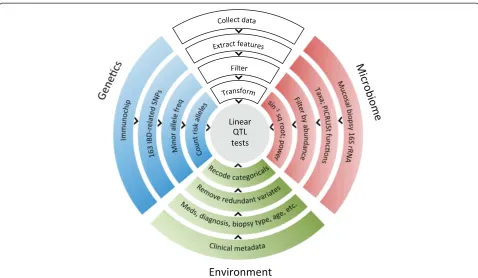
Our genotype-microbiome association testing methodology included steps to overcome power limitations given the very large number of potential comparisons, to incorporate published knowledge of signaling and metabolic pathways in the host genome, and to control for multiple environ-mental host factors affecting gut microbiome composition (Figure 1). In a targeted analysis of NOD2, we also accounted for multiple causal variants in the genetic locus (Supplementary methods in Additional file 1). After data preprocessing and normalization we tested linearly for as-sociation of risk allele count in each SNP with the relative abundance of each bacterial taxon. In all tests, we con-trolled for recent antibiotic usage (<1 month), recent im-munosuppressant usage (<1 month), biopsy inflammation status based on pathology, age, gender, biopsy location, CD/UC diagnosis, disease location, elapsed time since diag-nosis, cohort membership, and the first three principal components of genotype variation (Figure 1; Figure S3 in Additional file 1). Although the IBD-related SNPs extracted from the Immunochip data were identified previously in European populations, we do not expect this to limit our findings because our cohorts were mostly of European des-cent. We validated our linear testing methodology by com-paring associations in the Boston cohort with those in the other two cohorts, in addition to performing other sensitiv-ity analyses (Supplementary methods in Additional file 1).
We chose the FDR of 0.25 for this analysis due to the large number of tests and the fact that we used the significant results mainly to test for enrichment of certain host path-ways, rather than to focus on individual associations. We note that it is important to compare only the directionality of SNP-taxon effects between studies, and not the magni-tudes of the SNP-taxon regression coefficients, because the magnitude of a coefficient is closely linked to the mean relative abundance of a given taxon. To decrease bias toward a particular taxonomic level of association [28], we performed these tests using bacterial taxa at all taxonomic levels from phylum to genus, collapsing those with redundant signals. In contrast to using OTU clusters, binning by taxonomy allows inherent flexibility in the level of 16S gene sequence identity within each bin in different lineages.
A number of host genes, some with known involvement in microbial handling, and others with unknown function, demonstrated reproducible effects on the taxonomic struc-ture of the microbiome across two or more cohorts. Effect size and directionality of genotype-microbiome associations were highly reproducible between cohorts in the case of
NOD2 and 48 other host genes (FDR <0.25; Additional
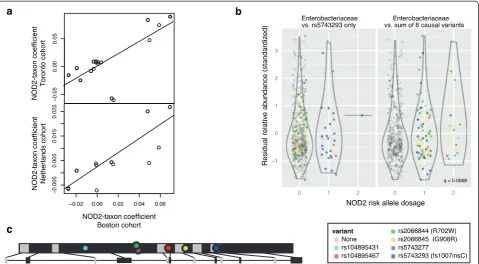
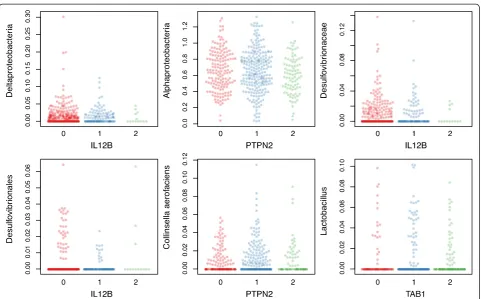
file 4).NOD2had one of the most highly reproducible sets of associations with bacterial taxa (MCC = 0.75, FDR = 2.6 × 10⁻⁴ comparing Boston versus Toronto cohorts; MCC = 0.85, FDR = 7.7 × 10⁻⁴Boston versus Netherlands; Figure 2a). Other genes with significantly conserved directionality of ef-fects on bacterial taxa between at least one pair of studies included tumor necrosis factor (ligand) superfamily, mem-ber 15 (TNFSF15; MCC = 0.87, FDR = 9.5 × 10⁻³, Boston versus Netherlands) and subunit beta of interleukin 12 (IL12B; MCC = 0.74, FDR = 1.5 × 10⁻³, Boston versus Netherlands).
in a mouse model ofEscherichia coliinfection. TNFSF14 and TNFSF15 are known to share an alternative recep-tor, indicating potential functional overlap. IL12B forms part of the interleukin-23 complex, involved in microbial defense mechanisms through the IL23-Th17 pathway.
Immunity-related host functional pathways linked to microbiome profile
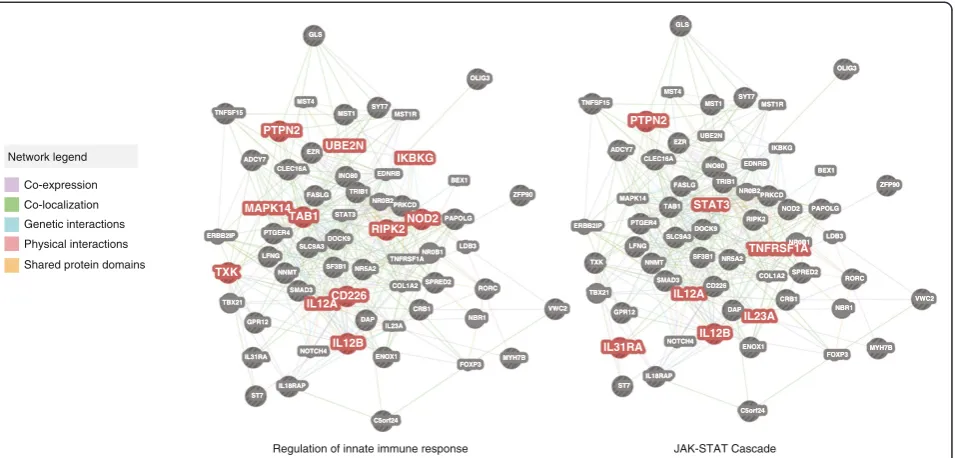
We hypothesized that host functional pathways containing multiple risk variants related to microbial handling and in-nate immune response would be associated with micro-biome features. To test this hypothesis we performed a functional enrichment analysis on the 49 genes identified to have conserved microbiome associations across co-horts. We found these genes to be significantly enriched for regulation of innate immune response (FDR = 2.31 × 10⁻⁶, hypergeometric enrichment test), inflammatory re-sponse (FDR = 7.43 × 10⁻⁶, hypergeometric enrichment test), and participation in the JAK-STAT cascade (FDR = 2.04 × 10⁻⁴, hypergeometric enrichment test) (Figures 3 and 4; Additional file 5). A gene-gene interaction network analysis also implicated STAT3, interleukin-12 subunit
alpha (IL12A), and interleukin-23 subunit alpha (IL23A) in the network of associated genes.
STAT3 and TNFSF15 are both implicated in IL23 sig-naling. STAT3 works in concert with Janus Kinase 2 (JAK2) in the JAK-STAT pathway to drive immune re-sponse to pathogenic infection. STAT3 also regulates T helper 17 (Th17) cell differentiation by binding IL23 re-ceptor (IL23R; risk variant for IBD: rs11209026) and RAR-related orphan receptor C (RORC; rs4845604), both of which are located in IBD risk loci.STAT3defects have also been implicated recently in skin microbial im-balance and impaired host defense. TNFSF15, a member of the tumor necrosis factor ligand superfamily, is a cost-imulator of T cells, and is specifically expressed more highly in the gut in IBD patients compared with healthy controls [31,32].
Fine mapping ofNOD2locus reveals association with Enterobacteriaceae
For all NOD2 testing we aggregated risk allele dosage across six known causal variants: rs2066844 (R702W), rs2066845 (G908R), rs5743277, rs5743293 (fs1007insC), rs104895431 and rs104895467 [29]. This novel method-ology was crucial as individual variants contained only part of the signal (Figure 2b,c).NOD2was associated with the first principal axis of taxonomic (via weighted UniFrac distances) microbiome variation (FDR <0.05, controlling for three principal axes tested), linkingNOD2to shifts in overall microbiome taxonomic composition. We identified increased Enterobacteriaceae in subjects with higher
NOD2risk allele dosage (FDR = 0.11, controlling for mul-tiple taxa tested; Figure 2b; Additional file 7). An increase in Gammaproteobacteria is a known component of IBD dysbiosis and is associated with inflammation in mice and humans [4,33] and with increased epithelial penetration in CD and UC [34].NOD2also had one of the most strongly reproducible associations with microbiome composition when comparing cohorts. AlthoughNOD2is only associ-ated with increased risk of CD,NOD2-microbiome associ-ations we observed were generally independent of CD/UC diagnosis, with high overlap between CD and UC when tested separately (taxa: Spearman’s rho = 0.57,P= 6.5 × 10⁻³; Figure S4 in Additional file 1). This implies that the associ-ation may be disease-independent, and may play a role in pathogenesis only in subjects with other risk factors. For
example, NOD2 SNP rs5743293 is associated with
complications in ileo-anal pouch patients despite their ori-ginal diagnosis being UC [35-38].
A complex web of genotype-environment-microbiome interactions in IBD
Our findings indicate that host genetics are part of a com-plex web of host-associated factors influencing micro-biome composition. We performed a meta-analysis of interactions between clinical host factors and bacterial taxa using the above 474 subjects and an additional 55 subjects who had recently taken antibiotics. This analysis includedNOD2as one of the host factors. We identified an additional 99 significant associations of non-genetic factors with relative abundance of specific bacterial taxa, largely in agreement with previous analyses of the IBD microbial environment [4]. To visualize the overlap of in-teractions between various host factors and microbial taxa, we constructed a network of associations between bacterial taxa and observed host and environmental fac-tors (Figure 5; Additional file 8; Supplementary methods in Additional file 1).
This analysis revealed a web of complex overlapping link-ages between numerous host factors and bacterial taxa. For example, recent antibiotic usage is associated with system-atic shifts in many major taxonomic groups (Figure 6; FDR <0.05); immunosuppressants are associated with decreased Firmicutes, and Ruminococcaceae. Biopsy location and IL23A IL23A BEX1 BEX1 IKBKG UBE2N MST1R MST1R TNFRSF1A TNFRSF1A IL12A MST4 MST4 COL1A2 COL1A2 FOXP3 FOXP3 NOTCH4 NOTCH4 STAT3 STAT3 EDNRB EDNRB MAPK14 LDB3 LDB3 ERBB2IP ERBB2IP NR0B2 NR0B2 NBR1 NBR1 TBX21 TBX21 NR0B1 NR0B1 SMAD3 SMAD3 PRKCD PRKCD IL12B TAB1 NR5A2 NR5A2 RIPK2 SF3B1 SF3B1 EZR EZR TXK SLC9A3 SLC9A3 FASLG FASLG IL18RAP IL18RAP ADCY7 ADCY7 CD226 PTPN2 SPRED2 SPRED2 LFNG LFNG GPR12 GPR12 RORC RORC NNMT NNMT NOD2 DAP DAP MST1 MST1 TRIB1 TRIB1 GLS GLS CLEC16A CLEC16A ST7 ST7 CRB1 CRB1 ENOX1 ENOX1 PTGER4 PTGER4 MYH7B MYH7B PAPOLG PAPOLG DOCK9 DOCK9 TNFSF15 TNFSF15 INO80 INO80 SYT7 SYT7 OLIG3 OLIG3 IL31RA IL31RA VWC2 VWC2 ZFP90 ZFP90 C5orf24 C5orf24 IL23A BEX1 BEX1 IKBKG IKBKG UBE2N UBE2N MST1R MST1R IL12A MST4 MST4 COL1A2 COL1A2 FOXP3 FOXP3 NOTCH4 NOTCH4 STAT3 EDNRB EDNRB MAPK14 MAPK14 LDB3 LDB3 ERBB2IP ERBB2IP NR0B2 NR0B2 NBR1 NBR1 TBX21 TBX21 NR0B1 NR0B1 SMAD3 SMAD3 PRKCD PRKCD IL12B TAB1 TAB1 NR5A2 NR5A2 RIPK2 RIPK2 SF3B1 SF3B1 EZR EZR TXK TXK SLC9A3 SLC9A3 FASLG FASLG IL18RAP IL18RAP ADCY7 ADCY7 CD226 CD226 PTPN2 SPRED2 SPRED2 LFNG LFNG GPR12 GPR12 RORC RORC NNMT NNMT NOD2 NOD2 DAP DAP MST1 MST1 TRIB1 TRIB1 GLS GLS CLEC16A CLEC16A ST7 ST7 CRB1 CRB1 ENOX1 ENOX1 PTGER4 PTGER4 MYH7B MYH7B PAPOLG PAPOLG DOCK9 DOCK9 TNFSF15 TNFSF15 INO80 INO80 SYT7 SYT7 OLIG3 OLIG3 IL31RA VWC2 VWC2 ZFP90 ZFP90 C5orf24 C5orf24
Regulation of innate immune response JAK-STAT Cascade
Co-expression
Co-localization
Genetic interactions
Physical interactions
Shared protein domains Network legend
TNFRSF1A
cohort membership had similarly broad effects; age, gender, and disease phenotype had measurable, although less broad, effects; genotype, as represented by theNOD2subtype, had a modest effect in relation to other factors. Inflammatory status of the biopsied tissue was associated with increased relative abundance of unclassified members ofLactobacillus, and with decreased relative abundance ofBacteroides unifor-mis(Figure S5 in Additional file 1). This analysis demon-strates the comprehensive and intermingled effects of treatment history, gastrointestinal biogeography, and other host and environmental factors on gut microbiome profile and makes clear the need to account for host factors when linking host genotype to microbial composition in a pheno-typically heterogeneous population. We confirmed that host genetics as a whole do have a significant effect on micro-biome profile by correlating overall between-subject genetic distance (Manhattan distance) with overall between-subject microbiome distance (unweighted UniFrac distance) (P< 5.0 × 10⁻¹⁰; Figure S6 in Additional file 1), but that it is only a minor contributor in the context of other sources of variation. A recent study of treatment-naïve pediatric tients with CD identified consistent microbiome shifts in pa-tients with recent antibiotic exposure toward the disease-related state [20]. That study exemplified the need to control
for the potentially confounding effects of antibiotics when attempting to identify bacterial profiles associated with dis-ease. Based on several studies linking short- and long-term dietary exposure to microbiome profile, it is also likely to be useful to include food intake diaries or dietary recall ques-tionnaires in future genotype-microbiome research [39,40].
Antibiotics contribute to IBD dysbiosis independent of NOD2 effects
microbial dysbiosis index (MDI). This recent study identi-fied an increase in the MDI scores of patients who had re-cently received antibiotics, indicating that antibiotics tend to shift patient microbiomes further into the realm of IBD-related dysbiosis. We used the same taxa as reported
previously to calculate an MDI score for each patient in our analysis. In our cohorts we confirmed the published finding that, when controlling for NOD2 effects on micro-biome structure, MDI score tended to be higher in pa-tients with recent usage (within less than one month) of antibiotics (P= 0.039,t-test of linear regression coefficient) (Figure 6). This finding, together with previously pub-lished findings regarding the effects of antibiotics on the IBD microbiome suggest that antibiotics and duration of disease are additional risk factors for IBD-related dysbiosis.
Conclusions
Taken together, our findings indicate a complex set of associations between the mucosal-adherent microbiome and genetic impairment of several host immune path-ways. Although we have been living and evolving with our microbial symbionts throughout human evolution, we have only been aware of their existence for a few centuries, and the genetic and functional diversity of our so-called 'second genome' has only become apparent in the last few decades. Also in recent decades incidence of IBDs and other autoimmune and autoinflammatory dis-eases has increased dramatically [42], and a rapidly growing set of these diseases has been linked to shifts both in taxonomic carriage and functional potential of host-associated microbial communities. Although our data are cross-sectional and therefore cannot define Figure 5Host factors associated with the IBD microbiome.A complex network of host factors associated with the IBD microbiome
(all associations FDR <0.05); only taxa with at least four significant associations are included in the network; green and purple edges indicate positive and negative associations, respectively; the width of an edge indicates the strength of the association. The effects of these factors on individual taxa are highly overlapping. The analysis identified covariates representing each type of host factor, consistent with previous results [4]. Biopsy location and medication history had the strongest and most comprehensive effects on microbiome profile; the effect ofNOD2was moderate in comparison. Cohort membership (not shown) also affected microbiome profile. These results demonstrate the need for study designs and analysis methodologies that control carefully for numerous host genetic and environmental factors when performing microbiome-based biomarker discovery. Abx, antibiotics within 1 month; Imm, immunosuppressants within 1 month; L2, no ileal involvement; PPI, biopsy from pre-pouch ileum.
causality, our analyses demonstrate complex host genetic associations with taxonomic and metabolic dysbiosis in humans. These include implications of microbiome-wide associations with TNFSF15, IL12B, and with innate immune response, inflammatory response, and the JAK-STAT pathway, as well asNOD2-related increases in En-terobacteriaceae relative abundance. Future studies may be warranted to account for the effects of copy number variation, pleiotropic genes and epigenetic modifications. It is also possible that certain genotype-microbiome as-sociations observed in IBD patients may be disease-independent and may be relevant to healthy individuals and individuals with other diseases. The methods we employed were validated on independent cohorts and make possible well-powered false-positive-controlled testing of microbiome-wide host genetic associations.
Accession numbers
16S rRNA sequences and Immunochip genotyping have been deposited at the National Center for Biotechnology Information as BioProject with top-level umbrella project ID PRJNA205152.
Additional files
Additional file 1:Supplementary methods and figures.
Additional file 2: Table S1.The prevalence of 163 known IBD-associated SNPs in the three independent cohorts included in this study.
Additional file 3: Table S2.Groups of taxa that were binned together prior to statistical testing due to high inter-group correlation.
Additional file 4: Table S3.Correlations and significance levels thereof of the directionalities of SNP-taxon associations between pairs of cohorts for those associations that were nominally significant in at least one of the cohorts being compared.
Additional file 5: Table S4Host genetic functional pathways that were significantly enriched for robustness of association with the microbiome across cohorts.
Additional file 6:Specific SNPs that were included in gene-level fine-mapping of disease association signals.
Additional file 7:Linear association test results for the association of each IBD SNP with each bacterial taxon.
Additional file 8:Additional association test results for a meta-analysis of the three cohorts, including statistics for the associations of clinical covariates with bacterial taxa.
Abbreviations
CD:Crohn’s disease; FDR: false discovery rate; IBD: inflammatory bowel disease; IL: interleukin; MCC: Matthew’s correlation coefficient; MDI: microbial dysbiosis index; OTU: operational taxonomic unit; SNP: single nucleotide polymorphism; Th17: T helper 17; UC: ulcerative colitis.
Competing interests
The authors declare that they have no competing interests.
Authors’contributions
DK, MSS, RKW, and RJX wrote the manuscript; JK, JS, AT, DG, and CH reviewed and revised the manuscript; MSS, GD, RKW, and RJX established biopsy and DNA collections; DK, JK, MSS, RKW, SvS, and Hailing H performed or supervised genotyping quality control and statistical analysis; DK and DG performed microbiome quality control and statistical analysis; AT performed
pouch sample collection and phenotyping; DK, PV, GA, and CH developed genome-microbiome association methods and performed association tests; Hu H analyzed shotgun metagenomic data; CH and RJX supervised methods development and statistical analysis; FI, JS and CR collected clinical data and managed the clinical databases; CR performed microbiome sample extraction. All authors read and approved the final manuscript.
Acknowledgements
We thank the patients who donated samples for this study, and the health professionals who collected them. We thank Tjasso Blokzijl for technical assistance and Levi Waldron for power analysis code. We thank Aylwin Ng and Moran Yassour for critical review of the manuscript. We thank Timothy Tickle and Tonya Ward for helpful discussions regarding methods. RKW is supported by a VIDI grant from the Netherlands Organization for Scientific Research (NWO) and the Dutch Digestive Foundation (WO 11-72). CH is partially supported by NIH R01HG005969, NSF DBI-1053486, and ARO W911NF-11-1-0473. MSS is partially supported by the Gale and Graham Wright Research Chair in Digestive Disease. Partial funding for sample collection for Toronto samples provided by the Crohn’s and Colitis Foundation of Canada. Work was supported by grants from the Crohn’s and Colitis Foundation of America, NIH grants U54 DE023798, and R01 DK092405 (RJX, CH, DG). JK is the Joanne Murphy Professor in Behavioural Science.
Author details
1Department of Computer Science and Engineering, University of Minnesota, Minneapolis, Minnesota 55455, USA.2Broad Institute of Harvard and MIT, Cambridge, Massachusetts 02142, USA.3Center for Computational and Integrative Biology, Massachusetts General Hospital and Harvard Medical School, Boston, Massachusetts 02114, USA.4Biotechnology Institute, University of Minnesota, St. Paul, Minnesota 55108, USA.5Zane Cohen Centre for Digestive Diseases, Mount Sinai Hospital IBD Group, University of Toronto, Toronto, Ontario M5G 1X5, Canada.6Department of Gastroenterology and Hepatology, University Medical Center Groningen, Groningen 9700RB, The Netherlands.7Analytic and Translational Genetics Unit, Massachusetts General Hospital, Boston, Massachusetts 02114, USA.8Department of Genetics, University Medical Center Groningen, Groningen 9700RB, The Netherlands. 9Biomedical Informatics and Computational Biology, University of Minnesota, Minneapolis, Minnesota 55455, USA.10Division of Gastroenterology, Massachusetts General Hospital and Harvard Medical School, Boston, Massachusetts 02114, USA.11Department of Psychiatry, University of Toronto, Toronto, Ontario M5T 1R8, Canada.12Department of Medicine, Analytic and Translational Genetics Unit, Massachusetts General Hospital and Harvard Medical School, Boston, Massachusetts 02114, USA.13Program in Medical and Population Genetics, Broad Institute of Harvard and MIT, Cambridge, Massachusetts 02142, USA.14Biostatistics Department, Harvard School of Public Health, Boston, Massachusetts 02115, USA.
Received: 2 September 2014 Accepted: 13 November 2014
References
1. Jostins L, Ripke S, Weersma RK, Duerr RH, McGovern DP, Hui KY, Lee JC, Schumm LP, Sharma Y, Anderson CA, Essers J, Mitrovic M, Ning K, Cleynen I, Theatre E, Spain SL, Raychaudhuri S, Goyette P, Wei Z, Abraham C, Achkar JP, Ahmad T, Amininejad L, Ananthakrishnan AN, Andersen V, Andrews JM, Baidoo L, Balschun T, Bampton PA, Bitton A,et al:Host-microbe interactions have shaped the genetic architecture of inflammatory bowel disease.Nature2012,491:119–124.
2. Abraham C, Cho J:Interleukin-23/Th17 pathways and inflammatory bowel disease.Inflamm Bowel Dis2009,15:1090–1100.
3. Knights D, Lassen KG, Xavier RJ:Advances in inflammatory bowel disease pathogenesis: linking host genetics and the microbiome.Gut2013,
62:1505–1510.
4. Morgan XC, Tickle TL, Sokol H, Gevers D, Devaney KL, Ward DV, Reyes JA, Shah SA, LeLeiko N, Snapper SB, Bousvaros A, Korzenik J, Sands BE, Xavier RJ, Huttenhower C:Dysfunction of the intestinal microbiome in inflammatory bowel disease and treatment.Genome Biol2012,13:R79. 5. Baumgart M, Dogan B, Rishniw M, Weitzman G, Bosworth B, Yantiss R, Orsi RH,
Wiedmann M, McDonough P, Kim SG, Berg D, Schukken Y, Scherl E, Simpson KW:
invasive Escherichia coli of novel phylogeny relative to depletion of Clostridiales in Crohn’s disease involving the ileum.ISME J2007,1:403–418. 6. Frank DN, St Amand AL, Feldman RA, Boedeker EC, Harpaz N, Pace NR:
Molecular-phylogenetic characterization of microbial community imbalances in human inflammatory bowel diseases.Proc Natl Acad Sci U S A2007,104:13780–13785. 7. Scanlan PD, Shanahan F, O’Mahony C, Marchesi JR:Culture-independent analyses of temporal variation of the dominant fecal microbiota and targeted bacterial subgroups in Crohn’s disease.J Clin Microbiol2006,
44:3980–3988.
8. Li E, Hamm CM, Gulati AS, Sartor RB, Chen H, Wu X, Zhang T, Rohlf FJ, Zhu W, Gu C, Robertson CE, Pace NR, Boedeker EC, Harpaz N, Yuan J, Weinstock GM, Sodergren E, Frank DN:Inflammatory bowel diseases phenotype, C. difficile and NOD2 genotype are associated with shifts in human ileum associated microbial composition.PLoS One2012,7:e26284.
9. Dalton JP, Desmond A, Shanahan F, Hall C:Detection of Mycobacterium avium subspecies paratuberculosis in patients with Crohn’s disease is unrelated to the presence of single nucleotide polymorphisms rs2241880 (ATG16L1) and rs10045431 (IL12B).Med microbiol and immun2014,203:195–205.
10. Ott SJ, Musfeldt M, Wenderoth DF, Hampe J, Brant O, Fölsch UR, Timmis KN, Schreiber S:Reduction in diversity of the colonic mucosa associated bacterial microflora in patients with active inflammatory bowel disease.
Gut2004,53:685–693.
11. Smeekens SP, Huttenhower C, Riza A, van de Veerdonk FL, Zeeuwen PLJM, Schalkwijk J, van der Meer JWM, Xavier RJ, Netea MG, Gevers D:Skin microbiome imbalance in patients with STAT1/STAT3 defects impairs innate host defense responses.J Innate Immun2013,6:253–262. 12. Frank DN, Robertson CE, Hamm CM, Kpadeh Z, Zhang T, Chen H, Zhu W,
Sartor RB, Boedeker EC, Harpaz N, Pace NR, Li E:Disease phenotype and genotype are associated with shifts in intestinal-associated microbiota in inflammatory bowel diseases.Inflamm Bowel Dis2011,17:179–184. 13. Couturier-Maillard A, Secher T, Rehman A, Normand S, De Arcangelis A,
Haesler R, Huot L, Grandjean T, Bressenot A, Delanoye-Crespin A, Gaillot O, Schreiber S, Lemoine Y, Ryffel B, Hot D, Nùñez G, Chen G, Rosenstiel P, Chamaillard M:NOD2-mediated dysbiosis predisposes mice to transmissible colitis and colorectal cancer.J Clin Invest2013,123:700–711.
14. Rajilić-StojanovićM, Smidt H, de Vos WM:Diversity of the human gastrointestinal tract microbiota revisited.Environ Microbiol2007,
9:2125–2136.
15. Hansen EE, Lozupone CA, Rey FE, Wu M, Guruge JL, Narra A, Goodfellow J, Zaneveld JR, McDonald DT, Goodrich JA, Heath AC, Knight R, Gordon JI: Pan-genome of the dominant human gut-associated archaeon, Methanobrevibacter smithii, studied in twins.Proc Natl Acad Sci U S A2011,108:4599–4606. 16. Ley RE, Bäckhed F, Turnbaugh P, Lozupone CA, Knight RD, Gordon JI:
Obesity alters gut microbial ecology.Proc Natl Acad Sci U S A2005,
102:11070–11075.
17. Hashimoto T, Perlot T, Rehman A, Trichereau J, Ishiguro H, Paolino M, Sigl V, Hanada T, Hanada R, Lipinski S, Wild B, Camargo SM, Singer D, Richter A, Kuba K, Fukamizu A, Schreiber S, Clevers H, Verrey F, Rosenstiel P, Penninger JM:ACE2 links amino acid malnutrition to microbial ecology and intestinal inflammation.Nature2012,487:477–481.
18. Cortes A, Brown MA:Promise and pitfalls of the Immunochip.Arthritis Res Ther2011,13:101.
19. Methé BA, Nelson KE, Pop M, Creasy HH, Giglio MG, Huttenhower C, Gevers D, Petrosino JF, Abubucker S, Badger JH, Chinwalla AT, Earl AM, FitzGerald MG, Fulton RS, Hallsworth-Pepin K, Lobos EA, Madupu R, Magrini V, Martin JC, Mitreva M, Muzny DM, Sodergren EJ, Versalovic J, Wollam AM, Worley KC, Wortman JR, Young SK, Zeng Q, Aagaard KM, Abolude OO,et al:A framework for human microbiome research.Nature2012,486:215–221. 20. Gevers D, Kugathasan S, Denson LA, Vázquez-Baeza Y, Van Treuren W, Ren B,
Schwager E, Knights D, Song SJ, Yassour M, Morgan XC, Kostic AD, Luo C, González A, McDonald D, Haberman Y, Walters T, Baker S, Rosh J, Stephens M, Heyman M, Markowitz J, Baldassano R, Griffiths A, Sylvester F, Mack D, Kim S, Crandall W, Hyams J, Huttenhower C,et al:The treatment-naive microbiome in new-onset Crohn’s disease.Cell Host Microbe2014,15:382–392. 21. Purcell S, Neale B, Todd-Brown K, Thomas L, Ferreira MAR, Bender D, Maller
J, Sklar P, de Bakker PIW, Daly MJ, Sham PC:PLINK: a tool set for whole-genome association and population-based linkage analyses.Am J Hum Genet2007,81:559–575.
22. Caporaso JG, Kuczynski J, Stombaugh J, Bittinger K, Bushman FD, Costello EK, Fierer N, Peña AG, Goodrich JK, Gordon JI, Huttley GA, Kelley ST, Knights D, Koenig JE, Ley RE, Lozupone CA, McDonald D, Muegge BD, Pirrung M,
Reeder J, Sevinsky JR, Turnbaugh PJ, Walters WA, Widmann J, Yatsunenko T, Zaneveld J, Knight R:QIIME allows analysis of high-throughput community sequencing data.Nat Methods2010,7:335–336. 23. McDonald D, Price MN, Goodrich J, Nawrocki EP, DeSantis TZ, Probst A,
Andersen GL, Knight R, Hugenholtz P:An improved Greengenes taxonomy with explicit ranks for ecological and evolutionary analyses of bacteria and archaea.ISME J2012,6:610–618.
24. Lozupone C, Lladser ME, Knights D, Stombaugh J, Knight R:UniFrac: an effective distance metric for microbial community comparison.ISME J
2011,5:169–172.
25. Meyer PE:infotheo: Information-Theoretic Measures[http://cran.r-project. org/web/packages/infotheo/index.html]
26. Press WH, Flannery BP, Teukolsky SA, Vetterling WT:Statistical Description of Data.InNumerical Recipes in C: The Art of Scientific Computing.3rd edition. New York: Cambridge University Press; 1992:634..
27. Csardi G, Nepusz T:The igraph software package for complex network research.InterJournal2006,Complex Sy:1695.
28. Knights D, Parfrey LW, Zaneveld J, Lozupone C, Knight R: Human-associated microbial signatures: examining their predictive value.Cell Host Microbe2011,10:292–296.
29. Rivas MA, Beaudoin M, Gardet A, Stevens C, Sharma Y, Zhang CK, Boucher G, Ripke S, Ellinghaus D, Burtt N, Fennell T, Kirby A, Latiano A, Goyette P, Green T, Halfvarson J, Haritunians T, Korn JM, Kuruvilla F, Lagacé C, Neale B, Lo KS, Schumm P, Törkvist L, Dubinsky MC, Brant SR, Silverberg MS, Duerr RH, Altshuler D, Gabriel S,et al:Deep resequencing of GWAS loci identifies independent rare variants associated with inflammatory bowel disease.Nat Genet2011,43:1066–1073.
30. Zuberi K, Franz M, Rodriguez H, Montojo J, Lopes CT, Bader GD, Morris Q:
GeneMANIA prediction server 2013 update.Nucleic Acids Res2013,41:
W115–W122.
31. Migone TS, Zhang J, Luo X, Zhuang L, Chen C, Hu B, Hong JS, Perry JW, Chen SF, Zhou JXH, Cho YH, Ullrich S, Kanakaraj P, Carrell J, Boyd E, Olsen HS, Hu G, Pukac L, Liu D, Ni J, Kim S, Gentz R, Feng P, Moore PA, Ruben SM, Wei P:TL1A is a TNF-like ligand for DR3 and TR6/DcR3 and functions as a T cell costimulator.Immunity2002,16:479–492.
32. Jin S, Chin J, Seeber S, Niewoehner J, Weiser B, Beaucamp N, Woods J, Murphy C, Fanning A, Shanahan F, Nally K, Kajekar R, Salas A, Planell N, Lozano J, Panes J, Parmar H, Demartino J, Narula S, Thomas-Karyat DA:
TL1A/TNFSF15 directly induces proinflammatory cytokines, including TNFα, from CD3 + CD161+ T cells to exacerbate gut inflammation.
Mucosal Immunol2012,6:886–899.
33. Garrett WS, Gallini CA, Yatsunenko T, Michaud M, DuBois A, Delaney ML, Punit S, Karlsson M, Bry L, Glickman JN, Gordon JI, Onderdonk AB, Glimcher LH:
Enterobacteriaceae act in concert with the gut microbiota to induce spontaneous and maternally transmitted colitis.Cell Host Microbe2010,
8:292–300.
34. Mylonaki M, Rayment NB, Rampton DS, Hudspith BN, Brostoff J:Molecular characterization of rectal mucosa-associated bacterial flora in inflammatory bowel disease.Inflamm Bowel Dis2005,11:481–487. 35. Tyler AD, Milgrom R, Stempak JM, Xu W, Brumell JH, Muise AM, Sehgal R,
Cohen Z, Koltun W, Shen B, Silverberg MS:The NOD2insC polymorphism is associated with worse outcome following ileal pouch-anal anastomosis for ulcerative colitis.Gut2013,62:1433–1439.
36. Sehgal R, Berg A, Hegarty JP, Kelly AA, Lin Z, Poritz LS, Koltun WA:NOD2/ CARD15 mutations correlate with severe pouchitis after ileal pouch-anal anastomosis.Dis Colon Rectum2010,53:1487–1494.
37. Ben-Shachar S, Yanai H, Baram L, Elad H, Meirovithz E, Ofer A, Brazowski E, Tulchinsky H, Pasmanik-Chor M, Dotan I:Gene expression profiles of ileal inflammatory bowel disease correlate with disease phenotype and advance understanding of its immunopathogenesis.Inflamm Bowel Dis
2013,19:2509–2521.
38. Tyler AD, Milgrom R, Xu W, Stempak JM, Steinhart AH, McLeod RS, Greenberg GR, Cohen Z, Silverberg MS:Antimicrobial antibodies are associated with a Crohn’s disease-like phenotype after ileal pouch-anal anastomosis.Clin Gastroenterol Hepatol2012,10:507–12.e1.
39. Wu GD, Chen J, Hoffmann C, Bittinger K, Chen Y-Y, Keilbaugh SA, Bewtra M, Knights D, Walters WA, Knight R, Sinha R, Gilroy E, Gupta K, Baldassano R, Nessel L, Li H, Bushman FD, Lewis JD:Linking long-term dietary patterns with Gut Microbial Enterotypes.Science2011,334:105–108.
Turnbaugh PJ:Diet rapidly and reproducibly alters the human gut microbiome.Nature2013,505:559–563.
41. Eklund A:beeswarm: The bee swarm plot, an alternative to stripchart
[http://cran.r-project.org/web/packages/beeswarm/index.html] 42. Bach J-F:The effect of infections on susceptibility to autoimmune and
allergic diseases.N Engl J Med2002,347:911–920.
doi:10.1186/s13073-014-0107-1
Cite this article as:Knightset al.:Complex host genetics influence the microbiome in inflammatory bowel disease.Genome Medicine20146:107.
Submit your next manuscript to BioMed Central and take full advantage of:
• Convenient online submission
• Thorough peer review
• No space constraints or color figure charges
• Immediate publication on acceptance
• Inclusion in PubMed, CAS, Scopus and Google Scholar
• Research which is freely available for redistribution
![Figure 6 Association of IBD-related dysbiosis and recent antibioticsofusage. A beeswarm plot [41] of the previously published microbialdysbiosis index [20] (MDI) stratified by recent antibiotics usage by patients.The test for this association between MDI and antibiotics (P = 0.039, linearregression t-test) included NOD2 risk allele count to control for the effects NOD2 genetics on the microbiome.](https://thumb-us.123doks.com/thumbv2/123dok_us/254629.1518533/8.595.58.540.90.297/association-antibioticsofusage-microbialdysbiosis-stratified-antibiotics-association-antibiotics-linearregression.webp)