RESEARCH
Aligning coding sequences
with frameshift extension penalties
Safa Jammali
1*, Esaie Kuitche
1, Ayoub Rachati
1, François Bélanger
1, Michelle Scott
2and Aïda Ouangraoua
1Abstract
Background: Frameshift translation is an important phenomenon that contributes to the appearance of novel cod-ing DNA sequences (CDS) and functions in gene evolution, by allowcod-ing alternative amino acid translations of gene coding regions. Frameshift translations can be identified by aligning two CDS, from a same gene or from homologous genes, while accounting for their codon structure. Two main classes of algorithms have been proposed to solve the problem of aligning CDS, either by amino acid sequence alignment back-translation, or by simultaneously accounting for the nucleotide and amino acid levels. The former does not allow to account for frameshift translations and up to now, the latter exclusively accounts for frameshift translation initiation, not considering the length of the translation disruption caused by a frameshift.
Results: We introduce a new scoring scheme with an algorithm for the pairwise alignment of CDS accounting for frameshift translation initiation and length, while simultaneously considering nucleotide and amino acid sequences. The main specificity of the scoring scheme is the introduction of a penalty cost accounting for frameshift extension length to compute an adequate similarity score for a CDS alignment. The second specificity of the model is that the search space of the problem solved is the set of all feasible alignments between two CDS. Previous approaches have considered restricted search space or additional constraints on the decomposition of an alignment into length-3 sub-alignments. The algorithm described in this paper has the same asymptotic time complexity as the classical Needle-man–Wunsch algorithm.
Conclusions: We compare the method to other CDS alignment methods based on an application to the comparison of pairs of CDS from homologous human, mouse and cow genes of ten mammalian gene families from the Ensembl-Compara database. The results show that our method is particularly robust to parameter changes as compared to existing methods. It also appears to be a good compromise, performing well both in the presence and absence of frameshift translations. An implementation of the method is available at https://github.com/UdeS-CoBIUS/FsePSA. Keywords: Coding DNA sequences pairwise alignment, Frameshifts, Dynamic programming
© The Author(s) 2017. This article is distributed under the terms of the Creative Commons Attribution 4.0 International License (http://creativecommons.org/licenses/by/4.0/), which permits unrestricted use, distribution, and reproduction in any medium, provided you give appropriate credit to the original author(s) and the source, provide a link to the Creative Commons license, and indicate if changes were made. The Creative Commons Public Domain Dedication waiver (http://creativecommons.org/ publicdomain/zero/1.0/) applies to the data made available in this article, unless otherwise stated.
Background
Biological sequence alignment is a cornerstone of bio-informatics and is widely used in such fields as phylo-genetic reconstruction, gene finding, genome assembly. The accuracy of the sequence alignments and similar-ity measures are directly related to the accuracy of sub-sequent analysis. CDS alignment methods have many important applications for gene tree and protein tree
reconstruction. In fact, they are useful to cluster homolo-gous CDS into groups of ortholohomolo-gous splicing isoforms [1, 2] and combine partial trees on orthology groups into a complete protein tree for a gene family [3, 4]. Aligning and measuring the similarity between homologous CDS requires to account for frameshift (FS) translations that cannot be detected at the amino acid (AA) level, but lead to a high similarity at the nucleotide level between func-tionnaly different sub-sequences.
FS translation consists in alternative AA translations of a coding region of DNA using different translation frames [5]. It is an important phenomenon resulting from different scenarios such as, insertion or deletion of a
Open Access
*Correspondence: [email protected]
1 Département d’informatique, Faculté des Sciences, Université de Sherbrooke, Sherbrooke, QC J1K2R1, Canada
nucleotide sequence whose length is not a multiple of 3 in a CDS through alternative splicing [6, 7] or evolutionary genomic indels [8, 9], programmed ribosomal frameshift-ing [10], or sequencing errors [11]. Recent studies have reported the role of FS translations in the appearance of novel CDS and functions in gene evolution [6, 12]. FS translation has also been found to be linked to several diseases such as the Crohn’s disease [13]. The compu-tational detection of FS translations requires the align-ment of CDS while accounting for their codon structure. A classical approach for aligning two CDS used in most alignment tools [14, 15] consists in a three-step method, where the CDS are first translated into AA sequences using their actual coding frame, then AA sequences are aligned, and finally the AA alignment is back-translated to a CDS alignment. This approach does not account for alternative AA translations between two CDS and it leads to incorrect alignment of the coding regions subject to FS translation. The opposite problem of aligning protein sequences while recovering their hypothetical nucleotide CDS sequences and accounting for FS translation was also studied in several papers [16, 17].
Here, we consider the problem of aligning two CDS while accounting for FS translation, by simultaneously accounting for their nucleotide and AA sequences. The problem has recently regained attention due to the increasing evidence for alternative protein production through FS translation by eukaryotic gene families [18, 19].
The problem was first addressed by Hein et al. [20, 21] who proposed a DNA/protein model such that the score of an alignment between two CDS of length n and m is a combination of its score at the nucleo-tide level and its score at the AA level. They described a O(n2m2) algorithm in [20], later improved to a O(nm) algorithm in [21] for computing an optimal score align-ment, under the constraint that the search space of the problem is restricted. Arvestad [22] later proposed a CDS alignment scoring model with a O(nm) alignment algorithm accounting for codon structures and FS trans-lations based on the concept of generalized substitu-tions introduced in [23]. In this model, the score of a CDS alignment depends on its decomposition into a concatenation of codon fragment alignments, such that a codon fragment of a CDS is defined as a substring of length w, 0≤w≤5. This decomposition into codon
fragment alignments allows to define a score of the CDS alignment at the AA level. More recently, Ran-wez et al. [18] proposed a simplification of the model of Arvestad limiting the maximum length of a codon frag-ment to 3. Under this model, a O(nm) CDS alignment algorithm was described and extended in the context of multiple sequence alignment [18]. In the models of
Arvestad [22] and Ranwez et al. [18], several scores may be computed for the same alignment based on different decompositions into codon fragment alignments. The corresponding algorithms for aligning two CDS then consist in computing an optimal score decomposition of an alignment between the two CDS. This optimal score exclusively accounts for FS translation initiations, i.e a FS translation in an alignment is penalized by adding a constant FS cost, which only penalizes the initiation of the FS, not accounting for the length of this FS transla-tion. However, taking account of FS translation lengths is important in order to increase the precision of CDS alignment scores, as these lengths induce more or less disruptions between the protein sequences.
In this paper, we propose the first alignment algorithm that accounts for both the initiation and the length of FS translations in order to compute the similarity scores of CDS alignments. The remaining of the paper is organized as follows. In the “Motivation”, we illustrate the impor-tance of accounting for FS translation length when align-ing CDS. In the “Preliminaries”, we give some preliminary definitions and we introduce a new CDS alignment scor-ing model with a self-contained definition of the score of an alignment penalizing both the initiation and the extension of FS translations. In the “Methods”, a dynamic programming algorithm for computing an optimal score alignment between two CDS is described. Finally, in the “Results”, we present and discuss the results of a com-parison of our method with other CDS alignment meth-ods for a pairwise comparison of CDS from homologous genes of ten mammalian gene families.
Motivation: importance of accounting for FS translation length
The two main goals of aligning biological sequences are to evaluate the similarity and to identify similar regions between the sequences, used thereafter to realize molec-ular analyses such as evolutionary, functional and struc-tural predictions. In practice, CDS alignment can be used to exhaustively identify the conserved features of a set of proteins. Thus, the definition of CDS similarity must account for sequence conservation and disruptions at both the nucleotide and the protein levels.
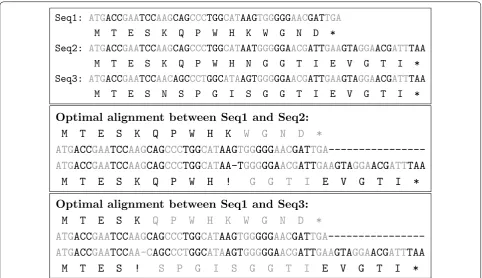
When looking at the AA translations of Seq1, Seq2 and Seq3, we observe that the similarity between Seq2 and Seq1 is higher than the similarity between Seq3 and Seq1 at the protein level, because Seq1 and Seq2 share a longer AA prefix “M T E S K Q P W H” (amino acids in black characters in the alignments). However, the pairwise CDS alignment algorithms that do not account for the length of FS translations would return the same score for the two following optimal alignments of Seq1 with Seq2 and Seq1 with Seq3, penalizing only the initiation of one FS translation in both cases (positions marked with a “!” symbol in the alignments), and not penalizing the sequence disruptions at the protein level.
From an evolutionary point of view, a good scoring model for evaluating the similarity between two CDS in the presence of FS translations should then penalize not only the initiation of FS but also the length of FS trans-lations extension (amino acids in gray characters in the alignments). The alignment of Seq1 with Seq2 would then have a higher similarity score than the alignment of Seq1 with Seq3.
Preliminaries: score of CDS alignment
In this section, we formally describe a new definition of the score of a CDS alignment that penalizes both the ini-tiation and the extension of FS translations.
Definition 1 [Coding DNA sequence (CDS)] A coding DNA sequence (CDS) is a DNA sequence on the alpha-bet of nucleotides N = {A,C,G,T} whose length n is a multiple of 3. A coding sequence is composed of a con-catenation of n
3 codons that are the words of length 3 in the sequence ending at positions 3i, 1≤i≤ n3. The AA translation of a CDS is a protein sequence of length n
3 on the alphabet A of AA such that each codon of the CDS is translated into an AA symbol in the protein sequence.
Note that, in practice an entire CDS begins with a start codon “ATG” and ends with a stop codon “TAA”, “TAG” or “TGA”.
Definition 2 (Alignment between DNA sequences) An alignment between two DNA sequences A and B is a pair (A′,B′) where A′ and B′ are two sequences of same length L derived by inserting gap symbols ′−′ in A and B, such that ∀i, 1≤i≤L, A′[i] �= ′−′ or B′[i] �= ′−′. Each
posi-tion i, 1≤i≤L, in the alignment is called a column of the alignment.
Given an alignment (A′,B′) of length L between two CDS A and B, let S be the sequence A′ or B′. We denote by S[k . . . l], 1≤k≤l≤L, the substring of S going from position k to position l.
S[k. . .l]
denotes the
Seq1:
ATG
ACC
GAA
TCC
AAG
CAG
CCC
TGG
CAT
AAG
TGG
GGG
AAC
GAT
TGA
M
T
E
S
K
Q
P
W
H
K
W
G
N
D
*
Seq2:
ATG
ACC
GAA
TCC
AAG
CAG
CCC
TGG
CAT
AAT
GGG
GGA
ACG
ATT
GAA
GTA
GGA
ACG
ATT
TAA
M
T
E
S
K
Q
P
W
H
N
G
G
T
I
E
V
G
T
I
*
Seq3:
ATG
ACC
GAA
TCC
AAC
AGC
CCT
GGC
ATA
AGT
GGG
GGA
ACG
ATT
GAA
GTA
GGA
ACG
ATT
TAA
M
T
E
S
N
S
P
G
I
S
G
G
T
I
E
V
G
T
I
*
Optimal alignment between Seq1 and Seq2:
M
T
E
S
K
Q
P
W
H
K
W
G
N
D
*
ATG
ACC
GAA
TCC
AAG
CAG
CCC
TGG
CAT
AAG
TGG
GGG
AAC
GAT
TGA
---ATG
ACC
GAA
TCC
AAG
CAG
CCC
TGG
CAT
AA-T
GGG
GGA
ACG
ATT
GAA
GTA
GGA
ACG
ATT
TAA
M
T
E
S
K
Q
P
W
H
!
G
G
T
I
E
V
G
T
I
*
Optimal alignment between Seq1 and Seq3:
M
T
E
S
K
Q
P
W
H
K
W
G
N
D
*
ATG
ACC
GAA
TCC
AAG
CAG
CCC
TGG
CAT
AAG
TGG
GGG
AAC
GAT
TGA
---ATG
ACC
GAA
TCC
AA-C
AGC
CCT
GGC
ATA
AGT
GGG
GGA
ACG
ATT
GAA
GTA
GGA
ACG
ATT
TAA
M
T
E
S
!
S
P
G
I
S
G
G
T
I
E
V
G
T
I
*
number of letters in S[k. . .l] that are different from the gap symbol ′−′. For example, if A′=ACCAT–GTAG and
B′=AC–TACGTAG, |A′[4 .. 8]| = |AT–G| =3. A codon of A or B is grouped in the alignment(A′,B′) if its three nucleotides appear in three consecutive columns of the alignment. For example, the first codon ACC of A is grouped, while the first codon ACT of B is not grouped.
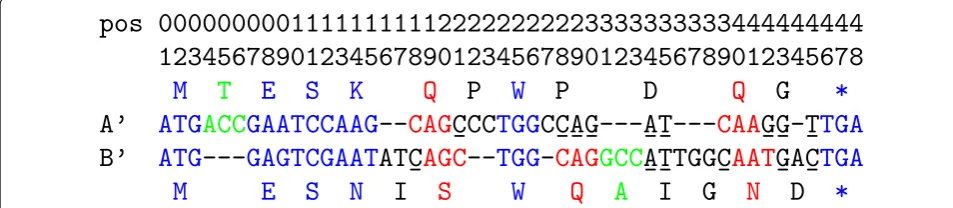
In the following, we give our definition of the score of an alignment (A′,B′) between two CDS A and B. It is based on a partition of the codons of A (resp. B) into four sets depending on the alignment of codons (see Fig. 2 for an illustration):
1. The set of In-frame Matching codons (IM) contains the codons that are grouped in the align-ment and aligned with a codon of the other CDS. 2. The set of Frameshift extension codons
(FSext) contains the codons that are grouped in the alignment and aligned with a concatenation of three nucleotides that overlaps two codons of the other CDS.
3. The set of Deleted/Inserted codons (InDel) contains the codons that are grouped in the alignment and aligned with a concatenation of 3 gap symbols.
4. All other codons constitutes Frameshift ini-tiation codons (FSinit). The set of Matching nucleotides in FSinit codons (MFS) contains all the nucleotides belonging to FSinit codons and aligned with a nucleotide of the other CDS.
The following notations and conventions are used in Definition 3 to denote the different sets of codons and nucleotides in A and B. The set of IM codons in A (resp. B) is denoted by IMA→B (resp. IMB→A). The set of FSext codons in A (resp. B) is denoted by FSextA→B (resp. FSextB→A). The set of InDel codons in A (resp.
B) is denoted by InDelA→B (resp. InDelB→A). The set of MFS nucleotides in A (resp. B) is denoted by MFSA→B (resp. MFSB→A). In these sets, the codons of A and B are simply identified by the position (column) of their last nucleotide in the alignment. In this case, we always have IMA→B=IMB→A as in the example below. The MFS nucleotides are also identified by their positions in the alignment.
For example, for the alignment depicted in Fig. 2, the composition of the different sets are: IMA→B=
IMB→A= {3, 9, 12, 15, 26, 48} ; FSextA→B= {20, 41}; InDelA→B= {6} ; MFSA→B= {21, 28, 29, 30, 34, 35, 42, 43, 45};
FSextB→A= {21, 30, 42}; InDelB→A= {33}; and
MFSB→A= {18, 34, 35, 39, 43, 45}.
In the alignment scoring model described in Defini-tion 3, the substitutions of IM and FSext codons are scored using an AA scoring function saa such that aligned
codons with silent nucleotide mutations get the same score as identity. A fixed FS extension cost denoted by fs_extend_cost is added for each FSext codon. The insertions/deletions of InDel codons are scored by adding a fixed gap cost denoted by gap_cost for each InDel codon. The alignment of MFS nucleotides are scored independently from each other, using a nucleotide scoring function san. The insertions or deletions of nucle-otides in FSinit codons are responsible for the initia-tion of FS translainitia-tions. They are then scored by adding a fixed FS opening cost denoted by fs_open_cost for each FSinit codon. Note that, by convention, the val-ues of all penalty costs for gap and FS (gap_cost, fs_ open_cost, fs_extend_cost) are negative. Note also that the scoring scheme assumes that the AA and the nucleotide scoring functions, saa and san, are symmetric.
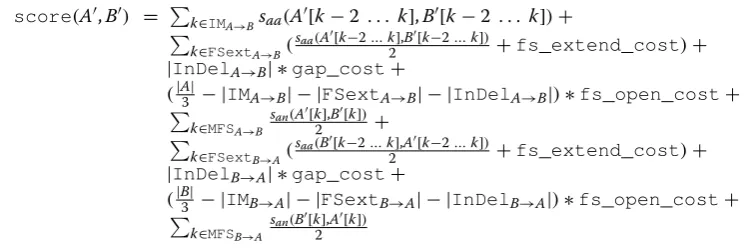
Definition 3 (Score of an alignment) Let (A′,B′) be an alignment of length L between two CDS A and B. The score of the alignment (A′,B′) is defined by:
pos 000000000111111111122222222223333333333444444444
123456789012345678901234567890123456789012345678
M
T
E
S
K
Q
P
W
P
D
Q
G
*
A’
ATGACCGAATCCAAG
--
CAG
C
¯
CC
TGG
CC
¯
A
¯
G
¯
---A
¯
T
¯
---
CAA
G
¯
G
¯
-T
¯
TGA
B’
ATG
---
GAGTCGAAT
ATC
¯
AGC
--
TGG
-
CAGGCC
A
¯
¯
T
TGGC
¯
AAT
G
¯
AC
¯
TGA
M
E
S
N
I
S
W
Q
A
I
G
N
D
*
Fig. 2 An alignment (A′,B′) of length 48 between two CDS, A (13 codons) and B (14 codons). The number arrays indicate the positions of the
con-secutive alignment columns. Codons of A and B are colored according to the set to which they belong: IM codons in blue color, FSext codons in
score(A′,B′) =
k∈IMA→Bsaa(A
′[k−2 . . . k],B′[k−2 . . . k])+
k∈FSextA→B(
saa(A′[k−2...k],B′[k−2...k])
2 +fs_extend_cost)+
|InDelA→B| ∗gap_cost+
(|A|3 − |IMA→B| − |FSextA→B| − |InDelA→B|)∗fs_open_cost+
k∈MFSA→B
san(A′[k],B′[k])
2 +
k∈FSextB→A(
saa(B′[k−2...k],A′[k−2...k])
2 +fs_extend_cost)+
|InDelB→A| ∗gap_cost+
(|B|3 − |IMB→A| − |FSextB→A| − |InDelB→A|)∗fs_open_cost+
k∈MFSB→A
san(B′[k],A′[k]) 2
and B[1 . . . j+α] where α=(3−i)(mod3) (resp.
α=(3−j)(mod3)). The table DF is filled as follows:
• If i(mod3)=0 and j(mod3)=0, DF(i,j)=D(i,j).
• If i(mod3)=0 and j(mod3)=2, or i(mod3)=2 and j(mod3)=0, DF(i,j) contains the maximum score of an alignment between A[1 . . . i+1] and B[1 . . . j+1] such that A[i+1] and B[j+1] are
aligned together and half of the score for aligning A[i+1] with B[j+1] is subtracted.
• If i(mod3)=0 and j(mod3)=1, or i(mod3)=1 and j(mod3)=0, DF(i,j) contains the maxi-mum score of an alignment between A[1 . . . i+2]
and B[1 . . . j+2] such that A[i+1],B[j+1] and
A[i+2],B[j+2] are aligned together and half of the
scores of aligning A[i+2] with B[j+2] and A[i+1]
with B[j+1] is subtracted.
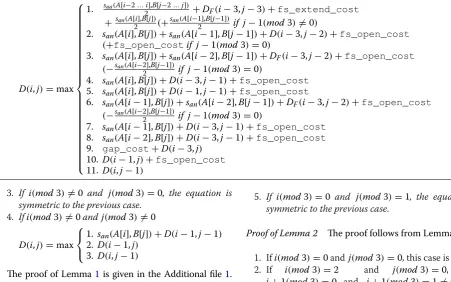
Lemma 1 (Filling up table D)
1. If i(mod3)=0 and j(mod3)=0
D(i,j)=max
1. saa(A[i−2 . . . i],B[j−2 . . . j])+D(i−3,j−3)
2. san(A[i],B[j])+san(A[i−1],B[j−1])+D(i−3,j−2)+2∗fs_open_cost 3. san(A[i],B[j])+san(A[i−2],B[j−1])+D(i−3,j−2)+2∗fs_open_cost 4. san(A[i],B[j])+D(i−3,j−1)+2∗fs_open_cost
5. san(A[i],B[j])+san(A[i−1],B[j−1])+D(i−2,j−3)+2∗fs_open_cost 6. san(A[i],B[j])+san(A[i−1],B[j−2])+D(i−2,j−3)+2∗fs_open_cost 7. san(A[i],B[j])+D(i−1,j−3)+2∗fs_open_cost
8. san(A[i],B[j])+D(i−1,j−1)+2∗fs_open_cost
9. san(A[i−21],B[j]) +san(A[i−22],B[j−1])+DF(i−3,j−2)+fs_open_cost 10. san(A[i−1],B[j])+D(i−3,j−1)+2∗fs_open_cost
11. san(A[i−22],B[j]) +DF(i−3,j−1)+fs_open_cost 12. gap_cost+D(i−3,j)
13. D(i−1,j)+fs_open_cost
14. san(A[i]2,B[j−1]) +san(A[i−21],B[j−2])+DF(i−2,j−3)+fs_open_cost 15. san(A[i],B[j−1])+D(i−1,j−3)+2∗fs_open_cost
16. san(A[i]2,B[j−2]) +DF(i−1,j−3)+fs_open_cost 17. gap_cost+D(i,j−3)
18. D(i,j−1)+fs_open_cost Methods
In this section, we describe a O(nm) time and space complexity algorithm that solves the problem of finding a maximum score alignment between two CDS A and B of lengths n and m. Similarly to other classical sequence alignment algorithms [24], we use dynamic program-ming tables that are indexed by the pairs of prefixes of the two CDS. The table D stores the maximum scores of the alignments between prefixes of A and B. The table DF is
used to account for potential cases of FS extensions that are counted subsequently.
Definition 4 (Dynamic programming tables) Given two CDS A and B as input, the algorithm uses two dynamic programming tables D and DF of size (n+1)×(m+1) .
The cell D(i, j) contains the maximum score of an align-ment between the prefixes A[1. . .i] and B[1. . .j] . The table DF is filled only for values of i and j such that
2. If i(mod3)=0 and j(mod3)�=0
D(i,j)=max
1. saa(A[i−2...2i],B[j−2...j])+DF(i−3,j−3)+fs_extend_cost + san(A[i]2,B[j])(+san(A[i−21],B[j−1])if j−1(mod3)�=0)
2. san(A[i],B[j])+san(A[i−1],B[j−1])+D(i−3,j−2)+fs_open_cost
(+fs_open_costif j−1(mod3)=0)
3. san(A[i],B[j])+san(A[i−2],B[j−1])+DF(i−3,j−2)+fs_open_cost (−san(A[i−2],2B[j−1]) if j−1(mod3)=0)
4. san(A[i],B[j])+D(i−3,j−1)+fs_open_cost 5. san(A[i],B[j])+D(i−1,j−1)+fs_open_cost
6. san(A[i−1],B[j])+san(A[i−2],B[j−1])+DF(i−3,j−2)+fs_open_cost
(−san(A[i−22],B[j−1]) if j−1(mod3)=0)
7. san(A[i−1],B[j])+D(i−3,j−1)+fs_open_cost 8. san(A[i−2],B[j])+D(i−3,j−1)+fs_open_cost 9. gap_cost+D(i−3,j)
10. D(i−1,j)+fs_open_cost 11. D(i,j−1)
5. If i(mod3)=0 and j(mod3)=1, the equation is symmetric to the previous case.
Proof of Lemma 2 The proof follows from Lemma 1.
1. If i(mod3)=0 and j(mod3)=0, this case is trivial. 2. If i(mod3)=2 and j(mod3)=0, then
i+1(mod3)=0 and j+1(mod3)=1�=0. The five cases follow from the application of Lemma 1, case 2 for computing D(i+1,j+1), and by keep-ing only the cases where A[i+1] and B[j+1] are
aligned together (cases 1, 2, 3, 4, 5 among the 11 cases). However, in each of the cases, we must sub-tract half of the score of aligning B[i+1] with
A[j+1]
s
an(A[i+1],B[j+1]) 2
, because this score will be added subsequently.
3. If i(mod3)�=0 and j(mod3)=0, the equation is symmetric to the previous case.
4. If i(mod3)�=0 and j(mod3)�=0
D(i,j)=max
1.san(A[i],B[j])+D(i−1,j−1)
2.D(i−1,j)
3.D(i,j−1)
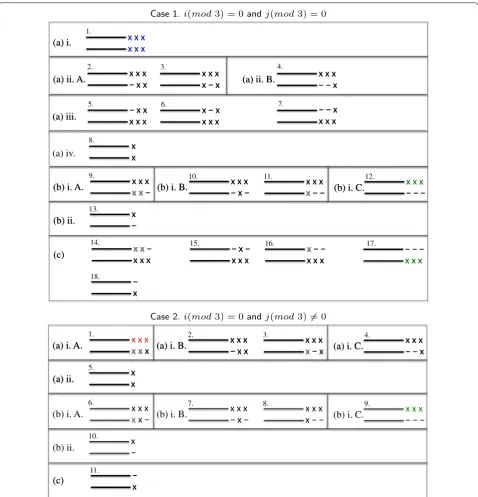
The proof of Lemma 1 is given in the Additional file 1. Figure 3 illustrates the configurations of alignment consid-ered in Lemma 1 for computing D(i, j) for cases 1 and 2.
Lemma 2 (Filling up table DF)
1. If i(mod3)=0 and j(mod3)=0 DF(i,j)=D(i,j)
2. If i(mod3)=2 and j(mod3)=0
DF(i,j)=max
1. saa(A[i−1...i+1],2B[j−1...j+1])+DF(i−2,j−2)+fs_extend_cost 2. san(A[i+21],B[j+1])+san(A[i],B[j])+D(i−2,j−1)+2∗fs_open_cost 3. san(A[i+1],2 B[j+1])+san(A[i−1],2 B[j])+DF(i−2,j−1)+fs_open_cost 4. san(A[i+1],2 B[j+1])+D(i−2,j)+fs_open_cost
5. san(A[i+1],2 B[j+1])+D(i,j)+fs_open_cost
3. If i(mod3)=0 and j(mod3)=2, the equation is symmetric to the previous case.
4. If i(mod3)=1 and j(mod3)=0
DF(i,j)=max
1. saa(A[i...i+22],B[j...j+2]) +DF(i−1,j−1)+fs_extend_cost
2. san(A[i+22],B[j+2])+san(A[i+21],B[j+1])+D(i−1,j)+fs_open_cost
Case 1.i(mod3) = 0 andj(mod 3) = 0
(a) i.
(a) ii. A. (a) ii. B.
(a) iii.
(b) i. A. (b) i. B. (b) i. C.
(b) ii.
(c) (a) i.
(a) ii. A. (a) ii. B.
(a) iii.
(b) i. A. (b) i. B. (b) i. C.
(b) ii.
(c) 1.
2. 3. 4.
5. 6. 7.
8.
9. 10. 11. 12.
13.
14. 15. 16. 17.
18. (a) iv.
Case 2.i(mod3) = 0 andj(mod 3) = 0
(a) i. A. (a) i. B. (a) i. C.
(a) ii.
(c)
(a) i. A. (a) i. B. (a) i. C.
(a) ii.
(c)
1. 2. 3. 4.
5.
11.
(b) i. A. (b) i. B. (b) i. C.
(b) ii.
6. 7. 8. 9.
10.
3. If i(mod3)=0 and j(mod3)=2, the proof is sym-metric to the previous case.
4. If i(mod3)=1 and j(mod3)=0, then i+2(mod3)=0 and j+2(mod3)=2�=0. Here again, the three cases follow from the application of Lemma 1, case 2 for computing D(i+2,j+2) and by keeping only the cases where A[i+1], B[i+1]
and A[i+2], B[i+2] can be aligned together (cases
1, 2, 5 among the 11 cases). However, in each of the cases, we must subtract half of the scores of align-ing B[i+2] with A[j+2] and aligning B[i+1] with A[j+1]
s
an(A[i+2],B[j+2])
2 ,
san(A[i+1],B[j+1]) 2
, because theses scores will be added subsequently.
5. If i(mod3)=0 and j(mod3)=1, the proof is sym-metric to the previous case.
The alignment algorithm using Lemmas 1 and 2 is described in the next theorem.
Theorem 1 (Computing a maximum score alignment)
Given two CDSA andB of lengthsn andm, a maximum score alignment betweenA andB can be computed in time and spaceO(nm), using the following algorithm.
Algorithm Align(A,B) for i = 0 to n do
D(i, 0)=floor
i 3
∗gap_cost
DF(i, 0)=D(i, 0)+
san(A[i+1],B[1])
2 +san(A[i+2],2 B[2])+fs_open_cost, if i (mod 3) = 1 san(A[i+1],B[1])
2 +fs_open_cost, if i (mod 3) = 2
for j = 0 to m do
D(0,j)=floor
j 3
∗gap_cost
DF(0,j)=D(0,j)+
san(A[1],B[j+1])
2 +
san(A[2],B[j+2])
2 +fs_open_cost, if j (mod 3) = 1
san(A[1],B[j+1])
2 +fs_open_cost, if j (mod 3) = 2
for i = 0 to n do
for j = 0 to m do
compute D(i,j) using Lemma 1
compute DF(i,j) using Lemma 2, if i (mod 3) = 0 or j (mod 3) = 0
Proof of Theorem 1 The proof relies on two points: (1) the algorithm computes the maximum score of an align-ment between A and B and (2) the algorithm runs with an O(nm) time and space complexity.
1. The validity of the algorithm, i.e. the fact that it fills the cells of the tables D and DF according to
Defini-tion 4, follows from five points.
• The initialization of the tables is a direct conse-quence of Definition 4.
• Lemmas 1 and 2.
• The couples (i, j) of prefixes of A and B that need to be considered in the algorithm are all the possi-ble couples for D(i, j) and only the couples such that i(mod3)=0 or j(mod3)=0 for DF(i,j) [see all the cases in which the table DF is used in Lemmas 1
(7 cases) and 2 (3 cases)].
• The couples (i, j) of prefixes of A and B are con-sidered in increasing order of length and D[i, j] is computed before DF[i,j] in the cases where
• A backtracking of the algorithm allows to find a maximum score alignment between A and B.
2. The time and space complexity of the algorithm is a direct consequence of the number of cells of the tables D and DF, 2×(n+1)×(m+1). Each cell is filled
in constant time. The exact formula for the computa-tional complexity of the algorithm is computed below.
18 × nm
9 For
nm
9 calls of the case 1 of
Lemma 1
+ 11 × 2×nm3 For 2×nm3 calls of the cases 2 or
3 of Lemma 1
+ 3 × 4nm
9 For
4nm
9 calls of the case 4 of
Lemma 1
+ 1 × nm
9 For
nm
9 calls of the case 1 of
Lemma 2
+ 5 × 2×nm9 For 2×nm9 calls of the cases 2
and 3 of Lemma 2
+ 3 × 2×nm9 For 2×nm9 calls of the cases 4
and 5 of Lemma 2
Total = 12.55 nm
Results and discussion
We implemented the present CDS alignment algorithm with an affine gap penalty scheme [25] such that the penalty for a concatenation of k inserted (resp. deleted) codons is gap_open_cost+k∗gap_cost, such that gap_open_cost is a negative penalty cost for gap ini-tiations. This was done by adding two dynamic program-ming tables GA and GB such that the cell GA(i,j) (resp. GB(i,j)) contains the maximum score of an alignment between the prefixes A[1. . .i]B[1. . .j]where the codon A[i−2 . . . i] (resp. B[j−2 . . . i]) is an InDel codon.
Data
We evaluated the algorithm through applications on a mammalian dataset containing CDS sequences from ten gene families obtained from the database Ensembl-Compara version 83 [26]. The first gene family named “FAM86” is such that three CDS from three of its paralo-gous human genes were shown in [6] to share a common FS region translated in three different frames in the three CDS (see Fig. 4 for an illustration of the multiple align-ment of these three CDS). The nine other families are the nine smallest (in term of the overall length of CDS) of fif-teen gene families listed in [12] where they were shown to display one FS translation region between some pairs of CDS. For each gene family, the CDS of all human, mouse and cow genes belonging to the family and satisfy-ing Definition 1 were downloaded. The overall number of distinct pairs of CDS within the ten gene families is 4011. Table 1 gives the details about the content and size of the ten gene families (The CDS of the ten gene families are provided in the Additional file 2).
Evaluation strategies
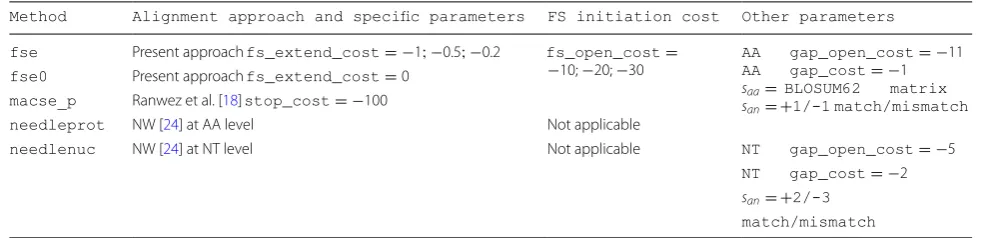
We compared the accuracy of five pairwise global align-ment methods, including the present method, for com-puting CDS alignments in the presence or absence of FS translation between the compared CDS. The five methods vary according to the alignment algorithm used, either the present CDS alignment algorithm called FsePSA allowing to penalize both FS translation initiation and extension, or the CDS alignment algorithm called MACSE [18] penalizing FS translation initiation, or the Needleman–Wunsch (NW) sequence alignment algo-rithm [24] penalizing neither. Table 2 summarizes the alignment algorithm and the values of parameters used for each of the five methods.
Table 1 Detailed description of the ten gene families of the mammalian dataset
For each gene family, the family identifier used in [6] or [12], the Ensembl identifier of a human gene member of the family, the number of human, mouse and cow
genes in the family, the total number of CDS of these genes, the total sum of lengths of these CDS and the number of distinct pairs of CDS are given
Gene family Human gene # of genes # of CDS Length N∗(N−1)
2
I (FAM86) ENSG00000118894 6 14 10335 91
II (HBG017385) ENSG00000143867 6 10 8988 45
III (HBG020791) ENSG00000179526 6 10 11070 45
IV (HBG004532) ENSG00000173020 17 33 52356 528
V (HBG016641) ENSG00000147041 13 33 64950 528
VI (HBG014779) ENSG00000233803 28 44 45813 946
VII (HBG012748) ENSG00000134545 24 44 28050 946
VIII (HBG015928) ENSG00000178287 5 19 5496 171
IX (HBG004374) ENSG00000140519 13 30 36405 435
X (HBG000122) ENSG00000105717 11 24 27081 276
The present CDS alignment algorithm is used in two of the five methods, namely fse and fse0. These two methods differ according to the value given to the param-eter fs_extend_cost, either fs_extend_cost < 0 (−1, −0.5 or −0.2) for the method fse penalizing FS
translation extension, or fs_extend_cost=0 for the method fse0 not penalizing FS translation exten-sion. The pairwise version of MACSE [18] is used in the method called macse_p. The NW alignment algo-rithm is used in the last two methods, the method called needlenuc computing scores and alignments at the nucleotide level and the method called needleprot at the AA level. For all methods using both the amino acid and nucleotide scoring functions saa and san, san was fixed to +1/-1 for match/mismatch, so that the overall score of 3 consecutive nucleotide identities in an align-ment scores less than the smallest identity score in saa .
All other parameters shared by several methods were given the same value for all methods. In particular, for the three methods fse, fse0 and macse_p penalizing FS translation initiation, the parameter fs_open_cost was given the values −10, −20 or −30. All other param-eters were fixed to the default values for the NW algo-rithm implementation of NCBI Blast at the nucleotide and AA levels [27].
We used the five methods to compute pairwise align-ments between the pairs of CDS within each of the ten gene families of our dataset, yielding 4011 alignments in total for each of five methods. In the absence of available benchmarks for the direct evaluation of the accuracy of CDS alignments, we base our evaluation on four indirect strategies.
In the first strategy, we consider the CDS multiple alignment of each gene family obtained using MACSE [18] as a benchmark. This strategy exploits the fact that multiple alignments are usually more accurate than pairwise alignments. It then assumes that the MACSE multiple alignments are closer to the reality than the pairwise alignments obtained using the five methods. Note that all the pairwise alignment methods included
in the comparison can be extended to multiple sequence alignment methods using classical strategies. Thus, the more accurate pairwise alignment methods should lead to more accurate multiple alignment methods. Here, we focus on the comparison of the pairwise versions of the methods. In the second strategy, we consider six compo-sition criteria for a CDS pairwise alignment called Iden-tity_NT, Identity_AA, Gap_init, Gap_length, FS_init, FS_length. The definitions of these crite-ria are given below, and used to compare the five meth-ods. In the third strategy, we manually build and use as a benchmark, the real multiple alignment of three CDS from three paralogous human genes of the gene family I (FAM86). In the fourth strategy, we generate and use a set of three CDS splicing orthology groups, each group containing seven existing or putative CDS from seven genes of gene family I (FAM86).
Based on the results of the large-scale experiments dis-cussed in the following, the best compromise for default values of FsePSA parameters are −30 for fs_open_ cost and −1 for fs_extend_cost.
Discussion
First strategy: using MACSE multiple alignments as benchmark
MACSE [18] was used with its default parameters (fs_open_cost = −30, stop_cost = −100,
saa=BLOSUM62 matrix, gap_open_cost=−7 ,
gap_cost=−1) to compute the CDS multiple align-ment of each of the ten gene families. For each MACSE multiple alignment of N CDS, we consider the N(N−1)
2 induced pairwise alignments as a benchmark. In total, we then obtained a benchmark composed of 4011 pairwise alignments. In order to compare an alignment (A′,B′) obtained with one of the five methods to the correspond-ing alignment (A′′,B′′) in the benchmark, we computed the number of nucleotides aligned in (A′,B′) with the same partner as in the benchmark alignment (A′′,B′′).
Table 3 shows the overall percentage of nucleotides aligned with the same partners as in the benchmark for Table 2 Description of the five methods considered in the experiment
For each method, the alignment approach and the values of specific and common parameters are given
Method Alignment approach and specific parameters FS initiation cost Other parameters fse Present approach fs_extend_cost= −1; −0.5; −0.2 fs_open_cost=
−10; −20; −30 AAAA gap_open_costgap_cost= −1 = −11 saa= BLOSUM62 matrix
san=+1/-1match/mismatch
fse0 Present approach fs_extend_cost=0
macse_p Ranwez et al. [18] stop_cost= −100
needleprot NW [24] at AA level Not applicable
needlenuc NW [24] at NT level Not applicable NT gap_open_cost= −5
NT gap_cost= −2
each of the compared methods, for varying fs_open_ cost (−10, −20 and −30) and fs_extend_cost (−1 , −0.5 and −0.2). It shows that the different versions of
the fse method and the fse0 method have the best scores greater than 79.4%, followed by the
needle-prot method with a score of 78.82%. On the opposite,
the needlenuc and macse_p method with fs_open_ cost=−30 return the worst scores, respectively 50.95%
and 47.35%. These results also show that the fse method
is more robust to the fs_open_cost parameter changes as compared to the macse_p method, whose scores show a large variation between 47.35 and 78.29%. Note that the needlenuc and needleprot do not account for the fs_open_cost parameter.
Second strategy: using six composition criteria for CDS pairwise alignment
Six criteria were defined and used to compare the five pairwise alignment methods. Given a pairwise CDS alignment, the first criterion Identity_NT counts the number of gap-free columns in the alignment containing a nucleotide match. The second criterion Identity_AA counts the number of IM and FSext codons c in the alignment that are aligned with a triplet of nucleotides yielding the same amino acid as c. The third criterion Gap_init is the number of gap-containing columns in the alignment, either insertion or deletion columns that are preceded by a different type of column. The fourth criterion Gap_length is the overall number of gap-con-taining columns in the alignment. The fifth criterion FS_ init is the number of FS translation segments found in the alignment. The last criterion FS_length is the overall number of columns in the alignment intersecting a FSext codon.
Note that the definitions of the six criteria exploit the definitions of codon sets used in Definition 3 but they are independent of any alignment scoring scheme. For example, for the alignment depicted in Fig. 2, Identity_NT=28, counting all gap-free columns
except the five columns at the positions {9, 12, 15, 42, 45} containing a nucleotide mismatch. Identity_AA=14 , counting all IM and FSext codons except the two IM codons AAG and AAT ending at position 15 yielding two
different amino acids K and N, and the FSext codon AAT ending at position 42 yielding the amino acid N different from the amino acid K yielded by the tri-plet AAG. Gap_init=7, counting the positions
{4, 16, 22, 27, 31, 36, 44}. FS_init=3, counting the positions {18, 28, 39}. The two last criteria have the values Gap_length=15 and FS_length=11.
For each of the nine cases obtained by combining the values of the parameters fs_open_cost (−10, −20 or
−30) and fs_extend_cost (−1, −0.5 or −0.2), we
con-sidered the 4011 pairs of CDS from the ten gene families dataset, and partitioned them into three sets. For each case, the first set called the noFS dataset is composed of the pairs of CDS for which the pairwise alignments obtained using the fse0, fse and macse_p methods all have the criteria FS_init=0. The second set called the
FS dataset is composed of the pairs of CDS for which the alignments obtained using the fse0, fse and macse_p methods all have the criteria FS_init>0. The third set called the ambiguFS dataset is composed of the remain-ing pairs of CDS.
Note that, in all nine cases, the set of CDS pairs for which FS_init=0 with the macse_p method was strictly included in the set of CDS pairs for which FS_init=0 with the fse method. For each of the nine cases, we computed the overall value of the six cri-teria for each method (fse0, fse, macse_p, needle-nuc and needleprot) and each dataset (noFS, FS and ambiguFS). Tables 4, 5 and 6 present the results.
Results for the noFS datasets
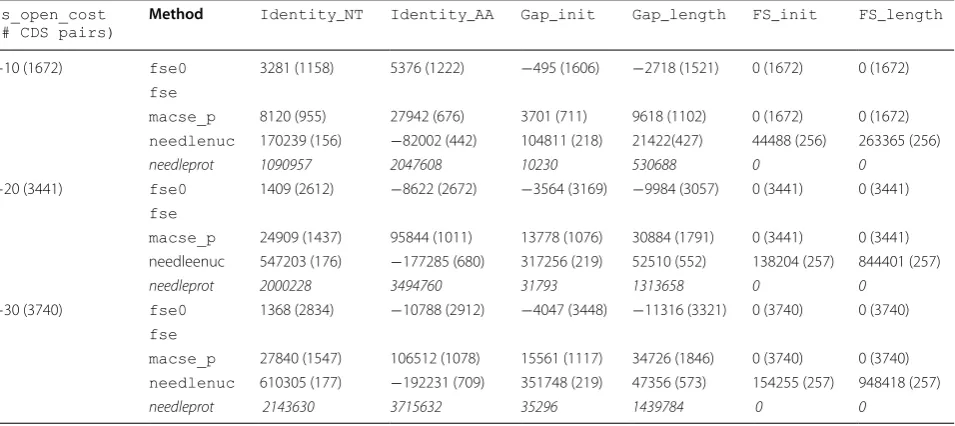
For the noFS datasets, we assume that the real align-ments should not contain FS translations. So, the nee-dleprot method most likely computes the more accurate alignments since it does not allow any FS translation in the alignments. Indeed, it computes a maximum score NW alignment at the AA level and back-translates this alignment at the nucleotide level. We then take the needleprot result as a reference for the noFS dataset, in all cases. By construction of the noFS dataset, for a fixed value of the parameter fs_open_cost, the fse0 and fse methods neces-sarily return two alignments with the same similarity Table 3 Comparison with MACSE multiple alignments benchmark
Percentage of nucleotides aligned with the same partner as in the benchmark alignments induced by the MACSE multiple alignments, for each method for varying
fs_open_cost (−10, −20 and −30) and fs_extend_cost (−1, −0.5 and −0.2). In each case, the number of CDS pairs with an alignment that presents the highest
similarity with the corresponding benchmark alignment as compared to the other methods is given in parenthesis. The best results are indicated in italics
fs_open_cost fse0 fse (−1) fse (−0.5) fse (−0.2) macse_p needlenuc needleprot
-10 79.58 (1404) 79.40 (1364) 79.52 (1415) 79.58 (1433) 77.17 (1076) 50.95 (255) 78.82 (972)
-20 79.68 (1550) 79.68 (1526) 79.65 (1558) 79.67 (1552) 78.29 (1389)
score for each pair of CDS of the dataset. Indeed, we observed that, for each value of fs_open_cost (−10 , −20 or −30), the alignments obtained using the meth-ods fse0 or fse with varying values of the parameter fs_extend_cost are unchanged.
Table 4 summarizes the results for
fs_open_cost= −10, −20 and −30, presenting the
results of the varying versions of fse and fse0 in a single line in the three cases. It shows that the results of the fse and fse0 methods are the closest to the reference for all the six criteria in all cases. However, they slightly overestimate or underestimate the criteria. The tendency of overestimat-ing the Identity_AA and all other criteria is particularly accentuated for the macse_p method as compared to the fse and fse0 methods, in all cases. On the opposite, the needlenuc method always largely underestimates the Identity_AA, while overestimating all other criterion.
Results for the FS datasets
For the FS datasets, we assume that the real alignments must contain FS translations. So, the needleprot method can no longer produce the most accurate results. On the contrary, it is most likely that it underestimates the Identity_AA criterion. Indeed, it correctly aligns AA in CDS regions that are free of FS translation, but in FS translation regions, it either leads to several AA mis-matches in the case of high mismis-matches scores, or to an overestimation of the Gap_init criterion. As expected, we observed that the value of Identity_AA for the
needleprot method was always the lowest (data shown in the Additional file 3). We focus on the four other methods.
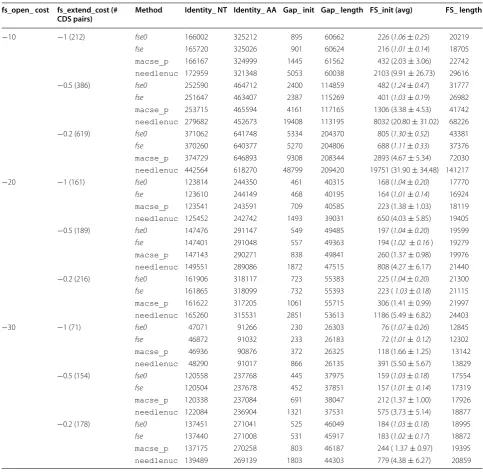
Table 5 summarizes the results for the nine cases con-sidered. For the Identity_NT and Identity_AA criteria, the differences between the values for the four methods are negligible. The main differences between the results reside in the values of the Gap_init and FS_init criteria. In particular, the FS_init crite-rion is useful to compare the accuracy of the methods for correctly identifying real FS translation regions. In [6] (for family I) and [12] (for families II–X), at most one FS translation region was detected and manually vali-dated for each pair of CDS of the ten gene families. So, the expected number of FS translation regions per align-ment in the FS data is 1. In Table 5, we observe that, in all cases, the fse and fse0 methods are the only meth-ods for which the average numbers of FS_init are close to 1 with +/− standard error values smaller than 1. The macse method and especially the needlenuc method overestimate the number of FS translation regions per alignment with large standard error values in all cases.
Results for the ambiguFS datasets
For the ambiguFS datasets, all methods do not agree for the presence or absence of FS translation regions between the pairs of CDS. Note that the needlenuc method reports FS translations for all pairs of CDS, with the highest average number of FS translation regions Table 4 Values of the six criteria for the noFS dataset (variations as compared to needleprot)
For varying values of the parameter fs_open_cost, the number of CDS pairs in the dataset is given.
The values of the criteria for the reference method “needleprot” are indicated in italics characters. For each of the other methods (fse, fse0, macse_p,
needlenuc), the variations of the criteria values as compared to the reference values are given. For each criteria and each method, the number of CDS pairs that have the closest value to the reference needleprot value is given in parentheses
fs_open_cost
(# CDS pairs) Method Identity_NT Identity_AA Gap_init Gap_length FS_init FS_length
−10 (1672) fse0 3281 (1158) 5376 (1222) −495 (1606) −2718 (1521) 0 (1672) 0 (1672)
fse
macse_p 8120 (955) 27942 (676) 3701 (711) 9618 (1102) 0 (1672) 0 (1672)
needlenuc 170239 (156) −82002 (442) 104811 (218) 21422(427) 44488 (256) 263365 (256)
needleprot 1090957 2047608 10230 530688 0 0
−20 (3441) fse0 1409 (2612) −8622 (2672) −3564 (3169) −9984 (3057) 0 (3441) 0 (3441)
fse
macse_p 24909 (1437) 95844 (1011) 13778 (1076) 30884 (1791) 0 (3441) 0 (3441) needleenuc 547203 (176) −177285 (680) 317256 (219) 52510 (552) 138204 (257) 844401 (257)
needleprot 2000228 3494760 31793 1313658 0 0
−30 (3740) fse0 1368 (2834) −10788 (2912) −4047 (3448) −11316 (3321) 0 (3740) 0 (3740)
fse
macse_p 27840 (1547) 106512 (1078) 15561 (1117) 34726 (1846) 0 (3740) 0 (3740)
needlenuc 610305 (177) −192231 (709) 351748 (219) 47356 (573) 154255 (257) 948418 (257)
per alignment in all cases (data shown in the Additional file 3). As needlenuc is already shown to perform poorly in both the absence and the presence of FS transla-tion regions, we focus on the four other methods. Table 6 summarizes the results. We observe that, for all criteria, macse_p has higher values than fse0, fse and nee-dleprot that have similar values. The most significant difference between the results resides in the values for the FS_init and FS_length criteria. The fse method
always reports a null or a very small number of FS regions with an average FS_init equals to 1 as expected. In all cases, the fse0 and macse methods overestimate the number of FS translation regions per alignment.
Third strategy: using a 3‑CDS manually‑built benchmark
We manually built the real pairwise alignments of three CDS from three paralogous human genes of gene family I, the CDS FAM86C1-002 coding for protein Table 5 Values of the six criteria for the FS dataset
For varying values of the parameters fs_open_cost and fs_extend_cost, the number of CDS pairs in the dataset is given. The values of the criteria for the fse,
fse0, macse_p, needlenuc methods are indicated. For each method, the average number of FS_init per alignment, with corresponding standard error values are also indicated
The best results are indicated in italics
fs_open_ cost fs_extend_cost (#
CDS pairs) Method Identity_ NT Identity_ AA Gap_ init Gap_ length FS_init (avg) FS_ length
−10 −1 (212) fse0 166002 325212 895 60662 226 (1.06 ± 0.25) 20219
fse 165720 325026 901 60624 216 (1.01± 0.14) 18705
macse_p 166167 324999 1445 61562 432 (2.03 ± 3.06) 22742
needlenuc 172959 321348 5053 60038 2103 (9.91 ± 26.73) 29616
−0.5 (386) fse0 252590 464712 2400 114859 482 (1.24 ± 0.47) 31777
fse 251647 463407 2387 115269 401 (1.03± 0.19) 26982
macse_p 253715 465594 4161 117165 1306 (3.38 ± 4.53) 41742
needlenuc 279682 452673 19408 113195 8032 (20.80 ± 31.02) 68226
−0.2 (619) fse0 371062 641748 5334 204370 805 (1.30 ± 0.52) 43381
fse 370260 640377 5270 204806 688 (1.11 ± 0.33) 37376
macse_p 374729 646893 9308 208344 2893 (4.67 ± 5.34) 72030
needlenuc 442564 618270 48799 209420 19751 (31.90 ± 34.48) 141217
−20 −1 (161) fse0 123814 244350 461 40315 168 (1.04 ± 0.20) 17770
fse 123610 244149 468 40195 164 (1.01± 0.14) 16924
macse_p 123541 243591 709 40585 223 (1.38 ± 1.03) 18119
needlenuc 125452 242742 1493 39031 650 (4.03 ± 5.85) 19405
−0.5 (189) fse0 147476 291147 549 49485 197 (1.04 ± 0.20) 19599
fse 147401 291048 557 49363 194 (1.02 ± 0.16 ) 19279
macse_p 147143 290271 838 49841 260 (1.37 ± 0.98) 19976
needlenuc 149551 289086 1872 47515 808 (4.27 ± 6.17) 21440
−0.2 (216) fse0 161906 318117 723 55383 225 (1.04 ± 0.20) 21300
fse 161865 318099 732 55393 223 ( 1.03 ± 0.18) 21115
macse_p 161622 317205 1061 55715 306 (1.41 ± 0.99) 21997
needlenuc 165260 315531 2851 53613 1186 (5.49 ± 6.82) 24403
−30 −1 (71) fse0 47071 91266 230 26303 76 (1.07 ± 0.26) 12845
fse 46872 91032 233 26183 72 (1.01± 0.12) 12302
macse_p 46936 90876 372 26325 118 (1.66 ± 1.25) 13142
needlenuc 48290 91017 866 26135 391 (5.50 ± 5.67) 13829
−0.5 (154) fse0 120558 237768 445 37975 159 (1.03 ± 0.18) 17554
fse 120504 237678 452 37851 157 (1.01 ± 0.14) 17319
macse_p 120338 237084 691 38047 212 (1.37 ± 1.00) 17926
needlenuc 122084 236904 1321 37531 575 (3.73 ± 5.14) 18877
−0.2 (178) fse0 137451 271041 525 46049 184 (1.03 ± 0.18) 18995
fse 137440 271008 531 45917 183 (1.02± 0.17) 18872
macse_p 137175 270258 803 46187 244 ( 1.37 ± 0.97) 19395
ENSP00000352182.4, FAM86B1-001 coding for protein ENSP00000431362.1 and FAM86B2-202 coding for pro-tein ENSP00000311330.6. The real multiple alignment of the three CDS is roughly depicted and detailed in Fig. 4. From Fig. 4, we observe that FAM86C1-002 shares with FAM86B1-001 a nucleotide region of length 159 translated in the same frame and a nucleotide region of length 89 with FS translation, while it only shares with FAM86B2-202 a nucleotide region of length 238 (89+149) entirely under
FS translation. It is then clear that CDS FAM86C1-002 and FAM86B1-001 are the most similar. Figure 4 also shows that each pair of CDS shares a single FS translation region.
Table 7 shows the normalized pairwise similarity scores and the number of FS translation regions computed by the five alignment methods (the pairwise alignments computed by the five methods with varying fs_open_ cost and fs_extend_cost are given in the Addi-tional file 4). It shows that needleprot and fse (in Table 6 Values of the six criteria for the ambiguFS dataset
For varying values of the parameters fs_open_cost and fs_extend_cost, and for each method, the number of CDS pairs displaying a FS translation is given. The values of the criteria for each method are indicated. For each method, the average number of FS_init per alignment, with corresponding standard error values are also indicated
fs_open_ cost fs_extend_cost (#
CDS pairs) Method Identity_ NT Identity_ AA Gap_ init Gap_ length FS_init (avg) FS_ length
−10 −1 (2127) fse0 (862) 1095102 1737105 24489 908218 1111 (1.28 ±0.54) 42730
fse 1086546 1719774 23483 906540 0 0
macse_p (2076) 1124316 1790199 45335 936002 12436 (5.99 ±4.96) 216772
needleprot 1085007 1723950 25288 916518 0 0
−0.5 (1953) fse0 (688) 1008514 1597605 22984 854021 855 (1.24 ±0.53 ) 31172
fse (2) 1003293 1587258 22102 853793 2 (1.0 ±0 ) 80
macse_p (1902) 1036768 1649604 42619 880399 11562 (6.07 ±4.91) 197772
needleprot 1001957 1591134 23790 863199 0 0
−0.2 (1720) fse0 (455) 890042 1420569 20050 764510 532 (1.16 ±0.48) 19568
fse (3) 887372 1415403 19465 764162 3 (1.0 ±0) 92
macse_p (1669) 915754 1468305 37472 789220 9975 (5.97 ±4.75) 167484
needleprot 886178 1418748 20955 772272 0 0
−20 −1 (409) fse0 (100) 219277 358554 3633 153487 120 (1.2 ±0.40) 6937
fse 216936 353586 3619 152391 0 0
macse_p (403) 225976 374391 6509 158165 1348 (3.34 ±3.00) 36179
needleprot 216842 355656 4172 153957 0 0
−0.5 (381) fse0 (72) 195615 311757 3545 144317 91 (1.26 ±0.44) 5108
fse 194048 308448 3505 144045 0 0
macse_p (375) 202374 327711 6380 148909 1311 (3.49 ±3.05) 34322
needleprot 193980 310632 4051 145563 0 0
−0.2 (354) fse0 (45) 181185 284787 3371 138419 63 (1.4 ±0.49) 3407
fse (1) 180151 282693 3344 138217 1 (1.0 ±0) 40
macse_p (348) 187895 300777 6157 143035 1265 (3.63 ±3.11) 32301
needleprot 180116 284946 3883 139731 0 0
−30 −1 (200) fse0 (119) 151090 289617 805 42437 120 (1.01 ±0.09) 6818
fse 147590 282018 852 40221 0 0
macse_p (200) 152626 292254 1309 43043 378 (1.89 ±2.16) 14515
needleprot 147228 281472 933 40455 0 0
−0.5 (117) fse0 (36) 77603 143115 590 30765 37 (1.02 ±0.16) 2109
fse 76678 141108 626 29913 0 0
macse_p (117) 79224 146046 990 31321 284 (2.42 ±2.65) 9731
needleprot 76561 141036 703 30099 0 0
−0.2 (93) fse0 (12) 60710 109842 510 22691 12 (1.0 ±0) 668
fse 60407 109170 518 22491 0 0
macse_p (93) 62387 112872 878 23181 252 (2.70 ±2.89) 8262
all cases where fs_extend_cost= −1) are the only two methods that allow to infer that FAM86C1-002 and FAM86B1-001 are the most similar. Table 7 also illustrates the fact that needlenuc and macse_p strongly overes-timate the number of FS translation regions per alignment in all cases. The fse method with the parameters fs_ open_cost=−10 and fs_extend_cost= −1 is the only method that allows to infer that FAM86C1-002 and FAM86B1-001 are the most similar and to detect a single FS translation region for each alignment.
Fourth strategy: inferring CDS splicing orthology groups and protein phylogenies
Based on the three CDS used in the previous strategy, CDS FAM86C1-002 from human gene ENSG00000158483, FAM86B1-001 from human gene ENSG00000186523 and FAM86B2-202 from human gene ENSG00000145002, we generated a dataset of three CDS splicing orthology groups composed of 21 homologous CDS. Each group contains one of the three initial CDS and its six splicing orthologs in the follow-ing set of seven genes from gene family I: human genes ENSG00000158483 denoted H1, ENSG00000186523 denoted H2 and ENSG00000145002 denoted H3, each containing one of the initial CDS, chimpan-zee gene ENSPTRG00000007738 denoted Ch, mouse gene ENSMUSG00000022544 denoted M, rat gene ENSRNOG0-0000002876 denoted R and cow gene ENSBTAG00000008222 denoted Co. The CDS splicing orthologs were predicted based on the spliced alignment
tool Splign [28] as follows: for each initial CDS A1 of a gene A and each gene B different from A, A1 was aligned to B and a putative or existing CDS of B ortholog to A1 with the same splicing structure was inferred. The 21 resulting CDS are given in Additional file 5.
We computed the normalized pairwise similarity scores between the CDS, using the five alignment methods (the pairwise alignments computed by the five methods with varying fs_open_cost and fs_extend_cost are given in the Additional file 5). For each method, we con-structed a phylogeny using an UPGMA and a Neighbor-Joining (NJ) algorithm, based on the computed CDS similarity matrix. The UPGMA algorithm was used to classify the CDS into three groups and infer the similarity relationships between the groups independently of any rate of evolution. The NJ algorithm was used to recon-struct the phylogeny inside each group. Table 8 summa-rizes the results. The three splicing orthology groups are denoted G1 (containing CDS C1-002), G2 (containing CDS B1-001) and G3 (containing CDS B2-202).
All methods allow to correctly classify the CDS into the three initial splicing orthology groups G1, G2, and G3. However, the needleprot and fse methods are the only methods that allow to infer the correct similar-ity relationships ((G1,G2),G3) between the groups, con-firming the results of the third evaluation strategy. For all methods, the CDS phylogeny reconstructed inside the group G2 is (Co,((M,R),((H1,Ch),(H2,H3)))) inducing an evolution of the seven genes with a speciation event at the root of the gene tree. The phylogeny reconstructed for Table 7 Pairwise similarity scores and number of FS translation regions computed by the methods
Normalized pairwise similarity scores and number of FS translation regions computed by the five methods for the 3-CDS manually-built benchmark composed of CDS
FAM86C1-002, FAM86B1-001 and FAM86B2-202 (Similarity scores are normalized by dividing them by the lengths of alignments)
fs_open_cost Method C1-002 vs B1-001 C1-002 vs B2-202 B1-001 vs B2-202
−10 fse0 0.42 (1) 0.58 (2) 0.45 (1)
fse (-1) 0.33 (1) 0.27 (1) 0.18 (1)
fse (-0.5) 0.37 (1) 0.43 (1) 0.31 (1)
fse (-0.2) 0.40 (1) 0.52 (1) 0.39 (1)
macse_p 0.40 (4) 0.54 (6) 0.44 (1)
−20 fse0 0.39 (1) 0.54 (1) 0.41 (1)
fse (-1) 0.36 (0) 0.24 (1) 0.14 (1)
fse (-0.5) 0.34 (1) 0.39 (1) 0.28 (1)
fse (-0.2) 0.37 (1) 0.48 (1) 0.36 (1)
macse_p 0.33 (4) 0.47 (6) 0.35 (1)
−30 fse0 0.35 (1) 0.50 (1) 0.38 (1)
fse (-1) 0.36 (0) 0.20 (1) 0.11 (1)
fse (-0.5) 0.36 (0) 0.35 (1) 0.25 (1)
fse (-0.2) 0.33 (1) 0.44 (1) 0.33 (1)
macse_p 0.27 (4) 0.39 (6) 0.29 (1)
needlenuc 0.16 (23) 0.35 (15) −0.36 (1)
the groups G1 and G3 is ((M,R),(Co,((H1,Ch),(H2,H3)))), inducing an evolution of the genes with a duplication event at the root of the phylogeny.
Comparing of the running times
Table 9 shows the running times for each of the five methods on the three first gene families of our dataset on a 24×2.1 GHz processor with 10 GB of RAM. The nee-dleprot method is the fastest, followed by macse_p and then needlenuc, while fse and fse0 are the slowest methods.
Note that for fse, fse0, needlenuc and needle-prot, the used implementations are in Python, while we used a JAVA implementation for macse_p provided by its authors. This explains the fact that macse_p is unex-pectedly faster here than fse, fse0, and even needle-nuc. Indeed, the five methods share the same asymptotic time complexity, but the exact complexity of each of them is dependent on the number of calls of the main
recurrence formulas in an execution, and the number of cases considered in each recurrence formula. The exact computational complexity of the five methods in terms of the lengths n and m of two compared CDS are 12.55× nm for fse and fse0 (as shown in the proof of Theo-rem 1), 3× nm for macse_p, 0.33× nm for needlenuc and 0.33× nm for needleprot.
Conclusions
In this paper, we introduce a new scoring model for the align-ment of CDS accounting for frameshift translation length. The motivation for this new scoring scheme is the increasing evidence for protein divergence through frameshift trans-lation in eukaryotic coding gene families, calling for auto-matic methods able to compare, align and classify CDS while accounting for their codon structure. The aim of this paper is to validate the necessity of accounting for frameshift transla-tion length when comparing CDS and show that computing a maximum score pairwise alignment under the new scoring scheme is possible in quadratic time complexity. The results of comparing five CDS alignment methods for the pairwise alignment of CDS from ten eukaryotic gene families show that our method is the best compromise for sets of CDS in which some pairs of CDS display FS translations while some do not. Future work will make use of benchmarks of CDS alignments generated manually and by simulation in order to confirm these experimental results. We also defer to a future work the extended study of our model’s robustness to param-eter changes and the calibration of its paramparam-eters using real data benchmarks. The perspectives of this work also include the design of a heuristic algorithm using local alignment that will achieve scalability for large datasets while keeping high accuracy, and the extension of the method toward multiple alignment. Finally, we plan to apply the algorithms for the dis-covery of non-annotated frameshifts, and the evaluation of the extent of frameshifts in eukaryotic gene families.
Additional files
Additional file 1: Proof of Lemma 1. File containg the detailed proof of Lemma 1.
Additional file 2: CDS of the ten gene families. Zip file containing the CDS files at the fasta format for each of the ten gene families considered in the “Results” section.
Additional file 3: Additional lines for Tables 5 and 6. File containing additional lines for Tables 5 (for needleprot) and 6 (for needlenuc) of the “Results” section.
Additional file 4: Pairwise alignments for the 3-CDS benchmark. Zip file containing the sequence file and the pairwise alignment files at the fasta format for the manually-built3-CDS benchmark considered in the “Results” section, for each of the five methods and each parameter configuration.
Additional file 5: Pairwise alignments for the 21-CDS dataset. Zip file containing the sequence file and the pairwise alignment files at the fasta format for the 21-CDS benchmarkconsidered in the “Results” section, for each of the five methods and each parameter configuration.
Table 8 Similarity relationships between the groups G1, G2 and G3 for the five methods
Similarity relationships between the splicing orthology groups G1, G2 and G3 computed using the similarity matrices of the five methods for the 21-CDS dataset
fs_open_cost Method ((G1,G3),G2) ((G1,G2),G3)
−10 fse (-1) X
fse (-0.5) X
fse (-0.2) X
fse0 X
macse_p X
−20 fse (-1) X
fse (-0.5) X
fse (-0.2) X
fse0 X
macse_p X
−30 fse (-1) X
fse (-0.5) X
fse (-0.2) X
fse0 X
macse_p X
needlenuc X
needleprot X
Table 9 Running time in seconds for each method
For each method and gene families I, II, and III, the running time was calculated on the same computer (24 processors of 2.1GHz each and 10GB of RAM) with the parameters fs_open_cost=−20 and fs_extend_cost=−0.2
Gene family fse0 fse macse_p needlenuc needleprot
I 299 291 53 97 22
II 270 260 45 93 20
• We accept pre-submission inquiries
• Our selector tool helps you to find the most relevant journal • We provide round the clock customer support
• Convenient online submission • Thorough peer review
• Inclusion in PubMed and all major indexing services • Maximum visibility for your research
Submit your manuscript at www.biomedcentral.com/submit
Submit your next manuscript to BioMed Central
and we will help you at every step:
Abbreviations
CDS: coding DNA sequence; FS: frameshift; NT: nucleotide; AA: amino acid; NW: Needleman–Wunsch.
Authors’ contributions
SJ, EK, FB and AO wrote the program and its documentation. SJ and AO con-ceived the study and its design. SJ, EK and AR ran the experiments. SJ, EK and AO analyzed and interpreted the data. SJ and AO wrote the manuscript. SJ, EK, MS and AO critically revised the manuscript. All authors read and approved the final manuscript.
Author details
1 Département d’informatique, Faculté des Sciences, Université de Sherbrooke, Sherbrooke, QC J1K2R1, Canada. 2 Département de biochimie, Faculté de médecine et des sciences de la santé, Université de Sherbrooke, Sherbrooke, QC J1E4K8, Canada.
Acknowledgements
EK has a scholarship from the Faculty of Science of Université de Sherbrooke. AO is funded by the Canada Research Chair in Computational and Biological Complexity and the Université de Sherbrooke.
Competing interests
The authors declare that they have no competing interests.
Availability of supporting data
An implementation of the pairwise alignment method in Python is available at https://github.com/UdeS-CoBIUS/FsePSA. The dataset used in section Results is available in the Additional files 1, 2, 3, 4 and 5.
Funding
Research funded by the Canada Research Chairs (CRC) (CRC Tier2 Grant 950-230577) and Université de Sherbrooke.
Received: 11 October 2016 Accepted: 18 March 2017
References
1. Zambelli F, Pavesi G, Gissi C, Horner DS, Pesole G. Assessment of ortholo-gous splicing isoforms in human and mouse ortholoortholo-gous genes. BMC Genom. 2010;11(1):1.
2. Barbosa-Morais NL, Irimia M, Pan Q, Xiong HY, Gueroussov S, Lee LJ, Slobodeniuc V, Kutter C, Watt S, Çolak R, et al. The evolution-ary landscape of alternative splicing in vertebrate species. Science. 2012;338(6114):1587–93.
3. Christinat Y, Moret BM. A transcript perspective on evolution. IEEE/ACM Trans Comput Biol Bioinform (TCBB). 2013;10(6):1403–11.
4. Kuitche E, Lafond M, Ouangraoua A. Reconstructing protein and gene phylogenies by extending the framework of reconciliation. To appear in Proceedings of International conference on bioinformatics and computa-tional biology (BICOB); 2017. arXiv preprint arXiv:1610.09732
5. Pruitt KD, Harrow J, Harte RA, et al. The consensus coding sequence (CCDS) project: identifying a common protein-coding gene set for the human and mouse genomes. Genome Res. 2009;19(7):1316–23. 6. Okamura K, Feuk L, Marquès-Bonet T, Navarro A, Scherer SW. Frequent
appearance of novel protein-coding sequences by frameshift translation. Genomics. 2006;88(6):690–7.
7. Barmak M, Christopher L. A genomic view of alternative splicing. Nat Genet. 2003;30:13–9.
8. Stoffers D, Zinkin N, Stanojevic V, Clarke W, Habener J. Pancreatic agenesis attributable to a single nucleotide deletion in the human ipf1 gene cod-ing sequence. Nat Genet. 1997;15(1):106–10.
9. Ikuo Y, Yuichi M, Hisao S, Yoshifumi H, Shuji I, Yoshitaka M, Nobuo M, Yutaka O. Nucleotide deletion resulting in frameshift as a possible cause of complete thyroxine-binding globulin deficiency in six japanese fami-lies. Nat Genet. 1991;73(2):262–7.
10. Robin K. On programmed ribosomal frameshifting: the alternative pro-teomes. Front Genet. 2012;3(242):1–10.
11. Wei S, Valerie B, Jonathan S, Mary K, Frank M, John M, Claudia S, Natalia V, Alexander L, Robert S, John C. Analysis of 454 sequencing error rate, error sources, and artifact recombination for detection of low-frequency drug resistance mutations in hiv-1 dna. Retrovirology. 2013;10(18):1–16. 12. Raes J, Van de Peer Y. Functional divergence of proteins through
frameshift mutations. Trends Genet. 2005;21(8):428–31.
13. Ogura Y, Bonen D, Inohara N, Nicolae D, Chen F, Ramos R, Britton H, Moran T, Karaliuskas R, Duerr R, Achkar J, Brant S, Bayless T, Kirschner B, Hanauer S, Nunez G, Cho J. A frameshift mutation in NOD2 associated with susceptibility to Crohn’s disease. Nature. 2001;411:601. 14. Abascal F, Zardoya R, Telford MJ. TranslatorX: multiple alignment of
nucleotide sequences guided by amino acid translations. Nucleic Acids Res. 2010;291.
15. Morgenstern B. DIALIGN: multiple DNA and protein sequence alignment at BiBiServ. Nucleic Acids Res. 2004;32(suppl 2):33–6.
16. Gîrdea M, Noé L, Kucherov G. Back-translation for discovering distant protein homologies in the presence of frameshift mutations. Algorithms Mol Biol. 2010;5(1):1.
17. Moreira A, Maass A. TIP: protein backtranslation aided by genetic algo-rithms. Bioinformatics. 2004;20(13):2148–9.
18. Ranwez V, Harispe S, Delsuc F, Douzery EJ. MACSE: multiple alignment of coding sequences accounting for frameshifts and stop codons. PLoS ONE. 2011;6(9):22594.
19. Danny B, Catherine L, Cyntia B, Guillaume T, Julie M, Xavier R. An out-of-frame overlapping reading frame in the ataxin-1 coding sequence encodes a novel ataxin-1 interacting protein. J Biol Chem. 2013;288(30):21824–35.
20. Hein J. An algorithm combining DNA and protein alignment. J Theor Biol. 1994;167(2):169–74.
21. Pedersen CN, Lyngsø R, Hein J. Comparison of coding DNA. In: Combina-torial pattern matching. Berlin: Springer; 1998. p. 153–73.
22. Arvestad L. Aligning coding DNA in the presence of frame-shift errors. In: Combinatorial pattern matching. Berlin: Springer; 1997. p. 180–90. 23. Sankoff D, Kruskal JB. Time warps, string edits, and macromolecules: the
theory and practice of sequence comparison. In Sankoff, David; Kruskal. Joseph B, editors. Reading: Addison-Wesley Publication; 1983. 24. Needleman SB, Wunsch CD. A general method applicabl