Eiszeitalter und Gegenwart Band 18 Seite 12,7-14l Öhringen/Württ., 31. Dezember 1967
Paleotemperature Changes in the Upper
and Middle Pleistocene
By T o M i S L A v S E G O T A , Z a g r e b With 3 figures.
A b s t r a c t . By the combination of land and sea data the author came to the conclusion that the duration of the Middle and Upper Pleistocene glacial ages was of the same order of magnitude. The temperature of the glacial ages was not exactly the same, but each younger glacial age was a little colder than the preceding one. Similarly, each younger interglacial age was a little cooler than the preceding one. Bringing together all known data the complex Pleistocene general ized paleotemperature curve is constructed showing the main trend of the temperature evolution from Mindel glacial until now, spanning the time of about 400,000 years.
Z u s a m m e n f a s s u n g . Aus festländischen und marinen Daten wird gefolgert, daß die Glazialzeiten des mittleren und oberen Pleistozäns zeitlich von gleicher Größenordnung waren. Die Temperaturen der einzelnen Eiszeiten waren nicht genau gleich: jede jüngere Eiszeit war ein wenig kälter als die vorhergehende; das gleiche gilt für die Interglaziale. Mit allen bekannten Daten wird eine generalisierte Paläotemperatur-Kurve konstruiert, welche den Trend der Tem peratur-Entwicklung vom Mindel bis heute (ca. 400 000 Jahre) zeigt.
I n t r o d u c t i o n
The radiometric measurement of time revolutionized paleoclimatological investiga tions, but different competent researchers arrived a t chronologies differing b y a factor of 5 , and the interpretation of paleoclimatic changes remains a very difficult problem. Paleoclimatic investigation abounds w i t h fundamentally different results and nearly a l l interpretations can be proved by most recently published data. In this article the present author attempts to bring into accordance with some facts so far known his concepts ( S E G O T A , 1 9 6 3 ) about the general course of the Quaternary paleotemperature changes plotted against the hypothetical chronology inferred by the same author (SEGOTA, 1 9 6 1 ) .
A b s o l u t e C h r o n o l o g y of t h e P a l e o t e m p e r a t u r e C h a n g e s
Due to many radiocarbon and other radiometric measurements the duration of the Würm glacial ( 6 0 , 0 0 0 years) is r e l a t i v e l y firmly established. In certain degree this can be said even for the Riss-Würm interglacial ( 4 0 , 0 0 0 y e a r s ) . The duration of the Riss glacial a t this moment is the most important problem of the Pleistocene chronology, because the extrapolations and radiometric measurements in this part of the Pleistocene differ considerably. Such a difficult problem can be solved only b y combining all data from the land and the sea. The drift sheets of the older glacial ages in North America and Europe have southern borders similar to that of the latest drift. Such similarity implies that the ice sheets of the different glacial ages formed and spread under essentially the same controls as those which determined the form of the latest ice sheets ( F L I N T , 1 9 5 7 ) . It seems probable that the physical conditions w e r e repeated with each glaciation, and that the ice sheets were governed b y the same physical and climatic controls ( C H A R L E S W O R T H , 1 9 5 7 ) . Accordingly, our assumption and calculation that the duration of the Riss glacial w a s of the same order of magnitude as the duration of the Würm glacial is soundly based. This is the basis for the construction of a deep-sea paleoclimatic chronology which fundamentally differs from that given by E M I L I A N I and his coworkers. All deep-sea chronologies are based on the sedimentation rates. In this case our hypo thetical chronology is founded on the established fact that the sedimentation rates have been considerably greater in glacial than in interglacial ages ( B R O E C K E R et. al., 1 9 5 8 ) .
The thickness of glacial and interglacial sediments respectively must be in a certain relationship with the temperatures and the duration of them. The durations and the temperatures of all glacial and interglacial ages was not the same and this is the reason why the extrapolations based on " a v e r a g e " or "constant" Pleistocene sedimentation rates cannot be v a l i d . This is exactly the same as w a s proved on the land we quoted above: similar climatic oscillations must have been accompanied by similar thicknesses of sedi ments on the sea bottom. More precisely, the thickness of deep-sea sediments precipitated during the Riss glacial must be similar to (not the same as) the thickness of the sediments of the Würm glacial.
According to B R O E C K E R and others (1958) the variation in rate of the coarse fraction ()74 f i ) deposition w i t h the surface ocean temperature is much less than that of the fine fraction. So we shall compare the sedimentation of the carbonate fraction smaller than 74 ( i in the core A 179-4 (ROSHOLT et al., 1961, fig. 7 ) . A certain difficulty arises from the fact that the sedimentation rate w a s not calculated for separate time-climatic sections (with the exception of the Holocene), and so the upper part of the core section belonging to the Riss-Würm interglacial ( E M I L I A N I ' S stage 5) was added to the stage 6 belonging to Riss). In spite of this, the section belonging to the stage 6 clearly indicates a high glacial rate of sedimentation. Much more important than this is the fact that the rate of the sedimentation between 305 and 450 cm. is exactly the same as that preceding stage 6. This means that all sections between about 255 (the boundary between Riss glacial and Riss-Würm interglacial) and 450 cm. were deposited under the same cold, we suppose, glacial conditions. The author calculated (1961) that the Riss glacial lasted 20 per cent longer than the Würm glacial. This means that the deep-sea sediments depo sited during the Riss glacial must have been about 20 per cent thicker than the Würm sediments (if the sedimentation was not interrupted), i. e. not only the stage 6, but even the stages 7, 8, 9, and m a / be even the stage 10, belong to the Riss glacial. In accordance with this assumption is the curve representing the weight percentages of the carbonate fraction larger than 62 f i k the core A 2 4 0 - M 1 ( R O S H O L T et al., 1961, fig. 1). The section of the core between 270 an,1 610 cm. shows weight percentages much lower than in the
part belonging to the Riss-Würm interglacial, but they are v e r y similar to that belonging to the Würm glacial. Just the same can be seen in fig. 2 of R O S H O L T and others (1961). The curve B representing weight percentages of carbonate fraction smaller than 74 JJL clearly is divided in two parts, one belonging to the Würm and Riss glacials with small weight percentages, and another part w i t h great weight percentages belonging to the Riss-Würm interglacial.
Our assumption excellently agrees w i t h P a2 3 1/ T h2 3 0 dating of core A 2 4 0 M 1 ( R o
-SHOLT et al., 1961, fig. 1). The remarkable temperature drop at about 530-570 cm., or between 148,000 and 175,000 years B.P., clearly shows that this drop of temperature represents the first temperature drop of the Riss glacial, it represents its first stadial.
E M I L I A N I and his coworkers founded their absolute time scale on the assumption that the bulk rate of sedimentation remained approximately constant. If we suppose — as in the previous case — that the sedimentation rate during the Mindel-Riss interglacial was of the same order of magnitude as in other interglacial ages, the thickness of the sediments deposited during this interglacial age must have been the function of its duration, and more than this the function of the temperature. However, the duration of the Mindel-Riss interglacial was much greater than the duration of the last interglacial age, and the temperature was higher (the effect was the lower sedimentation rate) than in the Riss-W ü r m interglacial. Riss-We suppose that the stages 11, 12, and 13 ( E M I L I A N I 1955a; 1958; 1961; 1964) represent the great interglacial age. The temperature drop within the great interglacial age (stage 12) represents a w e l l k n o w n cooling of the climate a little time after the middle of this interglacial age. Stage 14 would represent a maximum of the
Paleotemperature Changes in the Upper and Middle Pleistocene 129
Q. 20 2
W U R M
R/W
R I S S
D E P T H BELOW T O P (CM.)
Fig. 1. Paleotemperature curves of ten deep-sea cores from the Atlantic Ocean and the Mediter ranean Sea. Core numbers to the right. Tentative correlation with terrestrial stratigraphy of the
Alps region is suggested above the curve.
Mindel glacial, and the stages 1 5 , 1 6 and the greater part of the stage 1 7 ( E M I L I A N I , 1 9 6 4 ; 1 9 6 6 ) w o u l d belong to the other parts of the Mindel glacial. Thus the thickness of the sediments and the duration of the Mindel glacial would be in a reasonable pro portion to the other glacial ages.
The above conclusions well agree with the data derived from the Pacific Ocean. The 2 7 . 5 m. long deep-sea core from the Okhotsk Sea can be divided in 5 parts ( Z H U Z E & K O R E N E V A , 1 9 5 9 ) . The thickness of the sediments belonging to the last glacial age is
405 cm., and that belonging to the penultimate glacial age is 615 cm. Assuming a similar sedimentation rate during the glacial ages this leads to the conclusion that the duration of the Riss glacial must have been longer than the duration of the Würm glacial. Simil arly, the thickness of the sediments belonging to the younger interglacial age is 460 cm., and that of the older interglacial age is 945 cm.
At last, our chronology is based on a simple comparison between various paleotem perature curves which in essence is very similar to OLAUSSON'S (1965) chronology. We have no problems with the Würm glacial and Riss-Würmr interglacial, the difficulties arise deeper in the past. The comparative analysis of the paleotemperature curves (fig. 1) reveals that the oxygen isotope method, quite n a t u r a l l y , now is not an absolutely safe technique for the calculation of paleotemperature changes. The best example is EMILIANI'S Würm I, which is very clearly discernible in the cores A 172-6, A 179-4, 280, and A 254-BR-C (ROSHOLT et al., 1962); this minimum (stage 4) was as low as the minimum of the stage 2 (Würm maximum). The cores 234, 189 and A 180-73 show slightly higher tem peratures during Würm I which cannot compare with the drop of the temperature in previous cores. No temperature drop at all, or a h a r d l y perceptible drop, can be revealed in the same stage of the cores 246, A 2 4 0 - M 1 and CP-28. In spite of this marked dif ference the extreme evidence of the cores A 179-4 and A 172-6 outweighed the evidence of the other cores raised later and the first paleotemperature curve (EMILIANI, 1955a) at this stage failed to bring into accordance the evidence derived by the study of the cores raised later (EMILIANI, 1958, 1961,1964, 1966; ROSHOLT et al., 1961).
Similarly, the temperature oscillations corresponding to EMILIANI'S stages 6, 7, 8, 9 and 10, or to the Riss glacial according to our chronology, are not the same in all curves and thus can be interpreted in another w a y than did EMILIANI and his coworkers. Cores A 179-4 and A 172-6 are the representatives of the extreme group with very pronounced amplitudes (not so pronounced in some cores raised later). Contrary to this, the cores 234, 189, A 254-BR-C, and especially the core 246, are in this part v e r y similar to the „cold w a v e " representing the W ü r m glacial, indicating that this part of the curve belongs to a long period of time mainly w i t h low temperatures interrupted by warmer episodes. The marked temperature drop at the beginning of the Riss glacial (stage 10, or Mindel glacial in EMILIANI'S curves) probably was not so pronounced. This is the result of the analysis of the earlier cores A 172-6 and A 179-4, and confirmed by the cores A 2 4 0 - M 1 , A 254-BR-C and 189. This is v e r y similar to the exaggerated cooling at the beginning of the Würm glacial. The cores 280, 234 and 246 give no evidence for such strong cooling at the beginning of the Riss glacial. These cores show that the first Riss stadial w a s not as cold as the younger Riss stadials, and this is in good agreement with the similar mechanism confirmed during the Würm glacial. Bearing in mind that the isotopic curves show phases within the Würm glacial there seems to be no reason to correlate the Riss glacial with a single temperature minimum of short duration which cannot be compared with the duration of the W ü r m glacial (OLAUSSON, 1965).
T h e r m a l E v o l u t i o n of t h e Q u a t e r n a r y P e r i o d
Given that the oxygen isotope paleotemperature measurements is not an absolutely precise method on the one side, and the small temperature differences between two successive glacial or interglacial ages (especially in the lower latitudes) on the other side, we shall try to bring the data so far known into accordance w i t h the established facts on the lands. N a m e l y , the generalized paleotemperature curve must be the result of a study of many pertinent data both from the l a n d and the sea. Detailed investigations all over the w o r l d revealed that each successive glacial and interglacial was respectively a little colder than the preceding one (SEGOTA, 1966) as a continuation of a general
coo-Paleotemperature Changes in the Upper and Middle Pleistocene 131
ling of the Earth since the Eocene time. The Quaternary glaciation was not characterized by the succession of equally cold glacial ages and equally w a r m interglacial ages. The temperature differences between them were rather small but it is possible to discern them and in all cases it had a certain "practical" meaning (for the distribution of plants and animals, etc.).
The T e m p e r a t u r e of t h e Holocene W a r m P e r i o d
The estimated temperatures of the Holocene warm period differ considerably. The mean temperature of the Tapes-Littorina Sea was 1-3° C. higher than to-day. Northea stern Ireland was warmer than now by about 1.7° C , S w i t z e r l a n d by 2-3° C , Bohemia and Central Germany b y 2.3-2.6° C , Denmark b y 1.5-2° C. in the summer months (the detailed review in C H A R L E S W O R T H , 1957, and D E E V E Y & F L I N T , 1957). L O Z E K (1964) assumed 1-2° C. and even 3° C. higher temperatures in Czechoslovakia. It seems that the estimate made by F I R B A S (1949), 1.5-2.4° C. higher temperature of the vegetative period than now in Central Europe, is very close to the real values.
A much higher temperature rise (3.2° C.) was supposed by R I C H M O N D (1953) in Utah, USA, and about 2.7° C. higher temperature than now in southeast Canada ( T E R A S M A E , 1961).
As in a l l glacial and interglacial ages, the temperature difference must have been much greater in middle latitudes than in the lower one. If w e assumed about 1.8° C. higher temperature than now in the middle latitudes, the corresponding rise of the tem perature in the equatorial Atlantic and the Caribbean Sea would amount to about 1° or even 1.5° more than now (EMILIANI, 1955a; 1956).
The T e m p e r a t u r e of t h e W ü r m G l a c i a l
The differences in the estimates of the temperature drop during the last glacial age in middle latitudes vary between 3-4° C. a n d 10-12° C. Most recent estimates are very high, not r a r e l y even more than 12° C. ( P O S E R , 1947: about 15° C ; M A N L E Y , 1 9 5 1 : annual mean for south-east England about -2° C ; W E I S C H E T , 1954: 10-12° C. lower J u l y temperatures a n d at least 16° C. lower winter temperatures; E M I L I A N I , 1955b, 1961: temperature range of about 12° in the Mediterranean Sea; P R O S E K & L O Z E K , 1957: 10°; B Ü D E L , 1 9 6 0 : 14° C ; K A I S E R , 1 9 6 0 : 15-16° C ; S H O T T O N , 1 9 6 2 : 1 2 . 5 ° C ; K O P P , 1 9 6 3 : 12° lower mean annual temperature in San Sebastian, Spain; P E C S I , 1963: mean annual temperature in Hungary was -2° to -3° C ; P A N O V , 1964: 0°to -10° C. mean annual temperature in Central Europe; M A R K O V , 1965: 12°; W I L L I A M S , 1965: about -6° C. mean annual temperature in England.) Similar values are obtained in the U S A ( B L A C K , 1964: 10-15° C. lower mean annual temperature than now; D I L L O N , 1956: about 13.8° C. colder at the edge of the ice sheet. The temperature inversion in winter was responsible for such strong cooling ( M O R T E N S E N , 1952). We suppose that the drop of the temperature in Central Europe in the maximum of the W ü r m glacial was about 12° C. ( F L O H N , 1953: 13° C ; W O L D S T E D T , 1958a: 12° C ; S C H W A R Z B A C H , 1961: 8-13° C ) .
The minimum temperature was attained not in the middle of the Würm glacial, but closer to its end. The temperature curve of the Würm glacial — like the temperature curves of all other glacial ages — was not a symmetrical, but an asymmetrical one. The relation between the phase of the areal expansion (about 48,000 years in the case of the Würm glacial) a n d the phase of the recession (about 12,000 years) is 4 : 1 . This relation is a l w a y s the same, regardless of the duration and the age of the glacial age.
The basis for the reconstruction of the Würm climate w a s the well-known paleo temperature curves given by W O L D S T E D T (1962), G R O S S (1964), F L I N T (1963), and some other authors. However, the curves are corrected in accordance with some results of
investigation tending to damp the oscillations between successive phases ( K R E T Z O I , 1 9 6 1 ;
D E P L O E Y , 1961).
The durations of all younger stadials and interstadials are very small in comparison with the duration of the Upper and Middle Pleistocene and for this reason we shall not go deeply into the study and critical evaluation of m a n y details. No need to quote a very great number of radio-carbon dates; w e shall quote only the dates which are most suitable for the construction of the curve.
The Y o u n g e r D r y a s p e r i o d lasted about 800 years between 10,000 and 10,800 years ago. From Alleröd to Younger Dryas the forest line w a s lowered by 600 m. The temperature in Germany w a s b y 7-8° C. lower than now ( F I R B A S , 1947), in Kent, England, the mean temperature w a s about 0° C. ( K E R N E Y et al., 1964), and the mean J u l y temperature in Central Europe w a s 6° C. lower than to-day ( I V E R S E N , 1954). In central Poland the J u l y temperature was 6° C. lower than now ( W A S I L I K O W A , 1964). We assumed a 6° C. lower mean annual temperature of the Younger Dryas maximum in Central Europe.
A l l e r ö d p e r i o d . This w a r m period lastet from 10,800-12,000 years ago. The treeline was only 400 m. lower than to-day, and the mean J u l y temperature in Cen tral Europe was about 4° C o l d e r than now ( F I R B A S , 1947), 2° C. colder in middle Poland ( W A S I L I K O W A , 1964). In northern Europe the temperature w a s 2-3° C. lower than to-day ( I V E R S E N , 1954). We assumed a 3° C. lower mean annual temperature than now in Central Europe.
The O l d e r D r y a s p e r i o d lasted from 12,000 to 13,000 y e a r s ago. According to F I R B A S (1949) the tree-line w a s 1450 m. lower than now. We assumed that the mean annual temperature in Central Europe was 7° C. lower than now.
The B ö l l i n g p e r i o d began 14,500 years ago and ended 13,000 years ago. In middle Poland the mean J u l y temperature was 3° C. lower than now, and in Denmark ( I V E R S E N , 1954) the mean J u l y temperature was a little higher than 10° C .
The W ü r m m a x i m u m . Recent radiocarbon measurements give no ground to revise this earlier estimate of W ü r m maximum (20,000-22,000 years a g o ) . Many authors, especially D U B O I S (1933), concluded that the Würm maximum w a s the coldest episode of the Quaternary period. B y the analysis of the loess fauna B R A N D T N E R (1956) came to the same conclusion. Similarly, the fauna reveals that the Würm maximum was the coldest phase of the U k r a i n i a n Pleistocene (PIDOPLITSHKO, 1961).
The paleotemperature curves of six deep-sea cores clearly confirm the above conclusion (fig. 1). The temperature drop at the stage 2 was bigger than in the stage 6 (Riss m a x i mum) in the cores A 180-73, 246, 234, 189, A 2 4 0 - M 1 , and CP-28. Even E M I L I A N I (1958) states that most cores indicate that the stage 2 was the coldest episode of the Pleistocene. In spite of such an important conclusion E M I L I A N I in his well-known paleotemperature curves presented the paleotemperature maxima and minima as having reached the same values repeatedly, implying that the temperatures of the major glacial maxima were the same. C l e a r l y , this is not in accord w i t h his results of investigations.
The climate of the Würm glacial between the maximum and the first really colder Würm stadial (about 46,000-50,000 years ago), now is not clear enough. Numerous C1 4
-dates differ considerably, but in comparison with the data from North America ( F L I N T , 1963) we assumed that the P a u d o r f i n t e r s t a d i a l (or merely the warm oscil lation?) lasted from about 25,000-28,000 years ago. The very controversial Göttweig Interstadial is replaced by the name " W ü r m i a n I n t e r p l e n i g l a c i a l " (GROSS, 1964). The climate on the average w a s cool temperate interrupted by warmer and colder oscillations. The mean J u l y temperature at Fladbury (Worcester) about 38,000 years ago (GRO 1269) w a s lower by 5.5° C. ( C O O P E , 1962), or 6° C. ( C O O P E , 1965) than to-day.
Paleotemperature Changes in the Upper and Middle Pleistocene 1 3 3
Special attention must be dedicated to the t h i r d W ü r m s t a d i a l (GRO 1 2 1 9 : 4 8 , 3 0 0 ± 2 , 0 0 0 years), or Würm I. There are no firm grounds for believing that Würm I was as cold as the W ü r m maximum. In the earlier E M I L I A N I ' S curves the duration of this stadial was represented at about 6 0 , 0 0 0 - 7 0 , 0 0 0 years B.P. and in his later curves bet ween 5 0 , 0 0 0 and 6 5 , 0 0 0 years ago. W O L D S T E D T ( 1 9 6 2 ) put this stadial at about 5 0 , 0 0 0 years ago, and G R O S S ( 1 9 6 4 ) at about 4 8 , 0 0 0 - 5 4 , 0 0 0 years ago. SUESS ( 1 9 5 6 ) concluded that this was only a less pronounced temperature minimum at about 5 5 , 0 0 0 years ago. Similar temperature evolution was confirmed by the study of periglacial phenomena in Poland ( D Y L I K , 1 9 6 4 ) . The climate of the older Würm was cool and relatively humid; very low temperatures were attained later in the Würm maximum. The molluscan fauna in Vah valley in Czechoslovakia confirm that the Würm I had a fairly w a r m steppe character. It was only in the second half of the Würm that the strong development of the cold-loving boreal and boreoalpine fauna set in ( L O Z E K , 1 9 5 1 ) . Würm I was less cold than any other Würm stadial ( P R O S E K & L O Z E K , 1 9 5 7 ) . Summarizing the regularity of Würm loess sedimentation in Sachsen, L I E B E R O T H ( 1 9 6 4 ) concluded that the W a loess belonging to the early Würm is usually thin; W/? loess referred to as middle Würm is somewhat thicker. Wy loess which is assigned to late Würm is v e r y thick. This proves a similar process of progressive climatic cooling with the pronounced minimum in the late Würm. The same took place in the Llano Estacado ( H A F S T E N , 1 9 6 4 ) . During Terry P l u v i a l (contemporaneous w i t h Middle W ü r m ) summer temperatures were probably more than 5 ° C. cooler than to-day. But during Tahoka P l u v i a l ( 2 2 , 5 0 0 - 1 4 , 0 0 0 years ago) the temperatures both in summer and in winter were probably 8 - 1 0 ° C. lower than at present.
The B r ö r u p - L o o p s t e d t i n t e r s t a d i a l w a s the second Würm stadial. Its
duration was put at 5 0 , 0 0 0 - 6 0 , 0 0 0 y e a r s B.P. ( C O O P E et al., 1 9 6 1 ) . At Chelford (Eng
land) 5 7 , 0 0 0 years ago, the mean J u l y temperature w a s about 2 - 3 ° C. lower than now ( S H O T T O N , 1 9 6 2 ) . In Czechoslovakia the mean annual temperature was about 6 ° C. lower than now ( L O Z E K , 1 9 6 4 ) .
The s e c o n d W ü r m s t a d i a l was relatively w e a k ; its duration w a s estimated at 6 0 , 0 0 0 - 6 2 , 0 0 0 y e a r s ago ( C O O P E et al., 1 9 6 1 ) .
The A m e r s f o o r t i n t e r s t a d i a l was the first Würm interstadial. The radio carbon date 6 4 , 0 0 0 ± 1 , 1 0 0 years ago (GRO 1 3 9 7 ; H A R I N G at a l , 1 9 5 8 ) ist believed to refer to this interstadial. The mean annual temperature in Czechoslovakia was about
4 - 5 ° C. lower than now (LOZEK, 1 9 6 4 ) .
The f i r s t W ü r m s t a d i a l ( 7 0 , 0 0 0 - 6 7 , 0 0 0 years ago) initiated the beginning of the Würm glacial.
T h e T e m p e r a t u r e of t h e R i s s - W ü r m - I n t e r g l a c i a l
The Riss-Würm interglacial age lasted, according to our calculation, about 4 0 , 0 0 0 years. The temperature in the thermal optimum of this interglacial age was not only higher than to-day, but — it is believed by some authors — even higher than in the ther mal maximum of Holocene time. In Central Europe flourished plants like Brasenia pur purea, Vitis silvestris, Jugians regia, Aldrovanda vesiculosa, trapa natans, Naias flexilis, N. marina, Dulichium spathaceum, most of which do not now live in this area. The w e l l -known investigations made by J E S S E N & M I L T H E R S ( 1 9 2 8 ) and the inferred temperatures 2 ° C. higher than to-day in Denmark and northwestern Germany were confirmed in almost all parts of the world. Some authors (GAMS, 1 9 5 4 ) have assigned to this inter glacial age a classical interglacial sequence with Rhododendron ponticum and other species some of which are distinctly southern and do not now live in the Alps. The implied former mean annual temperature w a s warmer than the present by at least 2 ° C. ( P E N C K & B R Ü C K N E R , 1 9 0 9 ) .
a. 3 o. s.
H. W U R M
R/W
R I S S
M / R
M I N D E L
G / M
A
\
AB
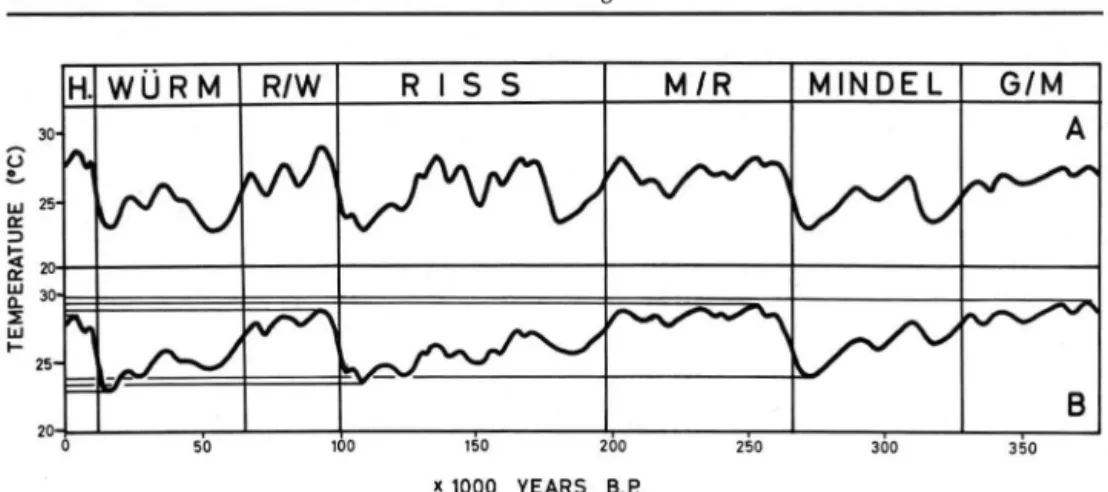
0 5 0 1 00 150 2 0 0 2 5 0 X 1000 YEARS B.R 3 0 0 3 5 0Fig. 2. A possible interpretation of the well-known paleotemperature curve of EMILIANI. Tentative correlation with the terrestrial stratigraphy of the Alps region suggested by the author is not in accord with EMILIANI'S absolute chronology. A. EMILIANI'S paleotemperature curve and time scale (the correlation with the terrestrial stratigraphy is given by the author). B. The amplitude of EMILIANI'S paleotemperature curve and the general trend of a slight over-all decrease of tempera
ture as brought into accord with terrestrial evidence. The time scale is of EMILIANI. In the North Sea Basin there lived representatives of the so-called Lusitanian fauna which comprised several species now living in the Mediterranean and off the coasts of Portugal and France (e. g. Tapes aureus v a r . eemsiensis, Gastrana fragilis, Lucina diva-ricata, Mytilus lineatus, Haminea navicula, Syndesmya ovata, Turritella communis, Eulimella nitidissima). In the Mediterranean Sea there lived some species which to-day do not live in this sea (GARGALLO, 1 9 6 2 ) , or — in the majority of cases — now thrive off the Moroccan coast or even in much lower latitudes (e. g. Strombus bubonius, Conus testudinarius, Mytilus senegalensis, Natica lactea, Bittium Deshayesi, Eastonia rugosa). The molluscan fauna in the Netherlands lived in water with temperatures 2 or 3 ° C. higher than at present (STRAATEN, 1 9 5 6 ) . During the last interglacial age there lived in England and Central Europe a pond tortoise Emys orbicularis indicating a mean J u l y temperature 2 - 3 ° C. higher than to-day (ULLRICH, 1 9 5 6 ) .
To the Riss-Würm interglacial belongs a molluscan fauna from Czechoslovakia (Heli-cigona banatica, Soosia diodonta, Gastrocopta theeli, Aegopis verticillus, Cepaea nemo-ralis, Laciniaria stabilis, Pagodulina pagodula, etc.) which lived in a climate 2 - 3 ° C. warmer than now (PROSEK & LOZEK, 1 9 5 7 ; ZÄRUBA et al., 1 9 6 2 ) , or even 2 - 4 ° C. warmer than to-day (LOZEK & KUKLA, 1 9 6 1 ; LOZEK, 1 9 6 4 ) . The insect fauna from Bobbits Hole, Ipswich, indicate an average J u l y temperature at least 3 ° F. warmer than to-day (COOPE, 1 9 6 5 ) . The "islands" of fossil chernozem found n o w a d a y s in dry localities of Central Europe were steppe islands which developed under a w a r m e r climate than now. From south-west Germany westwards, in France p a r t i c u l a r l y , and also in the Thames valley, the soils of the Riss-Würm interglacial have a colour more reddish than that of ordinary brown-earth. This can only mean that the climate had a tendency towards the Mediter ranean climate (ZEUNER, 1 9 5 9 ) . Paleopedological investigations in south-east Europe gave the same results; about 2 - 3 ° C. higher temperatures than now in the last three inter glacial ages (JARANOFF, 1 9 4 4 ) . This was the effect of summers hotter and drier than at present (MARKOVIC-MARJANOVIC, 1 9 6 4 ) . In the travertines of middle Germany have been found Pinns cf. nigra, Quercus cf. virgiliana; this implies a mean J u l y temperature about 2 - 3 ° C. higher than to-day (VENT, 1 9 5 8 ) . The fossils of Buxus sempervirens, Juglans regia, Thuja occidentalis and Quercus mammuthi in Bilzingsleben implies (WERTH, 1 9 2 5 ) 1 . 5 - 2 ° C. higher mean annual temperature. According to the displacement of the northern
Paleotemperature Changes in the Upper and Middle Pleistocene 135
boundary of Tilia tomentosa, it w a s deduced by RABIEN (1953) that the mean annual temperature at Wallensen was about 3° C. higher than now.
One of the best known units ascribed to the Sangamon is the Toronto formation with the Don beds indicating a mean temperature higher than now b y 2-3° C. ( W A T T , 1954).
The temperature w a s not uniform, but the temperature oscillations cannot compare with those of the glacial ages. In Denmark the w a r m phases II a n d IV are separated b y the subarctic phase III. In the last interglacial age one can trace one, or may be t w o cooler temperature oscillations (ZEUNER, 1959). The temperature oscillations during Riss-Würm interglacial are confirmed in all deep-sea cores, especially in the core 234 (EMILIANI, 1958) which prove the existence of two cool oscillations. Paleopedological investigations in Austria (BRANDTNER, 1956) proved a cool oscillation in the younger half of this interglacial age. Two sea-levels (18 and 7.5 m.) are believed to be in connection with the climatic changes (ZEUNER, 1954). Soil profiles in Czechoslovakia indicate a cool oscillation separating two warm periods (VALOCH, 1959).
The T e m p e r a t u r e of t h e R i s s G l a c i a l
The Riss glacial lasted 72,000 years (110,000-182,000 years B . P . ) . One must suppose that the mechanism of the development of the ice sheets in the northern hemisphere w a s in essence similar to that in the W ü r m glacial. The extent of the Rissian ice sheets leads to the conclusion that the temperature drop must have been of the same order of magni tude as that during the Würm glacial. SHOTTON (1962) estimated the drop of the tempe rature in Britain at 9° C. at least, but he is convinced that it was even greater. The tem perature difference between the Riss and Würm maxima was small a n d discernible only with difficulty.
In the vicinity of Brno ( M o r a v i a ) Rissian loess profiles are subdivided into a few loess and fossil soils (PELI'SEK, 1954). The detailed faunistic analysis revealed that the Rissian loess in Central Europe w a s accumulated in a climate w i t h strong maritime influence, contrary to the Würmian loess which was accumulated in a markedly continen tal climate, i. e. the climate of the Riss glacial was somewhat warmer than the climate of
the W ü r m glacial (LOZEK, 1 9 5 1 ; BRANDTNER, 1956; PROSEK & LOZEK, 1 9 5 7 ) .
The floristic development in the Netherlands indicates a warmer interstadial separa ting Pleniglacial A from Pleniglacial B (FLORSCHÜTZ, 1957). Between the Saale maximum and the Warthe stadial a warm interval was discovered, which w a s named by BRELIE (1955) the "Ohe-interglacial". Three stadials were discovered in the Pacific deep-sea cores (HOUGH, 1953). In the vicinity of Berlin the boring discovered four ground moraines belonging to the Saale glacial (CEPEK, 1961). The areal distribution of the moraines in Poland confirms the existence of three stadials (RÜHLE, 1957). Probably the most detailed microstratigraphic analysis of Rissian accumulation forms was carried on in the vicinity of H a l l e , Germany (SCHULZ, 1962) confirming many periodic advances and retreats of the ice sheet, which in essence were similar to the Würmian pulsations of the North-european Ice Sheet. These pulsations were similar to an older WOLDSTEDT'S (1958b) curve representing the oscillations of the Rissian ice front in Germany.
The T e m p e r a t u r e of t h e M i n d e l - R i s s I n t e r g l a c i a l
Due to its very long duration this interglacial age is called the „Great interglacial". The reason for such long duration of the Mindel-Riss interglacial is given elsewhere (SEGOTA, 1963). We m a y say summarily that the glacial age on the Antarctic Continent about the middle of the great interglacial age had no equivalent in the northern hemi sphere. The thermal influence of the Antarctic glacial age plus the influence of the
ex-panding Greenland ice sheet a n d the sea ice in the North Polar Sea were represented as a relatively slight temperature drop a little after the middle of the great interglacial age.
High temperature of the great interglacial age was established in one Pacific Ocean core (HOUGH, 1953). Calcium carbonate abounds much more in the sediments belonging to the great interglacial age than in the Riss-Würm sediments; this is, probably, the result of warmer water in the great interglacial age than in the Riss-Würm interglacial. Several minor fluctuations are indicated by various shades of colour of the sediments.
The changes of the erosion and accumulation intensity during the great interglacial age in the Thames Valley have been ascribed to climatic oscillations; up to five minor cold phases have been recognized (ZEUNER, 1959).
The Tertiary relics Tsuga, Zelkova, Pterocarya, Carya, imply a slightly higher tem perature in the great interglacial age than in the Riss-Würm interglacial (GAMS, 1954). In some localities are found Buxus sempervirens, Azolla filiculoides, Vitis silvestris, etc. implying high temperatures, at least in certain periods (WOLDSTEDT, 1 9 5 8 b ) . The Cannstatt fossil flora is v e r y similar to the recent Colchic flora and this proves that in the climatic optimum of this interglacial the temperature w a s 2-3° C. higher than to day (BERTSCH, 1927). A fossil flora in the Lublin area with Vitis silvestris implies that the mean annual temperature w a s at least 2° C. higher than now (SOBOLEWSKA, 1954). During the thermal maximum of this interglacial age in Ireland there grow Abies, Picea and Rhododendron, denoting a climate a little warmer than during the w a r m period of the Holocene (WATTS, 1959). The pollen curves of Pinus and Betula in the pollen diagrams from Central Europe denote a cooler phase in the great interglacial age (WOLDSTEDT, 1954). This w a s proved by m a n y paleobotanic investigations in Poland (SRODON, 1954). The high temperature of the Mediterranean Sea water is confirmed by the occurrence of a w a r m fauna (GIGNOUX, 1913) with Strombus bubonius, Mathilda canariensis, Tritonium ficoides, Cardita senegalensis, Mytilus senegalensis, Conus guinaicus, Natica lactea and other species with tropical affinities, which to-day find their northern limit off the Senegal coast or are restricted to the warmest part of the Mediterranean Sea. The shells Lutraria rugosa and Pecten polymorphus, the representatives of the warm Tyrrhenian in Britain, no longer thrive north of Madeira and Portugal (CHARLESWORTH, 1957). Of the same age are the Paludina Beds in the Berlin area with thermophile fresh water molluscs Paludina diluviana etc.
In the vicinity of Prague, chernozem strata are separated by a layer of loess which was precipitated under cool conditions belonging to the great interglacial age. The occurrences of Helix pomatia, Fruticicola fruticum, Celtis sp. in M o r a v i a denote a strong influence of the Mediterranean climate (PROSEK & LOZEK, 1957) with 3-4° C. higher temperature in the thermal maximum than now (LOZEK, 1964). The long duration and high temperature of the great interglacial age were also confirmed by paleopedologic investigations in Yugoslavia. The mean thickness of terra rossa in the Riss-Würm inter glacial in continental Y u g o s l a v i a is about 2 m., but that of the great interglacial age amounts to about 6—7 m. The red colour of the soil belonging to the great interglacial age is much more intense than the colour of the younger terra rossa. Besides this, pedo-genetic processes in the Pannonian Basin were interrupted by two colder phases when the loess w a s accumulated (MARKOVIC-MARJANOVIC, 1964). The colour intensity of the "Neufraer Interglazialboden" in southwest Germany indicates a temperature a few degrees higher than now (SCHÄDEL & WERNER, 1963). The cryoturbation horizon in the Holstein gravel sediments at Edderitz, Germany, is assigned to an influx of cold, and from this possibly follows a bipartition of the great interglacial age into two independent interglacial ages (KNOTH & LENK, 1962).
If our chronology is correct, EMILIANI'S stages 11, 12 and 13 may correspond to the great interglacial age. The long duration of this interglacial age in comparison with the
last interglacial age is clearly evident, as in the Pacific Ocean core (Zmize & KORENEVA, 1 9 5 9 ) where the thickness of the sediments belonging to the great interglacial age amounts to 9 4 5 cm. in comparison with 4 6 0 cm. which is assigned to the last interglacial age. In this section of the EMILIANI curve a little after the middle of the interglacial age one pronounced drop of temperature is cleirly evident, as well as three cool oscillations of much smaller amplitude. This is fairly consistent with the data from the land.
The T e m p e r a t u r e of M i n d e l G l a c i a l
The deepest section of the core A 1 7 2 - 6 w e believe to belong to the Mindel glacial (EMILIANI'S stage 1 4 ) . To the same glacial age belong the stages 1 4 , 1 5 and 1 6 of the core P 6 3 0 4 - 9 (EMILIANI, 1 9 6 6 ) . By means of his generalized temperature curve we reconstructed the paleotemperature of the Mindel glacial. A short analysis of EMILIANI'S generalized temperature curve reveals that this correlation m a y be correct. The Mindel section is of the same order of magnitude as the Riss and W ü r m sections, and consists of three colder stadials separated by two w a r m e r interstadials, exactly by the same me chanism as in all known glacial ages. The areal distribution of the Mindel ice sheets undoubtedly reveals that the temperature drop must have been in essence similar to the temperature drop during the Riss and Würm glacials. The general evolution of the Plei stocene climate leads to the conclusion that the Mindel glacial was a little warmer than the younger glacials, but this is with difficulty discernible. The climatic influence of the Mindel glacial w a s enormous, causing the extinction of many thermophile forms, but some survived in later interglacial ages and were exterminated by the colder younger glacial ages. In Central Europe this is well decumented by SZAFER ( 1 9 6 1 ) . The interbedding of loess and fossil soils in Czechoslovakia is attributed to the climatic oscillations within the Mindel g l a c i a l (PROSEK & LOZEK, 1 9 5 7 ) .
C o n c l u s i o n s
1. Due to the v e r y complex response of organic life to the temperature changes it is not possible to construct the generalized Pleistocene temperature curve solely on the base of the deep-sea cores oxygen isotopic measurements.
2 . Interglacial temperature maxima and glacial minima have not reached the same values repeatedly.
3. Throughout the Quaternary Period a slight over-all decrease of the temperature is clearly discernible. This trend continues a trend evident in Pliocene and earlier times.
4 . The duration of the glacial and interglacial ages respectively were different and it is not possible to discern any periodicity or temperature cycles.
5. The temperature curves of all glacial ages are in essence similar; maximum drop of the temperature was attained in the later part of their duration. The temperature curves of all glacial ages are asymmetrical.
6 . The chronology affirms the theory of a "long Pleistocene", thus avoiding EMILIANI'S gap between Günz glacial and the very old K - A r dates for Villafranchian time.
R e f e r e n c e s cited
BERTSCH, K.: Die diluviale Flora des Cannstätter Sauerwasserkalks. Z. Botanik, 19, 641-659, 1927. BLACK, R . F.: Periglacial phenomena of Wisconsin, north-central United States. VIth Int. Con
gress INQUA Warszawa 1961, 4, 21-28, Lodz 1964.
BRANDTNER, F.: Lößstratigraphie und paläolithische Kulturabfolge in Niederösterreich und in den angrenzenden Gebieten. Eiszeitalt. u. Gegenw., 7, 127-175, 1956.
BRELIE, G. VON DER: Die pollenstratigraphische Gliederung des Pleistozäns in Nordwestdeutsch land. 2. Eiszeitalt. u. Gegenw., 6, 25-38, 1955.
Paleotemperature Changes in the Upper and Middle Pleistocene 139
BROECKER, W. S., TUREKIAN, K. K. & HEEZEN, B. C.: The relation of deep-sea sedimentation rates to variations in climate. Am. Journ. Sei., 256, 503-517, 1958.
BÜDEL, J . : Die Gliederung der Würmkaltzeit. Würzburger geogr. Arb., 8, 44 p., 1960.
CEPEK, A.: Grundmoränenstratigraphie im Quartär Brandenburgs und ihre Bedeutung für das norddeutsche Vereisungsgebiet. Geologie 10, 720-722, 1961.
CHARLESWORTH, J . K.: The Quaternary Era 1, 2. 1700 p., London 1957.
COOPE, G. R.: A Pleistocene coleopterous fauna with Arctic affinities from Fladbury, Worcester shire. Quart. J . Geol. Soc, 118, p. 103-117, London 1962. - - Fossil insect faunas from Late Quaternary deposits in Britain. Advanc. Sei., 21, 564-575, 1965.
COOPE, G. R,- SHOTTON, F. W. & STRACHAN, I.: A Late Pleistocene fauna and flora from Upton Warren, Worchestershire. Philos. Trans. Roy. Soc. London, B, 244, no. 714, 379-421. 1961.
DEEVEY, E. S. & FLINT, R. F.: Postglacial Hypsithermal Interval. Science, 125, 182-184. 1957. DILLON, L. S.: Wisconsin climate and life zones in North America. Science 123, 167-176, 1956. DUBOIS, A. & STEHLIN, H. G.: La grotte de Cotencher, station mousterienne. Mem. Soc. paleont.
Suisse 11,53, Basle 1933.
DYLIK, J . : Sur les changements climatiques pendant la derniere periode froide. Vlth Int. Congress INQUA Warszawa 1961, 4, 55-66. Lodz 1964.
EMILIANI, C : Pleistocene temperatures. J . Geol., 63, 538-578, ^S'Sa. - - Pleistocene temperature variations in the Mediterranean. Quarternaria, 2, 87-98, 1955b. - - Note on absolute chronology of human evolution. Science, 123, 924-926, 1956a. - - Paleotemperature ana lysis of core 280 and Pleistocene correlations. J . Geol., 66, 264-275, 1958. - - Cenozoic climatic changes as indicated by the stratigraphy and chronology of deep-sea cores of Globigerina-ooze facies. N.York Acad. Sei. Ann., 95, 521-536, 1961. - - Paleotempera ture analysis of the Caribbean cores A2'54-BR-C and CP-28. Geol. Soc. Amer. Bull., 75, 129-144, 1964. - - Paleotemperature analysis of Caribbean cores P 6304-8 and P 6304-9 and a generalized temperature curve for the past 425,000 years. J . Geol., 74, 109-126, 1966.
FIRBAS, F.: Uber die späteiszeitliche Verschiebung der Waldgrenze. Naturwissenschaften, 34, 114-118, 1947. - - Spät- und nacheiszeitliche Waldgeschichte Mitteleuropas nördlich der Alpen. 1., 480 p., Jena 1949.
FLINT, R. F.: Glacial and Pleistocene geology. N.York, 553 p., 1957. - - Status of the Pleistocene Wisconsin stage in Central North America. Science 139, 402-404, 1963.
FLOHN, H.: Studien über die atmosphärische Zirkulation in der letzten Eiszeit. Erdkd., 7, 266-275, 1953.
FLORSCHÜTZ, F.: The subdivisions of the Middle and Young Pleistocene up to the Late-glacial in the Netherlands, England and Germany. Geol. en Mijnb., 19, 245-250, 1957.
GAMS, H.: Neue Beiträge zur Vegetations- und Klimageschichte der nord- und mitteleuropäischen Interglaziale. Experientia, 10, 357-363, 1954.
GARGALLO, G.: Reperti malacologici del piano tirreniano nel canale Mussolini. Quaternaria, 5, 241-256, 1962.
GIGNOUX, M.: Les formations marines pliocenes et quaternaires de lTtalie du Sud et de la Sicile. Ann. Univ. Lyon, 36, 1913.
GROSS, H.: Das Mittelwürm in Mitteleuropa und angrenzenden Gebieten. Eiszeitalt. u. Gegenw., 15, 187-198, 1964.
HAFSTEN, U.: A standard pollen diagram for the Southern High Plains, USA. Vlth Int. Congress INQUA Warszawa 1961, 2, 407-420, Lodz 1964.
HARING, A., DE VRIES, A. E. & DE VRIES, H.: Radiocarbon dating up to 70,000 years by isotopic enrichment. Science, 128, 472-473, 1958.
HOUGH, J . : Pleistocene climatic record in a Pacific Ocean core sample. J . Geol., 61, 252-262, 1953. IVERSEN, J . : The late glacial flora of Denmark and its relation to climate and soil. Danm. Geol.
Unders. 2, 80, 87-119, 1954.
JARANOFF, D.: Das Klima des Mittelmeergebietes während des Pliozäns und des Quartärs. Geol. Rdsch.,34, 434-446, 1944.
JESSEN, K. & MILTHERS, V.: Stratigraphical and palaeontological studies of the interglacial fresh water deposits in Jutland and northwest Germany. Danm. geol. Unders. 2, 48, 379 p., 1928.
KAISER, K.: Klimazeugen des periglazialen Dauerfrostbodens in Mittel- und Westeuropa. Eiszeit alt, u. Gegenw., 11, 121-141, 1960.
KERNEY, M. P., BROWN, E. H. & CHANDLER, T. J . : The Late-glacial and Post-glacial history of the chalk escarpment near Brook, Kent. Philos. Trans. Roy. Soc. London, B, 248, no. 745, 135-204, 1964.
KOPP, K.-O.: Schneegrenze und Klima der Würmeiszeit der baskischen Küste. Eiszeitalt. u. Ge genw., 14, 188-207, 1963.
KNOTH, W. & LENK, G.: Das Pleistozänprofil des ehemaligen Tagebaues Edderitz im Kreis Ko then. Geologie, 11, 1149-1163, 1962.
KRETZOI, M.: Stratigraphie und Chronologie. Vlth Int. Congress INQUA Warszawa 1961, 1, 313-332, Warszawa 1961.
LIEBEROTH, I.: Die Stratigraphie der sächsischen Lösse. Ein Beitrag zur Würmchronologie. Vlth Int. Congress INQUA Warszawa 1961, 4, 491-501, Lodz 1964.
LOZEK, V.: Survey of the Molluscan fauna of the Quaternary sediments in Czechoslovakia on the basis of recent explorations. Sborn. Üstf. üst. geol., 18, 1-20, 1951. - - Quartärmollusken der Tschechoslowakei. Rozpr. Üstf. üst. geol., 31, 374 p., Prag 1964.
LOZEK, V. & KUKLA, J . : Outline of the stratigraphy of the Czechoslovak Quaternary. Vlth Int. Congress INQUA Warszawa, 1, 155-170, 1961.
MANLEY, G.: The range of variation of the British climate. Geogr. J . , 117, 43-68, 1951.
MARKOV, K. K.: Die Typen der geographischen Regionen der Erde und die wichtigsten Züge ihrer Entwicklung im Quartär. Peterm. geogr. Mitt., 109, 15-17, 1965.
MARKOVIC-MARJANOVIC, J . : Le loess en Yougoslavie. Vlth Int. Congress INQUA Warszawa 1961, 4, 551-570, Lodz 1964.
MORTENSEN, H.: Heutiger Firnrückgang und Eiszeitklima. Erdkd., 6, 14"5-160, 1952.
OLAUSSON, E.: Evidence of climatic changes in North Atlantic deep-sea cores, in SEARS, M. (ed.): Progress in oceanography. V. 3, 221-252, Oxford 1965.
PANOV, D. G.: Paleotemperature conditions and paleoclimatic regionalization of Europe in the latest glaciation epoch. Izv. Vses. geogr. obsch., 96, 480-487, 1964 (in Russian). PECSI, M.: Die periglazialen Erscheinungen in Ungarn. Peterm. geogr. Mitt., 107, 161-182, 1963. PELISEK, J . : The Quaternary of the eastern vicinity of Brno. Anthropoz., 3, 7-28, 1954.
PENCK, A. & BRÜCKNER, E.: Die Alpen im Eiszeitalter. 1199 p., Leipzig 1909.
PIDOPLITSHKO, I. G.: Brief summary of the study of vertebrates from the Anthropogen (Quater nary) deposits of the Ukrainian SSR. Chetv. period, 13-15, p. 261-267, Kiev 1961 (in Russian with English summary).
DE PLOEY, J . : Morfologie en Kwartair-Stratigrafie van de Antwerpse Noorderkempen. Acta geogr. Lovaniensia, 1, 130 p., Leuven 1961.
POSER, H.: Auftautiefe und Frostzerrung im Boden Mitteleuropas während der Würm-Eiszeit. Naturwissenschaften, 34, 232-238, 262-267, 1947.
PROSEK, F. & LOZEK, V.: Stratigraphische Übersicht des tschechoslowakischen Quartärs. Eiszeitalt. u. Gegenw., 8, 37-90, 1957.
RABIEN, I.: Die Vegetationsentwicklung des Interglazials von Wallensen in der Hilsmulde. Eis zeitalt, u. Gegenw., 3, 1953.
RICHMOND, G. M.: Method for computing departures from present mean annual free-air tempera ture during Quaternary glacial and soil-forming maxima in the Rocky Mountains region. Abstr. Geol. Soc. Amer. Bull., 64, 1465-1466, 1953.
ROSHOLT, J . N., EMILIANI, C , GEISS, J., KOCZY, F. F. & WANGERSKY, P. J . : Absolute dating of deep-sea cores by the Pa231/Th230 method. J . Geol., 69, 162-185, 1961. - - !)sgt]X/l8EEd
dating a n d 018/016 temperature analysis of core A254-BR-C. J . Geophys. Res., 67, 2907-2911, 1962.
RÜHLE, E.: Map of Quaternary deposits in Poland. Quatern. Research in Poland, 8, 489-523, 1957.
SCHÄDEL, K. & WERNER, J . : Neue Gesichtspunkte zur Stratigraphie des mittleren und älteren Pleistozäns im Rheingletschergebiet. Eiszeitalt. u. Gegenw., 14, 5-26, 1963.
SCHULZ, W.: Gliederung des Pleistozäns in der Umgebung von Halle. Geologie, Beih., 36, 69 p., 1962.
SCHWARZBACH, M.: Das Klima der Vorzeit. 2. Aufl., 275 p., Stuttgart 1961.
SHOTTON, F. W.: The physical background of Britain in the Pleistocene. Advanc. Sei., 19, 193-206, 1962.
SOBOLEWSKA, M.: Vitis silvestris GMEL. in the Polish Pleistocene. Quatern. Research in Poland, 5, 159-164, 1954.
SRODON, A.: Pleistocene floras from Tarzymiechy on the river Wieprz. Quatern. Reserarch in Po land, 5, 5-55, 1954.
STRAATEN, L. VAN: Composition of shell beds formed in tidal flat environment in the Netherlands and in the Bay of Arcachon. Geol. en Mijnb., 18, 209-226, 1956.
SUESS, H. E.: Absolute chronology of the Last Glaciation. Science, 123, 355-357, 1956. Szafer, W.: Miocene flora from Stare Gliwice im Silesia. Inst. Geol., Prace, 33, 20$ p., 1961. SEGOTA, T.: Absolute chronology of the Quaternary Period. Bull. Sei., Conseil Acad. R.P.F.
Yougoslavie, 6, 39-40, 1961. - - Geographical background to ice ages. Radovi Geogr. inst. Zagreb, 4, 119 p., 1963. - - Quaternary temperature changes in Central Europe. Erdk., 20, 110-118, 1966.
Paleotemperature Changes in the Upper and Middle Pleistocene 141
TERASMAE, J . : Notes on Late-Quaternary climatic changes. N.York Acad. Sei. Ann., 95, 658-675, 1961.
ULLRICH, H.: Fossile Sumpfschildkröten (Emys orbicularis L.) aus dem Diluvialtravertin von Wei-mar-Ehringsdorf-Taubach und Tonna (Thür.). Geologie, 5, 360, 1956.
VALOCH, K.: Lösse und paläolithische Kulturen in der Tschechoslowakei. Quartär, 10/11, 115-149, 1959.
VENT, W . : Die Pflanzenwelt der Ilmtravertine von Weimar-Ehringsdorf zur Unstrutwarmzeit. Alt-Thüringen, 3, 15-28, 1958.
WASYLIKOWA, K . : Pollen analysis of the Late-glacial sediments in Witow near Leczyca, Middle Poland. Vlth Int. Congress INQUA Warszawa 1961, 2, 497-502, Lodz 1964.
WATT, A. K . : Correlation of the Pleistocene geology as seen in the subway with that of the Toronto region, Canada. Geol. Assoc. Canada Proc, 6, 69-81, 1954.
WATTS, W . A.: Interglacial deposits at Kilbeg and Newtown, Co. Waterford. Proc. Roy. Irish Acad., B 2, 60, 79-134, 1959.
WEISCHET, W . : Die gegenwärtige Kenntnis vom Klima in Mitteleuropa beim Maximum der letz ten Vereisung. Mitt. geogr. Ges. München, 39, 1954.
WERTH, E.: Die pflanzenführenden Diluvial-Ablagerungen der thüringisch-sächsischen Bucht und ihre pflanzengeschichtliche und klimatologische Bedeutung. Ber. Dtsch. Bot. Ges., 43, 391-399, 1925.
WILLIAMS, R. B. G.: Permafrost in England during the Last Glacial Period. Nature, 205, 1304-1305, 1965.
WOLDSTEDT, P.: Das Eiszeitalter. 1, 374 p., Stuttgart 1954. - - Eine neue Kurve der Würm-Eiszeit. Eiszeitalt. u. Gegenw., 9, 151-154, 1958a. - - Das Eiszeitalter. 2, 438 p., Stuttgart 1958b - - Uber die Gliederung des Quartärs und Pleistozäns. Eiszeitalt. u. Gegenw., 13 115-124, 1962.
ZÄRUBA, Q., KUKLA, J . & LOZEK, V.: Die altpleistozänen Ablagerungen in Zalov bei Prag. Anthropoz. 10, 135-162, 1962.
ZEUNER, F. E.: Riss or Wurm? Eiszeitalt. u. Gegenw., 4-5, 98-104, 1954. - - The Pleistocene Period. 447 p., 1959.
ZHUZE, A. P. & KORENEVA, E. A.: On the paleogeography of the Okhotsk Sea. Izv. Akad. nauk SSSR, ser. geogr., 2, 12-24, 1959 (in Russian).
Manuskr. eingeg. 5. 3. 1967. Anschr. d. Verf.: Docent Dr. Tomislav Segota, Geogr. Inst., Marulicev trg 19, Zagreb (Jugoslavia).