
680 ISSN: 2278 – 7798 All Rights Reserved © 2016 IJSETR
SQUARE DIFFERENCE 3-EQUITABLE LABELING
FOR SOME GRAPHS
R. Loheswari
1and S. Saravana kumar
21
Research Scholar, Department of Mathematics, Sri S.R.N.M. College,
Sattur-626 203, TN, India.
2
Department of Mathematics, Sri S.R.N.M. College,
Sattur-626 203, TN, India.
Abstract
:A square difference 3-equitable labeling of a graph G with vertex set V is a bijection f from V to {1, 2, ..., | V |} such that if each edge uv is assigned the label −1 if | [f(u)]2 − [f(v)2] |≡ −1(mod 4), the label 0 if | [f(u)]2 − [f(v)]2 |≡ 0(mod 4) and the label 1 if | [f(u)]2 − [f(v)]2
|≡ 1(mod 4), then the number of edges labeled with i and the number of edges labeled with j differ by atmost 1 for −1 ≤ i, j ≤ 1. If a graph has a square difference 3-equitable labeling, then it is called square difference 3-equitable graph. In this paper, we investigate the square difference 3-equitable labeling behaviour of comb, triangular snake, crown, star, wheel.
Keywords: Square difference 3-equitable
labeling, square difference 3-equitable graphs.
AMS Subject Classification (2010): 05C78.
1 INTRODUCTION
All graphs considered here are finite, simple and undirected. Gallian has given a dynamic survey of labeling [1]. For graph and theoretic terminologies and notations we follow Harary [2]. The concept of 3-equitable labeling was introduced by S.K. Vaidya and N.H. Shah in the year 2012[7] . A ternary vertex labeling of a graph G is called a 3-equitable labeling if | vf (i) − vf
(j) |≤ 1 and | ef (i) − ef (j) |≤ 1 for all −1 ≤ i, j
≤ 1. A graph G is equitable if it admits 3-equitable labeling. The concept of square difference labeling was introduced by J. Shiama in the year of 2012 and 2013[3, 4, 5, 6]. The concept of square difference 3-equitable labeling of pahs and cycle was introduced by S. Murugesan and J. Shiama in the year of 2015[8].
2 PRELIMINARIES
Definition 2.1. Let G = (V, E) be a graph. A
mapping f : V (G) → {−1, 0, 1} is called ternary vertex v of G and f(v) is called the label of the vertex v of G under f.
For an edge e = uv, he induced edge labeling is given by f* : E(G) →{−1, 0, 1}. Let vf
(−1), vf (0), vf (1) be the number of vertices
of G having labels −1, 0, 1 respectively under f and ef (−1), ef (0), ef (1) be the
number of edges having labels −1, 0, 1 respectively under f*.
Definition 2.2. A ternary vertex labeling of
a graph G is called a 3-equitable labeling if | vf (i) − vf (j) |≤ 1 and | ef (i) − ef (j) |≤ 1
for all −1 ≤ i, j ≤ 1. A graph G is 3-equitable if it admits 3-equitable labeling.
Definition 2.3. A square difference
3-equitable labeling of a graph G wih vertex set V (G) is a bijection f : V (G) → {1, 2, 3, ..., | V |} such that the induced edge labeling f*: E(G) → {−1, 0, 1} is defined by
681 ISSN: 2278 – 7798 All Rights Reserved © 2016 IJSETR
f*(e=uv) = −1 | [f(u)]2 − [f(v)]2 | ≡ −1(mod 4) 0 | [f(u)]2 − [f(v)]2 | ≡ 0(mod 4) 1 | [f(u)]2 − [f(v)]2 | ≡ 1(mod 4)
Definition 2.4. The corona G1ʘG2 of two
graphs G1 and G2 is defined as the graph G
obtained by taking one copy of G1 (which
has p1 points) and p1 copies of G2 and then
joining the ith copy of G1 to every point in
the ith copy of G2.The graph Pn ʘ K1 is
called a comb.
Definition 2.5. A Triangular Snake is
obtained from a path v1, v2, ...vn joining vi
and vi+1 to a new vertex wi for 1 ≤ i ≤ n − 1.
That is, every edge of a path is replaced by a triangle C3.
Definition 2.6. Cn+ is a graph obtained from
G by attaching a pendent vertex from each vertex of the graph Cn is called Crown.
Definition 2.7. The graph K1,r, r ≥ 1 is called
a star at the vertex has degree r is called center.
Definition 2.8. A graph Cn+K1 is called a
wheel with n spokes and is denoted by Wn.
3 MAIN RESULTS
Theorem 3.1. The comb Pn+ admits square
difference 3-equitable labeling.
Proof. Let G be a comb obtained from a path Pn = v1, v2, ..., vn by joining a vertex ui to vi.
The labeling of P1+ and P2+ are given as
follows.
If n ≥ 3, we consider the following cases.
Case-1: n≡ 1(mod 6) Define f(v1) = 2 f(v2) = 3 f(v3) = 1 f(v4) = 4, for 1 ≤ i ≤ 𝑛−7 6 , f(v6i−1) = 6i + 1 f(v6i) = 6i − 1 f(v6i+1) = 6i f(v6i+2) = 6i + 2 f(v6i+3) = 6i + 3 f(v6i+4) = 6i + 4 and f(vn−2) = n f(vn−1) = n − 2 f(vn) = n − 1. Then | [f(v1)]2 − [f(v2]2 |≡ 1(mod4) ) ⇒ f(v1v2) =1 | [f(v2)]2 − [f(v3]2 |≡ 0(mod4) ) ⇒f(v2v3) = 0 |[f(v3)]2 − [f(v4]2 |≡ −1(mod4) ⇒ f(v3v4)= −1, for 1 ≤ i ≤ 𝑛−7 6 ,
|[f(v6i−2]2−[f(v6i−1)]2|≡1(mod4)
⇒f*(v6i−v6i−1) = 1
|[f(v6i−1]2−[f(v6i)]2 |≡ 0(mod4)
⇒ f*(v6i-1v6i) = 0
|[f(v6i]2−[f(v6i+1)]2|≡−1(mod4)
⇒ f*(v6iv6i+1) = −1
|[f(v6i+1]2−[f(v6i+2)]2≡0(mod4)
⇒f*(v6i+1v6i+2) = 0
|[f(v6i+2)]2−[f(v6i+3)]2≡1(mod4)
⇒f*(v6i+2v6i+3) = 1
|[f(v6i+3)]2−[f(v6i+4)]2≡−1(mod4)
⇒f*(v6i+3v6i+4) = −1 and |[f(vn−3)]2−[f(vn−2]2|≡1(mod4) ⇒f*(vn−3vn−2) = 1 |[f(vn−2)]2−[f(vn−1]2|≡0(mod4) ⇒f*(vn−2vn−1)=0 |[f(vn−1)]2−[f(vn)]2 |≡ −1(mod4) ⇒f*(vn−1vn) = −1. f(uj) = n + j, 1 ≤ j ≤ 5
682 ISSN: 2278 – 7798 All Rights Reserved © 2016 IJSETR
f(uj) = 𝑛 + 𝑗 + 1 𝑗 ≡ 0(𝑚𝑜𝑑 3) 𝑛 + 𝑗 − 1 𝑗 ≡ 1(𝑚𝑜𝑑 3) 𝑛 + 𝑗 𝑗 ≡ 2(𝑚𝑜𝑑 3) , 6≤ j ≤ n Then ef (−1) = 2𝑛 +1 3 and ef (0) = ef (1) = 2𝑛 −1 3 . Case-2: n ≡ 2(mod6) Define f(v1) = 2 f(v2) = 3 f(v3) = 1 f(v4) = 4, for 1 ≤ i ≤ 𝑛−8 6 , f(v6i−1) = 6i + 1 f(v6i) = 6i − 1 f(v6i+1) = 6i f(v6i+2) = 6i + 2 f(v6i+3) = 6i + 3 f(v6i+4) = 6i + 4 and f(vn−3) = n − 1 f(vn−2) = n − 3 f(vn−1) = n − 2 f(vn) = n f(uj) = 𝑛 + 𝑗 𝑗 ≡ 0, 1, 2, 5(𝑚𝑜𝑑 6) 𝑛 + 𝑗 + 1 𝑗 ≡ 3(𝑚𝑜𝑑 6) 𝑛 + 𝑗 − 1 𝑗 ≡ 4(𝑚𝑜𝑑 6) Then ef (−1) = ef (0) = ef (1) = 2𝑛 −1 3 . Case-3: n ≡ 3(mod6) Define f(v1) = 2 f(v2) = 3 f(v3) = 1 f(v4) = 4, for 1 ≤ i ≤𝑛 −9 6 , f(v6i−1) = 6i + 1 f(v6i) = 6i − 1 f(v6i+1) = 6i f(v6i+2) = 6i + 2 f(v6i+3) = 6i + 3 f(v6i+4) = 6i + 4. and f(vn−4) = n − 2 f(vn−3) = n − 4 f(vn−2) = n − 3 f(vn−1) = n − 1 f(vn) = n. f(uj) = 𝑛 + 𝑗 + 1 𝑛 + 𝑗 − 1 𝑓𝑜𝑟 𝑗 = 1, 2 f(uj) = n + j, 3 ≤ j ≤ n. Then ef (−1) = ef (1) = 2𝑛 3 and ef (0) = 2𝑛 −1 4 . Case-4: n ≡ 4(mod6) Define f(v1) = 2 f(v2) = 3 f(v3) = 1 f(v4) = 4, for 1 ≤ i ≤ 𝑛−4 6 , f(v6i−1) = 6i + 1 f(v6i) = 6i − 1 f(v6i+1) = 6i f(v6i+2) = 6i + 2 f(v6i+3) = 6i + 3 f(v6i+4) = 6i + 4. and f(uj) = 𝑛 + 𝑗 𝑗 ≡ 0, 1, 4, 5(𝑚𝑜𝑑 6) 𝑛 + 𝑗 + 1 𝑗 ≡ 2(𝑚𝑜𝑑 6) 𝑛 + 𝑗 − 1 𝑗 ≡ 3(𝑚𝑜𝑑 6) Then ef (−1) = ef (1) = 2𝑛 −1 3 and ef (0) = 2𝑛 +1 3 . Case-5: n ≡ 5(mod6) Define f(v1) = 2 f(v2) = 3 f(v3) = 1 f(v4) = 4, for 1 ≤ i ≤ 𝑛−5 6 , f(v6i−1) = 6i + 1 f(v6i) = 6i − 1 f(v6i+1) = 6i f(v6i+2) = 6i + 2 f(v6i+3) = 6i + 3 f(v6i+4) = 6i + 4. and f(vn) = n and
683 ISSN: 2278 – 7798 All Rights Reserved © 2016 IJSETR
f(uj) = n + j, 1 ≤ j ≤ n Then ef (−1) = ef (0) = ef (1) = 2𝑛 3 . Case-6: n≡ 0(mod6) Define f(v1) = 2 f(v2) = 3 f(v3) = 1 f(v4) = 4, f(vi) = i, 5 ≤ i ≤ n and f(uj) = 𝑛 + 𝑗 𝑗 ≡ 1,2,3,4(𝑚𝑜𝑑 6) 𝑛 + 𝑗 + 1 𝑗 ≡ 5(𝑚𝑜𝑑 6) 𝑛 + 𝑗 − 1 𝑗 ≡ 0(𝑚𝑜𝑑 6) Then ef (−1), ef (0), ef (1) ∈ 2𝑛 −1 3 , 2𝑛 +1 3 .
Thus in all cases , | ef (i) − ef (j) |≤ 1 for all
−1 ≤ i, j ≤ 1 and therefore Pn+ is a square
difference 3-equitable labeling graph.
Illustration 1. The Square difference
3-equitable labeling of P12+ is shown below.
Theorem 3.2. The Triangular Snake Tn
admits a square difference 3-equitable labeling.
Proof. Let Tn be a path v1, v2, ..., vn joining
vi and vi+1 to a new vertex wi.
Define f(vi) = i, 1 ≤ i ≤ n and f(wi) = n + i,
1 ≤ i ≤ n − 1.
ef (−1) = ef (1) = n − 1 and ef (0) = n − 2.
Thus | ef (i) − ef (j) |≤ 1 for all −1 ≤ i, j ≤ 1
and therefore Tn is a square difference
3-equitable labeling.
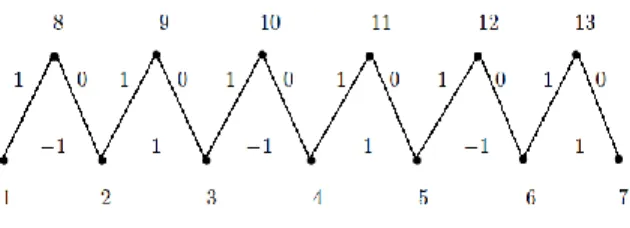
Illustration 2. The Square difference
3-equitable labeling of T7 is shown below.
Theorem 3.3. The Crown Cn+ admits a
square difference 3-equitable labeling except n ≡ 3(mod6).
Proof. Let v1v2v3...vnv1 be the cycle Cn.
Let ui be the vertex which is adjacent to vi,
1≤ i ≤ n. Case-1: n ≡ 1(mod6) Define f(v1) = 2 f(v2) = 3 f(v3) = 1 f(v4) = 4 for1 ≤ i ≤ 𝑛 −7 6 , f(v6i−1) = 6i + 1 f(v6i) = 6i − 1 f(v6i+1) = 6i f(v6i+2) = 6i + 2 f(v6i+3) = 6i + 3 f(v6i+4) = 6i + 4 and f(vn−2) = n f(vn−1) = n − 2 f(vn) = n − 1 and f(v1u1) = 2n f(v2u2) = n + i − 1 f(viui) = 𝑛 + 𝑖 𝑛 + 𝑖 − 2 3≤ i ≤ n − 1 f(vnun) = n + i − 1 Then ef (−1), ef (0), ef (1) ∈ 2𝑛 3 , 2𝑛 3 . Case-2: n ≡ 2(mod6) Define f(v1) = 2 f(v2) = 1 f(v3) = 4 f(v4) = 5
684 ISSN: 2278 – 7798 All Rights Reserved © 2016 IJSETR
f(v5) = 3 for1 ≤ i ≤ 𝑛 −8 6 , f(v6i) = 6i + 2 f(v6i+1) = 6i f(v6i+2) = 6i + 1 f(v6i+3) = 6i + 3 f(v6i+4) = 6i + 4 f(v6i+5) = 6i + 5 and f(vn−2) = n f(vn−1) = n − 2 f(vn) = n − 1 and f(v1u1) = 2n f(viui) = 𝑛 + 𝑖 − 1 𝑖 ≡ 4, 5(mod 6) 𝑛 + 𝑖 𝑖 ≡ 0, 2(mod 6) 𝑛 + 𝑖 − 2 𝑖 ≡ 1, 3(mod 6) f(vnun) = n + i − 1 Then ef (−1), ef (0), ef (1) ∈ 2𝑛 3 , 2𝑛 3 . Case-3: n ≡ 4(mod6) Define f(v1) = 2 f(v2) = 3 f(v3) = 1 f(v4) = 4 for 1 ≤ i ≤ 𝑛−4 6 , f(v6i−1) = 6i + 1 f(v6i) = 6i − 1 f(v6i+1) = 6i f(v6i+2) = 6i + 2 f(v6i+3) = 6i + 3 f(v6i+4) = 6i + 4 and f(viui) = 𝑛 + 𝑖 𝑖 ≡ 0, 1, 2, 5(𝑚𝑜𝑑 6) 𝑛 + 𝑖 + 1 𝑖 ≡ 3(𝑚𝑜𝑑 6) 𝑛 + 𝑖 − 1 𝑖 ≡ 4(𝑚𝑜𝑑 6) Then ef (−1), ef (0), ef (1) ∈ 2𝑛 3 , 2𝑛 3 . Case-4: n ≡ 5(mod6) Define f(v1) = 2 f(v2) = 1 f(v3) = 4 f(v4) = 5 f(v5) = 3 for1 ≤ i ≤ 𝑛−5 6 , f(v6i) = 6i + 2 f(v6i+1) = 6i f(v6i+2) = 6i + 1 f(v6i+3) = 6i + 3 f(v6i+4) = 6i + 4 f(v6i+5) = 6i + 5 and f(v1u1) = 2n f(vnun) = n + 2 f(viui) = 𝑛 + 𝑖 − 1 𝑖 ≡ 2, 4(𝑚𝑜𝑑 6) 𝑛 + 𝑖 𝑖 ≡ 0, 5(𝑚𝑜𝑑 6) 𝑛 + 𝑖 + 1 𝑖 ≡ 1, 3(𝑚𝑜𝑑 6) Then ef (−1), ef (0), ef (1) ∈ 2𝑛 3 , 2𝑛 3 . . Case-5: n ≡ 0(mod6) Define f(v1) = 2 f(v2) = 3 f(v3) = 5 f(v4) = 4 f(v5) = 1 f(v6) = 6 for 1 ≤ i ≤ 𝑛−6 6 f(v6i+1) = 6i + 3 f(v6i+2) = 6i + 1 f(v6i+3) = 6i + 2 f(v6i+4) = 6i + 4 f(v6i+5) = 6i + 5 f(v6i+6) = 6i + 6 and f(viui) = 𝑛 + 𝑖 𝑖 ≡ 1, 2, 3, 4(𝑚𝑜𝑑 6) 𝑛 + 𝑖 + 1 𝑖 ≡ 5(𝑚𝑜𝑑 6) 𝑛 + 𝑖 − 1 𝑖 ≡ 0(𝑚𝑜𝑑 6) Then ef (−1), ef (0), ef (1) ∈ 2𝑛 3 , 2𝑛 3 .
Thus in above cases, |ef (i) − ef (j)|≤ 1 for all
−1 ≤ i, j ≤ 1 and therefore Cn is a square
difference 3-equitable labeling graph.
Case-6: n ≡ 3(mod6)
We see that |ef (i) − ef (j)|=0 or 1 but
685 ISSN: 2278 – 7798 All Rights Reserved © 2016 IJSETR
Thus Cn+ is not square difference 3-equitable
labeling.
Hence Cn+ is square difference 3-equitable
labeling except n ≡ 3(mod6).
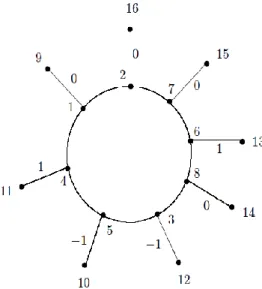
Illustration 3. The square difference
3-equitable labeling of C8+ is shown below.
Theorem 3.4. The Star graph K1,n is not
square difference 3-equitable labeling for n ≥ 9 except n = 10.
Proof. Let v be the central vertex and
let v1, v2, ..., vn be the end vertices of the star
K1,n.
Case-(1) : n = 1, 2, 3
The square difference 3-equitable labeling of K1,1 ,K1,2 and K1,3 are given as follows.
Case-(2) : 4 ≤ n ≤ 8 and n = 10
Assign the label 4 to the vertex v and the remaining labels to the vertices v1, v2, ..., vn.
We see that |ef (i) − ef (j)| ≤ 1 for all
−1 ≤ i, j ≤ 1.
Case-(3) : n = 9
We see that |ef (−1) − ef (0)|=2 and hence
K1,9 is not square difference 3-equitable
labeling.
Case-(4) : n ≥ 11
We see that |ef (−1) − ef (0)| ≥ 3.
Thus K1,n is not square difference
3-equitable labeling for n ≥ 9 except n = 10.
Illustration 4. The square difference
3-equitable labeling of K1,8 is shown below.
Theorem 3.5. The wheel graph Wn admits a
square difference 3-equitable labeling if n ≡ 1, 2(mod6).
Proof. Let Wn = Cn + K1.
Let Cn be a cycle u1, u2, ..., un, u1 and
V (K1) = {u}.
If n ≥ 5, we consider the following cases.
Case-(1) : n ≡ 1(mod6) Define f(u1) = 1 f(u2) = 3 f(u3) = 2 f(u4) = 5 for1 ≤ i ≤ 𝑛 −7 6 , Subcase-(i): i is odd f(u6i−1) = 6i − 2 f(u6i) = 6i + 1 f(u6i+1) = 6i f(u6i+2) = 6i + 2 f(u6i+3) = 6i + 5
686 ISSN: 2278 – 7798 All Rights Reserved © 2016 IJSETR
f(u6i+4) = 6i + 3 Subcase-(ii): i is even f(u6i−1) = 6i − 2 f(u6i) = 6i + 1 f(u6i+1) = 6i f(u6i+2) = 6i + 4 f(u6i+3) = 6i + 2 f(u6i+4) = 6i + 3 and f(un−2) = n − 3 f(un−1) = n f(un) = n − 1 and f(u) = n + 1 Then ef (−1), ef (0), ef (1) ∈ 2𝑛 3 , 2𝑛 3 . Case-(2) : n ≡ 2(mod6) Subcase-(i) : n = 8 Define f(u1) = 2 f(u2) = 3 f(u3) = 1 f(u4) = 4 f(u5) = 7 and f(un−2) = n − 3 f(un−1) = n − 2 f(un) = n + 1 Subcase-(ii) : n > 8 f(u1) = 2 f(u2) = 1 f(u3) = 3 f(u4) = 4 f(u5) = 7 for 1 ≤ i ≤ 𝑛−8 6 , Subcase-(a) : i is odd f(u6i) = 6i − 1 f(u6i+1) = 6i f(u6i+2) = 6i + 3 f(u6i+3) = 6i + 4 f(u6i+4) = 6i + 8 f(u6i+5) = 6i + 7 Subcase-(b):i is even f(u6i) = 6i − 1 f(u6i+1) = 6i f(u6i+2) = 6i + 3 f(u6i+3) = 6i + 4 f(u6i+4) = 6i + 7 f(u6i+5) = 6i + 8 and f(un−2) = n − 3 f(un−1) = n − 2 f(un) = n + 1 and f(u) = 8 Then ef (−1), ef (0), ef (1) ∈ 2𝑛 3 , 2𝑛 3 . Case-(3) : n ≡ 0, 3, 4, 5(mod6)
We see that |ef (i) − ef (j)|=0 or 1 but
|ef (i) − ef (j)|≥2.
Thus Wn is not square difference 3-equitable
labeling.
Hence Wn is square difference 3-equitable
labeling if n ≡ 1, 2(mod6).
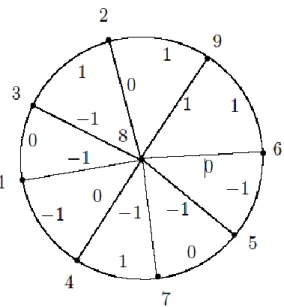
Illustration 5. The square difference
3-equitable labeling of W8 is shown below.
References
[1] J.A. Gallian, A dynamic survey of graph labeling, Electronic Journal of Combinatorics, 17(2010), DS6.
[2] F. Harary, Graph Theory, Addition-Wesley, Reading, Mass, 1972.
687 ISSN: 2278 – 7798 All Rights Reserved © 2016 IJSETR
[3] J. Shiama, Square sum labeling for some middle and total graphs, International Journal of Computer Applications (0975 − 8887) volume 37-No.4 January 2012.
[4] J. Shiama, Square difference labeling for some graphs, International Journal of Computer Applications (0975 − 8887) volume 44-No. 4 April 2012.
[5] J. Shiama, Some Special types of Square difference graphs, International Journal of Mathematical archives -3(6), 2012, 2369−2374 ISSN 2229−5046.
[6] J. Shiama, Square difference labeling for some path, fan, and gear graphs, International Journal of Scientific and Engineering Research volume 4, issues 3, March -2013, ISSN 2229 − 5518.
[7] S.K. Vaidya, N.H. Shah, 3-Equitable Labeling for Some Star and Bistar Related Graphs, International Journal of Mathematics and Scientific Computing, (ISSN: 2231 − 5330), vol 2, No. 1, 2012. [8] S. Murugesan, J. Shiama, Square Difference 3-Equitable Labeling of Paths and Cycles, International Journal of Computer Applications (0975 − 8887), Volume 123- No. 17, August 2015. .
![Poly[[μ N,N′ bis(2 hydroxyethyl) N,N,N′,N′ tetramethylpropane 1,3 diaminium κ2O:O′]tetra μ bromido dibromidodimanganese(II)]](data:image/gif;base64,R0lGODlhAQABAIAAAP///wAAACH5BAEAAAAALAAAAAABAAEAAAICRAEAOw==)