SANDIA REPORT
SAND2010-4766Unlimited Release Printed September 2010
National Cyber Defense High
Performance Computing and Analysis:
Concepts, Planning and Roadmap
Curtis M. Keliiaa and Jason R. Hamlet
Prepared by
Sandia National Laboratories
Albuquerque, New Mexico 87185 and Livermore, California 94550
Sandia National Laboratories is a multi-program laboratory managed and operated by Sandia Corporation, a wholly owned subsidiary of Lockheed Martin Corporation, for the U.S. Department of Energy's
National Nuclear Security Administration under contract DE-AC04-94AL85000. Approved for public release; further dissemination unlimited.
Issued by Sandia National Laboratories, operated for the United States Department of Energy by Sandia Corporation.
NOTICE: This report was prepared as an account of work sponsored by an agency of the United States Government. Neither the United States Government, nor any agency thereof, nor any of their employees, nor any of their contractors, subcontractors, or their employees, make any warranty, express or implied, or assume any legal liability or responsibility for the accuracy, completeness, or usefulness of any information, apparatus, product, or process disclosed, or represent that its use would not infringe privately owned rights. Reference herein to any specific commercial product, process, or service by trade name, trademark, manufacturer, or otherwise, does not necessarily constitute or imply its endorsement, recommendation, or favoring by the United States Government, any agency thereof, or any of their contractors or subcontractors. The views and opinions expressed herein do not necessarily state or reflect those of the United States Government, any agency thereof, or any of their contractors.
Printed in the United States of America. This report has been reproduced directly from the best available copy.
Available to DOE and DOE contractors from U.S. Department of Energy
Office of Scientific and Technical Information P.O. Box 62
Oak Ridge, TN 37831
Telephone: (865) 576-8401 Facsimile: (865) 576-5728 E-Mail: [email protected]
Online ordering: http://www.osti.gov/bridge
Available to the public from U.S. Department of Commerce National Technical Information Service 5285 Port Royal Rd.
Springfield, VA 22161
Telephone: (800) 553-6847 Facsimile: (703) 605-6900 E-Mail: [email protected]
SAND2010-4766 Unlimited Release Printed September 2010
National Cyber Defense High Performance
Computing and Analysis: Concepts, Planning
and Roadmap
Curtis M. KeliiaaAdvanced Networking Integration Jason R. Hamlet
Assurance Technology and Assessments Sandia National Laboratories
P.O. Box 5800
Albuquerque, New Mexico 87185-MS0806
Abstract
There is a national cyber dilemma that threatens the very fabric of government, commercial and private use operations worldwide. Much is written about “what” the problem is, and though the basis for this paper is an assessment of the problem space, we target the “how” solution space of the wide-area national information infrastructure through the advancement of science, technology, evaluation and analysis with actionable results intended to produce a more secure national information infrastructure and a comprehensive national cyber defense capability.
This cybersecurity High Performance Computing (HPC) analysis concepts, planning and roadmap activity was conducted as an assessment of cybersecurity analysis as a fertile area of research and investment for high value cybersecurity wide-area solutions. This report and a related SAND2010-4765 Assessment of Current Cybersecurity Practices in the Public Domain Cyber Indications and Warnings Domain report are intended to provoke discussion throughout a broad audience about developing a cohesive HPC centric solution to wide-area cybersecurity problems.
ACKNOWLEDGMENTS
Appreciation is due to the following individuals for their contributions in the development of this report.
Tan Chang Hu, 05627 Assurance Tech & Assessments David G. Robinson, 01415 Computer Science & Informatics Anand Ganti, 09336 Advanced Networking Integration Vitus J. Leung, 01415 Computer Science & Informatics
Keith Vanderveen, 08961, Manager, Scalable Computing R&D Robert A. Ballance, 09328 Scientific Computing Systems Steve A. Gossage, 09336, Advanced Networking Integration Kevin Pedretti, 01423, Computer Systems Analysis
CONTENTS
1. Executive Summary ... 7
2. Introduction... 9
2.1 Introduction... 9
2.2 Organization... 10
3. Priority Problems, Actionable Results, and Paths to Realization... 11
3.1 Defining the Cyberterrain Problem Space ... 11
3.1.1 Cyberterrain Problem Space: Assessment Conclusions ... 17
3.2 Areas of Impact, Priority Problems, Research, and Actionable Results... 17
3.3 Fundamental Relationships, Integration and Potential Benefits ... 22
3.3.1 Fundamental Relationships, Integration and Potential Benefits: Assessment Conclusions ... 34
4. Wide-Area Cybersecurity Design Space ... 35
4.1 Cybersecurity in an Ecosystem... 35
4.1.1 Cybersecurity in an Ecosystem: Assessment Conclusions... 37
4.2 Wide-Area Conceptual Design Space... 38
4.2.1 Wide-Area Conceptual Design Space: Assessment Conclusions ... 45
4.3 Related Impacts in the National Threat and Defense Posture... 46
4.3.1 Related Impacts within the National Threat and Defense Posture: Assessment Conclusions ... 51
5. Solution Space Concepts of Operations and Roadmaps ... 53
5.1 Solution Space Concepts of Operation ... 53
5.1.1 Value Based Information Protection Concept of Operations ... 53
5.1.2 Cyber Personification Schema Concept of Operations ... 54
5.1.3 Distributed Detection, Notification and Response Concept of Operations... 56
5.1.4 Cyber Adaptive Response Architectures Concept of Operations ... 58
5.1.5 Scalable Cyber Threat Definition Concept of Operations... 60
5.1.6 Federated Business Continuity Planning Concept of Operations ... 61
5.1.7 Solution Space Concepts of Operation: Assessment Conclusions ... 66
5.2 Roadmap with Quantifiable Goals and Objectives... 67
6. Challenges, Opportunities, and Conclusions ... 73
6.1 National Cyber Defense Challenges ... 73
6.2 Ten High Impact Opportunities ... 74
6.3 National Cyber Defense HPC Analysis Concepts, Planning and Roadmap: Conclusions75 Distribution ... 77
FIGURES
Figure 1. Cyberterrain Assessment & Game Board Metaphor Development Process ... 11Figure 2. Cybersecurity Subject Matter Matrix ... 12
Figure 4: Cyberterrain Areas of Impact ... 18
Figure 5: Cyberterrain Priority Wide-Area Problems... 19
Figure 6: Cyberterrain HPC Analysis Areas of Research... 19
Figure 7: Targeted Actionable Results of Cybersecurity HPC Analysis... 21
Figure 8: Areas of Impact, Priority Problems & Integrating Elements ... 23
Figure 9: Areas of Impact, Priority Problems, Integrating Principles & Threads of Reasoning .. 24
Figure 10: Areas of Research, Actionable Results & Integrating Elements... 26
Figure 11: Areas of Research, Actionable Results, Integrating Principles & Threads of Reasoning ... 27
Figure 12: Customer Objectives, Application, Function, Conceptual & Realization... 30
Figure 13: Conceptual Cyberterrain Wide-Area Threat Evaluation Environment ... 40
Figure 14: Conceptual Cyberterrain High Speed Distributed Sensor Environment ... 43
Figure 15: Conceptual Cyberterrain Distributed HPC Analysis Environment... 44
Figure 16: History Informs Our Future... 50
Figure 17: Conceptual Cyberterrain Cyber Adaptive Response Architecture... 59
Figure 18. Conceptual Scalable Cyber Threat Definition... 60
Figure 19: Federated BCP Command Structure ... 62
Figure 20: Emergency Management and BCP Coordination ... 64
Figure 21: Cyberterrain HPC Cybersecurity Analysis Roadmap ... 67
Figure 22: Cyberterrain Possible Outcomes and Future Actionable Results... 68
Figure 23: HPC Complexity Analysis and Modeling & Simulation Desired Outcomes... 69
Figure 24: Localized Trusted Interface Connections Desired Outcomes ... 70
Figure 25: Wide Area and Localized Trusted Interface Connections Desired Outcomes ... 71
Figure 26: Identified Shared Risk and Mitigations Desired Outcomes ... 72
TABLES
Table 1. Cyberterrain Defense and Nomenclature Continuums ... 14Table 2. Threat Characteristics ... 16
Table 3. Factors and Personification Risk Mitigation ... 56
Table 4. Cyber Threat Levels and Severity Indicators ... 58
1. EXECUTIVE SUMMARY
This report exists in the larger context as the third in a series of three related reports. The first, A Sensor Network Study1 provides a detailed description of sensor networks, which will likely be a critical component for collection, filtering, and initial analysis of cybersecurity data in distributed, high performance computing (HPC) oriented architectures. The second, Assessment
of Current Cybersecurity Practices in the Public Domain Cyber Indications and Warnings
Domain2 discusses current, unclassified cybersecurity practice and identifies abundant
opportunity for HPC use. This report presents initial concepts, planning and a roadmap toward cybersecurity HPC analysis to alleviate the cybersecurity dilemma on a national scale.
We began conceptualization by organizing areas of concern in the cybersecurity domain: 1. Threat & Vulnerability
2. Safeguards and Countermeasures 3. Risk Management
4. Prevention and Protection 5. Information Management 6. Detection and Warnings 7. Investigation and Response 8. Leadership and Authority 9. Resource Requirements 10.Workforce and Defenders
11.Coordination and Communication 12.Science and Engineering
13.Evaluation and Analysis 14.Actionable Results
Note that HPC resides in the Science and Engineering, Evaluation and Analysis, and Actionable Results areas of concern. We then identified seven areas where HPC could positively impact the wide-area of the national information infrastructure cybersecurity domain:
1. Threat & Vulnerability
2. Safeguards and Countermeasures 3. Risk Management
4. Prevention and Protection 5. Information Management 6. Detection and Warnings 7. Investigation and Response
The cybersecurity domain is presented as a cyberterrain game board metaphor to portray a continuous lifecycle with human, organizational, legal, and technical interdependencies.
1
SAND2009-6671 P A Sensor Network Study, January 2010
2
SAND2010-4765 Keliiaa, C.M and Hamlet, J.R. Assessment of Current Cybersecurity Practices in the Public Domain Cyber Indications and Warnings Domain, Aug. 2010
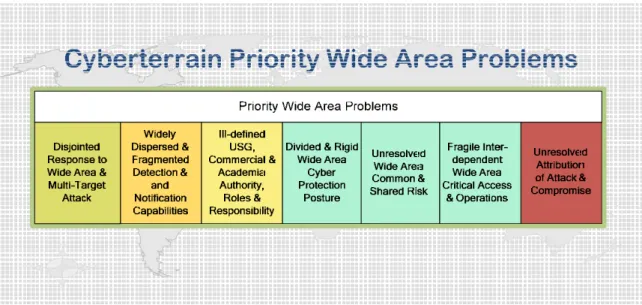
We identify seven priority wide-area problems in the wide-area cybersecurity domain: 1. Disjointed Response to Wide-Area and Multi Target Attack
2. Widely Dispersed and Fragmented Detection and Notification Capabilities 3. Ill-defined Government, Commercial, and Academic Roles and Responsibilities 4. Divided and Rigid Wide-Area Cyber Protection Posture
5. Unresolved Wide-Area Common and Shared Risks
6. Fragile Interdependent Wide-Area Critical Access and Operations 7. Unresolved Attribution of Attack and Compromise
We emphasize the solution space by presenting recommended areas of HPC research: 1. Trusted Connection and Automated Processes
2. Informatics, Statistics and Anomalous Behavior 3. Mathematics Analysis and Intrusion Detection 4. Complexity Science and Emergent Behavior 5. Modeling and Simulation
6. Analysis and Correlation Algorithms 7. Sociology and Psychology
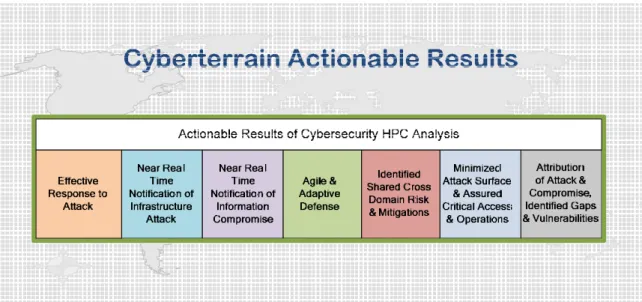
and actionable results to resolve national information infrastructure scale problems: 1. Identification of Gaps and Vulnerabilities
2. Effective Response to Attack
3. Near Real-Time Notification of Infrastructure Attack and Information Compromise 4. Agile and Adaptive Defense
5. Identified Cross Domain Risks and Mitigations 6. Minimized Attack Surface
7. Assured Critical Access and Operations 8. Attribution of Attack and Compromise
Discrete subject matter areas of interest are examined and potential paths to realization are explored. We consider the cyberterrain in terms of complexity on the scale of an ecosystem and expand and define the wide-area cybersecurity design space in terms of threat evaluation, distributed sensor network, and distributed HPC analysis environments to show a conceptual, high-level cybersecurity architecture that is amenable to HPC. We draw attention to the century old USG legal framework governing privacy of communications within which cybersecurity practices must operate, and consider broadly applied concepts of operation for increased national cyber defense and information asset protection.
Coarse flowcharts illustrating relationships between research activities and desired outcomes accompany a preliminary long term roadmap based on recent technological gains in anomaly detection, advanced operating system virtualization, and Sandia’s National Security Computing Center (NSCC). We conclude with a summation of national cyber defense challenges, opportunities and conclusions to help prioritize funding of future research.
2. INTRODUCTION
2.1 Introduction
There is a national cyber dilemma that threatens the very fabric of government, commercial and private use operations worldwide. Much is written about “what” the problem is and the cybersecurity industry has grown to international prominence in reaction to an ever increasing threat. Although the basis for this paper is an assessment of the problem space, we target the “how” solution space of the wide-area national information infrastructure through the advancement of science, technology, evaluation and analysis with actionable results intended to produce a more secure national information infrastructure and a comprehensive national cyber defense capability.
This cybersecurity High Performance Computing (HPC) analysis concepts, planning and roadmap activity was conducted as an assessment of cybersecurity analysis as a fertile area of research and investment for high value cybersecurity wide-area solutions. Areas of concern were considered as a game board metaphor to provide a fulsome “cyberterrain” description of the cyber problem domain. Cyberterrain areas of concern were identified as well as a subset of areas of impact that would benefit from particular areas of cybersecurity HPC research.
The areas of HPC research were first identified in a collaborative assessment 3 [SAND2009-7094 P] of the cybersecurity industry, HPC, and distributed sensor networks in the Cyber Indications and Warnings Domain (CIWD). These areas of research are considered computationally, large data-set, or time-to-solution intensive and of a nature appropriate to HPC analysis.
The reasoning, process and progressive development are shown with the intent to illuminate that the cyberterrain has evolved and increased in complexity on the scale of an ecosystem. The approach includes the assessment of several areas of importance:
1. Cyber Problem Space Domains of Concern
2. Areas of Impact, Priority Problems, Areas of Research, and Actionable Results 3. Fundamental Relationships, Integration and Potential Benefits
4. Cybersecurity in an Ecosystem 5. Wide-Area Conceptual Design Space
6. Related Impacts within the National Threat and Defense Posture 7. Solution Space Concepts of Operation
8. Roadmap with Quantifiable Goals and Objectives
Utilizing technological gains in anomaly detection, advanced operating system virtualization, and Sandia’s National Security Computing Center (NSCC) the resultant roadmap defines a possible program path forward with quantifiable goals and objectives. Such roadmaps may be useful in prioritizing future research and funding efforts.
3
SAND2009-7094 P Interim Report Task 1 Assessment of Current Cybersecurity Practices in the Public Domain: Cyber Indications and Warnings Domain, October 2009
2.2 Organization
The information herein is largely conceptual, although based on literature review of the cybersecurity industry, HPC systems and trends, and sensor network technologies. This document is accompanied by a report summarizing an assessment of current cybersecurity practices in the public domain. This accompanying report serves as the primary technical informational basis of this work, although additional review conducted for this national cyber defense concepts, planning and roadmap activity are noted within the text. Please refer to the
Assessment of Current Cybersecurity Practices in the Public Domain Cyber Indications and
Warnings Domain 4report for further technical discussion: Findings and Recommendations
discuss the current state of the cyber security industry; HPC class of systems and benchmarks; trends; applications of cybersecurity to HPC; high speed sensor networks; algorithms; reference architectures and data models; Conclusions include a discussion of influencing factors in distributed cyber security computing systems; and recommended actions and potential areas of research to advance HPC cybersecurity applications.
The remainder of this document is organized as follows. In chapter 3 we define the cyberterrain problem space on the scale of the wide-area national information infrastructure in a game board metaphor, and present priority problems, actionable results, and paths to realization through HPC research. In particular, section 3.1 identifies 14 areas of concern in the cybersecurity domain; section 3.2 identifies a subset of these areas that might benefit from HPC analysis, identifies priority problems in each area, and recommends areas of HPC research and actionable results from that research that are closely aligned with the priority problems; and section 3.3 illustrates relationships between the areas of impact and the priority problems and actionable results.
Chapter 4 explores the conceptual wide-area design space. Section 4.1 introduces an ecosystem metaphor for cybersecurity analysis applicable to HPC oriented wide-area cybersecurity architectures and section 4.2 defines the wide-area cybersecurity design space in terms of a threat evaluation, distributed sensor network, and distributed HPC analysis environments to show a conceptual, high-level cybersecurity architecture that is amenable to HPC. Section 4.3 describes some current national cybersecurity policy and the historical legal context within which cybersecurity practices must operate and the difficulty in investigating and prosecuting cyber crime in an international environment.
Chapter 5 explores the solution space and expands the discussion beyond HPC analysis with several related wide-area concepts of operation. Section 5.1 presents concepts of operation related to value based information protection, cyber personification, distributed detection, notification and response, cyber adaptive response architectures, scalable cyber threat definition, federated business continuity planning. Section 5.2 presents a preliminary long term cybersecurity roadmap for progressive development of a wide-area cybersecurity HPC capability and coarse flowchart style roadmaps illustrating relationships between research activities and desired outcomes. Finally, chapter 6 presents a summation of preliminary national cyber defense challenges, opportunities, and conclusions to assist in prioritization of future work.
4
SAND2010-4765 Keliiaa, C.M and Hamlet, J.R. Assessment of Current Cybersecurity Practices in the Public Domain Cyber Indications and Warnings Domain, Aug. 2010
3.
PRIORITY PROBLEMS, ACTIONABLE RESULTS, AND PATHS TO
REALIZATION
3.1 Defining the Cyberterrain Problem Space
Goal: Develop a game board metaphor illustrating “cyberterrain” areas of concern as applicable to the wide-area of the national information infrastructure.
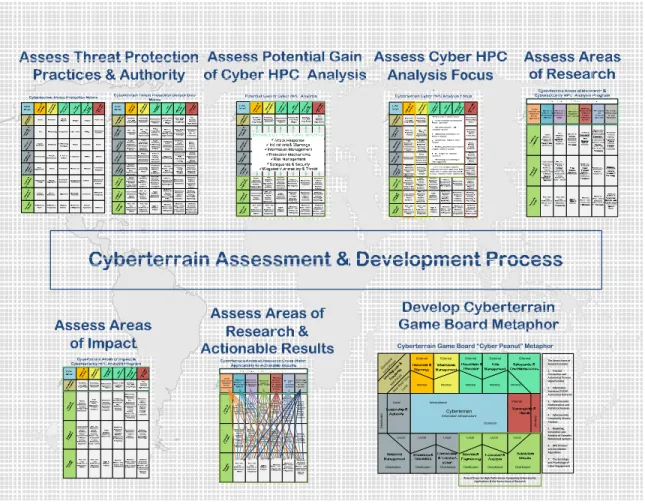
Figure 1 illustrates the cyberterrain assessment and development process followed to define the cyberterrain problem space on the scale of the wide-area national information infrastructure expressed in a game board metaphor. We began with a matrix of activity related to cybersecurity practices to assess requirements and scope of the “cyberterrain”. The initial assessment considered the detection and warnings domain and investigation and response domain as predominate areas for improvement in the cyberterrain. An additional advantage of the game board metaphor is to give reference to the oft used “game changing” paradigm.
Cyberterrain
Information Infrastructure
Cyberterrain Game Board “Cyber Peanut” Metaphor
Internal Internal Internal External Internal Internal External International Domestic External Near -Real-T ime Mid-R ange Long -Ran ge External External Internal E x ter nal Distributed Dis tr ib u te d Local Local Distributed
Local Local Local Local Local
Distributed Distributed Distributed Distributed Local Distributed
Area of Focus for High Performance Computing Cybersecurity Applications & the Seven Areas of Research
The Seven Areas of Research include: 1. Trusted Connection and Automated Process Opportunities 2. Informatics Statistical TCP/IP Anomalous Behavior 3. Cybersecurity Mathematical and Statistical Analysis 4. Cybersecurity Complexity Science Analysis 5. Modeling, Simulation and Analysis of Complex Networked Systems 6. HPC Analysis and Correlation Algorithms 7. The Sociology and Psychology of Cyber Engagement
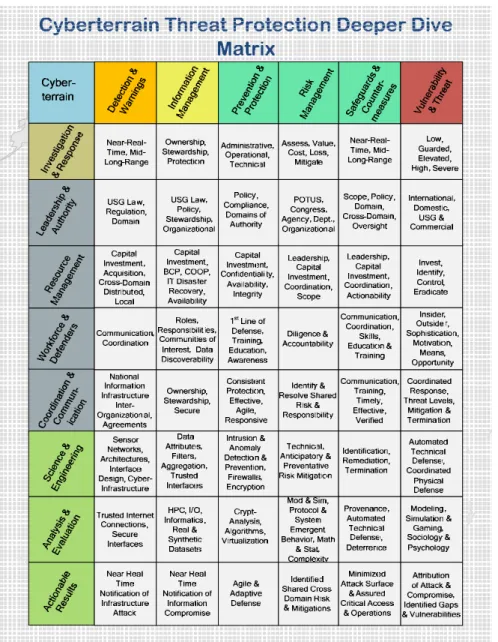
The fourteen areas or domains of concern were developed after careful consideration of the activities and authorities comprised in securing wide-area national information infrastructure. Figure 2 illustrates the concerns, responsibilities and practices of the cyberterrain created during a mapping/brainstorming exercise. This initial concept and planning exercise illustrated the need for a means of faster time-to-resolution for wide-area “shared” cybersecurity problems, and subsequent national cyber defense solutions. Such solutions would ideally be graded to the level of threat and the value of information assets at risk.
What is being done is not enough as evidenced by an escalating global cyber threat. Capital investments are needed to underwrite improved function and efficiency in each of the domains of concern. Key to a strengthened national cybersecurity posture is an increased and continued investment in advanced capability development, such as HPC analysis, and continued national leadership for broad coordination and communication.
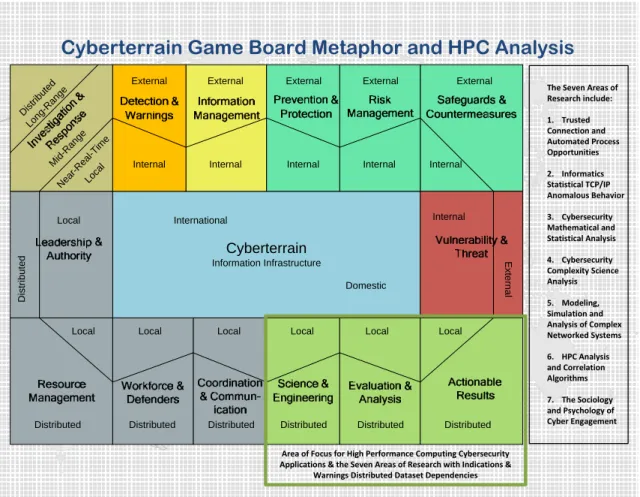
The full game board includes cybersecurity domains of concern (illustrated in bold type in Figure 3.). The “Internal” and “External” boundary represents the border between the national information infrastructure and the world-wide Internet. Similarly, the “Local” versus “Distributed” boundary represents the scope of authority and/or collaboration for wide-area interconnected autonomous area networks, information systems, and cyber-infrastructure. Note the “Cyber Peanut” form taken from the shape of the internal/external and local/distributed borders that is representative of a continuous cyberterrain lifecycle, which includes human, organizational, legal and technical interdependencies.
Note that the Detection and Warnings domain, as opposed to Indications and Warnings, is referenced to better define this domain in terms of cybersecurity practices within the cyberterrain. Also illustrated in figure 3 are the seven areas of recommended HPC research that were identified in the assessment of the CIWD and the HPC cybersecurity application area of focus comprising the Science and Engineering, Evaluation and Analysis, and Actionable Results domains of concern.
Cyberterrain
Information Infrastructure
Cyberterrain Game Board Metaphor and HPC Analysis
Internal Internal Internal External Internal Internal External International Domestic External Ne ar-Re al-Time Mid -Ran ge Long -Range External External Internal Exte rna l Distributed Dis trib u te d Local Local Distributed
Local Local Local Local Local
Distributed Distributed Distributed Distributed Loca l Distr ibut ed
Area of Focus for High Performance Computing Cybersecurity Applications & the Seven Areas of Research with Indications &
Warnings Distributed Dataset Dependencies
The Seven Areas of Research include: 1. Trusted Connection and Automated Process Opportunities 2. Informatics Statistical TCP/IP Anomalous Behavior 3. Cybersecurity Mathematical and Statistical Analysis 4. Cybersecurity Complexity Science Analysis 5. Modeling, Simulation and Analysis of Complex Networked Systems 6. HPC Analysis and Correlation Algorithms 7. The Sociology and Psychology of Cyber Engagement
Each domain of concern in the cyberterrain problem space is broad in scope and each comprises diverse aspects and disciplines. The cyberterrain domains of concern are:
1. Threat & Vulnerability
2. Safeguards and Countermeasures 3. Risk Management
4. Prevention and Protection 5. Information Management 6. Detection and Warnings 7. Investigation and Response 8. Leadership and Authority 9. Resource Requirements 10. Workforce and Defenders
11. Coordination and Communication 12. Science and Engineering
13. Evaluation and Analysis 14. Actionable Results
Cyberterrain defense can be expressed as a continuum that establishes translation through an accompanying nomenclature. The nomenclature continuum permits consistent expression and execution as cyber defense initiatives move from one view to the next while accommodating view specific syntax.
Each view uses appropriate language and terminology for view specific purpose. For example, the operational view uses business specific terms. Notice that representation is domain of concern and goal oriented as opposed to technical jargon.
Table 1. Cyberterrain Defense and Nomenclature Continuums
CYBERTERRAIN DEFENSE CONTINUUM ↔
Executive View
Operational View
Risk View Protection View Defense View
Leadership and Authority, Coordination and Communication Information Management, Resource Management, Work Force and Defenders, Coordination and Communication Vulnerability and Threat, Risk Management Safeguards and Countermeasures, Prevention and Protection Science and Technology, Evaluation and Analysis, Actionable Results, Detection and Warnings, Investigation and Response Inform the Decision Maker Inform the Defender Minimize Exposure Reduce the Attack Surface Effective Defense NOMENCLATURE CONTINUUM ↔
Network and information technology environments are intricate and complex. Therefore the cyber terrain continuum views are expressed in terms of a variety of perspectives.
Consider a business perspective for example: organizational relationships; contract and legal liabilities; operational dependencies; inter-organizational process requirements; and business continuity requirements comprise a business to business perspective.
Consider a system of systems perspective for example: distributed computational capabilities and capacity and system interfaces comprise an interconnected systems perspective; I/O characterization of data types, transactional data exchange and throughput or time requirements comprise an I/O perspective; service level agreement requirements comprise a telecommunications service perspective.
Consider a user perspective for example: stakeholders, data owners and data stewards, and all manner of consumers of information that generate, process, review and otherwise access information comprise a user perspective.
Consider a component/device perspective for example: Internet enabled cell phones and personal digital assistants (PDA), home computing, web interface, data storage servers and client hosts comprise a user component perspective; routing and switching telecommunications equipment comprise a telecommunication provider component perspective.
Consider an operational support systems (OSS) perspective for example: maintenance and operations include systems for monitoring heartbeat (host availability) and health (service availability), and datacenter environmental controls (HVAC and power). An OSS perspective represents business continuity concerns and indirect attack surfaces.
Consider an application perspective for example: order entry, email and messaging services such as twitter comprise a user application perspective; database, automated job processing and data backup comprise an operational application perspective; log review and auditing comprise a security application perspective.
Consider a service perspective for example: web based entertainment and online gaming, online banking, and public information access comprise a user or consumer services perspective; authentication services such as lightweight directory access protocol (LDAP) and Kerberos (authentication ticket), and intrusion detection and prevention comprise a security service perspective; the Domain Name Service (DNS) name resolution to IP address, network time protocol (NTP), dynamic host configuration protocol (DHCP) comprise a network services perspective. Middleware and data synchronization comprise an operational service perspective. Service disruption and denial of service represent a common attack vector.
Consider a function perspective for example: manufacturing, packaging, shipping and distribution of goods and services comprise a supply chain function perspective; consumer trends, supply and demand, and materials availability comprise a product delivery function perspective; asset valuation, funds availability and liabilities, and procurement comprise a financial function perspective. Interruption of supply chain, product delivery or financial means
of operation represent ancillary human or natural disaster threat vectors that impact continuity of operations.
Consider an information asset perspective for example: publically available information comprise a sharable information asset perspective; categorization such as mandatory labeling for classification of data such as confidential and secret, and intellectual property such as proprietary information and trade secrets comprise a sensitive information asset perspective; health records information comprise a private information asset perspective; and public safety records comprise a need-to-share information asset perspective. Taxonomy of information assets may reveal that some information is of such a value that it would better be destroyed than released.
Consider an information access perspective for example: communities of interest (COI) comprise a consumer information access perspective; creation and disposition of information comprise a data owner information access perspective; processing and handling of information comprise a data steward need-to-know information access perspective; local and remote access comprise a locality information access perspective; and finally an inappropriate use or modification of information comprise a no information access perspective.
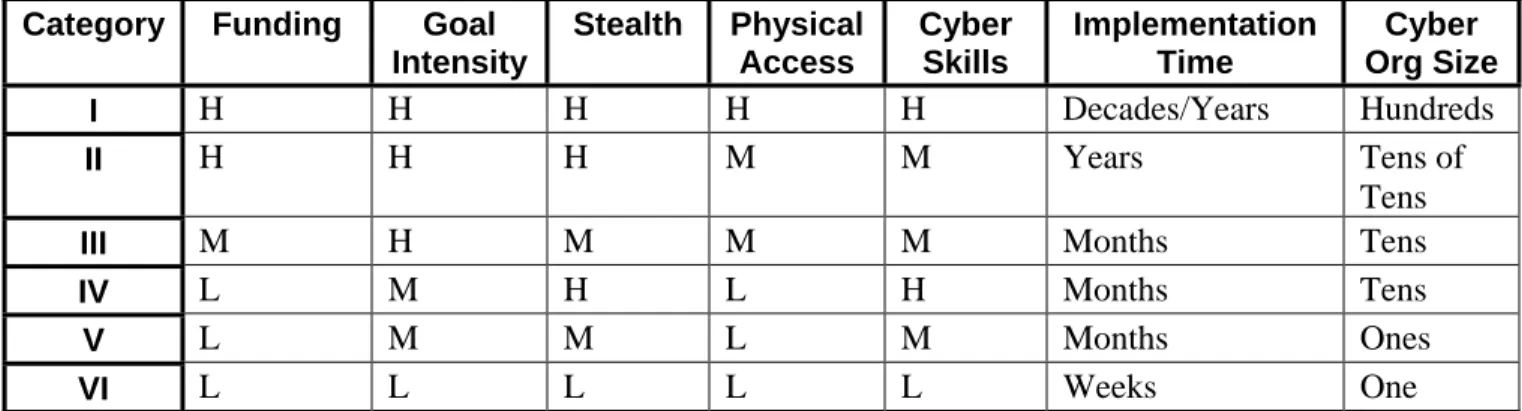
Consider an adversary perspective for example: generic threat profiles comprise an adversarial capability perspective 5 [SAND2005-5411]. The following is an excerpt from the Generic Threat Profiles Sandia report that describes an adversarial threat in terms of capability, which avoids the use of ambivalent terms such as “Nation State”. Expression of adversarial threat as a capability provides the benefit of model reuse for simulating various threat scenarios.
“Threat profiles are a way to bin threat organizations of differing political, social, and motivation structures such that relevant characteristics may be utilized in identifying classes of attacks each might be able to carry out.”
Table 2. Threat Characteristics Category Funding Goal
Intensity Stealth Physical Access Cyber Skills Implementation Time Cyber Org Size I H H H H H Decades/Years Hundreds II H H H M M Years Tens of Tens
III M H M M M Months Tens
IV L M H L H Months Tens
V L M M L M Months Ones
VI L L L L L Weeks One
5
3.1.1 Cyberterrain Problem Space: Assessment Conclusions
1. The tie between HPC and the cyberterrain game board is that advanced HPC analysis for cybersecurity is founded in the areas of science and engineering, evaluation and analysis, and actionable results that could have potentially profound impact in the Cyberterrain. 2. Cybersecurity HPC analysis is a potentially game changing means to support a wide-area
rapid time-to-solution national cyber defense capability.
3. Key to a strengthened national cybersecurity posture is an increased and continued investment in science and technology advanced capability development, such as HPC analysis, and continued national leadership for broad coordination and communication.
4. Cyber defense can be expressed as a continuum with an accompanying nomenclature continuum to facilitate multi-organizational communication toward common wide-area cybersecurity goals.
5. The cyberterrain continuum views should be further defined and expressed in terms of a variety of perspectives to capture complexity.
3.2 Areas of Impact, Priority Problems, Research, and Actionable
Results
Goal: Develop actionable results with regard to priority problems and promising areas of research that are applicable to wide-area national cyber defense.
The cyberterrain areas of concern pertaining to this phase of assessment are: 1. Threat & Vulnerability
2. Safeguards and Countermeasures 3. Risk Management
4. Prevention and Protection 5. Information Management 6. Detection and Warnings 7. Investigation and Response 8. Science and Engineering 9. Evaluation and Analysis 10. Actionable Results
Specific areas of impact were identified that are significant in that a more robust and resilient wide-area protection posture can be achieved through applied science and technology, evaluation and analysis, and actionable results made possible with cybersecurity HPC analysis. Consider that the wide-area comprises technical, organizational and human complexity on a grand scale and dependency on this system of systems results in the need for sustainable confidentiality,
integrity and availability of immense volumes of data. Therefore, an investment in HPC analysis aligned with national cyber defense will need to meet this scale of economy.
Areas of impact include:
1. Threat & Vulnerability
2. Safeguards and Countermeasures 3. Risk Management
4. Prevention and Protection 5. Information Management 6. Detection and Warnings 7. Investigation and Response
Figure 4: Cyberterrain Areas of Impact
An industry surrounding computer network defense (CND) has developed to address the threat of computer network attack (CNA) and exploitation (CNE). Common vulnerabilities and exposures (CVE) are widely present and exploited across all main stream computing platforms, information services and telecommunication protocols. The following priority wide-area cybersecurity problems are considered in a broad context to include multiple autonomous areas of responsibility, varied technological investments and priorities, and increased shared risk due to local cyber-defense planning and implementation without efficient consideration for the common system-of-systems infrastructure. It is at this level of shared risk that the priority wide-area cybersecurity problems align with the cyberterrain wide-areas of impact.
Figure 5: Cyberterrain Priority Wide-Area Problems
The most pressing of these problems is unresolved attribution of attack and compromise. Without confidence in the attribution of attack an effective response is difficult to mount against the responsible adversary. Furthermore, cyber deterrence is ineffective without a means to identify the level of sophistication and who is responsible for attack. Action can only be taken when malicious incursion can be readily attributed to the responsible party.
Science, technology, evaluation and analysis form the basis of HPC cybersecurity research applications with the purpose of producing actionable results for an improved wide-area protection posture. The HPC analysis areas of research are broadly applicable in the cyberterrain and have anticipated far reaching results to national cyber defense.
Figure 6: Cyberterrain HPC Analysis Areas of Research
A fuller description of the recommended areas of research for HPC Cybersecurity applications is provided below.
1. Identify Trusted Connections and Automated Process Opportunities for Collecting and Analyzing Information for Cybersecurity Applications.
2. Examine Informatics Statistical TCP/IP Anomalous Behavior Research for protocol anomalous and malicious characteristics; analysis of temporal and spatial characteristics of attack; harvesting data to seed Informatics visual analytics for cybersecurity subject matter.
3. Examine Cybersecurity Mathematical and Statistical Analysis Research to collect, handle, and analyze large datasets for modeling, intrusion detection, attack response, and identification of multistage attacks.
4. Examine Cybersecurity Complexity Science Analysis Research for studying the unpredictability in programs, machines, and networks, and large-scale modeling and simulation.
5. Examine Modeling, Simulation and Analysis of Complex Networked Systems, including large scale network models and models of network dynamics and cyber attack. Applications include intrusion detection, and examining the evolution of cyber threats. 6. Expand HPC Analysis and Correlation Algorithms for identification of temporal and
spatial characteristics associated with anomalous events, and detection of widespread, multistage, multiple method attacks.
7. Understand the Sociology and Psychology of Cyber Engagement for solving the problem of attributing an attack to responsible parties, and to aid in the development of anticipatory and preventative safeguards and countermeasures based on predictable behaviors.
8. Potential benefits of HPC cybersecurity research include the study and understanding of emergent behavior, anomalous and malicious characteristics, and the modeling and simulation of complex systems that is beyond human comprehension without the utility of supercomputing. Human directive and interaction can also be analyzed and understood through study of the psychology and sociology of attacker/defender behavior with potential advancement of predictive and anticipatory cyber defense technologies. Such complex and data intensive studies are not feasible without HPC cybersecurity analysis.
Figure 7: Targeted Actionable Results of Cybersecurity HPC Analysis
The proposed actionable results are broad in scope and are closely aligned with priority wide-area problems. Evaluation and analysis are expected to lead to greater understanding of development for a strengthened national cyber defense capability. This assessment finds a growing foundation of cybersecurity research and development, although limited funds availability and a lack of multi-agency program support threaten continued viability.
The actionable results listed below are considered as shared goals to facilitate a more secure national information infrastructure.
1. Identification of Gaps and Vulnerabilities 2. Effective Response to Attack
3. Near Real-Time Notification of Infrastructure Attack and Information compromise 4. Agile and Adaptive Defense
5. Identified Cross Domain Risks and Mitigations 6. Minimized Attack Surface
7. Assured Critical Access and Operations 8. Attribution of Attack and Compromise
Critically important to national cyber defense is the coordination required to identify shared risks, gaps and vulnerabilities, without which an effective response to wide-area or sophisticated multi-stage cyber attacks is insurmountable. Resolution of conflicts of interest in the protection of intellectual property, mission overlap, and competition for funding and authority within government is needed for improved coordination. Coordination is further inhibited by a lack of established and commonly understood roles and responsibilities for the handling and management of cyber threat data across organizations.
Areas of Impact, Priority Problems, Areas of Research, Actionable Results: Assessment Conclusions
1. An investment in HPC analysis areas of research aligned with cyber defense areas of impact and priority problems is essential for continued progress toward a national cyber defense capability.
2. Cyber deterrence is ineffective without a means to identify the level of sophistication and who is responsible for attack.
3. The study and understanding of technical, organizational and human complexity within the wide-area national information infrastructure is beyond human comprehension without the utility of supercomputing.
4. Ongoing work indicates a growing foundation of HPC cybersecurity research and development, although limited funds availability and lack of multi-agency program support threaten continued viability.
5. Critically important to national cyber defense is the coordination and work toward shared goals to address shared risks and therefore an effective defense to wide-area or sophisticated multi-stage attack.
3.3 Fundamental Relationships, Integration and Potential Benefits
Goal: Develop an understanding of fundamental relationships and integration, customer objectives, application, function, conceptual gains, realization, and potential benefit.
The cyberterrain areas of concern pertaining to this phase of assessment are: 1. Threat & Vulnerability
2. Safeguards and Countermeasures 3. Risk Management
4. Prevention and Protection 5. Information Management 6. Detection and Warnings 7. Investigation and Response 8. Science and Engineering 9. Evaluation and Analysis 10. Actionable Results
This phase of the planning exercise was conducted to develop an understanding of fundamental relationships and integration. Our approach considered customer objectives, application, function, conceptual gain (near and long term), and realization (CAFCR)6. Integrating elements, integrating principles and threads of reasoning were considered for high-value areas of impact
6
and priority wide-area problems. Similarly, Integrating elements, principles and threads of reasoning were considered for high-value areas of research, and actionable results.
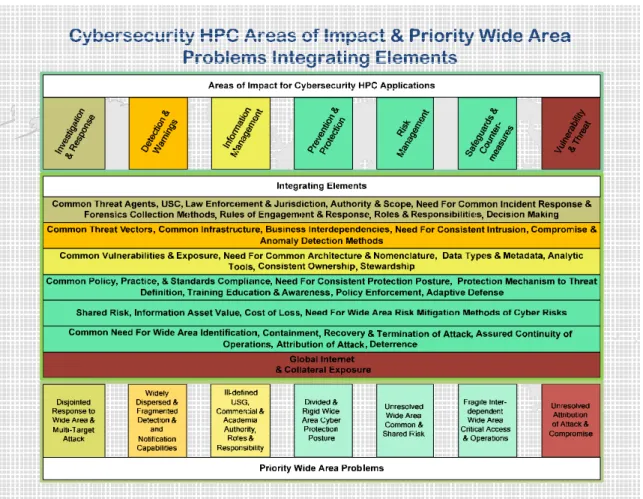
Figure 8: Areas of Impact, Priority Problems & Integrating Elements
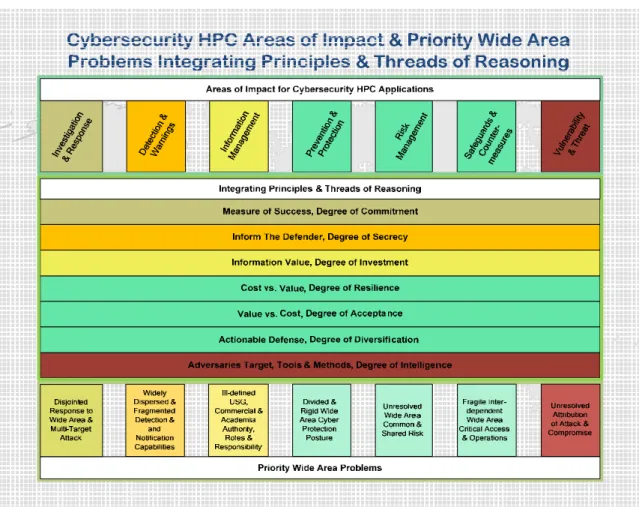
Illustrated in figures 8 and 9 are thumbnail assessments of fundamental relationships and integration for each area of impact to a specific wide area priority problem. In figure 8 consider that integrating elements span the spectrum of political, inter-organizational, guidance and practice, and geographic and technical lifecycles in the cyberterrain.
Figure 9: Areas of Impact, Priority Problems, Integrating Principles & Threads of Reasoning
Integrating elements, principles, and threads of reasoning were enumerated as being rooted in one area of impact and affecting the other areas of impact in the same way that protection posture and information management practices affect preparedness.
What is intended is a representation of a holistic balanced national cyber defense capability with quantified goals in a progressive approach to a comprehensive set of solutions. Fundamental to this approach is the integral relationship of function and security as opposed to function vs. security.
Investigation and Response Domain of Concern
Priority Wide Area Problem: Disjointed Response to Wide Area & Multi-Target Attack
Integrating elements of investigation and response as a high-value area of impact:
Common Threat Agents; USC, Law Enforcement and Jurisdiction; Authority and Scope; Need for Common Incident Response and Forensics Collection Methods, Rules of Engagement and Response, Defined Roles and Responsibilities, and Informed Decision Making
Integrating principles and threads of reasoning for investigation and response as a high-value area of impact: Measure of Success; Degree of Commitment
Detection and Warnings Domain of Concern
Priority Wide Area Problem: Widely Dispersed and Fragmented Detection and Notification
Capabilities
Integrating elements of detection and warnings as a high-value area of impact:
Common Threat Vectors; Common Infrastructure; Business Interdependencies; Need for Consistent Intrusion, Compromise and Anomaly Detection Methods
Integrating principles and threads of reasoning for detection and warnings as a high-value area of impact: Inform the Defender; Degree of Secrecy
Information Management Domain of Concern
Priority Wide Area Problem: Ill-defined USG, Commercial & Academia Authority, Roles & Responsibility
Integrating elements of information management as a high-value area of impact:
Common Vulnerabilities and Exposure; Need for Common Architecture and Nomenclature, Defined Data Types and Metadata, Analytic Tools, and Consistent Ownership and Stewardship
Integrating principles and threads of reasoning for information management as a high-value area of impact: Information Value; Degree of Investment
Prevention and Protection Domain of Concern
Priority Wide Area Problem: Divided and Rigid Wide Area Cyber Protection Posture
Integrating elements of prevention and protection as a high-value area of impact:
Common Policy, Practice, and Standards Compliance; Need for Consistent Protection Posture, Protection Mechanism to Threat Definition, Training Education and Awareness, Policy Enforcement, and Adaptive Defense
Integrating principles and threads of reasoning for prevention and protection as a high-value area of impact: Cost vs. Value; Degree of Resilience
Risk Management Domain of Concern
Priority Wide Area Problem: Unresolved Wide Area Common and Shared Risk
Integrating elements of risk management as a high-value area of impact:
Shared Risk, Information Asset Value, Cost of Loss; Need for Risk Mitigation Methods of Wide-Area Cyber Risks
Integrating principles and threads of reasoning for risk management as a high-value area of impact: Value vs. Cost; Degree of Acceptance
Safeguards and Countermeasures Domain of Concern
Priority Wide Area Problem: Fragile Interdependent Wide Area Critical Access and Operations Integrating elements of safeguards and countermeasures as a high-value area of impact:
Need for Wide Area Identification, Containment, Recovery and Termination of Attack, Assured Continuity of Operations, Attribution of Attack, and Deterrence
Integrating principles and threads of reasoning for safeguards and countermeasures as a high-value area of impact: Actionable Defense; Degree of Diversification
Vulnerability and Threat Domain of Concern
Priority Wide Area Problem: Unresolved Attribution of Attack and Compromise Integrating elements of vulnerability and threat as a high-value area of impact: Global Internet and Collateral Exposure
Integrating principles and threads of reasoning for vulnerability and threat as a high-value area of impact: Adversaries Target, Tools and Methods; Degree of Intelligence
Illustrated in figures 10 and 11 are thumbnail assessments of fundamental relationships and integration for each area of research to a related wide area actionable result.
Figure 11: Areas of Research, Actionable Results, Integrating Principles & Threads of Reasoning
Trusted Connection and Automated Process Opportunities Area of Research Actionable Result: Effective Response to Attack
Integrating elements of trusted connection and automated process opportunities as a high-value area of research: Broadly Applied Function, Command and Control, and Confidentiality
Integrating principles and threads of reasoning for trusted connection and automated process opportunities as a high-value area of research: Controlled Interfaces; Degree of Efficiency
Informatics Statistical TCP/IP Anomalous Behavior Area of Research Actionable Result: Near Real Time Notification of Infrastructure Attack
Integrating elements of informatics statistical TCP/IP anomalous behavior as a high-value area
of research: Distributed Network of Networks, Timeliness Dependent on Geography, I/O and
Integrating principles and threads of reasoning for statistical TCP/IP anomalous behavior as a high-value area of research: Baseline Operation; Degree of Adherence
Cybersecurity Mathematical and Statistical Analysis Area of Research Actionable Result: Near Real Time Notification of Information Compromise
Integrating elements of cybersecurity mathematical and statistical analysis as a high-value area of research: Information In-Transit and At-Rest; Integrity
Integrating principles and threads of reasoning for cybersecurity mathematical and statistical analysis as a high-value area of research: Provenance; Degree of Granularity
Cybersecurity Complexity Science Analysis Area of Research Actionable Result: Agile & Adaptive Defense
Integrating elements of cybersecurity complexity science analysis as a high-value area of research: Global Internet Threat and Vulnerability, Adversarial Directive, Critical Dependence on Information Systems
Integrating principles and threads of reasoning for cybersecurity complexity science analysis as a high-value area of research: Emergent Behavior; Degree of Adaptability
Modeling, Simulation and Analysis of Complex Networked Systems Area of Research Actionable Result: Identified Shared Cross Domain Risk and Mitigations
Integrating elements of modeling, simulation and analysis of complex networked systems as a
high-value area of research: System of Systems, Aggregate of Domains of Authority and
Communities of Interest
Integrating principles and threads of reasoning for modeling, simulation and analysis of complex networked systems as a high-value area of research: Changing Environment; Degree of Evolution
HPC Analysis and Correlation Algorithms Area of Research
Actionable Result: Minimized Attack Surface and Assured Critical Access and Operations
Integrating elements of HPC analysis and correlation algorithms as a high-value area of research: Similar to Signals Intelligence HPC Analysis, Wide Domain Diversity, and Shared Complex Problem
Integrating principles and threads of reasoning for HPC analysis and correlation algorithms as a high-value area of research: Many to Many; Degree of Harmony
The Sociology and Psychology of Cyber Engagement Area of Research
Integrating elements of the sociology and psychology of cyber engagement as a high-value area of research: Horizontal and Vertical Cultural Diversity, Inherent Technical Vulnerability
Integrating principles and threads of reasoning for the sociology and psychology of cyber engagement as a high-value area of research: Level of Sophistication; Degree of Orientation This assessment of fundamental relationships and integrating aspects is subjective, although it offers insight into the objectives, application, function, concept and realization of a more robust and resilient national information infrastructure.
In the conceptual cyberterrain CAFCR architectural model depicted in figure 12, the customer objectives are representative of the cybersecurity centric areas of concern: investigation and response; detection and warnings; information management; prevention and protection; risk management; safeguards and countermeasures; and threat and vulnerability. The application segment is representative of specific priority problems where improved cyber-defense is needed. The function segment represents goals toward specific areas of improved cybersecurity and defense capability. Conceptual gain is representative of applied near and long term capabilities envisioned as part of holistically secure wide-area information environment. Lastly, the realization segment represents the advancements enabled through HPC cybersecurity application research.
Figure 12: Customer Objectives, Application, Function, Conceptual & Realization
Several recent developments with potential high value benefits were identified while conducting an internal review of Sandia National Laboratory activities for the application of HPC for cybersecurity.
1. The National Nuclear Security Administration (NNSA) and Sandia National Laboratories recently dedicated the National Security Computing Center (NSCC). The center is based around the Sandia-built Red Storm supercomputer platform. Its unique capabilities will be applied to help solve pressing national security problems such as cyber defense, vulnerability assessments, informatics (network discovery), space systems threats, and situational awareness.
2. Palacios and Kitten: New High Performance Operating Systems For Scalable Virtualized and Native Supercomputing7 [Lange, Pedretti, Hudson, Dinda, Cui, Xia, Bridges, Gocke, Jaconette, Levenhagen, and Brightwell]. Palacios is a new high performance virtual machine monitor (VMM) architecture that has been embedded into Kitten, a high performance supercomputing operating system. Together, Palacios and Kitten provide a flexible, high performance virtualized system software platform for HPC systems. This platform broadens the applicability and usability of HPC systems by:
providing access to advanced virtualization features such as migration, full system check pointing, and debugging;
allowing system owners to support a wider range of applications and to more easily support legacy applications and programming models when changing the underlying hardware platform;
enabling system users to incrementally port their codes from small-scale development systems to large-scale supercomputer systems while carefully balancing their performance and system software service requirements with application porting effort; and
providing system hardware and software architects with a platform for exploring hardware and system software enhancements without disrupting other applications.
3. Statistical Language Analysis for Automatic Exfiltration Event Detection8 [SAND2010-2179]. This paper discusses a statistical approach for the automatic identification of anomalous network activity that is characteristic of exfiltration events. This approach is based on the language processing method referred to as latent dirichlet allocation (LDA). Current rule-based systems only apply to exfiltration behavior that has previously been observed. Since the LDA methodology is not a rules based approach, it makes it more difficult for insiders to hide data exfiltration activities. The results of LDA analysis provide a refined dataset of previously unobserved suspect network activity that are identified early (before firewall rules and antivirus signatures can be developed and distributed) for rapid response and investigation. New insights to the science of information analysis are emerging with mathematical techniques associated with probabilistic latent semantic analysis.
These recent advancements are important because they represent current work that provides a foundation for continued advancement of cybersecurity applications and HPC research and analysis. The NSCC is an example of the level of leadership investment needed for advancing HPC analysis for cybersecurity applications.
7
Palacios and Kitten: New High Performance Operating Systems For Scalable Virtualized and Native
Supercomputing, John Lange, Kevin Pedretti, Trammell Hudson, Peter Dinda, Zheng Cui, Lei Xia, Patrick Bridges, Andy Gocke, Steven Jaconette, Mike Levenhagen, and Ron Brightwell
Northwestern University, Department of Electrical Engineering and Computer Science Sandia National Laboratories, Scalable System Software Department
University of New Mexico, Department of Computer Science
8
Palacios and Kitten are representative of the advanced automation (virtualization) of operating systems. Such innovation is also evidenced by commercial virtualization displacing many conventional client server deployments. Palacios and Kitten provide the advantage of scale applicable to HPC platforms. Moreover, modeling and simulation of very large complex systems may lead to reduced cost and time-to-deployment of cyber defense in kind with that of virtualization in the datacenter.
LDA statistical language analysis enables anomaly detection that is a departure from the signature and rules based systems that cybersecurity applications are heavily dependent on today. Several advantages are possible: zero day vulnerability and malicious code can be observed in the initial act of exfiltration resulting in faster response and increased efficiency of damage control countermeasures; decision making can be made with quantifiable risk and increased confidence when responding to new suspicious activity; the approach can be extended to a formal risk-based approach to attribution wherein investigative resources are allocated based on the probability that a data exfiltration event occurred. One potential and very important advantage of a formal risk-based approach to attribution is faster time-to-resolution of attribution of attack, which is of high value for cyber deterrence strategies.
Palacios and Kitten has alignment with cybersecurity complexity science analysis, and modeling, simulation and analysis of complex networked systems, while LDA statistical language analysis has alignment with informatics statistical TCP/IP anomalous behavior, cybersecurity mathematical and statistical analysis, and HPC analysis and correlation algorithms. Although the seven areas of research represent only a small segment of the potential science based research and analysis needed to address the national cyber dilemma, they represent game changing opportunity when coupled with the capability and mission of the NSCC.
The technological advancements in anomaly detection, advanced operating system virtualization and the NSCC could play a pivotal role HPC cybersecurity research.
A review of external open sources revealed a resonance with high level policy activities and identified similar research efforts. A December 2008 report 9 [Catlett] outlines the need to apply basic and applied research and engineering to the cybersecurity problem domain to move from a reactive to a proactive and predictive cyber defense posture. This report emphasizes mathematics: for predictive awareness for secure systems; Information: self protecting data and software; and platforms: trustworthy systems from untrusted components. We find there are common theme, purpose and vision presented in this report and the December 2008 “Scientific Research and Development Approach to Cyber Security” report.
Noted in the December 2008 report is the President’s Information Technology Advisory Committee (PITAC) and the President’s Council of Advisors on Science and Technology (PCAST)10. The PCAST shall serve as the advisory committee identified in subsections 101(b) and 103(b) of the High-Performance Computing Act of 1991 (Public Law 102-194), as amended
9
A Scientific Research and Development Approach to Cyber Security, Submitted to the Department of Energy On Behalf of the Research and Development Community, December 2008. Comments to Charlie Catlett, Argonne National Laboratory
10
(15 U.S.C. 5511(b) and 5513(b)). In performing the functions of such advisory committee, the PCAST shall be known as the President's Innovation and Technology Advisory Committee11. PITAC cybersecurity research priorities include:
1. Authentication Technologies 2. Secure Fundamental Protocols
3. Secure Software Engineering and Software Assurance 4. Holistic System Security
5. Monitoring and Detection
6. Mitigation and Recovery Methodologies
7. Cyber Forensics: Catching Criminals and Deterring Criminal Activities 8. Modeling and Testbeds for New Technologies
9. Metrics, Benchmarks, and Best Practices
10. Non-Technology Issues That Can Compromise Cyber Security
We assert that the recommended areas of research and potential benefits presented herein are in full support of the PITAC cybersecurity research priorities.
11
3.3.1 Fundamental Relationships, Integration and Potential Benefits: Assessment Conclusions
1. A holistic balanced cyber response capability is essential for the development of a comprehensive set of solutions.
2. An integral relationship of function and security as opposed to function vs. security is fundamental to a comprehensive national cyber defense capability.
3. The NSCC provides an established facility for continued cybersecurity HPC analysis and national cyber defense development.
4. Advanced automation (virtualization/Cloud Computing) provides an advantage of scale applicable to HPC platforms for advanced computing research and analysis.
5. Modeling and simulation of very large complex systems may reduce cost and time-to-deployment of wide-area national cyber defense technologies.
6. Statistical language analysis enables anomaly detection that is a departure from the signature and rules based dependence of extant cybersecurity protection methods.
7. Potential LDA anomaly detection advantages include zero day detection at initial act of exfiltration.
8. LDA anomaly detection can be extended to a formal risk-based approach with faster time-to-resolution and high value cyber deterrence benefits.
9. New insights are emerging with mathematical techniques associated with probabilistic latent semantic analysis.
10. The areas of research, the identified areas of impact and the actionable results are in support of the PITAC cybersecurity research priorities.
4. WIDE-AREA CYBERSECURITY DESIGN SPACE
4.1 Cybersecurity in an Ecosystem
Goal: Develop characterization of cybersecurity in an ecosystem suitable to HPC research and development.
The cyberterrain areas of concern pertaining to this phase of assessment are: 1. Threat & Vulnerability
2. Safeguards and Countermeasures 3. Risk Management
4. Prevention and Protection 5. Information Management 6. Detection and Warnings 7. Investigation and Response 8. Leadership and Authority 9. Resource Requirements 10. Workforce and Defenders
11. Coordination and Communication 12. Science and Engineering
13. Evaluation and Analysis 14. Actionable Results
The Internet is global and multicultural. Similarly, the cyberterrain intersects all cultures as a global entity. For the purpose of this report, please consider that horizontal cultures exhibit behavioral commonality due to shared environment, history, tradition and belief. Differing horizontal cultures can be greatly diverse, for example, eastern and western cultural differences. Vertical cultures also factor in the cyberterrain ecosystem. For example, consider the global cyber workforce as a vertical culture that spans a spectrum of skills and behaviors with impact to the cyberterrain: computer scientists; software engineers; hardware engineers; systems and process engineers; cybersecurity professionals; telecommunication engineers; and technically savvy enthusiasts comprise a vertical culture of common interest from richly diverse horizontal cultures. Cyberterrain sub-cultures exist in the world-wide audience of Internet users based on geopolitical, economic or other factors of affiliation. The resultant cyberterrain ecosystem is therefore culturally and technologically intertwined as technology is invented and exercised at the discretion of many human directives.
The power grid, national and international banking infrastructure, USG civil, judicial, and executive branches, national defense, as well as state, county and municipal emergency services are dependent and interdependent on network and information systems availability. Integration and shared risks are increasing due to critical dependence on information systems and the automation that they provide.
The scope and complexity of the cyberterrain includes cloud computing, and supervisory, control and data acquisition systems (SCADA). The function and functional interfaces of this
interconnected system of systems represents the level of challenge involved in modeling critical infrastructure and the ways in which they operate and interact.
Cybersecurity analysis applications in high end computing (HEC) or HPC are relatively new and therefore not well defined or understood on a broad scale. The modeling and simulation of wide-area interconnected systems entails coupled model components equivalent to that of a global ecosystem. Decomposition of the problem domain into defined subsystems will in large part drive the software codes needed for analysis. New requirements for computationally or I/O intensive cybersecurity applications will be based on the specific problems to be analyzed, the efficiency of the codes and algorithms available, and the system processor, memory and I/O performance necessary to scale parallelism for fast time-to-solution.
Characterization of cybersecurity HPC analysis in an ecosystem can be described as a compilation of characteristics from other areas of HPC analysis. Consider that cybersecurity complexity embodies the technical characteristics of signals intelligence analysis, the inherent interdependency characteristics of climate modeling, and the entity relationship characteristics of human/organizational systems studies12 [NRC].
A quote from Getting Up To Speed: The Future of Supercomputing describes in part “Intelligence analysis begins with the output of IP and seeks to transform the blizzard of communications messages into a complete mosaic of knowledge so that adversaries’ intentions are discerned and actionable intelligence provided to national leadership and others with a need to know.” This serves as an apt description for cybersecurity analysis on the scale of the national information infrastructure.
Human and organizational systems studies are also relevant to the national cyber dilemma. This HPC analysis area studies macroeconomics and social dynamics, and hence the behavior of large human populations is simulated in terms of the overall effect of decisions by hundreds of millions of individuals. This is comparable to a world-wide cyber population.
Climate modeling is described as a composition of several major components of the climate system. These include an atmosphere model, an ocean model, a combined land-vegetation-river transport (hydrological) model, and a sea ice model. Consider that the national information infrastructure is similar in scope and complexity with human, cultural, organizational, legal and technical interdependent models.
From the ecosystem perspective, consider the need for modeling system behavior based on how information and technology are manipulated for human productive or malicious intent. Government, commercial, academic, nation state and citizen actors are part of potentially very intricate coupled model components. In addition, the participation of key stakeholders (government, academic, vendor, commercial and public communities), and decision makers which represent autonomous areas of authority and responsibility are also part of the human model in the cyber ecosystem. Hence, the study of cyber psychology and sociology of attacker/defender behavior, as well as massively multi-actor modeling and simulation will provide insight into phenomena such as cyber mob behavior.
12
We find that the concept of HPC analysis in near real time is largely dependent on geography in the cyberterrain. Threat data proximity and data transport time (latency) to an HPC analysis facility, computational time-to-solution, and response data transport time back to defenders and defense devices are all factors in the timely response to attack. Data integrity is also a mitigating factor, whereby the cleaner or more specific the dataset the faster the time to resolution of a problem.
When considering the cyberterrain as an ecosystem one can begin to understand the scope and complexity in terms of model variability. Also consider that the problem is increasing with the proliferation of technology world-wide. Distributed data collection and future petascale and exascale supercomputing analysis are anticipated requirements to adequately address a national cyber dilemma of increasing complexity.
The game board interpretation provides definition of cybersecurity in the context of a technical, organizational and human ecosystem. We find that this full spectrum or holistic approach is needed to address the broad scope of an environment on the scale of the national information infrastructure. Consider that the cyberterrain ecosystem consists of autonomous areas of authority interconnected via a network of networks with business dependencies and inter-dependencies conducted through a system of systems containing complexly varied and valuable types of information – in an aggressive threat environment.
Defense in the cyberterrain ecosystem is a daunting problem. A call to arms is on order to change the game board through science and technology, evaluation and analysis, and actionable results.
4.1.1 Cybersecurity in an Ecosystem: Assessment Conclusions
1. The composition and complexity of wide-area cybersecurity on the scale of the national information infrastructure is commensurate to an ecosystem.
2. Culture and technology are intertwined as technology is exercised at the discretion of human directive.
3. The knowledge gained through HPC analysis and evaluation may prove vital to meet the needs for economic, civil, and national security assurance because of sweeping vulnerability and national information asset protection fragmentation across the national information infrastructure.
4. Cybersecurity systems architecture of the wide-area cyberterrain requires the participation of key stakeholders (government, R&D, vendor and commercial communities) and decision makers to resolve the shared risks introduced by interconnectivity via a common infrastructure.
5. The concept of HPC analysis in near real time is largely dependent on threat data proximity and data transport time (latency) to the HPC analysis facility because of the latency in data