Ministry of Education and Science of Ukraine
Sumy State University
I. Ye. Yarova
INTERNATIONAL LOGISTICS
Study guide
Recommended by the Academic Council of Sumy State University
Sumy
Sumy State University
2020
2 УДК 339.188.4(075.8)
Y 29
Reviewers:
N. S. Krasnokutska – D.Sc. (Econ.), Professor, Head of the Department of Management and Taxation, National Technical University “Kharkiv Polytechnic Institute;
Y. M. Petrushenko – D.Sc. (Econ.), Professor, Head of the Department of International Economic Relations, Sumy State University
Recommended for publication
by the Academic Council of Sumy State University as a study guide
(minutes № 13 of 26.06.2020)
Yarova I. Ye.
Y 29
International Logistics : study guide
/ I. Ye. Yarova. –
Sumy : Sumy State University, 2020. – 119 p.
In this study guide the essence, the basic conceptions and the role of international logistics in economic development, the international and organizational aspects of procurement logistics, international warehousing, conceptual foundations of distribution logistics and inernational transport logistics are examined. This study guide is intended for students of specialty “International Economic Relations”.
УДК 339.188.4(075.8) © Yarova I. Ye., 2020
3 CONTENTS
Р.
Preface……….……….……… ... 5Chapter 1. Basics of International Logistics ……… 7
1.1.The Notion of International Logistics and its Historical Periodization………... ... 7 1.2. The Main Objectives, Functions and Activities of International Logistics ………... 10
1.3. Logistics in the Enterprise Management System……… 15 Self-control Questions………... 19
Chapter 2. Conceptual Foundations of International Logistics.. 20
2.1. Supply Chain Management as a Strategic Business Concept…. 20 2.2. International Logistics System and Logistics Cycle ……….. 23 2.3. Organization of Logistics Flows ………... 25
Self-control Questions………... 27
Chapter 3. International Aspects of Procurement Logistics…... 28
3.1. Theoretical Foundations of Procurement Logistics……… 28
3.2. Basic Approaches to Choosing a Supplier………. 29
3.3. The “Just-in-Time” Logistics………... 31
Self-control Questions………... 35
Chapter 4. Logistics of International Stocks………. 36
4.1. Theoretical Fundamentals of Inventory Logistics……….. 36
4.2. Inventory Management………... 38
4.3. “ABC-XYZ” Analysis in the Inventories' Management……… 40
4.4. Vendor Managed Inventory ………... 42
Self-control Questions……….. 43
Chapter 5. International Warehouse Logistics……….. ……... 44 5.1. Warehousing: Definition, Functions and Classification ………. 44 5.2. International Warehouse Logistics………. ……… 47 5.3. Packaging and Barcoding………... 48
Self-control Questions………... 50
4
6.1. General Characteristics of Production Logistics……… 52
6.2. Logistics Concepts: “MRP” vs “ERP” Systems……… 53
6.3. Lean Production System………. .……….. 57 6.4. Kanban as a Micrologistics System………... 59
6.5. Optimized Production Technology………. 64
Self-control Questions………... 66
Chapter 7. International Distribution Logistics……… 67 7.1. Fundamentals of Distribution Logistics………. 67
7.2. Distribution Logistics Channels………. 69
7.3. Logistics Intermediaries in Distribution Channels………. 72
7.4. Distribution Centers in Logistics Chains……… 75
7.5. Distribution Requirement Planning………... 76
Self-control Questions 79 Chapter 8. Fundamentals of the International Transport Logistics……… 80
8.1. Transport Logistics: Definition and Objectives... 80
8.2. International Forwarding Services………. ………. 82 8.3. Transport Eurologistics Strategy……… 86
Self-control Questions 90 Tests……….. 91
Glossary………. 108
5 PREFACE
«Getting the right product, to the right place, at the right time, in the right quantity, with the right quality, at the right cost, for the right customer»
(«7Rules» of Logistics) One of the important phenomena of our time is globalization. It has affected all aspects of our lives, influencing not only business but also cultural, social and political aspects in every country in the world. International logistics could not stay away from this process. The international division of labor and cooperation have led to the creation of a large number of multinational companies and financial-industrial groups using international logistics chains in business. The development of international logistics is facilitated by the large scale international transport and logistics companies, insurance companies using global information and telecommunication networks.
The term “International Logistics” refers to the process of planning, implementing and controlling the cost-effective flow of raw materials, work in progress, finished products, services and related information from the point of origin to the point of consumption with participation in the process of delivery of two or more states.
Deregulation procedures carried out by many countries to remove trade, customs, transport and financial barriers are essential for international logistics. The development of the Ukrainian economy requires the search for new opportunities for growth. One of such opportunities is the formation of international logistics systems at the macroeconomic level.
International logistics systems are a powerful means of saving scarce national resources. Active implementation of international logistics is one of the strategic ways to increase the competitiveness of domestic business.
Therefore the aim of the manual is to systematize, generalize and develop knowledge and practical skills of conceptual bases and aspects of international logistics activities, as well as methods, means of forming
6
international logistics systems, transport support of international business and trends in its development.
The proposed training manual represents an attempt to describe the issues of the organization and regulation of international logistics, including the modern trends and technologies in the international logistics operations. The consideration of the main issues of functioning and development of the international logistics determines the structure of the proposed manual.
Chapter 1 is devoted to the describing the essence and value of international logistics in the system of international economic relations and the features of its development. In this chapter the basic concepts of international logistics are discussed.
Chapter 2 is devoted to the conceptual foundations of international logistics: international logistics systems, logistics cycle, organization of logistics flows. And the notion of “Supply Chain Management” as a strategic business concept.
In chapter 3 the considerable attention is paid to the peculiarities and the main instruments of international aspects of procurement logistics.
Chapter 4 concerns the organizational aspects of inventory logistics and its management. It describes the forms and types of inventories. Also it defines the performance of “ABC-XYZ” analysis in the inventories' management.
Chapter 5 provides an opportunity to get acquainted with the basics of international warehouse logistics.
Chapter 6 describes the general characteristics of production logistics. The main focus is on the essence and forms of micrologistics concepts; modern logistics trends and technologies.
Chapter 7 is devoted to the fundamentals of distribution logistics; the notion of logistics intermediaries in distribution channels and distribution centers in logistics chains.
Chapter 8 concerns the fundamentals of international transport logistics; international forwarding services and development of transport Eurologistics strategy.
We hope that this training manual will enable students to make the maximum use of international experience of research in international logistics.
7 Chapter 1. Basics of International Logistics
1.1. The Notion of International Logistics and its Historical Periodization
1.2. The Main Objectives, Functions and Activities of International Logistics
1.3. Logistics in the Enterprise Management System
1.1.The Notion of International Logistics and its Historical Periodization
Logistics was originally a military term. The term “logistics” (in French
“logistique”) was popularized by military officer and writer Antoine-Henri Jomini, who defined it in his “Summary of the Art of War” (“Précis de l'Art
de la Guerre”) (McGinnis, 1992).
The Oxford English Dictionary defines logistics as "the branch of military science relating to procuring, maintaining and transporting material, personnel and facilities". However, the New Oxford American Dictionary defines logistics as "the detailed coordination of a complex operation involving many people, facilities, or supplies", and the Oxford Dictionary defines it as "the detailed organization and implementation of a complex operation" (Oxford Dictionary, 2015).
Logistics is a process of planning, execution and control of the movement and placement of people and/or goods and of supporting activities related to such movement and placement, within a system organised to achieve specific objectives (Fundamentals, 2018).
Unification and standardization of logistics terminology abroad currently mainly engaged in two organizations: Council of Logistics Management (CLM) and European Logistics Association (ELA).
The international logistics community is actively using network structures and modern information technologies, with the help of which research cooperation between scientists from different countries is developing. The most well-known body that develops common methodological approaches in logistics training is the Council of Supply Chain Management Professionals (CSCMP), a forum for researchers and logistics professionals in the United States. The organization holds annual logistics conferences to discuss many issues related to the development of
8
international logistics. Another organization is the European Logistics Association (ELA), organized on the basis of leading European universities.
The Community of European Business Schools (CEMS) is an organization consisting of one leading business school representing the participating country. CEMS is developing curricula for international logistics and supply chain management. The Northern Logistics Research Network (NOFOMA) operates in the Northern Europe, uniting researchers from Denmark, Norway, Finland and Sweden.
Periodization of logistics development:
Fragmentation period (1920-1950) is related to the idea of cost-cutting logistics. During this period, only the preconditions for the future implementation of the logistic concept have been formulated such as (McGinnis, 1992):
• increase of stocks and freight costs in the distribution system of goods;
• increase in freight rates;
• the emergence of marketing;
• development of the military logistics theory and practice.
Formation (conceptualization) of logistics (1950 - 1970s) is characterized by the rapid growth of the theory and practice of logistics. The marketing philosophy has quickly spread, and at the same time, it has been understood that there was necessity need to develop and to improve distribution, primarily from the point of view of cost reduction. One of the key factors in the rapid expansion of logistics was the emergence of a total costs concept in physical distribution.
Integral logistics (1980 - 1990) is characterized by the rapid development of modern marketing and integrated logistics. The logistics function is formed: "Procurement - production - sales".
This period can be called personalization. With the development of new trade relations and the elimination of state monopoly, the principle of business logistics became widely used.
Factors that have influenced the commercial logistics formation.
1950s - the overproduction crisis in the United States;
1970s - the global energy crisis;
1980s - development of information technologies;
1990s - decoupling of transport enterprises.
The concept of logistics is based on a total system view of the multitude of functions in movement of materials and goods from sources of supply to users. Accordingly, it forces management to think in terms of managing the total system; rather than just one part of it.
9
(previously the Council of Logistics Management), logistics is the process of planning, implementing and controlling procedures for the efficient and effective transportation and storage of goods including services and related information from the point of origin to the point of consumption for the purpose of conforming to customer requirements and includes inbound, outbound, internal and external movements (Material Handling, 2018; Business Dictionary, 2018; James F. Cox et al.,1995).
The most famous definition cited by most overseas university textbooks, is the definition of logistics given in the USA in 1985: “Logistics is the planning, executing and controlling process in terms of reducing the cost of raw materials stocks flow, unfinished production, finished products, service and related information from the point of its origin to the point of consumption (including import, export, internal and external movements) to fully meet customers' requirements” (Corporate Logistics, 2005).
According to Phillip Kotler: “Market logistics involves planning, implementing and controlling physical flow of material and final (finished) goods from the point of origin to the point of use to meet customer requirements, at a profit” (Corporate Logistics, 2005).
The term “international business logistics” has evolved since the 1960s (McGinnis, 1992) due to the increasing complexity to supply businesses with materials and to ship out products in an increasingly globalized supply chain, leading to a call for professionals called "supply chain logisticians". From a business point of view: “Logistics is a tool for integrated management of material and related information, financial flows, as well as ancillary services that contribute to achieving the goals of a business organization with the optimal cost of resources” (Corporate Logistics, 2005).
In the international business, logistics may have either an internal focus (inbound logistics) or an external focus (outbound logistics), covering the flow and storage of materials from point of origin to point of consumption. The main functions of a qualified logistician include inventory management, purchasing, transportation, warehousing, consultation, and the organizing and planning of these activities. Logisticians combine a professional knowledge of each function to coordinate resources in an organization (Ronald H. Ballou and Samir K. Srivastava, 2007; Business Dictionary, 2019).
The object of logistics is the flow processes, their structure and elements to achieve general and local goals and the implementation of their functions.
The main task of logistics is to achieve of the maximum adaptability of economic entities (enterprises, associations) to market conditions with optimal expenses; to increase the market share and to obtain competitive
10
advantages (Berzhanir et al., 2009). In this regard, the subject of logistics is the logistic processes associated with changes in the parameters of placement, time, the form of material and their accompanying flows at the enterprises, and the object-logistic flows (material, informational, financial, information, service and other flows).
The level of development of logistics in the world is assessed by several international organizations. The most well-known ratings are the Logistics Performance Index, also known as the Logistics Perception Index, published by the World Bank and the Liner Shipping Connectivity Index, and developed by the United Nations Conference on Trade and Development (UNCTAD).
1.2. The Main Objectives, Functions and Activities of International Logistics
The main objective of logistics is to adapt the firm to the market situation with the minimum costs, to increase its own presence in the market and to gain competitive advantages by creating an integrated effective system of regulation and control of material and information flows (Coyle J.J. et al., 1992).
Objectives of the International Logistics (Introduction, 2019; Logistics Management, 2019):
1) Cost reduction and profit maximization: Logistics management results in cost reduction and profit maximization, primarily due to:
improved material handling.
safe, speedy and economical transportation;
optimum number and convenient location of warehouses etc.
2) Efficient flow of manufacturing operations: Inbound logistics helps in the efficient flow of manufacturing operations, due to on-time delivery of materials, proper utilisation of materials and semi-finished goods in the production process and so on.
3) Competitive edge: Logistics provide, maintain and sharpen the competitive edge of an enterprise by:
increasing sales through providing better customer service;
arranging for rapid and reliable delivery;
avoiding errors in order processing; and so on.
4) Effective communication system: an efficient information system is a must for sound logistics management. As such, logistics management helps in developing effective communication system for continuous interface with suppliers and rapid response to customer enquiries.
by-11
product of logistics management. A major headache of production management, financial management etc. is how to ensure sound inventory management; which headache is cured by logistics management.
Key logistics functions include (Berzhanir et al., 2009):
1) Maintaining the quality standards of subsidiary and associated services production.
2) Transportation. 3) Inventory management.
4) Management of orders procedures. 5) Support of production procedures.
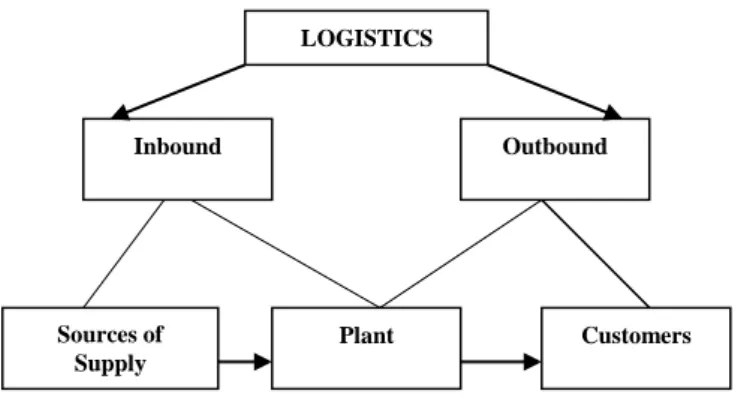
Logistics may be broadly classified into two categories (Figure 1.1), (Introduction, 2019):
1) Inbound logistics; which is concerned with the smooth and cost effective inflow of materials and other inputs (that are needed in the manufacturing process) from suppliers to the plant. For proper management of inbound logistics, the management has to maintain a continuous interface with suppliers (vendors).
2) Outbound logistics (also called physical distribution management or supply chain management); is associated with the flow of finished goods and other related information from the firm to the customer. For proper management of outbound logistics, the management has to maintain a continuous interface with transport operators and channels of distribution.
Figure 1.1 – Scope of logistical activities (Introduction, 2019).
Depending on the services performed by logisticians, the main fields of logistics can be broken down as follows (Pierre A. David et al., 2010):
1) Procurement logistics. 2) Distribution logistics. Sources of Supply LOGISTICS Inbound Outbound Plant Customers
12 3) After-sales logistics. 4) Disposal logistics. 5) Reverse logistics. 6) Green logistics. 7) Global logistics. 8) Domestic logistics. 9) Production Logistics. 10) Construction Logistics. 11) Capital Project Logistics. 12) Digital Logistics.
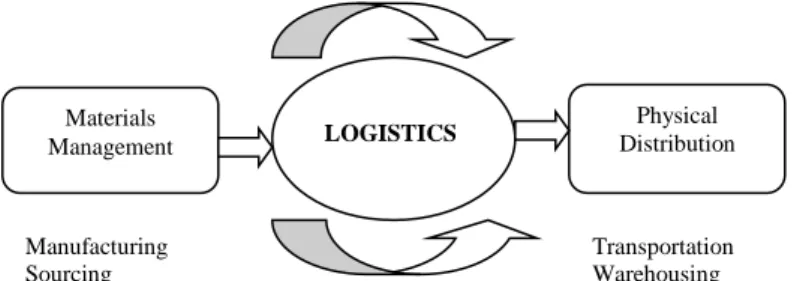
According to the Council of Logistics Management, logistics is the management process of planning, implementing and controlling the physical and information flows concerned with materials and finished goods from the point of origin to the point of usage (Figure 1.2). International logistics involves the management of object-logistic flows in a company's supply chain across at least the one international border (Pierre A. David et al., 2010).
Figure 1.2 – “Driven by demand” Logistics activities (Pierre A. David et al., 2010).
Example
Let us look at a simple example. Just pretend for a moment that you work as a logistics manager for a large American jewelry company based out of New York. Your company has an extensive international supply chain. We will walk through a simplified logistical process for a diamond
LOGISTICS Materials Management Physical Distribution Induced Demand Derived Demand Manufacturing Sourcing Inventory Packing Recycling/Reusing Transportation Warehousing Wholesale Retail
13
ring.
Your diamond supplier is in South Africa. You get your gold from a supplier in China. The jewelry itself is assembled in Switzerland. Your job is to manage the supply chain from acquisition of a resource through its transformation into a finished product and until it is sold to a customer. Your responsibilities may include the following:
1) Oversight of diamonds purchase in South Africa and gold necessary from China to fulfill the company's production demands.
2) Arranging for the temporary warehousing of the purchased diamonds and gold at local storage facilities.
3) Arranging for the international shipping of the gold stored in China to a subsidiary in a small Eastern European country, where the gold will be refined and prepared for the jewelers in Geneva.
4) Arranging for the international shipping of the diamonds stored in South Africa to the company's facilities in Geneva for cutting and polishing. 5) Arranging for the international shipping of the refined gold to the company's Geneva facility to create rings and settings.
6) Once the rings are finished, arranging for their warehousing at the company's central warehouse until they are needed to fill orders, keeping meticulous computerized inventory records, and ensuring the facility is adequately secured.
7) Arranging for the shipment of an order of diamond rings to the company's flagship Manhattan retail store.
8. Continued monitoring of the inventory at the retail store until the product is sold to a customer (Business Management, 2019).
Key activities involved in the International Logistics (Introduction, 2019; Pierre A. David et al., 2010):
1) Network design: network design is one of the prime responsibilities of logistics management. This network is required to determine the number and location of manufacturing plants, warehouses, material handling equipment’s etc. on which logistical efficiency depends.
2) Order processing: customers’ orders are very important in logistics management. Order processing includes activities for receiving, handling, filing, recording of orders. Herein, management has to ensure that order processing is accurate, reliable and fast. Further, management has to minimize the time between receipt of orders and date of dispatch of the consignment to ensure speedy processing of the order. Delays in execution of orders can become serious grounds for customer dissatisfaction; which must be avoided at all costs.
14
suppliers. It includes supply sourcing, negotiation, order placement, inbound transportation, receiving and inspection, storage and handling etc. Its main objective is to support manufacturing, by providing timely supplies of qualitative materials, at the lowest possible cost.
4) Material handling: it involves the activities of handling raw-materials, parts, semi-finished and finished goods into and out of plant, warehouses and transportation terminals. Management has to ensure that the raw-materials, parts, semi-finished and finished goods are handled properly to minimize losses due to breakage, spoilage etc. Further, the management has to minimize the handling costs and the time involved in material handling. Material handling systems, in logistics management are divided into three categories: mechanized systems; semi-automated systems; automated systems.
5) Inventory management: the basic objective of inventory management is to minimize the amount of working capital blocked in inventories; and at the same time to provide a continuous flow of materials to match production requirements; and to provide timely supplies of goods to meet customers’ demands.
6) Packaging and labeling: packaging and labeling are an important aspect of logistics management. Packaging implies enclosing or encasing a product into suitable packets or containers, for easy and convenient handling of the product by both, the seller and specially the buyer. Labeling is a strong sales promotion tool. The consumer who is persuaded to read the label may, in fact, try to buy the product; even though he/she had no such premeditation (advance idea).
7) Warehousing: storage or warehousing is that logistical activity which creates time utility by storing goods from the time of production till the time these are needed by ultimate consumers. Here, the management has to decide about: the number and type of warehouses needed and the location of warehouses. It depends on the desired level of customer service and the distance between the supply source and final destination i.e. markets.
8) Transportation: transportation is that logistical activity which creates place utility.
The main participants (elements) of the supply chain of International Logistics may be as follows: producers, supplier (venndor), exporter of goods and services; customs broker, importer of goods and services, end - user, freight forwarding companies, warehouse complexes, distributors, wholesalers, retailers, companies or individuals who are the final consumers of a product.
There are some peculiarities of International Logistics such as (Pierre A. David et al., 2010):
15 1) Specificity.
2) Export-import operations. 3) Passage of customs formalities.
4) Regulation of delivery orders, delivery point, delivery schedule and terms, under contracts of purchase on the basis of Incoterms and international rules of carriage conditions.
5) Registration of transport, goods and accompanying documents. 6) Insurance.
The peculiarities and complexity of international logistics are defined by
the formula «four D»: differentiation of means of transport; documentation; differentiation of cultures; dictatorship of consumer's demand.
1.3. Logistics in the Enterprise Management System
Logistics is the management which synchronizes such providing activities as procurement, production, sales, and distribution with demands. It aims to enhance corporate competitiveness and increase corporate value by realizing fulfillment of customers’ satisfaction, cutback of unprofitable inventory and minimization of its transfer, and reduction of supply costs (Logistics Concept, 2006; Logistics Management, 2019; Stock R. James and Lambert M. Douglas, 2001).
Logistics management consists of the process of planning, implementing and controlling the efficient flow of raw-materials, work-in-progress and finished goods and related information-from point of origin to point of consumption; with a view to provide satisfaction to the customer (Logistics Management,2019).
The concept of logistics is defined as a system of views to improve the production and economic activity of the enterprise through the streamlining of management of flow processes.
The modern concept of logistics is considered through study of its properties, based on categories of thinking, oriented on value and utility; system approach; total (full) expenses; service and efficiency (Figure 1.3).
16
Figure 1.3 – Properties of the logistics system(Berzhanir et al., 2009) Such providing actions as procurement, production, sales, and distribution were managed based on sector-specific evaluation indicators in the past. These optimum activities for individual sectors resulted in significant managerial losses including stock shortage, and excessive or bad inventory. Under the circumstances where synchronization of providing actions with trends for demands was required in order to eliminate such losses, logistics as management optimizing the entire providing actions developed. In logistics, all the providing actions function to synchronize with trends for demands (Logistics Concept, 2006).
For management, logistics is required to contribute to gain in profits by cutting down supply costs, and the reduction of assets by lowering inventory.
During the process of formation and development of logistics there was a consistent change in the perceptions about the essence of its concept and methodology, as a response to the change of priorities and the consumer market needs (Figure 1.4).
Factors of production (work, means of
production, information)
Delivery (to the right place, at the right time,
in the right quantity, with the right
quality) Logistics System Tasks: • processing orders; • transportation; • warehousing; • packaging; • designation; • inventory management; • customer service Exit Entrance
Logistics costs Logistics
17
Figure 1.4 – The main stages of logistics formation as a concept of enterprise management (Berzhanir et al., 2009)
Logistics in the enterprise management system:
1) supports the market orientation of the company, aims at offering the best service to the customers (level and quality of service);
2) contributes to increasing the transparency of the market, as well as the elasticity and ability of enterprises to adapt to changing market conditions;
2) focuses on the promotion of sales and services; 3) aims to use synergies and effects;
4) provides the opportunity to solve problems arising at the junctions of movement of goods and information with other spheres in the enterprise (marketing, production, finance, personnel, etc.);
5) generates and stimulates the management efficiency (Logistics Management, 2019).
The main logistics strategies in the enterprise management system are considered in Table 1.1. Global Integration (90s years of the 20th century) Fragmental connections (60s years of the 20th century) Integrated connections (80s of the 20th century) Demand Prediction Purchase Consumer requirements analysis Inventory of products Warehousing Cargo processing Packaging Distribution Distribution planning The rule of orders Transport Customer service
Information control of the formation and
movement of material and financial flows Organization and management of physical distribution Integrated Logistics
18
Table 1.1 – The main logistics strategies
Source: (Stock R. James and Lambert M. Douglas, 2001; Coyle J.J. et al., 1992; Jonson J.C. and Wood D.F, 1990).
Strategy Ways of realization
Minimizing total logistics costs Reduction of logistics costs in separate logistic functions;
Optimization of stock levels in the logistics system;
Choosing the best options for "warehousing - transportation" (switching from one logistic function to an alternative);
Optimization of solutions in selected functional areas and / or logistic functions on the criterion of minimum logistic costs; 3PL approach, etc.
Improving the quality of logistics operations and functions (transportation, warehousing, cargo handling, packaging, etc.);
Support for pre-sale and after-sales service; Value-added service;
Use of logistic technologies to support the product life cycle;
Creation of a quality management system for logistics services;
Certification of the firm's quality management system in accordance with national and international standards and procedures (in particular ISO 9000); Benchmarking etc.
Minimizing investment in logistics infrastructure
Optimize the configuration of the logistics network:
direct delivery of goods to consumers, bypassing warehousing;
use of warehouses of general use;
use of logistic intermediaries in transportation, storage, cargo processing; the use of logistics technology "Just in Time";
optimization of the location of logistics infrastructure objects, etc.
Logistics outsourcing The decision to "make or buy";
Concentration of the company in its key areas of competence, search of logistic intermediaries to perform non-key functions; Optimize the choice of sources of external resources;
Optimal disposition of production capacities and objects of logistic infrastructure; Application of innovations of suppliers; optimizing the number of logistic intermediaries and fixing their functions.
19
The relationship between Logistics and Management can be presented as follows (Logistics Management, 2019; Martin Christopher, 2010; Alan Harrison et al., 2019):
1) Creation and evaluation of logistics business management indicators. For management, logistics contributes to an increase in cash flow and Return On Assets (ROA) by reducing inventory assets through appropriate inventory and supply costs and by improving the total asset turnover. It is necessary to reorganize businesses from a logistics point of view in the relationship with each sector such as procurement, production, sales, and distribution as well as business partners, and to create, manage, and operate evaluation indicators such as KPI (Key Performance Indicator).
2) Training for a Chief Logistics Officer (CLO) and restructure of organization functions. In order to plan and establish optimization of a supply chain as a managerial strategy, training and assignment of a CLO who integrates and manages performances using business management indicators and Key Performance Indicator (KPI) are important issues. At the same time, it is essential to reorganize functions to make logistics work well in management organization.
3) Establishment of appropriate service levels such as conditions of transactions. In order to build a win-win relationship between each company comprising supply chains, it is important to establish appropriate service levels by reviewing conditions of transactions and others, and to minimize costs and environmental load.
Self-control Questions:
1. How did the term “logistics” originate and what are its dictionary definitions?
2. Is there a generally accepted (standard) definition of logistics? 3. What is a contemporary interpretation of logistics from the position of business?
4. What is the object of research in logistics? 5. What is the subject of research in logistics?
6. What are the logistic functions and how are they classified?
7. Why are the logistic functions divided into the key and supporting ones?
8. What parameters characterize the key logistic functions?
9. What is the role of logistics in the enterprise management system? 10. What is the main distinction between the national and international logistics?
20
Chapter 2. Conceptual Foundations of International Logistics 2.1. Supply Chain Management as a Strategic Business Concept 2.2. International Logistics System and Logistics Cycle
2.3. Organization of Logistics Flows
2.1. Supply Chain Management as a Strategic Business Concept
Supply Chain Management (SCM) is the integration of key business processes that begin with the final end user and cover all suppliers of goods, services and information that add value to consumers and other stakeholders (Handfield R. et al.,2013).
Supply Chain Management encompasses the planning and management of all activities involved in sourcing and procurement, conversion, and all logistics management activities.
Supply Chain Management (SCM) is the integration of eight key business processes such as (V. Misra et al., 2010):
1) Management of relations with consumers. 2) Customer service.
3) Demand management.
4) Management of orders execution. 5) Support of production processes. 6) Supply management.
7)Management of product development and its derivation for commercial use.
8)Management of material flows.
Logistics management as a part of the supply chain management includes plans, implements, and controls the efficient, effective forward and reverse flow and storage of goods, services and related information between the point of origin and the point of consumption in order to meet customers' requirements.
The Supply Chain is defined as the unification of all types of business processes (design, production, sales, service, procurement, distribution, resource management, supporting functions) necessary to meet the demand for products or services - from the initial point of raw materials' receipt or information to the delivery point (Bowman Glossary, 2019). (Figure 2.1).
Supply Chain Management includes coordination and collaboration with channel partners, which can be suppliers, intermediaries, third party service providers, and customers (Professional English, 2015). In essence, supply
21
chain management integrates supply and demand management within and across companies.
Figure 2.1 – Supply Chain Management as a Strategic Business Concept (Ballou, 1992)
Typical tasks for the SCM:
1) Formation of the network structure of raw materials and finished products to reduce operating logistics costs;
2) Optimization of the scheme of transport operations / routes (in terms of costs);
3) The choice made by the manufacturer of the goods for delivery to a specific regional market (Mallik et al., 2010).
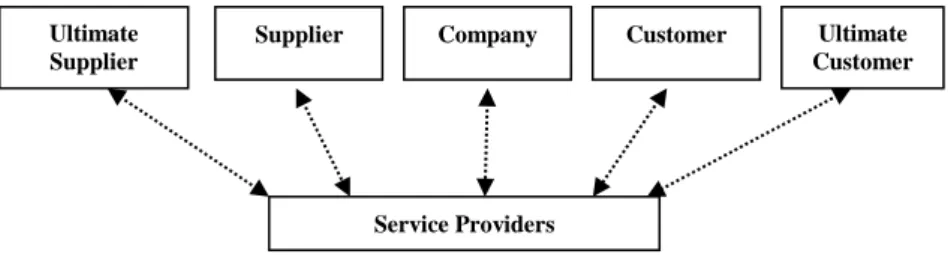
Logistics chain is a linearly ordered number of individuals or legal entities (producers, intermediaries, warehouses, etc.) that perform logistics operations aimed at bringing the external material flow from one logistics system to another or to the end user. In any given supply chain there is some combination of companies who perform different functions (Figure 2.2). There are companies that are producers, companies that are distributors or wholesalers, companies that are retailers, and companies or individuals that are the customers who are the final consumers of a product (Michael H. Hugos, 2018). Acceptance of raw materials, resources Suppliers Buyers Sales in the international market Purchases in the domestic market Purchases in the international market Sales in the domestic market IMPORT EXPORT Unloading goods Manufa cturer-seller: producti on, warranty and post-warranty service of equipme nt inside and outside the country
22
Figure 2.2 – Extended Supply Chain (Michael H.Hugos, 2018)
Producers or manufacurers are organizations that make a product. This includes companies that are producers of raw materials and copmanies that are producers of finished goods (raw materials and sub-assemblies made by other producers to create the products).
Distributors are companies that take inventory in bulk from producers and deliver abundle of related product lines to customers. Distributors are also known as wholesalers. They typically sell to other businesses and they sell products in larger quantities that an individual consumer would usually buy. Distributors buffer the producers from fluctuations in product demand by stocking inventory and doing much of the sales work to find and service customers. A distributor is typically an organization that takes ownership of significant inventories of products that they buy from producers and sell to consumers.
Retailers stock inventory and sell in smaller quantities to the general public. This organization also closely tracks the preferences and demands of the customers that it sells to. It advertises to its customers and often uses some combination of price, product selection, service, and convenience as the primary draw to attract customers for the products it sells.
Customers or consumers are any organization that purchase and use a product. A customer organization may be an organization that purchases a product in order to incorporate it into another product that they in turn sell to other customers. Or a customer maybe final end - user of a product who buys the product in order to consume it.
Ultimate Supplier
Ultimate Customer Extended Supply Chain
Supplier Company Customer
23
2.2. International Logistics System and Logistics Cycle
International logistics system involves process of planning and coordinating all aspects of the physical movement of materials, components and finished products to minimize costs and provide the desired level of service across at least one international border. The logistics system is a network of organizations, people, activities, information, and resources involved in the physical flow of products from supplier to customer (Figure 2.3).
Figure 2.3 – Logistic approach to the formation of enterprise production activity (Berzhanir et al., 2009)
The purpose of international logistics system is to ensure the delivery of goods, services to a given place in the required quantity and assortment, maximally prepared for production or personal consumption at the certain level of costs across at least one international border.
Subjects of the logistics system are industrial and trading enterprises, a set of industrial and infrastructure elements, as well as the links between them at different levels.
Elements of the logistics system are functionally separate objects that are not subject to further division within the framework of the task of analysis and synthesis of the logistic system that fulfill their local target function related to the execution of certain logistic procedures (Kisly et al., 2010).
The objects of logistics system management are the processes, operations and corresponding procedures, which are subject to the forecasting, analysis and management in time and space, which are realized in the logistic system in order to minimize costs, productive inter-system interaction, etc.
Supplier
Consumer r
Logistics system of the enterprise
Intra-productive logistics coordination
De signi ng P ur cha se of mate rial re sour ce s P roduc tion Dis tr ibut ion M ar ke ti ng
24
Macrologistics system is a large economic system of flow management, which includes enterprises and organizations of industry, supply and marketing, transport and other intermediary structures of different departments and forms of ownership, not limited to the territorial location.
Micrologistics system is an economic system that covers the internal logistics area of one enterprise or a group of enterprises united on corporate foundations.
The logistics channel is a partially ordered set of various intermediaries that implement the proof of the material flow from a particular manufacturer to its customers.
Logistic networks are logistic entities of interconnected units, which combine several logistic chains.
The length of channel determines the number of levels. The level of the distribution channel is any intermediary performing one or another work on the approach of the product and ownership of it to the final end user.
The width of channel - the number of intermediaries at each level of the distribution channel. It is worth knowing that between the participants of the same channel, as well as between different channels, can be observed different degrees of cooperation; conflicts; competition (Terminology, 1994).
The key to improve supply chain management is in making accurate forecasts to customer demand and managing the interactions betweenproducers, distributors and retailers so as to meet customer demand. And to do so at the lowest operating costs and lowest amounts of on-hand inventory at facilities across the supply chain (Bowersox, 1996; Christofer Martin, 1998).
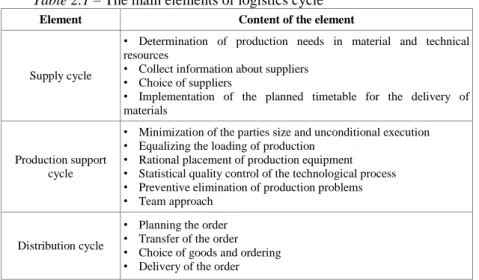
Logistics cycle is a repeating, completed and related process that transforms the purpose (satisfaction of the end user's needs) into a certain intended result of the demand (product, object and object). The logistics cycle essentially defines the structural basis of the logistics system(Table 2.1). It is determined by such main functional resources of logistics as supply, production support and distribution (Jonson J.C. and Wood D.F., 1990; Gorbenko, 2014).
25
Table 2.1 – The main elements of logistics cycle
Element Content of the element
Supply cycle
• Determination of production needs in material and technical resources
• Collect information about suppliers
• Choice of suppliers
• Implementation of the planned timetable for the delivery of materials
Production support cycle
• Minimization of the parties size and unconditional execution
• Equalizing the loading of production
• Rational placement of production equipment
• Statistical quality control of the technological process
• Preventive elimination of production problems
• Team approach
Distribution cycle
• Planning the order
• Transfer of the order
• Choice of goods and ordering
• Delivery of the order
Source: (Berzhanir, 2009; Corporate Logistics, 2005) 2.3. Organization of Logistics Flows
Flow is a set of objects that exists in a certain period of time, perceived as a whole, and measured in absolute units for a certain time. Each flow has the following parameters: a) initial and final items; b) geometry (trajectory) of the path; c) path length; d) movement speed and time; e) intermediate points; f) traffic intensity.
Material flows form the basis of logistics flows. Material flows are material resources (MR), incomplete production (IP) and finished products (FP), to which the logistic activities related to their physical movement in space are applied: loading, unloading, docking, crossdocking, transportation, sorting, consolidation, divestment, etc.
The material flow is characterized by a certain set of parameters and can be classified according to different criteria (nomenclature, assortment and quantity of goods items; weight properties (total weight, gross weight, net weight); physical and chemical characteristics of the cargo; characteristics of the container (packaging), commodity carrier, vehicle (loading capacity, cargo capacity); terms and conditions of sale and purchase agreements (transfer to ownership, delivery);conditions of transportation and insurance; financial (cost) characteristics).
In logistics processes, there are two types of services flows: 1) logistics service of material flow in production; 2) flows in service industries.
26
parameters as: a) tangibility; b) responsibility; c) reliability; d) competence; e) accessibility; f) security; g) correctness; g) sociability. All these parameters are quite difficult to measure and quantify. It is associated with the difficulties of forming the logistics of services. Despite this a special direction of logistics - SRL (Service Response Logistics - services logistics, has beendeveloped, which differs from CRL (Commodity Response Logistics).
Service flows are the service flows (intangible, special type of product or activity) generated by the logistics system as a whole or its subsystem (link, element) in order to meet external or internal consumers of business organization.
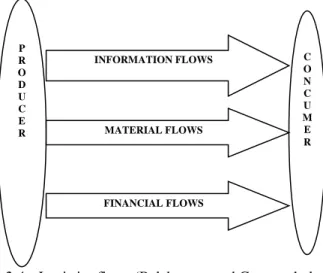
Organization of Logistics Flows can be presented as follows (Figure 2.4).
Organization of Logistics Flows
Figure 2.4 – Logistics flows (Balabanova and Germanchuk, 2012).
Financial flows are the directed flows of financial resources associated with material, informational and other flows both within and outside the logistics chain. Financial flows arise from the reimbursement of logistic costs and expenses.
Financial flows are classified according to seven characteristics:
1) in relation to the logistics system: a) internal; b) external; c) incoming; d) outcoming;
2) by purpose: a) the scope of supply; b) sales areas; c) investment; P R O D U C E R C O N C U M E R INFORMATION FLOWS MATERIAL FLOWS FINANCIAL FLOWS
27
d) material costs in the production process; e) labor reproduction;
3) by the method of transfer of the advanced cost: a) flows related fixed assets of the enterprise; b) flows due to the movement of circulating funds of the enterprise;
4) by the form of transactions: a) cash (currency); b) information and financial;
5) by types of economic relations: a) horizontal; b) vertical; 6) by source of receipt: a) own; b) borrowed;
7) by the direction of movement: a) coincided with the material flow; b) by reverse direction.
Information flows must accompany material flows. Information flows
are messages in oral, document (paper and electronic) and other forms, the accompanying material or service flows (Gadzhinsky, 2004). The main features of information flows are the nomenclature of transmitted messages, data types, documents; intensity and speed of data transmission; specific properties.
Self-control Questions:
1. What is the essence of a «Supply Chain Management» concept? 2. What is a logistics system?
3. What is a logistics chain? 4. What is a logistics channel? 5. What is a logistics network? 6. What is a logistics process? 7. What is a logistics cycle?
8. What is a material flow and what are its main characteristics? 9. How to classify the material flows?
10. What are the services flows from the position of logistics, what are their main characteristics?
11. What is a financial flow?
12. What main characteristics define financial flow? 13. How to classify the financial flows?
28
Chapter 3. International Aspects of Procurement Logistics 3.1. Theoretical Foundations of Procurement Logistics 3.2. Basic Approaches to Choosing a Supplier
3.3. The “Just-in-Time” Logistics
3.1. Theoretical Foundations of Procurement Logistics
Procurement Logistics is the management of material flows in the process of providing the company with the material resources.
International Procurement Logistics is associated with the processes of purchasing raw materials, components and semi-finished products outside the country (Peter Baily et al., 2006).
The main purpose of Procurement Logistics is to meet the needs of production in raw materials, semi-finished products with the maximum possible efficiency.
The basic tasks of Procurement Logistics are (Peter Baily et al., 2006; Learn about, 2018):
to establish the optimal terms for raw materials and component parts for supplying;
to ensure the exact relationships between the number of deliveries of the finished products and needs in them;
to comply with production requirements for quality of raw materials and component parts.
The main questions:
what to buy;
how much to buy;
for whom to buy;
on what conditions to purchase. List of the key tasks:
how systematically to associate purchases with production and sales;
29
3.2. Basic Approaches to Choosing a Supplier There are two ways to choose a supplier:
1) Selection of a supplier from among the companies that were already your suppliers and with which business relationships have already been established.
The main stages of this task:
to collect the information about suppliers;
to analyze the information based on the selection criteria of the supplier;
to make decisions about choosing a supplier.
2) Selection of a new supplier as a result of search and analysis of the market: a market with which the company has already been working or a completely new market (Каlchenko, 2006; Kisly et al., 2010).
Search for potential suppliers.
announcement of the competition;
study of promotional materials: corporate catalogs, advertisements in the media, etc.
visiting exhibitions and fairs;
correspondence and personal contacts with potential suppliers. Selection criteria of potential supplier analysis
remoteness of the supplier from the consumer;
terms of execution of current and extra orders;
availability of reserve capacities;
organization of quality management with the supplier;
psychological climate of the supplier;
ability to ensure the supply of spare parts throughout the life of the supplied equipment;
financial position of the supplier.
There are several common methods to choose a supplier: cost-ratio; dominant characteristics; preference categories; rating assessment of factors, etc (Каlchenko, 2006; Kisly et al., 2010).
In most cases, rating system is used to select suppliers’ assessment of their compliance with the criteria / factors, such as (Каlchenko, 2006):
1) Reliable delivery. 2) Quality assurance. 3) Production capacity. 4) Prices. 5) Location. 6) Technical potential.
30 7) Financial position.
8) The possibility of compromise.
9) Availability of an information system for communication. 10)After-sales service.
11)Reputation and role in the industry. 12)Business initiative.
13)Management and organization. 14)Process control.
15)Attitude to the buyer. 16)Image.
17)Registration of goods (packaging). 18)Labor Relations.
19)Business experience and relationship history. 20)Supporting documents and instructions.
As a result of the analysis of potential suppliers, a list of specific suppliers is being formed with which the work on concluding contractual relations is carried out.
The supplier's rating R can be defined as (Leenders et al., 1989):
n i і іk
c
R
1,
(3.1)Where n - the number of indicators of the supplier's rating; kі - the
significance of the indicator; сі- point assessment of the value provided by the supplier.
Economic Order Quantity (EOQ) is the quantity of a product that should be ordered so as to minimize the total cost that includes ordering costs and inventory holding costs. The basis to determine the supplier in the procurement logistics is to use the indicator of the economic (optimal) order quantity (William C.Copacino, 1993).
Economic Order Quantity (EOQ) is determined by the formula obtained by F.U. Harris. However, in the theory of inventory management, it is more commonly known as the Wilson's formula:
U × C S × C × 2 = EOQ i 0 (3.2)
Where EOQ – economic order quantity, units; С0 - cost of the order execution, UAH;
31 S - annual sales, units;
U - a share of storage costs in a unit's price.
This is deduced by differentiating and finding the minimum for the equation for the total annual cost, which comprises of the variable purchase cost, the ordering cost and the inventory holding cost. But the EOQ does not depend on the purchase cost as it remains constant for the same annual demand whatever be the order quantity (Каlchenko, 2006)
With increasing order quantity, the number of orders to be placed in the year decreases and thus the ordering cost decreases but at the same time the inventory holding cost goes on increasing. At the EOQ value, the total cost comprising of both these costs is at its minimum value.
3.3. The “Just-in-Time” Logistics
JIT stands for Just in Time, is system in operation management under which the production is made as per the demand at a particular moment. There is no prior production for any anticipated demand. This was pioneered by Toyota at their facility (Just-in-Time, 2019; C. Carl Pegels, 1984).
The aim is to reduce non profitable activities and make the manufacturing system more flexible, eliminating the associated costs of carrying and maintaining the inventory. There is no scope for Inventory what so ever. The Just-in-Time (JIT) methodology owes its name to the philosophy of doing only what is necessary when it is necessary and in which the amount is necessary.
The JIT delivery system is a delivery system that is based on synchronizing the delivery of material resources in the required quantity and at a time when the logistics system needs them, in order to minimize the costs associated with inventory creation.
There are various methods in which JIT can be achieved. However, all these methods are important but not exhaustive (Just-in-Time, 2019):
1) Elimination of defects and waste.
2) Balancing the flow and scheduling the output.
3) Multi-skilled labor force to carry out specific operations.
4) Maintenance of equipment and machinery for flawless operations. 5) Cellular manufacturing i.e. making in small batch sizes.
6) Streamlined design and process flows & layouts
One of the core ideas of the Just-in-Time management system is the elimination of unnecessary tasks.
32
organizations who have adopted JIT. Some of the advantages of JIT are mentioned below as follows (Just-in-Time, 2019):
1) Reduced setup time and low wastage.
2) The flow of goods from warehouse to shelves improves. 3) Employees with multiple skills are used more efficiently. 4) Increased emphasis on supplier relationships.
5) Minimizes storage space needed thereby saving warehousing costs. 6) Smaller chance of inventory breaking/expiring.
Disadvantages of JIT System (Just-in-Time, 2019):
1) Low stocks make any failures in the critical logistics system.
2) The introduction of the system may require major changes, which are difficult to achieve in practice.
3) High transport costs.
4) High dependence on one supplier (non-compliance with delivery terms may be loss of production).
5) High dependence on material quality (incoming control costs, claims).
6) A permanent information exchange is required (the obligation to confirm the financial status of the supplier and the producer).
7) The need for suppliers to move production and warehouses closer to the consumer.
8) Large losses from suppliers from specialization in crisis situations. Historical facts. The origin of the “Just-in-Time” system.
During the 50s and most part of the 60s and 70s, Japan was developing and perfecting production systems which allowed greater efficiency, a faster response in the market and less need to store a large amount of inventory in the factory. Outstanding was the system promoted by the Toyota car manufacturing plants which came to be known as the TPS (Toyota Production System) or simply Just-in-Time. It was not until the 80s that this system spread to Western factories.
In its origins, the norm is that the factories follow a push system in which each phase in the manufacturing process accumulates its production which would then be removed by the following phase (Just-in-Time, 2019; C. Carl Pegels, 1984). The great revolution of the Just-in-Time system as a system was that it followed a pull system in which each phase of the production asked the previous phase for what it needed when it needed it. In this way, they only produced what was necessary when it was really necessary and in necessary amounts, reducing the accumulation of inventory to a minimum. The Kanban system, based on cards, was created
33
to communicate the demands of one phase to the previous phase. It was necessary to optimise all the production phases as well as a coordinated operation with suppliers and customers (Just-in-Time, 2019).
Example
In Japanese plants of automobile manufacturers’ inventory measured in days of production ranges from three to four days. Second, the lead time required to produce a part or subassembly is reduced considerably. The benefit of this is considerable in case of necessary design changes or modifications because of design errors or weaknesses. It has been reported that in one of the Japanese automobile engine plants the engine block that is cast early in the morning appears in a finished and functioning automobile engine at night. Third, with just-in-time production there is no surplus parts production, and no lost parts, which even if they are found later may have to be scrapped. Fourth, just-in-time production requires that all parts are in-process and "visible" at all time. Hence, there is no need for parts or subassembly expeditors. Finally, the low inventory level significantly lowers the cost of holding inventory, including the storage space required to store in-process inventory (C. Carl Pegels, 1984).
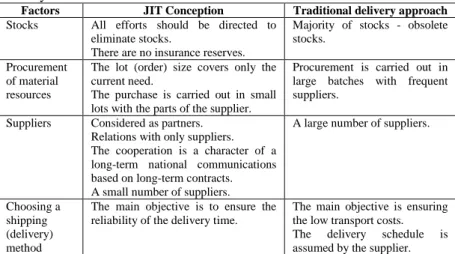
One of the core ideas of the Just-in-Time management system is the elimination of unnecessary tasks comparing with traditional delivery approach(Table 3.1).
Table 3.1 – Comparative peculiarities of traditional delivery and «JIT» delivery
Factors JIT Conception Traditional delivery approach
Stocks All efforts should be directed to eliminate stocks.
There are no insurance reserves.
Majority of stocks - obsolete stocks.
Procurement of material resources
The lot (order) size covers only the current need.
The purchase is carried out in small lots with the parts of the supplier.
Procurement is carried out in large batches with frequent suppliers.
Suppliers Considered as partners. Relations with only suppliers. The cooperation is a character of a long-term national communications based on long-term contracts. A small number of suppliers.
A large number of suppliers.
Choosing a shipping (delivery) method
The main objective is to ensure the reliability of the delivery time.
The main objective is ensuring the low transport costs. The delivery schedule is assumed by the supplier.
34
Production quality
The main purpose is the absence of defects in products.
The controlling quality process is made and assumed by the supplier.
A small number of defects (up to 2%) is allowed.
Quality control is carried out by the seller, who bears responsibility for it.
Source: (Handfield et al., 2013; Kisly et al., 2010).
The international experience has shown that the JIT strategy is not universal and is not always used. Its implementation is hampered by such important factors as poor quality of products, violation of the terms of delivery and payment for goods, errors and failures in the transfer of information between the customer and suppliers.
Example
The well-known American motorcycle manufacturer, Harley-Davidson, faced worsening competition with Japanese companies in the 1970s: Honda, Yamaha, Suzuki and Kawasaki. Most of the previously stable companies in this area went bankrupt. Four Japanese companies could supply their motorcycles to virtually anywhere in the world with higher quality and at a lower price than their competitors. In 1978 Harley-Davidson tried to prove to the court that Japanese companies are selling motorcycles at dumped prices, which is lower than their cost. But during court hearings it became clear that operational expenses from Japanese companies were 30% lower than that of Harley-Davidson. Therefore, in 1982, Harley-Davidson began developing and implementing the "materials as needed" program, an analogue of JIT. At first, the company faced difficulties, but over the past 5 years, it reduced the time needed to change equipment by 75%, reduced warranty costs and waste related expenses by 60%, and reduced inventories of work in progress by $ 22 million. During the same period, the company's productivity has increased by 30%, and now the company is successful in the market.
Successful implementation of the JIT strategy also depends on their number and territorial location of suppliers, the level of their irresponsibility when performing contractual obligations. Therefore, the huge costs associated with the implementation of the procurement method precisely in time, effective only in stable operating economies, subject to long-term economic relations.
An important requirement of just-in-time production is the production of defect free parts, subassemblies and finished goods. Just one defect in a long chain of parts can create havoc in a production system that depends on
35 just-in-time production.
The method to control quality and eliminate defects is called autonomation. It is a term coined by the Japanese and refers to the autonomous and automatic or manual inspection of all parts, components, and assemblies (C. Carl Pegels, 1984).
Self-control Questions:
1. What is “procurement” and what terms describe these activities? 2. What are the goals of logistics management in the procurement process?
3. What are the features of purchase process at an industrial enterprise? 4. What are the specific features of procurement process for trading companies?
5. What are typical objectives of procurement at an industrial company? 6. How should an industrial firm establish the relationships between the spheres of management within the procurement?
7. How do a procurement department and other company's functional subdivisions cooperate among themselves?
8. What does constitute a process of choosing a supplier in a company's procurement activity?
9. What factors have to be taken into account in choosing a supplier for an industrial company?
10. What does constitute a general procedure (algorithm) of choosing a supplier?
11. What is Economic Order Quantity?