University of Nebraska - Lincoln
DigitalCommons@University of Nebraska - Lincoln
Library Philosophy and Practice (e-journal) Libraries at University of Nebraska-Lincoln
5-22-2014
Spanish Journals of Education & Educational
Research in the JCR: A bibliometric analysis of the
citations
Alexander Maz-Machado
Universidad de Córdoba, Spain, [email protected]
Noelia Noelia Jiménez-Fanjul
Universidad de Córdoba, Spain, [email protected]
Natividad Adamuz-Povedano
Universidad de Cordoba - Spain, [email protected]
Follow this and additional works at:http://digitalcommons.unl.edu/libphilprac
Part of theLibrary and Information Science Commons
Maz-Machado, Alexander; Jiménez-Fanjul, Noelia Noelia; and Adamuz-Povedano, Natividad, "Spanish Journals of Education & Educational Research in the JCR: A bibliometric analysis of the citations" (2014).Library Philosophy and Practice (e-journal).Paper 1121.
Spanish Journals of Education & Educational Research in the JCR:
A bibliometric analysis of the citations
Alexander Maz-Machado, Noelia Jiménez-Fanjul Natividad Adamuz-Povedano Faculty of Education Sciences University of Córdoba
Córdoba, Spain.
Abstract:
This paper analyses the citation patterns of the Education & Educational research Spanish journals within the Journal Citation Report (JCR). The analysis is based on
four indicators: the references’ type percentage, the mean reference per documents, the mean reference age and the journals’ citation frequency. The results show that the mean reference age is higher than eleven years. Moreover, the citation to journals represent less than the half of the total amount of references.
Keywords:
Bibliometrics, Citation patterns, Spanish journals; Education research.
Introduction
It is widely known that the citations of a scientific publication are a main aspect to assess its relevance. The citation analysis is defined as the quantification of bibliographic information for use in analysis (Pritchard, 1969). In the Information Science field, the citations are a good source so as to identify the most cited journals and authors within a given scientific discipline. In a scientific research work, they also establish the theoretical framework of the research work, showing the current state of the art. Inside a given scientific research field, the citation analysis reveals which are the most influencing articles, journals and authors through several indicators such as the citation frequency and co-citation centrality.
Thus, all the information extracted from the citations lets us study a wide range of questions and bibliometric problems. Nevertheless, we shouldn’t forget that, as Woulters (1999) states, the articles’ references are produced by the science itself whereas the citations are by the measurement techniques of the Bibliometry.
On the other hand, due to the fact that scientific journals are the main way for spreading research results, these have been targeted in many analyses. In some cases, the scientific production of a specific field or research topic is analysed through a set of journals (Mahapatra, 1994; Yang & Lee, 2012), in others, it is compared the scientific production of several countries (Gupta & Mahesh, 2013). Other works are focus on the study of a group of journals published within a country or geographical region (Agudelo, Bretón-López, & Buela-Casal, 2003; González-Alcaide, 2010; Haddow & Genoni, 2009), or specific journals of a research field (Barik & Jena, 2013; Jiménez-Fanjul, Maz-Machado, & Bracho-López, 2013; Roy & Basak, 2013). In some other researches, the journals are analysed basing in authors’ gender (Håkanson, 2005) as well as the impact factor (Togia & Tsigilis, 2006).
In several of the aforementioned studies, the citation has been analysed because the citation frequency is being established as an indicator to assess the relevance and success of authors, research groups or institutions (Bornmann, Mutz, Neuhaus, & Daniel, 2008; Haddow & Genoni, 2010). Therefore, researchers have studied how the auto-citation affects the impact factor of a journal (Campanario, 2010; Campanario & Candelario, 2010; Rattan, 2013).
The citation analysis entails several difficulties all due to the way the databases process the reference information of the articles for creating the metadata. They only copy the reference information as it appears in the article, as the author wrote. This implies, as identified by several authors, some problems such as: variants in the name of a journal, errors in authors’ name or multiple authors with the same name (homonyms) (Borgman & Siegfrield, 1992; Moed, 2005). Often, the errors in the authors’ names are caused by typographical variation while transliterating from one alphabet to another (Moed, 2005). Another source of errors is that when the data are been incorporated to a data base index, such as the SSCI, some information is missed or miswritten: volume numbers,
number pages, or different abbreviated notations for the same journal (Glänzel & Schoepflin, 1999), even more when the cited journal is not indexed in the data base. Due to the fact that in the last decade the Social Sciences Citation Index (SSCI) has
been incorporating new journals from non-English countries, it is appropriate to study the behaviour of the specific journals for a scientific field analysing their references’ patterns. Therefore we select all the Spanish journals indexed in the Journal Citation Report (JCR) within the subject category Education & Educational Research.
Objectives
The main purposes of the study are to:
• Find out the rate of citations per article in Spanish Journals inside the category of Education & Educational Research indexed in the JCR.
• Determine the average references age in these journals.
• Reveal the types of cited documents.
• Determine the most cited journal. Materials and Methods
Firstly, the Spanish journals indexed in the JCR inside the Education & Educational Research category were identified, finding only 10 journal tittles: Revista de Educación, Comunicar, Infancia y Aprendizaje, Revista Española de Pedagogía, Cultura y Educación, Enseñanza de las Ciencias, Porta Linguarum, ESE Estudios Sobre Educación, Revista de Psicodidáctica, Educación XXI. Secondly, the metadata of all the
documents published in any of these ten beforesaid journals were downloaded from the database Social Science Citatión Index (SSCI), accessed through the Web of Science
(WoS). 2536 documents ranging from article, book review, editorial material, review, biographical item, proceedings paper to correction were obtained. The database was accessed on August 2013. We decided to reduce the sample by focusing on the articles and reviews only: 1772 documents. Henceforth we refer to any of both documents as documents.
For the analysis we used Bibexcel, a versatile bibliometric toolbox developed by Olle Persson (Persson, Danell and Sneider 2009). For the analysis, all references were listed
and grouped by document type (categories): journals, books, conference proceedings, report, unpublished dissertations/theses, government documents, and newspaper.
In order to assign a category to each reference, we took into account the structured given to each one by the SSCI. For instance, the references for journal articles are written in the SSCI as: First Author Last name and First name’s letter, year, journal’s abbreviated tittle, volume, first page, DOI (e.g. CARPENTER TP, 1981, J RES MATH EDUC, V12, P27, DOI 10.2307/748656). A book reference would follow the following pattern, as shown in the next example: SCHOENFELD AH, 1985, MATH PROBLEM SOLVING. That way we can distinguish between books and articles by seeking for volume number and first page. If we find them, the reference is an article, otherwise is a book. These last references were treated in two ways, manually and based on computer procedures for determine the type of reference: books, conference proceedings, report, dissertations/theses, and government documents.
The age of the references was determined as the difference between the publication year of the reference and the citing article. When the publication year is not presented in a reference is, for being an in-press article or not published document, for instance, we assigned the same publication year as the citing article.
Results and discussion
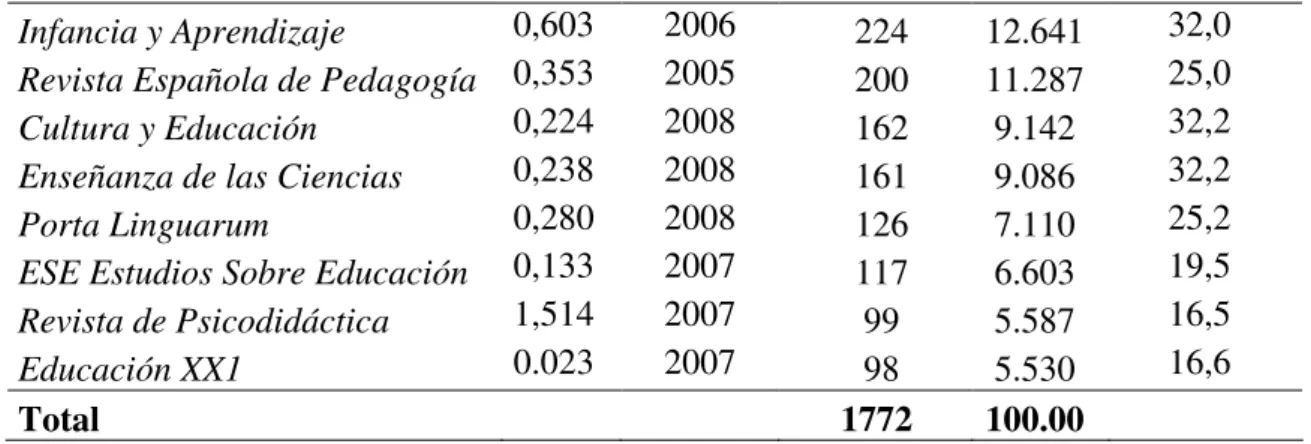
These ten journals contained 1772 documents (articles and reviews). The Revista de Educación journal has the highest number of documents published between 2005 and
2012 (Table 1). The four most prolific journals represents the 56,94% of all the Spanish production de within the Education & Educational Research category of the SSCI. As
we can see, the journals in the sample have an average ranging from 16,6 up to 66 documents published per year.
Table 1. Documents per journal
Journal IF 2012 First indexed by SSCI in Documents % of 1772 Documents per year Revista de Educación 0,309 2008 330 18.623 66,0 Comunicar 0,350 2007 255 14.391 42,5
Infancia y Aprendizaje 0,603 2006 224 12.641 32,0 Revista Española de Pedagogía 0,353 2005 200 11.287 25,0 Cultura y Educación 0,224 2008 162 9.142 32,2 Enseñanza de las Ciencias 0,238 2008 161 9.086 32,2
Porta Linguarum 0,280 2008 126 7.110 25,2
ESE Estudios Sobre Educación 0,133 2007 117 6.603 19,5 Revista de Psicodidáctica 1,514 2007 99 5.587 16,5
Educación XX1 0.023 2007 98 5.530 16,6
Total 1772 100.00
At the very beginnings, the overall production was anedotic but latter on this was increased due to the SSCI covered new journals. Thus, the increase rate is 1475% in only eight years, passing from 24 documents in 2005 to 354 in 2012 (Table 2). The last three years cover more than the 57% of the overall production in the period. The journal with the highest Impact Factor (IF) of the set publishes only a quarter of the production
cover by the most prolific journal. Needless to say, a lower number of documents published per year is not a guarantee for having a higher IF, what can be shown by
comparing the journals Revista de Psicodidáctica andEducación XXI.
Table 2. Documents per year, between 2005 and 2012
Publication Years Documents % of 1772 Cumulative percentage (%)
2005 24 1,35 1,35 2006 49 2,77 4,12 2007 147 8,30 12,41 2008 248 14,00 26,41 2009 289 16,31 42,72 2010 307 17,33 60,04 2011 354 19,98 80,02 2012 354 19,98 100,00 Total 1772 100,00
The 1772 generate a total amount of 53818 references, corresponding the 52,54% of the total to books and the 45,00% to journal articles. The citations to other types of documents, apart from books and journals articles, are insignificant (Table 3). However, it is remarkable that citations to dissertations/theses are almost the triple of citations to conference, even more taking into account that the access to the dissertations data is more restrictive than to the proceedings. The mean number of references per document (30,37) is more close to the values observed by Glänzel and Schoepflin (1999) for
Psychology and psychiatry (31,0) and Sociology (32,7). Table 3. Type of cited documents
Type of cited documents Total of
citations Percentage from total citation (%) Cumulative percentage of citations (%) Books 28275 52,54 52,54 Journals 24220 45,00 97,54 Unpublished dissertations/theses 762 1,42 98,96 Conference proceedings 277 0,51 99,47 Government documents 134 0,25 99,72 Reports 131 0,24 99,97 Newspapers 19 0,04 100,00 Total 53818 100,00
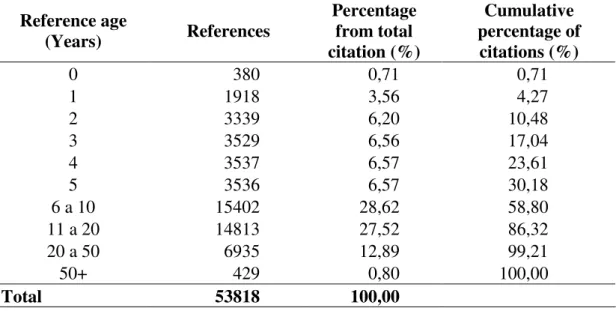
Analysing the average age of the references, it is observed that documents with an average age between 6 and 10 years are the 28,62% of the total production. These are follow by documents between 11 and 20 years (27,52%). Moreover, only the 30% of the references has an age equal or less than 5 years. The citing to recent documents, i.e. those published in same year than the citing article, is almost inexistent, being less than 1% (Table 4). It is shown the existence of references very old (more than 50 years), what is characteristic of the historical studies about Education (old textbooks, history of educational institutions, etc.).
Table 4. References’ distribution per age in Spanish education journals. 2005–2012. Reference age (Years) References Percentage from total citation (%) Cumulative percentage of citations (%) 0 380 0,71 0,71 1 1918 3,56 4,27 2 3339 6,20 10,48 3 3529 6,56 17,04 4 3537 6,57 23,61 5 3536 6,57 30,18 6 a 10 15402 28,62 58,80 11 a 20 14813 27,52 86,32 20 a 50 6935 12,89 99,21 50+ 429 0,80 100,00 Total 53818 100,00
period (2005) was 9,76 year and this has been increasing up to 12,54 years for 2012. In the whole, the average age of the references of the articles published by the Spanish educational journals covered by the JRC is 11,75 years, a value similar to those found for other scientific fields, such as Mathematics (11,3) and Psychology and psychiatry (11,4) (Glanzel & Schoepflin, 1999).
Table 5. Annual distribution of the average reference age for the Spanish journal of Education
Year Mean reference age
2005 9,76 2006 12,87 2007 12,02 2008 11,92 2009 11,65 2010 11,73 2011 11,51 2012 12,54
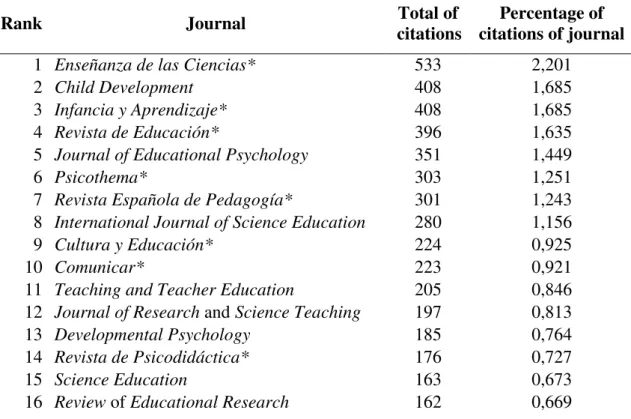
The articles in the sample cite to an amount of 4943 different journals. Only 203 of these cited journals are published in Spain and are the source for 4738 cites, i.e. the 19,56% of the total of references.
Table 6. Rank of the twelve journals most cited
Rank Journal Total of
citations
Percentage of citations of journal
1 Enseñanza de las Ciencias* 533 2,201
2 Child Development 408 1,685
3 Infancia y Aprendizaje* 408 1,685
4 Revista de Educación* 396 1,635
5 Journal of Educational Psychology 351 1,449
6 Psicothema* 303 1,251
7 Revista Española de Pedagogía* 301 1,243
8 International Journal of Science Education 280 1,156
9 Cultura y Educación* 224 0,925
10 Comunicar* 223 0,921
11 Teaching and Teacher Education 205 0,846
12 Journalof Research and Science Teaching 197 0,813
13 Developmental Psychology 185 0,764
14 Revista de Psicodidáctica* 176 0,727
15 Science Education 163 0,673
* Spanish journal.
Between the top-20 journal ranks shown in table 6, are 9 of the 10 Spanish journal analysed. Enseñanza de las ciencias is the most cited journal, whereas Porta Linguarum
is the 64th position with only 55 cites. These 20 journals are the 20, 98% of the total articles’ citations.
Conclusions
Despite having increased the number of documents published in the Spanish journals of education from 24 documents in 2005 up to 354 in 2012 –which is an increment of 1475%-, this is only due to the SSCI incorporated new journals, ranging from 1 journal in 2005 (Revista Española de Pedagogía) to ten. Likewise, this fact has also implied a
decrease in the number of documents published per year and journal, varying from 24 in 2005 and reaching 35 in 2012.
The grey literature, which is a referent in the educational research published in the Spanish journals, comes mainly from books and grey literature (55%). The fact that the average reference age is 11,7 years reveals that there is slowness in transfering the new educational advances and researches.
The results point out the interest in knowing if these citation patterns and the average reference age follow the same patterns than in the educational journals from English-speaking countries or neighboring countries.
The findings would be interesting for librarians in the faculties of education due to the educational journals most cited by Spanish journals can be clearly identified so as to consider incorporate them to their libraries.
References
Agudelo, D., J. Bretón-López & G. Buela-Casal (2003). Análisis bibliométrico de las revistas de Psicología Clínica editadas en Castellano. Psicothema, 15(4),
507-17 Revista de Investigación Educativa* 160 0,661
18 Revista Interuniversitaria* 144 0,595
19 Learningand Instruction 133 0,549
516.
Barik, N. & P. Jena (2013). Bibliometric Analysis of Journal of Knowledge
Management Practice, 2008-2012. Library Philosophy and Practice (e-journal),
Paper 1020. Retrieved from http://digitalcommons.unl.edu/libphilprac/1020/. Borgman, C. L. & S. L. Siegfrield (1992). Getty´s Synoname and its cousins: A survey
of applications of personal name-matching algorithms. Journal of the American
Society for Information Science, 43(7) 459-476.
Bornmann, L., R. Mutz, C. Neuhaus & H.-D. Daniel (2008). Citation counts for research evaluation: standards of good practice for analyzing bibliometric data and presenting and interpreting results. Ethics in Science and Environmental Politics,8(1), 93–102.
Campanario, J. M. (2010). Self-Citations That Contribute to the Journal Impact Factor: An Investment-Benefit-Yield Analysis. Journal of the American Society for Information Science and Technology, 61(12), 2575-2580.
Campanario, J. M. & A. Candelario (2010). La influencia de las autocitas en el aumento del factor de impacto en revistas de Ciencias Sociales. Revista Española De Documentacion Cientifica, 33 (2), 185-200. Retrieved from
http://redc.revistas.csic.es/index.php/redc/article/viewFile/551/625
Garfield, E., M. V. Malin & H. Small (1978). Citation data as science indicators. In
Toward a metric of science, eds. Y. Elkana, J. Lederberg, R. K. Merton, A.
Thackray & H. Zuckerman, 179-207. New York: John Wiley & sons.
Glänzel, W. & U. Schoepflin (1999). A bibliometric study of reference literature in the sciences and social sciences. Information Processing & Management, 35, 31-44.
González-Alcaide, G. (2010). Autorías, colaboración y patrones de citación de las revistas biomédicas editadas en España incluidas en el Journal Citation Reports (2003-2007). Revista Española De Documentacion Cientifica, 33(3), 397-427.
Retrieved from http://redc.revistas.csic.es/index.php/redc/article/view/564/639 Gupta, B. M. & G. Mahesh (2013). A comparative Analysis of Social Sciences
Research Publications in four South Asian countries. Library Philosophy and Practice (e-journal), Paper 956. http://digitalcommons.unl.edu/libphilprac/956.
Haddow, G. & P. Genoni (2009). Australian education journals: quantitative and qualitative indicators. Australian Academic and Research Libraries, 40(2),
88-104.
science journals. Scientometrics, 85(2), 471–487.
Håkanson, M. (2005) The Impact of Gender on Citations: An Analysis of College & Research Libraries, Journal of Academic Librarianship, and Library Quarterly.
College & Research Libraries, 66(4), 312-323. Retrieved from
http://crl.acrl.org/content/66/4/312.full.pdf+html
Jiménez-Fanjul, N., A. Maz-Machado & R. Bracho-López (2013). Bibliometric analysis of the mathematics education journals in the SSCI. International Journal of Research in Social Sciences, 2(3), 26-32. Retrieved from
http://www.ijsk.org/uploads/3/1/1/7/3117743/3_social_journals.pdf
Mahapatra, G. (1994). Indian Library and Information Science journals. A bibliometric analisys of the rate of citations and their characterictics. Library Review, 43(3),
41-46.
Moed, H. F. (2005). Citation Analysys in research evaluation. Springer.
Persson, O., R. Danell & J. W. Sneider. (2009). How to use Bibexcel for various types of bibliometric analysis. In Celebrating scholarly communication studies: A Festschrift for Olle Persson at his 60th Birthday, eds. F. Åström, R. Danell, B.
Larsen & J. Schneider, 9-24. Leuven, Belgium: International Society for Scientometrics and Informetrics.
Pritchard, A. (1969). Statistical bibliography or bibliometrics? Journal of
Documentation, 25(4), 358-359.
Rattan, G. K. (2013). Self-citations in Annals of Library and Information Studies.
Library Philosophy and Practice (ejournal), Paper 924. Retrieved from
http://digitalcommons.unl.edu/libphilprac/924.
Roy, S. B. & M. Basak (2013). Journal of Documentation : a Bibliometric Study.
Library Philosophy and Practice (e-journal), Paper 945. Retrieved from
http://digitalcommons.unl.edu/libphilprac/945.
Togia, A. & N. Tsigilis (2006). Impact factor and education journals: a critical examination and analysis. International Journal of Educational Research, 45,
362-379.
Yang, K. & J. Lee (2012). Analysis of publication patterns in Korean library and information science research. Scientometrics,93,(2) 233–251.