MAGYAR NEMZETI BANK
MONETARY TRANSMISSION
IN HUNGARY
MAGYAR NEMZETI BANK
MONETARY TRANSMISSION
IN HUNGARY
H-1850 Budapest, Hungary Phone: +36/1/428-2600
Fax: +36/1/428-2569 E-mail: [email protected] Internet: http://www.mnb.hu
Published in Budapest by the central bank of Hungary Publisher in charge: Gábor Missura
Printed in Hungary by D-Plus Print 19-21 Csillaghegyi út, H-1037 Budapest, Hungary
The views expressed here are those of the authors and do not necessarily reflect the official view of the central bank of Hungary (Magyar Nemzeti Bank).
ISBN-10: 963-9383-78-3 (print) ISBN-13: 978-963-9383-78-4 (print)
ISBN-10: 963-9383-79-1 (online) ISBN-13: 978-963-9383-79-1 (online)
Authors of this volume:
Csilla Horváth, Zoltán M. Jakab, Péter Karádi, Gábor Kátay, Gergely Kiss, Judit Krekó, Anna Naszódi, Gábor Orbán, András Rezessy, Zoltán Szalai, Gábor Vadas, Viktor Várpalotai,
Balázs Vonnák, Zoltán Wolf Editor: Balázs Vonnák Technical assistant: Erzsébet Heé
All rights reserved. Reproduction for educational and non-commercial purposes is permitted provided that the source is acknowledged.
The publisher has used its best endeavours to ensure that the URLs for external websites referred to in this book are correct and active at the time of printing. However, the publisher has
no responsibility for the websites and can make no guarantee that a site will remain live or that the content is or will remain appropriate.
On the cover: Tivadar Csontváry Kosztka [1853-1919], The Lonely Cedar [1907], Oil on canvas, 194 x 248cm.
(Magyar Nemzeti Bank collection, 1994-2005. Donated to Hungarian National Gallery in 2005.)
Csontváry was one of the first Hungarian painters to become well-known in Europe. He painted more than one hundred pictures, the most famous and emblematic of which is probably Magányos cédrus(The Lonely Cedar). His art connects with post-impression-ism and expressionpost-impression-ism, but actually he was an autodidact and can-not be classified into an exact style.
Acknowledgements
The editor would like to thank Ágnes Csermely and István Hamecz for their support to the project. Special thanks to Attila Csajbók for his support to the project as the head of division, and particu-larly for his help in creating this volume. Erzsébet Heé and Daniella Tóth did an excellent job of turning the manuscript into a finished product.Foreword
by György Szapáry
1. The Hungarian monetary transmission mechanism: an assessment
8
Balázs Vonnák
2. Interest rate pass-trough: the case of Hungary
32
Csilla Horváth, Judit Krekó and Anna Naszódi
3. Estimating the immediate impact of monetary policy shocks on the
exchange rate and other asset prices in Hungary
53
András Rezessy
4. Exchange rate smoothing in Hungary
69
Péter Karádi
5. The role of the housing market in monetary transmission
89
Gergely Kiss and Gábor Vadas
6. Is there a bank-lending channel in Hungary? Evidence from bank
panel data
119
Csilla Horváth, Judit Krekó and Anna Naszódi
7. Estimating the effect of Hungarian monetary policy within a structural
VAR framework
155
Balázs Vonnák
8. How does monetary policy affect aggregate demand? A multimodel
approach for Hungary
181
Zoltán M. Jakab, Viktor Várpalotai and Balázs Vonnák
9. Investment behavior, user cost and monetary policy transmission
– the case of Hungary
207
Gábor Kátay and Zoltán Wolf
10. The expected effect of the euro on the Hungarian monetary transmission
239
Gábor Orbán and Zoltán Szalai
When inflation targeting was introduced in Hungary in 2001, decision makers in the Monetary Council had to rely on limited knowledge about how the monetary transmission mechanism worked in the Hungarian economy. Apart from some early works, there was no comprehensive empirical research in this area. The main reason for this was the lack of reliable statistical data in the form of long enough time series or large enough cross-section database. Although there were some estimates for the exchange rate pass-through, our empirical evidence lost their validity with the monetary regime change, since those relationships were estimated for a period of tightly managed exchange rate regimes.
The Hungarian Monetary Transmission Mechanism research project was expected to fill the gaps in our knowledge. Almost fifteen years after the beginning of the Hungarian transition to a market economy, we felt that the time has come to launch a comprehensive research project with the purpose of obtaining an understanding based on more solid econometric results. Our project was also motivated by the Monetary Transmission Network in the Eurosystem, which gave us the opportunity to compare the Hungarian transmission mechanism to that of the euro area.
It took almost three years for the colleagues at the Bank's economics department to explore the most important areas of the transmission mechanism. The research faced several challenges. The data used for estimation are still not completely satisfactory. Moreover, the framework of mone-tary policy, as well as some structural features of the Hungarian economy have changed during the period under investigation. Moreover, the special characteristics of our economy required a focus somewhat different from what is usual in the literature. Due to the uneven information available regarding the various sectors and markets, it was clear from the beginning that some areas would have to receive only limited coverage, rendering the synthesis of individual results difficult. Despite these shortcomings, the empirical work presented in this volume allows us to gain a bet-ter understanding of the Hungarian monetary transmission mechanism and has thus served its stated objective well.
The benefits of the project are threefold. First, it confirms our assumption about the primacy of the exchange rate channel in Hungary's small open economy. Second, there are some interesting results that may alter our thinking about how the monetary transmission works. For example, we obtained a refined and – at least compared to earlier beliefs – slightly different picture about the way consumption and investments react to monetary policy actions . Third, it brought to the fore important areas where our knowledge is far from being satisfactory. This recognition calls for fur-ther research in order to strengthen the theoretical underpinnings of our monetary policy actions. Such areas are, for example, the labour market and credit markets. We also need a deeper under-standing of the factors at work determining the exchange rate.
This volume collects the papers written by the project participants. The volume is structured as follows. Studies dealing with the first stages of the transmission mechanism, i.e. how the monetary policy actions are transmitted to financial markets and asset prices, are presented first. They are fol-lowed by papers estimating the macroeconomic effects of monetary policy and the behavior of aggregate demand. The last study in the volume tries to assess the potential consequences on the transmission mechanism of joining the eurozone.
Our hope is that this volume will serve as a useful document for central bankers, as well as for economists and graduate students interested in the Hungarian economy and monetary policy related issues.
György Szapáry Deputy Governor
1.1 Introduction
From the central bank’s point of view, the transmission of monetary policy to the economy is of distinguished interest among various topics of macroeconomics. Without being aware of the monetary transmission mechanism (MTM) it is not possible to conduct good policy. In Hungary, our knowledge so far has been based mainly on intuitive understanding of the structural features of the economy instead of evidence from quantitative research.
In the beginning of 2004 a comprehensive research project has been launched at the Magyar Nemzeti Bank. The objective of the project was to provide quantitative results about the Hungarian monetary transmission mechanism in order to form an overall picture. The focus of the project was on empirics. We investigated first of all those areas, where most up-to-date economet-ric methods could be applied.
The sample used for estimations typically covered the period between 1995 and 2004. In some cases when the higher frequency or the existence of panel data endowed us with enough observa-tions, the sample was even shorter. The identification of the effect of monetary policy has been particularly challenging due to the fact that during this period the main driving force behind macroeconomic fluctuation came from the supply side, not from the demand. Being aware of this difficulty, we tried to apply techniques that are capable to disentangle the monetary policy from other sources of shocks.
This paper tries to create a synthetic view from particular results. During 2004 and 2006 nine papers have been published within the project as either an MNB study or an MNB working paper. The synthesis basically relies on those studies, but other research results are also considered as long as they concern the transmission mechanism.
There are some aspects that make our synthesis challenging. The first difficulty to overcome is that the particular estimates were based on various sample periods. Despite this, we will treat the underlying studies as if they referred to the same sample, which is typically the decade between 1995 and 2004. The second problem is that the definition of monetary policy differs across esti-mations. Some papers consider the effect of an interest rate change, while other authors investi-gated only those changes that were not an endogenous reaction of monetary policy to some eco-nomic shocks. Taking into account their limited comparability, we try to create a qualitative syn-thesis which is consistent with each individual findings.
transmission mechanism:
an assessment
Balázs Vonnák
In the assessment of the overall picture we focus on two particular issues that are of primary interest. The first one is about the effectiveness of the monetary policy. Having an open capital market with predominant presence of foreign investors, interest rates and the exchange rate are strongly influenced by risk preferences and risk assessment of international players. It was some-times not obvious whether there is an autonomous monetary policy in Hungary that conducts a policy according to its targets, or the interest and exchange rates are driven by international and other factors. Hence, we first posed the question, whether it is possible to detect significant effect of monetary policy on key variables.
The second question we try to answer is whether the exchange rate channel dominates the trans-mission mechanism. Hungarian monetary policy has paid special attention to exchange rate move-ments and expectations. The belief was that this is the most, if not the only effective channel of transmission. It was observed that tradable goods prices followed closely exchange rate move-ments influencing incomes, wages and other prices. Should this picture alters significantly, there might be consequences for the monetary policy strategy.
In order to be able to address the above-mentioned issues we need a comprehensive view of the transmission mechanism. We try to synthesise particular results using a scheme that focuses on two stages of transmission mechanism. At the first stage monetary policy impulses are transmitted by special markets to agents who make decisions on purchasing and production. To describe the first stage we rely on Mishkin’s (1996) classification of different channels of transmission mechanism. He distinguishes between the interest rate, exchange rate, other asset price and credit channels. Each mechanism is based on a particular theory of the effect of monetary policy. We add the expectation channel to the analysis, a mechanism that relates to the transparency and credibility of the monetary policy objective and strategy.
Several studies addressed explicitly this first step within the MTM project. Horváth et al. (2004) (HKN henceforth) investigated how commercial bank rates follow the policy rate. Rezessy (2005) presented estimates of the pass through to government bond yields and equity prices. Kiss and Vadas (2005) provide information about the Hungarian housing market. HKN (2006) posed the question whether credit supply of banks is affected by monetary policy.
The first stage includes the behaviour of the exchange rate as well. Unfortunately, the empirical literature produced so far mainly puzzling result regarding the effect of monetary policy. Although these puzzles were interesting from scientific point of view, they were of less practical importance regarding large, closed economic entities like the U.S. or the euro area. Hungary is a small open economy and the exchange rate has played a distinguished role in formulating and communicat-ing monetary policy. Hence, we allocated more resources to this issue than it is usual in the liter-ature of monetary transmission mechanism. Whereas Rezessy (2005) and Karádi (2005) investigat-ed the short term reaction of the exchange rate using high frequency data from the very recent period, Vonnák (2005) obtained estimates for a longer horizon.
After commercial bank interest rates and asset prices accumulated all the information about the stance of monetary policy, economic agents on goods market make their purchase decisions. At this second stage we analyze the behaviour of aggregate demand with special regard to private con-sumption, investment decisions and foreign trade.
Finally, we give a brief overview about how relative price changes disappear in the long run and what role the labour market plays in this procedure. We can consider this as the third stage of the The Hungarian monetary transmission mechanism: an assessment
transmission process. Despite its obvious importance, we cannot have a deep insight as we have no specific research focusing on this area.
The structure of the paper is the following: in section 2 we present the overall picture and put it into an international context highlighting the special features of Hungarian MTM. Section 3 classifies particular results using Mishkin’s (1996) approach. In section 4 we investigate aggregate demand. In section 5 we review our knowledge about medium-run effects including labour mar-ket and the non-tradable sector. Section 6 concludes and, based on Orbán and Szalai (2005), tries to assess future trends.
1.2 The overall picture
The most important aspect of the transmission mechanism is the way monetary policy can influ-ence inflation and output. Central banks usually have the primary goal to maintain price stability. The volatility of output is also of distinguished concern. In this section we present a bird’s eye view of the effect of a Hungarian monetary policy shock. We compare our results for inflation and out-put to findings for other countries. In the subsequent sections we go beyond the overall picture and try to describe the mechanism in more detail and to explain the special features of Hungarian MTM.
We investigate the behaviour of output and prices after an unexpected monetary tightening. Our monetary policy shock can be characterised as a 30-40 basispoint interest rate hike coupled with a 0.6-0.8 percent exchange rate appreciation. Both changes are transitory, the variables return to the baseline after 3-4 years.
The response of Hungarian consumer prices to the shock is shown in Figure 1.1 borrowed from Jakab et al. (2006; JVV henceforth). There is substantial similarity between the three impulse response functions, each of them coming from a model estimated on Hungarian data. Consumer prices react to monetary tightening by a quick drop. The lower price level seems to persist for sev-eral years. In terms of yearly inflation rate, which is the target variable in Hungary, it means that the effect of monetary policy is the largest within the first two years with the peak being some-where at the end of the first year.
This shape of price response is somewhat different from those found in closed, developed economies like the U.S. or the Euro area. Most SVAR estimates1
show a slight increase during the first year and prices typically begin to fall only later, but then the decline lasts for several years. Accordingly, yearly inflation rate is higher at the beginning, but later falls below the baseline per-sistently. This stands in clear contrast with the Hungarian price dynamics.
The response of Hungarian output is not as clear-cut as in the case of prices. While two models in JVV show a slight decline in real activity after the contractionary shock, SVAR estimates using time series of GDP suggest rather a small although not significant increase. The reason for this is that within the same framework a significantly higher consumption of households is detected that offsets the decline in investments. It should be noted, however, that using the same methodology but industrial production data instead of GDP, Vonnák (2005) estimated a significant drop in
1
industrial output and the magnitude was even higher than those found by the other two models in JVV. We conclude therefore that the Hungarian GDP drops somewhat after the contraction.
Estimates for the U.S. and the Euro area show a more pronounced output response. Although there are some studies that could not find significant effect of monetary policy,2most results
indi-cate a clear slowdown of the economy after an unexpected monetary tightening. The consensus view fits the basic features of a new-keynesian economy with sticky prices: after the monetary policy action, volumes react quicker to the changes of demand and output returns to its natural level only when price adjustment takes place, that is GDP response leads price response.
In the case of Hungary the same new-keynesian explanation alone is not able to explain fully what happens after a monetary policy shock. The response of output is moderate. The reaction of prices is instantaneous and does not lag behind that of output gap. For Hungary some alternative description of the transmission mechanism is needed. In the following sections we try to identify the special features of Hungarian MTM relying mainly on our fresh results.
1.3 The channels of monetary transmission
The mechanism through which monetary policy affects the economy can be divided into two steps. In the first step monetary policy influences market interest rates, the exchange rate, asset prices, credit supply of the banking sector and the expectations through its policy rate and com-munication. Economic agents extract signal transmitted by those markets and make decisions on their demand for goods and production. The second stage of MTM consists of the reaction of demand as well as the adjustment process of the supply side and labour market. In this section we classify results that relate to the first stage of MTM relying first of all on Mishkin (1996) who dis-tinguishes between interest rate, exchange rate, asset price and credit channels. We augment this classification scheme by the expectation channel.
Interest rate channel
The first stage of the interest rate channel is the mechanism through which policy rate passes through to commercial bank rates, that is to corporate and household deposit and loan rates. The second stage is when households and firms make their consumption and investment decisions in face of new interest rate conditions. We summarize here our findings concerning the first stage which is far simpler than the second.
Monetary policy has the power to determine the very short end of the yield curve by providing or absorbing liquidity with a maturity ranging typically from overnight to two weeks or one month. The rate set by the central bank is the (opportunity) cost of having excess liquidity for com-mercial banks, and therefore influences money market interest rates of the same maturity very quickly and effectively. In Hungary during the past ten years a short-term deposit rate acted as pol-icy instrument. Up until 1997 its maturity was one month, since then the polpol-icy rate is the two-week deposit rate.
The Hungarian monetary transmission mechanism: an assessment
2
According to the expectation hypothesis, longer maturities are linked to the policy rate through expectations on future development of short term rates. For example, if an interest rate hike by the central bank is expected to be temporary, longer term interest rates will not be affected to the extent short term rates change. On the contrary, if market expects higher rates will remain for longer period, long term yields increase more, thereby monetary policy may be more effective.
An important feature of most of our research is that typically 3-month money market or T-bill rates are used as policy rate instead of the central bank’s deposit interest rate. The reason for this is twofold. On the one hand, for higher frequency estimation (monthly or more frequent) the policy rate sometimes does not reflect the frequent change in monetary policy stance. On the other hand, we can consider 3-month interest rates as embedding more information than the policy rate, since it contains expectations about its movement in the very near future. If, for example, the Monetary Council leaves the base rate unchanged according to market expectations, but at the same time releases a statement containing tightening bias, 3-month market rates will rise and this reflects a genuine monetary tightening correctly, even in the absence of immediate inter-est rate move. Nonetheless, at monthly or quarterly frequency the policy rate co-moves with 3-month market rates closely, as it is shown in Figure 1.2.
For government bond yields and T-bill rates Rezessy (2005) estimated the immediate effect of an unexpected interest rate move on the yield curve. He found significant impact all along the entire curve. Even the 10-year benchmark yield increases by 10 basispoint after a 100 basispoint surprise policy rate hike on the same day. The one year ahead forward interest rate increased by half percentage point, but beginning with the 5-year horizon, significant decrease was detected. As long as forward rates reflect interest rate expectations, the reaction of forward rates can be inter-preted as the half of the unexpected move is expected to be maintained one year later, and to die out completely by the fifth year.
Although the pass-through from short to longer maturities is found to be satisfactory, it is not necessary for an effective interest rate channel because in Hungary the maturity of loans and deposits are typically shorter than in developed countries. In some cases, like corporate loans, even if the maturity is longer, the interest rate is linked to the 3-month interbank rate rendering it essen-tially a short term debt with frequent re-pricing.
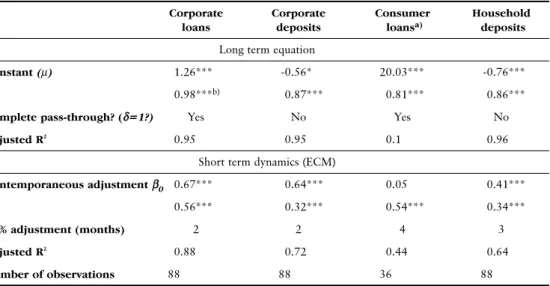
HKN (2004) investigate the connection between short-term money market rate and commercial bank rates. They detect relatively fast pass through with the adjustment of corporate loan rates being the fastest and most complete, but even the most slowly and least completely reacting con-sumption loan rates absorb the 80 percent of short term interest rate moves.
From our point of view the relevant finding of these papers is that this first stage of the interest rate channel performs well, it depends on the household and corporate sector whether interest rate movements exert direct influence on aggregate demand. As we will see in section 4, the interest rate channel may be effective through mainly investment decisions.
Exchange rate channel
The first, and perhaps empirically the most challenging step of the exchange rate channel is the reaction of the exchange rate to interest rate movements. A very simple and in theoretical modell-ing widely used assumption is uncovered interest rate parity (UIP). Within the UIP framework risk
neutral agents demand excess yield on assets that compensate them from the expected loss caused by depreciation:
(1) where i denotes one period yield, s is the home currency (forint) value of the foreign currency (euro) and * stands for foreign variable.
As in Dornbusch’s (1976) model, an unexpected interest rate increase with flat foreign rates causes the spot exchange rate to appreciate and/or the expected future rate to weaken. Unfortunately, statistical methods failed to detect this mechanism3. The estimated relationship
between interest rate and exchange rate was just the opposite, that is appreciation was more fre-quently coupled with positive interest rate differential.
One possible explanation is the presence of time-varying risk preferences. When the right-hand side of (1) is augmented with a risk premium term, the relationship alters in a way that investors require compensation not only for an expected depreciation, but also for holding domestic assets at all. The latter term can represent, for instance, an exchange rate risk premium if investors are risk averse.
(1’) It is easy to see that an increase in risk premium (rp) can lead to higher domestic interest rate, to a spot depreciation or can be offset by an appreciation in the future. If risk premium shocks dominate autonomous monetary policy, the observed co-movement between interest rate and exchange rate will be the opposite of the pure UIP case.
For Hungary the model containing time-varying risk premium is certainly the relevant one. During the past decade, since foreign portfolio investors appeared at forint markets, several episodes were recorded when it was obvious that changing risk assessment and preferences caused large swings in the exchange rate. Monetary policy tried to partially neutralise those shocks, other-wise they would have caused undesired movements in consumer prices.
The presence of shocks to risk premium renders measuring the effect of monetary policy to the exchange rate difficult. Relying purely on the correlation between interest rate and exchange rate would lead to a perverse effect, monetary tightening would seem to weaken the currency. Distinguishing between two types of ‘financial’ shock, monetary policy and risk premium shocks, is therefore crucial. Unfortunately, due to its limited relevance for developed economies, this prob-lem has not received much attention in the empirical literature.
Three of our research papers dealt explicitly with the reaction of exchange rate to monetary pol-icy. Rezessy (2005) estimated the immediate impact of monetary policy shocks on exchange rate. He used daily data starting in the middle of 2001 when the intervention band of the forint has been widened and the inflation targeting regime has been introduced. His identification strategy exploited the fact that on rate-setting meetings of the Monetary Council monetary policy shocks The Hungarian monetary transmission mechanism: an assessment
3
are typically larger than on other days. He detected significant effect with the expected sign on the first day, and an even larger effect on the day after rate-setting meeting.
For a longer period, beginning in 1995, Vonnák (2005) estimated the dynamic effect of mone-tary policy shocks on industrial production, consumer prices, short term interest rate and nominal exchange rate. It is important to note that the response of the exchange rate was in one case part of the identifying assumptions, therefore it cannot be considered as being purely estimated. One identification strategy there assumed that out of all the possible shocks that have only delayed effect on output, monetary policy shock is the only one producing negative correlation between the interest rate and exchange rate (higher interest rates with appreciation). The other identifica-tion scheme, however, did not use any presumpidentifica-tion about the exchange rate, it was based instead on some historical evidence about Hungarian monetary policy. The response of exchange rate was in each case almost identical, and despite the different data set, comparable to Rezessy (2005) results. We are therefore quite certain that during the past 5-10 years monetary policy have been able to influence the exchange rate. An unexpected 25 basispoint rate hike on average appreciates the exchange rate almost immediately by 0.5-1 percent.
Karádi (2005) introduce a more sophisticated model of monetary policy and exchange rate. In his set-up there are two channels of affecting the exchange rate by the central bank: one is the tra-ditional interest rate policy, the second one is influencing exchange rate expectations. The rele-vance of his model is obvious from the characteristics of the Hungarian monetary policy in the past. During the crawling peg regime the preannounced rate of depreciation anchored expecta-tions. Even later, in the first two years of inflation targeting, a range of exchange rate considered to be consistent with the inflation target was usually announced.
From (1) it is obvious that with full control over the exchange rate expectations it is possible to manage the spot exchange rate without changing the policy rate. With constant foreign and home interest rates, one percent change of expected future exchange rate will move the spot rate by the same amount to the same direction. It is therefore possible to tighten monetary conditions simply by announcing a credible exchange rate target, which is stronger than earlier expected. Something similar happened after the widening of the intervention band in May 2001. The measure itself was a clear message for the markets that the MNB would like to see a more appreciated exchange rate in order to bring down the inflation. As a consequence, the forint appreciated by 10 percent with-in two month without any policy rate hike.
The second step in the exchange rate channel is the relationship between domestic prices and the exchange rate. This link is traditionally viewed as the most important one in Hungary. Monetary policy strategies have been based on the role exchange rate. Being a small open econo-my, the consensus view has been that exchange rate movements are tracked closely by tradable good prices and affect tradable sector strongly. Hence, the level of the exchange rate, not the interest rate was considered as a proper representation of the monetary policy stance. Although this link of the MTM belongs rather to the second stage, here we review briefly the most impor-tant findings for Hungary.
There is a branch of papers in the literature investigating how exchange rate changes passes through to domestic nominal variables. From our point of view, most of the results are only part-ly informative, since we restrict our attention to exchange rate movements that are generated by monetary policy. Pass-through coefficient estimates are usually not conditioned to a specific shock,
therefore they can be considered as an average across all possible sources of shocks with weights proportional to the importance, or frequency of that particular shock, as it is stressed in Bouakez and Rebei (2005).
In order to highlight this issue let us consider the case of changing risk premium again. In sev-eral cases Hungarian monetary policy has been successful in preventing the real economy from being affected by risk premium shocks. It achieved this by quickly reverting exchange rate move-ments induced by sudden shifts in risk assessment of foreign investors. As a result, these shocks have had virtually no effect on output and prices. In contrast with this, autonomous monetary pol-icy had persistent effect on the exchange rate, and therefore consumer prices also reacted in medi-um term. Intuitively, after an exchange rate change economic agent are more or less aware of the nature of the shock, and they reset their prices only if they do not expect the exchange rate to return to its previous level quickly.
To our knowledge, two papers have attempted so far to estimate the Hungarian exchange rate pass-through or describe its main features. Darvas (2001) applied an equilibrium real exchange rate framework. He modelled price and exchange rate dynamics in a two-equation system, and estimated time-varying parameters for Hungary, Czech Republic, Poland and Slovenia. He found that long run exchange rate pass-through was high in Hungary during the years of the crawling peg regime, compared to the other three countries.
Jakab and Kovács (2003) investigate the role of expectations, goods market and labour market in the exchange rate pass-through. Simulating with the Hungarian block of the NIGEM model, they conclude that during the first 1-2 years after an exchange rate movement the pass-through mainly depends on the pricing elasticity to cost changes and the role expectations play in price and wage-setting. From the third year onwards the mark-up elasticity becomes dominant. Labour mar-ket characteristics, namely the elasticity of wages to unemployment and productivity are impor-tant only on longer run, roughly after 5 years after the shock.
Our project has not included any research with the sole aim to obtain fresh estimates for the pass-through. Nevertheless, for the understanding of consumption and investment decisions, JVV could not escape from dealing with exchange rate pass-through. Using information of three empirical macromodels they concluded that pass-through to tradable good prices is immediate and almost complete, but it is slow to prices of non-tradable goods. The pass-through to overall consumer prices seems to be gradual.
Finally, Kovács (2005) gives a very informative insight into the effect of exchange rate depreci-ations on the real economy using the experiences of the austerity package of finance minister Bokros Lajos in 1995. One central element of that package was the surprise devaluation of the forint by 9% which serves as an excellent example to investigate some aspects of the exchange rate channel. His main conclusions concerning the external equilibrium were the following: (1) the profitability of the corporate sector was not significantly affected by the devaluation; (2) the posi-tion of the household sector deteriorated because of the negative income effect of the surprise inflation; (3) the success of the package hinged primarily on the fiscal policy, especially on the fact that the inflating the expenditure side of the budget was not followed by a correction, so there was a persistent improvement in real terms on the expenditure side.
It is in order here to mention the role of intermediate goods in transmitting exchange rate changes. McCallum and Nelson (2001) present an open-economy model in which imports are The Hungarian monetary transmission mechanism: an assessment
treated not as finished goods but rather as raw-material inputs to domestic production. Hence, exchange rate movements affect production costs directly through the price of intermediate goods. They show that their model produced a relationship between exchange rate and inflation that is closer to empirical evidence.
We have only little empirical evidence on how exchange rate pass-through works through pro-duction costs. Although our project has not covered the supply side, we can invoke some other studies. As Tóth and Vincze (1998) report, the two most important reasons for changing their prices, Hungarian companies in a survey refer to change in ‘fuel, raw material, accessories price’ or in ‘the exchange rate’. On the other hand, demand and productivity are ranked among least important determinants of pricing. This observation suggests that the cost channel may be relevant in Hungary.
Kovács (2005) demonstrates that firms’ profit did not significantly improve after the depreciation in 1995-1996. The reason is that while surprise inflation decreased real wages, material related expenses grew considerably at the same time, rendering the total effect nearly neutral. The neutral-izing role of material costs was particularly important for firms producing for export. After the nominal appreciation in 2001-2002 similar story but with opposite sign can be read from firm level data. Kovács (2005) makes the general statement that in Hungary corporate sector’s profitability is mainly determined by foreign trade partners’ business cycle and the role of real exchange rate is negligible.
Asset price channel
According to monetarist as well as Keynesian theories, asset prices decline after a monetary contraction. Higher interest rate results in higher yield expected from bonds decreasing their prices. Stock prices also fall. The loss of property value can be also important as households’ consumption spending might be affected through house equity withdrawal.
Mishkin (1996) explains the asset price channel focusing on the stock prices. The first example he cites is Tobin’s q theory of investment (Tobin, 1969). When equities are cheap relative to the replacement cost of capital, firms do not want to issue new equities in order to buy investment goods, therefore investments decline. The second channel works through households’ consump-tion. Lower equity prices reduce households’ wealth and they consume less.
In Hungary there are at least two reasons for considering stock price channel as irrelevant. First, there is no empirical evidence that monetary policy affects stock prices. We have estimates only for the instantaneous impact of monetary policy decisions on the Hungarian stock market index (BUX). Rezessy (2005) found no effect which is in contrast with Rigobon and Sack (2004) who detected significant decrease in major U.S. stock market indices after an unexpected tightening. Taking into account the ability of stock markets to absorb news quickly, it is hard to imagine that monetary policy shocks have only delayed effect on equity prices.
Second, shares play minor role in Hungarian households’ financial wealth. They amounted typically roughly to the 10 percent of all financial assets during the past ten years. The same is true for other securities, like government bonds. Their amount has never exceeded ten percent of total assets. Even households’ financial wealth itself is not as large as in more developed countries. At the end of 2004 total financial assets excluding items that are not supposed to play role in the asset
price channel (cash, deposits, insurance technical reserves) amounted to 40 percent of annual GDP (see Figure 1.3).
Housing wealth may play a more important role in asset price channel, as their market value is more than three times larger than households’ financial assets. Kiss and Vadas (2005) estimated the effect of an interest rate increase on house prices. They then fed the results into the consump-tion funcconsump-tion of the MNB’s quarterly projecconsump-tion model.4It is important to emphasise that they
obtained an estimate that combines the asset price channel with the credit channel, as the con-sumption function cannot distinguish between the two mechanisms. They detected significant effect of interest rate on private consumption and housing investments through house prices. However, if we compare it to other macro level estimates like JVV or Vonnák (2005) and take into account the relative size of the interest rate shock5
, we can conclude that even the housing market is incapable to explain the effect of monetary policy.
Credit channel
The role of credit supply in magnifying the effect monetary policy is discussed in details among others in Bernanke et al. (1995). The basic idea is that monetary tightening leads to higher exter-nal finance premium stemming from imperfections on credit market, such as principal-agent prob-lem. They argue that the conventional cost-of-capital effect fails to explain the size, timing and the composition of the observed response of spending on durable goods. The additional mechanism, called credit channel, should not be imagined as a stand-alone mechanism but rather as an ampli-fier of the conventional way interest rate exerts its effect. It works in the same direction: a mone-tary contraction not only reduces demand for durables, it also decreases loan supply.
The authors distinguish between bank lending channel and balance sheet channel. The former concept rests on the assumption that a monetary contraction drains loanable fund from the bank-ing sector. Commercial banks can raise new funds only at higher price by issubank-ing certificates of deposits or equity. The balance sheet channel is related to the financial accelerator phenomenon. Changes in interest rate affect the net worth of a firm through its cash-flow and the value of collat-eral. Higher interest rates thus lead to lower net worth and higher external finance premium.
Stylised facts about the Hungarian economy suggest that even if there exists a credit channel, its contribution to the transmission mechanism may not be highly significant. Large part of commer-cial banks as well as the non-financommer-cial corporate sector is owned by large foreign companies. Loans from the parent company is available for numbers of domestic firms at normal price even if the monetary policy is tight in Hungary, as either these loans are in fact internal financing at firm level or the cost of raising additional funds from external sources is not affected by Hungarian mone-tary policy. The same argument but to a limited extent also applies to Hungarian commercial banks owned mainly by foreign banks.
The Hungarian monetary transmission mechanism: an assessment
4
A non-technical summary of the model is available on the MNB’s website (Jakab et al., 2004).
5
Kiss and Vadas (2005) assumed a permanent 1 percentage point increase in interest rate and they got 0.3 and 1 percent devi-ation of consumption and housing investments from the baseline. In JVV a much smaller interest rate shock (0.4 percentage point increase in the first quarter, shrinking to 0.1 by the end of the year) resulted in a 0.1-0.2 percent response of GDP components.
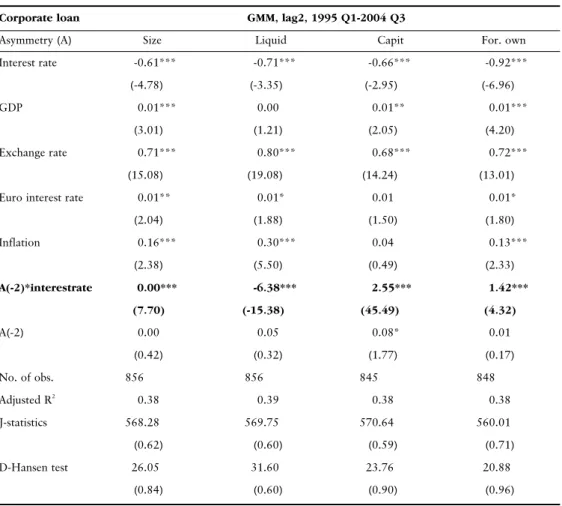
Regarding the estimation, Kashyap and Stein (1995) argue that the easiest way to test for the existence of credit channel is to use cross-section estimates. In this way one can identify credit sup-ply effect that is independent of the demand side. The idea is that certain banks and firms, typi-cally the smaller ones suffer more from higher external premium. HKN (2006) tested whether the existence of cross-bank asymmetries in lending activity can be rejected in Hungary. They estimat-ed several crestimat-edit supply equation on a panel of 25 commercial banks during the period of 1995 to 2004. They related banks’ ability to raise new funds to their size, liquidity, capitalization and for-eign ownership. In the regression they also controlled for GDP growth, inflation, exchange rate and foreign interest rate. Using several specifications they could not reject the null hypothesis that the effect of the monetary policy is magnified by the bank lending channel.
As for the balance sheet channel we have no research at hand dedicated exclusively to that phe-nomenon. However, there is some indirect evidence. Kátay and Wolf (2004) estimated an invest-ment equation on a large panel of non-financial firms. In their specification the investinvest-ment depended on the user cost of capital, sales revenues and the cash-flow. They found that the latter had significantly non-zero effect on investment spending. Although there may exist several chan-nels through which cash-flow can influence investments, one plausible candidate is the external finance premium, that is the balance sheet channel.
Taking into account the ownership structure of Hungarian banking and corporate sector, as well as the results of HKN (2006) and Kátay and Wolf (2004) we arrive at the conclusion that although empirical evidence points towards the existence of the credit channel, for structural reasons we do not consider it to be a crucial ingredient in the transmission mechanism.
Expectations
In a simple model with a Taylor-type monetary policy rule the long term or steady state infla-tion is determined by the target of the central bank. Forward looking and rainfla-tional agents in this model-world anchor their interest rate expectations to the known policy rule, their long run infla-tion expectainfla-tions to the known target. If a shock occurs, the monetary policy responds to it according its rule and no one doubts that all the variables, including inflation will return to the steady-state value. As a consequence of forward-lookingness, the effect of the shock is mitigated by the public expectations as well. Similarly, if the central bank changes its target and announces it, expectations may help the interest rate policy achieve the new goal, as long as perfect credibil-ity is assumed. In the model-world the expectation channel has more to do with the policy rule rather than with policy shocks.
In the real world it is usually the case that either the target is not explicit or is not believed by the public (credibility problem). The central bank may want to signal that his target is below or above the current or forecasted level of the inflation. He can do it by communication or in the absence of credibility, by demonstrative, unexpected changes of its instrument. Monetary policy shocks can be thus useful to send messages about the preference of monetary policy and to gain credibility, to signal commitment. In the reality and particularly when policy preferences are changing the expec-tation channel is related more to monetary policy surprises than systematic policy.
The role of monetary policy in coordinating expectations is most obvious in price and wage-sett-ing, the two mechanisms that play crucial role in new-keynesian theories of monetary
transmis-sion. The higher the credibility of the monetary policy, the lower the real cost of disinflation, that is the sacrifice ratio depends heavily on the expectation channel. With more flexible nominal wages, production can be adjusted to changes in real demand without major changes in employ-ment, therefore the short-run supply curve is more vertical than in the rigid-wage case.
An important example for the way expectations determine price-setting is the so-called Taylor-hypothesis. Taylor (2000) investigates the observed low pass-through of cost shocks to consumer prices. He relates the phenomenon to the low inflation and low nominal volatility environment arguing that when setting their prices, producers do not follow closely input prices as changes in the latter are expected to be short-lived due to the nominal stability established by the monetary policy.
Expectations also play role in some of the earlier-analysed channels, especially in the response of asset prices including the exchange rate. The way interest rate steps affect the entire yield curve is determined mainly by what market participants think of the future course and the effectiveness of monetary policy. The reaction of exchange rate as well as other asset prices is also crucially dominated by the assessment of monetary policy.
Unfortunately, we have limited knowledge about price- and wage-setting in Hungary and how it has changed over time. As for pricing behaviour, Tóth and Vincze (1998) and Tóth (2004) report the results of a survey in which Hungarian private companies were asked about their pric-ing practice in 1998 and 2001. In 1998 the typical frequency of price reviews was lower in Hungary than that was found in the UK by a similar survey reported in Hall et al. (1997). In an environment of higher inflation one would expect more frequent re-optimising of prices, yet, whereas a typical Hungarian firm reviewed it quarterly in the UK respondents chose monthly frequency. Another counterintuitive result was that in the 2001 Hungarian survey the pattern became more similar to the UK pricing practice despite the fact that the Hungarian inflation had been decreasing between 1998 and 2001 even if not very dramatically (from 14-15% to 10%). The relatively rare price-reviewing in Hungary can be justified by the costs of gathering information, as it is argued in Mankiw and Reis (2002). Anyway, firms’ responses regarding the reasons for price-changing suggest that costs are more important than expectations.
We know even less about the Hungarian labour market. Pula (2005) gives a comprehensive description of the flexibility of Hungarian labour market. He claims that in Hungary the bargain-ing power of trade unions and employees are weak compared to other EU-members. On the other hand, JVV found that nominal wages are rigid. After a monetary policy shock, it takes at least one year until nominal wages are modified according to the new path of prices. Putting these two observations together, a plausible reason for wage stickiness is the backward-looking nature of wage-setting. An alternative explanation can be that the disinflationary monetary policy had not enough credibility, thus economic agents expected the past level of inflation to remain.
Some results related to other channels bear information about the expectations. One possible explanation of the findings of Rezessy (2005), namely that long term forward interest rates decrease after an unexpected rate hike is that market participants believed in the success of etary policy. Interest rate policy served to some extent as a channel for signalling long term mon-etary policy preferences.
Karádi’s (2005) exchange rate model incorporates public expectations about central bank exchange rate preference. His results show that communication was effective in coordinating mar-The Hungarian monetary transmission mechanism: an assessment
ket participants’ exchange rate expectations and it helped exert influence on spot rate, too. These two examples highlight the importance of expectations of agents at financial markets.
Although this channel is the most difficult one from the econometrician’s point of view and we do not have specific results, we have the overall impression that while financial market were sup-portive and expectations made policy more effective, expectations of price and wage-setters has not been anchored by the goals of monetary policy. Nevertheless, the latter fact is quite natural taking into account that the monetary policy in our sample period can be best characterised as shifting gradually from a more external-position-oriented regime towards a price-stability-orient-ed one and gaining crprice-stability-orient-edibility for the new objectives takes time.
1.4 Demand
In basic models of MTM, production is affected by monetary policy mainly through the demand channel, as it is explained in Ireland (2005). According to the new-keynesian view, changes in demand first influence output with prices adjusting only with some delay. The mech-anism is the following: tighter (looser) monetary policy reduces (expands) demand for real goods to which firms first respond by temporarily decrease (increase) their output, as re-pricing is cost-ly and thus can be made oncost-ly later. Lower demand without price adjustment results in output level and marginal costs lower (higher) than natural. As time goes, firms cut (lift) their prices according to the altered environment. Lower (higher) prices stimulate (calm down) demand and production will return to its natural level. This mechanism can be labelled as the output gap, or demand channel.
As for Hungary, there is some empirical evidence of such new-keynesian pattern in the demand channel. Tóth and Vincze (1998) digest the results of a survey taken among Hungarian private companies in 1998. Tóth (2004) evaluates how the picture has changed relying on a 2001 survey. One of the questions in both surveys was the ordering of possible responses to a change in demand. Firms typically ranked steps like adjusting hours worked and employment or changing capacity before re-pricing. Their finding is in accordance with the result of a similar survey in the UK in 1995 (Hall et al. 1997).
In this section we review what we have learned about the behaviour of some key components of aggregate demand, namely, consumption, investment and net export. For this section JVV is our starting point. Using three different macromodels they show that significant effect of mone-tary policy can be detected first of all in the case of investments. In the following we survey the relevant literature and check how their findings fit existing evidence. At the end of the section we connect the demand components to the individual channels of the transmission.
Consumption
Investigating the transmission mechanism within an SVAR framework, Angeloni et al. (2003) found that while in the U.S. households’ consumption dominates the response of output to mon-etary policy shocks, in the eurozone the contribution of investments is more important. Nevertheless, the sign of impulse responses are intuitive in both economies, namely, after an unex-pected tightening both the consumption and investments drop.
In contrast with the eurozone and the U.S., JVV demonstrated that in Hungary there are no empirical evidence of lower consumption after monetary contraction, one model shows even ris-ing consumption. This findris-ing may appear to be counterintuitive especially when one takes into account the results of Kiss and Vadas (2005) who detected significant consumption effect of mon-etary policy through the housing market.
Nevertheless, there are some empirical studies as well as theoretical ones that suggest this type of consumption response is plausible. Theoretically, one important reason can be that the appre-ciation of the currency increases the wealth of households. Households then may spend their excess revenue stemming from higher purchasing power of their wealth to either tradable or non-tradable goods depending on the income elasticities of both. Benczúr (2003) shows in a two-sec-tor dynamic growth model how a nominal appreciation can stimulate consumption.
Van Els et al. (2001) compare the main characteristics of MTM in eurozone members using country models. In four out of the twelve countries, consumption is above the baseline during a couple of years after a tightening monetary shock. In Belgium and Italy the authors attribute ris-ing consumption to the net creditorship of households. In the case of Finland their explanation is in line with Benczúr (2003) claiming that the pure exchange rate channel dominates. In the German model prices fall faster than nominal wages raising real wages and thereby consumer spending.
JVV explain the reaction of consumption by the stickiness of nominal wages and relatively quick exchange rate pass-through. Their argument is that tradable prices respond to monetary policy quickly because they track exchange rate movements closely. Since the short-term reaction of non-tradable prices are virtually neutral, overall price level declines already during the first year. Contrary to prices, nominal wages remain unchanged for at least one year meaning that real wages rise. The income effect offsets other mechanisms, like asset price changes etc.
It is important to stress that the empirical evidence of this kind of consumption response is not strong enough. The identification of the effect of monetary policy is complicated by the fact that the appreciation of the forint after the widening of the intervention band coincided with several fiscal measures aimed at stimulating private consumption. Since the band widening in 2001 can be regarded as probably the biggest unexpected monetary tightening during the past ten years6, statistical methods that do not control for fiscal policy may fail to separate the two
effects. Nevertheless, the way JVV explained why consumption does not fall after monetary contraction is in line with Jakab and Vadas (2001) who found that wages are far the most impor-tant explanatory variable for consumption and they could not detect significant role for inter-est rates.
To sum up and putting these findings into Mishkin’s framework we can conclude that there are no signs that after a monetary tightening private consumption fall in Hungary. The reason is the relatively quick exchange rate pass-through and the slower nominal wage adjustment. Our inter-pretation is that the exchange rate channel offsets interest rate, asset price and other channels concerning the behaviour of Hungarian households.
The Hungarian monetary transmission mechanism: an assessment
6
Actually, one of the identification schemes of Vonnák (2005) was based on that assumption and proved to be equivalent to a completely different approach.
Investments
JVV found that the reaction of investment spending is the most robust ingredient of the demand effect of unexpected monetary policy. Hence, to form an overall picture about the monetary trans-mission mechanism, it is crucial that we understand the mechanism through which firms’ invest-ment decisions are affected.
Kátay and Wolf (2004, KW henceforth) give us a deeper insight into the investment behaviour of Hungarian firms. They estimated an investment function using large number of observations of firm level balance sheet data obtained from the APEH database. The main advantage of their approach over aggregate time series techniques is the high degree of freedom from cross-section.
Most importantly, they found a significant and quick reaction of investments to changes in user cost, which reinforces the finding of JVV. Obviously, there are serious limitations of trans-lating KW’s result to macro level. The first problem comes from the cross section heterogene-ity. The obtained impulse response is valid at aggregate level only as long as there is no consid-erable heterogeneity between firms with regard to their investment function, particularly the user cost elasticity.
The second challenge is the missing link between the instrument of monetary policy (in Hungary it is the two-week deposit rate) and the user cost. The specification they used relates investments to the user cost, which consists of expected return on equity, bank lending rates among others. Obviously, monetary policy has no direct control over all these factors. In order to assess the impact of monetary policy on investments, we need to know the relationship between policy rate and user cost, but, unfortunately, we have no empirical evidence.
The third difficulty to overcome is that they estimated only one dynamic equation in which investment spending are explained by the user cost, sales and cash flow. Even if we treat user cost as exogenous, which is also a questionable assumption in itself, cash flow and sales depend appar-ently on past investments, therefore, for the calculation of the dynamic effect of user cost addi-tional relationships would be necessary.
Finally, monetary policy can affect firms’ cash flow and sales through channels other than invest-ments. The adequate exercise would be therefore to simulate the effect of policy instrument on user cost, cash flow and sales, calculate the response of investments to these variables, taking into account that lagged investment changes also influence cash flow and output. The simulated firm level behaviour needs then a proper aggregation technique.
Using the same database as KW, Reiff (2006) estimated on firm-level an investment model for the Hungarian corporate sector in which firms face three types of adjustment costs: the standard convex cost, a fixed cost and an irreversibility cost. Using the estimated model he was then able to analyze at both aggregate and firm-level how investments respond to a so-called profitability shock. In line with KW and JVV he finds that firms react immediately by reducing investment spending after profitability falls. His findings are informative also from the MTM point of view as there are substantial similarities between monetary policy and profitability shocks and he solves the aggregation problem as well.
Despite all the shortcomings mentioned above and the limited comparability of the three mod-els, the high degree of similarity between impulse responses from micro- and macroestimates make us believe that those results reinforce each other and – similarly to the eurozone – investments are
key ingredients of the demand effect of monetary policy. As we will show in the next subsection, the demand for investment goods may help keeping foreign trade balanced despite the strong exchange rate response.
Noteworthy to mention is that although the cost-of-capital channel is usually counted to the classical interest rate channel, the role of exchange rate in investment decisions may be important, as JVV emphasize. Since investment goods are typically tradables, their price move closely togeth-er with the exchange rate. The cost of capital includes the (expected) inflation of investment goods in a way that declining prices mean higher costs as postponing investment spending pays-off. Their conclusion is that although the existing evidence is insufficient to separate exchange-rate effect from direct interest rate effect, the response of investments is likely to be affected through both channels.
Net exports
The third main component of output investigated by JVV is net exports. The results from the three models they used were less conclusive than for private consumption and investments and the authors concluded that they could not detect any significant effect of monetary policy. Only one model predicted considerable deteriorating of trade balance after an unexpected monetary tight-ening, the other two suggested rather a balanced path but with substantial uncertainty.
Looking at exports and imports separately it becomes obvious that while the models indicate similar response of exports, it is the reaction of imports that is responsible for diverging results. All three models predict a sizable drop in exports after a monetary tightening. Export prices also decline quickly suggesting that the export sector reacts flexibly to changes in demand. The lack of price stickiness can be understood taking into account the strong competition at international goods markets.
There is, however, much less agreement among models on how import reacts to monetary pol-icy. According to the quarterly projection model of the MNB, imports rise after a tightening. Contrary to that, the other two models used in the referred paper predict declining imports that can explain the rather balanced net export response they obtained.
There might be several plausible explanations for the insignificant net export response, and the ambiguous import response. According to Kim (2001), after an appreciation expenditure-switch-ing results in less export and more import, due to the change in their relative price. The observed behaviour of Hungarian consumption itself would imply higher import demand, at least accord-ing to two models used in JVV. On the other hand, contractionary monetary policy may reduce imports through lowering domestic demand, that is through income-absorption. In Hungary the significant drop in investments and exports may easily offset the additional import effect of high-er consumption, because of their high import content.
To conclude, foreign trade is probably affected by monetary policy in several ways. First of all, exchange rate changes cause quick response of exports both in volumes and prices. Secondly, changes in investments and consumption as well as exports influence imports. It seems that the import demand from investments and exports dominate imports, therefore income-absorption effect offsets expenditure-switching implying that no significant net export reaction can be detect-ed by econometric methods.
How individual channels of transmission influence demand for real goods?
In this subsection we combine the findings on particular channels of transmission with those regarding demand. Of course, not all channels can be associated with all components of demand; for example, we have no idea how credit supply asymmetries could affect net exports. In other cases even if the relationship exists, the interpretation is not straightforward. This is especially true for the exchange rate channel with regard to consumption and investments. There are also cases that are not covered by our research project, sometimes it is not possible to identify through which channel a certain component of demand was affected. Nevertheless, using this scheme, we can rank the importance of particular mechanisms.
Taking into account the high sensitivity of private investments to monetary policy, the interest rate channel may play an important role in the transmission mechanism. Nevertheless, it is not possible to disentangle it from other channels. JVV explain how exchange rate appreciation can lead to the same reaction through the user cost of capital. Similarly, we cannot exclude that cred-it supply also contributes. On the other hand, asset price channel seems not to influence the invest-ment behaviour.
In the case of consumption the exchange rate channel was identified as the main reason for the insignificant response. Through the income effect it can offset interest rate and credit channel. Asset prices are not found to be able to explain consumption behaviour.
The role of the exchange rate is trivial in the case of net exports. Although we could not detect significant effect of monetary policy on the trade balance, the quick reaction of export and import prices highlights the dominance of exchange rate channel in short run price devel-opment.
We can conclude that exchange rate channel dominates short run output and price effect of monetary policy. Due to the openness of the Hungarian economy, consumer prices react more quickly than in the U.S. or the euro area, while the change in output is smaller due to the lack of households’ consumption response. Nevertheless, the significant reaction of investments suggests that interest rate channel may not be negligible in Hungary.
1.5 Nominal adjustment in the medium run
Changes in aggregate demand affect various sectors differently. In the medium run relative prices adjust mainly because labour market transmits monetary policy impulses between sectors. As for Hungary, we expect that tradable price changes spread over the entire economy, including non-tradable goods’ prices. In this section we present what we know about the medium run effects of monetary policy. Since we have not conducted specific research in this topic, we rely on some other studies outside of the MTM project and present some fresh estimates.
The most important observation is that although exchange rate and tradable prices dominate the short-run effect of monetary policy, consumer prices remain at a lower level even when the exchange rate return to its initial value. Since tradable prices follow closely exchange rate move-ments, this indicates some price adjustment of non-tradable goods.
Indeed, SVAR estimates7
show (see Figure 1.4) that non-tradable prices, approximated by the price index of market services respond slowly to monetary policy. The adjustment of goods prices not directly affected by exchange rate seems to prolong the immediate reaction of tradable prices. One possible explanation of relative price adjustment is based on labour market. If wages equate between sectors, demand shocks to some sectors spill over to the rest of the economy. In our case the fall in exports and investments after a monetary contraction may exert downward pressure on employment and wages in the entire economy. Lower wages allow producers in sectors not direct-ly affected by lower demand cut their prices. The relevance of labour market in medium run is demonstrated in Jakab and Kovács (2003) who found that several years after an exchange rate shock pass-through depends on labour market developments in Hungary.
In JVV wage responses to a monetary policy shock are shown. Nominal wages tend to react only one year later than the shock occurs, which is not an extremely sticky style of wage-setting, but taking into account the relatively quick exchange rate pass-through to consumer prices, results in significant changes in real wages.
Figure 5 presents impulse responses from an SVAR similar to the previous one used to estimate tradable and non-tradable price response.8As in JVV, nominal wages decline slower than
con-sumer prices after a monetary contraction. Real wages, therefore, increase significantly for two years. On the other hand, employment drops quickly and begins to return to the baseline as early as in the second year. Probably it is the higher unemployment rate that promotes the nominal wages to adjust. According to the SVAR estimates, firms respond to higher wage costs first by cutt-ing jobs. Lower employment then pushes wages down allowcutt-ing firms to keep prices low even 3-4 years after the monetary shock.
1.6 Conclusion and forward-looking remarks
In this paper we reviewed the fresh results of nine studies made under the umbrella of the Hungarian MTM project. Relying on other studies as well, we created a synthesis from particular findings.
Our overall picture about how monetary policy works in Hungary can be summarized as fol-lows: consumer prices are affected immediately in the first year after the monetary policy has increased its policy rate. The response is persistent; the price level remains lower for several years. On the other hand, output reacts only marginally. The reason for this on the demand side may be that while investment drops significantly after a monetary tightening, consump-tion seems to offset more or less the demand effect of decreasing investment spending.
The output and price dynamics differ significantly from that found for large, developed economies. Empirical estimates for US and eurozone monetary transmission mechanism suggest The Hungarian monetary transmission mechanism: an assessment
7
The estimation was based on Vonnák (2005). Similarly to the SVAR estimation strategy introduced in JVV, I augmented the 4-variable benchmark monthly VAR (industrial production, CPI, 3-month T-bill rate, exchange rate, sample 1995:m1-2004:m12) with industrial goods and market services sub-indices. For identification of monetary policy shocks I used sign restriction as in Vonnák (2005). The results are comparable to those of the referred paper.
8
In this case a VAR model of quarterly GDP, CPI, short term interest rate, nominal exchange rate, employment and nominal wages in the private sector was estimated. The identification was the same as in the previous SVAR.
that in those economies output reacts first and significantly, and consumer prices are adjusted only with substantial lag.
We attribute the difference first of all to the central role exchange rate plays in the Hungarian monetary transmission mechanism mainly for two reasons. First, due to openness, exchange rate movements pass through to tradable goods’ prices quickly. Second, the output response is mitigat-ed by the fact that because of the short-run nominal wage rigidity and the quick exchange rate pass-through, the income effect offsets the interest rate effect on consumption resulting in a fair-ly insensitive reaction.
Being an EU-member country, Hungary is expected to adopt the common European currency as soon as it meets the Maastricht criteria. With the adoption of the euro, the most important channel of transmission will disappear. This raises the question, whether it is optimal for Hungary to join the eurozone running the risk that the economy will remain without effective monetary policy that could smooth shocks.
Orbán and Szalai (2005) point out that after euro adoption the scope of the interest rate chan-nel will broaden for at least two reasons. First, common monetary policy shocks in the eurozone will influence Hungarian economy through foreign demand which is now an exogenous factor for monetary policy. Second, ECB’s interest rate policy affects interest rate burden on euro-denomi-nated loans directly. They conclude that the differences between Hungarian MTM and those of present eurozone-member countries will not be so important that asymmetric response to common monetary policy and real divergence in the eurozone could be expected.
References
MTM projectHORVÁTH, CS., J. KREKÓ ANDA. NASZÓDI(2004): “Interest rate pass-through in Hungary”, MNB
Working Papers,No. 2004/8.
HORVÁTH, CSILLA, J. KREKÓ AND A. NASZÓDI (2006): “Is there a bank lending channel in Hungary?”, MNB Working Papers,No. 2006/7.
JAKAB, M. Z., V. VÁRPALOTAI ANDB. VONNÁK(2006): “How does monetary policy affect aggre-gate demand? A multimodel approach for Hungary”, MNB Working Papers,No. 2006/4.
KARÁDI, P. (2005): “Exchange rate smoothing in Hungary”, MNB Working Papers,No. 2005/6. KÁTAY, G. ANDZ. WOLF(2004): “Investment behavior, user cost and monetary policy transmis-sion – the case of Hungary”, MNB Working Papers,No. 2004/12.
KISS, G. ANDG. VADAS(2005): “The role of the housing market in monetary transmission”, MNB Background StudiesNo. 2005/3.
ORBÁN, G. ANDZ. SZALAI(2005: “The expected effect of the euro on the Hungarian monetary transmission”, MNB Background StudiesNo. 2005/4.
REZESSY, A. (2005): “Estimating the immediate impact of monetary policy shocks on the exchange rate”, MNB Occasional Papers No. 2005/38.
VONNÁK, B. (2005): “Estimating the Effect of Hungarian Monetary Policy within a Structural VAR Framework”, MNB Working PapersNo. 2005/1.