PLEASE SHARE THIS PUBLICATION WITH ANYONE YOU FEEL MIGHT BENEFIT FROM ITS CONTENTS. PLEASE SHARE THIS PUBLICATION WITH ANYONE YOU FEEL MIGHT BENEFIT FROM ITS CONTENTS.
About the Author Welcome.
For more than 20-years, I have helped growth-oriented businesses develop more effective ways to attract and retain profitable clients.
My focus is on leveraging your strengths and available resources in order to drive performance improvement in key areas such as:
Lower cost per new customer Higher retention rates
Higher referral rates
Higher average order/annual billing
I work with your sales and marketing team to develop practical action plans for demand
generation, lead scoring/nurturing, customer retention and customer referrals. And I provide you with insight into your audience and competition with my research and competitive intelligence experience.
So, if you’re business could benefit from improved sales and marketing performance, give me a call so we can talk. And be sure to ask about the free, no obligation sales and marketing audit for qualified firms. (Your business must have an existing sales and marketing function supported with a budget that is at least 5% of annual revenue and annual revenues of more than $5
million.)
Contact Information: Phone: 410-977-7355
Introduction
One of the key secrets to success is the ability to improve— and when 98% of Best-in-Class marketing and sales
organizations are reporting improvement in both lead-to-sales conversion rates and revenue year-over-year, you have to ask one simple question.
What can our business learn from Best-in-Class marketing and sales organizations?
That’s what we will be addressing over the next few
pages—and we will be explaining the secrets to success in a simple, straight-forward step-by-step way so you can determine how you can put these proven techniques to work for your business.
Over the following pages you will learn:
The importance of marketing and sales collaboration How to better target highly qualified buyers most like
your best customers
How to consistently deliver the right message and offers to the right people at the right time
How frequency, focus and relevancy drives profits Test. Measure. Analyze. Modify. Repeat.
Technology is not the cure for ineffective processes As always, if you have any questions, comments or
suggestions regarding the content in this eBook—contact us immediately. Measure demand generation effectiveness. Best-in-Class companies are planning on instilling an organizational focus on demand generation metrics and measurement. Ninety-seven percent (97%) of Laggards don’t measure lead to sales conversion rates, in comparison to 100% of the Best-in -Class and 89% of Industry Average. (Source: Aberdeen Research) In order to improve, you need to know what’s working and what isn’t.
Guessing doesn’t consistently
produce
98% of Best-in-Class Marketing and Sales organizations have
improved lead-to-sales conversion rates and lead-to-sales revenue
(year over year) versus the industry average of 54%.
Figure 1: Performance of Best-in-Class, Industry Average and ’Laggard’ from Aberdeen Group (2007) Description Mean Class Performance
Best in Class (Top
20%) 98% improved the year-over-year lead-to-sales conversion rate 96% improved year-over-year lead qualification rate 89% improved year-over-year lead response time
98% improved year-over-year lead-to-sales revenue
Average 54% improved the year-over-year lead-to-sales conversion rate 57% improved year-over-year lead qualification rate
40% improved year-over-year lead response time 54% improved year-over-year lead-to-sales revenue
Less Effective 2% improved the year-over-year lead-to-sales conversion rate 0% improved year-over-year lead qualification rate
0% improved year-over-year lead response time 4% improved year-over-year lead-to-sales revenue
Step 1: Alignment
Highly successful marketing and sales organizations know how to make these two key departments work together in order to improve performance.
The key is to make sure your business has marketing and sales focused on the same goals and objectives!
Too many businesses set ‘demand generation goals’ for marketing, and ‘sales revenue goals’ for sales – and when neither group shares the same definition for ‘lead’, the gap between the two can be immense.
Before we jump into an example – let’s define some terms of our own so we don’t run into the same problems. (The following stages and definitions are for example purposes only and are based on common terminology—however, your business can identify its own stages and definitions based on your processes.)
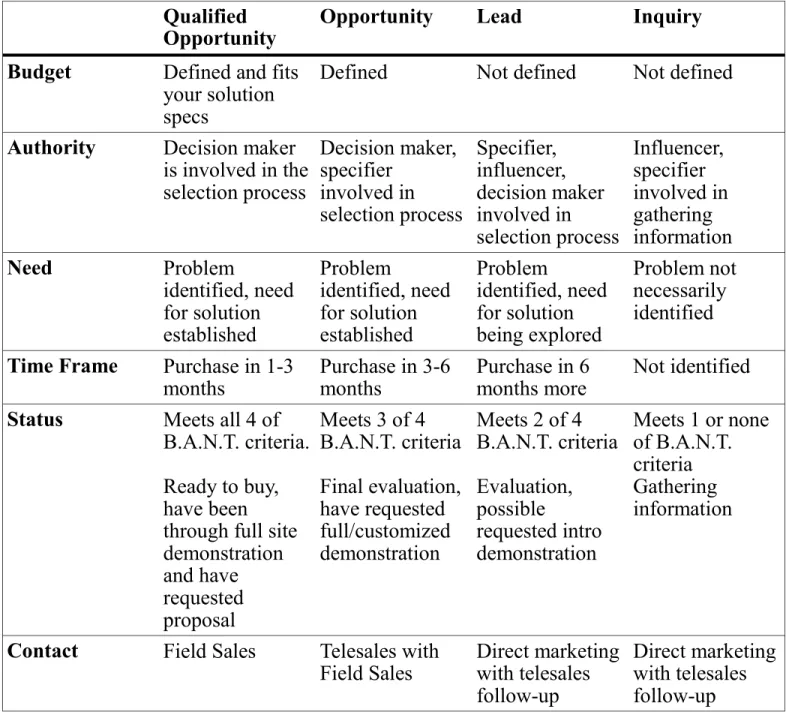
On the following page (Figure 2), you will find one organization’s criteria for defining each stage of the
qualification process relative to the key sales elements of Budget definition, Authority to buy, Need for your solution, and Time from of purchase (also known as the B.A.N.T. Criteria). In addition, Status and Contact criteria are shown for each qualification stage. The terms are:
Inquiry Lead
(Continued on page 7)
Best-in-Class companies are 1.5-times more likely to have sales and marketing departments that work in alignment to achieve common goals and objectives. Organizations can achieve sales and
marketing alignment by setting up formalized cross-functional groups to develop and identify best practices. By working together to formalize new
processes, sales and marketing can gain a deeper understanding of the complexities of both roles.
(Source: Aberdeen Research)
You invest too much money in marketing and sales NOT to have them work together for the benefit of the entire business.
Figure 2 Example of B.A.N.T. Process for Lead Generation and Qualification Qualified
Opportunity Opportunity Lead Inquiry Budget Defined and fits
your solution specs
Defined Not defined Not defined
Authority Decision maker is involved in the selection process Decision maker, specifier involved in selection process Specifier, influencer, decision maker involved in selection process Influencer, specifier involved in gathering information Need Problem identified, need for solution established Problem identified, need for solution established Problem identified, need for solution being explored Problem not necessarily identified Time Frame Purchase in 1-3
months Purchase in 3-6 months Purchase in 6 months more Not identified Status Meets all 4 of
B.A.N.T. criteria. Ready to buy, have been through full site demonstration and have requested proposal Meets 3 of 4 B.A.N.T. criteria Final evaluation, have requested full/customized demonstration Meets 2 of 4 B.A.N.T. criteria Evaluation, possible requested intro demonstration Meets 1 or none of B.A.N.T. criteria Gathering information
Contact Field Sales Telesales with
Field Sales Direct marketing with telesales follow-up
Direct marketing with telesales follow-up
Opportunity
Qualified Opportunity
By reading the BANT chart vertically for any stage in the qualification process, you can get a clear idea of the
characteristics of that stage. As an Inquiry moves closer to the late stage of the process (Qualified Opportunity), more sophisticated outcomes are implied for each of the BANT criteria.
Again, your business might have a process that has a different number of stages, as well as different names and definition—the key is that this information must be created and agreed to by marketing and sales.
What’s important here is that marketing and sales created this information together so that, together, both departments were focused on the same results.
With all that under our belts – let’s dive into a very real world example…
Company A does not have a universal definition for any of the terms – Inquiry, Lead, Opportunity, and Qualified
Opportunity. Marketing, however, believes that anyone who responds to a demand generation campaign is a ‘lead’ and, as a result, immediately passes anyone and everyone that responds to a demand generation campaign to sales.
(Continued from page 5)
(Continued on page 8)
“
The marketing
department
should qualify
leads before
passing them on
to sales.
Eight-six
percent (86%) of
Best-in-Class
marketing
departments
qualified leads
before passing
them on to sales. “
(Source: Aberdeen Research)Let sales SELL! Follow this approach and watch conversion rates increase, order size increase, morale increase and
employee turnover fall.
At the same time, the Sales Team at Company A is evaluated and compensated based on closed sales and revenue generated. Yet every day, marketing sends them ‘leads’ from “Mickey Mouse” and people that lack the need and money to buy the products offered by Company A. That’s why sales leadership team is prone to say “The lead quality stinks!”
Now, when marketing doesn’t define key terms the same ways as sales, sales will typically respond in the following way – sales will begin to perform ‘triage’ or, if you listen to marketing, ‘cherry picking’. What this means is that the sales staff sifts through the stack of ‘leads’ and pulls out
(Continued from page 7)
(Continued on page 9) “Sales typically disqualifies 70% of leads – and 80% of those disqualified leads go on to buy within 24 months.” (Sirius Decisions)
Imagine the impact on your company’s
bottom line that would come from creating a more efficient process of generating and managing leads!
those that appear to be worth pursuing.
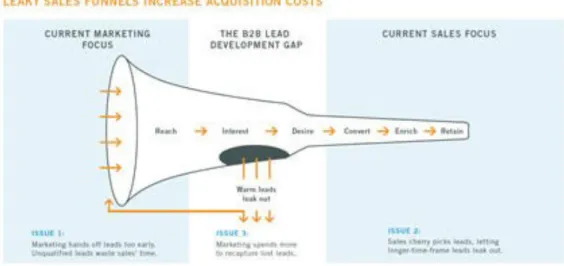
Below (Figure 3), the “Leaky Funnel” shows just how inefficient ‘cherry picking’ can be—because some of your ‘leads’, ‘opportunity’ and ‘qualified opportunity’ will be ignored and ‘leak’ out of the funnel.
In other words, Company A will have ‘leads’, ‘opportunity’ and ‘qualified opportunity’ taking their business to the competition OR re-entering Company A’s demand generation funnel at the top!
And in order to re-enter the funnel, Company A gets to pay for the lead again…and again…and again.
So, as you can see, motivating marketing and sales to sit down and work together on how to achieve the same goals – sales – can have a significant impact on the performance of your demand generation efforts!
Step 2: Preparation (Know your target)
With a clear understanding of what your business needs to do in order to succeed, the next step is generating the interesting and motivating the buyers to respond. The best place to start is with your best customers—and you need to know them better than you know yourself.
(Continued from page 8)
(Continued on page 10)
When you develop the right messages and offers for your lead generation campaigns, you also create content that will attract buyers to your website.
That’s referred to as leveraging content from outbound
marketing campaigns in order to drive for inbound marketing
.
Inbound andOutbound Marketing: What’s best for your business?
Getting started: Identifying your best customers with
RFM Analysis. For most businesses, the best customer
is one that purchased recently, as well as frequently over a specific time period. And that adds up to a great deal of money.
Recency. Frequency. Monetary.
Performing this analysis is relatively easy. First, select a period of time – for example, the past 12 months.
Second, select all customer records that show a purchase in that time period.
Third, rank each customer based on these three factors— how recently have they purchased from you? How
frequently did they purchase from you during that time frame? And how much did their purchases total during that time frame?
Remember, after ranking each factor, divide the customer file into deciles (10 groups of equal numbers) and award points (1 for lowest, 10 for highest).
Fourth, once you have ranked and scored each customer based on these three factors, total the scores and divide the list into deciles one final time.
Congratulations—those customers in the top deciles are your best customers!
(Continued from page 9)
(Continued on page 11)
The importance of a strong database strategy.
Best-in-class
marketing and sales organizations capture the names and titles of the buyer, decision makers, influencer. Other organizations capture “Purchasing Department”. Developing ‘Buyer Personas’ is much easier and more effective when you have quality data.
Building a Clearer Picture: Add data. At this point, you want to know as much about your best customers as possible – so start with adding data such as firmagraphics (See
Addendum A).
This will allow you identify segments within the larger group – and this is important because this helps you develop stronger messages and offers.
See Addendum B for the “Buyer Persona Worksheet” as an example.
Getting to Know Your Best Customers: Research. At this point, you know who your best customers are based upon recent performance and some general data points such as industry, number of employees, annual revenue, geographic location and more.
Now it’s time to understand what makes them tick. What are their needs, wants, expectation, perceptions and buying processes? You can gather this information through
in-depth interviews with the buyer and other key participants within your customers’ business.
Develop ‘Buyer Personas’ or ‘Customer Profile’s’ to increase performance. The end result of this work is the creation of ‘buyer personas’ – also known as ‘customer profiles’ - which are detailed descriptions of the person that is your ’buyer’. A strong persona or profile helps marketing focus on the needs and wants of the individual—producing
(Continued from page 10)
(Continued on page 12)
“A persona is a composite sketch representative of a type of customer you serve. Personas extend beyond the traditional
demographic profiles commonly used to summarize an ideal customer.”
(Source: Ardath’s Albee, from her book,
eMarketing Strategies for the Complex Sale.)
A ‘Buyer Persona’ - also known as a ‘Customer Profile’ focuses marketing and sales on the individual—and
motivates both teams to helping the person that is the “buyer”.
stronger, more effective messages and offers.
The persona also helps sales quickly and more accurately identify and respond to qualified leads.
For examples, refer to Addendum A at the end of this document.
Step 3: Relevancy (Messages and Offers tied to Buying Process)
The next critical element to a successful demand generation campaign is the ability to deliver the right message to the right person at the right time via the right channel. That’s why, in Step 2, you identified the needs, wants, perceptions and motivations of your targeted buyers as well as their buying process –which includes where they turn for information and insight.
Let’s start by identifying the stages of the typical buying process:
Pre-Need: This is actually the stage prior to the start of the buying process – and it describes that period of time where the buyer does not have a known need but may be gathering information in order to remain current on relevant options and opportunities available in the market. During this stage, the buyer is interested in developing trends and
(Continued from page 11)
(Continued on page 13)
“Irrelevant messages, regardless of
communication channel will cause buyers to disengage and potentially discontinue the business relationship.” (CMO Council 2009) By disqualifying the lead, your business ends up acquiring the lead again—at an extra cost—or losing the sale. Neither option is efficient.
new technology, as well as the experiences of others (product reviews, customer comments). This information may help the buyer identify a need or provide them with new insight and knowledge that will drive future purchases.
Identify: This is when the buyer identifies a need and formalizes the process of exploring options, gathering
information including product reviews, customer comments, white papers, webinars and other resources. At this point, your messages should remain educational but may expand from ‘general education’ such as ‘how to” articles to include ‘case studies’ that show how your business has helped other buyers solve their needs.
Search: The buyer begins to search for options and solutions. At this point, events such as webinars,
conferences, workshops and trade shows begin to play a more important role in the buyer’s development. This is the stage were many buyers will begin to make themselves known to your business – so you can begin to cultivate personal 1-on-1 relationships including custom content based on the information shared by the buyer.
Evaluate: The buyer begins to evaluate those options and solutions uncovered during the Search stage. From this stage forward, the buyer is working closely with your sales team in order to get relevant, personalized information that will allow the buyer to make a buying decision. Some companies may continue to send relevant content – new
(Continued from page 12)
(Continued on page 14)
More and more B2B buyers are searching for information before a need to buy has officially been
identified. During this stage, Best-in-Class organizations focus on education rather than promotional offers. A buyer is always a buyer—they just not be ready to buy today. Use every opportunity to develop awareness and trust so your business is positioned for future purchases.
product news, new business news, new customer comments – but this is in the background so as not to distract the buyer from working with sales.
Decide: The buyer selects the solution. Messaging is primarily focused on the specific requirements of the buyer – the proposed solution for the expressed needs of the buyer including product specifications with features and benefits, pricing including financing, payment terms,
discounts and guarantees or warranties as well as delivery, installation, training and related topics.
(Continued from page 13)
Purchase: The buyer commits to the solution and acquires it. During this stage messaging turns to specifics on terms and conditions, financing, delivery, installation, training and related topics.
Re-evaluate: More commonly referred to as “Buyer's Remorse”, this stage refers to the period of time
immediately after the purchase. Messaging in this stage is focused on reinforcing the reasons the buyer selected this particular product/service. Training and service as well as sales will make personal inquiries in order to verify the product is working and meeting or exceeding expectations, and to identify any additional needs that might have arisen. The goal is to help the buyer through this process quickly and positively.
Step 4: Consistency (Integrated Marketing and Sales Communications)
The typical buyer will receive 3,000 promotional messages today. And in order to cut through the clutter, you will need to reach them with 5 to 7 messages.
One of the most significant differences between a highly successful marketing and sales organization and the rest of the pack is that demand generation activities are ongoing and focused on those most likely to buy.
Messaging and offers are clearly, consistently delivered in all promotional efforts and by all staff that may come in
(Continued from page 14)
contact with prospective buyers. And the demand
generation campaign includes a variety of communication channels based on the insight gathered during past
campaign performance and research addressing where the buyer turns to gather information in the buying process. For example, a $150M software company offering analytics software to small and medium-sized businesses involved in the financial services industry may have seen a large
number of new buyers generated from print ads in an industry or professional association magazine – only to learn, after interviewing and surveying the CIO (buyer) at these companies, that the magazine was not as important as the magazine’s website because the content was
fresher. This might motivate the marketing director at the software company to test the website in order to determine if that proves to be a more effective and efficient generator of new customers in the coming months.
Step 5: Process (Qualification and Routing)
Your phone is ringing. Your website traffic is increasing. You are seeing more interest than ever before.
But you still don’t know if you are generating quality leads or a larger quantity of inquiries—which is why highly
successful marketing and sales organizations have
developed a process for quickly qualifying the responses and directing them to the appropriate next step.
Again, based on research from companies like Forrester,
(Continued from page 15) The typical buyer will
receive 3,000 promotional
messages today. And in order to cut through the clutter, you will need to reach them with 5 to 7 messages.
Effective Lead Generation Campaigns are constant and on-going. Inconsistent promotion makes it much more difficult to attract buyers.
More than 50% of all businesses cannot report, with confidence, marketing campaign performance. (Source: Sirius Decisions; Forrester)
The key to improving performance is
knowing what is working, what is not working and what needs fixing,
Sirrius and others, demand generation campaigns will produce approximately 20% buyers with an immediate need, 20% unqualified inquiries and 60% qualified buyers with a need to buy sometime in the future.
What you don’t want to do is hand them all to sales and expect them to sift through the volume in order to identify the gold.
In Figure 2 (page 6), you saw an example of a process known as B.A.N.T. – which stands for Budget, Authority, Need and Time frame. As described earlier in this
document, marketing would be responsible for validating the inquiry and then would deliver the information to sales when the individual meets the requirements for ‘lead’.
Step 6: Improvement (Test. Measure. Analyze. Modify. Repeat.)
According to leading research firms, Sirius Research and Forrester, more than 50% of all businesses are unable to report on the performance of their marketing campaigns with confidence.
Think of demand generation performance in the following way:
20% of your campaigns are over-performing 20% of your campaigns are under-performing 60% of your campaigns are on target
(Continued from page 16)
Now, what would be the impact on your business if you could redirect 20% of your marketing budget from under-performing campaigns to either over-under-performing campaigns or new campaigns?
What do you want to test?
Campaign performance: How is each piece of your
demand generation effort (advertising, direct mail, public relations, etc.) working in terms of inquiries, valid
inquiries, sales ready leads, qualified leads and first time buyers? Then dig deeper – look at ad, or public relations activity, or how your house list performed against rented lists for direct mail.
Other Tests: You should test creative, messages, and offers. For example, print advertising can provide you with the opportunity to perform an A/B Split – which means that you can run two ads and readers will receive one or the other based on random select by the
publisher. The ad might have a different creative presentation but the same copy and offer – or it might have the same creative presentation and copy but have a different offer. The goal is to identify ways to improve performance!
A Word about Technology
You have just read a great deal about the importance of process and it is human nature to wonder about how
technology might help. Please keep in mind that successful processes are built by people, for people – and technology
(Continued from page 17)
(Continued on page 19)
Where did your current best customers come from? What lead generation campaigns produced the most buyers? What offers and messages
generate the highest ROI?
Understanding campaign
performance will help you direct resources on the most
successful activities— generating a higher ROI.
is best entered into the mix after the processes have been successfully developed and utilized. Technology should help strengthen weaknesses in the processes and speed up the routine, repetitive tasks.
Technology will not provide you with the processes you need to improve performance - as a matter of fact, most installations fail to help improve performance for a simple fact. You can’t force process on top of chaos – and when an organization currently lacks the discipline to support a manual process, it is extremely unlikely that the
organization will positively respond to a process being forced upon them by technology.
“Laggard organizations are prematurely turning to technology expecting to see improvements in demand generation through one-to-one marketing initiatives or email marketing automation. Laggards lack the capabilities to fully exploit these strategies. They must focus on formalizing processes for
reviewing campaign effectiveness and alignment between sales and marketing.“ (Source: Aberdeen Research)
Technology does not overcome ineffective processes.
Appendix A: Market Segmentation Checklist
Category Criteria Demographics Gender Age range Household Income Marital Status Telephone numbers Occupation Religion Race/ethnic group Language spoken Education Presence of children Age of children Length of residence Postal information – for zip 4 penetration All normal census data
Geographics Country Region State County City/town Size of population Climate Population density Psychographics Leader or follower
Extrovert or introvert
Achievement-oriented or content with status quo Independent or dependent
Conservative or liberal Traditional or experimental
Society-conscious or self-centered Religious or non religious
Lifestyle characteristics can be further refined to suit your product/service offer. For example, “outdoor sports and recreation” can be refined to the type of sport the customer/prospect participates in, such as skiing, running,
Category Criteria
Consumer Behavioral Products purchased
Specific channel products purchased through Rate of usage
Benefits sought Method of usage Frequency of usage Frequency of purchase Lifestyle * Credit cards used
Investor Length of residence Home ownership Length of residence Dwelling type Cooking/dinning preferences Gardening Healthy choices Contributors Pets Collector
Crafts and needlework Music preferences
Outdoor sports and recreation
Computer and online services usage Other lifestyle interests
Business Markets Type of business
North American Industry Classification System (NAICS) (replaced SIC Codes)
Size of business Financial strength Number of employees
Location (number of locations) Structure
Sales level
Special requirements Distribution patterns
ADDENDUM B: BUYER PERSONA or CUSTOMER PROFILE
The following is an example of a buyer persona or customerprofile. Please note that this includes firmagraphics,
demographics, psychographics and behavioral elements that will help marketing and sales target, engage and convert.
“Bob” is a vice president of information technology for a regional retail
organization with up to 20 locations, a successful online/ecommerce operation, and between $100 to $150 million in annual revenues.
He manages between 10 to 20 people and is responsible for all technology including telecommunications.
Bob is between 35 and 45 years of age, and is an experienced IT professional with an undergraduate degree in computer science or information technology, and 10 to 15 years experience in running IT departments for retailers.
Bob believes in constantly educating himself in order to stay on top of developing trends and technology. He is a member of several professional organizations such as National Retail Federation , Association for Retail Technology Standards and the Information Technology Association of America.
He attends conferences and workshops (in-person and online), and is involved in several committees. He uses these opportunities to learn and maintain a strong network which he can also call upon for information, insight, and recommendations.
His title may be “Vice President of IT” but he sees his role as ‘technology visionary’ because he is on the look-out for ways to use technology in order to help the organization achieve its goals and objectives as a leader in the market. He prefers cutting edge technology developed by a vendor/firm that will
collaborate with him in order to generate an end product that is uniquely designed for his company’s needs.
advantage and ROI which he views as long-term wins rather than the short-term value of low price.
His buying process includes a great deal of reading industry magazines such as Retail Information System News, and CIO Magazine as well as numerous blogs written by companies such as Evolution Robotics Retail and iCongo.
Bob also makes time in his schedule for webinars—live and archived— in order to expand his knowledge of options. As he has been known to say “There are new solutions being developed every day—my job is to know about them and be able to determine if our company should pursue them in order to achieve our goals and gain an advantage over the competition.”
Bob will meet with sales representatives but only once he has
determined there is a need and interest on his end. Until that point, he wants to learn so he can determine the best course of action—and so he can tell the sales people what he specifically needs rather than listen to what they want to sell.
Bob has a budget of between $10 and $50 million, and has authority to spend up to $5 million on new technology solutions.
He is especially interested in ecommerce, with focus on mobile marketing solutions.
The following is a checklist to help increase your chances for a successful lead generation effort. You may wish to modify this for your own needs.
Ideal Customer Profile: Do you have a defined and
documented profile of your ideal customer, including all the stakeholders and their roles in the buying process?
Customer Needs and Issues: Do you have clear, specific, defined and documented primary customer needs and underlying issues?
Value Map:
Have you documented how you provide value to
customers with capabilities that address customer issues ‐‐ uniquely, matched with competitive alternatives, weak or non‐existent with customer alternatives ? Have you tested and documented key messages for
each need, issue and capability, that articulate the value you provide, in ways that resonate with customers Customer buying process: Have you identified, confirmed and
documented your customer's buying process, including
primary steps, the information required at each step, and their preferred information delivery methods?
Determine content requirements ‐‐ using the value map and the customer buying process, determine priorities for specific content pieces for each stage, stakeholder, specific interest or issue, message/value point, competitive response, etc.
Integrated Marketing Communications plan:
Have you developed and implemented a plan to deploy content across all relevant communication channels (on-line and off-(on-line) in order to increase your chances for attracting the prospective buyer’s attention?
prospective buyer at specific times based upon their action or inaction to earlier communications?
Have you created a process for creating, reviewing, approving and producing content?
Have you created an editorial calendar for producing and delivering content?
Have you established a search engine optimization program, including resources to oversee and manage the effort, a
defined and documented list of key words, and implementation of the program
Marketing database: Have you designed a process for capturing key data in a centralized location so that you can measure performance of key metrics such as media, creative, messages, offers?
Program management: Have you assigned responsibility to manage the ongoing execution and oversight of these activities, and
established program management plans, including for collecting and assessing feedback to make continuous improvements ?
Please share this document with anyone you feel might benefit from its contents.
If you have any questions or comments, please contact Pat McGraw at 410-977-7355 or [email protected].