Calhoun: The NPS Institutional Archive
Theses and Dissertations Thesis and Dissertation Collection
2016-12
Fracking: unintended consequences for local communities
Stangeland, Chad David
Monterey, California: Naval Postgraduate School http://hdl.handle.net/10945/51619
NAVAL
POSTGRADUATE
SCHOOL
MONTEREY, CALIFORNIA
THESIS
Approved for public release. Distribution is unlimited. FRACKING: UNINTENDED CONSEQUENCES FOR
LOCAL COMMUNITIES
by
Chad David Stangeland
December 2016
Thesis Co-Advisors: Thomas Mackin
REPORT DOCUMENTATION PAGE Form Approved OMB No. 0704-0188
Public reporting burden for this collection of information is estimated to average 1 hour per response, including the time for reviewing instruction, searching existing data sources, gathering and maintaining the data needed, and completing and reviewing the collection of information. Send comments regarding this burden estimate or any other aspect of this collection of information, including suggestions for reducing this burden, to Washington headquarters Services, Directorate for Information Operations and Reports, 1215 Jefferson Davis Highway, Suite 1204, Arlington, VA 22202-4302, and to the Office of Management and Budget, Paperwork Reduction Project (0704-0188) Washington DC 20503.
1. AGENCY USE ONLY
(Leave blank)
2. REPORT DATE December 2016
3. REPORT TYPE AND DATES COVERED Master’s thesis
4. TITLE AND SUBTITLE
FRACKING: UNINTENDED CONSEQUENCES FOR LOCAL COMMUNITIES
5. FUNDING NUMBERS
6. AUTHOR(S) Chad David Stangeland
7. PERFORMING ORGANIZATION NAME(S) AND ADDRESS(ES) Naval Postgraduate School
Monterey, CA 93943-5000
8. PERFORMING
ORGANIZATION REPORT NUMBER
9. SPONSORING /MONITORING AGENCY NAME(S) AND ADDRESS(ES)
N/A
10. SPONSORING / MONITORING AGENCY REPORT NUMBER
11. SUPPLEMENTARY NOTES The views expressed in this thesis are those of the author and do not reflect the official policy or position of the Department of Defense or the U.S. Government. IRB number ____N/A____. 12a. DISTRIBUTION / AVAILABILITY STATEMENT
Approved for public release. Distribution is unlimited.
12b. DISTRIBUTION CODE 13. ABSTRACT (maximum 200 words)
The advent of hydraulic fracturing and the ability to bore horizontal wells have changed the energy industry for better and worse since 2005. Advancements have dramatically increased the extraction of oil from shale, but the controversial process, commonly known as “fracking,” has transformed North Dakota’s Bakken into a major producer of oil that has affected global oil markets. The questions asked in this thesis
are as follows: What are the effects of unconventional shale oil exploration on local communities? How can they prepare for, prevent, mitigate, and recover from the socioeconomic impacts associated with shale oil exploration?
What happened at the Bakken served as a case study to evaluate the holistic impact of fracking on the environment and socioeconomics of local communities at the epicenter of shale oil production. This study included an evaluation of crucial environmental issues: water consumption, water quality, air quality, wastewater disposal, and seismic activity in western North Dakota. Socioeconomic concerns comprised population growth, housing availability, employment rate, community growth, taxes, infrastructure needs, and crime rate. An analysis of these impacts leads this thesis to six offer recommendations that local decision makers should consider as they strive to implement risk-reduction strategies and policies for their communities.
14. SUBJECT TERMS
fracking, shale oil, hydraulic fracturing, Bakken
15. NUMBER OF PAGES 135 16. PRICE CODE 17. SECURITY CLASSIFICATION OF REPORT Unclassified 18. SECURITY CLASSIFICATION OF THIS PAGE Unclassified 19. SECURITY CLASSIFICATION OF ABSTRACT Unclassified 20. LIMITATION OF ABSTRACT UU
NSN 7540-01-280-5500 Standard Form 298 (Rev. 2-89)
Approved for public release. Distribution is unlimited.
FRACKING: UNINTENDED CONSEQUENCES FOR LOCAL COMMUNITIES
Chad David Stangeland
Assistant Chief, Moorhead Fire Department, Moorhead, Minnesota B.S., University of Cincinnati, 2006
Submitted in partial fulfillment of the requirements for the degree of
MASTER OF ARTS IN SECURITY STUDIES (HOMELAND SECURITY AND DEFENSE)
from the
NAVAL POSTGRADUATE SCHOOL December 2016
Approved by: Thomas Mackin Thesis Co-Advisor
Rudolph Darken Thesis Co-Advisor
Erik Dahl
Associate Chair of Instruction
ABSTRACT
The advent of hydraulic fracturing and the ability to bore horizontal wells have changed the energy industry for better and worse since 2005. Advancements have dramatically increased the extraction of oil from shale, but the controversial process, commonly known as “fracking,” has transformed North Dakota’s Bakken into a major producer of oil that has affected global oil markets. The questions asked in this thesis are as follows: What are the effects of unconventional shale oil exploration on local communities? How can they prepare for, prevent, mitigate, and recover from the socioeconomic impacts associated with shale oil exploration?
What happened at the Bakken served as a case study to evaluate the holistic impact of fracking on the environment and socioeconomics of local communities at the epicenter of shale oil production. This study included an evaluation of crucial environmental issues: water consumption, water quality, air quality, wastewater disposal, and seismic activity in western North Dakota. Socioeconomic concerns comprised population growth, housing availability, employment rate, community growth, taxes, infrastructure needs, and crime rate. An analysis of these impacts leads this thesis to offer six recommendations that local decision makers should consider as they strive to implement risk-reduction strategies and policies for their communities.
TABLE OF CONTENTS
I. INTRODUCTION...1
A. THE IMPORTANCE OF OIL TO THE U.S. ECONOMY ...1
B. WHAT IS FRACKING? ...3
1. The Fracking Process ...3
2. Defining the Problem ...5
C. RESEARCH DESIGN ...7
D. STUDY LIMITATIONS ...8
E. INSTRUMENTATION (DATA AND EVIDENCE)...9
F. INTENDED OUTPUT ...9
G. PREVIEW OF CHAPTERS ...10
II. LITERATURE REVIEW ...11
A. ENVIRONMENTAL IMPACTS ...11 1. Air Quality ...16 2. Water Consumption...18 3. Water Quality ...19 4. Seismic Activity ...20 B. SOCIOECONOMIC CHALLENGES ...21 1. Population In-Migration ...21 2. Housing ...23 3. Infrastructure ...25 4. Crime ...27 C. CONCLUSION ...29
III. RESEARCH METHODOLOGY ...31
A. INTRODUCTION...31
B. RESEARCH METHODOLOGY ...31
C. DATA COLLECTION ...32
D. DATA ANALYSIS ...32
IV. CASE STUDY OF THE BAKKEN ...35
A. CASE STUDY (ENVIRONMENTAL) ...41
1. The Region’s Water Sources ...42
2. Water Consumption...43
3. Handling of Produced Water ...48
4. Contamination of Groundwater ...50
6. Water Quality Concerns Resulting from Spills...53
7. Air Quality Concerns ...56
B. CASE STUDY (SOCIOECONOMIC) ...58
1. Williston before the Oil Boom ...59
2. Population In-Migration ...60
3. Housing ...63
4. Economic Impact ...66
5. The Effects of Oil Collection Slowdown...75
6. Unemployment Trends ...78 7. Crime ...80 V. DISCUSSION ...85 A. ENVIRONMENTAL IMPACTS ...85 B. SOCIOECONOMIC IMPACTS ...89 1. Indication of a Bust ...92 2. The Upside ...94
3. Summary of Socioeconomic Impacts ...94
C. SUMMARY OF FINDINGS ...94
VI. RECOMMENDATION AND CONCLUSION ...97
A. POLICY AND GUIDANCE RECOMMENDATIONS ...97
1. Increased Governance and Regulation ...97
2. Increased Oversight through Inspection and Enforcement ...98
3. Proactive Community Planning and Zoning ...99
4. Development of Best Practices ...100
5. Investment in Transportation Infrastructure ...101
6. Capitalization on the Economic Boom ...101
B. RECOMMENDATIONS FOR FUTURE RESEARCH...102
C. LIMITATIONS ...103
D. CONCLUSION ...104
LIST OF REFERENCES ...105
LIST OF FIGURES
Figure 1. Plot of Oil Imports (Blue) and Exports (Orange) from 1995 to the Present, Showing a Recent Convergence of Domestic Supply and
Demand. ...2
Figure 2. Plot of Oil Production by Fracking from 1998 to the Present Shows a Dramatic Increase Beginning in 2007 with a Peak in 2014 and Subsequent Drop to Current Production Levels. ...3
Figure 3. An Example of a Conventional and Unconventional Wells. ...13
Figure 4. The Hydraulic Fracturing Process. ...16
Figure 5. Map of the Bakken–Three Forks Formation. ...36
Figure 6. North Dakota Oil History...37
Figure 7. North Dakota Oil Rig and Oil Field Locations. ...38
Figure 8. Percentages of Oil Produced in the Top 10 North Dakota Counties for 2015. ...39
Figure 9. Oil Production Trends in the Top Four North Dakota Counties. ...40
Figure 10. Potential Oil Existing in Western North Dakota Portion of Bakken/Three Forks. ...41
Figure 11. North Dakota Water Use Permits from 2005–2015. ...44
Figure 12. Combined Water Usage of the Top Four Oil-Producing Counties. ...47
Figure 13. North American Fault Stress Map. ...53
Figure 14. Containment Status of Reported Oil and Gas Spills in 2015. ...54
Figure 15. The Amount of Natural Gas Flared in North Dakota. ...57
Figure 16. Map of the Bakken. ...58
Figure 17. Population Trends in Williams County, North Dakota. ...61
Figure 18. Construction Permits Trends in Williams County, North Dakota. ...65
Figure 20. Distribution of Severance Taxes Back to the Top Four Oil Producing
Counties. ...69
Figure 21. Trends in the City of Williston’s Budget ...71
Figure 22. Trends of the City of Williston Reserve Balance. ...72
Figure 23. Aviation Boarding Trends from the Williston Airport. ...75
Figure 24. City of Williston’s Comprehensive Revenue and Expense Model. ...76
Figure 25. Trends in the Mean Household Income in Williams County, North Dakota. ...79
Figure 26. Unemployment Trend in Williams County, North Dakota. ...80
Figure 27. City of Williston, North Dakota, Crime Rates from 2005–2012. ...83
LIST OF TABLES
Table 1. Annual Water Permits Issued in North Dakota. ...46
Table 2. Comparative Analysis of the City of Williston’s Population, Employment, Income Levels, and Housing. ...60
Table 3. City of Williston Top Three Revenue Sources. ...72
Table 4. Williston Crime Rate. ...83
LIST OF ACRONYMS AND ABBREVIATIONS
BLM Bureau of Land Management
CO2 carbon dioxide
CRS Congressional Research Service
EPA Environmental Protection Agency
FBI Federal Bureau of Investigation GAO Government Accountability Office mb/d million barrels per day
NDDOT North Dakota Department of Transportation
NDIC: Oil and Gas North Dakota Industrial Commission: Oil and Gas Division NDSU North Dakota State University
NORM naturally occurring radioactive materials
NOx nitrogen oxides
NRC National Research Council
O3 ozone
OGW oil and gas wastewater
PM particle matter
SO2 sulfur dioxide
SWDA Safe Water Drinking Act
TDS total dissolved solids
UCR uniform crime rate
EXECUTIVE SUMMARY
After a rise in the global market price of oil and decades-long U.S. reliance on imported oil to meet demands, advancements occurred in the extraction of shale oil. The combination of improvements in hydraulic fracturing, also known as fracking, and the ability to bore wells horizontally created a boom in the energy sector, the epicenter of which was the Bakken shale oil formation in western North Dakota.
Different from conventional oil production, the extraction of oil from shale is known as unconventional oil production, which pumps out a pocket of trapped oil. As with any advancement, its unintended consequences continue to be the subject of research. Since fracking is a relatively new process, speculation and controversy surround it, which inhibits decision makers who must make difficult policy decisions that can have lasting impacts. The primary question asked in this thesis is: What are the effects of unconventional shale oil exploration on local communities?
To answer the research question, this thesis took the form of an analysis of a qualitative case study of the Bakken, the largest shale oil formation in the United States. It includes an identification of causation effects on the local environment, as well as an analysis of the socioeconomic impacts at the local level and their correlation with the boom-and-bust cycle. The case study included the identified environmental concerns of water consumption, groundwater and surface water contamination, handling of produced water, spills, air quality, and seismic activity. The identified socioeconomic concerns comprised the effects of population in-migration, housing demands, economic changes, tax revenues, infrastructure needs, and crime. Based on the data, a qualitative analysis revealed patterns matching previous research, the how and why of events, and trends in the chronology of events.
Oil prices spiking to new highs typically cause a boom: a rapid influx of people looking for high-paying jobs, an abrupt rise in the housing market, income disparity, the displacement of long-time residents, atypical variance in community demographics, an increase in crime, the rapid expansion of infrastructure, an influx of tax revenue, and the
deviation of long-term investments from their expected growth pattern. As oil prices drop, the bust ensues: The local economy retracts, causing an increase in local debt. At the time of this writing, the extent of local impacts to the Bakken were emergent.
This research revealed local impacts from unconventional oil production, albeit to varying degrees. Fracking has contributed to the consumption of trillions of gallons of fresh water. Spills have contaminated the soil and surface water with a potential for contaminating groundwater. The release of natural gas has globally polluted air quality. The rapid influx of workers to the area has caused housing prices and crime to rise while many original residents have become either physically or emotionally displaced from their own community. Regardless, fracking has facilitated the creation of new infrastructure in the area.
Six policy and governance recommendations have emerged for decision makers for the prevention of, preparation for, and mitigate of known risks from the findings of this and previous research on fracking. As many long-term impacts remain unknown, the subject of fracking will continue to evolve, resulting in increased clarity. The lessons gained from the case study on the Bakken can frame the discussion and improve decisions for the next community leaders who face the unintended consequences of fracking.
ACKNOWLEDGMENTS
I am most grateful for the support and sacrifices of my wife, Kathryn, and two sons, Dillon and Brendan. After six long years completing the Executive Fire Officer Program and transitioning directly into the Naval Postgraduate School, they have been with me every step of the way. They have sacrificed nights and weekends that we can never reclaim. I hope that my educational achievement inspires the boys to achieve their dreams. The completion of this master’s program and thesis would have been impossible without the support of my wife. I thank her for all the seemingly never-ending hours of reviewing my writing. I could never have made it to the finish line without her. She is the best, and I will never be able to repay her.
I thank Chief Rich Duysen of the Moorhead (Minnesota) Fire Department, whose support allowed me to attend the Naval Postgraduate School. He covered my work obligations when I was away, recognized the importance of education, and fought hard against others who perceived my endeavors as a waste of time. I am grateful to Bryan Green of the Clay County (Minnesota) Sheriff’s Office, who not only took my place at numerous meetings while I was attending classes, but whose support also helped me gain admission to the program.
Thanks to Tom Mackin, my advisor, for guiding me through the thesis process with high aspirations of publishing a paper together on the important subject of fracking. The excitement and energy he brought to academics and the Center for Homeland Defense and Security was inspirational. He pushed me to do more than merely complete a thesis, but instead to make a contribution to the academic community. Thanks to Rudy Darken, who also instilled a desire to perform at a higher level and who provided the pivotal suggestion to relate this thesis to the boom-and-bust cycle.
Finally, I acknowledge my friends and colleagues of Cohort 1503/1504. Discussing new ideas and getting to know you personally have been a great pleasure. I feel honored and humbled to know each and every one of you. I would like to give special acknowledgment to Scott Martis, Ed Scott, Jeff Siems, and Don Simko. Scott has
been an indispensable part of the CHDS program and has become a great friend. He made every course run worry-free so that all students had to do was focus on the academics. I am honored to call Ed, Jeff, and Don friends, and will greatly miss not seeing them every three months. I thank them for their camaraderie and humor.
I.
INTRODUCTION
A. THE IMPORTANCE OF OIL TO THE U.S. ECONOMY
For decades, U.S. oil consumption exceeded domestic production, creating a net demand for oil imports.1 Recent technological improvements in oil extraction have made
it more economically feasible to produce oil by hydraulic fracturing, generating a boom in domestic production. The method of hydraulic fracturing to extract oil is a process commonly called fracking.2 Those improvements have created an opportunity to increase
domestic oil production, which reduces the need to import foreign oil (see Figure 1). A Government Accountability Office (GAO) report indicated that shale oil development, also known as unconventional oil production or fracking, could limit the need to import expensive oil and help to reduce the U.S. trade deficit.3 Decreased reliance on imported
oil and increased domestic production have substantial benefits, including job creation, increased prosperity, and increased tax and royalty payments to the local, state, and federal government.4
1 United States Government Accountability Office, Oil and Gas: Information on Shale Resources,
Development, and Environmental and Public Health Risks (GAO-12-732) (Washington, DC: United States Government Accountability Office, 2012), 1.
2 Ibid. 3 Ibid.
4Unconventional Oil and Gas Production: Opportunities and Challenges of Oil Shale Development:
Hearings before the Subcommittee on Energy and Environment, Committee on Science, Space, and Technology (2012) (statement of Anu K. Mittal).
Figure 1. Plot of Oil Imports (Blue) and Exports (Orange) from 1995 to the Present, Showing a Recent Convergence of Domestic Supply and
Demand.5
The use of oil extracted via fracking has come at a time when production from conventional wells has decreased. Although an approximate 5% decrease has occurred in production from older conventional fields, a loss of 3 to 4 million barrels per day (mb/d), an increase in production from unconventional sources, such as shale, has offset that loss.6 Since 2005, the net effect has generated an increase in oil production by
approximately 75 mb/d.7 High global oil prices drove the market for unconventional oil
extraction,8 leading to unprecedented increases in shale oil production.9 From 2007 to
5 Adapted from “Review of Emerging Resources: U.S. Shale Gas and Shale Oil Plays,” accessed
March 26, 2016, http://www.eia.gov/analysis/studies/usshalegas/.
6 James W. Murray and Jim Hansen, “Peak Oil and Energy Independence: Myth and Reality,” EOS,
Transactions American Geophysical Union 94, no. 28 (2013): 245.
7 Ibid., 247. 8 Ibid.
9 United States Government Accountability Office, Oil and Gas: Information on Shale Resources,
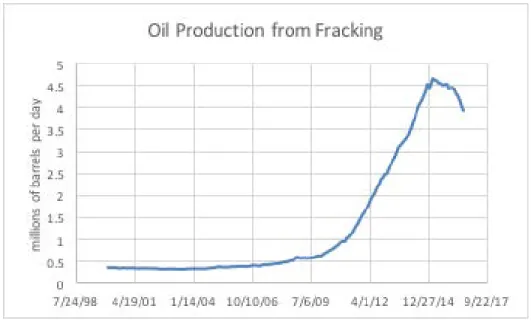
2011, annual shale oil production saw a five-fold increase, from 39 to roughly 217 million barrels.10 Figure 2 plots data from the U.S. Energy Information Administration,
showing the dramatic increase in oil production by fracking since 2009. In fact, fracking constitutes over 50% of U.S. domestic oil production. A close look at Figure 2 shows peak production in 2014, followed by a rapid drop to production levels at the time of this writing.
Figure 2. Plot of Oil Production by Fracking from 1998 to the Present Shows a Dramatic Increase Beginning in 2007 with a Peak in 2014 and
Subsequent Drop to Current Production Levels.11
B. WHAT IS FRACKING?
1. The Fracking Process
Shale oil extraction, or fracking, is both more complicated and expensive than conventional oil well extraction and requires additional technology.12 Deep in the earth’s
10 United States Government Accountability Office, Oil and Gas: Information on Shale Resources,
Development, and Environmental and Public Health Risks, 25.
11 Adapted from “Review of Emerging Resources: U.S. Shale Gas and Shale Oil Plays.” 12 Murray and Hansen, “Peak Oil and Energy Independence,” 245.
shale and porous rock formations are pockets of trapped oil.13 To extract shale oil, the
first step is to purchase the land rights and build a wellpad with all necessary infrastructure to pump, collect, and store the oil. With the support infrastructure in place, a wellbore is established by drilling vertically into the earth to reach the shale formation, then drilling horizontally into the shale. The horizontal drilling typically extends 2,000 to 6,000 feet but can be as long as 12,000 feet.14 When drilling is complete, the drill bit is
removed, and the metal casing and cement are inserted to secure a metal casing pipe, which creates a sealed system that allows for the pressurization of the well to enable the hydraulic fracturing process. As smaller and smaller casing pipe is inserted into the borehole, cement serves to bond the pipe to the formation.15
To extract shale oil, steam or a liquid called a fracturing fluid is injected at high pressure into the formation through the casing pipe. While proprietary, fracturing fluid is likely a combination of hydrochloric acid, ethylene glycol, water, and fracturing sand.16
The pressurized steam or fluid expands into any natural fractures in the formation and creates new fractures. When the pressure is reduced, oil pushes back through the new or expanded fractures, and is then pumped to the surface. The end product, called produced water, contains the fracturing fluid, water, oil, and other gases.17 Oil is separated from
this mixture of fluids, and the produced water, absent the oil but still containing a mixture of chemicals, is then stored in retention pools, called impoundment areas, injected into other underground wells, trucked to a disposal site or water treatment facility, or reused for other processes.18
Once the well produces oil or natural gas, the equipment necessary for the fracking process is removed, and only the infrastructure needed to pump, collect, and
13 United States Government Accountability Office, Energy-Water Nexus: Information on the
Quantity, Quality, and Management of Water Produced during Oil and Gas Production (GAO-12-156) (Washington, DC: United States Government Accountability Office, 2012), 5.
14 United States Government Accountability Office, Oil and Gas: Information on Shale Resources,
Development, and Environmental and Public Health Risks, 9.
15 Ibid., 8. 16 Ibid., 12. 17 Ibid. 18 Ibid.
store the oil remains. As well production decreases, the well can be restimulated by repeating the hydraulic fracturing process.19 Once the useful life of the well is over, the
casing is sealed.
Regulation of shale oil production and the fracking process is governed by local, state, and federal laws.20 The majority of fracking, which occurs on private land, is
governed by local or state regulations and their associated agencies. A federal agency, such as the Bureau of Land Management (BLM), oversees the fracking that occurs on federal land; however, federal regulations can also apply locally because many of the federal regulations that apply to off-shore conventional oil production also apply to unconventional oil production.21
2. Defining the Problem
As with many new advancements, predicting and sometimes detecting all the consequences can be difficult, especially when such impacts are studied individually instead of in aggregate. As fracking had generated so much domestic income and its consequences were masked by the readily apparent benefits, a wide variety of opinion and public policies have arisen. This thesis includes an examination of the issue from a local perspective and a discussion of local impacts, both positive and negative, with the aim of providing a set of recommendations useful to guide policy making by local government and agencies.
Much of the available research provides high quality information and trends but does not aggregate that information into a comprehensive analysis of the adverse effects that boom-and-bust technologies can level on local communities. Those adverse effects present a homeland security concern: Chemicals used during the fracking process and the shale oil itself present public health concerns to the communities in the drilling areas with little known or published on the potential long-term effects.
19 United States Government Accountability Office, Oil and Gas: Information on Shale Resources,
Development, and Environmental and Public Health Risks, 13.
20 Ibid. 21 Ibid.
A gap currently exists in the understanding of short- and long-term unintended consequences for communities that choose to allow fracking. In addition, until those consequences are viewed holistically, the local communities will not be fully prepared. Aside from the positive economic impact, the advent of a fracking boom generates an influx of workers, increased traffic, increased demand for housing and social services, planning and zoning issues, infrastructure demands, and socioeconomic concerns. Communities must plan for all these changes if they are to be properly informed prior to making any policy decisions related to permitting the process. The unintended costs of extraction and adverse consequences from environmental interference, as well as socioeconomic flux, have yet to be explored and properly juxtaposed to the economic gains. This research extends beyond previous research, which focused only on the individual risks of fracking. Instead, this research expands the consequence measures with an examination of the broader impacts to a community to create a more accurate representation of any interconnected events associated with fracking.
For local communities to be prepared properly for any ancillary effects of fracking, additional research on both short- and long-term consequences is essential. As societal effects and their measurements were in emergent stages at the time of this writing, analyzing the available data was critical so communities could make informed decisions before permitting fracking operations. For that purpose, a descriptive research paradigm was instrumental in answering the primary research question: What are the effects of unconventional shale oil exploration on local communities?
An exploratory research paradigm was essential in answering ancillary research questions that were designed to identify the most effective ways to reduce identified negative impacts. The ancillary questions were how can communities prepare for, prevent, or mitigate the environmental impacts of shale oil exportation? How can communities prepare for, prevent, mitigate, and recover from the socioeconomic impacts associated with shale oil exploration?
According to the GAO, the three largest onshore shale oil producing formations are the Bakken22 in western North Dakota, the Eagle Ford in southern Texas, and the
Niobrara extending into Colorado, Kansas, Nebraska, and Wyoming. Since Bakken shale oil in Williston, North Dakota accounts for more than 65% of all U.S. shale oil, it is the focus of this thesis.23 The presumption was that Williston represents a case-study city
useful in informing other communities; furthermore, although this thesis covered the specific case of fracking, the results have been discussed in a broader context of any boom-and-bust technology that involved short-term exploitation of a natural resource. An additional presumption was that because the Bakken is the largest shale-oil field, Williston could serve as a representative test case. If any undesirable consequences of fracking exist, they will most certainly occur in the largest fracking community. The purposes of this thesis were to examine holistically the multiple community impacts associated with shale oil and to use this case study to identify recommended actions that would decrease any evident negative impacts.
C. RESEARCH DESIGN
To examine the unintended consequences of shale oil extraction resulting from the hydro-fracking process on local communities, an embedded case study of the community of Williston, North Dakota, yielded patterns of impacts associated with fracking. According to Robert Yin, a single case study is ideal when it represents a “critical case.”24 The community of Williston and the Bakken shale oil play is a critical
case because it is the largest and most developed fracking community in the US and is thus highly generalizable to other communities.25
The basis of the selection of the Williston, North Dakota area, and the Bakken shale oil case study, was the overall significance of the shale oil formation. According to
22 The Bakken is named after Henry O. Bakken who discovered oil on his farmstead northeast of
Tioga, North Dakota from wells drilled in 1951 and 1952.
23 United States Government Accountability Office, Oil and Gas: Information on Shale Resources,
Development, and Environmental and Public Health Risks, 27.
24 Robert K. Yin, Case Study Research: Design and Methods, 4th ed., Applied Social Research
Methods, v. 5 (Los Angeles: Sage Publications, 2009), 47.
the United States Geologic Survey (USGS), the Bakken is the “largest ‘continuous’ oil accumulation ever assessed by the USGS.”26 Williston, a rural community with a
population of 24,562 as of 2014, has changed dramatically since 2008 when the oil industry leaders determined that the Bakken shale oil play held approximately four billion barrels of crude oil.27 The discovery resulted in an economic boom for the community
and the region, which made it an ideal case study for this thesis. Adding interest is that Bakken crude oil has proven to be more flammable than other kinds of crude and made its transport a worst-case scenario.
D. STUDY LIMITATIONS
The scope of this research concerned what local communities can do, or what state agencies can do, in support of local communities to mitigate associated risks. The federal government has a role and responsibility to mitigate risks, and that role should be evaluated; however, improvements to federal support were not examined for the purpose of this thesis because a local or state government can do little to influence federal regulations. When it comes to environmental concerns, this thesis focused only on air, water, and seismic activity and how the state or local governments regulate, inspect, or measure any impacts. As for socioeconomic concerns, this study was limited to the City of Williston and the immediate surrounding county in North Dakota because Williston is the largest community and sits at the epicenter of the Bakken. In addition, despite the potential to affect mitigation strategies used by local communities, how states use tax surcharges or oil extraction taxes was not a focus of this thesis. Many of the aforementioned social and geopolitical impacts would have required interviews and personal data outside the scope of this research.
26 “USGS Release: 3 to 4.3 Billion Barrels of Technically Recoverable Oil Assessed in North Dakota
and Montana’s Bakken Formation—25 Times More Than 1995 Estimate—(4/10/2008 2:25:36 PM),” accessed October 10, 2016, https://archive.usgs.gov/archive/sites/www.usgs.gov/newsroom/article.asp-ID=1911.html.
27 “Williston City North Dakota QuickFacts from the U.S. Census Bureau,” accessed March 29, 2016,
E. INSTRUMENTATION (DATA AND EVIDENCE)
Inspection and violation data, processing or disposing of fracking waste information, seismic history, and data on water resource quality and consumption provided the detail needed for the analysis of environmental impact. A picture of the impact of fracking on the water sources emerged from water usage permits from the State of North Dakota Water Commission. Data on past environmental spills and fines demonstrated the frequency and magnitude of the spills associated with fracking. Data derived from monitoring sites in North Dakota, where most waste-water disposal occurs through deep well injection, enabled the evaluation of water quality and air quality. Historical seismic data throughout the Bakken verified the association of fracking with seismic activity.
City and state budgets, building permits and construction valuation reports, census data, cost of living data, aviation boarding reports, job service reports and crime figures constituted the instrument of the analysis of socioeconomic impact. City budgets identified infrastructure improvements, increased debt resulting from staffing increases, expansion of water or sewer, and increased taxes. Census data reflected changes in population, demographics, and the housing market. Data on employment rates, housing expenses, sales tax, and property taxes provided insight necessary to determine any changes in the cost of living. The FBI database facilitated an analysis of crime data and possible trends that may well accompany the associated social changes.
F. INTENDED OUTPUT
The aim of this thesis was to provide governance recommendations for communities seeking to prevent, prepare, or mitigate the risks associated with fracking, in particular, or any boom-and-bust industry. Suggestions offered focus on how rural communities can better understand and decrease risks and how they can implement sound policy and regulations to preserve their natural resources and limit the societal impacts that accompany rapid growth scenarios. The information in this thesis may also help policy makers and decision makers to frame the discussion around the local impacts to communities.
G. PREVIEW OF CHAPTERS
Chapter II contains a review of the current literature on fracking and its effects on the environment and the socioeconomics of a community. As of 2016, literature dealing with fracking in the Bakken region was in an emergent state; therefore, examining any trends as the data becomes available is crucial.
Chapter III offers a discussion of the case study research used to analyze the information. Data were evaluated to match patterns, build explanation, and analyze a time series to strengthen the argument of causation.
Chapter IV presents the data from a detailed discussion of the Bakken and the impacts of oil production on the environment and the socioeconomic of the area. The chapter includes a discussion of known emerging environmental concerns regarding air and water quality issues in the region and the environmental impact of water consumption in the Bakken appears. Another focus of Chapter IV is the social and economic variables associated with the boom and bust of oil production. Also appearing in Chapter IV is a description of the impacts upon the community of Williston, North Dakota, in terms of population migration, housing, infrastructure improvements, government budgets, tax burdens, crime rates, employment rates, and income levels. The Williston community provides the framework for the analysis of trends in Chapter V.
Chapter V covers commonalties identified in communities undertaking fracking and highlights findings about unintended impacts to provide a basis for the formulation of recommendations for communities.
Chapter VI provides recommendations to serve as the foundation for policy created from best practices. Prepared and proactive community leaders are crucial in the long-term prognosis of a community potentially impacted by fracking. This chapter offers recommendation and preparations that can mitigate the risk local communities may face.
II.
LITERATURE REVIEW
The short- and long-term effects of unconventional oil extraction, such as impacts on the environment, the socioeconomic changes in communities, and the risks associated with product transportation, were the subjects of ongoing research at the time of this writing. This research, however, has stalled for the following reasons. Some of the chemical processes are proprietary, the process takes place several hundred feet underground, and the process has not been in existence long enough for communities to experience or for researchers to study impacts longitudinally.28 The literature indicates
that the better prepared a community is for the influx of workers, the transportation of hazardous products, increased housing demands, planning and zoning activities, pressure on the infrastructure, and socioeconomic instability, the less detrimental the impacts will be.
A. ENVIRONMENTAL IMPACTS
Advancements in hydraulic fracturing and horizontal boring have increased the feasibility of shale oil extraction. More complicated and expensive than conventional extraction, this process requires additional technology.29 Thus, the fracking process,
studied by both proponents and opponents, has caused controversy. Some researchers who have studied the fracking process have published articles detailing common environmental issues.30 In addition, the New York State Department of Health,
28 Simona L. Perry, “Environmental Reviews and Case Studies: Addressing the Societal Costs of
Unconventional Oil and Gas Exploration and Production: A Framework for Evaluating Short-Term, Future, and Cumulative Risks and Uncertainties of Hydrofracking,” Environmental Practice 14, no. 4 (December 2012): 352, doi: 10.1017/S1466046612000336.
29 Murray and Hansen, “Peak Oil and Energy Independence,” 245.
30 Paul C. Stern, Thomas Webler, and Mitchell J. Small, “Understanding the Risks of Unconventional
Shale Gas Development,” Environmental Science & Technology 48, no. 15 (August 5, 2014): 8287–8288, doi: 10.1021/es502459b; Katherine E. Konschnik and Mark K. Boling, “Shale Gas Development: A Smart Regulation Framework,” Environmental Science & Technology 48, no. 15 (August 5, 2014): 8404–8416, doi: 10.1021/es405377u; Robert B. Jackson et al., “The Environmental Costs and Benefits of Fracking,”
Annual Review of Environment and Resources 39, no. 1 (October 17, 2014): 327–362, doi: 10.1146/annu rev-environ-031113-144051.
Congressional Research Service (CRS), and GAO have released reports detailing the effects on the environment and public health associated with fracking.31
The oil extraction process is directly connected to the environment, which poses a significant risk to the environment, as well as to public health.32 Researchers have
concurred that the fracking process poses a risk to air quality, water consumption, and water quality, and has induced seismic activity.33 The GAO has reported that because
long-term environmental and public health risks have not been documented, all risks are still unknown;34 therefore, additional research is needed to provide more direction for
local governments to reduce these risks.
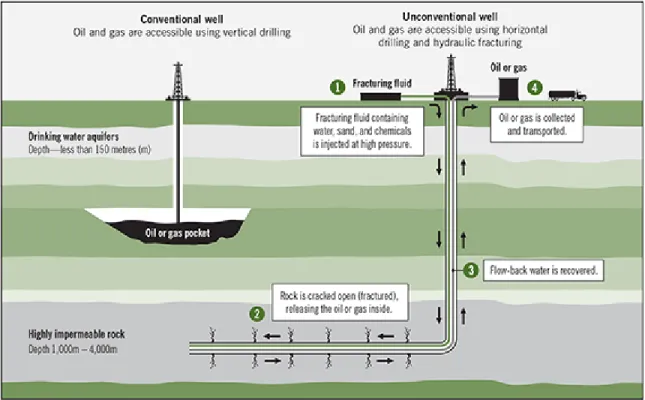
The oil and gas found in shale, sandstone, and the coal bed is called unconventional oil. It differs from conventional oil sources that are found in deep, porous rock, and thus, flow freely; in unconventional oil production the oil and gas are trapped in the rock formation and do not flow freely.35 To extract the oil and gas in rock formations,
operators use a process called hydraulic fracturing, or fracking (see Figure 3).
31 Howard Zucker, A Public Health Review of High Volume Hydraulic Fracturing for Shale Gas
Development (Albany, NY: New York Department of Health, 2014); Michael Ratner and Mary Tiemann,
An Overview of Unconventional Oil and Natural Gas: Resources and Federal Actions (CRS Report No. R43148) (Washington, DC: Congressional Research Service, 2014), http://www.pennyhill.com/jmsfile seller/docs/R43148.pdf; United States Government Accountability Office, Unconventional Oil and Gas Production: Opportunities and Challenges of Oil Shale Development (GAO-12-740T) (Washington, DC: United States Government Accountability Office, 2012).
32 United States Government Accountability Office, Unconventional Oil and Gas Production:
Opportunities and Challenges of Oil Shale Development.
33 United States Government Accountability Office, Oil and Gas: Information on Shale Resources,
Development, and Environmental and Public Health Risks, 33–52.
34 Ibid., 32. 35 Ibid., 5.
Figure 3. An Example of a Conventional and Unconventional Wells.36
The process of fracking requires multiple steps to produce a successful well. The first step—to identify a suitable source that will produce oil—starts with an operator conducting seismic testing by hitting the ground hard with a thumper mounted on a truck and measuring the energy as it bounces within the subsurface.37 This measurement helps
determine the characteristics of the formation. If the location appears favorable, the operator negotiates with the land owner for mineral rights to drill for oil or gas, obtaining permits from the North Dakota Industrial Commission: Oil and Gas Division (NDIC: Oil and Gas), which has authority to regulate and permit the oil and gas production in the state.38
36 Source: “2012 Fall Report of the Commissioner of the Environment and Sustainable Development,
Chapter 5—Environmental Petitions,” http://www.oag-bvg.gc.ca/internet/English/parl_cesd_201212_05_e_ 37714.html.
37 United States Government Accountability Office, Oil and Gas: Information on Shale Resources,
Development, and Environmental and Public Health Risks, 7.
38 “Welcome to the North Dakota Industrial Commission, Department of Mineral Resources, Oil and
Generally, the operation then moves into the development phase, which includes construction of a well pad, drilling, well construction, and hydraulic fracturing of the rock.39
First, the site must be prepared by removing surface vegetation and leveling the ground. The pad site must be made large enough to allow for frequent truck and heavy machinery traffic. Infrastructure including roads, tanks, impoundment ponds, piping, and the drill rig must also be constructed.40 Next, equipment and the additives (chemicals),
sand, and water that will be mixed together and injected during the fracking process must be transported to the site. Impoundment ponds or pits must be constructed and lined for the storage of fracturing fluids, commonly referred to as produced water or brine.41
The third phase is a multistep process, during which a wellbore is drilled through a series of vertical and horizontal holes. At multiple and varying depths, the drill bit is removed and a casing is inserted and cemented for cohesion with the rock.42 This step is
critical because it prevents fugitive gas from moving along the bore casing to other ground sources or the surface. To monitor the pressure and also prevent the uncontrolled release of oil or gas, a blowout preventer is installed.43 As the wellbore is drilled, a
lubricant known as a drilling fluid is injected to flush the drilling debris away from the bit to the surface. This mixture of rock debris and drilling fluid is collected in the impoundment pond.44
After the vertical portion of the wellbore is complete, cement is again injected to seal the casing, followed by horizontal drilling through the shale.45 Horizontal well bores
can extend 2,000 to 6,000 feet from the vertical wellbore.46 During the drilling process,
39 United States Government Accountability Office, Oil and Gas: Information on Shale Resources,
Development, and Environmental and Public Health Risks, 7–8.
40 Ibid., 8. 41 Ibid. 42 Ibid. 43 Ibid. 44 Ibid. 45 Ibid. 46 Ibid., 9.
natural gas is commonly released from the wellbore and either vented or flared. If the gas is flared, it is ignited and consumed. If the gas is vented, it is released directly into the atmosphere. The process of venting natural gas has been found to contribute to the production of smog and can contain toxic volatile organic compounds (VOCs).47 Flaring
produces carbon monoxide and contributes to greenhouse gas production but decreases the impact from VOCs.48
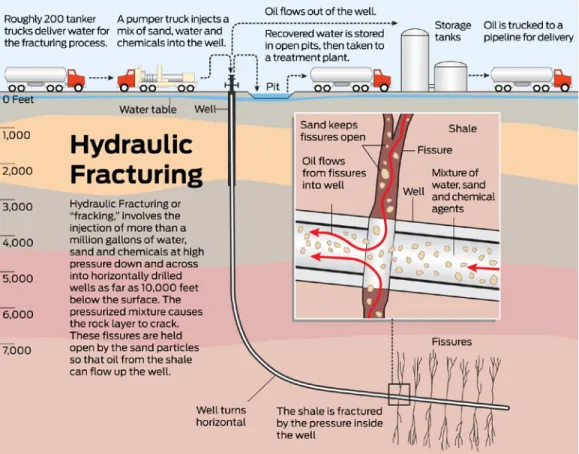
The fourth phase is the fracking process (see Figure 4). To prepare the well for stimulation, the operator must insert a metal pipe with holes, designed to release fracturing fluid and propant into the rock fractures. Fracturing fluid, water, and sand (known as propant) are injected under pressure to fracture the rock and allow for the release of oil and gas. Fracturing fluids can differ in chemical makeup and are adjusted to the rock conditions.49 Once the pressure fractures the rock formation, the propant keeps
the fracture open.50 During the fracking process, some of the fracturing fluid, along with
water that is naturally found in the rock formation, returns to the surface. That fluid is commonly referred to as produced water, flowback, or brine.51 Until it can be transported
for treatment, recycled to be used at a different drill site, or disposed of by injection into wells, the produced water is collected at the site pad in impoundment ponds.52 Once the
well initially produces, the equipment and infrastructure used for the drilling and fracturing process are removed and relocated.53
47 Ratner and Tiemann, An Overview of Unconventional Oil and Natural Gas: Resources and Federal
Actions, 9.
48 Ibid.
49 United States Government Accountability Office, Oil and Gas: Information on Shale Resources,
Development, and Environmental and Public Health Risks, 11.
50 Ibid., 12. 51 Ibid. 52 Ibid. 53 Ibid., 13.
Figure 4. The Hydraulic Fracturing Process.54
1. Air Quality
Researchers have agreed that shale oil extraction affects air quality. A multistage oil extraction can require between 320 and 1,365 truckloads to transport the necessary water, chemicals, sand, and heavy equipment to drill a well.55 This increased truck traffic
decreases air quality because of its release of nitrogen oxides and particulate matter.56
“There can also be long-term regional increases in air pollutants from oil shale processing and the generation of additional electricity to power oil shale development operations. Pollutants, such as dust, nitrogen oxides, and sulfur dioxide, can contribute to the
54 Source: “Squeezing the Shale,” accessed August 28, 2016, http://lubbockonline.com/Squeezing_
Shale.
55 United States Government Accountability Office, Oil and Gas: Information on Shale Resources,
Development, and Environmental and Public Health Risks, 13.
formation of regional haze.”57 The flaring, or burning off of natural gas, from the shale
oil, also affects air quality.58 The flaring process produces carbon dioxide, methane, and
other volatile compounds that contribute to greenhouse gas emissions.59 According to an
Environmental Protection Agency (EPA) report, “Natural gas completions involving hydraulic fracturing vent substantially more natural gas, approximately 230 times more, than natural gas completions not involving hydraulic fracturing.”60
Numerous researchers and the CRS have expressed concerns that air emissions from open-air water containment pits can allow the release of volatile organic compounds (VOCs) into the air.61 Various levels of toxic gases, such as methane, benzene, toluene,
and occasionally hydrogen sulfide, are released into the air and contain VOCs, which are known carcinogens.62 According to the GAO, several serious health concerns are
associated with air contaminants near the drill site.63 When emission sources were
combined to include drilling, fracking, and truck and power generation needs, nitrous oxide emissions at the site were estimated to have increased between 12% and 27%.64
Research conducted to estimate the damage associated with shale oil extraction in
57 United States Government Accountability Office, Unconventional Oil and Gas Production:
Opportunities and Challenges of Oil Shale Development, Highlights.
58 United States Government Accountability Office, Oil and Gas: Information on Shale Resources,
Development, and Environmental and Public Health Risks, 35.
59 Ibid.
60 U.S. Environmental Protection Agency, Regulatory Impact Analysis: Final New Source
Performance Standards and Amendments to the National Emissions Standards for Hazardous Air Pollutants for the Oil and Natural Gas Industry (Research Triangle Park, NC: U.S. Environmental Protection Agency, 2012), 3–6.
61 Jackson et al., “The Environmental Costs and Benefits of Fracking”; Christopher W. Moore et al.,
“Air Impacts of Increased Natural Gas Acquisition, Processing, and Use: A Critical Review,”
Environmental Science & Technology 48, no. 15 (August 5, 2014): 8349–8359, doi: 10.1021/es4053472; Ratner and Tiemann, An Overview of Unconventional Oil and Natural Gas: Resources and Federal Actions, 9.
62 Jackson et al., “The Environmental Costs and Benefits of Fracking,” 346–347.
63 United States Government Accountability Office, Unconventional Oil and Gas Development, Key
Environmental and Public Health Requirements (GAO-12-874) (Washington, DC: United States Government Accountability Office, 2012), 14–15.
Pennsylvania showed annual damage to be $2.5 to $5.5 million for the life of the well.65
Pennsylvania shale oil extraction contributed to an increase of 2.60%–10% VOCs, 29%– 30% nitrous oxide gases, and 35%–55% sulfur dioxide gases.66
2. Water Consumption
Water consumption is another environmental and public health concern associated with fracking. Research has shown that shale oil extraction presents a risk to both surface and ground water67 because of extraction, the consumption of water in the fracking
process, water requiring water consumption, and water taken from surface and underground water sources.68 The removal of water from lakes, streams, and rivers can
jeopardize the quality of those sources subject to higher summer temperatures, which adversely affects aquatic life and wildlife habitat.69 Similarly, the removal of water from
shallow aquifers can deplete ground water sources and the streams and springs fed by them.70 Removal from deeper aquifers has long-lasting effects because deep aquifers take
a very long time to replenish.71 This amount of water consumption is of great concern
because the water used for fracking is permanently removed from the water cycle as a result of waste-water injection into deep rock formations.72
65 Aviva Litovitz et al., “Estimation of Regional Air-Quality Damages from Marcellus Shale Natural
Gas Extraction in Pennsylvania,” Environmental Research Letters 8, no. 1 (January 31, 2013): 5, doi: 10.10 88/1748-9326/8/1/014017.
66 Moore et al., “Air Impacts of Increased Natural Gas Acquisition, Processing, and Use,” 8353. 67 Jackson et al., “The Environmental Costs and Benefits of Fracking,” 478–493; B. R. Scanlon, R. C.
Reedy, and J.-P. Nicot, “Comparison of Water Use for Hydraulic Fracturing for Unconventional Oil and Gas versus Conventional Oil,” Environmental Science & Technology 48, no. 20 (October 21, 2014): 12386–12393, doi: 10.1021/es502506v; Avner Vengosh et al., “A Critical Review of the Risks to Water Resources from Unconventional Shale Gas Development and Hydraulic Fracturing in the United States,”
Environmental Science & Technology 48, no. 15 (August 5, 2014): 8334–8348, doi: 10.1021/es405118y; United States Government Accountability Office, Oil and Gas: Information on Shale Resources, Development, and Environmental and Public Health Risks, 37–39.
68 United States Government Accountability Office, Oil and Gas: Information on Shale Resources,
Development, and Environmental and Public Health Risks, 37.
69 Ibid., 38. 70 Ibid. 71 Ibid. 72 Ibid., 39.
Despite a sizable consumption, research has indicated that water consumption through fracking pales in comparison to conventional oil extraction and other usage as in thermoelectric power plants and agricultural irrigation.73 That said, water consumption
could eventually limit the growth of the shale oil industry because of a lack of the resource.74 The cumulative effects of drilling in a region can negatively impact the local
water supply and make the region vulnerable to drought.75
3. Water Quality
The shale oil extraction process provides the potential for the underground migration of gas and chemicals that can contaminate the water of nearby drinking water wells.76 When an oil well is neither properly protected nor isolated from water sources
through the casing and cementing process, gas and other fluids from the extraction process can migrate into nearby drinking water aquifers.77 This migration occurs through
fractures that have been created or natural fractures that can be thousands of meters away.78 The challenge is that research is indicative of a minimal risk of water
contamination, but the risk exists. Research spanning a 25-year period in Ohio identified 185 cases of groundwater contamination, or a 0.1% occurrence rate attributed to fracking. In Texas, the rate of occurrence was lower at 0.02%.79
Water quality is also potentially impacted by the release of produced water, which contains chemicals, oil, and gases. This release can occur onsite or during
73 United States Government Accountability Office, Oil and Gas: Information on Shale Resources,
Development, and Environmental and Public Health Risks, 38; Scanlon, Reedy, and Nicot, “Comparison of Water Use for Hydraulic Fracturing for Unconventional Oil and Gas versus Conventional Oil,” 12392; Vengosh et al., “A Critical Review of the Risks to Water Resources from Unconventional Shale Gas Development and Hydraulic Fracturing in the United States,” 8343.
74 United States Government Accountability Office, Unconventional Oil and Gas Production:
Opportunities and Challenges of Oil Shale Development, 6.
75 United States Government Accountability Office, Oil and Gas: Information on Shale Resources,
Development, and Environmental and Public Health Risks, 39.
76 Stern, Webler, and Small, “Understanding the Risks of Unconventional Shale Gas Development,”
8287.
77 Jackson et al., “The Environmental Costs and Benefits of Fracking,” 341. 78 Ibid.
transportation.80 Onsite, produced water is stored in an impoundment area until a time
when it can be disposed of or treated.81 During storage, risks occur from tears in the
storage liner and from overflows of the impoundment area.82 In 2010 and 2011, melting
snows in North Dakota caused overflows of impoundment areas.83 If produced water is
disposed of, it is taken by truck or train, and transportation is always accompanied by the risk of accidental spillage.84
4. Seismic Activity
Treatment of wastewater, or produced water, from a drilling well is potentially damaging to water treatment plants. An alternative to wastewater treatment is subsurface injection that disposes the contaminated water by injecting it back into a used well. Onsite disposal of produced water through injection can reduce the expense and risk of transporting the waste off site.85 The injection disposal method has unknown long-term
effects.86 Seismic activity can occur from rock formations that undergo stress changes.
During or soon after hydraulic fracturing, the fault line may become critically stressed;87
however, they concluded that the likelihood of hydraulic fracturing-induced earthquakes
80 United States Government Accountability Office, Oil and Gas: Information on Shale Resources,
Development, and Environmental and Public Health Risks, 7; Jackson et al., “The Environmental Costs and Benefits of Fracking,” 341–344; Luisa Torres, Om Prakash Yadav, and Eakalak Khan, “A Review on Risk Assessment Techniques for Hydraulic Fracturing Water and Produced Water Management Implemented in Onshore Unconventional Oil and Gas Production,” Science of The Total Environment 539 (January 2016): 478–93, doi: 10.1016/j.scitotenv.2015.09.030.
81 Ibid. 82 Ibid. 83 Ibid.
84 United States Government Accountability Office, Oil and Gas: Information on Shale Resources,
Development, and Environmental and Public Health Risks, 39–42.
85 Torres, Yadav, and Khan, “A Review on Risk Assessment Techniques for Hydraulic Fracturing
Water and Produced Water Management Implemented in Onshore Unconventional Oil and Gas Production,” 491.
86 Ibid.
87 Richard Davies et al., “Induced Seismicity and Hydraulic Fracturing for the Recovery of
Hydrocarbons,” Marine and Petroleum Geology 45 (August 2013): 172, doi: 10.1016/j.marpetgeo.2013.03. 016.
is extremely small, and if it occurs, a small-magnitude earthquake is the probable result.88
Pennsylvania had a limited the number of wells suitable for disposal injection.89
To resolve its problem, Pennsylvania found locations in Ohio that would take its contaminated produced water and inject it into wells for disposal.90 From March 2011 to
January 2012, twelve earthquakes occurred in Ohio, ranging from 2.1 to 4.0 on the Richter scale. In March 2012, the Ohio Department of Natural Resources acknowledged “a compelling argument” that injection of produced water induced the seismic activity.91
This acknowledgement led the Ohio Governor to put a moratorium on injection in the Youngtown area.92 A conflict between the two states quickly developed.93
B. SOCIOECONOMIC CHALLENGES
1. Population In-Migration
Oil extraction and production typically coincide with rapid economic growth and a population influx.94 This phenomenon, commonly known as a “boomtown” or a
88 Ibid., 183.
89 Barry G. Rabe and Christopher Borick, “Conventional Politics for Unconventional Drilling?
Lessons from Pennsylvania’s Early Move into Fracking Policy Development: Conventional Politics for Unconventional Drilling,” Review of Policy Research 30, no. 3 (May 2013): 337, doi: 10.1111/ropr.12018.
90 Ibid.
91 United States Government Accountability Office, Unconventional Oil and Gas Development, Key
Environmental and Public Health Requirements, 59.
92 Ibid.
93 Rabe and Borick, “Conventional Politics for Unconventional Drilling?” 337; Barry G. Rabe, “Shale
Play Politics: The Intergovernmental Odyssey of American Shale Governance,” Environmental Science & Technology 48, no. 15 (August 5, 2014): 8375, doi: 10.1021/es4051132.
94 Kai A. Schafft, Yetkin Borlu, and Leland Glenna, “The Relationship between Marcellus Shale Gas
Development in Pennsylvania and Local Perceptions of Risk and Opportunity,” Rural Sociology 78, no. 2 (June 2013): 143.
“boom-and-bust cycle,” has impacted communities.95 Recent boomtown studies have
centered on the tremendous population growth resulting from the fracking of shale oil. This growth has mainly occurred in rural communities, the nature of which has made them more vulnerable to rapid population contractions as the oil price or production decreases.96
The preboom population experiences negative social consequences because of the influx of workers from other areas,97 some of which include “rising divorce rates,
prostitution, alcoholism and drug abuse, childhood stress, and mental health issues.”98
New workers have diverse backgrounds, bringing with them different cultural and social norms that may well clash with those in an already established community. Long-term residents face frustration and the insecurity of not knowing new neighbors. Additional cultural and social norms bring a shift in values. For long-term residents, all the change creates a perception that everything is about money. In many ways, original residents feel nostalgic about their old lifestyle and regret the chaos that oil production has brought to their community.99
95 Jeffrey B. Jacquet, “Review of Risks to Communities from Shale Energy Development,”
Environmental Science & Technology 48, no. 15 (August 5, 2014): 8322–23, doi: 10.1021/es404647x; Shawn Dalton, Discussion Paper—Potential Socioeconomic Effects of Unconventional Oil and Gas Development in Nova Scotia Communities (Sydney, Nova Scotia, Canada: Cape Breton University, 2014), 8–10, https://www.google.com/search?q=socialeconomical+impact+of+unconventional+oil+exploration &ie=utf-8&oe=utf-8; Schafft, Borlu, and Glenna, “The Relationship between Marcellus Shale Gas Development in Pennsylvania and Local Perceptions of Risk and Opportunity,” 144–146; Jessica Crowe et al., “Differences in Public Perceptions and Leaders’ Perceptions on Hydraulic Fracturing and Shale Development,” Sociological Perspectives 58, no. 3 (2015): 445.
96 Audrey Putz, Alex Finken, and Gary A. Goreham, Sustainability in Natural Resource-Dependent
Regions That Experienced Boom-Bust-Recovery Cycles: Lessons Learned from a Review of the Literature, Center for Community Vitality Working Paper (Fargo, ND: North Dakota State University, 2011), 14, http://www.visionwestnd.com/pdf/Boom-bust%20communities.pdf.
97 Schafft, Borlu, and Glenna, “The Relationship between Marcellus Shale Gas Development in
Pennsylvania and Local Perceptions of Risk and Opportunity,” 144–145; Dalton, Discussion Paper— Potential Socioeconomic Effects of Unconventional Oil and Gas Development in Nova Scotia Communities, 9.
98 Schafft, Borlu, and Glenna, “The Relationship between Marcellus Shale Gas Development in
Pennsylvania and Local Perceptions of Risk and Opportunity,” 144.
99 Shelby Bohnenkamp et al., Concerns of the North Dakota Bakken Oil Counties: Extension Service
and Other Organizations’ Program Responses to These Concerns (Fargo, ND: Center for Community Vitality, NDSU Extension Service, 2011), 7–8, http://www.visionwestnd.com/pdf/bakken_needs_report.pdf
2. Housing
During the extraction and development phases, activity is more intense and requires numerous truck drivers, mechanics, heavy equipment operators, and rig workers among others.100 Numerous researchers have found that those who follow shale oil work
are primarily young males who have no ties to the community, which causes a shift in community demographics.101 From July 1, 2010, to July 1, 2014, the U.S. Census Bureau
showed an estimated increase of 9.9% in the population of North Dakota, attributed to an over 43% population growth in Williams County. Williston, North Dakota is located in Williams County and is the epicenter of the Bakken oil production.102 Compared to the
national unemployment rate of 7.4% and a job growth rate of .32% in July 2013, Williston had an unemployment rate of 0.07% and a job growth rate of 32.09%.103 That
population increase exacerbated the already tight housing market in North Dakota.104
As the shale oil boom started in North Dakota, its housing costs skyrocketed along with the cost of living.105 The same type of housing crunch doubled or tripled rent
prices during the early stages of the Marcellus development, a shale oil formation primarily a natural gas producer located in Pennsylvania.106 In addition, increasing
housing costs displaced those on fixed incomes.107 People in communities without rent
100 KLJ, Inc., 2014–2019 North Dakota Oil and Gas Industry Impact Study (Bismarck, ND: KLJ, Inc.,
2014), 30–31.
101 Rick Ruddell et al., “Drilling Down: An Examination of the Boom-Crime Relationship in
Resource-Based Boom Counties,” Western Criminology Review 15, no. 1 (April 2014): 3; Carol L. Cwiak et al., The New Normal: The Direct and Indirect Impacts of Oil Drilling and Production on the Emergency Management Function in North Dakota (Fargo, ND: North Dakota State University, 2015), 23, http://www. ndsu.edu/fileadmin/emgt/FINALThe_New_Normal_January_2015_a.pdf; KLJ, Inc., 2014–2019 North Dakota Oil and Gas Industry Impact Study, 38.
102 “American FactFinder, Cumulative Estimates of Resident Population Change and Rankings: April
1, 2010 to July 1, 2014—State -- County/County Equivalent 2014 Population Estimates,” accessed
November 8, 2015, http://factfinder.census.gov/faces/tableservices/jsf/pages/productview.xhtml?pid=PEP_ 2014_PEPCUMCHG.ST05&prodType=table.
103 Jacquet, “Review of Risks to Communities from Shale Energy Development,” 8322. 104 Cwiak et al., The New Normal, 23–25.
105 Bohnenkamp et al., Concerns of the North Dakota Bakken Oil Counties, 8.
106 Schafft, Borlu, and Glenna, “The Relationship between Marcellus Shale Gas Development in
Pennsylvania and Local Perceptions of Risk and Opportunity,” 150.
107 Ibid.; Crowe et al., “Differences in Public Perceptions and Leaders’ Perceptions on Hydraulic