Recovery IC with Integrated Limiting Amp
ADN2819
Rev.B
Information furnished by Analog Devices is believed to be accurate and reliable. However, no responsibility is assumed by Analog Devices for its use, nor for any infringements of patents or other rights of third parties that may result from its use.
One Technology Way, P.O. Box 9106, Norwood, MA 02062-9106, U.S.A.
FEATURES
Meets SONET requirements for jitter transfer/generation/tolerance Quantizer sensitivity: 4 mV typical
Adjustable slice level: ±100 mV 1.9 GHz minimum bandwidth Patented clock recovery architecture Loss of signal detect range: 3 mV to 15 mV
Single reference clock frequency for all rates, including 15/14 (7%) wrapper rate
Choice of 19.44 MHz, 38.88 MHz, 77.76 MHz, or 155.52 MHz REFCLK
LVPECL/LVDS/LVCMOS/LVTTL compatible inputs (LVPECL/LVDS only at 155.52 MHz)
19.44 MHz oscillator on-chip to be used with external crystal Loss of lock indicator
Loopback mode for high speed test data Output squelch and bypass features Single-supply operation: 3.3 V Low power: 540 mW typical 7 mm × 7 mm 48-lead LFCSP
APPLICATIONS
SONET OC-3/-12/-48, SDH STM-1/-4/-16, GbE and 15/14 FEC rates WDM transponders Regenerators/repeaters Test equipment Backplane applications
PRODUCT DESCRIPTION
The ADN2819 provides the receiver functions of quantization, signal level detect, and clock and data recovery at rates of OC-3, OC-12, OC-48, Gigabit Ethernet, and 15/14 FEC rates. All SONET jitter requirements are met, including jitter transfer, jitter generation, and jitter tolerance. All specifications are quoted for –40°C to +85°C ambient temperature, unless otherwise noted.
The device is intended for WDM system applications, and can be used with either an external reference clock or an on-chip oscillator with external crystal. Both native rates and 15/14 rate digital wrappers are supported by the ADN2819, without any change of reference clock.
This device, together with a PIN diode and a TIA preamplifier, can implement a highly integrated, low cost, low power, fiber optic receiver.
The receiver front end signal detect circuit indicates when the input signal level has fallen below a user-adjustable threshold. The signal detect circuit has hysteresis to prevent chatter at the output.
The ADN2819 is available in a compact 7 mm × 7 mm, 48-lead chip scale package.
FUNCTIONAL BLOCK DIAGRAM
LEVEL DETECT DATA RETIMING DIVIDER 1/2/4/16 FRACTIONAL DIVIDER FREQUENCY LOCK DETECTOR LOOP FILTER PHASE
SHIFTER PHASEDET. VCO
XTAL OSC LOOP FILTER QUANTIZER /n ADN2819
SLICEP/N VCC VEE CF1 CF2 LOL
REFSEL[0..1] REFCLKP/N XO1 XO2 REFSEL SEL[0..2] CLKOUTP/N DATAOUTP/N SDOUT THRADJ VREF NIN PIN 2 2 2 2 2 3 02999-0-001 Figure 1.
TABLE OF CONTENTS
Specifications... 3
Absolute Maximum Ratings... 6
Thermal Characteristics ... 6
ESD Caution... 6
Pin Configuration and Function Descriptions... 7
Definition of Terms... 9
Maximum, Minimum, and Typical Specifications ... 9
Input Sensitivity and Input Overdrive... 9
Single-Ended vs. Differential ... 9
LOS Response Time ... 10
Jitter Specifications... 10
Theory of Operation ... 12
Functional Description ... 14
Multirate Clock and Data Recovery... 14
Limiting Amplifier ... 14
Slice Adjust ... 14
Loss of Signal (LOS) Detector ... 14
Reference Clock... 14
Lock Detector Operation ... 15
Squelch Mode ... 16
Test Modes: Bypass and Loopback... 16
Applications Information ... 17
PCB Design Guidelines ... 17
Choosing AC-Coupling Capacitors ... 19
DC-Coupled Application ... 20
LOL Toggling During Loss of Input Data... 20
Outline Dimensions ... 21
Ordering Guide ... 21
REVISION HISTORY
5/04—Data Sheet Changed from Rev. A to Rev. B Updated Format...Universal Changes to Specifications ... 3Changes to Table 7 and Table 8... 15
Updated Outline Dimensions ... 21
Changes to Ordering Guide ... 21
1/03—Data Sheet Changed from Rev. 0 to Rev. A Changes to Table IV ... 12
SPECIFICATIONS
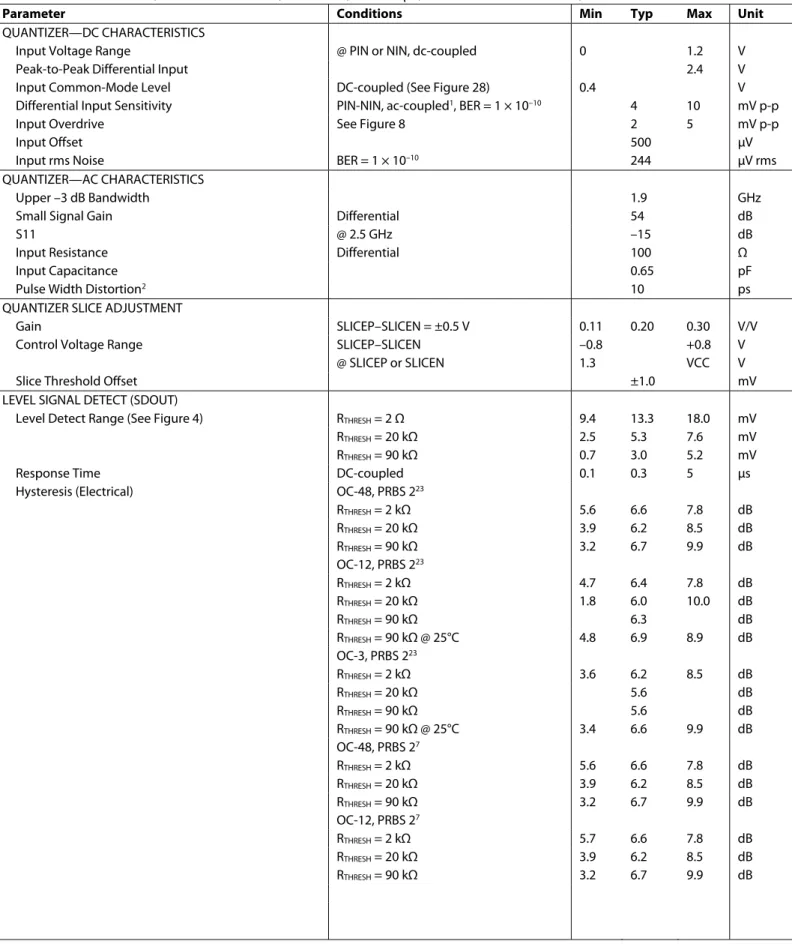
Table 1. TA = TMIN to TMAX, VCC = VMIN to VMAX, VEE = 0 V, CF = 4.7 µF, SLICEP = SLICEN = VCC, unless otherwise noted.
Parameter Conditions Min Typ Max Unit
QUANTIZER—DC CHARACTERISTICS
Input Voltage Range @ PIN or NIN, dc-coupled 0 1.2 V
Peak-to-Peak Differential Input 2.4 V
Input Common-Mode Level DC-coupled (See Figure 28) 0.4 V
Differential Input Sensitivity PIN-NIN, ac-coupled1, BER = 1 × 10⁻¹⁰ 4 10 mV p-p
Input Overdrive See Figure 8 2 5 mV p-p
Input Offset 500 µV
Input rms Noise BER = 1 × 10⁻¹⁰ 244 µV rms
QUANTIZER—AC CHARACTERISTICS
Upper –3 dB Bandwidth 1.9 GHz
Small Signal Gain Differential 54 dB
S11 @ 2.5 GHz –15 dB
Input Resistance Differential 100 Ω
Input Capacitance 0.65 pF
Pulse Width Distortion2 10 ps
QUANTIZER SLICE ADJUSTMENT
Gain SLICEP–SLICEN = ±0.5 V 0.11 0.20 0.30 V/V
Control Voltage Range SLICEP–SLICEN –0.8 +0.8 V
@ SLICEP or SLICEN 1.3 VCC V
Slice Threshold Offset ±1.0 mV
LEVEL SIGNAL DETECT (SDOUT)
Level Detect Range (See Figure 4) RTHRESH = 2 Ω 9.4 13.3 18.0 mV
RTHRESH = 20 kΩ 2.5 5.3 7.6 mV
RTHRESH = 90 kΩ 0.7 3.0 5.2 mV
Response Time DC-coupled 0.1 0.3 5 µs
Hysteresis (Electrical) OC-48, PRBS 223
RTHRESH = 2 kΩ 5.6 6.6 7.8 dB RTHRESH = 20 kΩ 3.9 6.2 8.5 dB RTHRESH = 90 kΩ 3.2 6.7 9.9 dB OC-12, PRBS 223 RTHRESH = 2 kΩ 4.7 6.4 7.8 dB RTHRESH = 20 kΩ 1.8 6.0 10.0 dB RTHRESH = 90 kΩ 6.3 dB RTHRESH = 90 kΩ @ 25°C 4.8 6.9 8.9 dB OC-3, PRBS 223 RTHRESH = 2 kΩ 3.6 6.2 8.5 dB RTHRESH = 20 kΩ 5.6 dB RTHRESH = 90 kΩ 5.6 dB RTHRESH = 90 kΩ @ 25°C 3.4 6.6 9.9 dB OC-48, PRBS 27 RTHRESH = 2 kΩ 5.6 6.6 7.8 dB RTHRESH = 20 kΩ 3.9 6.2 8.5 dB RTHRESH = 90 kΩ 3.2 6.7 9.9 dB OC-12, PRBS 27 RTHRESH = 2 kΩ 5.7 6.6 7.8 dB RTHRESH = 20 kΩ 3.9 6.2 8.5 dB RTHRESH = 90 kΩ 3.2 6.7 9.9 dB
Parameter Conditions Min Typ Max Unit Hysteresis (Electrical) (continued) OC-3, PRBS 27
RTHRESH = 2 kΩ 5.4 6.6 7.7 dB
RTHRESH = 20 kΩ 4.6 6.4 8.2 dB
RTHRESH = 90 kΩ 3.9 6.8 9.7 dB
LOSS OF LOCK DETECTOR (LOL)
Loss of Lock Response Time From fVCO error > 1000 ppm 60 mV
POWER SUPPLY VOLTAGE 3.0 3.3 3.6 V
POWER SUPPLY CURRENT 150 164 215 mA
PHASE-LOCKED LOOP CHARACTERISTICS PIN–NIN = 10 mV p-p
Jitter Transfer BW OC-48 590 880 kHz
GbE 310 480 kHz
OC-12 140 200 kHz
OC-3 48 85 kHz
Jitter Peaking OC-48 0.025 dB
OC-12 0.004 dB
OC-3 0.002 dB
Jitter Generation OC-48, 12 kHz–20 MHz 0.003 UI rms
0.05 0.09 UI p-p
OC-12, 12 kHz–5 MHz 0.002 UI rms
0.02 0.04 UI p-p
OC-3, 12 kHz–1.3 MHz 0.002 UI rms
0.02 0.04 UI p-p
Jitter Tolerance OC-48 (See Figure 14)
600 Hz3 92 UI p-p
6 kHz3 20 UI p-p
100 kHz 5.5 UI p-p
1 MHz3 1.0 UI p-p
GbE (OC-24) (See Figure 14)
300 Hz3 16 UI p-p
3 kHz3 16 UI p-p
50 kHz 7.7 UI p-p
500 kHz3 2.2 UI p-p
OC-12 (See Figure 14)
30 Hz3 100 UI p-p
300 Hz 44 UI p-p
25 kHz 5.8 UI p-p
250 kHz3 1.0 UI p-p
OC-3 (See Figure 14)
30 Hz3 50 UI p-p
300 Hz3 23.5 UI p-p
6500 Hz 6.0 UI p-p
65 kHz3 1.0 UI p-p
CML OUTPUTS (CLKOUTP/N, DATAOUTP/N)
Single-Ended Output Swing VSE (See Figure 7) 300 455 600 mV
Differential Output Swing VDIFF (See Figure 7) 600 910 1200 mV
Output High Voltage VOH VCC V
Output Low Voltage VOL, referred to VCC –0.60 –0.30 V
Rise Time 20%–80% 150 ps
Parameter Conditions Min Typ Max Unit
Setup Time TS (See Figure 3)
OC-48 140 ps
GbE 350 ps
OC-12 750 ps
OC-3 3145 ps
Hold Time TH (See Figure 3)
OC-48 150 ps
GbE 350 ps
OC-12 750 ps
OC-3 3150 ps
REFCLK DC INPUT CHARACTERISTICS
Input Voltage Range @ REFCLKP or REFCLKN 0 VCC V
Peak-to-Peak Differential Input 100 mV
Common-Mode Level DC-coupled, single-ended VCC/2 V
TEST DATA DC INPUT CHARACTERISTICS4 (TDINP/N) CML inputs
Peak-to-Peak Differential Input Voltage 0.8 V
LVTTL DC INPUT CHARACTERISTICS
Input High Voltage VIH 2.0 V
Input Low Voltage VIL 0.8 V
Input Current VIN = 0.4 V or VIN = 2.4 V –5 +5 µA
Input Current (SEL0 and SEL1 Only)5 V
IN = 0.4 V or VIN = 2.4 V –5 +50 µA
LVTTL DC OUTPUT CHARACTERISTICS
Output High Voltage VOH, IOH = –2.0 mA 2.4 V
Output Low Voltage VOL, IOL = +2.0 mA 0.4 V
1 PIN and NIN should be differentially driven, ac-coupled for optimum sensitivity. 2 PWD measurement made on quantizer outputs in bypass mode.
3 Jitter tolerance measurements are equipment limited.
4 TDINP/N are CML inputs. If the drivers to the TDINP/N inputs are anything other than CML, they must be ac-coupled. 5 SEL0 and SEL1 have internal pull-down resistors, causing higher I
ABSOLUTE MAXIMUM RATINGS
Table 2.
Parameter Rating
Supply Voltage (VCC) 5.5 V
Minimum Input Voltage (All Inputs) VEE – 0.4 V Maximum Input Voltage (All Inputs) VCC + 0.4 V
Maximum Junction Temperature 165°C
Storage Temperature –65°C to +150°C
Lead Temperature (Soldering 10 sec) 300°C
Stresses above those listed under Absolute Maximum Ratings may cause permanent damage to the device. This is a stress rating only; functional operation of the device at these or any other conditions above those indicated in the operational section of this specification is not implied. Exposure to absolute maximum rating conditions for extended periods may affect device reliability.
THERMAL CHARACTERISTICS
Thermal Resistance
48-lead LFCSP, 4-layer board with exposed paddle soldered to VCC
θJA = 25°C/W
ESD CAUTION
ESD (electrostatic discharge) sensitive device. Electrostatic charges as high as 4000 V readily accumulate on the human body and test equipment and can discharge without detection. Although this product features proprietary ESD protection circuitry, permanent damage may occur on devices subjected to high energy electrostatic discharges. Therefore, proper ESD precautions are recommended to avoid performance degradation or loss of functionality.
PIN CONFIGURATION AND FUNCTION DESCRIPTIONS
PIN 1 INDICATOR TOP VIEW ADN2819 THRADJ 1 VCC 2 VEE 3 VREF 4 PIN 5 NIN 6 SLICEP 7 SLICEN 8 VEE 9 LOL 10 XO1 11 XO2 12 RE FCLKN 1 3 REFCLKP 14 R EFSEL 15 VEE 16 TDINP 17 TDINN 1
8 VEE 19 VCC 2 0 C F 1 21 VEE 22 R E FSEL1 23 R E FSEL0 24 36 VCC 35 VCC 34 VEE 33 VEE 32 SEL0 31 SEL1 30 SEL2 29 VEE 28 VCC 27 VEE 26 VCC 25 CF2 48 LOOPEN 47 VC C 46 VEE 45 SD OU T 44 B Y PA SS 43 VEE 42 VEE 4 1 CLK O UTP 4 0 CLK O UTN 39 SQ U E LC H 3 8 DATAOUTP 3 7 DATAOUTN 02999-B -002
Figure 2. 48-Lead LFCSP Pin Configuration
Table 3. Pin Function Descriptions
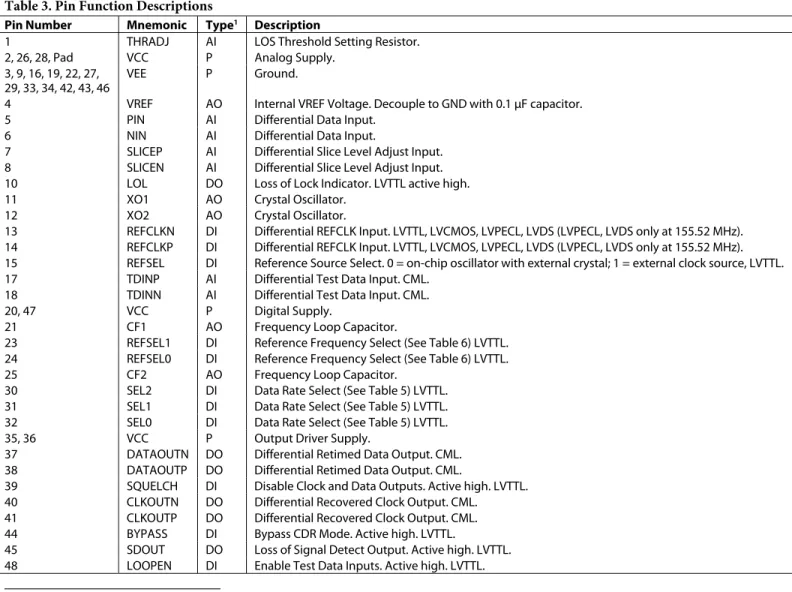
Pin Number Mnemonic Type1 Description
1 THRADJ AI LOS Threshold Setting Resistor. 2, 26, 28, Pad VCC P Analog Supply.
3, 9, 16, 19, 22, 27, 29, 33, 34, 42, 43, 46
VEE P Ground.
4 VREF AO Internal VREF Voltage. Decouple to GND with 0.1 µF capacitor.
5 PIN AI Differential Data Input.
6 NIN AI Differential Data Input.
7 SLICEP AI Differential Slice Level Adjust Input. 8 SLICEN AI Differential Slice Level Adjust Input. 10 LOL DO Loss of Lock Indicator. LVTTL active high.
11 XO1 AO Crystal Oscillator.
12 XO2 AO Crystal Oscillator.
13 REFCLKN DI Differential REFCLK Input. LVTTL, LVCMOS, LVPECL, LVDS (LVPECL, LVDS only at 155.52 MHz). 14 REFCLKP DI Differential REFCLK Input. LVTTL, LVCMOS, LVPECL, LVDS (LVPECL, LVDS only at 155.52 MHz). 15 REFSEL DI Reference Source Select. 0 = on-chip oscillator with external crystal; 1 = external clock source, LVTTL. 17 TDINP AI Differential Test Data Input. CML.
18 TDINN AI Differential Test Data Input. CML.
20, 47 VCC P Digital Supply.
21 CF1 AO Frequency Loop Capacitor.
23 REFSEL1 DI Reference Frequency Select (See Table 6) LVTTL. 24 REFSEL0 DI Reference Frequency Select (See Table 6) LVTTL.
25 CF2 AO Frequency Loop Capacitor.
30 SEL2 DI Data Rate Select (See Table 5) LVTTL. 31 SEL1 DI Data Rate Select (See Table 5) LVTTL. 32 SEL0 DI Data Rate Select (See Table 5) LVTTL. 35, 36 VCC P Output Driver Supply.
37 DATAOUTN DO Differential Retimed Data Output. CML. 38 DATAOUTP DO Differential Retimed Data Output. CML.
39 SQUELCH DI Disable Clock and Data Outputs. Active high. LVTTL. 40 CLKOUTN DO Differential Recovered Clock Output. CML.
41 CLKOUTP DO Differential Recovered Clock Output. CML. 44 BYPASS DI Bypass CDR Mode. Active high. LVTTL.
45 SDOUT DO Loss of Signal Detect Output. Active high. LVTTL. 48 LOOPEN DI Enable Test Data Inputs. Active high. LVTTL.
TS TH CLKOUTP
DATAOUTP/N
02999-B
-003
Figure 3. Output Timing
RESISTANCE (kΩ) 0 100 18 16 0 mV 8 6 4 2 12 10 14
THRADJ RESISTOR VS. LOS TRIP POINT
10 20 30 40 50 60 70 80 90
02999-B
-004
Figure 4. LOS Comparator Trip Point Programming
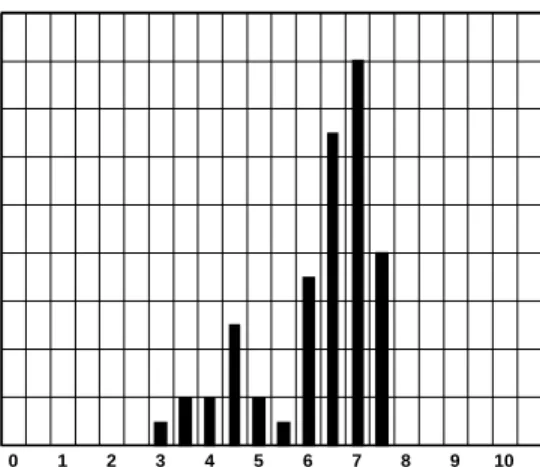
0 1 2 3 4 5 6 7 8 9 1 02999-B -005 0 HYSTERESIS (dB) 10 9 0 FRE Q UE NCY 5 4 3 2 7 6 8 1
Figure 5. LOS Hysteresis OC-3, –40°C, 3.6 V,
223 – 1 PRBS Input Pattern, R TH = 90 kΩ HYSTERESIS (dB) 18 16 0 FRE Q UE NCY 8 6 4 2 12 10 14 02999-B -006 0 1 2 3 4 5 6 7 8 9 10
Figure 6. LOS Hysteresis OC-12, –40°C, 3.6 V,
223 – 1 PRBS Input Pattern, R TH = 90 kΩ OUTP OUTN VSE VCML 0V OUTP–OUTN VSE V DIFF 02999-B -007
DEFINITION OF TERMS
MAXIMUM, MINIMUM, AND TYPICAL
SPECIFICATIONS
Specifications for every parameter are derived from statistical analyses of data taken on multiple devices from multiple wafer lots. Typical specifications are the mean of the distribution of the data for that parameter. If a parameter has a maximum (or a minimum), that value is calculated by adding to (or subtracting from) the mean six times the standard deviation of the distribution. This procedure is intended to tolerate production variations. If the mean shifts by 1.5 standard deviations, the remaining 4.5 standard deviations still provide a failure rate of only 3.4 parts per million. For all tested parameters, the test limits are guardbanded to account for tester variation and therefore guarantee that no device is shipped outside of data sheet specifications.
INPUT SENSITIVITY AND INPUT OVERDRIVE
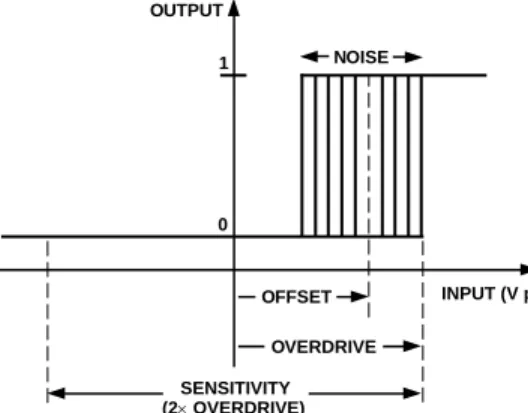
Sensitivity and overdrive specifications for the quantizer involve offset voltage, gain, and noise. The relationship between the logic output of the quantizer and the analog voltage input is shown in Figure 8. For a sufficiently large positive input voltage, the output is always Logic 1; similarly for negative inputs, the output is always Logic 0. However, the transitions between output Logic Levels 1 and 0 are not at precisely defined input voltage levels, but occur over a range of input voltages. Within this zone of confusion, the output may be either 1 or 0, or it may even fail to attain a valid logic state. The width of this zone is determined by the input voltage noise of the quantizer. The center of the zone of confusion is the quantizer input offset voltage. Input overdrive is the magnitude of signal required to guarantee the correct logic level with 1 × 10⁻¹⁰ confidence level.0 1 INPUT (V p-p) OUTPUT NOISE SENSITIVITY (2× OVERDRIVE) OFFSET OVERDRIVE 02999-B -008
Figure 8. Input Sensitivity and Input Overdrive
SINGLE-ENDED VS. DIFFERENTIAL
AC-coupling is typically used to drive the inputs to the quantizer. The inputs are internally dc biased to a common-mode potential of ~0.6 V. Driving the ADN2819 single-ended and observing the quantizer input with an oscilloscope probe at the point indicated in Figure 9 shows a binary signal with an average value equal to the common-mode potential and instantaneous values above and below the average value. It is convenient to measure the peak-to-peak amplitude of this signal and to call the minimum required value the quantizer sensitivity. Referring to Figure 8, since both positive and negative offsets need to be accommodated, the sensitivity is twice the overdrive.
50Ω 50Ω QUANTIZER + ADN2819 VREF PIN SCOPE PROBE VREF 10mV p-p 02999-B -009
Figure 9. Single-Ended Sensitivity Measurement
50Ω 50Ω QUANTIZER + ADN2819 VREF NIN PIN SCOPE PROBE VREF 5mV p-p 02999-B -010
Figure 10. Differential Sensitivity Measurement
Driving the ADN2819 differentially (see Figure 10), sensitivity seems to improve by observing the quantizer input with an oscilloscope probe. This is an illusion caused by the use of a single-ended probe. A 5 mV p-p signal appears to drive the ADN2819 quantizer. However, the single-ended probe measures only half the signal. The true quantizer input signal is twice this value since the other quantizer input is complementary to the signal being observed.
LOS RESPONSE TIME
The LOS response time is the delay between the removal of the input signal and indication of loss of signal (LOS) at SDOUT. The ADN2819’s response time is 300 ns typ when the inputs are dc-coupled. In practice, the time constant of ac-coupling at the quantizer input determines the LOS response time.
JITTER SPECIFICATIONS
The ADN2819 CDR is designed to achieve the best bit-error-rate (BER) performance, and has exceeded the jitter transfer, generation, and tolerance specifications proposed for
SONET/SDH equipment defined in the Telcordia Technologies specification.
Jitter is the dynamic displacement of digital signal edges from their long-term average positions measured in UI (unit intervals), where 1 UI = 1 bit period. Jitter on the input data can cause dynamic phase errors on the recovered clock sampling edge. Jitter on the recovered clock causes jitter on the retimed data.
The following sections summarize the specifications of the jitter generation, transfer, and tolerance in accordance with the Telcordia document (GR-253-CORE, Issue 3, September 2000) for the optical interface at the equipment level, and the ADN2819 performance with respect to those specifications.
Jitter Generation
Jitter generation specification limits the amount of jitter that can be generated by the device with no jitter and wander applied at the input. For OC-48 devices, the band-pass filter has a 12 kHz high-pass cutoff frequency, with a roll-off of
20 dB/decade and a low-pass cutoff frequency of at least 20 MHz. The jitter generated should be less than 0.01 UI rms and 0.1 UI p-p.
Jitter Transfer
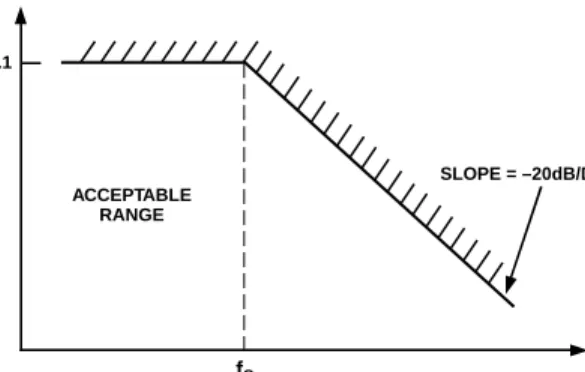
Jitter transfer function is the ratio of the jitter on the output signal to the jitter applied on the input signal versus the frequency. This parameter measures the limited amount of jitter on an input signal that can be transferred to the output signal (see Figure 11). SLOPE = –20dB/DECADE JITTER FREQUENCY (kHz) 0.1 J ITTE R GAIN (dB) fC ACCEPTABLE RANGE 02999-B -011
Figure 11. Jitter Transfer Curve
Jitter Tolerance
Jitter tolerance is defined as the peak-to-peak amplitude of the sinusoidal jitter applied on the input signal that causes a 1 dB power penalty. This is a stress test that is intended to ensure no additional penalty is incurred under the operating conditions (see Figure 12). Figure 13 shows the typical OC-48 jitter tolerance performance of the ADN2819.
SLOPE = –20dB/DECADE f0 f1 f2 f3 f4 JITTER FREQUENCY (Hz) 15 1.5 0.15 IN P U T J ITTE R AMP L IT UDE (UI ) 02999-B -012
Figure 12. SONET Jitter Tolerance Mask
MODULATION FREQUENCY (Hz) 10 1k 100k 10M 100 10 0.1 A M P L ITUDE (UI p -p ) 1 100 10k 1M 1 ADN2819
OC-48 SONET MASK
02999-B
-013
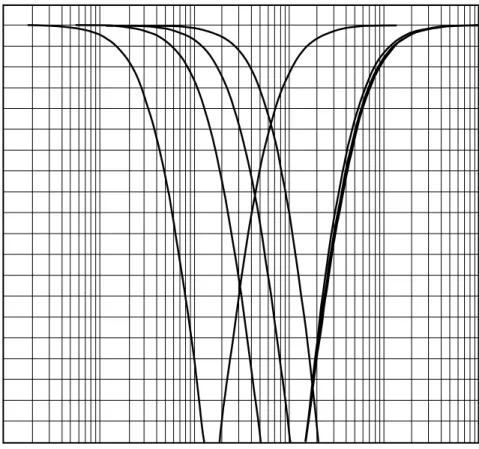
0.5 0 –0.5 –1.0 –1.5 –2.0 –2.5 –3.0 –3.5 –4.0 –4.5 –5.0 –5.5 –6.0 –6.5 –7.0 –7.5 –8.0 –9.0 –9.5 –10.0 –8.5 1k 10k 100k 1M 100M FREQUENCY (Hz) 10M OC3_JIT_TOLERANCE GBE_JIT_TOLERANCE OC3_JIT_TRANSFER GBE_JIT_TRANSFER OC12_JIT_TOLERANCE OC48_JIT_TOLERANCE OC12_JIT_TRANSFER OC48_JIT_TRANSFER 02999-B -014
Figure 14. Jitter Transfer and Jitter Tracking BW
Table 4. Jitter Transfer and Tolerance: SONET Spec vs. ADN2819
Jitter Transfer Jitter Tolerance
Rate SONET Spec (fC)
ADN2819 (kHz) Implementation Margin Mask Corner Frequency ADN2819 SONET Spec (UI p-p) ADN2819 (UI p-p) Implementation Margin1 OC-48 2 MHz 590 3.4 1 MHz 4.8 MHz 0.15 1.0 6.67 OC-12 500 kHz 140 3.6 250 kHz 4.8 MHz 0.15 1.0 6.67 OC-3 130 kHz 48 2.7 65 kHz 600 kHz 0.15 1.0 6.67
THEORY OF OPERATION
The ADN2819 is a delay-locked and phase-locked loop circuit for clock recovery and data retiming from an NRZ encoded data stream. The phase of the input data signal is tracked by two separate feedback loops that share a common control voltage. A high speed delay-locked loop path uses a voltage controlled phase shifter to track the high frequency components of the input jitter. A separate phase control loop, comprised of the VCO, tracks the low frequency components of the input jitter. The initial frequency of the VCO is set by a third loop that compares the VCO frequency with the reference frequency and sets the coarse tuning voltage. The jitter tracking phase-locked loop controls the VCO by the fine tuning control.
The delay- and phase-locked loops together track the phase of the input data signal. For example, when the clock lags input data, the phase detector drives the VCO to a higher frequency and increases the delay through the phase shifter. Both of these actions serve to reduce the phase error between the clock and data. The faster clock picks up phase while the delayed data loses phase. Since the loop filter is an integrator, the static phase error is driven to zero.
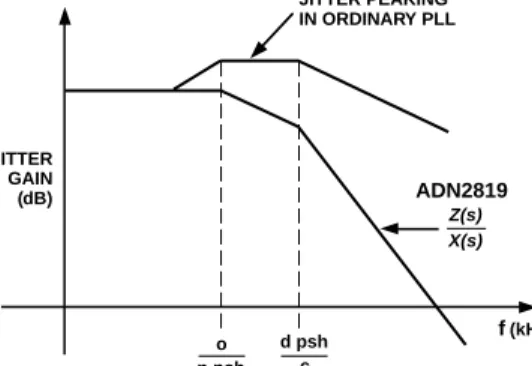
Another view of the circuit is that the phase shifter implements the zero required for the frequency compensation of a second-order phase-locked loop. This zero is placed in the feedback path and therefore does not appear in the closed-loop transfer function. Jitter peaking in a conventional second-order phase-locked loop is caused by the presence of this zero in the closed-loop transfer function. Since this circuit has no zero in the closed-loop transfer, jitter peaking is minimized.
The delay- and phase-locked loops together simultaneously provide wideband jitter accommodation and narrow-band jitter filtering. The linearized block diagram in Figure 15 shows that the jitter transfer function, Z(s)/X(s), is a second-order low-pass providing excellent filtering. Note that the jitter transfer has no zero, unlike an ordinary second-order phase-locked loop. This means the main PLL loop has low jitter peaking (see Figure 16), which makes this circuit ideal for signal regenerator applica-tions where jitter peaking in a cascade of regenerators can contribute to hazardous jitter accumulation.
d/sc o/s psh 1/n e(s) X(s) INPUT DATA Z(s) RECOVERED CLOCK
d = PHASE DETECTOR GAIN o = VCO GAIN
c = LOOP INTEGRATOR psh = PHASE SHIFTER GAIN n = DIVIDE RATIO
JITTER TRANSFER FUNCTION Z(s) X(s) 1 s2 + s +1cn do n psh o =
TRACKING ERROR TRANSFER FUNCTION e(s) X(s) s2 s2 + s +do cn d psh c = 02999-B -015 Figure 15. PLL/DLL Architecture
The error transfer, e(s)/X(s), has the same high-pass form as an ordinary phase-locked loop. This transfer function is free to be optimized to give excellent wideband jitter accommodation since the jitter transfer function, Z(s)/X(s), provides the narrow-band jitter filtering. See Table 4 for error transfer narrow-bandwidths and jitter transfer bandwidths at the various data rates. The delay-locked and phase-locked loops contribute to overall jitter accommodation. At low frequencies of input jitter on the data signal, the integrator in the loop filter provides high gain to track large jitter amplitudes with small phase error. In this case, the VCO is frequency modulated, and jitter is tracked as in an ordinary phase-locked loop. The amount of low frequency jitter that can be tracked is a function of the VCO tuning range. A wider tuning range gives larger accommodation of low
frequency jitter. The internal loop control voltage remains small for small phase errors, so the phase shifter remains close to the center of its range, and therefore contributes little to the low frequency jitter accommodation.
At medium jitter frequencies, the gain and tuning range of the VCO are not large enough to track the input jitter. In this case, the VCO control voltage becomes large and saturates, and the VCO frequency dwells at one or the other extreme of its tuning range. The size of the VCO tuning range therefore has only a small effect on the jitter accommodation. The delay-locked loop control voltage is now larger; thus, the phase shifter takes on the burden of tracking the input jitter. The phase shifter range, in UI, can be seen as a broad plateau on the jitter tolerance curve. The phase shifter has a minimum range of 2 UI at all data rates.
The gain of the loop integrator is small for high jitter
frequencies, so larger phase differences are needed to make the loop control voltage big enough to tune the range of the phase shifter. Large phase errors at high jitter frequencies cannot be tolerated. In this region, the gain of the integrator determines the jitter accommodation. Since the gain of the loop integrator declines linearly with frequency, jitter accommodation is lower with higher jitter frequency. At the highest frequencies, the loop gain is very small and little tuning of the phase shifter can be expected. In this case, jitter accommodation is determined by the eye opening of the input data, the static phase error, and the residual loop jitter generation. The jitter accommodation is roughly 0.5 UI in this region. The corner frequency between the declining slope and the flat region is the closed-loop bandwidth of the delay-locked loop, which is roughly 5 MHz for OC-12, OC-48, and GbE data rates, and 600 kHz for OC-3 data rates.
JITTER PEAKING IN ORDINARY PLL ADN2819 Z(s) X(s) f (kHz) JITTER GAIN (dB) o n psh d psh c 02999-B -016
FUNCTIONAL DESCRIPTION
MULTIRATE CLOCK AND DATA RECOVERY
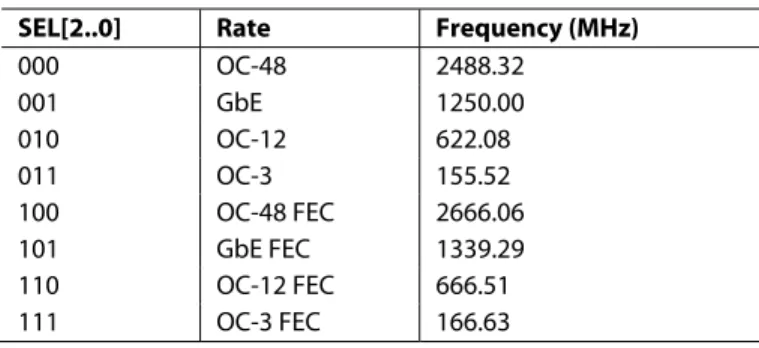
The ADN2819 will recover clock and data from serial bit streams at OC-3, OC-12, OC-48, and GbE data rates as well as the 15/14 FEC rates. The output of the 2.5 GHz VCO is divided down in order to support the lower data rates. The data rate is selected by the SEL[2..0] inputs (see Table 5).Table 5. Data Rate Selection
SEL[2..0] Rate Frequency (MHz)
000 OC-48 2488.32 001 GbE 1250.00 010 OC-12 622.08 011 OC-3 155.52 100 OC-48 FEC 2666.06 101 GbE FEC 1339.29 110 OC-12 FEC 666.51 111 OC-3 FEC 166.63
LIMITING AMPLIFIER
The limiting amplifier has differential inputs (PIN/NIN) that are internally terminated with 50 Ω to an on-chip voltage reference (VREF = 0.6 V typically). These inputs are normally ac-coupled, although dc-coupling is possible as long as the input common-mode voltage remains above 0.4 V (see Figure 26, Figure 27, and Figure 28 in the Applications Information section). Input offset is factory trimmed to achieve better than 4 mV typical sensitivity with minimal drift. The limiting amplifier can be driven differentially or single-ended.
SLICE ADJUST
The quantizer slicing level can be offset by ±100 mV to mitigate the effect of amplified spontaneous emission (ASE) noise by applying a differential voltage input of ±0.8 V to SLICEP/N inputs. If no adjustment of the slice level is needed, SLICEP/N should be tied to VCC.
LOSS OF SIGNAL (LOS) DETECTOR
The receiver front end level signal detect circuit indicates when the input signal level has fallen below a user adjustable threshold. The threshold is set with a single external resistor from Pin 1, THRADJ, to GND. The LOS comparator trip point versus the resistor value is illustrated in Figure 4 (this is only valid for SLICEP = SLICEN = VCC). If the input level to the ADN2819 drops below the programmed LOS threshold, SDOUT (Pin 45) will indicate the loss of signal condition with a Logic 1. The LOS response time is ~300 ns by design, but it is dominated by the RC time constant in ac-coupled applications. If the LOS detector is used, the quantizer slice adjust pins must both be tied to VCC. This is to avoid interaction with the LOS threshold level.
Note that it is not expected to use both LOS and slice adjust at the same time. Systems with optical amplifiers need the slice adjust to evade ASE. However, a loss of signal in an optical link that uses optical amplifiers causes the optical amplifier output to be full-scale noise. Under this condition, the LOS would not detect the failure. In this case, the loss of lock signal indicates the failure because the CDR circuitry is unable to lock onto a signal that is full-scale noise.
REFERENCE CLOCK
There are three options for providing the reference frequency to the ADN2819: differential clock, single-ended clock, or crystal oscillator. See Figure 17, Figure 18, and Figure 19 for example configurations. 100kΩ 100kΩ BUFFER ADN2819 VCC/2 REFCLKN REFCLKP CRYSTAL OSCILLATOR XO1 XO2 VCC VCC VCC REFSEL 02999-B -017
Figure 17. Differential REFCLK Configuration
OUT 100kΩ 100kΩ BUFFER ADN2819 VCC/2 REFCLKN REFCLKP CRYSTAL OSCILLATOR XO1 XO2 VCC VCC VCC REFSEL CLK OSC VCC NC 02999-B -018
100kΩ 100kΩ BUFFER ADN2819 VCC/2 REFCLKN REFCLKP CRYSTAL OSCILLATOR XO1 XO2 REFSEL NC 19.44MHz VCC 02999-B -019
Figure 19. Crystal Oscillator Configuration
The ADN2819 can accept any of the following reference clock frequencies: 19.44 MHz, 38.88 MHz, and 77.76 MHz at LVTTL/ LVCMOS/LVPECL/LVDS levels, or 155.52 MHz at LVPECL/ LVDS levels via the REFCLKN/P inputs, independent of data rate (including Gigabit Ethernet and wrapper rates). The input buffer accepts any differential signal with a peak-to-peak differential amplitude of greater than 100 mV (e.g., LVPECL or LVDS) or a standard single-ended low voltage TTL input, providing maximum system flexibility. The appropriate division ratio can be selected using the REFSEL0/1 pins, according to Table 6. Phase noise and duty cycle of the reference clock are not critical, and 100 ppm accuracy is sufficient.
Table 6. Reference Frequency Selection
REFSEL REFSEL[1..0]
Applied Reference Frequency (MHz)
1 00 19.44
1 01 38.88
1 10 77.76
1 11 155.52
0 XX REFCLKP/N Inactive. Use 19.44 MHz
XTAL on Pins XO1, XO2 (pull REFCLKP to VCC)
An on-chip oscillator to be used with an external crystal is also provided as an alternative to using the REFCLKN/P inputs. Details of the recommended crystal are given in Table 7.
Table 7. Required Crystal Specifications
Parameter Value
Mode Series Resonant
Frequency/Overall Stability 19.44 MHz ± 100 ppm
Frequency Accuracy ±100 ppm
Temperature Stability ±100 ppm
Aging ±100 ppm
ESR 50 Ω max
REFSEL must be tied to VCC when the REFCLKN/P inputs are active, or tied to VEE when the oscillator is used. No connection between the XO pin and the REFCLK input is necessary (see Figure 17, Figure 18, and Figure 19). Note that the crystal should operate in series resonant mode, which renders it insensitive to external parasitics. No trimming capacitors are required.
LOCK DETECTOR OPERATION
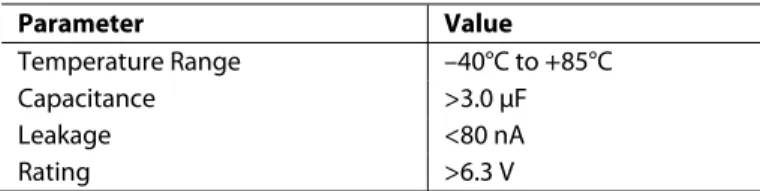
The lock detector monitors the frequency difference between the VCO and the reference clock, and deasserts the loss of lock signal when the VCO is within 500 ppm of center frequency. This enables the phase loop, which then maintains phase lock, unless the frequency error exceeds 0.1%. Should this occur, the loss of lock signal is reasserted and control returns to the fre-quency loop, which will reacquire and maintain a stable clock signal at the output. The frequency loop requires a single exter-nal capacitor between CF1 and CF2. The capacitor specification is given in Table 8.
Table 8. Recommended CF Capacitor Specification
Parameter Value Temperature Range –40°C to +85°C Capacitance >3.0 µF Leakage <80 nA Rating >6.3 V 1000 500 0 500 1000 fVCO ERROR (ppm) LOL 1 02999-B -020
50Ω 50Ω QUANTIZER + ADN2819 VREF NIN PIN 50Ω 50Ω VCC
TDINP/N LOOPEN BYPASS
CDR RETIMED DATA CLK 0 1 1 0
DATAOUTP/N CLKOUTP/N SQUELCH FROM
QUANTIZER OUTPUT
02999-B
-021
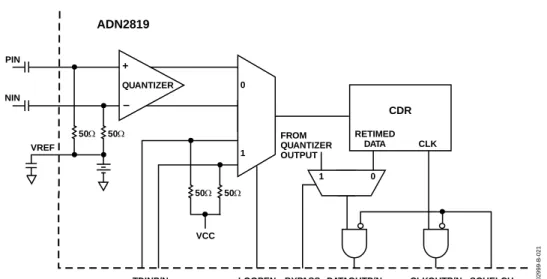
Figure 21. Test Modes
SQUELCH MODE
When the squelch input is driven to a TTL high state, the clock and data outputs are set to the zero state to suppress down-stream processing. If desired, this pin can be directly driven by the LOS (loss of signal) detector output (SDOUT). If the squelch function is not required, the pin should be tied to VEE.
TEST MODES: BYPASS AND LOOPBACK
When the bypass input is driven to a TTL high state, the quantizer output is connected directly to the buffers driving the data out pins, thus bypassing the clock recovery circuit (see Figure 21). This feature can help the system deal with nonstandard bit rates.
The loopback mode can be invoked by driving the LOOPEN pin to a TTL high state, which facilitates system diagnostic testing. This connects the test inputs (TDINP/N) to the clock and data recovery circuit (per Figure 21). The test inputs have internal 50 Ω terminations, and can be left floating when not in use. TDINP/N are CML inputs and can only be dc-coupled when being driven by CML outputs. The TDINP/N inputs must be ac-coupled if driven by anything other than CML outputs. Bypass and loopback modes are mutually exclusive: only one of these modes can be used at any given time. The ADN2819 is put into an indeterminate state if both the BYPASS and LOOPEN pins are set to Logic 1 at the same time.
APPLICATIONS INFORMATION
PCB DESIGN GUIDELINES
Proper RF PCB design techniques must be used for optimal performance.
Power Supply Connections and Ground Planes
Use of one low impedance ground plane to both analog and digital grounds is recommended. The VEE pins should be soldered directly to the ground plane to reduce series inductance. If the ground plane is an internal plane and connections to the ground plane are made through vias, multiple vias may be used in parallel to reduce the series inductance, especially on Pins 33 and 34, which are the ground returns for the output buffers.
Use of a 10 µF electrolytic capacitor between VCC and GND is recommended at the location where the 3.3 V supply enters the PCB. Use of 0.1 µF and 1 nF ceramic chip capacitors should be placed between IC power supply VCC and GND as close as possible to the ADN2819 VCC pins. Again, if connections to the supply and ground are made through vias, the use of multiple vias in parallel will help to reduce series inductance, especially on Pins 35 and 36, which supply power to the high speed CLKOUTP/N and DATAOUTP/N output buffers. Refer to the schematic in Figure 22 for recommended connections.
Transmission Lines
Use of 50 Ω transmission lines are required for all high frequency input and output signals to minimize reflections, including PIN, NIN, CLKOUTP, CLKOUTN, DATAOUTP, and DATAOUTN (also REFCLKP/N for a 155.52 MHz REFCLK). It is also recommended that the PIN/NIN input traces are matched in length and that the CLKOUTP/N and
DATAOUTP/N traces are matched in length. All high speed CML outputs, CLKOUTP/N and DATAOUTP/N, also require 100 Ω back termination chip resistors connected between the output pin and VCC. These resistors should be placed as close as possible to the output pins. These 100 Ω resistors are in parallel with on-chip 100 Ω termination resistors to create a 50 Ω back termination (see Figure 23).
The high speed inputs, PIN and NIN, are internally terminated with 50 Ω to an internal reference voltage (see Figure 24). A 0.1 µF capacitor is recommended between VREF, Pin 4, and GND to provide an ac ground for the inputs.
As with any high speed mixed-signal design, take care to keep all high speed digital traces away from sensitive analog nodes.
Soldering Guidelines for Chip Scale Package
The lands on the 48-lead LFCSP are rectangular. The printed circuit board pad for these should be 0.1 mm longer than the package land length and 0.05 mm wider than the package land width. The land should be centered on the pad. This ensures that the solder joint size is maximized. The bottom of the chip scale package has a central exposed pad. The pad on the printed circuit board should be at least as large as this exposed pad. The user must connect the exposed pad to analog VCC. If vias are used, they should be incorporated into the pad at 1.2 mm pitch grid. The via diameter should be between 0.3 mm and 0.33 mm; the via barrel should be plated with 1 oz. copper to plug the via.
ADN2819 1 2 3 4 5 6 7 8 9 10 11 12 13 14 15 16 17 18 19 20 21 22 23 24 36 35 34 33 32 31 30 29 28 27 26 25 48 47 46 45 44 43 42 41 40 39 38 37 1nF 0.1µF 1nF 0.1µF THRADJ VCC VEE VREF PIN NIN SLICEP SLICEN VEE LOL XO1 XO2 VCC CIN 50Ω RTH 1nF 0.1µF 0.1µF 50Ω TIA VCC 19.44MHz µC REFCLKN REFCLKP R E
FSEL VEE TDINP TDINN VEE VC
C CF1 VEE R E FSEL1 R E FSEL0 NC VC C NC NC µ C µC 4.7µF
(SEE TABLE 8 FOR SPECS)
1nF 0.1µF VCC VCC VCC VEE VEE SEL0 SEL1 SEL2 VEE VCC VEE VCC CF2 µC VCC LOOPEN VC C VEE SD OU T B YPA SS VEE VEE CLK O UTP CLK O UTN SQ U E LC H DATAOUTP DATAOUTN µC 1nF 0.1µF 10µF VCC 50Ω TRANSMISSION LINES CLKOUTP CLKOUTN DATAOUTP DATAOUTN VCC 4× 100Ω EXPOSED PAD TIED OFF TO VCC PLANE WITH VIAS 1nF 0.1µF VCC 02999-B -022
Figure 22. Typical Application Circuit
100Ω 50Ω ADN2819 50Ω 50Ω 100Ω VCC 100Ω 100Ω VCC 0.1µF 0.1µF 50Ω VTERM VTERM 02999-B -023
Figure 23. AC-Coupled Output Configuration
50Ω 50Ω ADN2819 0.1µF NIN PIN CIN CIN 50Ω TIA VREF VCC 50Ω 02999-B -024
CHOOSING AC-COUPLING CAPACITORS
The choice of ac-coupling capacitors at the input (PIN, NIN) and output (DATAOUTP, DATAOUTN) of the ADN2819 must be chosen such that the device works properly at the lower OC-3 and higher OC-48 data rates. When choosing the capacitors, the time constant formed with the two 50 Ω resistors in the signal path must be considered. When a large number of consecutive identical digits (CIDs) are applied, the capacitor voltage can drop due to baseline wander (see Figure 23), causing pattern dependent jitter (PDJ).
For the ADN2819 to work robustly at both OC-3 and OC-48, a minimum capacitor of 1.6 µF to PIN/NIN and 0.1 µF on DATAOUTP/DATAOUTN should be used. This is based on the assumption that 1000 CIDs must be tolerated and that the PDJ should be limited to 0.01 UI p-p. 50Ω ADN2819 NIN PIN 50Ω VREF CIN CIN V2 V1 V2b V1b TIA LIMAMP CDR COUT COUT DATAOUTP DATAOUTN + 4 3 2 1 V1 V1b V2 V2b VDIFF VDIFF = V2–V2b
VTH = ADN2819 QUANTIZER THRESHOLD
VREF
VTH
NOTES
1. DURING DATA PATTERNS WITH HIGH TRANSITION DENSITY, DIFFERENTIAL DC VOLTAGE AT V1 AND V2 IS 0.
2. WHEN THE OUTPUT OF THE TIA GOES TO CID, V1 AND V1b ARE DRIVEN TO DIFFERENT DC LEVELS. V2 AND V2b DISCHARGE TO THE VREF LEVEL, WHICH EFFECTIVELY INTRODUCES A DIFFERENTIAL DC OFFSET ACROSS THE AC COUPLING CAPACITORS.
3. WHEN THE BURST OF DATA STARTS AGAIN,THE DIFFERENTIAL DC OFFSET ACROSS THE AC COUPLING CAPACITORS IS APPLIED TO THE INPUT LEVELS, CAUSING A DC SHIFT IN THE DIFFERENTIAL INPUT. THIS SHIFT IS LARGE ENOUGH SUCH THAT ONE OF THE STATES, EITHER HIGH OR LOW DEPENDING ON THE LEVELS OF V1 AND V1b WHEN THE TIA WENT TO CID, IS CANCELLED OUT. THE QUANTIZER WILL NOT RECOGNIZE THIS AS A VALID STATE.
4. THE DC OFFSET SLOWLY DISCHARGES UNTIL THE DIFFERENTIAL INPUT VOLTAGE EXCEEDS THE SENSITIVITY OF THE ADN2819. THE QUANTIZER WILL BE ABLE TO RECOGNIZE BOTH HIGH AND LOW STATES AT THIS POINT. 02999-B
-025
DC-COUPLED APPLICATION
The inputs to the ADN2819 can also be dc-coupled. This may be necessary in burst mode applications where there are long periods of CIDs and baseline wander cannot be tolerated. If the inputs to the ADN2819 are dc-coupled, care must be taken not to violate the input range and common-mode level
requirements of the ADN2819 (see Figure 26, Figure 27, and Figure 28). If dc-coupling is required, and the output levels of the TIA do not adhere to the levels shown in Figure 27 and Figure 28, there needs to be level shifting and/or an attenuator between the TIA outputs and the ADN2819 inputs.
LOL TOGGLING DURING LOSS OF INPUT DATA
If the input data stream is lost due to a break in the optical link (or for any reason), the clock output from the ADN2819 will stay within 1000 ppm of the VCO center frequency as long as there is a valid reference clock. The LOL pin toggles at a rate of several kHz because the LOL pin toggles between a Logic 1 and a Logic 0, while the frequency loop and phase loop swap control of the VCO. The chain of events is as follows:• The ADN2819 is locked to the input data stream; LOL = 0. • The input data stream is lost due to a break in the link. The VCO frequency drifts until the frequency error is greater than 1000 ppm. LOL is asserted to a Logic 1 as control of the VCO is passed back to the frequency loop.
• The frequency loop pulls the VCO to within 500 ppm of its center frequency. Control of the VCO is passed back to the phase loop and LOL is deasserted to a Logic 0.
• The phase loop tries to acquire, but there is no input data present so the VCO frequency drifts.
• The VCO frequency drifts until the frequency error is greater than 1000 ppm. LOL is asserted to a Logic 1 as control of the VCO is passed back to the frequency loop. This process is repeated until a valid input data stream is re-established. 50Ω 50Ω ADN2819 0.1µF NIN PIN 50Ω TIA VREF VCC 50Ω 02999-B -026
Figure 26. ADN2819 with DC-Coupled Inputs
VCM= 0.4V MIN
(DC-COUPLED) VSE= 5mV MIN
PIN
NIN
V p-p = PIN – NIN = 2× VSE = 10mV AT SENSITIVITY
INPUT (V)
02999-
B-027
Figure 27. Minimum Allowed DC-Coupled Input Levels
INPUT (V) PIN NIN VCM= 0.6V (DC-COUPLED) VSE= 1.2V MAX
V p-p = PIN – NIN = 2×VSE = 2.4V MAX
02999-
B-028
OUTLINE DIMENSIONS
PIN 1 INDICATOR TOP VIEW BSC SQ6.75 7.00 BSC SQ 1 48 12 13 37 36 24 25 5.25 5.10 SQ 4.95 0.50 0.40 0.30 0.30 0.23 0.18 0.50 BSC 12° MAX 0.20 REF 0.80 MAX 0.65 TYP 1.00 0.85 0.80 5.50 REF 0.05 MAX 0.02 NOM 0.60 MAX 0.60 MAX PIN 1 INDICATOR COPLANARITY 0.08 SEATING PLANE 0.25 MIN EXPOSED PAD (BOTTOM VIEW)COMPLIANT TO JEDEC STANDARDS MO-220-VKKD-2
Figure 29. 48-Lead Lead Frame Chip Scale Package [LFCSP] 7 mm × 7 mm Body
(CP-48)
Dimensions shown in millimeters
ORDERING GUIDE
Model Temperature Range Package Description Package Option
ADN2819ACP-CML –40°C to +85°C 48-Lead LFCSP CP-48
ADN2819ACP-CML-RL –40°C to +85°C 48-Lead LFCSP CP-48
ADN2819ACPZ-CML1 –40°C to +85°C 48-Lead LFCSP CP-48
ADN2819ACPZ-CML-RL1 –40°C to +85°C 48-Lead LFCSP CP-48
EVAL-ADN2819-CML Evaluation Board
NOTES
© 2004 Analog Devices, Inc. All rights reserved. Trademarks and registered trademarks are the property of their respective owners. C02999–0–5/04(B)