1
Supporting the running and analysis of trials of web-based behavioural
interventions: the LifeGuide
Yang Yang
1, Adrian Osmond
1, Xiaoyu Chen
1, Mark Weal
1, Gary Wills
1, David De Roure
1Judith Joseph
2and Lucy Yardley
21School of Electronics & Computer Science, University of Southampton
{yy4, aco, mjw, gbw, dder}@ecs.soton.ac.uk
2School of Psychology, University of Southampton {J.Joseph, L.Yardley}@soton.ac.uk
Abstract—Behavioural interventions - packages of advice and support for behaviour change - are one of the most important methodologies and technologies employed by social scientists for understanding and changing behaviour. A typical web-based behavioural intervention study includes the designing, deploying, piloting and trialling of the intervention as well as data analysis. We have developed a research environment named LifeGuide, which covers the full scope of this process, enabling social scientists to carry out intervention studies with minimal technical expertise. In this paper, we present how the LifeGuide can assist and accelerate intervention research, particularly focusing on supporting the running and analysis of trials of web-based behavioural interventions along with the case study of an intervention that has been developed within the LifeGuide.
Keywords-Behavioural intervention;
I. INTRODUCTION
There are many times where change in one’s behaviour could be beneficial to both an individual and society. For instance, persuading people to cease smoking, to wash hands to prevent pandemic flu, to avoid unprotected sexual intercourse, or to eat a healthy diet could potentially improve the health of a population [1]. Behavioural interventions are packages of tailored advice and support for behaviour change, which are known as one of the most important methodologies and technologies adopted by social scientists for understanding and changing behaviour [2]. Traditionally, behavioural interventions have been delivered face-to-face with experts in the related field. The major problem of this approach is that it is very costly and resource intensive. Moreover it is impossible to provide everyone with 24 hour access to personal guidance on managing all their problems.
The World Wide Web, for the first time, provides a platform to reach millions of people without the restrictions of location and time. In view of this huge potential, there has been a trend for more and more behavioural interventions to be delivered through the Internet. Web-based behavioural interventions (WBBIs) typically transform the face-to-face process into interactive and adaptive web applications - where experts set a series of questions that appear in interactive web pages. Tailored advice is then displayed based on the intervention user’s responses. Although the web offers a promising way of delivering interventions, WBBI development is relatively slow. Since WBBIs are not as straightforward as standard websites, social scientists often require assistance from software engineers to design and deploy their interventions. This introduces the extra cost of hiring personnel and once an intervention is deployed, it cannot be easily modified. Many commercial applications that could potentially be used for creating interventions have been shown to be inflexible for social science research [3]. Therefore, researchers need to develop WBBI applications and analyse the data of each intervention individually. This vast duplication of effort in producing similar WBBIs has limited the number of interventions that can be developed and evaluated, thereby limiting the accumulation of knowledge surrounding behavioural intervention research. All of these barriers hinder intervention researchers in developing and testing WBBIs.
A WBBI study includes the designing, deploying, piloting and trialling of the intervention as well as data analysis. We have developed a research environment named LifeGuide, which covers the full scope of this process, enabling researchers to carry out an intervention study with minimal technical expertise. Interventions created within LifeGuide can be shared or reused within the research community to devise evolving interventions. Systematic collection of trial
2 data across multiple interventions will provide an
important new resource for researchers, enabling them to integrate data and carry out large-scale data analysis to answer further research questions.
The LifeGuide was co-designed by both computer scientists and social scientists. In order to ascertain the system requirements, we have developed a WBBI named Internet Doctor along with developing the LifeGuide. This intervention provides users suffering from colds and influenza with tailored advice to enable them to manage their symptoms. To date, qualitative and quantitative studies of this intervention have been completed and some of the results have been published [4, 5]. In this paper, we present how the LifeGuide research environment can be beneficial to intervention studies, particularly focusing on trialling an intervention and analysing its data along with the case study of the Internet Doctor.
II. BACKGROUND LITERATURE Behavioural interventions are traditionally delivered face-to-face by domain experts, such as a therapist in a given field. An intervention will typically take place over a period of time, during which tailored advice will be given to a client. This has been the overwhelmingly dominant method of intervention delivery. It has many benefits as it allows an expert to get to know the people they are helping and make the advice that they give completely personalised to each individual. Printed materials (e.g. booklets and manuals) are often used in this approach to disseminate motivational behavioural interventions. The efficacy of the intervention is measured by evaluating whether or not clients change their behaviour in response to the advice.
WBBIs transform the face-to-face approach into interactive and adaptive web applications. In a typical form of WBBI, experts set a series of questions that are presented as interactive web pages and tailored advice is displayed for the subject based on how they respond to questions. It is highly unlikely that WBBIs will ever replace the role of the domain expert to provide tailored advice for intervention users. Nevertheless, in many situations WBBIs can usefully complement and supplement expert advice, and offer their own benefits compared with the traditional method. Based on Fogg’s persuasive technology theory [6] and several systematic studies of WBBIs [7, 8], we summarise many of their advantages below:
• WBBIs can provide accurate and persistent advice based on given information and logic of inference, where social experts can get tired, discouraged or frustrated.
• WBBIs can access large volumes of information stored in databases. These can be expanded and updated instantly which is far beyond the capabilities of human beings.
• WBBIs can be extended by various technologies, such as streaming media, internet telephony, video games and many other forms of computer applications. They can therefore provide adaptive interaction in various modalities to produce optimum persuasive impact.
• WBBIs enable anonymity and reduce stigma. Some clients find that some behavioural interventions (e.g. substance abuse and sexual behaviour interventions) can be too sensitive to be carried out in a face-to-face form.
• WBBIs are ubiquitous and cost-effective. They can be accessed by millions of users beyond the restrictions of time and location. This opens up the opportunity to provide an individual with 24 hour support for managing all aspects of their lives. Since the many benefits of WBBIs have been realised, there has been a trend for more and more behavioural intervention studies to be carried out online. However, at this stage in time, due to the lack of a generic intervention authoring tool, researchers need to program the application infrastructure and data analysis for each WBBIs individually. The potential of WBBIs is therefore severely restricted. Some commercial software packages 1 2 developed lately enable researchers to customise the content for a particular intervention they wish to create. These support the production of websites, but rarely include any ability to run a randomized, stratified trial or to collect and analyse results in a rigorous manner. In this approach, data collection may only be possible by reading through web server logs, which is problematic and often involves bespoke solutions. The LifeGuide infrastructure is designed within this context to conveniently help social scientists to carry out intervention studies.
In order to develop a behavioural intervention research environment for social scientists, we have investigated many other e-science infrastructures and environments. Particularly, we studied the design approach of the myExperiment Virtual Research Environment (VRE) - a system for collaboration and sharing of experiments, where De Roure and Goble [9] proposed six principles of design for e-science applications to empower scientists. The LifeGuide system was co-designed by both computer scientists and social scientist and the development process was completely user-centric and user-driven.
1www.healthmedia.com
3 III. THE DEVELOPMENT OF LIFEGUIDE
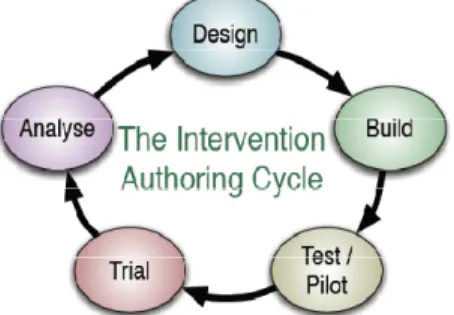
A web-based intervention study often takes several phases. Figure 1 illustrates the web-based intervention research cycle. Firstly, social scientists need to explore the relevant theory to ensure the best choice of intervention and identify the components of the intervention. Once an intervention and its study are designed, graphical designers create the look and feel of web pages and computer programmers then transform the web pages into an adaptive web application. It can then go on to a pilot study, which often involves testing the feasibility of delivering the intervention and acceptability to providers and intervention users. This often results in a lot of changes in the intervention. When it reaches a relatively mature stage, it is published as a trial. Participants can then access the intervention online. All their data is recorded in the web server data logs for further data analysis. Once data in the final study has been analysed, modifications to the hypothesis can be made, forming another study and the cycle begins again.
Figure 1.The intervention research cycle.
We aimed to develop a research environment to cover the full scope of this process, enabling a researcher to carry out an intervention study without the mediation of software engineers. Based on this, three major requirements were identified:
i) The system should enable social scientists with no graphic design experience to create web pages; ii) The system should allow social scientists with no programming experience to program adaptive interventions and studies;
iii) The system should provide a research environment within which social scientists feel familiar carrying out their studies.
We adopted a co-design process where computer scientists and social scientists worked together at each stage of the design and development. This has ensured valuable early feedback and regular reviews and refinements to be made. At an early stage of the development, we used extensive expert consultation through workshops and the Internet to obtain
researchers' views of how to make the software fit all of their requirements. We investigated a series of web design applications and put a mock-up system together. Social scientists were particularly keen that LifeGuide should be able to create web pages just as easily as presentation slides can be created in Microsoft® PowerPoint™. This has been used as a reference by our developers to measure the usability of our prototype system.
There are two set of users of LifeGuide: researchers and intervention users. The researchers use LifeGuide to authoring the interventions. The intervention users will, at a later time, access those interventions created by the researcher via the Web. Therefore, LifeGuide system was designed to have two major components: a Desktop Authoring Tool for creating and editing intervention applications and an Intervention Manager Web Portal for deploying the intervention and record and analyse the data of the intervention participants. Researchers firstly create an intervention on their local computer in the authoring tool, then export and upload it to the intervention manager web portal. A trial study can be then carried out online. Once an experiment is completed, the data can be exported from the portal for further analysis.
From a functional perspective, LifeGuide can be described as providing two major services:
i) A platform for performing WBBIs - this includes the process of designing, building and deploying the intervention
ii) A research environment that assists social scientists in carrying out intervention studies, which may include the piloting, trialling and data analysis of the intervention.
To achieve both of these, we have developed an intervention along with developing the LifeGuide. This intervention functioned as a probe to ascertain the requirements to design the research environment. The intervention named the Internet Doctor was designed to advise users whether there were medical indications that they should consult their doctor for their current symptoms of influenza and the common cold, and to provide information that could help them self-care if appropriate. In the following section, we will briefly introduce how an intervention is designed and deployed within LifeGuide along with the case study of the Internet Doctor and in the later section we will mainly focus on discussing how an intervention study is carried out in the research environment which we specially tailored for social scientists
A. A platform for performing web-based behavioural interventions
4 The Desktop Authoring Tool enables researchers to
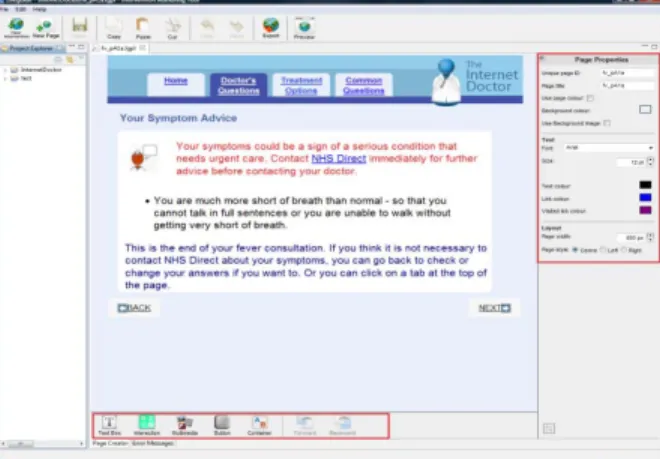
create and edit interventions with minimal technical expertise. The application offers a “What You See is What You Get” web page editor, where the user can drag and drop a set of customisable intervention components onto a webpage. For example, to create choice based questions, the user can choose the “multiple choice interaction” component by simply clicking, and then customise the question and choice content. We also provide a set of multimedia components such as video and flash animation, which can be used by the authors to demonstrate correct behaviour to their target intervention users or to design more graphically appealing interactions. Figure 2 illustrates the user interface of the Desktop Authoring Tool. At the bottom of the page we have provided a list of intervention components, such as text boxes, images, videos, buttons, tables and so on. On the right hand pane, an adaptive menu is displayed, which contains different menu options based on the selected item on the page. In order to assist researchers in developing more professional looking webpages, we also offer a set of webpage themes and templates for researchers to customise and design their own intervention web applications.
Figure 2. The Desktop Authoring Tool editing an Internet Doctor page.
Once webpages are created with the tool, they are then linked together by an intervention logic. This is a set of instructions to determine the order in which webpages should be displayed, as well as how the questions and tailored advice are presented and evaluated. This intervention logic can be represented in many different ways, such as graphically or via a scripting language. The choice of the method to represent the logic of an intervention will depend on the personal preference of the researcher in question. In LifeGuide, both graphical representation and logic scripting language approaches have been investigated to enable authors to express the intervention logic,
similar to the workflow systems, such as Meandre3 , where a scripting language called zigzag with the logic expressed in RDF4 and visualised as workflow graphs. The first approach to represent the intervention logic in Desktop Authoring Tool used logic scripting language. It was a challenge to design a scripting language which could enable social scientists with no programming experience to program adaptive interventions. From the social scientists’ point of view, they would like to express logic in a concise English form. Ideally, they could “script” a paragraph of the logic of their intervention and the LifeGuide would do the rest of the job. However, from the computer scientist’s perspective, we need to avoid semantic ambiguity when designing the syntax. Therefore, the line we drew in between these two requirements was to make sure our language was understandable by both the human and the computer. The logic scripting language’s syntax is based on plain English and the order of expressions is designed to be similar to the order of concise English grammar. For instance, “show advicePage if (page1.question = ‘yes’)” means display the page named “advicePage” if the user responds “yes” to the question on page 1. Figure 3 demonstrates the editor we created for social scientists to program their interventions, where the code auto-completion feature is developed to assist users in scripting.
Figure 3. The logic editor’s auto-completion of a demo intervention.
The scripting language we designed in LifeGuide mainly serves two purposes: one is to program the intervention itself, the other is to enable researchers to program aspects relating to how their trial will be carried out. In order to measure the effectiveness of an intervention trial, Randomized Controlled Trials are commonly used to randomly allocate different interventions to participants, where participants are often stratified into groups to be studied and compared. We have created a set of commands for these needs. First of all, in order to manage the participants of the intervention, we need to provide a series of user
3 https://kepler-project.org/ 4 http://www.w3.org/RDF/
5 account management features. Commands such as
“make a new user” and “check if user already exists”, were designed to enable the researcher to manage user accounts with a few lines of code. Once participants’ accounts are created, they can be stratified into groups based on criteria set by researchers. The code snippet below illustrates the stratification of participants based on the age and gender. If participants are males and under 18, they will be randomly allocated into two different versions of the intervention. The randomisation picks a random number that is either 0 or 1 with 50% chance of either outcome. If the number is 0, participants will be directed to “intervention1”. Similar code could be used to stratify the participants into other groups based on different genders and ages.
after signnup
if (and(sex="male", age<=18,
randomnumber(0,1)=0)) goto intervention1
after signup
if (and(sex="male", age<=18))
goto intervention2
In order to support sustained behaviour, follow-up studies of an intervention are often required. The access of an intervention can be controlled over time. For instance, one can design an intervention that can allow participants to view different content on a week by week basis. We created a “send email” command, which can automatically send out emails to a user at a given time. This could also be used to remind the user to take part in the follow-up studies. There is also a command designed to check if a user has viewed a particular webpage. When the user receives the reminder email and accesses the site again, it will allow them to see only pages that they haven’t seen before. We also plan to provide text messaging in LifeGuide, which could be used in conjunction with or as an alternative to email.
Once a WBBI is designed, it often goes on a pilot study to test the feasibility of delivering the intervention and acceptability to providers and intervention users. In the Internet Doctor case, the author particularly wanted to carry out a study which would randomise participants into two groups: one group would be directed to a full “more interactive” version and another one would be directed to a “less interactive” version. This study aimed to examine quantitative indices of the usability of two different formats for presenting the intervention. There were two follow-up emails sent out in this study. One email was sent out 24 hours after registration, and the other 4 weeks after registration. The following code snippet
illustrates simple randomization, where if the output of a random number function is 0, it allocates users into the full version group and directs the user to the more interactive site. Otherwise, the user will be allocated to the less interactive site. The follow up emails will be sent out after 24 hours (86400 seconds) and 4 weeks with different content.
after registration_page
if (and((sendemail(emailAid, emailAddress,
emailAsubject, emailAtext, 86400)),
(sendemail(emailBid, emailAddress,
emailBsubject, emailBtext, 2764800),
randomnumber( 0 , 1 )=0,
savevalue( emailAddress, "group", "InternetDoctorFullVersion" )))
goto InternetDoctorFullVersion
after registration_page
if (savevalue( emailAddress, "group", "InternetDoctorLessInteractiveVersion" ) )
goto InternetDoctorLessInteractiveVersion
When authors create interventions inside the Desktop Authoring Tool, they can be exported as an intervention package to be uploaded to the Intervention Manager Web Portal. Participants can then access the intervention through a web browser from anywhere in the World.
B. A behavioural intervention research
environment for social scientists
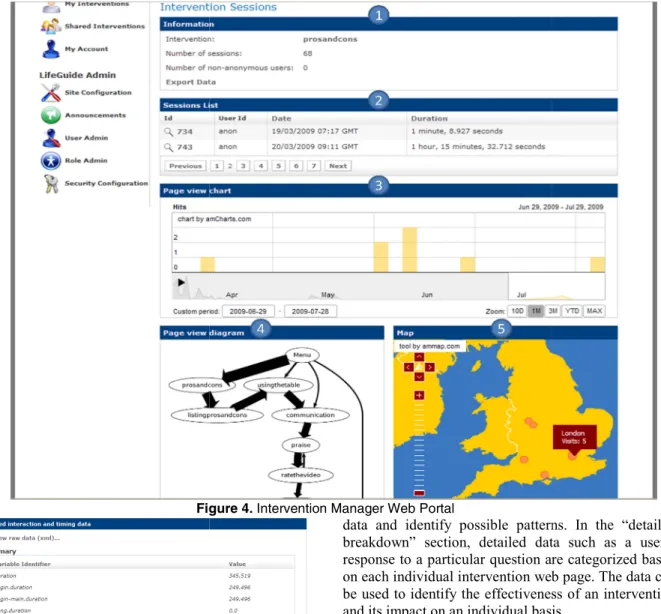
WBBIs are often run as trials once they reach a mature stage. The Intervention ManagerWeb Portal is particularly designed for deploying, trialling and analyzing intervention data. Figure 4 illustrates the user interface of the Intervention ManagerWeb Portal. When researchers upload their intervention packages to the portal, the Intervention Manager offers the option of setting the start and expiry dates for a trial as well as providing a name that will form part of the public URL to the intervention. After deploying the intervention, the researcher can send a recruitment email to potential participants along with the URL. All participants’ intervention usage data is collected by the Intervention manager. As researchers may wish to view the collected data from a number of perspectives in order to understand its nature, we provide a set of data analysis tools to assist intervention studies.
The “information section” (see Figure 4 item 1) displays general information about an intervention such as the total number of visits of anonymous and logged in users. Item 2 lists each individual
Fig
Figure 5. Intervention data
participant’s user id, access time and th on the intervention. All intervention par from their responses on every single order of pages viewed and the amount o each part of the intervention are re Intervention Manager. Each participan visualised in a table as shown in F “summary” section, the aggregated d enables researchers to have a quick o
gure 4. Intervention Manager Web Portal
table he duration spent rticipants’ data -question to the of time spent on ecorded by the nt’s data can be Figure 5. In the data information overview of the
data and identify possible pattern breakdown” section, detailed dat response to a particular question ar on each individual intervention web be used to identify the effectivenes and its impact on an individual basi Figure 4 item 3 shows the inte Chart, which statistically displays of an intervention over a period o the graph can be customised betw year-to-date. Regular peaks in this that participants are continuing t intervention. It can also be utili usefulness or the popularity of a given time as well as trends in usa access of a pandemic flu relate dramatically increase while the flu population. Figure 4 item 5 - the map - graphically displays where were geographically located. To ev over a population, many interv restricted to a particular location users may be geographically intervention access map offers a c distribution of intervention users.
6 ns. In the “detailed ta such as a user’s re categorized based b page. The data can ss of an intervention is.
ervention Page View the number of visits of time. The scale of ween 10 days and the graph could indicate to take part in the ized to identify the an intervention at a age. For instance, the d intervention may u is spreading over a
intervention access e intervention users valuate a sample size vention studies are
and the intervention y stratified. The lear overview of the
The participant’s navigation path c to many intervention studies. Figure 4 the aggregated navigation path of th where the thickness of an arrow repre frequency level. The most popular nav be easily identified through the graph. understanding to outcomes of the in researcher can determine what components are most effective. In the q of an intervention, the web navigatio analysed in usability testing to identif problems with the intervention de LifeGuide, researchers can also go into analyse an individual’s navigation illustrates the navigation path of a p lengths of time that the participants s with web pages are labelled on the grap
Figure 6. The navigation path of an participant
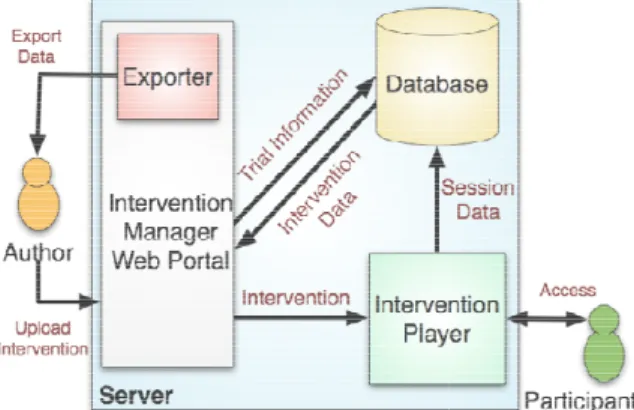
All data recorded by the Interventio be exported from the web portal in format for further data analysis. The ar server application is shown in Figu recorded by the Intervention Manager main parts: session information ( addresses) and intervention data (e.g. t users to questions). During the data Internet Doctor, researchers found th data from LifeGuide can be overly len improved by allowing the users to variables they wanted to appear in their
Figure 7. Architecture of the server
On top of all of this, the Interventio Portal also provides several social fea group mailing list, a wiki and message b communication between both intervent users.
can be important item 4 displays he intervention, esents the access vigation path can By linking this ntervention, the t intervention qualitative study on path can be fy any potential esign. Within o more detail to path. Figure 6 participant. The spent interacting ph. n intervention on Manager can n the Excel file
rchitecture of the ure 7. The data r consists of two (e.g. users’ IP
the responses of analysis of the hat the exported ngthy. This was o select which r export. r application on ManagerWeb atures such as a boards to enable tion authors and
IV. TOWARDS OPEN INTERVENTIO WBBIs are often designed bas theories. For each intervention co theories and studies to support i From this perspective, WBBIs ar However, the benefits of WBBIs utilized in the past - we have seen overlapping intervention studie smoking cessation interventions ha many times5[10], requiring de piloting of the intervention every LifeGuide - a generic intervention opportunities are opened up interventions and reinventing t purposes. All interventions gene will form an intervention reposit can develop evolving interve previously authored interventions. VRE, an e-science social network promising way of sharing exp between scientists and it provid communication tools, it is our LifeGuide with myExperiment to en to share their own intervention in sharing workflows.
There are two social netw behavioural intervention communit authors network; ii) an intervent Both networks can be utilized for Intervention research often involve which are used for the initial elicit needs and desires, assessment of and experts’ views regarding the co interventions [11]. To digitalise enable the members of the inter comment on each other’s interv The intervention user network will to-peer support groups and it can researchers to recruit the participa studies.
Based on the REST Web myExperiment, an intervention can and shared. Since LifeGuide is an o platform, its server application can customised for individual use. F interventions, researchers can ap protection policy. The decentrali intervention experiments can be int data set. The linked data movemen Semantic Web community, can b 5 www.ceasetobacco.org 7 N BEHAVIOURAL N RESEARCH sed on a number of omponent, there are ts design decisions. e knowledge assets.
have not been well n many duplicated or es. For instance, ave been carried out esign, building and y single time. Using
n authoring system, for recycling old them for different erated by LifeGuide
ory and researchers entions based on
Since myExperiment application, offers a periment workflows
des a large set of r plan to integrate nable social scientists
a similar fashion to works behind the ty: i) an intervention tion users network. r different purposes. es qualitative studies, tation of stakeholder f intervention users’
ontent and format of this process is to rvention network to vention components.
naturally form peer-also be utilized for ants for intervention Service API of n be easily retrieved
open source research n be downloaded and For e-health related
ply their own data sed data of refined tegrated into a larger t, emerging from the be applied maximize
8 the sharing and reuse of data. As web-based
behavioural interventions become widely used in many aspects of life, the integrated data will eventually form a foundation for “population laboratories” in the future. The semantically linked data can then be utilized to carry out more powerful analysis to answer new research questions which have hitherto not been possible.
V. CONCLUSIONS
The LifeGuide research environment provides a platform to author and host web-based behavioural interventions and to assist researchers in carrying out their intervention studies. The system covers the full process of the intervention research cycle - from the designing, building and piloting to trialling and analysing of data. To date, there are a number of interventions under development using LifeGuide. We have conducted workshops in a number of institutions, demonstrating our system and a total of 144 researchers have joined the LifeGuide network. Although the LifeGuide has demonstrated immediate benefits to the research community, some challenges remain. Despite the fact that the majority of LifeGuide users can create interventions with simple logic, we have observed a difficulty in creating interventions with complex logic. The LifeGuide learning materials are currently under-development and a graphical programming method is also under investigation. The set of data analysis tools we have provided in LifeGuide could be improved by providing more elaborate information (e.g. to display the percentage of the distribution of the participants on the intervention map) and more interactive ways of browsing data. Since all intervention data can be exported in a standard format, some common data analysis procedures could also be further automated.
Interventions created within LifeGuide and their results can be shared or reused within the research community to devise evolving interventions. The data for each intervention could be potentially integrated to carry out large-scale data analysis to answer further research questions. Looking ahead, it is in our plan to integrate LifeGuide with the existing e-science virtual research environment to embrace more open behavioural intervention research.
ACKNOWLEDGEMENTS
The LifeGuide project is supported by the Economic and Social Research Council (grant number: RES-149-25-1069). The development of Virtual Research Integration Collaboration project is funded by JISC.
REFERENCES
[1] S. Michie and C. Abraham, "Interventions to change health behaviours: based or evidence-inspired?," Psychology & Health, 2004.
[2] L. Yardley, A. Osmond, J. Hare, G. Wills, M. Weal, D. d. Roure, and S. Michie, "Introduction to the LifeGuide: software facilitating the development of interactive internet interventions," in Symposium: Persuasive Technology and Digital Behaviour Intervention Edinburgh, Scotland, 2009.
[3] A. Osmond, J. Hare, J. Price, A. Smith, M. Weal, G. Wills, Y. Yang , L. Yardley, and D. De Roure, "Designing authoring tools for the creation of on-line behavioural interventions.," in Proceedings 5th
International Conference on e-Social Science, Cologne,
Germany, 2009.
[4] J. A. Joseph, L. Yardley, J. Hare, A. Osmond, Y. Yang , M. Weal, and G. Wills, "Application of the LifeGuide: The development and quantitative analysis of the 'Internet Doctor'. ," in Proceedings 5th International Conference
on e-Social Science, Cologne, Germany., 2009.
[5] L. G. Morrison, J. A. Joseph, P. Andreou, and L. Yardley, "Application of the LifeGuide: A think-aloud study of users' experiences of the 'Internet Doctor'." in Proceedings 5th International Conference on e-Social
Science, Cologne, Germany., 2009.
[6] B. J. Fogg, J. Grudin, J. Nielsen, and S. Card, Persuasive Technology: Using Computers to Change What We Think
and Do: Science & Technology Books, 2002.
[7] F. Griffiths, A. Lindenmeyer, J. Powell, P. Lowe, and M. Thorogood, "A systematic review of the published literature.Why are health care interventions delivered over the internet? ," Journal of Medical Internet
Research, 2006.
[8] W. Dean, P. Carmen, H. William, S. Rob, and M. Eva, "The effectiveness of Web-based vs. non-Web-based interventions: a meta-analysis of behavioral change outcomes. ," Med Internet Res., 2004.
[9] D. De Roure and C. Goble, "Software Design for Empowering Scientists.," IEEE Software, vol. 26, pp. 88-95, 2009.
[10] T. N. Chirikos and T. A. Herzog, "Cost-effectiveness analysis of a complementary health intervention: the case of smoking relapse prevention," Int. J. Technol. Assess.
Health Care, vol. 20, pp. 475-480, 2004.
[11] C. Pagliari, "Design and evaluation in eHealth: challenges and implications for an interdisciplinary field.," Journal